WHO WATCHES THE WATCHERS?
B R Y A N G A S T O N
H E R I T A G E H A L L S C H O O L
O K L A H O M A C I T Y , O K
2 0 1 5 - 2 0 1 6
Domestic Surveillance:
Policy Topic Analysis
The Order
1. Resolution and Key Terms
2. Historical Background
3. Affirmative Advantages/Harms
4. Plans/Cases
5. Negative Disadvantages,
Counterplans, and Kritiks
The Resolution and Key Terms
Resolved: The United States
federal government should
substantially curtail its
domestic surveillance.
Resolution and Key Terms
 United States federal government-the executive,
legislative and judicial branches of the federal
governments of the United States.
 You will likely see cases that use executive action,
congressional action, or judicial action.
 The case for why your specific actor matters when
debating the surveillance topic!
Resolution and Key Terms
 Curtail-reduce in extent or quantity; impose a
restriction on.
 Its-possessive form of it. (must be USFG domestic
surveillance—excludes foreign, state and local
government surveillance)
Resolution and Key Terms
 Domestic-of or relating to one’s own or a particular
country as apart from other countries.
 Surveillance-continuous observation of a place,
person, group, or ongoing activity in order to gather
information.
 A “domestic surveillance” definition?
“Domestic Surveillance” Precise Definition
Small 8 [“His Eyes are Watching You: Domestic Surveillance, Civil Liberties
and Executive Power during Times of National Crisis,” MATTHEW L.
SMALL, United States Air Force Academy, 2008
http://www.thepresidency.org/storage/documents/Fellows2008/Small.pdf]
Domestic surveillance is a subset of intelligence gathering.
Intelligence, as it is to be understood in this context, is
“information that meets the stated or understood needs of
policy makers and has been collected, processed and
narrowed to meet those needs” (Lowenthal 2006, 2). In
essence, domestic surveillance is a means to an end; the
end being intelligence. The intelligence community best
understands domestic surveillance as the acquisition of
nonpublic information concerning United States persons
(Executive Order 12333 (3.4) (i)). With this definition
domestic surveillance remains an overly broad concept.
Historical Background
 1791--4th Amendment in the Bill of Rights protects
citizens from “unreasonable searches and seizures.”
security vs. liberty balance
 1967—Katz v. United States: 4th Amendment does
protect non-tangible possessions such as phone calls
and electronic transmissions. It establishes
“reasonable expectation of privacy” in homes, office,
hotel rooms, and warrants are necessary for
surveillance of those spaces.
Historical Background
 1968—Omnibus Crime Control and Safe Streets Act:
restricts wiretapping but allows executive exception
if in service of protecting the United States.
 1972—Nixon is impeached (wiretapping and theft of
docs)
 1978—Foreign Intelligence Surveillance Act (FISA):
creates secret court to hear requests for warrants to
obtain foreign intelligence information.
 1986—Electronic Comm Privacy Act (ECPA): adds
wireless data and communications to OCSSA Act.
Historical Background
 2001—Wake of 9/11, Patriot Act: changes to FISA
and ECPA including easing wiretapping restrictions.
Section 215 allows sharing of “any tangible thing” as
part of foreign intelligence or international terrorism
investigation.
 2006—Patriot Act Renewed
 2007—Protect America Act: amends FISA by
removing warrant requirement for surveillance of
foreign targets “reasonably believed” to be outside
the US. President Bush issues 1st National Strategy
for Information Sharing (NSI)
Historical Background
 2008—FISA Amendments Act: allows immunity for
telecom companies that cooperate with government
informational gathering and more.
 2011—Extension of the Patriot Act
 2012—Congress extends FISA Amendments Act
while the New York times has be reporting on over
collection of data by the USFG for years.
 2013—Snowden happens, PRISM revealed to public,
1st ruling against NSA’s surveillance program handed
down by Federal District Court for DC. The program
is allowed to exist while Congress reforms the law.
Historical Background
 2014—President Obama announced reforms to the
surveillance program based on an advisory panel
commissioned in 2013 to evaluate the NSA.
 The reforms he outlined include: requiring NSA analysts
to get a court order to access phone data unless in cases
of emergencies; an eventual end to the collection of
massive amounts of metadata by the government; the
NSA will stop eavesdropping on leaders of allied nations;
officials can pursue a phone number linked to a terrorist
association by two degrees rather than three; and
Congress will appoint advocates to argue on the side of
civil liberties before the FISA court.
Historical Background
 2015—2nd US Circuit Court of Appeals in Manhattan ruled in May
that Congress never authorized the bulk collection of phone records
in the Patriot Act so the NSA program is illegal. They said it may
continue but they called on Congress to amend the law.
 June 2nd USA Freedom Act: The act ends the NSA's bulk collection
of phone records of millions of Americans. That responsibility shifts
to the phone companies, who can turn the data over to the
government only when the Foreign Intelligence Surveillance Court
issues a warrant to search the phone records of individuals. The law
also reinstates three provisions of the USA Patriot Act, which
expired on June 1: roving wiretaps of terror suspects who change
devices, surveillance of "lone wolf" suspects who are not affiliated
with a terrorist organization, and the seeking of court orders to
search business records.
Affirmative Advantages/Harms
 Democracy/Tyranny: Path to totalitarianism,
weaken democratic norms, international modeling
vs. domestic decline
 Racism and Religious Discrimination:
Disproportionate targeting of specific groups
 Constitutional Rights
A. 1st Amendment—Speech, press, right to assemble and petition
B. 4th Amendment—Unreasonable searches and seizures
C. 14th Amendment—Due process and equal protection
Affirmative Advantages/Harms
 Economy: Foreign companies and countries
concerns over US corporation compliance with USFG
surveillance
 Foreign Relations: Many countries are angry about
US surveillance. Possible International Law internal
links
 US Hegemony: Accessed via soft power or hard
power internals
Affirmative Advantages/Harms
 Securitization: State transforms subjects into
matters of security, an extreme form of politicization
 Biopolitics: Social and political power over life
 Ethics of Privacy
 Internet Security (US infrastructure trust)
Potential Plans/Cases
 Mass Surveillance Program Cases
 Surveillance State Repeal Act (Patriot Act and FISA
Amendments Act of 08)
 Stricter requirements for access/warrants
 Private company can collect but no NSA
 FISA court regulations
 End a specific program like PRISM (corporations
giving data to the USFG)
Potential Plans/Cases
 Technology Cases
 Drones
 Face-recognition, Biometrics
 RFID Chips
 Smart Video Surveillance-learn what’s “normal”
 Civilian Encryption Protection
 Just scratching surface…
Potential Plans/Cases
 Social Monitoring Affs
 Boarder/Immigration Surveillance
 End Muslim and Arab Targeting
 End Surveilling of the Black Body
 Disease Monitoring
 Welfare Monitoring
 Protest Group Infiltration-specific group
 FBI Searches and CONTELPRO
 Education Tracking Programs
Negative Disadvantages
 Terrorism or Intelligence DA
 Political Capital DA
 Elections DA
 Executive Power Good DA
 Federalism DA
 Court DAs
A. Court Politics-how they rule in future case
based on Aff plan ruling
B. Judicial Activism-SOP and Legitimacy
Impacts
Negative Counterplans
 Agent CP Debate: Courts vs. Executive Action vs.
Congress vs. States
 Regulate/Limit vs. Eliminate surveillance CP
 Private Oversight Boards/Commissions CP
 Advantage CPs
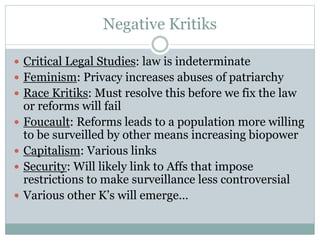
Negative Kritiks
 Critical Legal Studies: law is indeterminate
 Feminism: Privacy increases abuses of patriarchy
 Race Kritiks: Must resolve this before we fix the law
or reforms will fail
 Foucault: Reforms leads to a population more willing
to be surveilled by other means increasing biopower
 Capitalism: Various links
 Security: Will likely link to Affs that impose
restrictions to make surveillance less controversial
 Various other K’s will emerge…
Conclusion
 This is a current and timely topic so lots of information is
available. It’s very student friendly for researching.
 Don’t forget the National Debate Coaches Association will
upload camp files for free access as they receive them.
http://www.debatecoaches.org/
 The National Speech and Debate Association will have more
resources about policy debate and the topic in the future.
 Feel free to contact me with questions or just to brainstorm
about the topic:
 Bryan Gaston, Head Debate Coach, Heritage Hall School, OKC OK
 bgaston@heritagehall.com

Poliy Debate topic analysis 15 16-bg

  • 1.
    WHO WATCHES THEWATCHERS? B R Y A N G A S T O N H E R I T A G E H A L L S C H O O L O K L A H O M A C I T Y , O K 2 0 1 5 - 2 0 1 6 Domestic Surveillance: Policy Topic Analysis
  • 2.
    The Order 1. Resolutionand Key Terms 2. Historical Background 3. Affirmative Advantages/Harms 4. Plans/Cases 5. Negative Disadvantages, Counterplans, and Kritiks
  • 3.
    The Resolution andKey Terms Resolved: The United States federal government should substantially curtail its domestic surveillance.
  • 4.
    Resolution and KeyTerms  United States federal government-the executive, legislative and judicial branches of the federal governments of the United States.  You will likely see cases that use executive action, congressional action, or judicial action.  The case for why your specific actor matters when debating the surveillance topic!
  • 5.
    Resolution and KeyTerms  Curtail-reduce in extent or quantity; impose a restriction on.  Its-possessive form of it. (must be USFG domestic surveillance—excludes foreign, state and local government surveillance)
  • 6.
    Resolution and KeyTerms  Domestic-of or relating to one’s own or a particular country as apart from other countries.  Surveillance-continuous observation of a place, person, group, or ongoing activity in order to gather information.  A “domestic surveillance” definition?
  • 7.
    “Domestic Surveillance” PreciseDefinition Small 8 [“His Eyes are Watching You: Domestic Surveillance, Civil Liberties and Executive Power during Times of National Crisis,” MATTHEW L. SMALL, United States Air Force Academy, 2008 http://www.thepresidency.org/storage/documents/Fellows2008/Small.pdf] Domestic surveillance is a subset of intelligence gathering. Intelligence, as it is to be understood in this context, is “information that meets the stated or understood needs of policy makers and has been collected, processed and narrowed to meet those needs” (Lowenthal 2006, 2). In essence, domestic surveillance is a means to an end; the end being intelligence. The intelligence community best understands domestic surveillance as the acquisition of nonpublic information concerning United States persons (Executive Order 12333 (3.4) (i)). With this definition domestic surveillance remains an overly broad concept.
  • 8.
    Historical Background  1791--4thAmendment in the Bill of Rights protects citizens from “unreasonable searches and seizures.” security vs. liberty balance  1967—Katz v. United States: 4th Amendment does protect non-tangible possessions such as phone calls and electronic transmissions. It establishes “reasonable expectation of privacy” in homes, office, hotel rooms, and warrants are necessary for surveillance of those spaces.
  • 9.
    Historical Background  1968—OmnibusCrime Control and Safe Streets Act: restricts wiretapping but allows executive exception if in service of protecting the United States.  1972—Nixon is impeached (wiretapping and theft of docs)  1978—Foreign Intelligence Surveillance Act (FISA): creates secret court to hear requests for warrants to obtain foreign intelligence information.  1986—Electronic Comm Privacy Act (ECPA): adds wireless data and communications to OCSSA Act.
  • 10.
    Historical Background  2001—Wakeof 9/11, Patriot Act: changes to FISA and ECPA including easing wiretapping restrictions. Section 215 allows sharing of “any tangible thing” as part of foreign intelligence or international terrorism investigation.  2006—Patriot Act Renewed  2007—Protect America Act: amends FISA by removing warrant requirement for surveillance of foreign targets “reasonably believed” to be outside the US. President Bush issues 1st National Strategy for Information Sharing (NSI)
  • 11.
    Historical Background  2008—FISAAmendments Act: allows immunity for telecom companies that cooperate with government informational gathering and more.  2011—Extension of the Patriot Act  2012—Congress extends FISA Amendments Act while the New York times has be reporting on over collection of data by the USFG for years.  2013—Snowden happens, PRISM revealed to public, 1st ruling against NSA’s surveillance program handed down by Federal District Court for DC. The program is allowed to exist while Congress reforms the law.
  • 12.
    Historical Background  2014—PresidentObama announced reforms to the surveillance program based on an advisory panel commissioned in 2013 to evaluate the NSA.  The reforms he outlined include: requiring NSA analysts to get a court order to access phone data unless in cases of emergencies; an eventual end to the collection of massive amounts of metadata by the government; the NSA will stop eavesdropping on leaders of allied nations; officials can pursue a phone number linked to a terrorist association by two degrees rather than three; and Congress will appoint advocates to argue on the side of civil liberties before the FISA court.
  • 13.
    Historical Background  2015—2ndUS Circuit Court of Appeals in Manhattan ruled in May that Congress never authorized the bulk collection of phone records in the Patriot Act so the NSA program is illegal. They said it may continue but they called on Congress to amend the law.  June 2nd USA Freedom Act: The act ends the NSA's bulk collection of phone records of millions of Americans. That responsibility shifts to the phone companies, who can turn the data over to the government only when the Foreign Intelligence Surveillance Court issues a warrant to search the phone records of individuals. The law also reinstates three provisions of the USA Patriot Act, which expired on June 1: roving wiretaps of terror suspects who change devices, surveillance of "lone wolf" suspects who are not affiliated with a terrorist organization, and the seeking of court orders to search business records.
  • 14.
    Affirmative Advantages/Harms  Democracy/Tyranny:Path to totalitarianism, weaken democratic norms, international modeling vs. domestic decline  Racism and Religious Discrimination: Disproportionate targeting of specific groups  Constitutional Rights A. 1st Amendment—Speech, press, right to assemble and petition B. 4th Amendment—Unreasonable searches and seizures C. 14th Amendment—Due process and equal protection
  • 15.
    Affirmative Advantages/Harms  Economy:Foreign companies and countries concerns over US corporation compliance with USFG surveillance  Foreign Relations: Many countries are angry about US surveillance. Possible International Law internal links  US Hegemony: Accessed via soft power or hard power internals
  • 16.
    Affirmative Advantages/Harms  Securitization:State transforms subjects into matters of security, an extreme form of politicization  Biopolitics: Social and political power over life  Ethics of Privacy  Internet Security (US infrastructure trust)
  • 17.
    Potential Plans/Cases  MassSurveillance Program Cases  Surveillance State Repeal Act (Patriot Act and FISA Amendments Act of 08)  Stricter requirements for access/warrants  Private company can collect but no NSA  FISA court regulations  End a specific program like PRISM (corporations giving data to the USFG)
  • 18.
    Potential Plans/Cases  TechnologyCases  Drones  Face-recognition, Biometrics  RFID Chips  Smart Video Surveillance-learn what’s “normal”  Civilian Encryption Protection  Just scratching surface…
  • 19.
    Potential Plans/Cases  SocialMonitoring Affs  Boarder/Immigration Surveillance  End Muslim and Arab Targeting  End Surveilling of the Black Body  Disease Monitoring  Welfare Monitoring  Protest Group Infiltration-specific group  FBI Searches and CONTELPRO  Education Tracking Programs
  • 20.
    Negative Disadvantages  Terrorismor Intelligence DA  Political Capital DA  Elections DA  Executive Power Good DA  Federalism DA  Court DAs A. Court Politics-how they rule in future case based on Aff plan ruling B. Judicial Activism-SOP and Legitimacy Impacts
  • 21.
    Negative Counterplans  AgentCP Debate: Courts vs. Executive Action vs. Congress vs. States  Regulate/Limit vs. Eliminate surveillance CP  Private Oversight Boards/Commissions CP  Advantage CPs
  • 22.
    Negative Kritiks  CriticalLegal Studies: law is indeterminate  Feminism: Privacy increases abuses of patriarchy  Race Kritiks: Must resolve this before we fix the law or reforms will fail  Foucault: Reforms leads to a population more willing to be surveilled by other means increasing biopower  Capitalism: Various links  Security: Will likely link to Affs that impose restrictions to make surveillance less controversial  Various other K’s will emerge…
  • 23.
    Conclusion  This isa current and timely topic so lots of information is available. It’s very student friendly for researching.  Don’t forget the National Debate Coaches Association will upload camp files for free access as they receive them. http://www.debatecoaches.org/  The National Speech and Debate Association will have more resources about policy debate and the topic in the future.  Feel free to contact me with questions or just to brainstorm about the topic:  Bryan Gaston, Head Debate Coach, Heritage Hall School, OKC OK  bgaston@heritagehall.com