Policy-based
access control
Willem De Groef, iMinds-DistriNet
Willem.DeGroef@kuleuven.be
2
3
4
● Software artifact
● Declarative specification of access rules
● Independent from enforcement mechanism
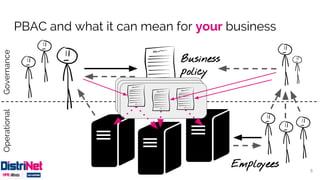
PBAC and what it can mean for your business
Business
policy
Employees
GovernanceOperational
5
Explaining PBAC
6
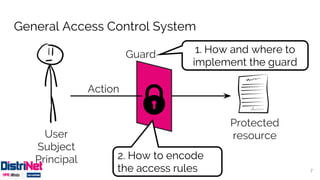
User
Subject
Principal
Guard
Protected
resource
Action
1. How and where to
implement the guard
2. How to encode
the access rules 7
General Access Control System
Basic approach: rules in code
[....]
if (! (“manager” in user.roles
and doc.owner == user
and 8h00 < now() < 17h00 )) {
[...]
}
+ straightforward
+ you can encode almost
anything
- access rules are code
- no separation of concerns
- no modularity leads to audit challenge
- what if rules change?
▪ update application code
▪ updates all over the place
8
More advanced approach: modularization
@authz(user, “read”, result)
public Document getDoc(docId) { [...] }
+ central definition of rules
+ easier to audit
- access rules are code
- IT is still in charge
- no separation of concerns
- what if rules change?
▪ update application code
▪ updates all over the place
9
public boolean authz(
subject, action, resource) {
if (! (“manager” in user.roles and …)) { [...] }
Most advanced approach: policy-based
@authz(user, “read”, result)
public Document getDoc(docId) { [...] }
Policy
Decision
Point
Policy
+ central authorization logic
+ central definition of rules
+ easy to audit
+ access rules independent artifacts
+ clear separation of concerns
+ rule updates at run-time
10
Not all rainbows and unicorns
11
PBAC and what it can mean for your business
Business
policy
Employees
GovernanceOperational
12
<Policy PolicyId=“dynamic-separation-of-duty"
RuleCombiningAlgId=“deny-overrides">
<Description>Dynamic separation of duty</Description>
<Target>
<Resources>
<Resource>
<ResourceMatch MatchId="string-equal">
<AttributeValue DataType="string">doc123</AttributeValue>
<ResourceAttributeDesignator AttributeId="resource:id" DataType="string"/>
</ResourceMatch>
</Resource>
</Resources>
</Target>
<Rule RuleId="deny" Effect=“Deny">
<Description>Deny if viewed other doc</Description>
<Condition>
<Apply FunctionId="string-is-in">
<AttributeValue DataType="string">doc456</AttributeValue>
<SubjectAttributeDesignator AttributeId="subject:historyy" DataType="string"/>
</Apply>
</Condition>
</Rule>
<Rule RuleId=“default-permit" Effect=“Permit"> </Rule>
<Obligations>
<Obligation ObligationId="append-attribute" FulfillOn="Permit">
<AttributeAssignment AttributeId="value" DataType="string">
<SubjectAttributeDesignator AttributeId="resource:id" DataType="string"/>
</AttributeAssignment>
<AttributeAssignment AttributeId="attribute-id" DataType="string">subject:history</AttributeAssignment>
</Obligation>
13
Independent declarative policy specification
1. Easy-to-use Policy languages
14
15
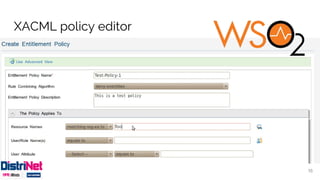
XACML policy editor
16
IDE for ALFA policy language
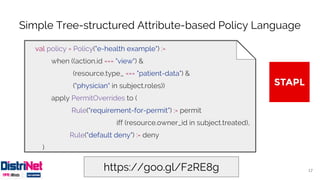
Simple Tree-structured Attribute-based Policy Language
17https://goo.gl/F2RE8g
val policy = Policy("e-health example") :=
when ((action.id === "view") &
(resource.type_ === "patient-data") &
("physician" in subject.roles))
apply PermitOverrides to (
Rule("requirement-for-permit") := permit
iff (resource.owner_id in subject.treated),
Rule("default deny") := deny
)
2. Correctness & completeness support
18
19
20
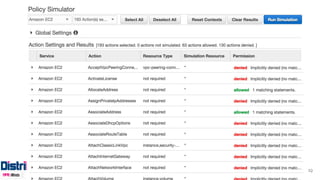
Only syntactically correctness checks
21
Decoupling from application logic is hard
{
"Version": "2012-10-17",
"Statement": {
"Effect": "Allow",
"Action": "s3:ListBuckets",
"Resource": "arn:aws:s3:::example_bucket"
}
}
s3:ListBucket
Open research challenges
● Improve performance & scalability of the PDP
● Interoperability across multiple applications
● Access rules for the database layer
● Conflict resolution in policies
● Management of policies
● Supporting organizational processes
22
Conclusions
23
Conclusions
24
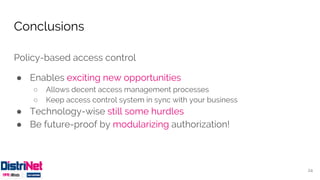
Policy-based access control
● Enables exciting new opportunities
○ Allows decent access management processes
○ Keep access control system in sync with your business
● Technology-wise still some hurdles
● Be future-proof by modularizing authorization!
Policy-based
access control
Any further questions?
Contact us at
Willem.DeGroef@kuleuven.be
Interested in our events?
Subscribe here
http://bit.ly/DistrinetAccessControl

Policy based access control

  • 1.
    Policy-based access control Willem DeGroef, iMinds-DistriNet Willem.DeGroef@kuleuven.be
  • 2.
  • 3.
  • 4.
    4 ● Software artifact ●Declarative specification of access rules ● Independent from enforcement mechanism
  • 5.
    PBAC and whatit can mean for your business Business policy Employees GovernanceOperational 5
  • 6.
  • 7.
    User Subject Principal Guard Protected resource Action 1. How andwhere to implement the guard 2. How to encode the access rules 7 General Access Control System
  • 8.
    Basic approach: rulesin code [....] if (! (“manager” in user.roles and doc.owner == user and 8h00 < now() < 17h00 )) { [...] } + straightforward + you can encode almost anything - access rules are code - no separation of concerns - no modularity leads to audit challenge - what if rules change? ▪ update application code ▪ updates all over the place 8
  • 9.
    More advanced approach:modularization @authz(user, “read”, result) public Document getDoc(docId) { [...] } + central definition of rules + easier to audit - access rules are code - IT is still in charge - no separation of concerns - what if rules change? ▪ update application code ▪ updates all over the place 9 public boolean authz( subject, action, resource) { if (! (“manager” in user.roles and …)) { [...] }
  • 10.
    Most advanced approach:policy-based @authz(user, “read”, result) public Document getDoc(docId) { [...] } Policy Decision Point Policy + central authorization logic + central definition of rules + easy to audit + access rules independent artifacts + clear separation of concerns + rule updates at run-time 10
  • 11.
    Not all rainbowsand unicorns 11
  • 12.
    PBAC and whatit can mean for your business Business policy Employees GovernanceOperational 12
  • 13.
    <Policy PolicyId=“dynamic-separation-of-duty" RuleCombiningAlgId=“deny-overrides"> <Description>Dynamic separationof duty</Description> <Target> <Resources> <Resource> <ResourceMatch MatchId="string-equal"> <AttributeValue DataType="string">doc123</AttributeValue> <ResourceAttributeDesignator AttributeId="resource:id" DataType="string"/> </ResourceMatch> </Resource> </Resources> </Target> <Rule RuleId="deny" Effect=“Deny"> <Description>Deny if viewed other doc</Description> <Condition> <Apply FunctionId="string-is-in"> <AttributeValue DataType="string">doc456</AttributeValue> <SubjectAttributeDesignator AttributeId="subject:historyy" DataType="string"/> </Apply> </Condition> </Rule> <Rule RuleId=“default-permit" Effect=“Permit"> </Rule> <Obligations> <Obligation ObligationId="append-attribute" FulfillOn="Permit"> <AttributeAssignment AttributeId="value" DataType="string"> <SubjectAttributeDesignator AttributeId="resource:id" DataType="string"/> </AttributeAssignment> <AttributeAssignment AttributeId="attribute-id" DataType="string">subject:history</AttributeAssignment> </Obligation> 13 Independent declarative policy specification
  • 14.
  • 15.
  • 16.
    16 IDE for ALFApolicy language
  • 17.
    Simple Tree-structured Attribute-basedPolicy Language 17https://goo.gl/F2RE8g val policy = Policy("e-health example") := when ((action.id === "view") & (resource.type_ === "patient-data") & ("physician" in subject.roles)) apply PermitOverrides to ( Rule("requirement-for-permit") := permit iff (resource.owner_id in subject.treated), Rule("default deny") := deny )
  • 18.
    2. Correctness &completeness support 18
  • 19.
  • 20.
  • 21.
    21 Decoupling from applicationlogic is hard { "Version": "2012-10-17", "Statement": { "Effect": "Allow", "Action": "s3:ListBuckets", "Resource": "arn:aws:s3:::example_bucket" } } s3:ListBucket
  • 22.
    Open research challenges ●Improve performance & scalability of the PDP ● Interoperability across multiple applications ● Access rules for the database layer ● Conflict resolution in policies ● Management of policies ● Supporting organizational processes 22
  • 23.
  • 24.
    Conclusions 24 Policy-based access control ●Enables exciting new opportunities ○ Allows decent access management processes ○ Keep access control system in sync with your business ● Technology-wise still some hurdles ● Be future-proof by modularizing authorization!
  • 25.
    Policy-based access control Any furtherquestions? Contact us at Willem.DeGroef@kuleuven.be Interested in our events? Subscribe here http://bit.ly/DistrinetAccessControl