MA. CLARISSE G. DOMAGTOY
Discussant
FORMALISM
A Literary Theory
What is Formalism?
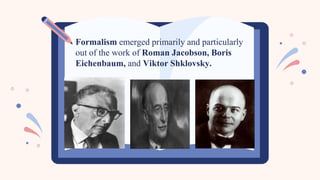
Formalism emerged primarily and particularly
out of the work of Roman Jacobson, Boris
Eichenbaum, and Viktor Shklovsky.
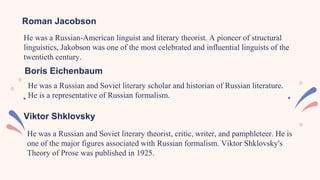
He was a Russian-American linguist and literary theorist. A pioneer of structural
linguistics, Jakobson was one of the most celebrated and influential linguists of the
twentieth century.
Roman Jacobson
He was a Russian and Soviet literary scholar and historian of Russian literature.
He is a representative of Russian formalism.
Boris Eichenbaum
Viktor Shklovsky
He was a Russian and Soviet literary theorist, critic, writer, and pamphleteer. He is
one of the major figures associated with Russian formalism. Viktor Shklovsky's
Theory of Prose was published in 1925.
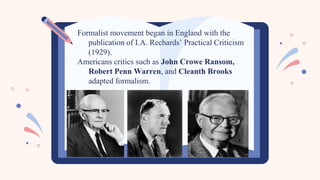
Formalist movement began in England with the
publication of I.A. Rechards’ Practical Criticism
(1929).
Americans critics such as John Crowe Ransom,
Robert Penn Warren, and Cleanth Brooks
adapted formalism.
An American educator, scholar, literary critic, poet, essayist and editor. He is considered to be a
founder of the New Criticism school of literary criticism. As a faculty member at Kenyon
College, he was the first editor of the widely regarded Kenyon Review.
John Crowe Ransom
An American poet, novelist, and literary critic and was one of the founders of New
Criticism. He was also a charter member of the Fellowship of Southern Writers. He
founded the literary journal The Southern Review with Cleanth Brooks in 1935.
Robert Penn Warren
Cleanth Brooks
An American literary critic and professor. He is best known for his contributions to New
Criticism in the mid-20th century and for revolutionizing the teaching of poetry in American
higher education.
Formalism seeks out
meaning from a work by
giving attention to the form
or structure of a work and
literary devices operating in
it.
It regards literature as “a
unique form of human
knowledge that needs to be
examined on its own
terms”.
Examples: ● all elements of a text is important
such as style, structure, imagery, tone
etc...
● elements of the story or poem such
as characters, setting, tone, point of
view, diction and other elements.
● form is the key not the content
● how elements work together.
In examining a text through
formalism, the social,
cultural, historical and
political realities inside the
text is neglected.
Poètes Écrivains Romanciers
Paris
30%
70%
50%
Bordeaux
60% 20%
75%
In formalism, we are like judging a book by
its cover.
--- its form
and structure.
Because in
formalism,
the one that
is being
examined is
the text
itself...
Now, let’s take a
look at these
examples....
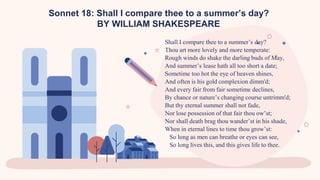
Sonnet 18: Shall I compare thee to a summer’s day?
BY WILLIAM SHAKESPEARE
Shall I compare thee to a summer’s day?
Thou art more lovely and more temperate:
Rough winds do shake the darling buds of May,
And summer’s lease hath all too short a date;
Sometime too hot the eye of heaven shines,
And often is his gold complexion dimm'd;
And every fair from fair sometime declines,
By chance or nature’s changing course untrimm'd;
But thy eternal summer shall not fade,
Nor lose possession of that fair thou ow’st;
Nor shall death brag thou wander’st in his shade,
When in eternal lines to time thou grow’st:
So long as men can breathe or eyes can see,
So long lives this, and this gives life to thee.
Now, let us interpret
the poem using
formalism.
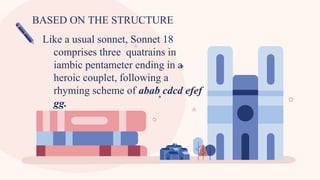
BASED ON THE STRUCTURE
Like a usual sonnet, Sonnet 18
comprises three quatrains in
iambic pentameter ending in a
heroic couplet, following a
rhyming scheme of abab cdcd efef
gg.
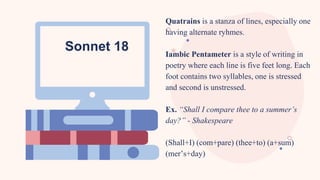
Quatrains is a stanza of lines, especially one
having alternate ryhmes.
Iambic Pentameter is a style of writing in
poetry where each line is five feet long. Each
foot contains two syllables, one is stressed
and second is unstressed.
Ex. “Shall I compare thee to a summer’s
day?” - Shakespeare
(Shall+I) (com+pare) (thee+to) (a+sum)
(mer’s+day)
Sonnet 18
Repetition (“more lovely and more
temperate”, “every fair from fair”)
Anaphora (lines 6 and 7, lines 10 and
11, lines 13 and 14) are used heavily
throughout the sonnet.
Ex. And often...
And every...
Nor lose...
Nor shall...
So long...
So long...
Sonnet 18
Contrast are emphasized by
antitheses, “more temperate/rough
winds” and the last word of lines 5
and 6, opposing “shines” with
“dimmed”.
Alliteration is lightly used which
makes it more effective when it
does appear, “chance, or nature’s
changing course”, used at the end
of the octave.
Sonnet 18
The Road Not Taken
BY ROBERT FROST
Two roads diverged in a yellow wood,
And sorry I could not travel both
And be one traveler, long I stood
And looked down one as far as I could
To where it bent in the undergrowth;
Then took the other, as just as fair,
And having perhaps the better claim,
Because it was grassy and wanted wear;
Though as for that the passing there
Had worn them really about the same,
And both that morning equally lay
In leaves no step had trodden black.
Oh, I kept the first for another day!
Yet knowing how way leads on to way,
I doubted if I should ever come back.
I shall be telling this with a sigh
Somewhere ages and ages hence:
Two roads diverged in a wood, and I—
I took the one less traveled by,
And that has made all the difference.
Metaphor a literary device that compares two
things directly without using “like” or “as”
(road and yellow wood).
Simile a literary device that compares two
things using “as” and “like”
ex. “as just as fair” (2nd stanza)
Assonance is the repetition of the vowel sound across
words within the lines of the poem.
ex. “somewhere ages and ages”
Personification a poetic device where animals, plants
or even inanimate objects, are given human
qualities.
ex. “because it was grassy and wanted wear”
Stanza
 fixed number of lines
 each stanza has five verses or lines
Rhyme Pattern: ABAAB
TIPS IN INTERPRETING A POEM USING
FORMALISM
Determine the form, structure, and
devices used in the text.
DO’s
Check the biographical, social, and
historical background of the author to
unlock the meaning of the text.
DON’Ts
FORMALISM PROS AND CONS
PROS CONS
Gives a better understanding of the writer’s
techniques in writing, e.g. literary devices, figure
of speech, etc.
Time consuming based on the text size
and writing style of the author.
Works best when applied to poetry and short
story fiction.
Context is ignored and text is analyzed
in a very technical way because it is
more of structure.
Emphasizes the value of the text instead of its
context.
Not compatible with all types of text
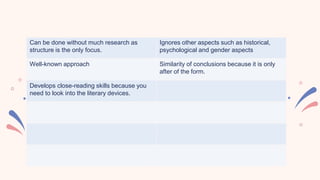
Can be done without much research as
structure is the only focus.
Ignores other aspects such as historical,
psychological and gender aspects
Well-known approach Similarity of conclusions because it is only
after of the form.
Develops close-reading skills because you
need to look into the literary devices.
THANK YOU
FOR
LISTENING! :)
Formalism.pptx A Literary Theory by Ma.C

Formalism.pptx A Literary Theory by Ma.C

  • 1.
    MA. CLARISSE G.DOMAGTOY Discussant FORMALISM A Literary Theory
  • 2.
  • 3.
    Formalism emerged primarilyand particularly out of the work of Roman Jacobson, Boris Eichenbaum, and Viktor Shklovsky.
  • 4.
    He was aRussian-American linguist and literary theorist. A pioneer of structural linguistics, Jakobson was one of the most celebrated and influential linguists of the twentieth century. Roman Jacobson He was a Russian and Soviet literary scholar and historian of Russian literature. He is a representative of Russian formalism. Boris Eichenbaum Viktor Shklovsky He was a Russian and Soviet literary theorist, critic, writer, and pamphleteer. He is one of the major figures associated with Russian formalism. Viktor Shklovsky's Theory of Prose was published in 1925.
  • 5.
    Formalist movement beganin England with the publication of I.A. Rechards’ Practical Criticism (1929). Americans critics such as John Crowe Ransom, Robert Penn Warren, and Cleanth Brooks adapted formalism.
  • 6.
    An American educator,scholar, literary critic, poet, essayist and editor. He is considered to be a founder of the New Criticism school of literary criticism. As a faculty member at Kenyon College, he was the first editor of the widely regarded Kenyon Review. John Crowe Ransom An American poet, novelist, and literary critic and was one of the founders of New Criticism. He was also a charter member of the Fellowship of Southern Writers. He founded the literary journal The Southern Review with Cleanth Brooks in 1935. Robert Penn Warren Cleanth Brooks An American literary critic and professor. He is best known for his contributions to New Criticism in the mid-20th century and for revolutionizing the teaching of poetry in American higher education.
  • 7.
    Formalism seeks out meaningfrom a work by giving attention to the form or structure of a work and literary devices operating in it. It regards literature as “a unique form of human knowledge that needs to be examined on its own terms”.
  • 8.
    Examples: ● allelements of a text is important such as style, structure, imagery, tone etc... ● elements of the story or poem such as characters, setting, tone, point of view, diction and other elements. ● form is the key not the content ● how elements work together.
  • 9.
    In examining atext through formalism, the social, cultural, historical and political realities inside the text is neglected. Poètes Écrivains Romanciers Paris 30% 70% 50% Bordeaux 60% 20% 75%
  • 10.
    In formalism, weare like judging a book by its cover. --- its form and structure. Because in formalism, the one that is being examined is the text itself...
  • 11.
    Now, let’s takea look at these examples....
  • 12.
    Sonnet 18: ShallI compare thee to a summer’s day? BY WILLIAM SHAKESPEARE Shall I compare thee to a summer’s day? Thou art more lovely and more temperate: Rough winds do shake the darling buds of May, And summer’s lease hath all too short a date; Sometime too hot the eye of heaven shines, And often is his gold complexion dimm'd; And every fair from fair sometime declines, By chance or nature’s changing course untrimm'd; But thy eternal summer shall not fade, Nor lose possession of that fair thou ow’st; Nor shall death brag thou wander’st in his shade, When in eternal lines to time thou grow’st: So long as men can breathe or eyes can see, So long lives this, and this gives life to thee.
  • 13.
    Now, let usinterpret the poem using formalism.
  • 14.
    BASED ON THESTRUCTURE Like a usual sonnet, Sonnet 18 comprises three quatrains in iambic pentameter ending in a heroic couplet, following a rhyming scheme of abab cdcd efef gg.
  • 15.
    Quatrains is astanza of lines, especially one having alternate ryhmes. Iambic Pentameter is a style of writing in poetry where each line is five feet long. Each foot contains two syllables, one is stressed and second is unstressed. Ex. “Shall I compare thee to a summer’s day?” - Shakespeare (Shall+I) (com+pare) (thee+to) (a+sum) (mer’s+day) Sonnet 18
  • 16.
    Repetition (“more lovelyand more temperate”, “every fair from fair”) Anaphora (lines 6 and 7, lines 10 and 11, lines 13 and 14) are used heavily throughout the sonnet. Ex. And often... And every... Nor lose... Nor shall... So long... So long... Sonnet 18
  • 17.
    Contrast are emphasizedby antitheses, “more temperate/rough winds” and the last word of lines 5 and 6, opposing “shines” with “dimmed”. Alliteration is lightly used which makes it more effective when it does appear, “chance, or nature’s changing course”, used at the end of the octave. Sonnet 18
  • 18.
    The Road NotTaken BY ROBERT FROST Two roads diverged in a yellow wood, And sorry I could not travel both And be one traveler, long I stood And looked down one as far as I could To where it bent in the undergrowth; Then took the other, as just as fair, And having perhaps the better claim, Because it was grassy and wanted wear; Though as for that the passing there Had worn them really about the same, And both that morning equally lay In leaves no step had trodden black. Oh, I kept the first for another day! Yet knowing how way leads on to way, I doubted if I should ever come back. I shall be telling this with a sigh Somewhere ages and ages hence: Two roads diverged in a wood, and I— I took the one less traveled by, And that has made all the difference.
  • 19.
    Metaphor a literarydevice that compares two things directly without using “like” or “as” (road and yellow wood). Simile a literary device that compares two things using “as” and “like” ex. “as just as fair” (2nd stanza)
  • 20.
    Assonance is therepetition of the vowel sound across words within the lines of the poem. ex. “somewhere ages and ages” Personification a poetic device where animals, plants or even inanimate objects, are given human qualities. ex. “because it was grassy and wanted wear”
  • 21.
    Stanza  fixed numberof lines  each stanza has five verses or lines Rhyme Pattern: ABAAB
  • 22.
    TIPS IN INTERPRETINGA POEM USING FORMALISM Determine the form, structure, and devices used in the text. DO’s Check the biographical, social, and historical background of the author to unlock the meaning of the text. DON’Ts
  • 23.
    FORMALISM PROS ANDCONS PROS CONS Gives a better understanding of the writer’s techniques in writing, e.g. literary devices, figure of speech, etc. Time consuming based on the text size and writing style of the author. Works best when applied to poetry and short story fiction. Context is ignored and text is analyzed in a very technical way because it is more of structure. Emphasizes the value of the text instead of its context. Not compatible with all types of text
  • 24.
    Can be donewithout much research as structure is the only focus. Ignores other aspects such as historical, psychological and gender aspects Well-known approach Similarity of conclusions because it is only after of the form. Develops close-reading skills because you need to look into the literary devices.
  • 25.