Reading Poetry—
Preparing for Essay
Writing
Asking Questions and Analyzing
Poetry—Understanding
Rhythm
• The most widely HEARD poetry appears in song lyrics.
• But, not all songs are poetic.
• What makes a song poetic?

• Examples:

• Blackalicious “Make You Feel that Way”
• Bruce Springsteen’s “You’re Missing” p. 777

• Look for repeated sounds and places where the language is
  more powerful or textured.
Bruce Springsteen’s “You’re
Missing”
• DISCUSS THE FOLLOWING IN A GROUP:
• What was your experience while reading the poem/song
  compared to listening to it?
• How do the descriptions of home work to evoke a particular
  mood in the song and what is that mood?
• Do you see this as a “narrative”? As in—does it tell a story?
  What is the story about?
S. Pearl Sharp’s “It’s the Law: A
Rap Poem”
• Watch the performance.

• Why is poetry more evocative of performance? What is it
  about lyric that asks for drama?

• How are the laws different from rules in this poem? What
  does the sound and rhythm do to evoke meaning?
Terrence Hayes’ “Lighthead’s
Guide to Addiction”
•   Read the poem silently.
•   Listen to Hayes’ reading
•   Discuss your reactions in small groups
•   What is the purpose for the repetition in this poem? How
    may this signify meaning? What words stuck out to you? Are
    those words more about literal meaning or do you think they
    are included more for “sound” purposes?
Group Writing
List poems use a type of writing called “litany.” This is when a
phrase is repeated over and over and slightly changed at the
end.

In groups—try to write a “mimic” poem to Terrence Hayes’.
Think of a phrase that could be repeated over and over and
work together to add to the sentences in order to change the
meaning.
Hard Poetry v. Soft Poetry
“A poem begins in delight and ends in wisdom.” –Robert Frost

Poems can be soft in several ways:
• In form
• In thought and feeling (sentimental)
• Excess verbiage
Robert Frost said to “squeeze the water out of a poem.”

Poems can be hard in several ways:
• Hard poetry is hard to write
• Hard poems are challenging to read—hard to figure meaning
  and to exhaust its beauty
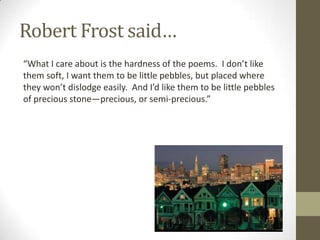
Robert Frost said…
“What I care about is the hardness of the poems. I don’t like
them soft, I want them to be little pebbles, but placed where
they won’t dislodge easily. And I’d like them to be little pebbles
of precious stone—precious, or semi-precious.”
Writing Exercise
•   Write a response to Lisa Parker’s “Snapping Beans” on p. 782
•   Would you categorize this poem as hard or soft?
•   What did you relate to?
•   What was baffling?
Mary Oliver’s “The Poet with
His Face in His Hands”
• What is the attitude the speaker has towards the poet?

• What is the purpose of using nature in the poem?
Alfred, Lord Tennyson
“Crossing the Bar” p. 785
• What could we choose to focus on in this poem that would
  work for an essay analyzing the poem?

• What do you notice about this poem that is different from the
  others we have looked at?

Reading Poetry, Preparing For Essay Writing

  • 1.
    Reading Poetry— Preparing forEssay Writing Asking Questions and Analyzing
  • 2.
    Poetry—Understanding Rhythm • The mostwidely HEARD poetry appears in song lyrics. • But, not all songs are poetic. • What makes a song poetic? • Examples: • Blackalicious “Make You Feel that Way” • Bruce Springsteen’s “You’re Missing” p. 777 • Look for repeated sounds and places where the language is more powerful or textured.
  • 3.
    Bruce Springsteen’s “You’re Missing” •DISCUSS THE FOLLOWING IN A GROUP: • What was your experience while reading the poem/song compared to listening to it? • How do the descriptions of home work to evoke a particular mood in the song and what is that mood? • Do you see this as a “narrative”? As in—does it tell a story? What is the story about?
  • 4.
    S. Pearl Sharp’s“It’s the Law: A Rap Poem” • Watch the performance. • Why is poetry more evocative of performance? What is it about lyric that asks for drama? • How are the laws different from rules in this poem? What does the sound and rhythm do to evoke meaning?
  • 5.
    Terrence Hayes’ “Lighthead’s Guideto Addiction” • Read the poem silently. • Listen to Hayes’ reading • Discuss your reactions in small groups • What is the purpose for the repetition in this poem? How may this signify meaning? What words stuck out to you? Are those words more about literal meaning or do you think they are included more for “sound” purposes?
  • 6.
    Group Writing List poemsuse a type of writing called “litany.” This is when a phrase is repeated over and over and slightly changed at the end. In groups—try to write a “mimic” poem to Terrence Hayes’. Think of a phrase that could be repeated over and over and work together to add to the sentences in order to change the meaning.
  • 7.
    Hard Poetry v.Soft Poetry “A poem begins in delight and ends in wisdom.” –Robert Frost Poems can be soft in several ways: • In form • In thought and feeling (sentimental) • Excess verbiage Robert Frost said to “squeeze the water out of a poem.” Poems can be hard in several ways: • Hard poetry is hard to write • Hard poems are challenging to read—hard to figure meaning and to exhaust its beauty
  • 8.
    Robert Frost said… “WhatI care about is the hardness of the poems. I don’t like them soft, I want them to be little pebbles, but placed where they won’t dislodge easily. And I’d like them to be little pebbles of precious stone—precious, or semi-precious.”
  • 9.
    Writing Exercise • Write a response to Lisa Parker’s “Snapping Beans” on p. 782 • Would you categorize this poem as hard or soft? • What did you relate to? • What was baffling?
  • 10.
    Mary Oliver’s “ThePoet with His Face in His Hands” • What is the attitude the speaker has towards the poet? • What is the purpose of using nature in the poem?
  • 11.
    Alfred, Lord Tennyson “Crossingthe Bar” p. 785 • What could we choose to focus on in this poem that would work for an essay analyzing the poem? • What do you notice about this poem that is different from the others we have looked at?