Denotation, Connotation, and
Imagery Analysis in
George Herbert’s “Virtue”
By : Melani
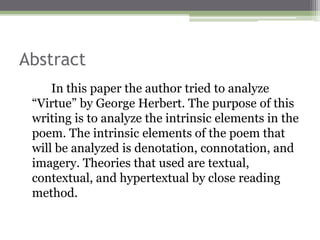
Abstract
In this paper the author tried to analyze
“Virtue” by George Herbert. The purpose of this
writing is to analyze the intrinsic elements in the
poem. The intrinsic elements of the poem that
will be analyzed is denotation, connotation, and
imagery. Theories that used are textual,
contextual, and hypertextual by close reading
method.
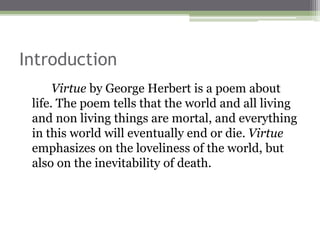
Introduction
Virtue by George Herbert is a poem about
life. The poem tells that the world and all living
and non living things are mortal, and everything
in this world will eventually end or die. Virtue
emphasizes on the loveliness of the world, but
also on the inevitability of death.
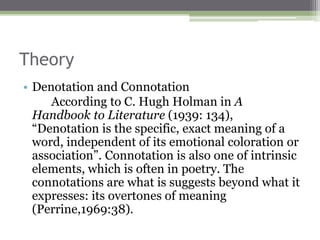
Theory
• Denotation and Connotation
According to C. Hugh Holman in A
Handbook to Literature (1939: 134),
“Denotation is the specific, exact meaning of a
word, independent of its emotional coloration or
association”. Connotation is also one of intrinsic
elements, which is often in poetry. The
connotations are what is suggests beyond what it
expresses: its overtones of meaning
(Perrine,1969:38).
• Imagery
“Imagery may be defined as the
representative through language of sense
experience. Poetry appeals directly to our
senses, of course, through its music and rhythm,
which we actually hear when it is read aloud.”
(Perrine, 1969:54).
Biography
George Herbert was born in a prominent family
on April, 3rd 1593, in Montgomery Castle, Wales. He
was an English poet who largely known for his work
after his death. Herbert studied at Westminster
School and then attended Trinity College at
Cambridge University, where he demonstrated his
writing talents. His mother died in 1627 and he
expressed his grief in verse, penning several poems
in tribute to her. Herbert devoted himself to religion
in 1630 by taking responsibility for the parish of
Fugglestone-cum-Bemerton, where he spent the
final three years of his life.
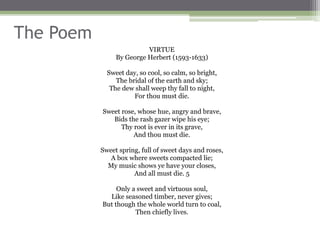
The Poem
VIRTUE
By George Herbert (1593-1633)
Sweet day, so cool, so calm, so bright,
The bridal of the earth and sky;
The dew shall weep thy fall to night,
For thou must die.
Sweet rose, whose hue, angry and brave,
Bids the rash gazer wipe his eye;
Thy root is ever in its grave,
And thou must die.
Sweet spring, full of sweet days and roses,
A box where sweets compacted lie;
My music shows ye have your closes,
And all must die. 5
Only a sweet and virtuous soul,
Like seasoned timber, never gives;
But though the whole world turn to coal,
Then chiefly lives.
Discussion
• Denotation
• Day : The period in 24 hours when it is naturally
light. In stanza one line one “Sweet day, so cool, so calm,
so bright” , it clearly explains that the day is so
wonderful but it will end when the night comes.
• Spring : Spring has both sweet days and roses, it is
the time of year which is compared with a box of
compressed sweet. And all things, regardless of how
small or seemingly inconsequential they seem are finite.
Like the living things, spring will end when the other
season is coming.
• Dew : The dew here may symbolize drops of
water that form on the ground. Although it is so
beautiful, it will disappear when the night comes.
• Timber : Trees that are grown so that the
wood from them can be used for building. In
stanza four line two “Like seasoned timber,
never gives”, it means the trees that have grown
wont share what it has to the others.
• Music : A pattern of sounds made by
musical instruments, singing or computers, or a
combination of these, intended to give pleasure
to people listening to it.
• Virtuous Soul : A soul which is having good
moral qualities and behavior.
• Connotation
• Closes : In Virtue, the closes have a
meaning that it does not matter how beautiful a
life is, containing the elements such as the living
and non living things, when the time comes
everything will die.
• Earth and Sky : The writer describes the day as
something calm, bright and he compares it to
the marriage between a women and a man which
are symbolized by earth and sky. The
relationship between man and woman based on
love is so wonderful.
• Rose : Rose here represents a kind of flower and also the
anger which is supposed to be red. Everyone knows that a rose is a
beautiful flower. It has a great red color which makes every people
fall in love with this kind of flower. Although rose is beautiful, it can
not live forever. There is a time when the flowers are fading and they
can not escape from this. It does not matter how beautiful the rose
once, when they start to wither, the beauty has no meaning.
• Coal : In stanza four line three “But though the whole world
turn to coal”, it does not mean that everyone in the world will turn
into coal as a black substance which is dug from the earth in pieces,
but actually it means if everyone and everything in the world will
not die and will live forever they will be stubborn and does not care
about other people because they think that they can handle anything
by themselves for they are immortal.
• Rash Gazer : The one who looks too closely to see not the beauty
and life in the rose, but dwells on the reality of ultimate death, the
rose's roots—its grave.
Imagery
• Visual Imagery
• Stanza 1 Line 1 : Sweet day, so cool, so calm, so bright
This line represents a visual imagery. In this line the reader can imagine
how is the condition of the day which is being told by the poet so that the
reader can visualize it in their mind’s eyes.
• Stanza 1 Line 3 : Sweet rose, whose hue, angry and brave
This line represents a visual imagery because the reader can visualize when
the Poet try to describe the beauty of a rose. The Poet try to show a
beautiful rose by using word “sweet”, “hue”, “angry”, and “brave”. Hue, a
kind of combination color, represents many kinds of color that exists so that
the readers can imagine how beautiful the rose is by their mind’s eyes. The
rose is angry and brave, it means that the flower challenges anyone who is
brave enough to pick it.
• Stanza 1 Line 3 : Sweet spring, full of sweet days and roses
This line represents a visual imagery. The word “roses” indicates that the
Poet try to tell the reader a sweet spring that full of roses. It is a beautiful
season that can be visualized by the readers.
• Kinesthetic Imagery
• Stanza 1 Line 3 : The dew shall weep thy fall to night
This line represents a kinesthetic imagery. When the dew
weep, it makes a movement when it falls from the top to
the ground. It indicates an activity when the day changes
into night.
• Stanza 1 Line 3 : Bids the rash gazer wipe his eye
This line represents a kinesthetic imagery. The word
“wipe his eye” is clearly seen as an activity done by
moving our hand against our eyes. In stanza two line two
“Bids the rash gazer wipe his eye”, it shows an activity
done by the effect of seeing the beautiful rose.
• Stanza 1 Line 3 : But though the whole world turn to
coal
This line represents a kinesthetic imagery. The word
“turn” indicates a movement as a result of a changing
form of all elements on earth into a coal.
Conclusion
Virtue by George Herbert is a poem about life. The
poem tells that the world and all living and non living
things are mortal, and everything in this world will
eventually end or die. Virtue emphasizes on the
loveliness of the world, but also on the inevitability of
death. At the end, Mr. Herbert states that the way to
fight against inevitable death is to live a good life, so that
the impact lasts longer than you do. Mr. Herbert uses
imagery, denotation, and connotation to explain his
poetry. He uses visual and kinesthetic imagery. All of
them help the poem to be imagined easily. The moral
value of this poem is it does not matter how beautiful
your life is, you still have to face your end. In this
situation, the purity of your soul is tested.

I learning upload paper poetry ppt

  • 1.
    Denotation, Connotation, and ImageryAnalysis in George Herbert’s “Virtue” By : Melani
  • 2.
    Abstract In this paperthe author tried to analyze “Virtue” by George Herbert. The purpose of this writing is to analyze the intrinsic elements in the poem. The intrinsic elements of the poem that will be analyzed is denotation, connotation, and imagery. Theories that used are textual, contextual, and hypertextual by close reading method.
  • 3.
    Introduction Virtue by GeorgeHerbert is a poem about life. The poem tells that the world and all living and non living things are mortal, and everything in this world will eventually end or die. Virtue emphasizes on the loveliness of the world, but also on the inevitability of death.
  • 4.
    Theory • Denotation andConnotation According to C. Hugh Holman in A Handbook to Literature (1939: 134), “Denotation is the specific, exact meaning of a word, independent of its emotional coloration or association”. Connotation is also one of intrinsic elements, which is often in poetry. The connotations are what is suggests beyond what it expresses: its overtones of meaning (Perrine,1969:38).
  • 5.
    • Imagery “Imagery maybe defined as the representative through language of sense experience. Poetry appeals directly to our senses, of course, through its music and rhythm, which we actually hear when it is read aloud.” (Perrine, 1969:54).
  • 6.
    Biography George Herbert wasborn in a prominent family on April, 3rd 1593, in Montgomery Castle, Wales. He was an English poet who largely known for his work after his death. Herbert studied at Westminster School and then attended Trinity College at Cambridge University, where he demonstrated his writing talents. His mother died in 1627 and he expressed his grief in verse, penning several poems in tribute to her. Herbert devoted himself to religion in 1630 by taking responsibility for the parish of Fugglestone-cum-Bemerton, where he spent the final three years of his life.
  • 7.
    The Poem VIRTUE By GeorgeHerbert (1593-1633) Sweet day, so cool, so calm, so bright, The bridal of the earth and sky; The dew shall weep thy fall to night, For thou must die. Sweet rose, whose hue, angry and brave, Bids the rash gazer wipe his eye; Thy root is ever in its grave, And thou must die. Sweet spring, full of sweet days and roses, A box where sweets compacted lie; My music shows ye have your closes, And all must die. 5 Only a sweet and virtuous soul, Like seasoned timber, never gives; But though the whole world turn to coal, Then chiefly lives.
  • 8.
    Discussion • Denotation • Day: The period in 24 hours when it is naturally light. In stanza one line one “Sweet day, so cool, so calm, so bright” , it clearly explains that the day is so wonderful but it will end when the night comes. • Spring : Spring has both sweet days and roses, it is the time of year which is compared with a box of compressed sweet. And all things, regardless of how small or seemingly inconsequential they seem are finite. Like the living things, spring will end when the other season is coming. • Dew : The dew here may symbolize drops of water that form on the ground. Although it is so beautiful, it will disappear when the night comes.
  • 9.
    • Timber :Trees that are grown so that the wood from them can be used for building. In stanza four line two “Like seasoned timber, never gives”, it means the trees that have grown wont share what it has to the others. • Music : A pattern of sounds made by musical instruments, singing or computers, or a combination of these, intended to give pleasure to people listening to it. • Virtuous Soul : A soul which is having good moral qualities and behavior.
  • 10.
    • Connotation • Closes: In Virtue, the closes have a meaning that it does not matter how beautiful a life is, containing the elements such as the living and non living things, when the time comes everything will die. • Earth and Sky : The writer describes the day as something calm, bright and he compares it to the marriage between a women and a man which are symbolized by earth and sky. The relationship between man and woman based on love is so wonderful.
  • 11.
    • Rose :Rose here represents a kind of flower and also the anger which is supposed to be red. Everyone knows that a rose is a beautiful flower. It has a great red color which makes every people fall in love with this kind of flower. Although rose is beautiful, it can not live forever. There is a time when the flowers are fading and they can not escape from this. It does not matter how beautiful the rose once, when they start to wither, the beauty has no meaning. • Coal : In stanza four line three “But though the whole world turn to coal”, it does not mean that everyone in the world will turn into coal as a black substance which is dug from the earth in pieces, but actually it means if everyone and everything in the world will not die and will live forever they will be stubborn and does not care about other people because they think that they can handle anything by themselves for they are immortal. • Rash Gazer : The one who looks too closely to see not the beauty and life in the rose, but dwells on the reality of ultimate death, the rose's roots—its grave.
  • 12.
    Imagery • Visual Imagery •Stanza 1 Line 1 : Sweet day, so cool, so calm, so bright This line represents a visual imagery. In this line the reader can imagine how is the condition of the day which is being told by the poet so that the reader can visualize it in their mind’s eyes. • Stanza 1 Line 3 : Sweet rose, whose hue, angry and brave This line represents a visual imagery because the reader can visualize when the Poet try to describe the beauty of a rose. The Poet try to show a beautiful rose by using word “sweet”, “hue”, “angry”, and “brave”. Hue, a kind of combination color, represents many kinds of color that exists so that the readers can imagine how beautiful the rose is by their mind’s eyes. The rose is angry and brave, it means that the flower challenges anyone who is brave enough to pick it. • Stanza 1 Line 3 : Sweet spring, full of sweet days and roses This line represents a visual imagery. The word “roses” indicates that the Poet try to tell the reader a sweet spring that full of roses. It is a beautiful season that can be visualized by the readers.
  • 13.
    • Kinesthetic Imagery •Stanza 1 Line 3 : The dew shall weep thy fall to night This line represents a kinesthetic imagery. When the dew weep, it makes a movement when it falls from the top to the ground. It indicates an activity when the day changes into night. • Stanza 1 Line 3 : Bids the rash gazer wipe his eye This line represents a kinesthetic imagery. The word “wipe his eye” is clearly seen as an activity done by moving our hand against our eyes. In stanza two line two “Bids the rash gazer wipe his eye”, it shows an activity done by the effect of seeing the beautiful rose. • Stanza 1 Line 3 : But though the whole world turn to coal This line represents a kinesthetic imagery. The word “turn” indicates a movement as a result of a changing form of all elements on earth into a coal.
  • 14.
    Conclusion Virtue by GeorgeHerbert is a poem about life. The poem tells that the world and all living and non living things are mortal, and everything in this world will eventually end or die. Virtue emphasizes on the loveliness of the world, but also on the inevitability of death. At the end, Mr. Herbert states that the way to fight against inevitable death is to live a good life, so that the impact lasts longer than you do. Mr. Herbert uses imagery, denotation, and connotation to explain his poetry. He uses visual and kinesthetic imagery. All of them help the poem to be imagined easily. The moral value of this poem is it does not matter how beautiful your life is, you still have to face your end. In this situation, the purity of your soul is tested.