Assessing Local Needs and
Resources
This module provides a guide for
developing and implementing a plan to
assess the needs of communities and
the resources available to them.
Plan
WHAT DO WE MEAN BY NEEDS AND RESOURCES?
WHY DEVELOP A PLAN FOR ASSESSING LOCAL
NEEDS AND RESOURCES?
WHO SHOULD BE INVOLVED IN DEVELOPING A
PLAN FOR ASSESSING LOCAL NEEDS AND
RESOURCES?
WHEN SHOULD NEEDS AND ASSETS BE
IDENTIFIED?
HOW DO YOU DEVELOP A PLAN FOR ASSESSING
LOCAL NEEDS AND RESOURCES?
WHAT DO WE MEAN BY NEEDS AND RESOURCES?
• Needs can be defined as the gap between
what is and what should be. A need can be felt
by an individual, a group, or an entire
community. It can be as concrete as the need
for food and water or as abstract as improved
community cohesiveness. Examining
situations closely helps uncover what is truly
needed, and leads toward future
improvement.
WHAT DO WE MEAN BY NEEDS AND RESOURCES?
• Resources, or assets are : individuals,
organizations and institutions, buildings,
landscapes, equipment -- anything that can be
used to improve the quality of life.
• Examples: mother who volunteers to organize
games and sports for neighborhood children after
school, the farmers' cooperative that makes it
possible for farmers to buy seed and fertilizer
cheaply and to send their produce directly to
market without a middle man,
WHAT DO WE MEAN BY NEEDS AND RESOURCES?
the bike and walking path where city residents
can exercise -- all represent resources that
enhance community life.
• Every individual is a potential community
asset, and everyone has assets that can be
used for community building.
WHY DEVELOP A PLAN FOR ASSESSING LOCAL NEEDS
AND RESOURCES?
• Two questions
First: Why assess needs and resources?
- a deeper understanding of the community (needs
, resources, assets, culture, social sturctures,
history, etc) allows understanding how to address
the community’s needs and use its resources;
- Assessments encourage community members to
consider the community's assets and how to use
them, as well as the community's needs and how
to address them.
WHY DEVELOP A PLAN FOR ASSESSING LOCAL NEEDS
AND RESOURCES?
They will learn how to use their own resources to solve
problems and improve community life.
- It will help understanding what are the issues and
how they arose. By taking advantage of community
resources increases the community's capacity for
solving its own problems and creating its own
change.
- Identifying needs and resources before starting a
program means that you know from the beginning
what you're dealing with so you minimize risks
WHY DEVELOP A PLAN FOR ASSESSING LOCAL NEEDS
AND RESOURCES?
The second question is: Why develop a plan for
that assessment?
- It allows you to involve community members
from the very beginning of the process. This
encourages both trust in the process and
community buy-in and support, not only of
the assessment, but of whatever actions are
taken as a result of it.
WHY DEVELOP A PLAN FOR ASSESSING LOCAL NEEDS
AND RESOURCES?
community participation also promotes leadership
from within the community and gives voice to
those who may feel they have none.
- An assessment is a great opportunity to
use community-based participatory research
- A good plan will provide an easy-to-follow road
map for conducting an accurate assessment. So
you will save time and effort in carrying out the
process.
WHY DEVELOP A PLAN FOR ASSESSING LOCAL NEEDS
AND RESOURCES?
- A planning process will give community
members the opportunity to voice their
opinions, hopes, and fears about the
community. Their idea of priorities might be
different from those of professionals, but they
shouldn't be ignored.
WHY DEVELOP A PLAN FOR ASSESSING LOCAL NEEDS
AND RESOURCES?
• SO
It may be important to address the community's priorities
first, in order to establish trust and show respect, even
if you don't believe that those priorities are in fact the
most important issues.
Building relationships and credibility may be more
important at the beginning of a long association than
immediately tackling what seems to be the most
pressing need.
Among other things, community members' priorities may
be the right ones: they may see underlying factors that
you don't yet understand.
WHO SHOULD BE INVOLVED IN DEVELOPING A PLAN
FOR ASSESSING LOCAL NEEDS AND RESOURCES?
• The assessment process benefits greatly when
there's full participation from community
stakeholders. Among those who should be
involved?
- It's both fair and logical to involve those who
are most directly affected by adverse
conditions by those who are experiencing
needs.
WHO SHOULD BE INVOLVED IN DEVELOPING A PLAN
FOR ASSESSING LOCAL NEEDS AND RESOURCES?
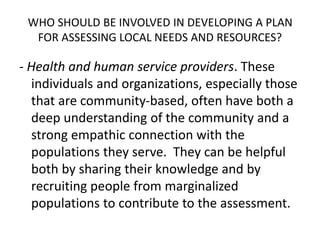
- Health and human service providers. These
individuals and organizations, especially those
that are community-based, often have both a
deep understanding of the community and a
strong empathic connection with the
populations they serve. They can be helpful
both by sharing their knowledge and by
recruiting people from marginalized
populations to contribute to the assessment.
WHO SHOULD BE INVOLVED IN DEVELOPING A PLAN
FOR ASSESSING LOCAL NEEDS AND RESOURCES?
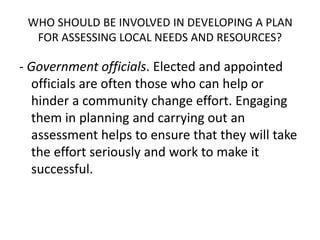
- Government officials. Elected and appointed
officials are often those who can help or
hinder a community change effort. Engaging
them in planning and carrying out an
assessment helps to ensure that they will take
the effort seriously and work to make it
successful.
WHO SHOULD BE INVOLVED IN DEVELOPING A PLAN
FOR ASSESSING LOCAL NEEDS AND RESOURCES?
- Influential people. These can include
individuals who are identified as leaders
because of their positions -- college
presidents, directors of hospitals and other
major organizations, corporate CEOs --
because of the prestige of their professions --
doctors, professors, judges, clergy -- or
because they are known to be people of
intelligence, integrity, and good will who care
about the community.
WHO SHOULD BE INVOLVED IN DEVELOPING A PLAN
FOR ASSESSING LOCAL NEEDS AND RESOURCES?
- People whose jobs or lives could be affected by
the eventual actions taken as a result of the
assessment. These include teachers, police,
emergency room personnel, landlords, and
others who might have to react if new
community policies or procedures are put in
place.
WHO SHOULD BE INVOLVED IN DEVELOPING A PLAN
FOR ASSESSING LOCAL NEEDS AND RESOURCES?
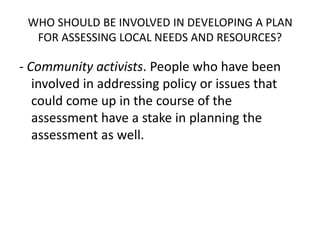
- Community activists. People who have been
involved in addressing policy or issues that
could come up in the course of the
assessment have a stake in planning the
assessment as well.
WHEN SHOULD NEEDS AND ASSETS BE IDENTIFIED?
ASSESSMENTS OF RESOURCES AND NEEDS SHOULD BE
DONE REGULARLY THROUGHOUT YOUR INITIATIVE:
- Prior to planning the initiative. This gives coalition
members, community leaders, and those being served an
idea of how to improve their circumstances;
- During implementation of an initiative. It is important to
make sure that you are on target not only at the
beginning and the end of a project, but also during its
implementation. Identifying needs and assets during the
life of the initiative helps you use your own resources
well, and ensures that you're addressing the right issues
in the right way
WHEN SHOULD NEEDS AND ASSETS BE IDENTIFIED?
- On an ongoing basis. During monitoring and
evaluation, either ongoing or after the
completion of a project, it is important to
celebrate successes and to learn from
setbacks to further community development.
HOW DO YOU DEVELOP A PLAN FOR ASSESSING LOCAL
NEEDS AND RESOURCES?
- Recruit a planning group that represents all
stakeholders and mirrors the diversity of the
community
- Design an evaluation process for the assessment,
including the development of the plan;
- Decide why you want to conduct the assessment;
- Determine what data is already available;
- Figure out what other information you need
- Decide what methods you'll use for gathering
information
HOW DO YOU DEVELOP A PLAN FOR ASSESSING LOCAL
NEEDS AND RESOURCES?
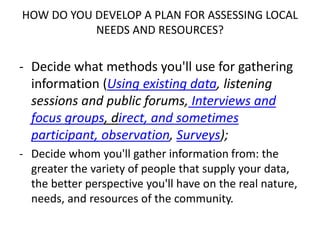
- Decide what methods you'll use for gathering
information (Using existing data, listening
sessions and public forums, Interviews and
focus groups, direct, and sometimes
participant, observation, Surveys);
- Decide whom you'll gather information from: the
greater the variety of people that supply your data,
the better perspective you'll have on the real nature,
needs, and resources of the community.
HOW DO YOU DEVELOP A PLAN FOR ASSESSING LOCAL
NEEDS AND RESOURCES?
- If you're concerned with domestic violence,
you'd certainly want to include those directly
or indirectly exposed to it, as well as
emergency room personnel and police, in your
data gathering. If you're concerned with
preserving open space, you might look to
include both environmentalists and
developers.
HOW DO YOU DEVELOP A PLAN FOR ASSESSING LOCAL
NEEDS AND RESOURCES?
- Decide who will collect data;
- Decide how you'll reach your informants;
- Decide who will analyze the data and how they'll do
it;
- Plan whatever training is needed;
- Decide how you'll record the results of the
assessment and present them to the community.

Assessing Local Needs and Resources.pptx

  • 1.
    Assessing Local Needsand Resources This module provides a guide for developing and implementing a plan to assess the needs of communities and the resources available to them.
  • 2.
    Plan WHAT DO WEMEAN BY NEEDS AND RESOURCES? WHY DEVELOP A PLAN FOR ASSESSING LOCAL NEEDS AND RESOURCES? WHO SHOULD BE INVOLVED IN DEVELOPING A PLAN FOR ASSESSING LOCAL NEEDS AND RESOURCES? WHEN SHOULD NEEDS AND ASSETS BE IDENTIFIED? HOW DO YOU DEVELOP A PLAN FOR ASSESSING LOCAL NEEDS AND RESOURCES?
  • 3.
    WHAT DO WEMEAN BY NEEDS AND RESOURCES? • Needs can be defined as the gap between what is and what should be. A need can be felt by an individual, a group, or an entire community. It can be as concrete as the need for food and water or as abstract as improved community cohesiveness. Examining situations closely helps uncover what is truly needed, and leads toward future improvement.
  • 4.
    WHAT DO WEMEAN BY NEEDS AND RESOURCES? • Resources, or assets are : individuals, organizations and institutions, buildings, landscapes, equipment -- anything that can be used to improve the quality of life. • Examples: mother who volunteers to organize games and sports for neighborhood children after school, the farmers' cooperative that makes it possible for farmers to buy seed and fertilizer cheaply and to send their produce directly to market without a middle man,
  • 5.
    WHAT DO WEMEAN BY NEEDS AND RESOURCES? the bike and walking path where city residents can exercise -- all represent resources that enhance community life. • Every individual is a potential community asset, and everyone has assets that can be used for community building.
  • 6.
    WHY DEVELOP APLAN FOR ASSESSING LOCAL NEEDS AND RESOURCES? • Two questions First: Why assess needs and resources? - a deeper understanding of the community (needs , resources, assets, culture, social sturctures, history, etc) allows understanding how to address the community’s needs and use its resources; - Assessments encourage community members to consider the community's assets and how to use them, as well as the community's needs and how to address them.
  • 7.
    WHY DEVELOP APLAN FOR ASSESSING LOCAL NEEDS AND RESOURCES? They will learn how to use their own resources to solve problems and improve community life. - It will help understanding what are the issues and how they arose. By taking advantage of community resources increases the community's capacity for solving its own problems and creating its own change. - Identifying needs and resources before starting a program means that you know from the beginning what you're dealing with so you minimize risks
  • 8.
    WHY DEVELOP APLAN FOR ASSESSING LOCAL NEEDS AND RESOURCES? The second question is: Why develop a plan for that assessment? - It allows you to involve community members from the very beginning of the process. This encourages both trust in the process and community buy-in and support, not only of the assessment, but of whatever actions are taken as a result of it.
  • 9.
    WHY DEVELOP APLAN FOR ASSESSING LOCAL NEEDS AND RESOURCES? community participation also promotes leadership from within the community and gives voice to those who may feel they have none. - An assessment is a great opportunity to use community-based participatory research - A good plan will provide an easy-to-follow road map for conducting an accurate assessment. So you will save time and effort in carrying out the process.
  • 10.
    WHY DEVELOP APLAN FOR ASSESSING LOCAL NEEDS AND RESOURCES? - A planning process will give community members the opportunity to voice their opinions, hopes, and fears about the community. Their idea of priorities might be different from those of professionals, but they shouldn't be ignored.
  • 11.
    WHY DEVELOP APLAN FOR ASSESSING LOCAL NEEDS AND RESOURCES? • SO It may be important to address the community's priorities first, in order to establish trust and show respect, even if you don't believe that those priorities are in fact the most important issues. Building relationships and credibility may be more important at the beginning of a long association than immediately tackling what seems to be the most pressing need. Among other things, community members' priorities may be the right ones: they may see underlying factors that you don't yet understand.
  • 12.
    WHO SHOULD BEINVOLVED IN DEVELOPING A PLAN FOR ASSESSING LOCAL NEEDS AND RESOURCES? • The assessment process benefits greatly when there's full participation from community stakeholders. Among those who should be involved? - It's both fair and logical to involve those who are most directly affected by adverse conditions by those who are experiencing needs.
  • 13.
    WHO SHOULD BEINVOLVED IN DEVELOPING A PLAN FOR ASSESSING LOCAL NEEDS AND RESOURCES? - Health and human service providers. These individuals and organizations, especially those that are community-based, often have both a deep understanding of the community and a strong empathic connection with the populations they serve. They can be helpful both by sharing their knowledge and by recruiting people from marginalized populations to contribute to the assessment.
  • 14.
    WHO SHOULD BEINVOLVED IN DEVELOPING A PLAN FOR ASSESSING LOCAL NEEDS AND RESOURCES? - Government officials. Elected and appointed officials are often those who can help or hinder a community change effort. Engaging them in planning and carrying out an assessment helps to ensure that they will take the effort seriously and work to make it successful.
  • 15.
    WHO SHOULD BEINVOLVED IN DEVELOPING A PLAN FOR ASSESSING LOCAL NEEDS AND RESOURCES? - Influential people. These can include individuals who are identified as leaders because of their positions -- college presidents, directors of hospitals and other major organizations, corporate CEOs -- because of the prestige of their professions -- doctors, professors, judges, clergy -- or because they are known to be people of intelligence, integrity, and good will who care about the community.
  • 16.
    WHO SHOULD BEINVOLVED IN DEVELOPING A PLAN FOR ASSESSING LOCAL NEEDS AND RESOURCES? - People whose jobs or lives could be affected by the eventual actions taken as a result of the assessment. These include teachers, police, emergency room personnel, landlords, and others who might have to react if new community policies or procedures are put in place.
  • 17.
    WHO SHOULD BEINVOLVED IN DEVELOPING A PLAN FOR ASSESSING LOCAL NEEDS AND RESOURCES? - Community activists. People who have been involved in addressing policy or issues that could come up in the course of the assessment have a stake in planning the assessment as well.
  • 18.
    WHEN SHOULD NEEDSAND ASSETS BE IDENTIFIED? ASSESSMENTS OF RESOURCES AND NEEDS SHOULD BE DONE REGULARLY THROUGHOUT YOUR INITIATIVE: - Prior to planning the initiative. This gives coalition members, community leaders, and those being served an idea of how to improve their circumstances; - During implementation of an initiative. It is important to make sure that you are on target not only at the beginning and the end of a project, but also during its implementation. Identifying needs and assets during the life of the initiative helps you use your own resources well, and ensures that you're addressing the right issues in the right way
  • 19.
    WHEN SHOULD NEEDSAND ASSETS BE IDENTIFIED? - On an ongoing basis. During monitoring and evaluation, either ongoing or after the completion of a project, it is important to celebrate successes and to learn from setbacks to further community development.
  • 20.
    HOW DO YOUDEVELOP A PLAN FOR ASSESSING LOCAL NEEDS AND RESOURCES? - Recruit a planning group that represents all stakeholders and mirrors the diversity of the community - Design an evaluation process for the assessment, including the development of the plan; - Decide why you want to conduct the assessment; - Determine what data is already available; - Figure out what other information you need - Decide what methods you'll use for gathering information
  • 21.
    HOW DO YOUDEVELOP A PLAN FOR ASSESSING LOCAL NEEDS AND RESOURCES? - Decide what methods you'll use for gathering information (Using existing data, listening sessions and public forums, Interviews and focus groups, direct, and sometimes participant, observation, Surveys); - Decide whom you'll gather information from: the greater the variety of people that supply your data, the better perspective you'll have on the real nature, needs, and resources of the community.
  • 22.
    HOW DO YOUDEVELOP A PLAN FOR ASSESSING LOCAL NEEDS AND RESOURCES? - If you're concerned with domestic violence, you'd certainly want to include those directly or indirectly exposed to it, as well as emergency room personnel and police, in your data gathering. If you're concerned with preserving open space, you might look to include both environmentalists and developers.
  • 23.
    HOW DO YOUDEVELOP A PLAN FOR ASSESSING LOCAL NEEDS AND RESOURCES? - Decide who will collect data; - Decide how you'll reach your informants; - Decide who will analyze the data and how they'll do it; - Plan whatever training is needed; - Decide how you'll record the results of the assessment and present them to the community.