Network-Attached Storage
Chapter 7(5.3)
NAS(ISMDR:BEIT:VIII:Chap5.3,Madhu N.
PIIT)
1
NAS(ISMDR:BEIT:VIII:Chap5.3,
Madhu N. PIIT)
- 2
File Sharing Environment
• File system is structured way of storing and
organizing data files
• File Sharing
– Storing and accessing data files over network
– FS must be mounted in order to access files
• Client/server model is implemented with file-
sharing protocols for remote file sharing
– Example: FTP, CIFS and NFS
NAS(ISMDR:BEIT:VIII:Chap5.3,
Madhu N. PIIT)
- 3
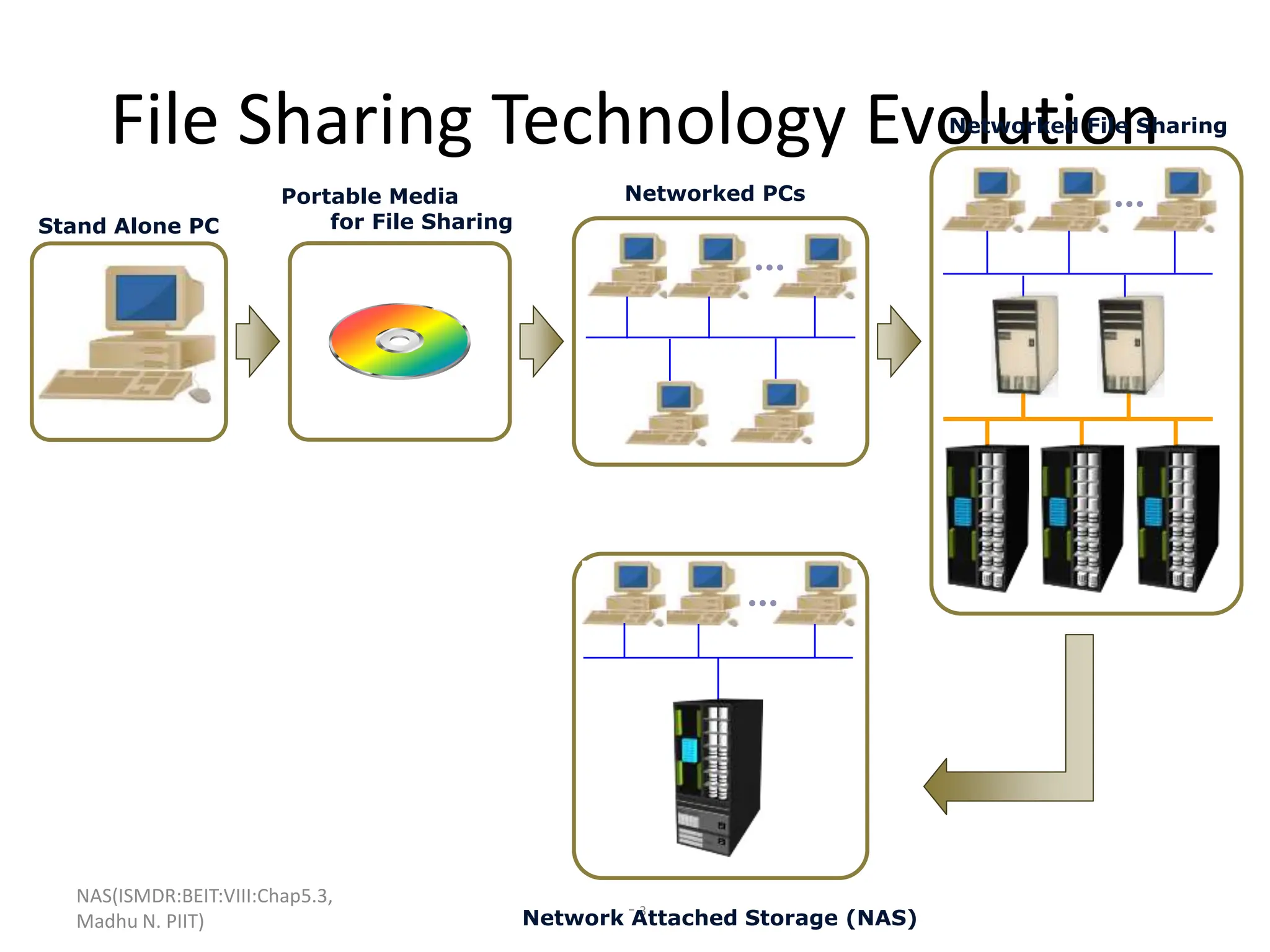
File Sharing Technology Evolution
Network Attached Storage (NAS)
Stand Alone PC
Networked File Sharing
Networked PCs
Portable Media
for File Sharing
NAS(ISMDR:BEIT:VIII:Chap5.3,
Madhu N. PIIT)
- 4
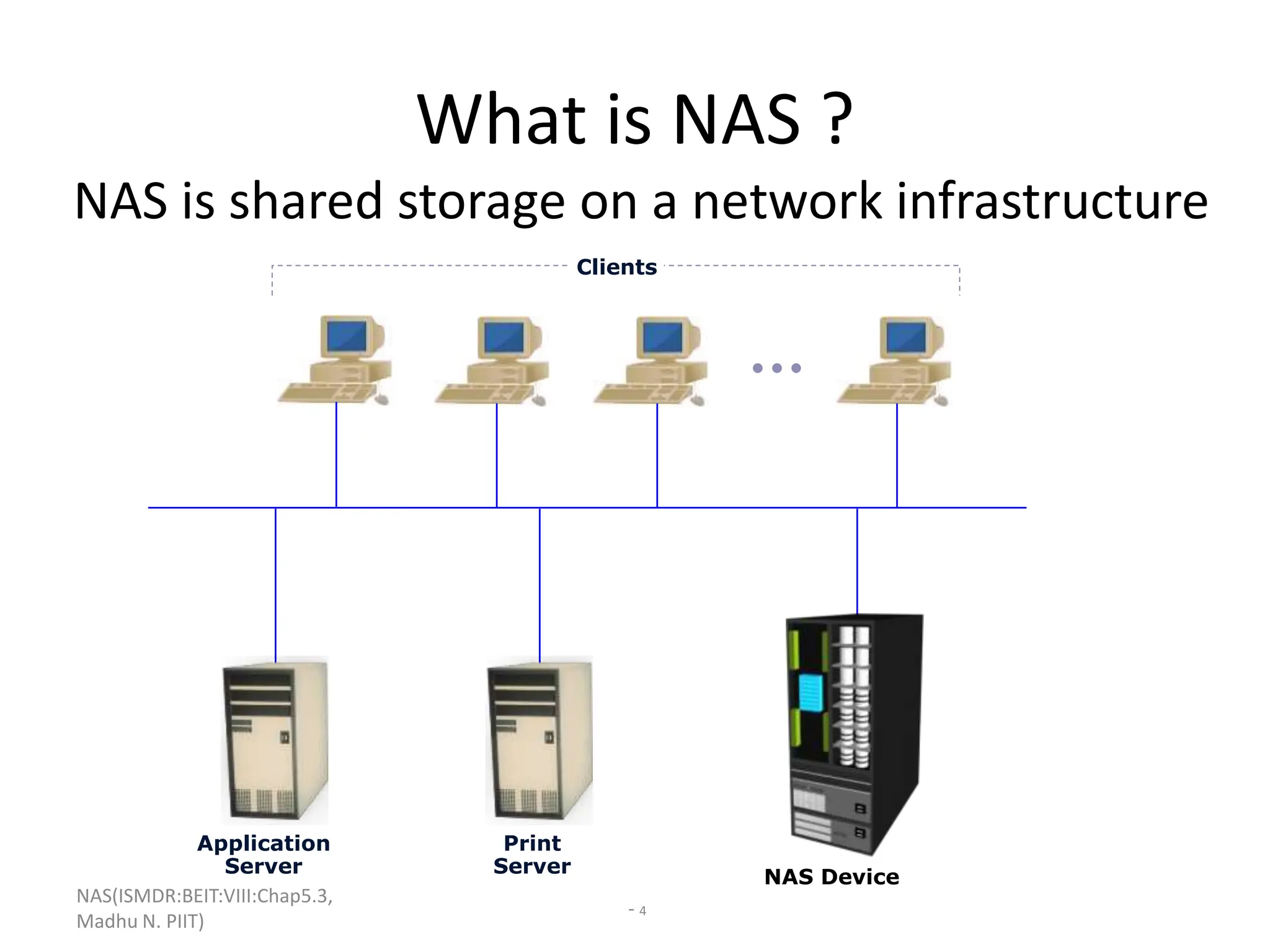
What is NAS ?
NAS is shared storage on a network infrastructure
Clients
Application
Server
Print
Server
NAS Device
NAS(ISMDR:BEIT:VIII:Chap5.3,
Madhu N. PIIT)
- 5
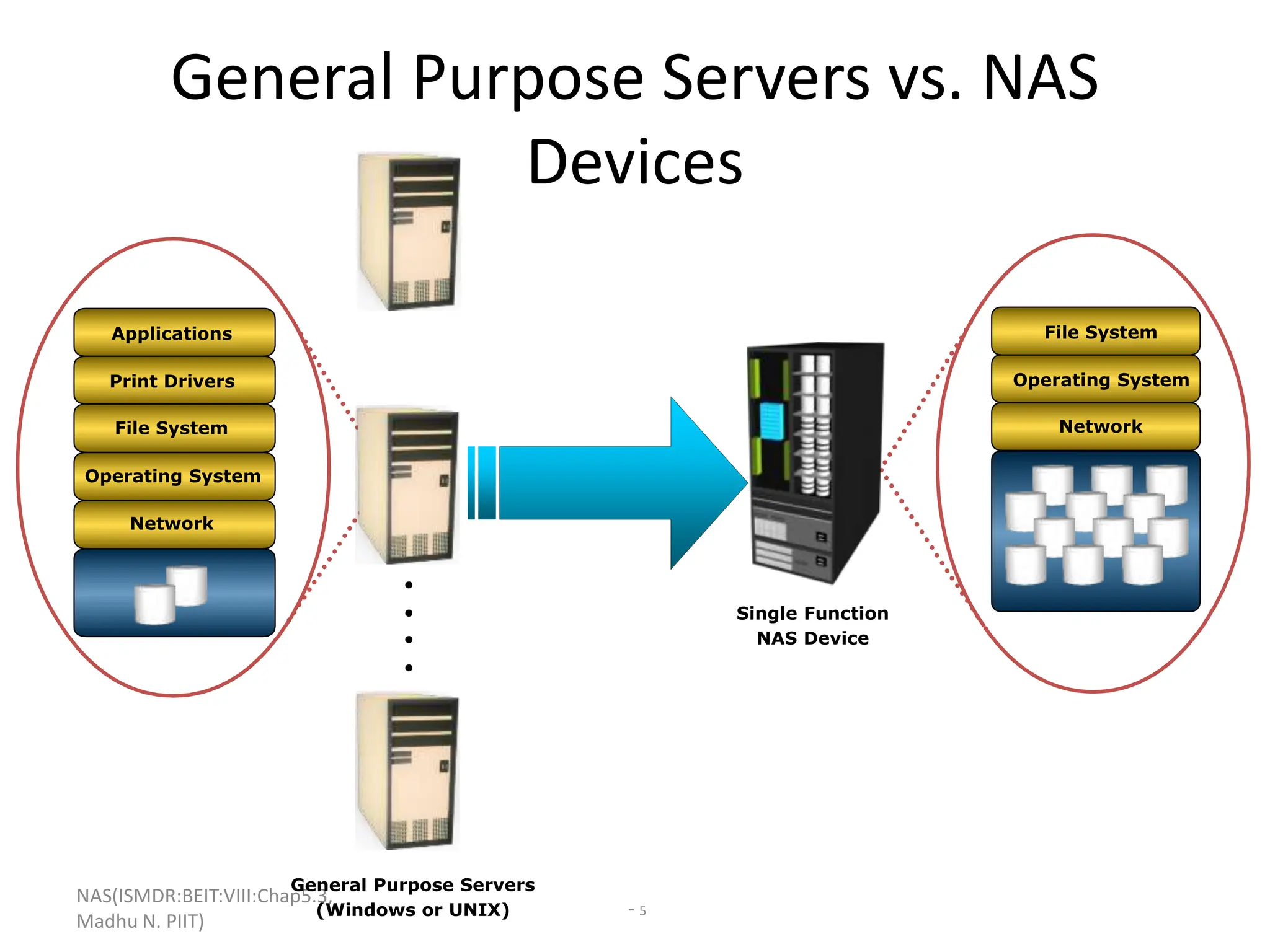
General Purpose Servers vs. NAS
Devices
Applications
Print Drivers
File System
Operating System
Network
File System
Operating System
Network
Single Function
NAS Device
General Purpose Servers
(Windows or UNIX)
NAS(ISMDR:BEIT:VIII:Chap5.3,
Madhu N. PIIT)
- 6
Benefits of NAS
• Improves efficiency
• Improved flexibility
• Centralized storage
• Simplifies management
• Scalability
• High availability – through native clustering
• Provides security integration to environment
(user authentication and authorization)
NAS(ISMDR:BEIT:VIII:Chap5.3,Madhu N. PIIT)
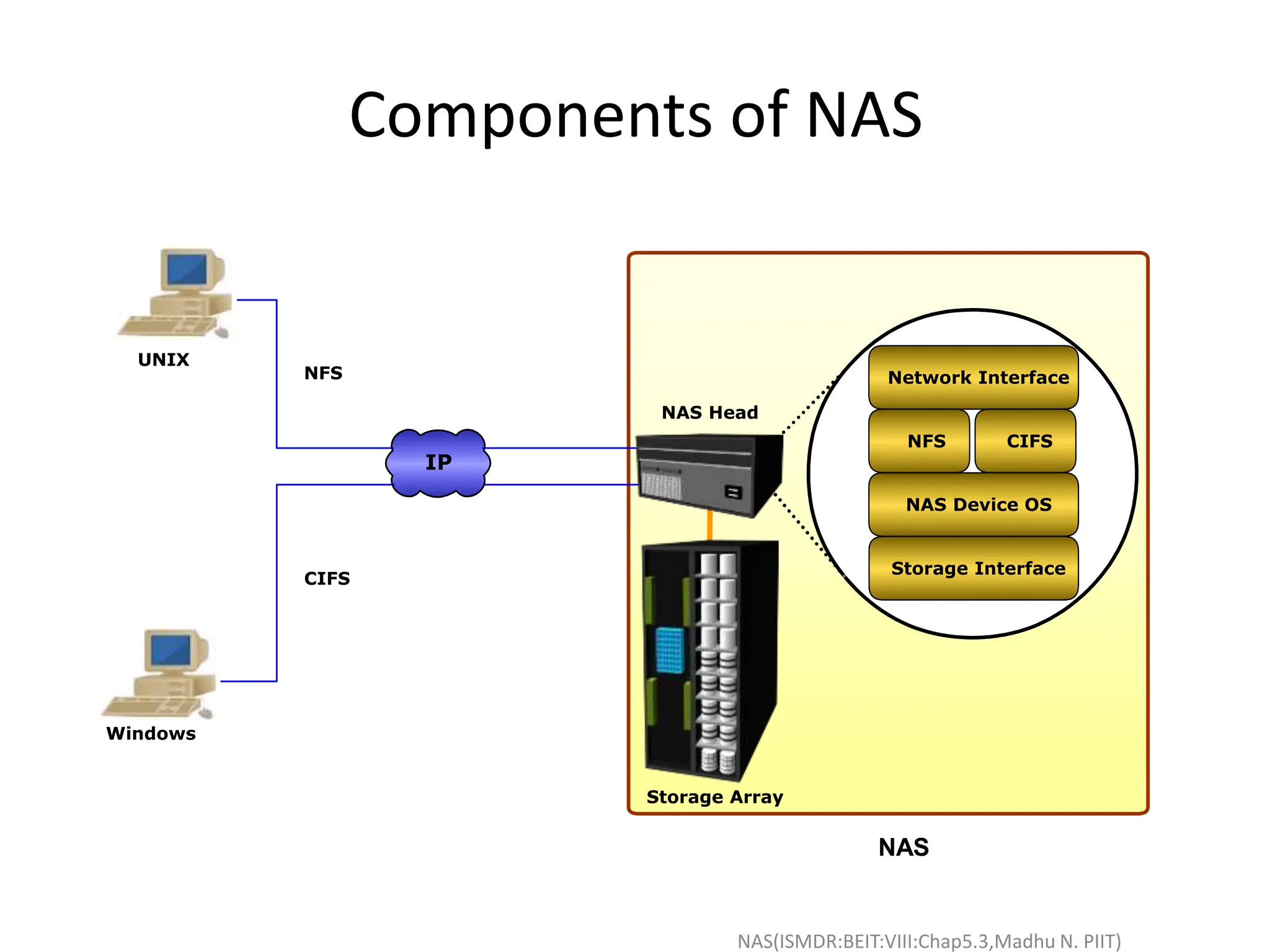
Components of NAS
Network Interface
NFS CIFS
NAS Device OS
Storage Interface
NAS Head
NFS
CIFS
UNIX
Windows
Storage Array
IP
NAS
NAS(ISMDR:BEIT:VIII:Chap5.3,
Madhu N. PIIT)
- 8
NAS File Sharing Protocols
• Two common NAS file sharing protocols are:
– CIFS – Common Internet File System protocol
• Traditional Microsoft environment file sharing protocol,
based upon the Server Message Block protocol
– NFS – Network File System protocol
• Traditional UNIX environment file sharing protocol
NAS(ISMDR:BEIT:VIII:Chap5.3,
Madhu N. PIIT)
- 9
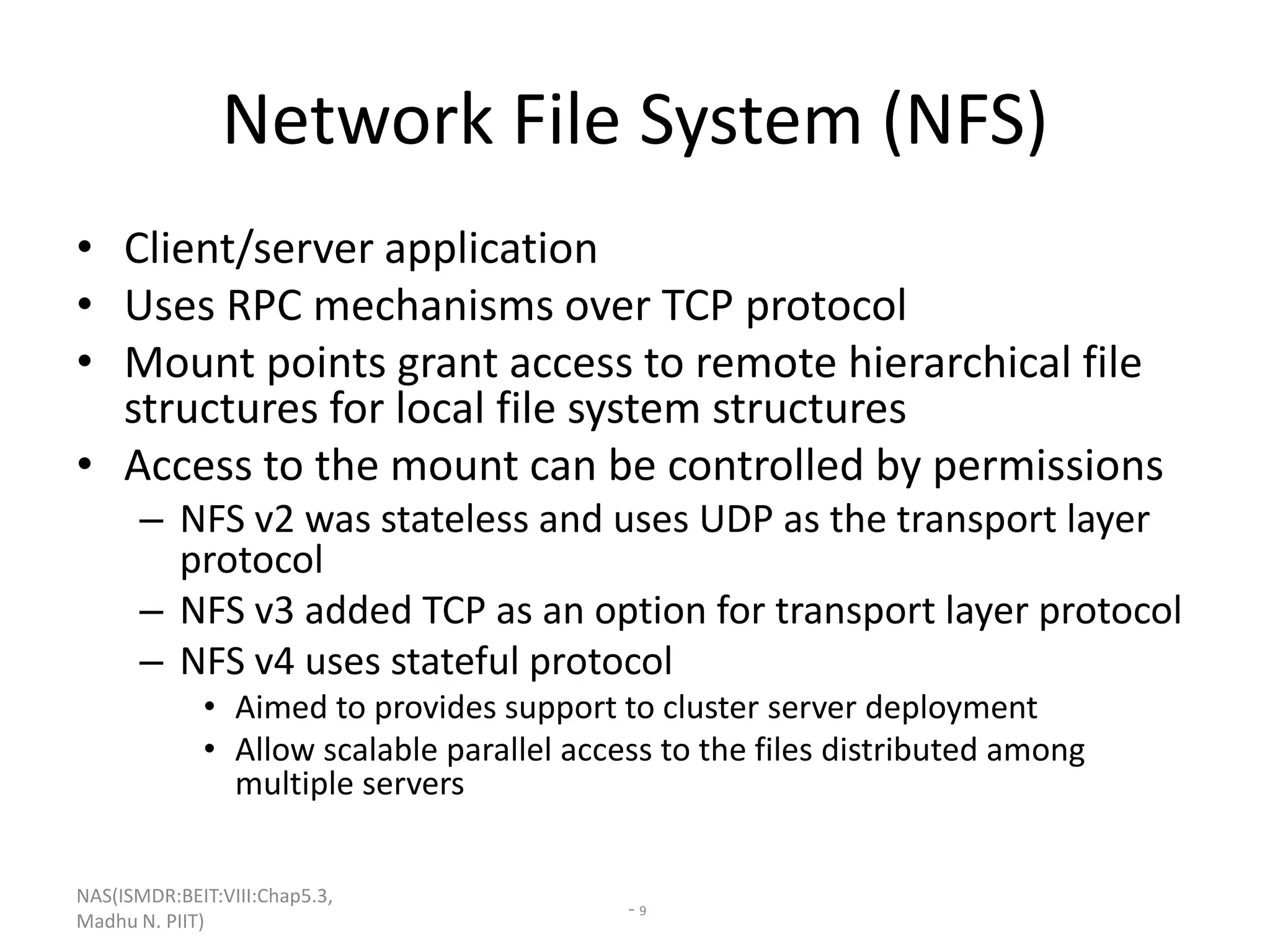
Network File System (NFS)
• Client/server application
• Uses RPC mechanisms over TCP protocol
• Mount points grant access to remote hierarchical file
structures for local file system structures
• Access to the mount can be controlled by permissions
– NFS v2 was stateless and uses UDP as the transport layer
protocol
– NFS v3 added TCP as an option for transport layer protocol
– NFS v4 uses stateful protocol
• Aimed to provides support to cluster server deployment
• Allow scalable parallel access to the files distributed among
multiple servers
NAS(ISMDR:BEIT:VIII:Chap5.3,
Madhu N. PIIT)
- 10
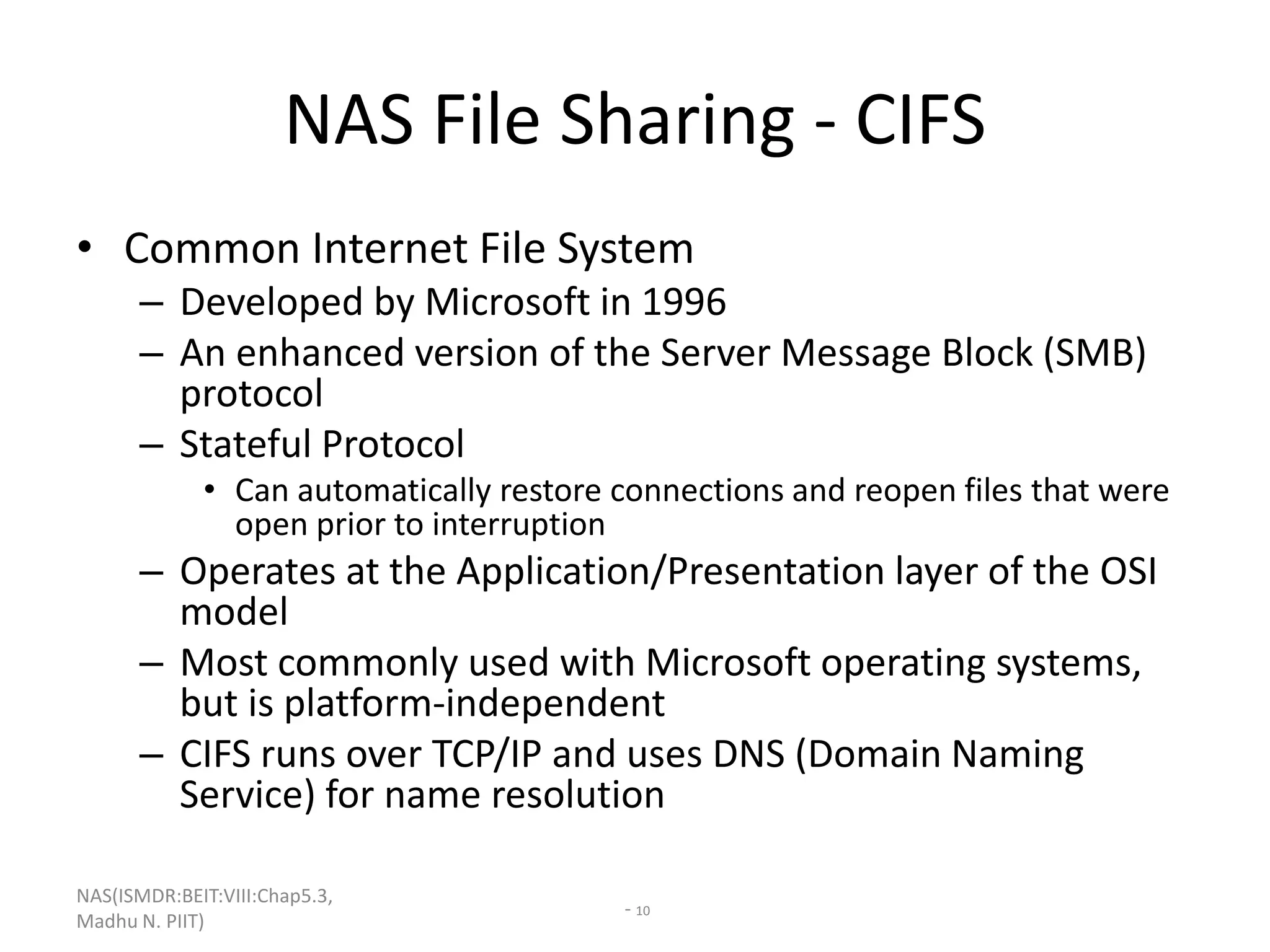
NAS File Sharing - CIFS
• Common Internet File System
– Developed by Microsoft in 1996
– An enhanced version of the Server Message Block (SMB)
protocol
– Stateful Protocol
• Can automatically restore connections and reopen files that were
open prior to interruption
– Operates at the Application/Presentation layer of the OSI
model
– Most commonly used with Microsoft operating systems,
but is platform-independent
– CIFS runs over TCP/IP and uses DNS (Domain Naming
Service) for name resolution
NAS(ISMDR:BEIT:VIII:Chap5.3,
Madhu N. PIIT)
- 11
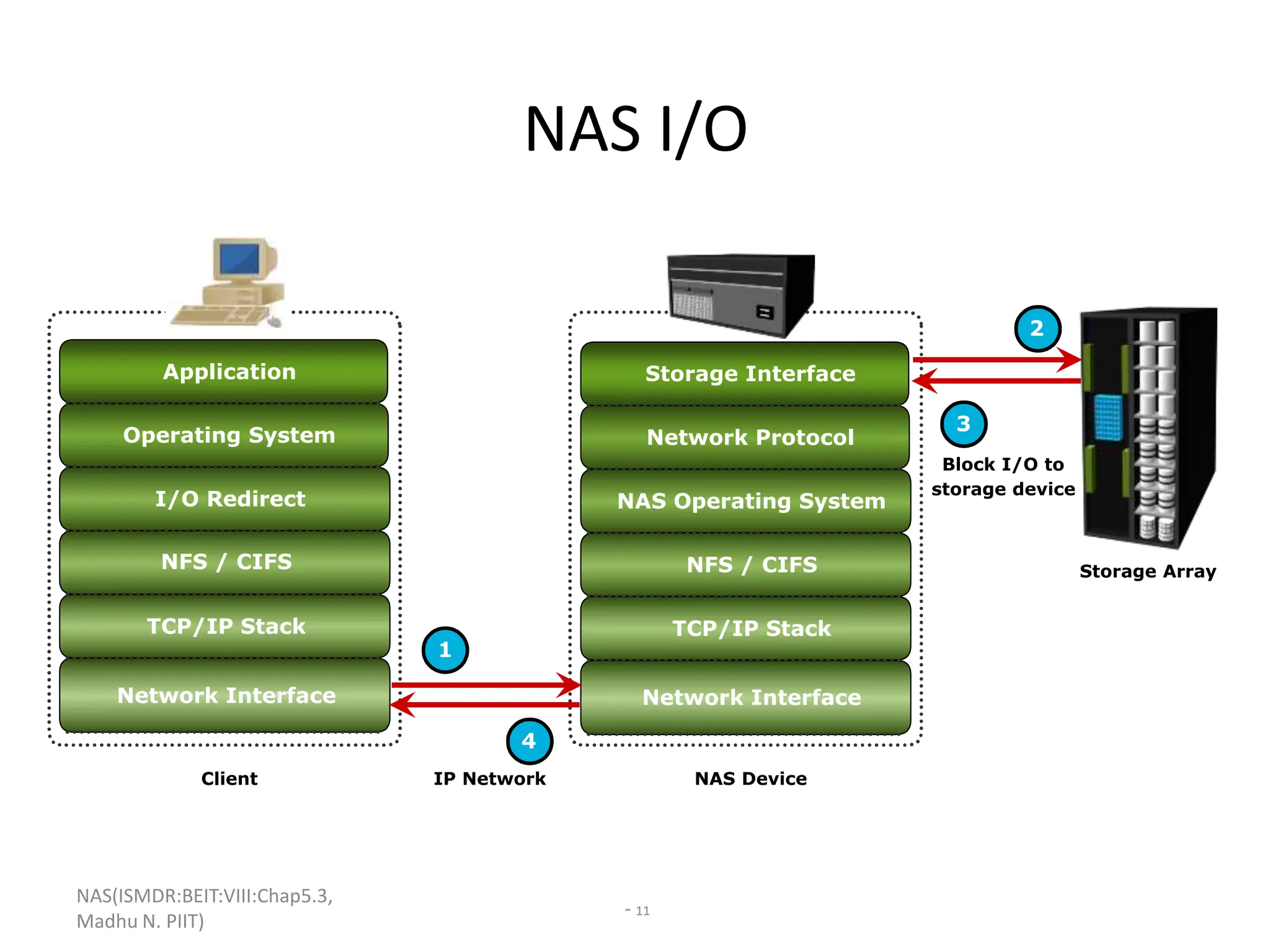
IP Network NAS Device
Client
Storage Interface
Network Protocol
NAS Operating System
NFS / CIFS
TCP/IP Stack
Network Interface
Application
Operating System
I/O Redirect
NFS / CIFS
TCP/IP Stack
Network Interface
1
3
2
4
Block I/O to
storage device
Storage Array
NAS I/O
NAS(ISMDR:BEIT:VIII:Chap5.3,
Madhu N. PIIT)
- 12
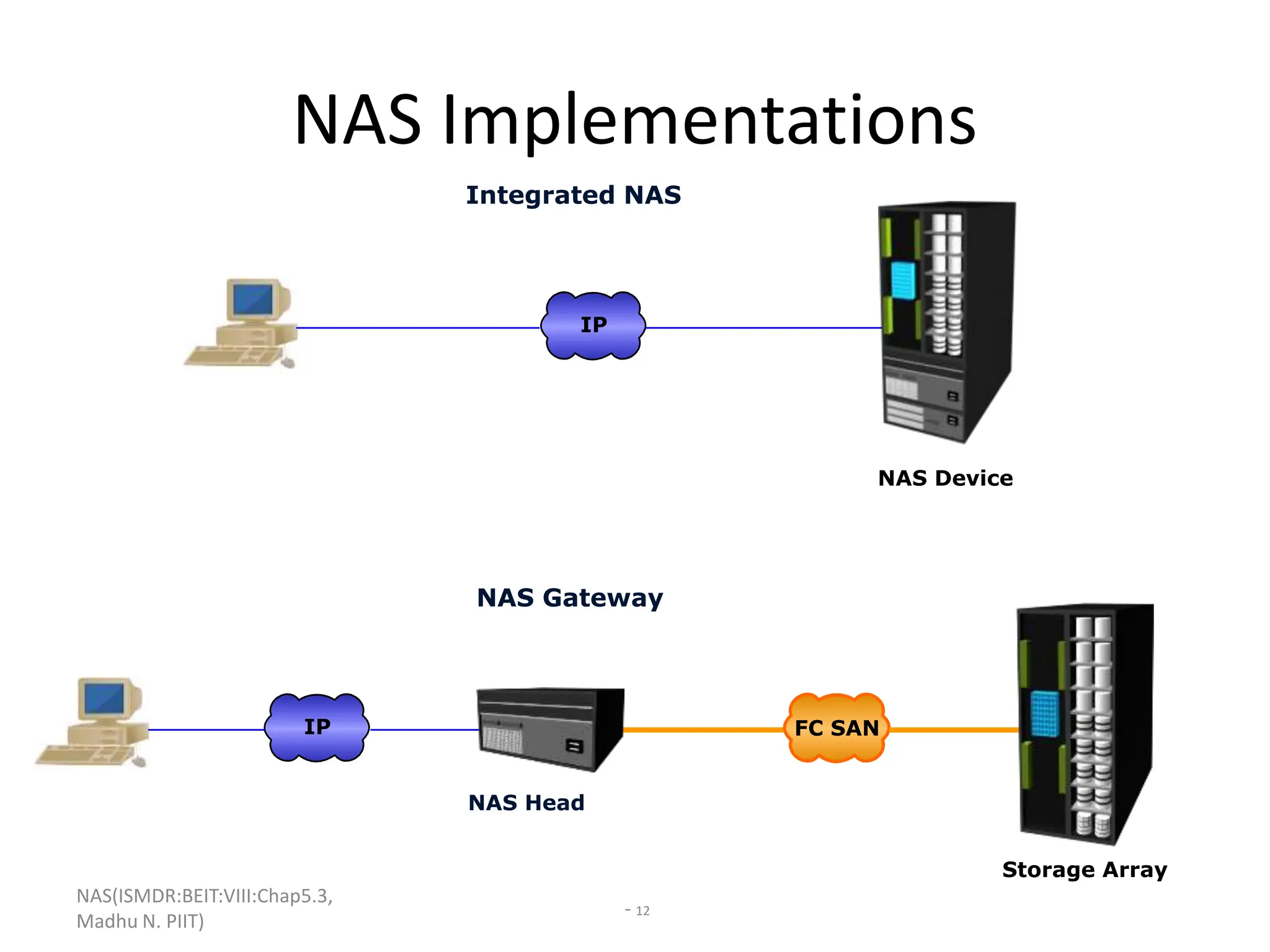
NAS Implementations
Integrated NAS
IP
NAS Device
NAS Gateway
NAS Head
IP FC SAN
Storage Array
NAS(ISMDR:BEIT:VIII:Chap5.3,
Madhu N. PIIT)
- 13
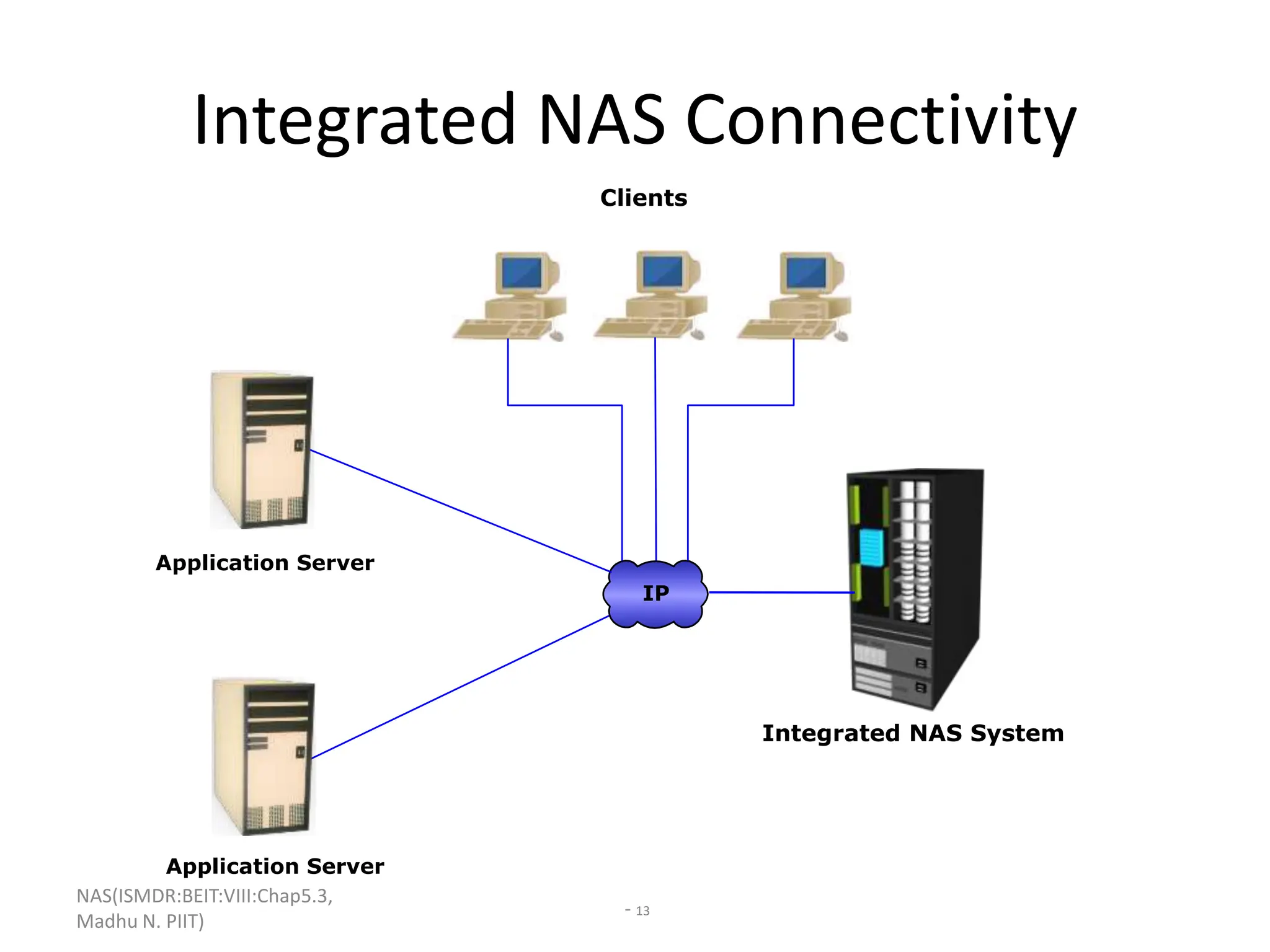
Integrated NAS Connectivity
Application Server
Application Server
Integrated NAS System
Clients
IP
NAS(ISMDR:BEIT:VIII:Chap5.3,Madhu N. PIIT)
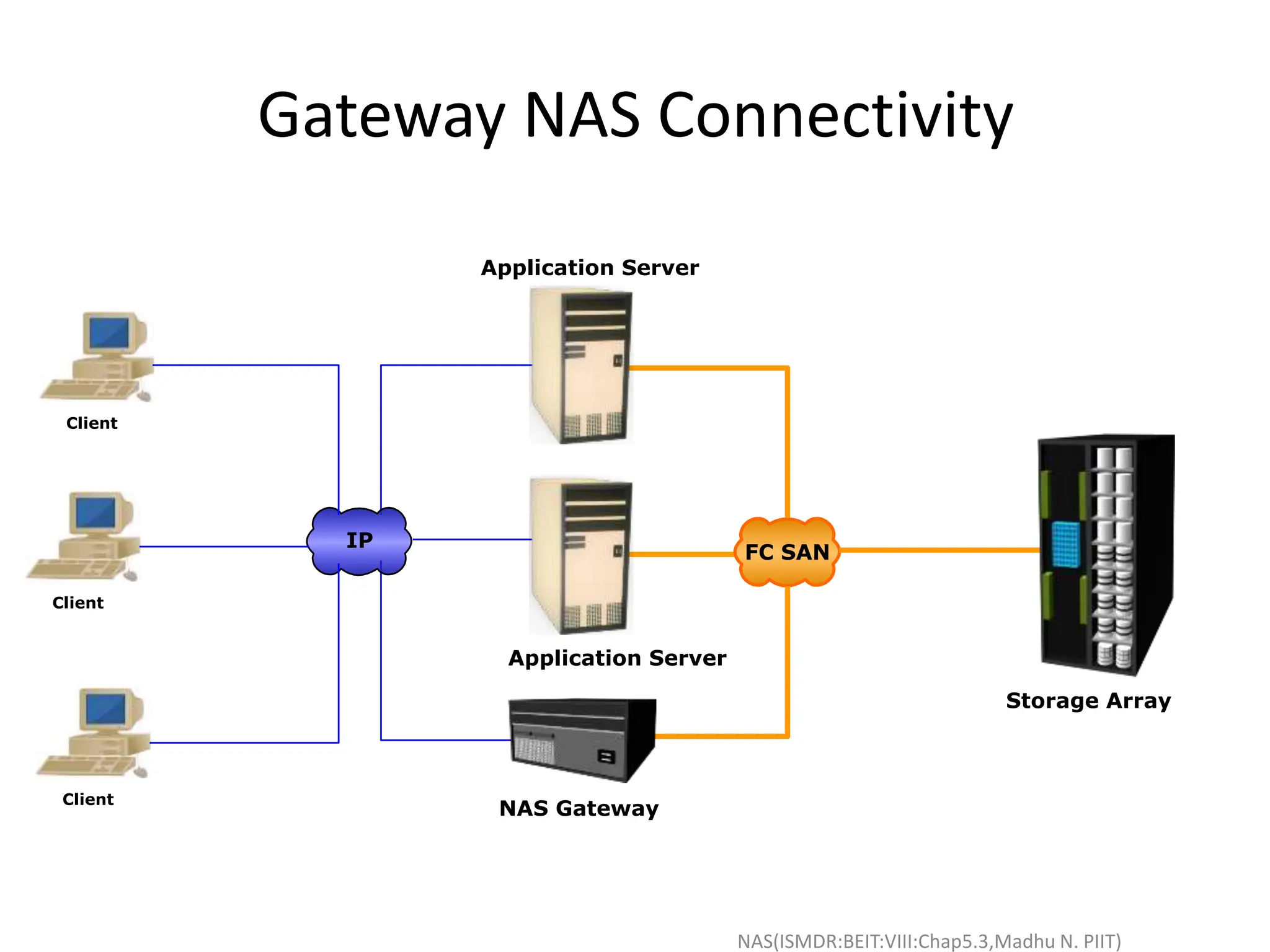
Gateway NAS Connectivity
Application Server
NAS Gateway
Storage Array
Application Server
IP
FC SAN
Client
Client
Client
NAS(ISMDR:BEIT:VIII:Chap5.3,Madhu N. PIIT)
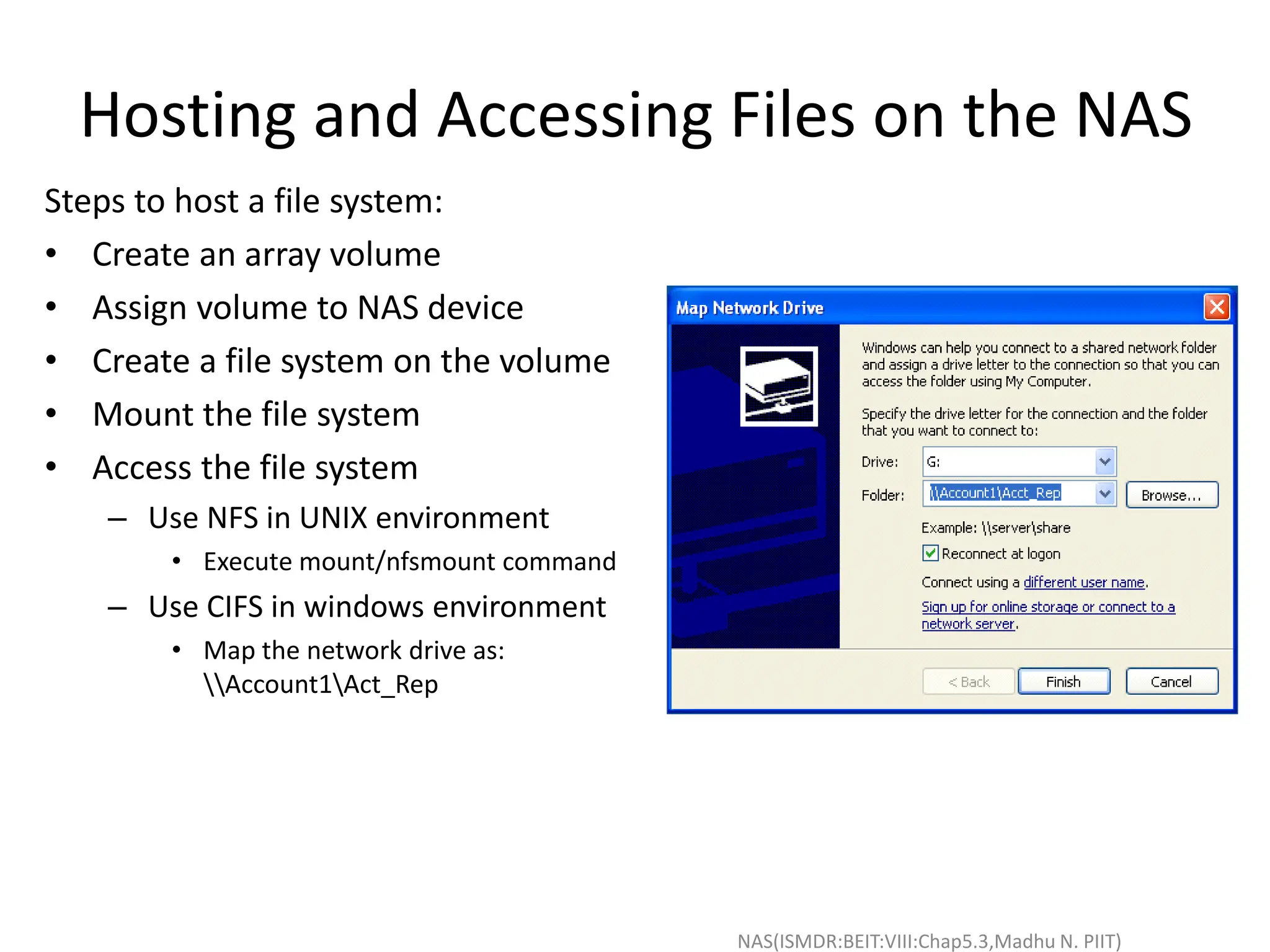
Hosting and Accessing Files on the NAS
Steps to host a file system:
• Create an array volume
• Assign volume to NAS device
• Create a file system on the volume
• Mount the file system
• Access the file system
– Use NFS in UNIX environment
• Execute mount/nfsmount command
– Use CIFS in windows environment
• Map the network drive as:
Account1Act_Rep
NAS(ISMDR:BEIT:VIII:Chap5.3,
Madhu N. PIIT)
- 16
NAS Management
• Ships with vendor management software
• Have unique management issues
• Require preliminary analysis
• Need additional complementary software
NAS(ISMDR:BEIT:VIII:Chap5.3,
Madhu N. PIIT)
- 17
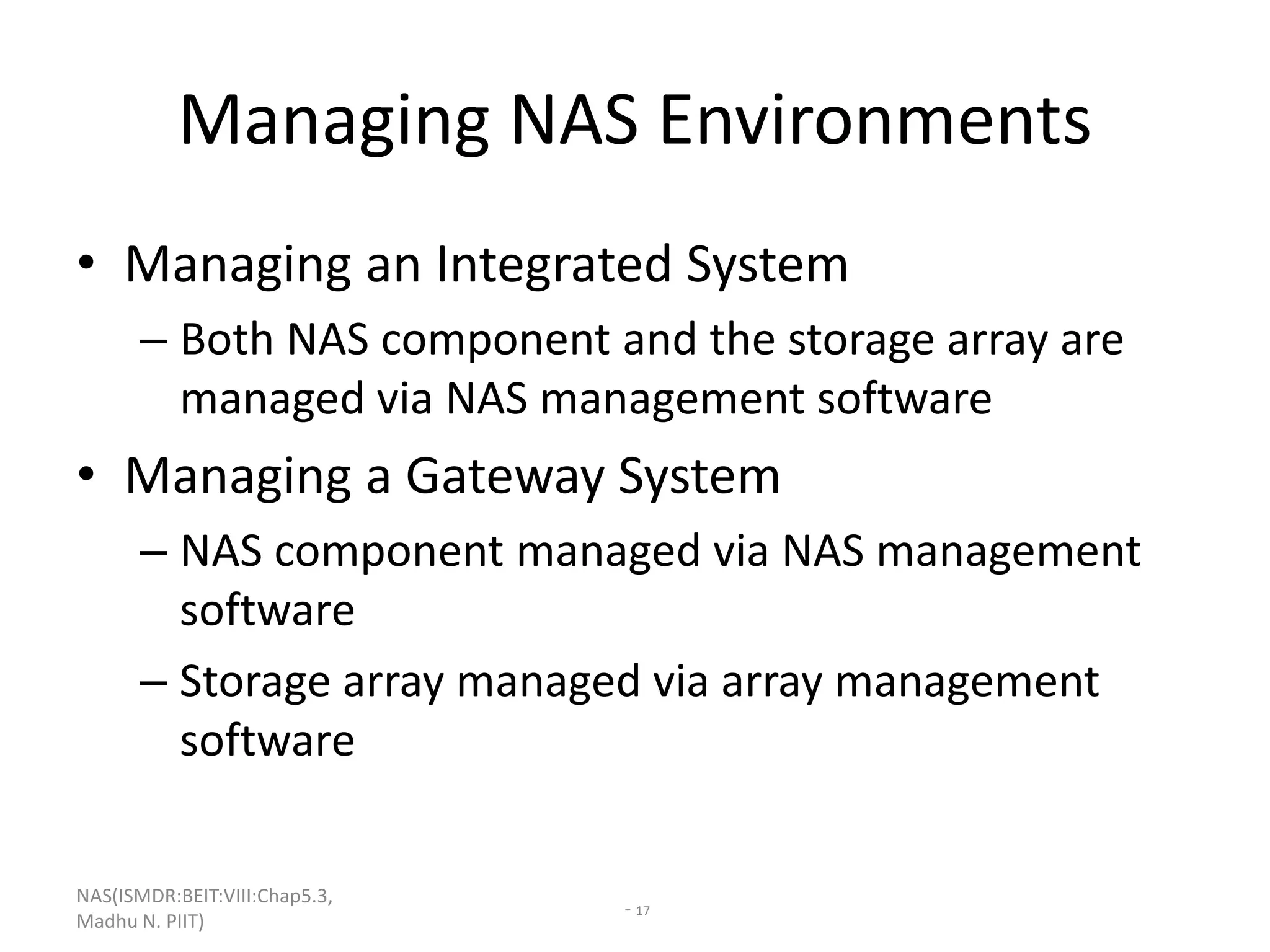
Managing NAS Environments
• Managing an Integrated System
– Both NAS component and the storage array are
managed via NAS management software
• Managing a Gateway System
– NAS component managed via NAS management
software
– Storage array managed via array management
software
NAS(ISMDR:BEIT:VIII:Chap5.3,
Madhu N. PIIT)
- 18
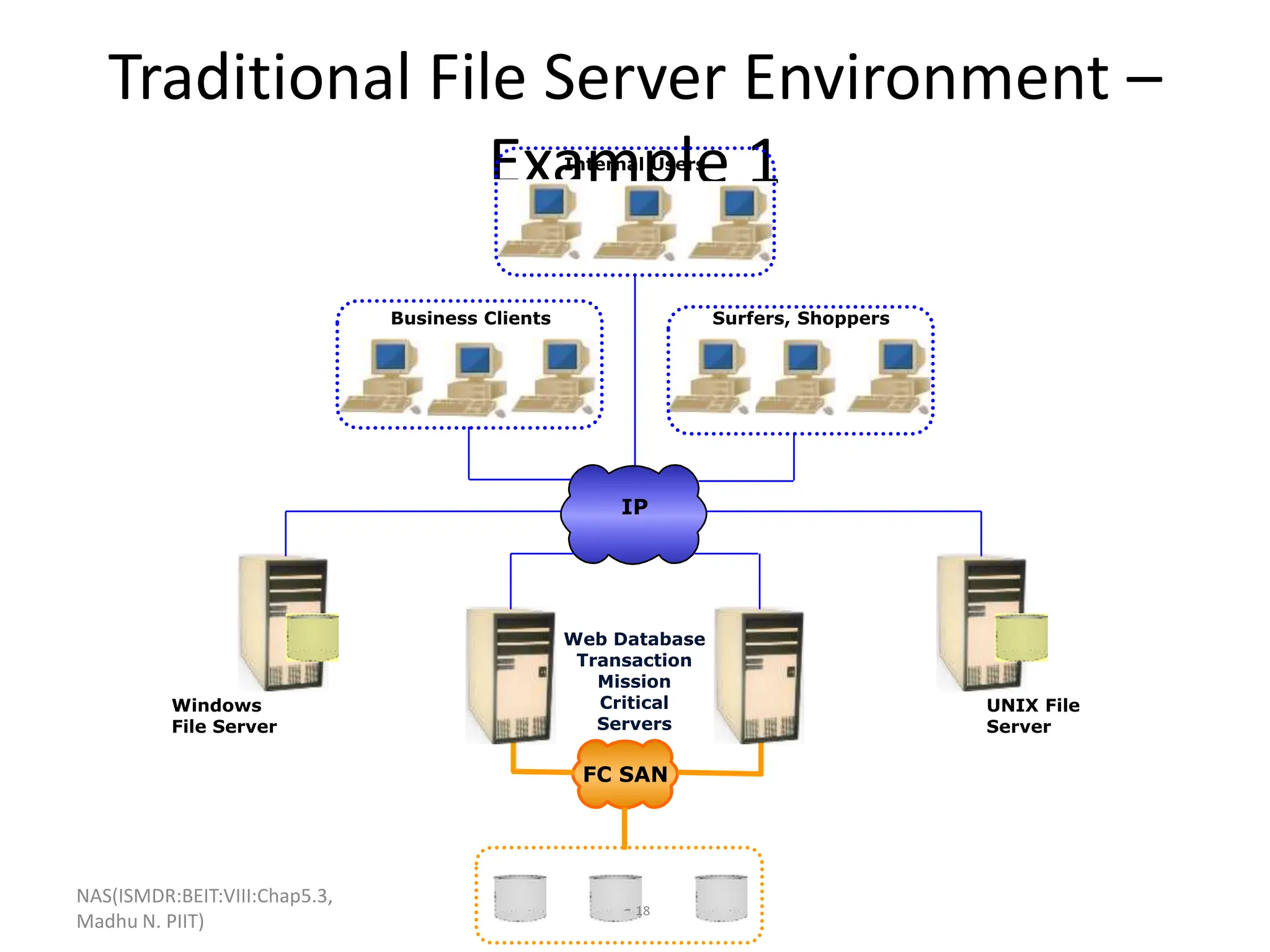
Traditional File Server Environment –
Example 1
Web Database
Transaction
Mission
Critical
Servers
IP
FC SAN
Windows
File Server
UNIX File
Server
Internal Users
Business Clients Surfers, Shoppers
NAS(ISMDR:BEIT:VIII:Chap5.3,
Madhu N. PIIT)
- 19
Storage Consolidation with NAS
Database
Transaction
Mission
Critical
Servers
LAN/WAN
FC SAN
NAS
Head
Internal Users
Surfers, Shoppers
Business Clients
NAS(ISMDR:BEIT:VIII:Chap5.3,
Madhu N. PIIT)
- 20
Traditional File Server Environment –
Example 2
General purpose OS serving files via
FTP, CIFS, NFS, HTTP. . .
UNIX NT
W2K
UNIX Windows
IP
NAS(ISMDR:BEIT:VIII:Chap5.3,
Madhu N. PIIT)
- 21
Server Consolidation with NAS
NAS
General purpose OS serving files via
FTP, CIFS, NFS, HTTP. . .
UNIX Windows
IP
NAS(ISMDR:BEIT:VIII:Chap5.3,
Madhu N. PIIT)
- 22
Chapter Summary
• Key topics covered in this chapter:
– NAS Benefits
– NAS Components
– NAS File Sharing Protocols
• CIFS and NFS
– NAS Implementation
• Integrated NAS
• Gateway NAS
– NAS Management
NAS(ISMDR:BEIT:VIII:Chap5.3,
Madhu N. PIIT)
- 23
Concept in Practice – EMC Celerra
• Celerra is:
– Dedicated and high-
performance infrastructure for
file level I/Os
• Consists of:
– Data Movers
– Control Station
– Specialized O/S (DART)
EMC Celerra NS-960
Integrated NAS
EMC Celerra NS40G
(Gateway NAS)
NAS(ISMDR:BEIT:VIII:Chap5.3,
Madhu N. PIIT)
- 24
Joining the Building Blocks - Integrated
Data Mover
Control Station
Internal Network
Switch
Serial cable connect
Internal network connect
Fibre Channel storage connect
IP Network
NAS(ISMDR:BEIT:VIII:Chap5.3,
Madhu N. PIIT)
- 25
Joining the Building Blocks - Gateway
Data Mover NAS NAS NAS NAS NAS NAS
Control Station
Serial cable connect
Internal network connect
Fibre Channel storage connect
IP Network
Fibre Channel
Switch
SAN SAN SAN SAN SAN SAN
SAN Host(s)
Internal Network
Switch

Network Attached Storage Details enivorments.ppt

  • 1.
  • 2.
    NAS(ISMDR:BEIT:VIII:Chap5.3, Madhu N. PIIT) -2 File Sharing Environment • File system is structured way of storing and organizing data files • File Sharing – Storing and accessing data files over network – FS must be mounted in order to access files • Client/server model is implemented with file- sharing protocols for remote file sharing – Example: FTP, CIFS and NFS
  • 3.
    NAS(ISMDR:BEIT:VIII:Chap5.3, Madhu N. PIIT) -3 File Sharing Technology Evolution Network Attached Storage (NAS) Stand Alone PC Networked File Sharing Networked PCs Portable Media for File Sharing
  • 4.
    NAS(ISMDR:BEIT:VIII:Chap5.3, Madhu N. PIIT) -4 What is NAS ? NAS is shared storage on a network infrastructure Clients Application Server Print Server NAS Device
  • 5.
    NAS(ISMDR:BEIT:VIII:Chap5.3, Madhu N. PIIT) -5 General Purpose Servers vs. NAS Devices Applications Print Drivers File System Operating System Network File System Operating System Network Single Function NAS Device General Purpose Servers (Windows or UNIX)
  • 6.
    NAS(ISMDR:BEIT:VIII:Chap5.3, Madhu N. PIIT) -6 Benefits of NAS • Improves efficiency • Improved flexibility • Centralized storage • Simplifies management • Scalability • High availability – through native clustering • Provides security integration to environment (user authentication and authorization)
  • 7.
    NAS(ISMDR:BEIT:VIII:Chap5.3,Madhu N. PIIT) Componentsof NAS Network Interface NFS CIFS NAS Device OS Storage Interface NAS Head NFS CIFS UNIX Windows Storage Array IP NAS
  • 8.
    NAS(ISMDR:BEIT:VIII:Chap5.3, Madhu N. PIIT) -8 NAS File Sharing Protocols • Two common NAS file sharing protocols are: – CIFS – Common Internet File System protocol • Traditional Microsoft environment file sharing protocol, based upon the Server Message Block protocol – NFS – Network File System protocol • Traditional UNIX environment file sharing protocol
  • 9.
    NAS(ISMDR:BEIT:VIII:Chap5.3, Madhu N. PIIT) -9 Network File System (NFS) • Client/server application • Uses RPC mechanisms over TCP protocol • Mount points grant access to remote hierarchical file structures for local file system structures • Access to the mount can be controlled by permissions – NFS v2 was stateless and uses UDP as the transport layer protocol – NFS v3 added TCP as an option for transport layer protocol – NFS v4 uses stateful protocol • Aimed to provides support to cluster server deployment • Allow scalable parallel access to the files distributed among multiple servers
  • 10.
    NAS(ISMDR:BEIT:VIII:Chap5.3, Madhu N. PIIT) -10 NAS File Sharing - CIFS • Common Internet File System – Developed by Microsoft in 1996 – An enhanced version of the Server Message Block (SMB) protocol – Stateful Protocol • Can automatically restore connections and reopen files that were open prior to interruption – Operates at the Application/Presentation layer of the OSI model – Most commonly used with Microsoft operating systems, but is platform-independent – CIFS runs over TCP/IP and uses DNS (Domain Naming Service) for name resolution
  • 11.
    NAS(ISMDR:BEIT:VIII:Chap5.3, Madhu N. PIIT) -11 IP Network NAS Device Client Storage Interface Network Protocol NAS Operating System NFS / CIFS TCP/IP Stack Network Interface Application Operating System I/O Redirect NFS / CIFS TCP/IP Stack Network Interface 1 3 2 4 Block I/O to storage device Storage Array NAS I/O
  • 12.
    NAS(ISMDR:BEIT:VIII:Chap5.3, Madhu N. PIIT) -12 NAS Implementations Integrated NAS IP NAS Device NAS Gateway NAS Head IP FC SAN Storage Array
  • 13.
    NAS(ISMDR:BEIT:VIII:Chap5.3, Madhu N. PIIT) -13 Integrated NAS Connectivity Application Server Application Server Integrated NAS System Clients IP
  • 14.
    NAS(ISMDR:BEIT:VIII:Chap5.3,Madhu N. PIIT) GatewayNAS Connectivity Application Server NAS Gateway Storage Array Application Server IP FC SAN Client Client Client
  • 15.
    NAS(ISMDR:BEIT:VIII:Chap5.3,Madhu N. PIIT) Hostingand Accessing Files on the NAS Steps to host a file system: • Create an array volume • Assign volume to NAS device • Create a file system on the volume • Mount the file system • Access the file system – Use NFS in UNIX environment • Execute mount/nfsmount command – Use CIFS in windows environment • Map the network drive as: Account1Act_Rep
  • 16.
    NAS(ISMDR:BEIT:VIII:Chap5.3, Madhu N. PIIT) -16 NAS Management • Ships with vendor management software • Have unique management issues • Require preliminary analysis • Need additional complementary software
  • 17.
    NAS(ISMDR:BEIT:VIII:Chap5.3, Madhu N. PIIT) -17 Managing NAS Environments • Managing an Integrated System – Both NAS component and the storage array are managed via NAS management software • Managing a Gateway System – NAS component managed via NAS management software – Storage array managed via array management software
  • 18.
    NAS(ISMDR:BEIT:VIII:Chap5.3, Madhu N. PIIT) -18 Traditional File Server Environment – Example 1 Web Database Transaction Mission Critical Servers IP FC SAN Windows File Server UNIX File Server Internal Users Business Clients Surfers, Shoppers
  • 19.
    NAS(ISMDR:BEIT:VIII:Chap5.3, Madhu N. PIIT) -19 Storage Consolidation with NAS Database Transaction Mission Critical Servers LAN/WAN FC SAN NAS Head Internal Users Surfers, Shoppers Business Clients
  • 20.
    NAS(ISMDR:BEIT:VIII:Chap5.3, Madhu N. PIIT) -20 Traditional File Server Environment – Example 2 General purpose OS serving files via FTP, CIFS, NFS, HTTP. . . UNIX NT W2K UNIX Windows IP
  • 21.
    NAS(ISMDR:BEIT:VIII:Chap5.3, Madhu N. PIIT) -21 Server Consolidation with NAS NAS General purpose OS serving files via FTP, CIFS, NFS, HTTP. . . UNIX Windows IP
  • 22.
    NAS(ISMDR:BEIT:VIII:Chap5.3, Madhu N. PIIT) -22 Chapter Summary • Key topics covered in this chapter: – NAS Benefits – NAS Components – NAS File Sharing Protocols • CIFS and NFS – NAS Implementation • Integrated NAS • Gateway NAS – NAS Management
  • 23.
    NAS(ISMDR:BEIT:VIII:Chap5.3, Madhu N. PIIT) -23 Concept in Practice – EMC Celerra • Celerra is: – Dedicated and high- performance infrastructure for file level I/Os • Consists of: – Data Movers – Control Station – Specialized O/S (DART) EMC Celerra NS-960 Integrated NAS EMC Celerra NS40G (Gateway NAS)
  • 24.
    NAS(ISMDR:BEIT:VIII:Chap5.3, Madhu N. PIIT) -24 Joining the Building Blocks - Integrated Data Mover Control Station Internal Network Switch Serial cable connect Internal network connect Fibre Channel storage connect IP Network
  • 25.
    NAS(ISMDR:BEIT:VIII:Chap5.3, Madhu N. PIIT) -25 Joining the Building Blocks - Gateway Data Mover NAS NAS NAS NAS NAS NAS Control Station Serial cable connect Internal network connect Fibre Channel storage connect IP Network Fibre Channel Switch SAN SAN SAN SAN SAN SAN SAN Host(s) Internal Network Switch