PMP Formulas
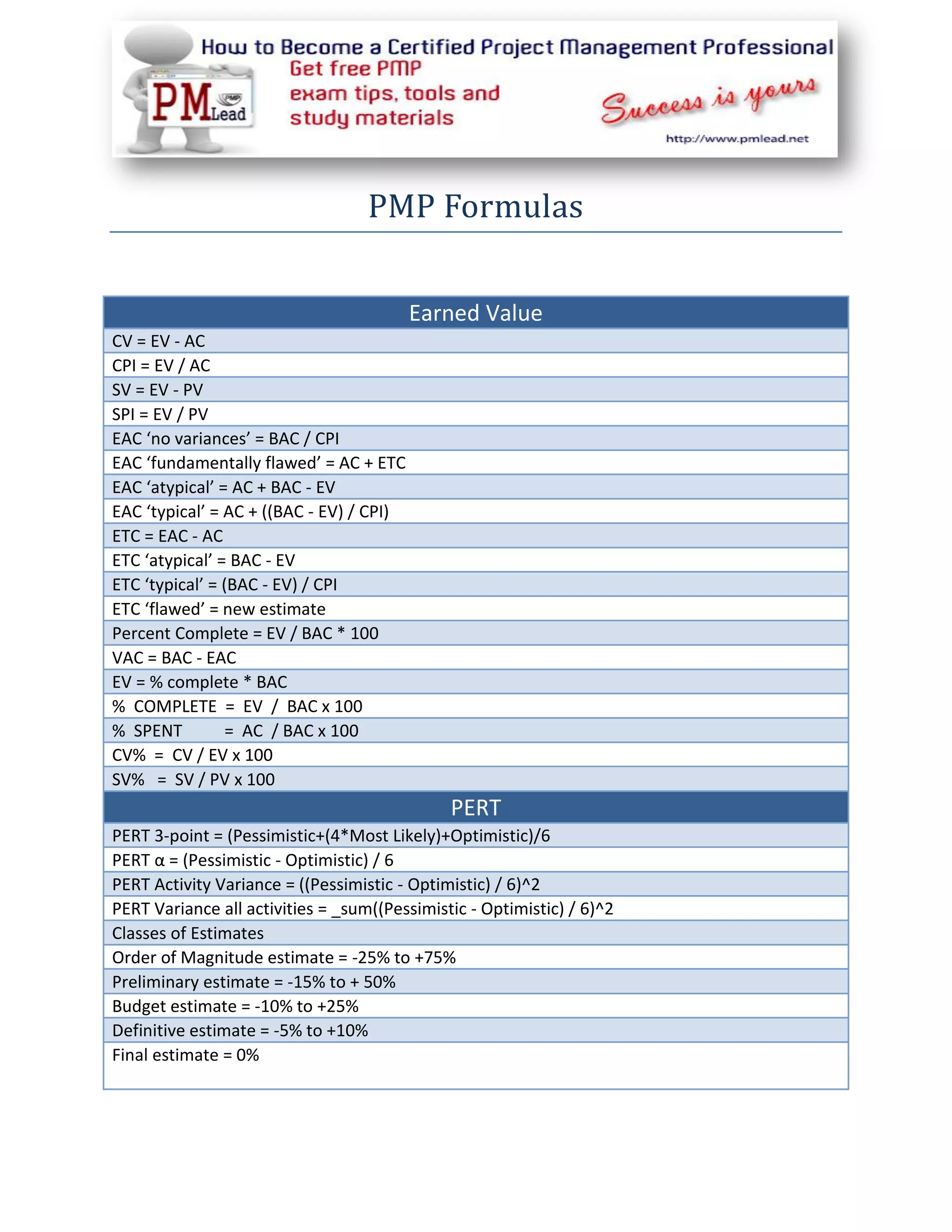
Earned Value
CV = EV - AC
CPI = EV / AC
SV = EV - PV
SPI = EV / PV
EAC ‘no variances’ = BAC / CPI
EAC ‘fundamentally flawed’ = AC + ETC
EAC ‘atypical’ = AC + BAC - EV
EAC ‘typical’ = AC + ((BAC - EV) / CPI)
ETC = EAC - AC
ETC ‘atypical’ = BAC - EV
ETC ‘typical’ = (BAC - EV) / CPI
ETC ‘flawed’ = new estimate
Percent Complete = EV / BAC * 100
VAC = BAC - EAC
EV = % complete * BAC
% COMPLETE = EV / BAC x 100
% SPENT = AC / BAC x 100
CV% = CV / EV x 100
SV% = SV / PV x 100
PERT
PERT 3-point = (Pessimistic+(4*Most Likely)+Optimistic)/6
PERT α = (Pessimistic - Optimistic) / 6
PERT Activity Variance = ((Pessimistic - Optimistic) / 6)^2
PERT Variance all activities = _sum((Pessimistic - Optimistic) / 6)^2
Classes of Estimates
Order of Magnitude estimate = -25% to +75%
Preliminary estimate = -15% to + 50%
Budget estimate = -10% to +25%
Definitive estimate = -5% to +10%
Final estimate = 0%
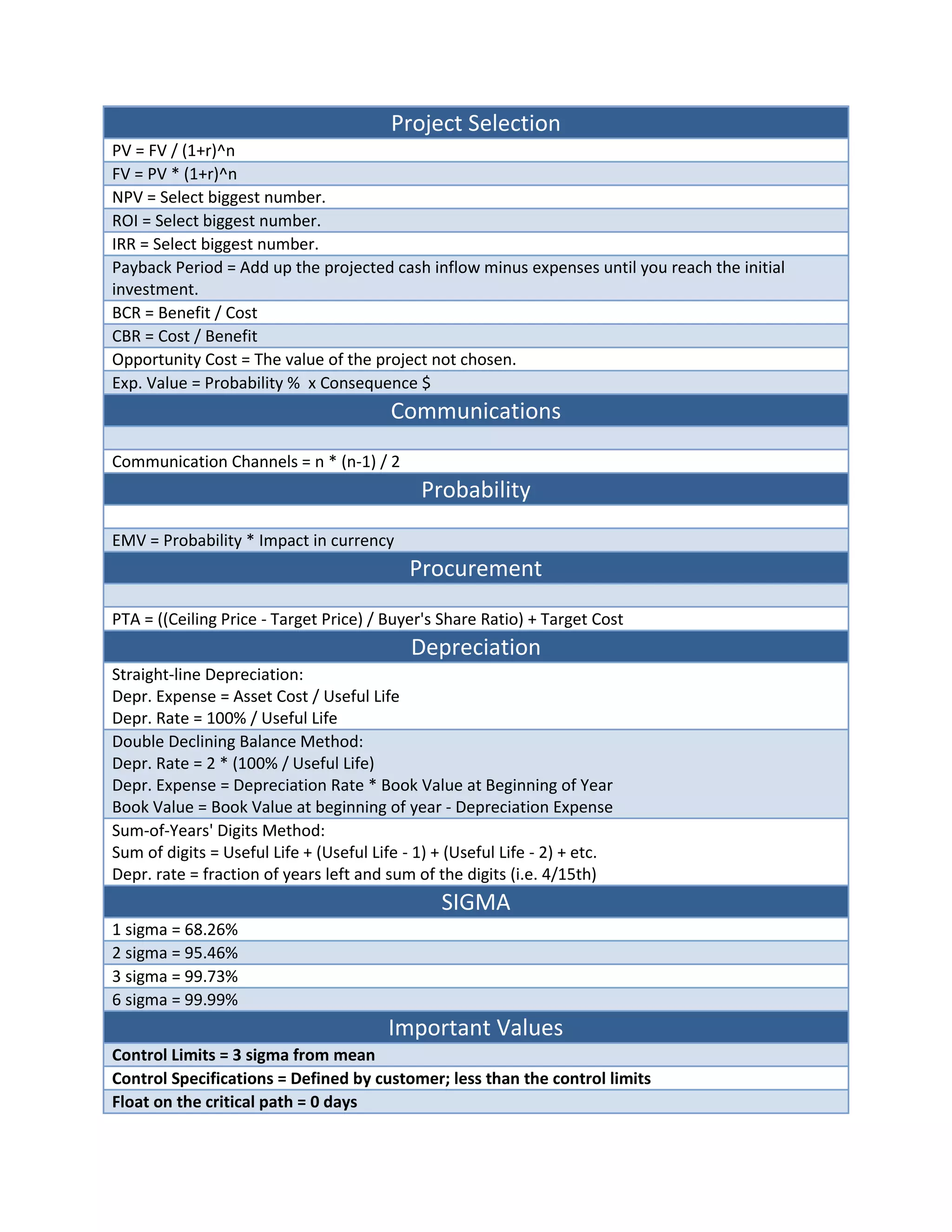
Project Selection
PV = FV / (1+r)^n
FV = PV * (1+r)^n
NPV = Select biggest number.
ROI = Select biggest number.
IRR = Select biggest number.
Payback Period = Add up the projected cash inflow minus expenses until you reach the initial
investment.
BCR = Benefit / Cost
CBR = Cost / Benefit
Opportunity Cost = The value of the project not chosen.
Exp. Value = Probability % x Consequence $
Communications
Communication Channels = n * (n-1) / 2
Probability
EMV = Probability * Impact in currency
Procurement
PTA = ((Ceiling Price - Target Price) / Buyer's Share Ratio) + Target Cost
Depreciation
Straight-line Depreciation:
Depr. Expense = Asset Cost / Useful Life
Depr. Rate = 100% / Useful Life
Double Declining Balance Method:
Depr. Rate = 2 * (100% / Useful Life)
Depr. Expense = Depreciation Rate * Book Value at Beginning of Year
Book Value = Book Value at beginning of year - Depreciation Expense
Sum-of-Years' Digits Method:
Sum of digits = Useful Life + (Useful Life - 1) + (Useful Life - 2) + etc.
Depr. rate = fraction of years left and sum of the digits (i.e. 4/15th)
SIGMA
1 sigma = 68.26%
2 sigma = 95.46%
3 sigma = 99.73%
6 sigma = 99.99%
Important Values
Control Limits = 3 sigma from mean
Control Specifications = Defined by customer; less than the control limits
Float on the critical path = 0 days
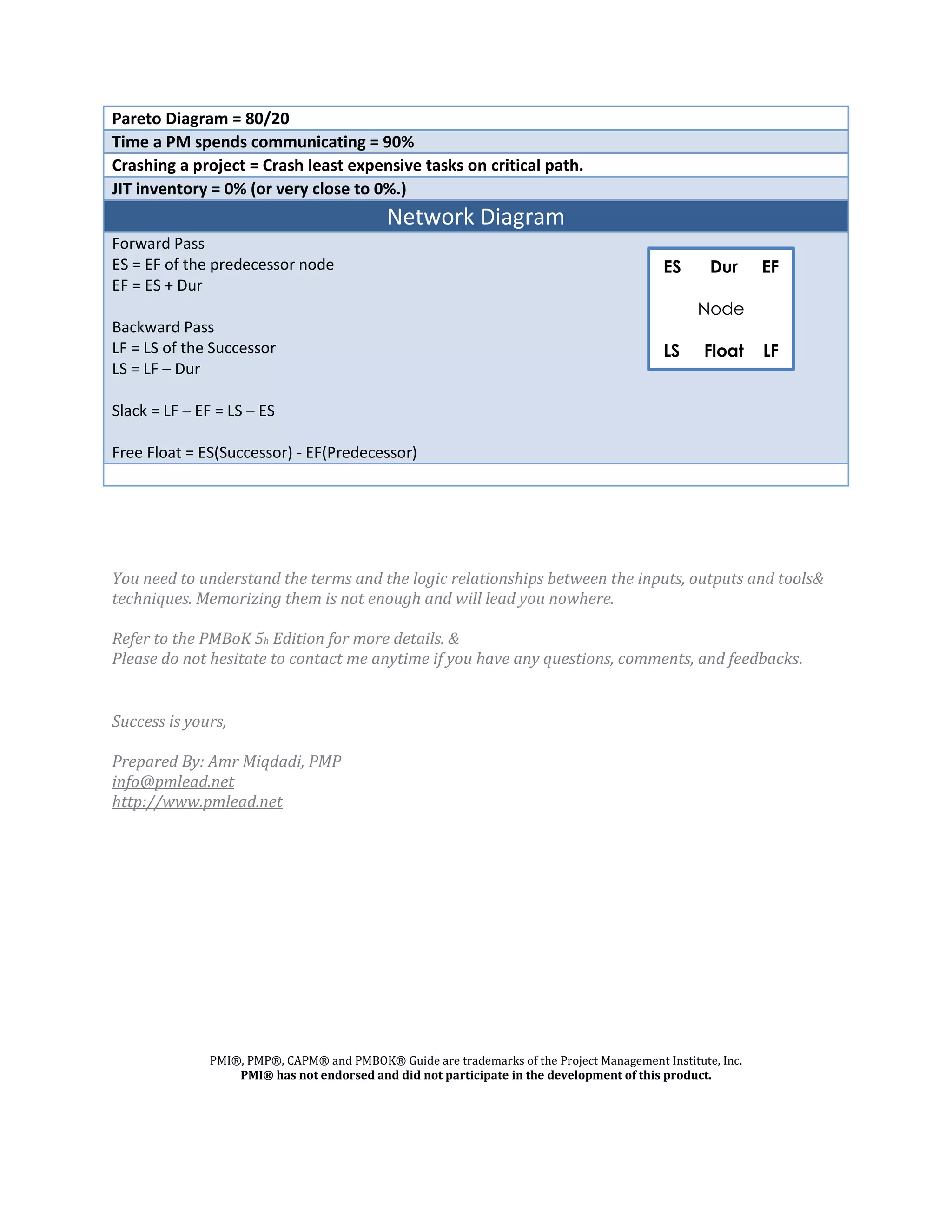
Pareto Diagram = 80/20
Time a PM spends communicating = 90%
Crashing a project = Crash least expensive tasks on critical path.
JIT inventory = 0% (or very close to 0%.)
Network Diagram
Forward Pass
ES = EF of the predecessor node
EF = ES + Dur
Backward Pass
LF = LS of the Successor
LS = LF – Dur
Slack = LF – EF = LS – ES
Free Float = ES(Successor) - EF(Predecessor)
You need to understand the terms and the logic relationships between the inputs, outputs and tools&
techniques. Memorizing them is not enough and will lead you nowhere.
Refer to the PMBoK 5h Edition for more details. &
Please do not hesitate to contact me anytime if you have any questions, comments, and feedbacks.
Success is yours,
Prepared By: Amr Miqdadi, PMP
info@pmlead.net
http://www.pmlead.net
PMI®, PMP®, CAPM® and PMBOK® Guide are trademarks of the Project Management Institute, Inc.
PMI® has not endorsed and did not participate in the development of this product.
ES Dur EF
Node
LS Float LF

Pmp formulas

  • 1.
    PMP Formulas Earned Value CV= EV - AC CPI = EV / AC SV = EV - PV SPI = EV / PV EAC ‘no variances’ = BAC / CPI EAC ‘fundamentally flawed’ = AC + ETC EAC ‘atypical’ = AC + BAC - EV EAC ‘typical’ = AC + ((BAC - EV) / CPI) ETC = EAC - AC ETC ‘atypical’ = BAC - EV ETC ‘typical’ = (BAC - EV) / CPI ETC ‘flawed’ = new estimate Percent Complete = EV / BAC * 100 VAC = BAC - EAC EV = % complete * BAC % COMPLETE = EV / BAC x 100 % SPENT = AC / BAC x 100 CV% = CV / EV x 100 SV% = SV / PV x 100 PERT PERT 3-point = (Pessimistic+(4*Most Likely)+Optimistic)/6 PERT α = (Pessimistic - Optimistic) / 6 PERT Activity Variance = ((Pessimistic - Optimistic) / 6)^2 PERT Variance all activities = _sum((Pessimistic - Optimistic) / 6)^2 Classes of Estimates Order of Magnitude estimate = -25% to +75% Preliminary estimate = -15% to + 50% Budget estimate = -10% to +25% Definitive estimate = -5% to +10% Final estimate = 0%
  • 2.
    Project Selection PV =FV / (1+r)^n FV = PV * (1+r)^n NPV = Select biggest number. ROI = Select biggest number. IRR = Select biggest number. Payback Period = Add up the projected cash inflow minus expenses until you reach the initial investment. BCR = Benefit / Cost CBR = Cost / Benefit Opportunity Cost = The value of the project not chosen. Exp. Value = Probability % x Consequence $ Communications Communication Channels = n * (n-1) / 2 Probability EMV = Probability * Impact in currency Procurement PTA = ((Ceiling Price - Target Price) / Buyer's Share Ratio) + Target Cost Depreciation Straight-line Depreciation: Depr. Expense = Asset Cost / Useful Life Depr. Rate = 100% / Useful Life Double Declining Balance Method: Depr. Rate = 2 * (100% / Useful Life) Depr. Expense = Depreciation Rate * Book Value at Beginning of Year Book Value = Book Value at beginning of year - Depreciation Expense Sum-of-Years' Digits Method: Sum of digits = Useful Life + (Useful Life - 1) + (Useful Life - 2) + etc. Depr. rate = fraction of years left and sum of the digits (i.e. 4/15th) SIGMA 1 sigma = 68.26% 2 sigma = 95.46% 3 sigma = 99.73% 6 sigma = 99.99% Important Values Control Limits = 3 sigma from mean Control Specifications = Defined by customer; less than the control limits Float on the critical path = 0 days
  • 3.
    Pareto Diagram =80/20 Time a PM spends communicating = 90% Crashing a project = Crash least expensive tasks on critical path. JIT inventory = 0% (or very close to 0%.) Network Diagram Forward Pass ES = EF of the predecessor node EF = ES + Dur Backward Pass LF = LS of the Successor LS = LF – Dur Slack = LF – EF = LS – ES Free Float = ES(Successor) - EF(Predecessor) You need to understand the terms and the logic relationships between the inputs, outputs and tools& techniques. Memorizing them is not enough and will lead you nowhere. Refer to the PMBoK 5h Edition for more details. & Please do not hesitate to contact me anytime if you have any questions, comments, and feedbacks. Success is yours, Prepared By: Amr Miqdadi, PMP info@pmlead.net http://www.pmlead.net PMI®, PMP®, CAPM® and PMBOK® Guide are trademarks of the Project Management Institute, Inc. PMI® has not endorsed and did not participate in the development of this product. ES Dur EF Node LS Float LF