1
University of Tehran, Project Management Information System (PMIS), Dr. Sasan Hosseyni, xwir@yahoo.com, 2018
University of Tehran
College of Engineering
School of Industrial Engineering
“Master of Science in Engineering” Program
Project Management Information System
PART 3 – Earned Value Management
2018 Fall Semester
Dr. Sasan Hosseyni
XWIR@yahoo.com
2
University of Tehran, Project Management Information System (PMIS), Dr. Sasan Hosseyni, xwir@yahoo.com, 2018
Outlines:
• PART 1 Definitions (IS, PMBOK, PMIS)
• PART 2 PMIS in Practice
• PART 3 Earned Value Management
• PART 4 Business Process Management
• PART 5 Enterprise Resource Planning
• PART 6 Enterprise Architecture (for a Project Based Org.)
• PART 7 Implementation Methodologies
• PART 8 Organizational Change Management
• PART 9 Implementation Critical Success Factors
• PART 10 Academic Researches
3
University of Tehran, Project Management Information System (PMIS), Dr. Sasan Hosseyni, xwir@yahoo.com, 2018
Earned Value Management (EVM) helps project managers to measure
project performance. It is a systematic project management process used to
find variances in projects based on the comparison of worked performed
and work planned.
EVM is used on the cost and schedule control and can be very useful in
project forecasting. The project baseline is an essential component of EVM
and serves as a reference point for all EVM related activities. EVM provides
quantitative data for project decision making. (projectsmart.co.uk, Dwivedi)
Earned Value Management Definition
4
University of Tehran, Project Management Information System (PMIS), Dr. Sasan Hosseyni, xwir@yahoo.com, 2018
Some of the most well known organizations practicing EVM are:
• NASA
• Project Management Institute (PMI)
• Society of Cost Estimating and Analysis
• Defense Acquisition University
• Federal Acquisition Institute
• Acquisition Management (UK)
Earned Value Management Definition
5
University of Tehran, Project Management Information System (PMIS), Dr. Sasan Hosseyni, xwir@yahoo.com, 2018
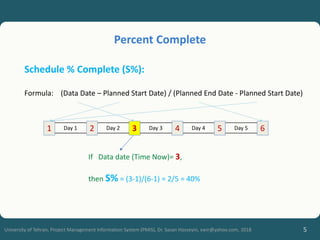
Schedule % Complete (S%):
Formula: (Data Date – Planned Start Date) / (Planned End Date - Planned Start Date)
If Data date (Time Now)= 3,
then S% = (3-1)/(6-1) = 2/5 = 40%
Day 1 Day 2 Day 3 Day 4 Day 5
1 2 3 4 5 6
Percent Complete
6
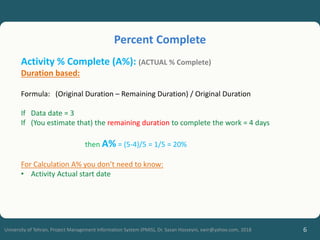
University of Tehran, Project Management Information System (PMIS), Dr. Sasan Hosseyni, xwir@yahoo.com, 2018
Activity % Complete (A%): (ACTUAL % Complete)
Duration based:
Formula: (Original Duration – Remaining Duration) / Original Duration
If Data date = 3
If (You estimate that) the remaining duration to complete the work = 4 days
then A% = (5-4)/5 = 1/5 = 20%
For Calculation A% you don’t need to know:
• Activity Actual start date
Percent Complete
7
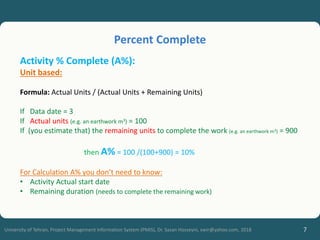
University of Tehran, Project Management Information System (PMIS), Dr. Sasan Hosseyni, xwir@yahoo.com, 2018
Activity % Complete (A%):
Unit based:
Formula: Actual Units / (Actual Units + Remaining Units)
If Data date = 3
If Actual units (e.g. an earthwork m3) = 100
If (you estimate that) the remaining units to complete the work (e.g. an earthwork m3) = 900
then A% = 100 /(100+900) = 10%
For Calculation A% you don’t need to know:
• Activity Actual start date
• Remaining duration (needs to complete the remaining work)
Percent Complete
8
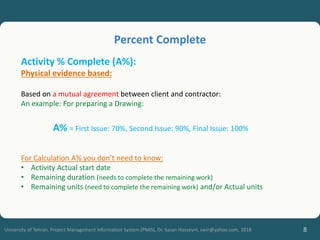
University of Tehran, Project Management Information System (PMIS), Dr. Sasan Hosseyni, xwir@yahoo.com, 2018
Activity % Complete (A%):
Physical evidence based:
Based on a mutual agreement between client and contractor:
An example: For preparing a Drawing:
A% = First Issue: 70%, Second Issue: 90%, Final Issue: 100%
For Calculation A% you don’t need to know:
• Activity Actual start date
• Remaining duration (needs to complete the remaining work)
• Remaining units (need to complete the remaining work) and/or Actual units
Percent Complete
9
University of Tehran, Project Management Information System (PMIS), Dr. Sasan Hosseyni, xwir@yahoo.com, 2018
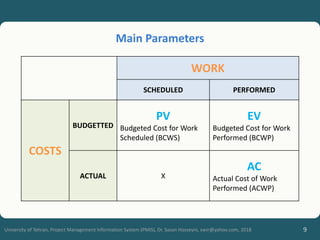
Main Parameters
WORK
SCHEDULED PERFORMED
COSTS
BUDGETTED
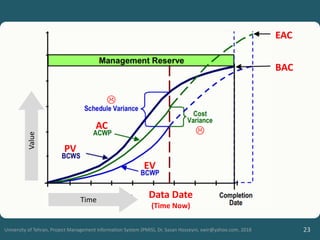
PV
Budgeted Cost for Work
Scheduled (BCWS)
EV
Budgeted Cost for Work
Performed (BCWP)
ACTUAL X
AC
Actual Cost of Work
Performed (ACWP)
10
University of Tehran, Project Management Information System (PMIS), Dr. Sasan Hosseyni, xwir@yahoo.com, 2018
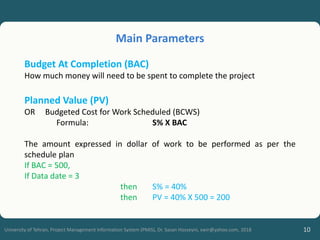
Budget At Completion (BAC)
How much money will need to be spent to complete the project
Planned Value (PV)
OR Budgeted Cost for Work Scheduled (BCWS)
Formula: S% X BAC
The amount expressed in dollar of work to be performed as per the
schedule plan
If BAC = 500,
If Data date = 3
then S% = 40%
then PV = 40% X 500 = 200
Main Parameters
11
University of Tehran, Project Management Information System (PMIS), Dr. Sasan Hosseyni, xwir@yahoo.com, 2018
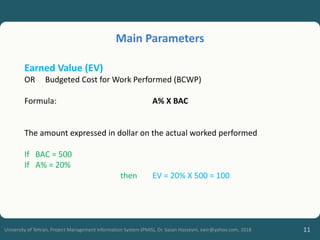
Earned Value (EV)
OR Budgeted Cost for Work Performed (BCWP)
Formula: A% X BAC
The amount expressed in dollar on the actual worked performed
If BAC = 500
If A% = 20%
then EV = 20% X 500 = 100
Main Parameters
12
University of Tehran, Project Management Information System (PMIS), Dr. Sasan Hosseyni, xwir@yahoo.com, 2018
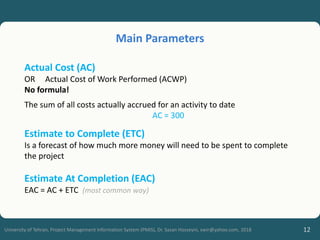
Actual Cost (AC)
OR Actual Cost of Work Performed (ACWP)
No formula!
The sum of all costs actually accrued for an activity to date
AC = 300
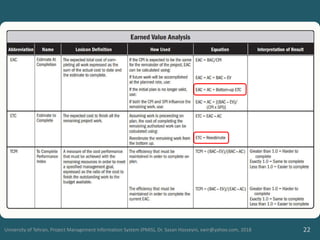
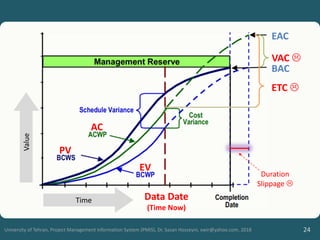
Estimate to Complete (ETC)
Is a forecast of how much more money will need to be spent to complete
the project
Estimate At Completion (EAC)
EAC = AC + ETC (most common way)
Main Parameters
13
University of Tehran, Project Management Information System (PMIS), Dr. Sasan Hosseyni, xwir@yahoo.com, 2018
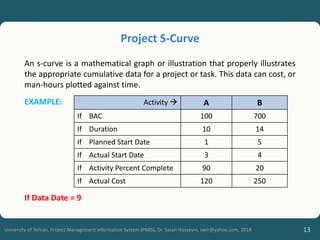
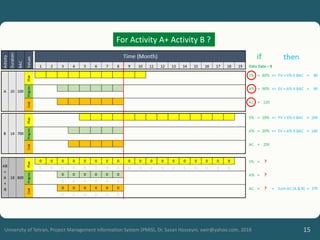
An s-curve is a mathematical graph or illustration that properly illustrates
the appropriate cumulative data for a project or task. This data can cost, or
man-hours plotted against time.
EXAMPLE:
If Data Date = 9
Project S-Curve
Activity  A B
If BAC 100 700
If Duration 10 14
If Planned Start Date 1 5
If Actual Start Date 3 4
If Activity Percent Complete 90 20
If Actual Cost 120 250
14
University of Tehran, Project Management Information System (PMIS), Dr. Sasan Hosseyni, xwir@yahoo.com, 2018
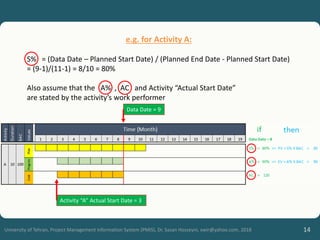
e.g. for Activity A:
S% = (Data Date – Planned Start Date) / (Planned End Date - Planned Start Date)
= (9-1)/(11-1) = 8/10 = 80%
Also assume that the A% , AC and Activity “Actual Start Date”
are stated by the activity’s work performer
Activity “A” Actual Start Date = 3
Data Date = 9
15
University of Tehran, Project Management Information System (PMIS), Dr. Sasan Hosseyni, xwir@yahoo.com, 2018
For Activity A+ Activity B ?
16
University of Tehran, Project Management Information System (PMIS), Dr. Sasan Hosseyni, xwir@yahoo.com, 2018
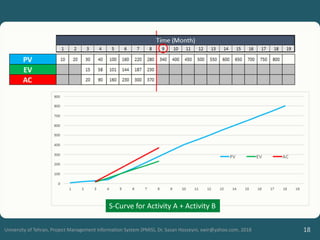
Cumulative
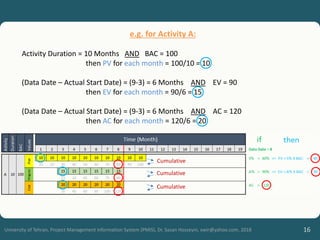
e.g. for Activity A:
Activity Duration = 10 Months AND BAC = 100
then PV for each month = 100/10 = 10
(Data Date – Actual Start Date) = (9-3) = 6 Months AND EV = 90
then EV for each month = 90/6 = 15
(Data Date – Actual Start Date) = (9-3) = 6 Months AND AC = 120
then AC for each month = 120/6 = 20
Cumulative
Cumulative
17
University of Tehran, Project Management Information System (PMIS), Dr. Sasan Hosseyni, xwir@yahoo.com, 2018
Cumulative
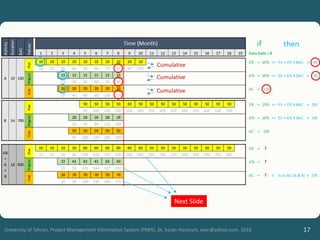
Next Slide
Cumulative
Cumulative
18
University of Tehran, Project Management Information System (PMIS), Dr. Sasan Hosseyni, xwir@yahoo.com, 2018
S-Curve for Activity A + Activity B
19
University of Tehran, Project Management Information System (PMIS), Dr. Sasan Hosseyni, xwir@yahoo.com, 2018
20
University of Tehran, Project Management Information System (PMIS), Dr. Sasan Hosseyni, xwir@yahoo.com, 2018
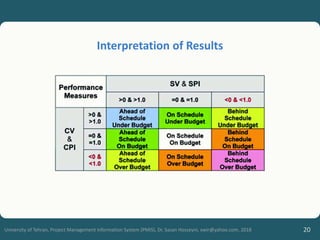
Interpretation of Results
21
University of Tehran, Project Management Information System (PMIS), Dr. Sasan Hosseyni, xwir@yahoo.com, 2018
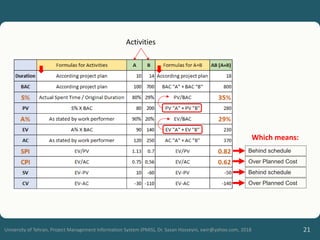
Behind schedule
Over Planned Cost
Which means:
Behind schedule
Over Planned Cost
Activities
22
University of Tehran, Project Management Information System (PMIS), Dr. Sasan Hosseyni, xwir@yahoo.com, 2018
23
University of Tehran, Project Management Information System (PMIS), Dr. Sasan Hosseyni, xwir@yahoo.com, 2018
Data Date
(Time Now)
AC
PV
EV
Time
Value
EAC
BAC


24
University of Tehran, Project Management Information System (PMIS), Dr. Sasan Hosseyni, xwir@yahoo.com, 2018
Data Date
(Time Now)
AC
PV
EV
Time
Value
EAC
BAC
ETC 
Duration
Slippage 
VAC 
25
University of Tehran, Project Management Information System (PMIS), Dr. Sasan Hosseyni, xwir@yahoo.com, 2018
Data Date
(Time Now)
AC
PV
EV
Time
Value
EAC
BAC
Time Behind 
Pro-Active Approach
Time Behind! 
(Needs a calculation for trend)
This one is my suggestion ;)
26
University of Tehran, Project Management Information System (PMIS), Dr. Sasan Hosseyni, xwir@yahoo.com, 2018
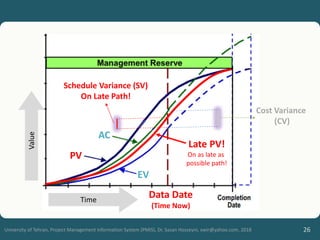
Data Date
(Time Now)
AC
PV
EV
Time
Value
Late PV!
On as late as
possible path!
Schedule Variance (SV)
On Late Path!
Cost Variance
(CV)
27
University of Tehran, Project Management Information System (PMIS), Dr. Sasan Hosseyni, xwir@yahoo.com, 2018
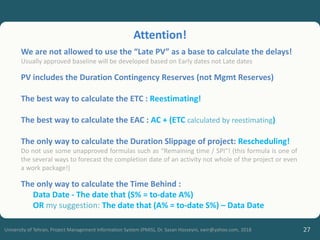
We are not allowed to use the “Late PV” as a base to calculate the delays!
Usually approved baseline will be developed based on Early dates not Late dates
PV includes the Duration Contingency Reserves (not Mgmt Reserves)
The best way to calculate the ETC : Reestimating!
The best way to calculate the EAC : AC + (ETC calculated by reestimating)
The only way to calculate the Duration Slippage of project: Rescheduling!
Do not use some unapproved formulas such as “Remaining time / SPI”! (this formula is one of
the several ways to forecast the completion date of an activity not whole of the project or even
a work package!)
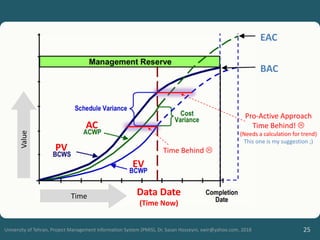
The only way to calculate the Time Behind :
Data Date - The date that (S% = to-date A%)
OR my suggestion: The date that (A% = to-date S%) – Data Date
Attention!
28
University of Tehran, Project Management Information System (PMIS), Dr. Sasan Hosseyni, xwir@yahoo.com, 2018
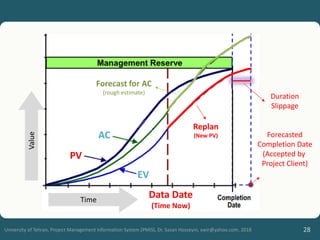
Data Date
(Time Now)
AC
PV
EV
Time
Value
Replan
(New PV)
Forecast for AC
(rough estimate)
Duration
Slippage
Forecasted
Completion Date
(Accepted by
Project Client)
29
University of Tehran, Project Management Information System (PMIS), Dr. Sasan Hosseyni, xwir@yahoo.com, 2018
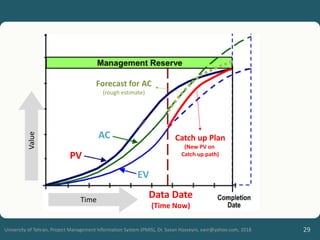
Data Date
(Time Now)
AC
PV
EV
Time
Value
Catch up Plan
(New PV on
Catch up path)
Forecast for AC
(rough estimate)
30
University of Tehran, Project Management Information System (PMIS), Dr. Sasan Hosseyni, xwir@yahoo.com, 2018
Reschedule: Scheduling the project on a new Data Date
• Usually every month  to report the project status
Replan: Planning the project again! (to create a new baseline)
• After rescheduling, if Schedule Variance > 25% and/or
project plan is not realistic/applicable anymore
• After replan, the new baseline (New PV) and “forecasted completion date”
should be approved by project client
Catch-up Plan: Replan without change in “Completion Date”
• After replan, the new baseline (New PV) should be approved by project
client
Reschedule Vs. Replan
31
University of Tehran, Project Management Information System (PMIS), Dr. Sasan Hosseyni, xwir@yahoo.com, 2018
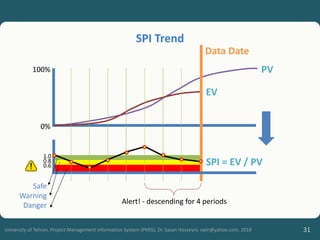
SPI Trend
Data Date
0%
100% PV
EV
Alert! - descending for 4 periods
0.6
0.8
1.0
SPI = EV / PV
Safe
Warning
Danger

PMIS Course Part 3 – Earned Value Management

  • 1.
    1 University of Tehran,Project Management Information System (PMIS), Dr. Sasan Hosseyni, xwir@yahoo.com, 2018 University of Tehran College of Engineering School of Industrial Engineering “Master of Science in Engineering” Program Project Management Information System PART 3 – Earned Value Management 2018 Fall Semester Dr. Sasan Hosseyni XWIR@yahoo.com
  • 2.
    2 University of Tehran,Project Management Information System (PMIS), Dr. Sasan Hosseyni, xwir@yahoo.com, 2018 Outlines: • PART 1 Definitions (IS, PMBOK, PMIS) • PART 2 PMIS in Practice • PART 3 Earned Value Management • PART 4 Business Process Management • PART 5 Enterprise Resource Planning • PART 6 Enterprise Architecture (for a Project Based Org.) • PART 7 Implementation Methodologies • PART 8 Organizational Change Management • PART 9 Implementation Critical Success Factors • PART 10 Academic Researches
  • 3.
    3 University of Tehran,Project Management Information System (PMIS), Dr. Sasan Hosseyni, xwir@yahoo.com, 2018 Earned Value Management (EVM) helps project managers to measure project performance. It is a systematic project management process used to find variances in projects based on the comparison of worked performed and work planned. EVM is used on the cost and schedule control and can be very useful in project forecasting. The project baseline is an essential component of EVM and serves as a reference point for all EVM related activities. EVM provides quantitative data for project decision making. (projectsmart.co.uk, Dwivedi) Earned Value Management Definition
  • 4.
    4 University of Tehran,Project Management Information System (PMIS), Dr. Sasan Hosseyni, xwir@yahoo.com, 2018 Some of the most well known organizations practicing EVM are: • NASA • Project Management Institute (PMI) • Society of Cost Estimating and Analysis • Defense Acquisition University • Federal Acquisition Institute • Acquisition Management (UK) Earned Value Management Definition
  • 5.
    5 University of Tehran,Project Management Information System (PMIS), Dr. Sasan Hosseyni, xwir@yahoo.com, 2018 Schedule % Complete (S%): Formula: (Data Date – Planned Start Date) / (Planned End Date - Planned Start Date) If Data date (Time Now)= 3, then S% = (3-1)/(6-1) = 2/5 = 40% Day 1 Day 2 Day 3 Day 4 Day 5 1 2 3 4 5 6 Percent Complete
  • 6.
    6 University of Tehran,Project Management Information System (PMIS), Dr. Sasan Hosseyni, xwir@yahoo.com, 2018 Activity % Complete (A%): (ACTUAL % Complete) Duration based: Formula: (Original Duration – Remaining Duration) / Original Duration If Data date = 3 If (You estimate that) the remaining duration to complete the work = 4 days then A% = (5-4)/5 = 1/5 = 20% For Calculation A% you don’t need to know: • Activity Actual start date Percent Complete
  • 7.
    7 University of Tehran,Project Management Information System (PMIS), Dr. Sasan Hosseyni, xwir@yahoo.com, 2018 Activity % Complete (A%): Unit based: Formula: Actual Units / (Actual Units + Remaining Units) If Data date = 3 If Actual units (e.g. an earthwork m3) = 100 If (you estimate that) the remaining units to complete the work (e.g. an earthwork m3) = 900 then A% = 100 /(100+900) = 10% For Calculation A% you don’t need to know: • Activity Actual start date • Remaining duration (needs to complete the remaining work) Percent Complete
  • 8.
    8 University of Tehran,Project Management Information System (PMIS), Dr. Sasan Hosseyni, xwir@yahoo.com, 2018 Activity % Complete (A%): Physical evidence based: Based on a mutual agreement between client and contractor: An example: For preparing a Drawing: A% = First Issue: 70%, Second Issue: 90%, Final Issue: 100% For Calculation A% you don’t need to know: • Activity Actual start date • Remaining duration (needs to complete the remaining work) • Remaining units (need to complete the remaining work) and/or Actual units Percent Complete
  • 9.
    9 University of Tehran,Project Management Information System (PMIS), Dr. Sasan Hosseyni, xwir@yahoo.com, 2018 Main Parameters WORK SCHEDULED PERFORMED COSTS BUDGETTED PV Budgeted Cost for Work Scheduled (BCWS) EV Budgeted Cost for Work Performed (BCWP) ACTUAL X AC Actual Cost of Work Performed (ACWP)
  • 10.
    10 University of Tehran,Project Management Information System (PMIS), Dr. Sasan Hosseyni, xwir@yahoo.com, 2018 Budget At Completion (BAC) How much money will need to be spent to complete the project Planned Value (PV) OR Budgeted Cost for Work Scheduled (BCWS) Formula: S% X BAC The amount expressed in dollar of work to be performed as per the schedule plan If BAC = 500, If Data date = 3 then S% = 40% then PV = 40% X 500 = 200 Main Parameters
  • 11.
    11 University of Tehran,Project Management Information System (PMIS), Dr. Sasan Hosseyni, xwir@yahoo.com, 2018 Earned Value (EV) OR Budgeted Cost for Work Performed (BCWP) Formula: A% X BAC The amount expressed in dollar on the actual worked performed If BAC = 500 If A% = 20% then EV = 20% X 500 = 100 Main Parameters
  • 12.
    12 University of Tehran,Project Management Information System (PMIS), Dr. Sasan Hosseyni, xwir@yahoo.com, 2018 Actual Cost (AC) OR Actual Cost of Work Performed (ACWP) No formula! The sum of all costs actually accrued for an activity to date AC = 300 Estimate to Complete (ETC) Is a forecast of how much more money will need to be spent to complete the project Estimate At Completion (EAC) EAC = AC + ETC (most common way) Main Parameters
  • 13.
    13 University of Tehran,Project Management Information System (PMIS), Dr. Sasan Hosseyni, xwir@yahoo.com, 2018 An s-curve is a mathematical graph or illustration that properly illustrates the appropriate cumulative data for a project or task. This data can cost, or man-hours plotted against time. EXAMPLE: If Data Date = 9 Project S-Curve Activity  A B If BAC 100 700 If Duration 10 14 If Planned Start Date 1 5 If Actual Start Date 3 4 If Activity Percent Complete 90 20 If Actual Cost 120 250
  • 14.
    14 University of Tehran,Project Management Information System (PMIS), Dr. Sasan Hosseyni, xwir@yahoo.com, 2018 e.g. for Activity A: S% = (Data Date – Planned Start Date) / (Planned End Date - Planned Start Date) = (9-1)/(11-1) = 8/10 = 80% Also assume that the A% , AC and Activity “Actual Start Date” are stated by the activity’s work performer Activity “A” Actual Start Date = 3 Data Date = 9
  • 15.
    15 University of Tehran,Project Management Information System (PMIS), Dr. Sasan Hosseyni, xwir@yahoo.com, 2018 For Activity A+ Activity B ?
  • 16.
    16 University of Tehran,Project Management Information System (PMIS), Dr. Sasan Hosseyni, xwir@yahoo.com, 2018 Cumulative e.g. for Activity A: Activity Duration = 10 Months AND BAC = 100 then PV for each month = 100/10 = 10 (Data Date – Actual Start Date) = (9-3) = 6 Months AND EV = 90 then EV for each month = 90/6 = 15 (Data Date – Actual Start Date) = (9-3) = 6 Months AND AC = 120 then AC for each month = 120/6 = 20 Cumulative Cumulative
  • 17.
    17 University of Tehran,Project Management Information System (PMIS), Dr. Sasan Hosseyni, xwir@yahoo.com, 2018 Cumulative Next Slide Cumulative Cumulative
  • 18.
    18 University of Tehran,Project Management Information System (PMIS), Dr. Sasan Hosseyni, xwir@yahoo.com, 2018 S-Curve for Activity A + Activity B
  • 19.
    19 University of Tehran,Project Management Information System (PMIS), Dr. Sasan Hosseyni, xwir@yahoo.com, 2018
  • 20.
    20 University of Tehran,Project Management Information System (PMIS), Dr. Sasan Hosseyni, xwir@yahoo.com, 2018 Interpretation of Results
  • 21.
    21 University of Tehran,Project Management Information System (PMIS), Dr. Sasan Hosseyni, xwir@yahoo.com, 2018 Behind schedule Over Planned Cost Which means: Behind schedule Over Planned Cost Activities
  • 22.
    22 University of Tehran,Project Management Information System (PMIS), Dr. Sasan Hosseyni, xwir@yahoo.com, 2018
  • 23.
    23 University of Tehran,Project Management Information System (PMIS), Dr. Sasan Hosseyni, xwir@yahoo.com, 2018 Data Date (Time Now) AC PV EV Time Value EAC BAC  
  • 24.
    24 University of Tehran,Project Management Information System (PMIS), Dr. Sasan Hosseyni, xwir@yahoo.com, 2018 Data Date (Time Now) AC PV EV Time Value EAC BAC ETC  Duration Slippage  VAC 
  • 25.
    25 University of Tehran,Project Management Information System (PMIS), Dr. Sasan Hosseyni, xwir@yahoo.com, 2018 Data Date (Time Now) AC PV EV Time Value EAC BAC Time Behind  Pro-Active Approach Time Behind!  (Needs a calculation for trend) This one is my suggestion ;)
  • 26.
    26 University of Tehran,Project Management Information System (PMIS), Dr. Sasan Hosseyni, xwir@yahoo.com, 2018 Data Date (Time Now) AC PV EV Time Value Late PV! On as late as possible path! Schedule Variance (SV) On Late Path! Cost Variance (CV)
  • 27.
    27 University of Tehran,Project Management Information System (PMIS), Dr. Sasan Hosseyni, xwir@yahoo.com, 2018 We are not allowed to use the “Late PV” as a base to calculate the delays! Usually approved baseline will be developed based on Early dates not Late dates PV includes the Duration Contingency Reserves (not Mgmt Reserves) The best way to calculate the ETC : Reestimating! The best way to calculate the EAC : AC + (ETC calculated by reestimating) The only way to calculate the Duration Slippage of project: Rescheduling! Do not use some unapproved formulas such as “Remaining time / SPI”! (this formula is one of the several ways to forecast the completion date of an activity not whole of the project or even a work package!) The only way to calculate the Time Behind : Data Date - The date that (S% = to-date A%) OR my suggestion: The date that (A% = to-date S%) – Data Date Attention!
  • 28.
    28 University of Tehran,Project Management Information System (PMIS), Dr. Sasan Hosseyni, xwir@yahoo.com, 2018 Data Date (Time Now) AC PV EV Time Value Replan (New PV) Forecast for AC (rough estimate) Duration Slippage Forecasted Completion Date (Accepted by Project Client)
  • 29.
    29 University of Tehran,Project Management Information System (PMIS), Dr. Sasan Hosseyni, xwir@yahoo.com, 2018 Data Date (Time Now) AC PV EV Time Value Catch up Plan (New PV on Catch up path) Forecast for AC (rough estimate)
  • 30.
    30 University of Tehran,Project Management Information System (PMIS), Dr. Sasan Hosseyni, xwir@yahoo.com, 2018 Reschedule: Scheduling the project on a new Data Date • Usually every month  to report the project status Replan: Planning the project again! (to create a new baseline) • After rescheduling, if Schedule Variance > 25% and/or project plan is not realistic/applicable anymore • After replan, the new baseline (New PV) and “forecasted completion date” should be approved by project client Catch-up Plan: Replan without change in “Completion Date” • After replan, the new baseline (New PV) should be approved by project client Reschedule Vs. Replan
  • 31.
    31 University of Tehran,Project Management Information System (PMIS), Dr. Sasan Hosseyni, xwir@yahoo.com, 2018 SPI Trend Data Date 0% 100% PV EV Alert! - descending for 4 periods 0.6 0.8 1.0 SPI = EV / PV Safe Warning Danger