The Stakeholder Perspective for
the Value Generation
Effective Knowledge Based Stakeholder Management
to increase the Success Rate in Complex Projects
Roma, October 27th, 2017
Speaker:
Massimo Pirozzi,
M. Sc., Eur-Ing
The Project Stakeholders
The Stakeholder Perspective for the Value Generation - Massimo Pirozzi
2
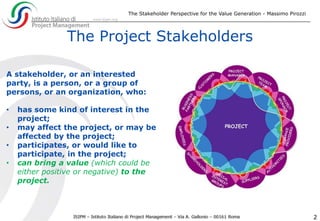
A stakeholder, or an interested
party, is a person, or a group of
persons, or an organization, who:
• has some kind of interest in the
project;
• may affect the project, or may be
affected by the project;
• participates, or would like to
participate, in the project;
• can bring a value (which could be
either positive or negative) to the
project.
The Value of the Stakeholder Relations
The Stakeholder Perspective for the Value Generation - Massimo Pirozzi
3
In each project, the stakeholder
relations:
 are a value, which is fundamental to
the existence of the project and to its
definition;
 generate a value, which is
incorporated in the project;
 allow the exchange of value,
through the delivery of project results.
Stakeholder Relations are the Core of Project Value
Generated Value: from Strategies to Benefits
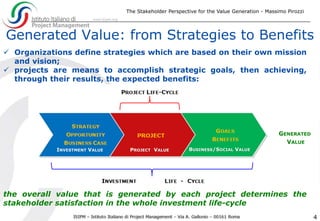
 Organizations define strategies which are based on their own mission
and vision;
 projects are means to accomplish strategic goals, then achieving,
through their results, the expected benefits:
the overall value that is generated by each project determines the
stakeholder satisfaction in the whole investment life-cycle
The Stakeholder Perspective for the Value Generation - Massimo Pirozzi
4
GENERATED
VALUE
INVESTMENT VALUE PROJECT VALUE BUSINESS/SOCIAL VALUE
The Stakeholder Perspective
The Stakeholder Perspective for the Value Generation - Massimo Pirozzi
5
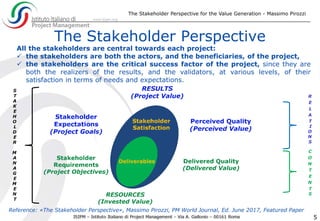
All the stakeholders are central towards each project:
 the stakeholders are both the actors, and the beneficiaries, of the project,
 the stakeholders are the critical success factor of the project, since they are
both the realizers of the results, and the validators, at various levels, of their
satisfaction in terms of needs and expectations.
C
O
N
T
E
N
T
S
R
E
L
A
T
I
O
N
S
Reference: «The Stakeholder Perspective», Massimo Pirozzi, PM World Journal, Ed. June 2017, Featured Paper
S
T
A
K
E
H
O
L
D
E
R
M
A
N
A
G
E
M
E
N
T
Effective Stakeholder Management is needed…
The Stakeholder Perspective for the Value Generation - Massimo Pirozzi
6
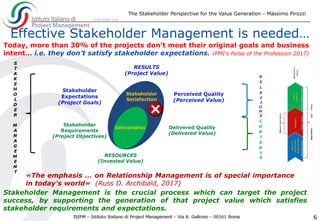
Stakeholder Management is the crucial process which can target the project
success, by supporting the generation of that project value which satisfies
stakeholder requirements and expectations.
S
T
A
K
E
H
O
L
D
E
R
M
A
N
A
G
E
M
E
N
T
Today, more than 30% of the projects don’t meet their original goals and business
intent… i.e. they don’t satisfy stakeholder expectations. (PMI’s Pulse of the Profession 2017)
R
E
L
A
T
I
O
N
S
C
O
N
T
E
N
T
S
«The emphasis … on Relationship Management is of special importance
in today's world» (Russ D. Archibald, 2017)
Success in Classical Projects
The Stakeholder Perspective for the Value Generation - Massimo Pirozzi
7
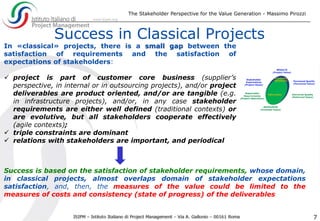
In «classical» projects, there is a small gap between the
satisfaction of requirements and the satisfaction of
expectations of stakeholders:
 project is part of customer core business (supplier’s
perspective, in internal or in outsourcing projects), and/or project
deliverables are product oriented, and/or are tangible (e.g.
in infrastructure projects), and/or, in any case stakeholder
requirements are either well defined (traditional contexts) or
are evolutive, but all stakeholders cooperate effectively
(agile contexts);
 triple constraints are dominant
 relations with stakeholders are important, and periodical
Success is based on the satisfaction of stakeholder requirements, whose domain,
in classical projects, almost overlaps domain of stakeholder expectations
satisfaction, and, then, the measures of the value could be limited to the
measures of costs and consistency (state of progress) of the deliverables
Success in Complex Projects
The Stakeholder Perspective for the Value Generation - Massimo Pirozzi
8
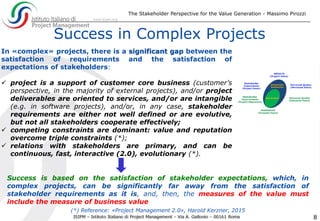
In «complex» projects, there is a significant gap between the
satisfaction of requirements and the satisfaction of
expectations of stakeholders:
 project is a support of customer core business (customer’s
perspective, in the majority of external projects), and/or project
deliverables are oriented to services, and/or are intangible
(e.g. in software projects), and/or, in any case, stakeholder
requirements are either not well defined or are evolutive,
but not all stakeholders cooperate effectively;
 competing constraints are dominant: value and reputation
overcome triple constraints (*);
 relations with stakeholders are primary, and can be
continuous, fast, interactive (2.0), evolutionary (*).
Success is based on the satisfaction of stakeholder expectations, which, in
complex projects, can be significantly far away from the satisfaction of
stakeholder requirements as it is, and, then, the measures of the value must
include the measure of business value
(*) Reference: «Project Management 2.0», Harold Kerzner, 2015
Success is achieving Business Value …
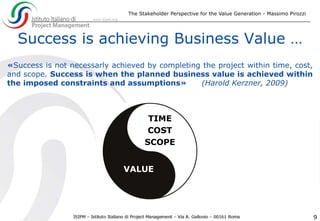
«Success is not necessarly achieved by completing the project within time, cost,
and scope. Success is when the planned business value is achieved within
the imposed constraints and assumptions» (Harold Kerzner, 2009)
The Stakeholder Perspective for the Value Generation - Massimo Pirozzi
9
TIME
COST
SCOPE
VALUE
… Value Management Requires Measures
The Stakeholder Perspective for the Value Generation - Massimo Pirozzi
10
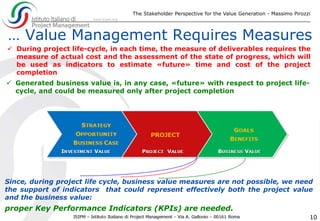
Since, during project life cycle, business value measures are not possible, we need
the support of indicators that could represent effectively both the project value
and the business value:
proper Key Performance Indicators (KPIs) are needed.
 During project life-cycle, in each time, the measure of deliverables requires the
measure of actual cost and the assessment of the state of progress, which will
be used as indicators to estimate «future» time and cost of the project
completion
 Generated business value is, in any case, «future» with respect to project life-
cycle, and could be measured only after project completion
The Stakeholder Perspective for the Value Generation - Massimo Pirozzi
11
Key Performance Indicators
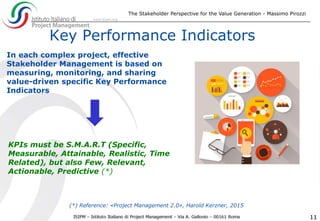
In each complex project, effective
Stakeholder Management is based on
measuring, monitoring, and sharing
value-driven specific Key Performance
Indicators
KPIs must be S.M.A.R.T (Specific,
Measurable, Attainable, Realistic, Time
Related), but also Few, Relevant,
Actionable, Predictive (*)
(*) Reference: «Project Management 2.0», Harold Kerzner, 2015
The Stakeholder Perspective for the Value Generation - Massimo Pirozzi
12
The Power of Dashboards
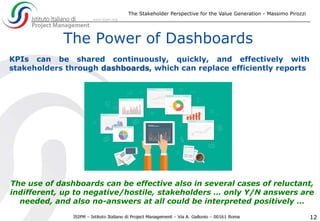
KPIs can be shared continuously, quickly, and effectively with
stakeholders through dashboards, which can replace efficiently reports
The use of dashboards can be effective also in several cases of reluctant,
indifferent, up to negative/hostile, stakeholders … only Y/N answers are
needed, and also no-answers at all could be interpreted positively …
Stakeholders Target Different Values
The Stakeholder Perspective for the Value Generation - Massimo Pirozzi
13
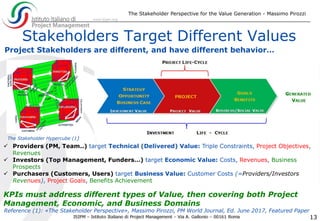
Project Stakeholders are different, and have different behavior…
 Providers (PM, Team..) target Technical (Delivered) Value: Triple Constraints, Project Objectives,
Revenues
 Investors (Top Management, Funders…) target Economic Value: Costs, Revenues, Business
Prospects
 Purchasers (Customers, Users) target Business Value: Customer Costs (=Providers/Investors
Revenues), Project Goals, Benefits Achievement
KPIs must address different types of Value, then covering both Project
Management, Economic, and Business Domains
Reference (1): «The Stakeholder Perspective», Massimo Pirozzi, PM World Journal, Ed. June 2017, Featured Paper
The Stakeholder Hypercube (1)
The Stakeholder Perspective for the Value Generation - Massimo Pirozzi
14
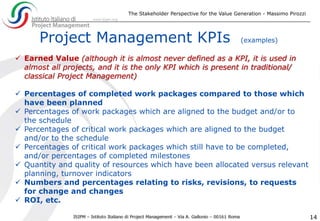
Project Management KPIs (examples)
 Earned Value (although it is almost never defined as a KPI, it is used in
almost all projects, and it is the only KPI which is present in traditional/
classical Project Management)
 Percentages of completed work packages compared to those which
have been planned
 Percentages of work packages which are aligned to the budget and/or to
the schedule
 Percentages of critical work packages which are aligned to the budget
and/or to the schedule
 Percentages of critical work packages which still have to be completed,
and/or percentages of completed milestones
 Quantity and quality of resources which have been allocated versus relevant
planning, turnover indicators
 Numbers and percentages relating to risks, revisions, to requests
for change and changes
 ROI, etc.
The Stakeholder Perspective for the Value Generation - Massimo Pirozzi
15
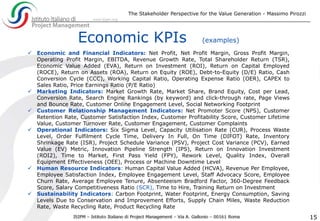
Economic KPIs (examples)
 Economic and Financial Indicators: Net Profit, Net Profit Margin, Gross Profit Margin,
Operating Profit Margin, EBITDA, Revenue Growth Rate, Total Shareholder Return (TSR),
Economic Value Added (EVA), Return on Investment (ROI), Return on Capital Employed
(ROCE), Return on Assets (ROA), Return on Equity (ROE), Debt-to-Equity (D/E) Ratio, Cash
Conversion Cycle (CCC), Working Capital Ratio, Operating Expense Ratio (OER), CAPEX to
Sales Ratio, Price Earnings Ratio (P/E Ratio)
 Marketing Indicators: Market Growth Rate, Market Share, Brand Equity, Cost per Lead,
Conversion Rate, Search Engine Rankings (by keyword) and click-through rate, Page Views
and Bounce Rate, Customer Online Engagement Level, Social Networking Footprint
 Customer Relationship Management Indicators: Net Promoter Score (NPS), Customer
Retention Rate, Customer Satisfaction Index, Customer Profitability Score, Customer Lifetime
Value, Customer Turnover Rate, Customer Engagement, Customer Complaints
 Operational Indicators: Six Sigma Level, Capacity Utilisation Rate (CUR), Process Waste
Level, Order Fulfilment Cycle Time, Delivery In Full, On Time (DIFOT) Rate, Inventory
Shrinkage Rate (ISR), Project Schedule Variance (PSV), Project Cost Variance (PCV), Earned
Value (EV) Metric, Innovation Pipeline Strength (IPS), Return on Innovation Investment
(ROI2), Time to Market, First Pass Yield (FPY), Rework Level, Quality Index, Overall
Equipment Effectiveness (OEE), Process or Machine Downtime Level
 Human Resource Indicators: Human Capital Value Added (HCVA), Revenue Per Employee,
Employee Satisfaction Index, Employee Engagement Level, Staff Advocacy Score, Employee
Churn Rate, Average Employee Tenure, Absenteeism Bradford Factor, 360-Degree Feedback
Score, Salary Competitiveness Ratio (SCR), Time to Hire, Training Return on Investment
 Sustainability Indicators: Carbon Footprint, Water Footprint, Energy Consumption, Saving
Levels Due to Conservation and Improvement Efforts, Supply Chain Miles, Waste Reduction
Rate, Waste Recycling Rate, Product Recycling Rate
The Stakeholder Perspective for the Value Generation - Massimo Pirozzi
16
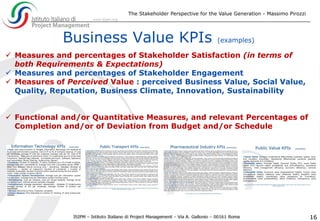
Business Value KPIs (examples)
 Measures and percentages of Stakeholder Satisfaction (in terms of
both Requirements & Expectations)
 Measures and percentages of Stakeholder Engagement
 Measures of Perceived Value : perceived Business Value, Social Value,
Quality, Reputation, Business Climate, Innovation, Sustainability
 Functional and/or Quantitative Measures, and relevant Percentages of
Completion and/or of Deviation from Budget and/or Schedule
The Stakeholder Perspective for the Value Generation - Massimo Pirozzi
17
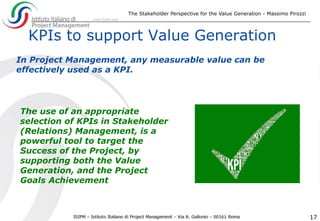
KPIs to support Value Generation
The use of an appropriate
selection of KPIs in Stakeholder
(Relations) Management, is a
powerful tool to target the
Success of the Project, by
supporting both the Value
Generation, and the Project
Goals Achievement
In Project Management, any measurable value can be
effectively used as a KPI.
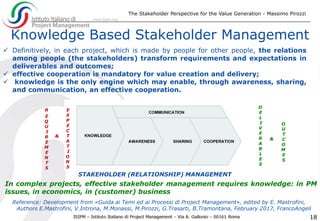
Knowledge Based Stakeholder Management
 Definitively, in each project, which is made by people for other people, the relations
among people (the stakeholders) transform requirements and expectations in
deliverables and outcomes;
 effective cooperation is mandatory for value creation and delivery;
 knowledge is the only engine which may enable, through awareness, sharing,
and communication, an effective cooperation.
The Stakeholder Perspective for the Value Generation - Massimo Pirozzi
18
O
U
T
C
O
M
E
S
R
E
Q
U
I
R
E
M
E
N
T
S
D
E
L
I
V
E
R
A
B
L
E
S
E
X
P
E
C
T
A
T
I
O
N
S
&
&
STAKEHOLDER (RELATIONSHIP) MANAGEMENT
Reference: Development from «Guida ai Temi ed ai Processi di Project Management», edited by E. Mastrofini,
Authors E.Mastrofini, V.Introna, M.Monassi, M.Pirozzi, G.Trasarti, B.Tramontana, February 2017, FrancoAngeli
In complex projects, effective stakeholder management requires knowledge: in PM
issues, in economics, in (customer) business
The Stakeholder Perspective for the Value Generation - Massimo Pirozzi
19
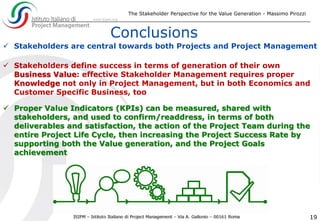
 Stakeholders are central towards both Projects and Project Management
 Stakeholders define success in terms of generation of their own
Business Value: effective Stakeholder Management requires proper
Knowledge not only in Project Management, but in both Economics and
Customer Specific Business, too
Conclusions
 Proper Value Indicators (KPIs) can be measured, shared with
stakeholders, and used to confirm/readdress, in terms of both
deliverables and satisfaction, the action of the Project Team during the
entire Project Life Cycle, then increasing the Project Success Rate by
supporting both the Value generation, and the Project Goals
achievement
The Stakeholder Perspective for the Value Generation - Massimo Pirozzi
20
THANK YOU SO MUCH
pirozzi@isipm.org

PMexpo17 - The Stakeholder Perspective - Massimo Pirozzi

  • 1.
    The Stakeholder Perspectivefor the Value Generation Effective Knowledge Based Stakeholder Management to increase the Success Rate in Complex Projects Roma, October 27th, 2017 Speaker: Massimo Pirozzi, M. Sc., Eur-Ing
  • 2.
    The Project Stakeholders TheStakeholder Perspective for the Value Generation - Massimo Pirozzi 2 A stakeholder, or an interested party, is a person, or a group of persons, or an organization, who: • has some kind of interest in the project; • may affect the project, or may be affected by the project; • participates, or would like to participate, in the project; • can bring a value (which could be either positive or negative) to the project.
  • 3.
    The Value ofthe Stakeholder Relations The Stakeholder Perspective for the Value Generation - Massimo Pirozzi 3 In each project, the stakeholder relations:  are a value, which is fundamental to the existence of the project and to its definition;  generate a value, which is incorporated in the project;  allow the exchange of value, through the delivery of project results. Stakeholder Relations are the Core of Project Value
  • 4.
    Generated Value: fromStrategies to Benefits  Organizations define strategies which are based on their own mission and vision;  projects are means to accomplish strategic goals, then achieving, through their results, the expected benefits: the overall value that is generated by each project determines the stakeholder satisfaction in the whole investment life-cycle The Stakeholder Perspective for the Value Generation - Massimo Pirozzi 4 GENERATED VALUE INVESTMENT VALUE PROJECT VALUE BUSINESS/SOCIAL VALUE
  • 5.
    The Stakeholder Perspective TheStakeholder Perspective for the Value Generation - Massimo Pirozzi 5 All the stakeholders are central towards each project:  the stakeholders are both the actors, and the beneficiaries, of the project,  the stakeholders are the critical success factor of the project, since they are both the realizers of the results, and the validators, at various levels, of their satisfaction in terms of needs and expectations. C O N T E N T S R E L A T I O N S Reference: «The Stakeholder Perspective», Massimo Pirozzi, PM World Journal, Ed. June 2017, Featured Paper S T A K E H O L D E R M A N A G E M E N T
  • 6.
    Effective Stakeholder Managementis needed… The Stakeholder Perspective for the Value Generation - Massimo Pirozzi 6 Stakeholder Management is the crucial process which can target the project success, by supporting the generation of that project value which satisfies stakeholder requirements and expectations. S T A K E H O L D E R M A N A G E M E N T Today, more than 30% of the projects don’t meet their original goals and business intent… i.e. they don’t satisfy stakeholder expectations. (PMI’s Pulse of the Profession 2017) R E L A T I O N S C O N T E N T S «The emphasis … on Relationship Management is of special importance in today's world» (Russ D. Archibald, 2017)
  • 7.
    Success in ClassicalProjects The Stakeholder Perspective for the Value Generation - Massimo Pirozzi 7 In «classical» projects, there is a small gap between the satisfaction of requirements and the satisfaction of expectations of stakeholders:  project is part of customer core business (supplier’s perspective, in internal or in outsourcing projects), and/or project deliverables are product oriented, and/or are tangible (e.g. in infrastructure projects), and/or, in any case stakeholder requirements are either well defined (traditional contexts) or are evolutive, but all stakeholders cooperate effectively (agile contexts);  triple constraints are dominant  relations with stakeholders are important, and periodical Success is based on the satisfaction of stakeholder requirements, whose domain, in classical projects, almost overlaps domain of stakeholder expectations satisfaction, and, then, the measures of the value could be limited to the measures of costs and consistency (state of progress) of the deliverables
  • 8.
    Success in ComplexProjects The Stakeholder Perspective for the Value Generation - Massimo Pirozzi 8 In «complex» projects, there is a significant gap between the satisfaction of requirements and the satisfaction of expectations of stakeholders:  project is a support of customer core business (customer’s perspective, in the majority of external projects), and/or project deliverables are oriented to services, and/or are intangible (e.g. in software projects), and/or, in any case, stakeholder requirements are either not well defined or are evolutive, but not all stakeholders cooperate effectively;  competing constraints are dominant: value and reputation overcome triple constraints (*);  relations with stakeholders are primary, and can be continuous, fast, interactive (2.0), evolutionary (*). Success is based on the satisfaction of stakeholder expectations, which, in complex projects, can be significantly far away from the satisfaction of stakeholder requirements as it is, and, then, the measures of the value must include the measure of business value (*) Reference: «Project Management 2.0», Harold Kerzner, 2015
  • 9.
    Success is achievingBusiness Value … «Success is not necessarly achieved by completing the project within time, cost, and scope. Success is when the planned business value is achieved within the imposed constraints and assumptions» (Harold Kerzner, 2009) The Stakeholder Perspective for the Value Generation - Massimo Pirozzi 9 TIME COST SCOPE VALUE
  • 10.
    … Value ManagementRequires Measures The Stakeholder Perspective for the Value Generation - Massimo Pirozzi 10 Since, during project life cycle, business value measures are not possible, we need the support of indicators that could represent effectively both the project value and the business value: proper Key Performance Indicators (KPIs) are needed.  During project life-cycle, in each time, the measure of deliverables requires the measure of actual cost and the assessment of the state of progress, which will be used as indicators to estimate «future» time and cost of the project completion  Generated business value is, in any case, «future» with respect to project life- cycle, and could be measured only after project completion
  • 11.
    The Stakeholder Perspectivefor the Value Generation - Massimo Pirozzi 11 Key Performance Indicators In each complex project, effective Stakeholder Management is based on measuring, monitoring, and sharing value-driven specific Key Performance Indicators KPIs must be S.M.A.R.T (Specific, Measurable, Attainable, Realistic, Time Related), but also Few, Relevant, Actionable, Predictive (*) (*) Reference: «Project Management 2.0», Harold Kerzner, 2015
  • 12.
    The Stakeholder Perspectivefor the Value Generation - Massimo Pirozzi 12 The Power of Dashboards KPIs can be shared continuously, quickly, and effectively with stakeholders through dashboards, which can replace efficiently reports The use of dashboards can be effective also in several cases of reluctant, indifferent, up to negative/hostile, stakeholders … only Y/N answers are needed, and also no-answers at all could be interpreted positively …
  • 13.
    Stakeholders Target DifferentValues The Stakeholder Perspective for the Value Generation - Massimo Pirozzi 13 Project Stakeholders are different, and have different behavior…  Providers (PM, Team..) target Technical (Delivered) Value: Triple Constraints, Project Objectives, Revenues  Investors (Top Management, Funders…) target Economic Value: Costs, Revenues, Business Prospects  Purchasers (Customers, Users) target Business Value: Customer Costs (=Providers/Investors Revenues), Project Goals, Benefits Achievement KPIs must address different types of Value, then covering both Project Management, Economic, and Business Domains Reference (1): «The Stakeholder Perspective», Massimo Pirozzi, PM World Journal, Ed. June 2017, Featured Paper The Stakeholder Hypercube (1)
  • 14.
    The Stakeholder Perspectivefor the Value Generation - Massimo Pirozzi 14 Project Management KPIs (examples)  Earned Value (although it is almost never defined as a KPI, it is used in almost all projects, and it is the only KPI which is present in traditional/ classical Project Management)  Percentages of completed work packages compared to those which have been planned  Percentages of work packages which are aligned to the budget and/or to the schedule  Percentages of critical work packages which are aligned to the budget and/or to the schedule  Percentages of critical work packages which still have to be completed, and/or percentages of completed milestones  Quantity and quality of resources which have been allocated versus relevant planning, turnover indicators  Numbers and percentages relating to risks, revisions, to requests for change and changes  ROI, etc.
  • 15.
    The Stakeholder Perspectivefor the Value Generation - Massimo Pirozzi 15 Economic KPIs (examples)  Economic and Financial Indicators: Net Profit, Net Profit Margin, Gross Profit Margin, Operating Profit Margin, EBITDA, Revenue Growth Rate, Total Shareholder Return (TSR), Economic Value Added (EVA), Return on Investment (ROI), Return on Capital Employed (ROCE), Return on Assets (ROA), Return on Equity (ROE), Debt-to-Equity (D/E) Ratio, Cash Conversion Cycle (CCC), Working Capital Ratio, Operating Expense Ratio (OER), CAPEX to Sales Ratio, Price Earnings Ratio (P/E Ratio)  Marketing Indicators: Market Growth Rate, Market Share, Brand Equity, Cost per Lead, Conversion Rate, Search Engine Rankings (by keyword) and click-through rate, Page Views and Bounce Rate, Customer Online Engagement Level, Social Networking Footprint  Customer Relationship Management Indicators: Net Promoter Score (NPS), Customer Retention Rate, Customer Satisfaction Index, Customer Profitability Score, Customer Lifetime Value, Customer Turnover Rate, Customer Engagement, Customer Complaints  Operational Indicators: Six Sigma Level, Capacity Utilisation Rate (CUR), Process Waste Level, Order Fulfilment Cycle Time, Delivery In Full, On Time (DIFOT) Rate, Inventory Shrinkage Rate (ISR), Project Schedule Variance (PSV), Project Cost Variance (PCV), Earned Value (EV) Metric, Innovation Pipeline Strength (IPS), Return on Innovation Investment (ROI2), Time to Market, First Pass Yield (FPY), Rework Level, Quality Index, Overall Equipment Effectiveness (OEE), Process or Machine Downtime Level  Human Resource Indicators: Human Capital Value Added (HCVA), Revenue Per Employee, Employee Satisfaction Index, Employee Engagement Level, Staff Advocacy Score, Employee Churn Rate, Average Employee Tenure, Absenteeism Bradford Factor, 360-Degree Feedback Score, Salary Competitiveness Ratio (SCR), Time to Hire, Training Return on Investment  Sustainability Indicators: Carbon Footprint, Water Footprint, Energy Consumption, Saving Levels Due to Conservation and Improvement Efforts, Supply Chain Miles, Waste Reduction Rate, Waste Recycling Rate, Product Recycling Rate
  • 16.
    The Stakeholder Perspectivefor the Value Generation - Massimo Pirozzi 16 Business Value KPIs (examples)  Measures and percentages of Stakeholder Satisfaction (in terms of both Requirements & Expectations)  Measures and percentages of Stakeholder Engagement  Measures of Perceived Value : perceived Business Value, Social Value, Quality, Reputation, Business Climate, Innovation, Sustainability  Functional and/or Quantitative Measures, and relevant Percentages of Completion and/or of Deviation from Budget and/or Schedule
  • 17.
    The Stakeholder Perspectivefor the Value Generation - Massimo Pirozzi 17 KPIs to support Value Generation The use of an appropriate selection of KPIs in Stakeholder (Relations) Management, is a powerful tool to target the Success of the Project, by supporting both the Value Generation, and the Project Goals Achievement In Project Management, any measurable value can be effectively used as a KPI.
  • 18.
    Knowledge Based StakeholderManagement  Definitively, in each project, which is made by people for other people, the relations among people (the stakeholders) transform requirements and expectations in deliverables and outcomes;  effective cooperation is mandatory for value creation and delivery;  knowledge is the only engine which may enable, through awareness, sharing, and communication, an effective cooperation. The Stakeholder Perspective for the Value Generation - Massimo Pirozzi 18 O U T C O M E S R E Q U I R E M E N T S D E L I V E R A B L E S E X P E C T A T I O N S & & STAKEHOLDER (RELATIONSHIP) MANAGEMENT Reference: Development from «Guida ai Temi ed ai Processi di Project Management», edited by E. Mastrofini, Authors E.Mastrofini, V.Introna, M.Monassi, M.Pirozzi, G.Trasarti, B.Tramontana, February 2017, FrancoAngeli In complex projects, effective stakeholder management requires knowledge: in PM issues, in economics, in (customer) business
  • 19.
    The Stakeholder Perspectivefor the Value Generation - Massimo Pirozzi 19  Stakeholders are central towards both Projects and Project Management  Stakeholders define success in terms of generation of their own Business Value: effective Stakeholder Management requires proper Knowledge not only in Project Management, but in both Economics and Customer Specific Business, too Conclusions  Proper Value Indicators (KPIs) can be measured, shared with stakeholders, and used to confirm/readdress, in terms of both deliverables and satisfaction, the action of the Project Team during the entire Project Life Cycle, then increasing the Project Success Rate by supporting both the Value generation, and the Project Goals achievement
  • 20.
    The Stakeholder Perspectivefor the Value Generation - Massimo Pirozzi 20 THANK YOU SO MUCH pirozzi@isipm.org