Moons and History of Earth bound DiscoveringByEli, Conor, Matt and Jaden
What is the Definition of a Moon–noun1.the earth's natural satellite, orbiting the earth at a meandistance of 238,857 miles (384,393 km) and having adiameter of 2160 miles (3476 km).2.this body during a particular lunar month, or during a certainperiod of time, or at a certain point of time, regarded as adistinct object or entity. 
Earths MoonThe Earths Moon is one of the larger natural satellites with a diameter of 2,160 miles. It is the only moon close enough to us that details of its surface can be seen through a telescope from Earth. 
The Largest MoonThe largest moon is Ganymede with a diameter of 3,280 miles. It is longer than the planets Mercury and Pluto. Saturn's moon, Titan, is the second biggest in the Solar System with a diameter of 3,200 miles. One and one half as large as Earths Moon. 
The Smallest Moon The smallest moon is Deimos, at Mars, only 7miles in diameter.  There may also be tiny moons as small as only 1 mile around 
Mars’s MoonsPhobosis the larger and closer of the two moons of Mars, the other being Deimos. Both moons were discovered in 1877. With a mean radius of 11.1 km (6.9 mi), Phobos is 7.24 times as massive as Deimos. It is named after the Greek god Phobos (which means "fear").
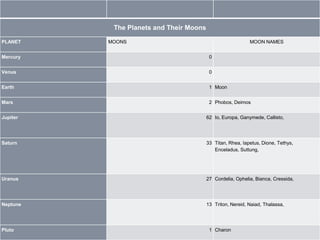
Jupiter's moonsEuropa is the sixth moon of the planet Jupiter, and the smallest of its four Galilean satellites.Ganymede is a satellite of Jupiter and the largest satellite in the Solar System.Calisto It is the third-largest moon in the Solar System and the second largest in the Jovian system, after Ganymede. Calisto has about 99% the diameter of the planet Mercury
SaturnTitan or Saturn VI, is the largest moon of Saturn, the only natural satellite known to have a dense atmosphere, and the only object other than Earth for which clear evidence of stable bodies of surface liquid has been found
Neptune moonTritonis the only large moon in the Solar System with retrograde orbit, which is an orbit in the opposite direction to its planet's rotation. At 2700 km in diameter, it is the seventh-largest moon in the Solar System. Because of its retrograde orbit and composition similar to Pluto's, Triton is thought to have been captured from the Kuiper belt.[ Triton consists of a crust of frozen nitrogen over an icy mantle believed to cover a substantial core of rock and metal.The core makes up two-thirds of its total mass. Triton has a mean density of 2.061 g/cm3 and is composed of approximately 15–35% water ice.
Pluto moonCharon is the largest satellite of the dwarf planet Pluto. It was discovered in 1978 at the United States Naval Observatory Flagstaff Station. Following the 2005 discovery of two other natural satellites of Pluto (Nix and Hydra),
UranusUranus, the seventh planet of the Solar System, has 27 known moons,[1] all of which are named after characters from the works of William Shakespeare and Alexander Pope.[2] William Herschel discovered the first two moons, Titania and Oberon, in 1787, and the other spherical moons were discovered in 1851 by William Lassell (Arie and Umbriel) and in 1948 by Gerard Kuiper(Miranda). The remaining moons were discovered after 1985, either during the Voyager 2 flyby mission or with the aid of advanced Earth-based telescopes.Uranian moons are divided into three groups: thirteen inner moons, five major moons, and nine irregular moons
History of Earth bound DiscoveringBy Eli, Matt, Conor
Tools for discovery and investigation	there are many different types of tools for discovery and investigation of space.  Some of them are telescopes, space probes, and satellites.  All of these devices have explored space.
TelescopesThe first telescopes were seen around 1608.Hans Lippershey and Zacharias Janssen invented the spyglass which was  later used for space.These early refracting telescopes consisted of convex lenses and a concave eyepiece. Galileo perfected the spy glass into the first astronomical telescope in 1611.These are many different telescope types, here are some of them:Reflecting, Refracting, X-Ray, Infrared, UV,  Gamma, Radio.
Keck Telescopes The keck telescopes are located in Hawaii The keck telescopes are the largest optical and infrared telescopes in the world. Each of the keck telescopes is 8 stories tall and weighs 300 tons. The telescopes primary mirrors are 10 meters in diameter. Hawaii is the best place to have infrared telescopes because of the thousands of miles of thermally steady water. The keck telescopes are located by the mountain Mauna Kea.
Space probesA space probe is a scientific space  exploration mission in which a robotic spacecraft leaves the well of Earth and approaches the Moon or enters interplanetary or interstellar space. This is a list of some of the space probes: Rosetta launched march 2, 2004Messenger launched august 4, 2004New horizons launched January 19, 2006Dawn launched September 27, 2007
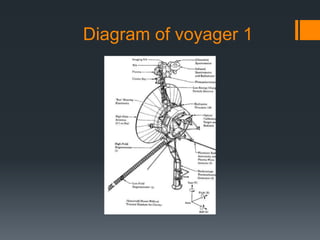
Voyager 1 is currently the furthest man-made object from Earth. As of January 2010 it lies about 112 AU from the sun[2] (10 billion miles, or 0.0018 light years), and it will not be overtaken by any other craft.  Voyager 1 weighs 733-kilogram. It was originally tasked with investigating Jupiter and Saturn, and the moons of these planets. Its continuing data feed offers the first direct measurements of the heliosheath and may eventually provide data on the heliopause. It is hoped that Voyager 1 will continue operating until at least 2020.Voyager 1
Diagram of voyager 1
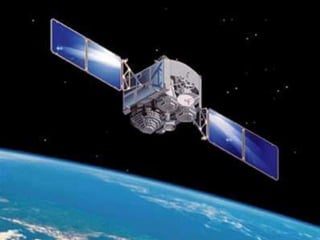
SatellitesIn the context of spaceflight, a satellite is an object which has been placed into orbit by human endeavor. Such objects are sometimes called artificial satellites to distinguish them from natural satellites such as the Moon.
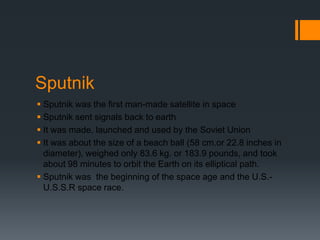
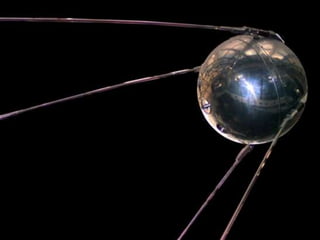
SputnikSputnik was the first man-made satellite in spaceSputnik sent signals back to earthIt was made, launched and used by the Soviet UnionIt was about the size of a beach ball (58 cm.or 22.8 inches in diameter), weighed only 83.6 kg. or 183.9 pounds, and took about 98 minutes to orbit the Earth on its elliptical path.Sputnik was  the beginning of the space age and the U.S.-U.S.S.R space race.
Bibliography Moon. (2011). Retrieved from http://dictionary.reference.com/browse/moon?o=102889Robert Nemiroff, Jerry Bonnel. (2009, March 16).Astronomy picture of the day. Retrieved from http://apod.nasa.gov/apod/ap090316.htmlUranus' moons. (2006, Semtember 14). Retrieved from http://burro.astr.cwru.edu/stu/uranus_moons.htmlHamilton, C. (1997). Triton. Retrieved from 	http://www.solarviews.com/eng/triton.htmhttp://dictionary.reference.com/browse/moon?o=102889Cian, F. (2008, July 11). What is the largest moon in the solar system. Retrieved from http://www.universetoday.com/15509/what-is-the-largest-moon-in-the-solar-system/Smith, Y. (2010, January 8). Jupiter's moons. Retrieved from http://www.nasa.gov/multimedia/imagegallery/image_feature_1560.htmlErickson, K. (2010, December 2). Voyager 1. Retrieved from http://solarsystem.nasa.gov/missions/profile.cfm?Sort=Alpha&Letter=V&Alias=Voyager%201Cain, F. (2003, December 9). Heliopause seems to be 23 billion kilometres. Retrieved 	from http://www.universetoday.com/9096/heliopause-seems-to-be-23-billion-kilometres/Whalen, David J. "Communications Satellites Short History ." NASA. NASA, 2011. Web. 3 Feb  	2011. http://history.nasa.gov/satcomhistory.html

Eli jaden matt and conor science

  • 1.
    Moons and Historyof Earth bound DiscoveringByEli, Conor, Matt and Jaden
  • 2.
    What is theDefinition of a Moon–noun1.the earth's natural satellite, orbiting the earth at a meandistance of 238,857 miles (384,393 km) and having adiameter of 2160 miles (3476 km).2.this body during a particular lunar month, or during a certainperiod of time, or at a certain point of time, regarded as adistinct object or entity. 
  • 3.
    Earths MoonThe EarthsMoon is one of the larger natural satellites with a diameter of 2,160 miles. It is the only moon close enough to us that details of its surface can be seen through a telescope from Earth. 
  • 4.
    The Largest MoonThelargest moon is Ganymede with a diameter of 3,280 miles. It is longer than the planets Mercury and Pluto. Saturn's moon, Titan, is the second biggest in the Solar System with a diameter of 3,200 miles. One and one half as large as Earths Moon. 
  • 5.
    The Smallest Moon Thesmallest moon is Deimos, at Mars, only 7miles in diameter. There may also be tiny moons as small as only 1 mile around 
  • 7.
    Mars’s MoonsPhobosis thelarger and closer of the two moons of Mars, the other being Deimos. Both moons were discovered in 1877. With a mean radius of 11.1 km (6.9 mi), Phobos is 7.24 times as massive as Deimos. It is named after the Greek god Phobos (which means "fear").
  • 8.
    Jupiter's moonsEuropa is the sixth moon ofthe planet Jupiter, and the smallest of its four Galilean satellites.Ganymede is a satellite of Jupiter and the largest satellite in the Solar System.Calisto It is the third-largest moon in the Solar System and the second largest in the Jovian system, after Ganymede. Calisto has about 99% the diameter of the planet Mercury
  • 9.
    SaturnTitan or Saturn VI, isthe largest moon of Saturn, the only natural satellite known to have a dense atmosphere, and the only object other than Earth for which clear evidence of stable bodies of surface liquid has been found
  • 10.
    Neptune moonTritonis theonly large moon in the Solar System with retrograde orbit, which is an orbit in the opposite direction to its planet's rotation. At 2700 km in diameter, it is the seventh-largest moon in the Solar System. Because of its retrograde orbit and composition similar to Pluto's, Triton is thought to have been captured from the Kuiper belt.[ Triton consists of a crust of frozen nitrogen over an icy mantle believed to cover a substantial core of rock and metal.The core makes up two-thirds of its total mass. Triton has a mean density of 2.061 g/cm3 and is composed of approximately 15–35% water ice.
  • 11.
    Pluto moonCharon is thelargest satellite of the dwarf planet Pluto. It was discovered in 1978 at the United States Naval Observatory Flagstaff Station. Following the 2005 discovery of two other natural satellites of Pluto (Nix and Hydra),
  • 12.
    UranusUranus, the seventhplanet of the Solar System, has 27 known moons,[1] all of which are named after characters from the works of William Shakespeare and Alexander Pope.[2] William Herschel discovered the first two moons, Titania and Oberon, in 1787, and the other spherical moons were discovered in 1851 by William Lassell (Arie and Umbriel) and in 1948 by Gerard Kuiper(Miranda). The remaining moons were discovered after 1985, either during the Voyager 2 flyby mission or with the aid of advanced Earth-based telescopes.Uranian moons are divided into three groups: thirteen inner moons, five major moons, and nine irregular moons
  • 13.
    History of Earthbound DiscoveringBy Eli, Matt, Conor
  • 14.
    Tools for discoveryand investigation there are many different types of tools for discovery and investigation of space. Some of them are telescopes, space probes, and satellites. All of these devices have explored space.
  • 15.
    TelescopesThe first telescopeswere seen around 1608.Hans Lippershey and Zacharias Janssen invented the spyglass which was later used for space.These early refracting telescopes consisted of convex lenses and a concave eyepiece. Galileo perfected the spy glass into the first astronomical telescope in 1611.These are many different telescope types, here are some of them:Reflecting, Refracting, X-Ray, Infrared, UV, Gamma, Radio.
  • 16.
    Keck Telescopes Thekeck telescopes are located in Hawaii The keck telescopes are the largest optical and infrared telescopes in the world. Each of the keck telescopes is 8 stories tall and weighs 300 tons. The telescopes primary mirrors are 10 meters in diameter. Hawaii is the best place to have infrared telescopes because of the thousands of miles of thermally steady water. The keck telescopes are located by the mountain Mauna Kea.
  • 17.
    Space probesA space probe isa scientific space exploration mission in which a robotic spacecraft leaves the well of Earth and approaches the Moon or enters interplanetary or interstellar space. This is a list of some of the space probes: Rosetta launched march 2, 2004Messenger launched august 4, 2004New horizons launched January 19, 2006Dawn launched September 27, 2007
  • 18.
    Voyager 1 is currentlythe furthest man-made object from Earth. As of January 2010 it lies about 112 AU from the sun[2] (10 billion miles, or 0.0018 light years), and it will not be overtaken by any other craft. Voyager 1 weighs 733-kilogram. It was originally tasked with investigating Jupiter and Saturn, and the moons of these planets. Its continuing data feed offers the first direct measurements of the heliosheath and may eventually provide data on the heliopause. It is hoped that Voyager 1 will continue operating until at least 2020.Voyager 1
  • 19.
  • 20.
    SatellitesIn the contextof spaceflight, a satellite is an object which has been placed into orbit by human endeavor. Such objects are sometimes called artificial satellites to distinguish them from natural satellites such as the Moon.
  • 22.
    SputnikSputnik was thefirst man-made satellite in spaceSputnik sent signals back to earthIt was made, launched and used by the Soviet UnionIt was about the size of a beach ball (58 cm.or 22.8 inches in diameter), weighed only 83.6 kg. or 183.9 pounds, and took about 98 minutes to orbit the Earth on its elliptical path.Sputnik was the beginning of the space age and the U.S.-U.S.S.R space race.
  • 24.
    Bibliography Moon. (2011).Retrieved from http://dictionary.reference.com/browse/moon?o=102889Robert Nemiroff, Jerry Bonnel. (2009, March 16).Astronomy picture of the day. Retrieved from http://apod.nasa.gov/apod/ap090316.htmlUranus' moons. (2006, Semtember 14). Retrieved from http://burro.astr.cwru.edu/stu/uranus_moons.htmlHamilton, C. (1997). Triton. Retrieved from http://www.solarviews.com/eng/triton.htmhttp://dictionary.reference.com/browse/moon?o=102889Cian, F. (2008, July 11). What is the largest moon in the solar system. Retrieved from http://www.universetoday.com/15509/what-is-the-largest-moon-in-the-solar-system/Smith, Y. (2010, January 8). Jupiter's moons. Retrieved from http://www.nasa.gov/multimedia/imagegallery/image_feature_1560.htmlErickson, K. (2010, December 2). Voyager 1. Retrieved from http://solarsystem.nasa.gov/missions/profile.cfm?Sort=Alpha&Letter=V&Alias=Voyager%201Cain, F. (2003, December 9). Heliopause seems to be 23 billion kilometres. Retrieved from http://www.universetoday.com/9096/heliopause-seems-to-be-23-billion-kilometres/Whalen, David J. "Communications Satellites Short History ." NASA. NASA, 2011. Web. 3 Feb 2011. http://history.nasa.gov/satcomhistory.html