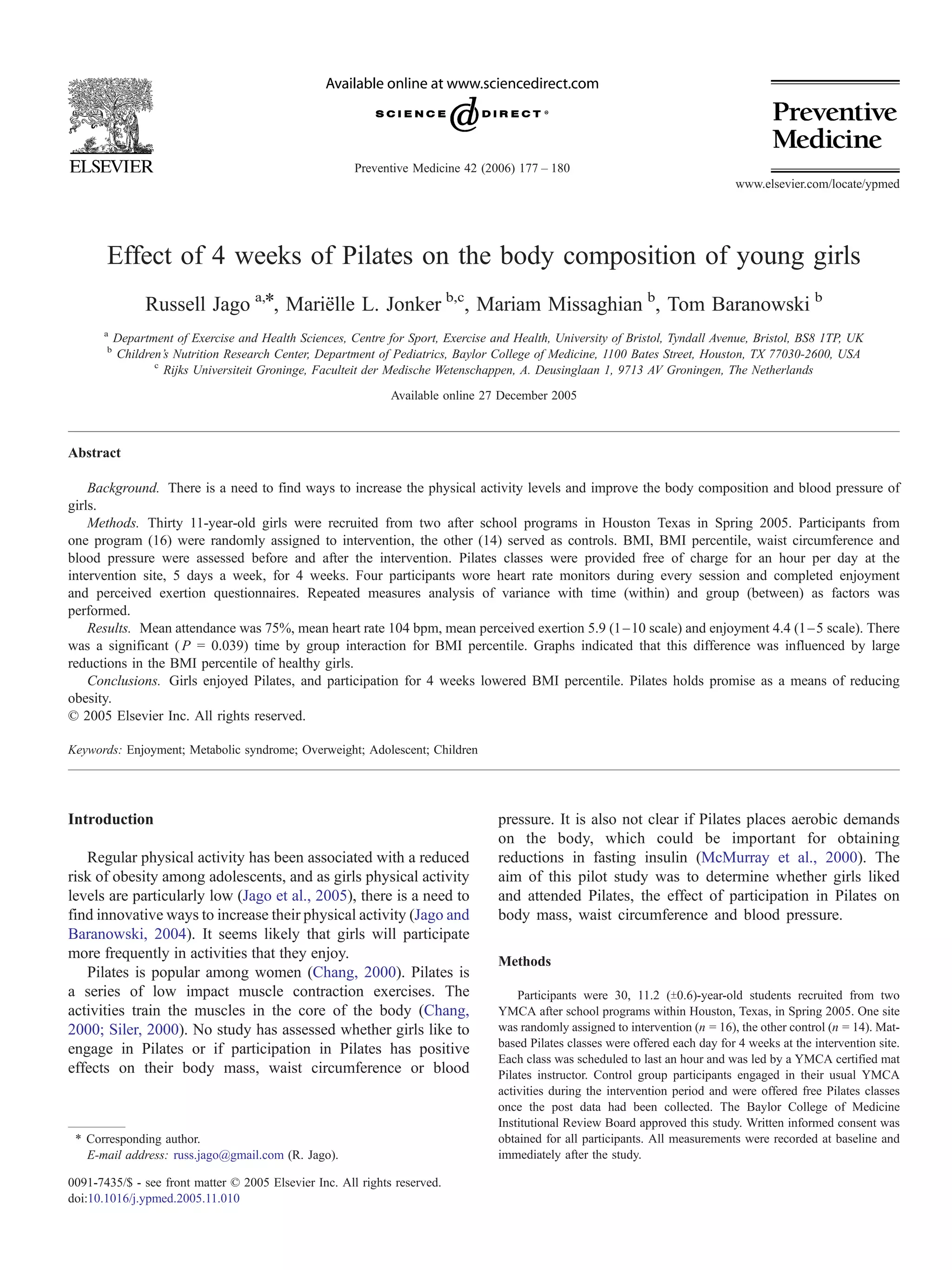
Effect of 4 weeks of Pilates on the body composition of young girls
Russell Jago a,*, Marie¨lle L. Jonker b,c
, Mariam Missaghian b
, Tom Baranowski b
a
Department of Exercise and Health Sciences, Centre for Sport, Exercise and Health, University of Bristol, Tyndall Avenue, Bristol, BS8 1TP, UK
b
Children’s Nutrition Research Center, Department of Pediatrics, Baylor College of Medicine, 1100 Bates Street, Houston, TX 77030-2600, USA
c
Rijks Universiteit Groninge, Faculteit der Medische Wetenschappen, A. Deusinglaan 1, 9713 AV Groningen, The Netherlands
Available online 27 December 2005
Abstract
Background. There is a need to find ways to increase the physical activity levels and improve the body composition and blood pressure of
girls.
Methods. Thirty 11-year-old girls were recruited from two after school programs in Houston Texas in Spring 2005. Participants from
one program (16) were randomly assigned to intervention, the other (14) served as controls. BMI, BMI percentile, waist circumference and
blood pressure were assessed before and after the intervention. Pilates classes were provided free of charge for an hour per day at the
intervention site, 5 days a week, for 4 weeks. Four participants wore heart rate monitors during every session and completed enjoyment
and perceived exertion questionnaires. Repeated measures analysis of variance with time (within) and group (between) as factors was
performed.
Results. Mean attendance was 75%, mean heart rate 104 bpm, mean perceived exertion 5.9 (1–10 scale) and enjoyment 4.4 (1–5 scale). There
was a significant ( P = 0.039) time by group interaction for BMI percentile. Graphs indicated that this difference was influenced by large
reductions in the BMI percentile of healthy girls.
Conclusions. Girls enjoyed Pilates, and participation for 4 weeks lowered BMI percentile. Pilates holds promise as a means of reducing
obesity.
D 2005 Elsevier Inc. All rights reserved.
Keywords: Enjoyment; Metabolic syndrome; Overweight; Adolescent; Children
Introduction
Regular physical activity has been associated with a reduced
risk of obesity among adolescents, and as girls physical activity
levels are particularly low (Jago et al., 2005), there is a need to
find innovative ways to increase their physical activity (Jago and
Baranowski, 2004). It seems likely that girls will participate
more frequently in activities that they enjoy.
Pilates is popular among women (Chang, 2000). Pilates is
a series of low impact muscle contraction exercises. The
activities train the muscles in the core of the body (Chang,
2000; Siler, 2000). No study has assessed whether girls like to
engage in Pilates or if participation in Pilates has positive
effects on their body mass, waist circumference or blood
pressure. It is also not clear if Pilates places aerobic demands
on the body, which could be important for obtaining
reductions in fasting insulin (McMurray et al., 2000). The
aim of this pilot study was to determine whether girls liked
and attended Pilates, the effect of participation in Pilates on
body mass, waist circumference and blood pressure.
Methods
Participants were 30, 11.2 (T0.6)-year-old students recruited from two
YMCA after school programs within Houston, Texas, in Spring 2005. One site
was randomly assigned to intervention (n = 16), the other control (n = 14). Mat-
based Pilates classes were offered each day for 4 weeks at the intervention site.
Each class was scheduled to last an hour and was led by a YMCA certified mat
Pilates instructor. Control group participants engaged in their usual YMCA
activities during the intervention period and were offered free Pilates classes
once the post data had been collected. The Baylor College of Medicine
Institutional Review Board approved this study. Written informed consent was
obtained for all participants. All measurements were recorded at baseline and
immediately after the study.
0091-7435/$ - see front matter D 2005 Elsevier Inc. All rights reserved.
doi:10.1016/j.ypmed.2005.11.010
* Corresponding author.
E-mail address: russ.jago@gmail.com (R. Jago).
Preventive Medicine 42 (2006) 177 – 180
www.elsevier.com/locate/ypmed
Measures
Date of birth was obtained by self-report and age calculated. Height was
measured to the nearest 0.1 cm on a stadiometer (PE-AIM-101, Perspective
Enterprises, Kalamazoo, MI) with the participants shoeless. Body weight was
measured to the nearest 0.1 kg using a pre-calibrated electronic scale (SECA
Alpha 882, Vogel and Halke, Hamburg). Body mass index (BMI) was
calculated (kg/m2
) and age and gender specific BMI percentile computed
using the Centers for Disease Control program (National Center for Health
Statistics, 2000). Waist circumference was recorded to the nearest 0.1 cm at
the iliac crest. Research assistants were within 0.5 kg (weight), 0.5 cm
(height) and 1 cm (waist circumference) of the first author on at least 90% of
a certification group during a pre-study training and certification procedure.
Blood pressure was recorded three times using an automated blood pressure
monitor (Omron HEM-907, Vernon Hills, IL). The initial value was recorded
after the participant had been seated quietly for 3 min with each subsequent
value recorded 1 min after the preceding recording. The mean of the second
and third readings was used in all analyses. Study staff recorded treatment
group attendance at the Pilates sessions. Four randomly selected treatment
participants wore Polar heart rate monitors placed in the center of the chest
during each Pilates session. The same participants also completed previously
validated perceived exertion (1–10 scale) (Robertson et al., 2000) and
enjoyment (1–5 scale) questions (Macfarlane and Kwong, 2003) at the end of
each session.
Statistics
Mean heart rate, perceived exertion and enjoyment ratings were calculated
across sessions, and mean attendance (percent) was calculated. Independent t
tests were used to test for differences in participants weight, BMI, BMI
percentile, waist circumference, diastolic and systolic blood between the
treatment and control groups at baseline. Repeated measures analysis of
variance with time (within) and treatment groups (between) as factors was used
to test for time by treatment effects on participant’s weight, BMI, BMI
percentile, waist circumference, diastolic and systolic blood pressure with
separate models run for each variable.
Results
There were no significant differences in any of the outcome
variables between the two groups at baseline (Table 1). There
were no time-related changes in the pattern of attendance, heart
rate or enjoyment across the study. Mean intervention
attendance was 75% with a mean heart rate of 104 bpm. Mean
perceived exertion was 5.9 (1–10 scale) with a mean
enjoyment of 4.4 (1–5 scale).
The repeated measures ANOVA yielded a significant time
by group interaction for BMI percentile ( P = 0.039). There was
a 3.1 reduction in the BMI percentile of the treatment group
while the control group increased by 0.8 percentiles. There was
also a time by group interaction that approached significance
for systolic blood pressure ( P = 0.071).
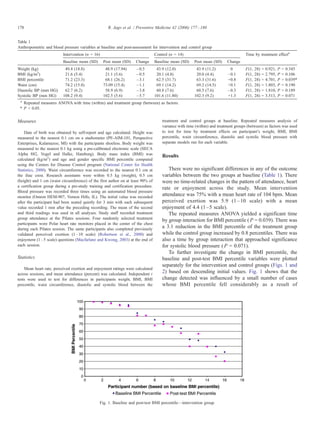
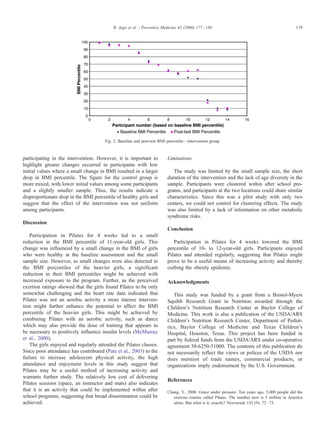
To further investigate the change in BMI percentile, the
baseline and post-test BMI percentile variables were plotted
separately for the intervention and control groups (Figs. 1 and
2) based on descending initial values. Fig. 1 shows that the
change detected was influenced by a small number of cases
whose BMI percentile fell considerably as a result of
Table 1
Anthropometric and blood pressure variables at baseline and post-assessment for intervention and control group
Intervention (n = 16) Control (n = 14) Time by treatment effecta
Baseline mean (SD) Post mean (SD) Change Baseline mean (SD) Post mean (SD) Change
Weight (kg) 49.4 (18.8) 48.9 (17.94) À0.5 43.9 (12.0) 43.9 (11.2) 0 F(1, 28) = 0.921, P = 0.345
BMI (kg/m2
) 21.6 (5.4) 21.1 (5.6) À0.5 20.1 (4.8) 20.0 (4.4) À0.1 F(1, 28) = 2.795, P = 0.106
BMI percentile 71.2 (23.3) 68.1 (26.2) À3.1 62.5 (31.7) 63.3 (31.6) +0.8 F(1, 28) = 4.701, P = 0.039*
Waist (cm) 74.2 (15.8) 73.09 (15.4) À1.1 69.1 (14.2) 69.2 (14.5) +0.1 F(1, 28) = 1.803, P = 0.190
Diastolic BP (mm HG) 62.7 (6.2) 58.9 (6.9) À3.8 60.8 (7.6) 60.5 (7.6) À0.3 F(1, 28) = 1.810, P = 0.189
Systolic BP (mm HG) 108.2 (9.4) 102.5 (5.6) À5.7 101.6 (11.80) 102.3 (9.2) +1.3 F(1, 28) = 3.513, P = 0.071
a
Repeated measures ANOVA with time (within) and treatment group (between) as factors.
* P < 0.05.
Fig. 1. Baseline and post-test BMI percentile—intervention group.
R. Jago et al. / Preventive Medicine 42 (2006) 177–180178
participating in the intervention. However, it is important to
highlight greater changes occurred in participants with low
initial values where a small change in BMI resulted in a larger
drop in BMI percentile. The figure for the control group is
more mixed, with lower initial values among some participants
and a slightly smaller sample. Thus, the results indicate a
disproportionate drop in the BMI percentile of healthy girls and
suggest that the effect of the intervention was not uniform
among participants.
Discussion
Participation in Pilates for 4 weeks led to a small
reduction in the BMI percentile of 11-year-old girls. This
change was influenced by a small change in the BMI of girls
who were healthy at the baseline assessment and the small
sample size. However, as small changes were also detected in
the BMI percentiles of the heavier girls, a significant
reduction in their BMI percentiles might be achieved with
increased exposure to the program. Further, as the perceived
exertion ratings showed that the girls found Pilates to be only
somewhat challenging and the heart rate data indicated that
Pilates was not an aerobic activity a more intense interven-
tion might further enhance the potential to affect the BMI
percentile of the heavier girls. This might be achieved by
combining Pilates with an aerobic activity, such as dance
which may also provide the dose of training that appears to
be necessary to positively influence insulin levels (McMurray
et al., 2000).
The girls enjoyed and regularly attended the Pilates classes.
Since poor attendance has contributed (Pate et al., 2003) to the
failure to increase adolescent physical activity, the high
attendance and enjoyment levels in this study suggest that
Pilates may be a useful method of increasing activity and
warrants further study. The relatively low cost of delivering
Pilates sessions (space, an instructor and mats) also indicates
that it is an activity that could be implemented within after
school programs, suggesting that broad dissemination could be
achieved.
Limitations
The study was limited by the small sample size, the short
duration of the intervention and the lack of age diversity in the
sample. Participants were clustered within after school pro-
grams, and participants at the two locations could share similar
characteristics. Since this was a pilot study with only two
centers, we could not control for clustering effects. The study
was also limited by a lack of information on other metabolic
syndrome risks.
Conclusion
Participation in Pilates for 4 weeks lowered the BMI
percentile of 10- to 12-year-old girls. Participants enjoyed
Pilates and attended regularly, suggesting that Pilates might
prove to be a useful means of increasing activity and thereby
curbing the obesity epidemic.
Acknowledgments
This study was funded by a grant from a Bristol-Myers
Squibb Research Grant in Nutrition awarded through the
Children’s Nutrition Research Center at Baylor College of
Medicine. This work is also a publication of the USDA/ARS
Children’s Nutrition Research Center, Department of Pediat-
rics, Baylor College of Medicine and Texas Children’s
Hospital, Houston, Texas. This project has been funded in
part by federal funds from the USDA/ARS under co-operative
agreement 58-6250-51000. The contents of this publication do
not necessarily reflect the views or polices of the USDA nor
does mention of trade names, commercial products, or
organizations imply endorsement by the U.S. Government.
References
Chang, Y., 2000. Grace under pressure. Ten years ago, 5,000 people did the
exercise routine called Pilates. The number now is 5 million in America
alone. But what is it, exactly? Newsweek 135 (9), 72–73.
Fig. 2. Baseline and post-test BMI percentile—intervention group.
R. Jago et al. / Preventive Medicine 42 (2006) 177–180 179
Jago, R., Baranowski, T., 2004. Non-curricular approaches for increasing
physical activity in youth: a review. Prev. Med. 39 (1), 157–163.
Jago, R., Anderson, C., Baranowski, T., Watson, K., 2005. Adolescent patterns
of physical activity: differences by gender, day and time of day. Am. J. Prev.
Med. 28 (5), 447–452.
Macfarlane, D., Kwong, W.T., 2003. Children’s heart rates and enjoyment
levels during PE classes in Hong Kong primary schools. Pediatr. Exerc. Sci.
15, 179–190.
McMurray, R.G., Bauman, M.J., Harrell, J.S., Brown, S., Bangdiwala, S.I.,
2000. Effects of improvement in aerobic power on resting insulin and
glucose concentrations in children. Eur. J. Appl. Physiol. 81, 132–139.
National Center for Health Statistics, 2000. CDC Growth Charts: United States
Pate, R.P., Saunders, R.P., Ward, D.S., Felton, G., Trost, S.G., Dowda, M.,
2003. Evaluation of a community-based intervention to promote physical
activity in youth: lessons from active winners. Am. J. Health Promot. 17
(3), 171–182.
Robertson, R.J., Goss, F.L., Boer, N.F., Peoples, J.A., Foreman, A.J.,
Dabayebeh, I.M., Millich, N.B., Balasekaran, G., Riechman, S.E.,
Gallagher, J.D., Thompkins, T., 2000. Children’s OMNI scale of perceived
exertion: mixed gender and race validation. Med. Sci. Sports Exerc. 32 (3),
452–458.
Siler, B., 2000. The Pilates Body. Broadway Books, New York.
R. Jago et al. / Preventive Medicine 42 (2006) 177–180180

Effect of 4 weeks of Pilates on the body composition of young girls

  • 1.
    Effect of 4weeks of Pilates on the body composition of young girls Russell Jago a,*, Marie¨lle L. Jonker b,c , Mariam Missaghian b , Tom Baranowski b a Department of Exercise and Health Sciences, Centre for Sport, Exercise and Health, University of Bristol, Tyndall Avenue, Bristol, BS8 1TP, UK b Children’s Nutrition Research Center, Department of Pediatrics, Baylor College of Medicine, 1100 Bates Street, Houston, TX 77030-2600, USA c Rijks Universiteit Groninge, Faculteit der Medische Wetenschappen, A. Deusinglaan 1, 9713 AV Groningen, The Netherlands Available online 27 December 2005 Abstract Background. There is a need to find ways to increase the physical activity levels and improve the body composition and blood pressure of girls. Methods. Thirty 11-year-old girls were recruited from two after school programs in Houston Texas in Spring 2005. Participants from one program (16) were randomly assigned to intervention, the other (14) served as controls. BMI, BMI percentile, waist circumference and blood pressure were assessed before and after the intervention. Pilates classes were provided free of charge for an hour per day at the intervention site, 5 days a week, for 4 weeks. Four participants wore heart rate monitors during every session and completed enjoyment and perceived exertion questionnaires. Repeated measures analysis of variance with time (within) and group (between) as factors was performed. Results. Mean attendance was 75%, mean heart rate 104 bpm, mean perceived exertion 5.9 (1–10 scale) and enjoyment 4.4 (1–5 scale). There was a significant ( P = 0.039) time by group interaction for BMI percentile. Graphs indicated that this difference was influenced by large reductions in the BMI percentile of healthy girls. Conclusions. Girls enjoyed Pilates, and participation for 4 weeks lowered BMI percentile. Pilates holds promise as a means of reducing obesity. D 2005 Elsevier Inc. All rights reserved. Keywords: Enjoyment; Metabolic syndrome; Overweight; Adolescent; Children Introduction Regular physical activity has been associated with a reduced risk of obesity among adolescents, and as girls physical activity levels are particularly low (Jago et al., 2005), there is a need to find innovative ways to increase their physical activity (Jago and Baranowski, 2004). It seems likely that girls will participate more frequently in activities that they enjoy. Pilates is popular among women (Chang, 2000). Pilates is a series of low impact muscle contraction exercises. The activities train the muscles in the core of the body (Chang, 2000; Siler, 2000). No study has assessed whether girls like to engage in Pilates or if participation in Pilates has positive effects on their body mass, waist circumference or blood pressure. It is also not clear if Pilates places aerobic demands on the body, which could be important for obtaining reductions in fasting insulin (McMurray et al., 2000). The aim of this pilot study was to determine whether girls liked and attended Pilates, the effect of participation in Pilates on body mass, waist circumference and blood pressure. Methods Participants were 30, 11.2 (T0.6)-year-old students recruited from two YMCA after school programs within Houston, Texas, in Spring 2005. One site was randomly assigned to intervention (n = 16), the other control (n = 14). Mat- based Pilates classes were offered each day for 4 weeks at the intervention site. Each class was scheduled to last an hour and was led by a YMCA certified mat Pilates instructor. Control group participants engaged in their usual YMCA activities during the intervention period and were offered free Pilates classes once the post data had been collected. The Baylor College of Medicine Institutional Review Board approved this study. Written informed consent was obtained for all participants. All measurements were recorded at baseline and immediately after the study. 0091-7435/$ - see front matter D 2005 Elsevier Inc. All rights reserved. doi:10.1016/j.ypmed.2005.11.010 * Corresponding author. E-mail address: russ.jago@gmail.com (R. Jago). Preventive Medicine 42 (2006) 177 – 180 www.elsevier.com/locate/ypmed
  • 2.
    Measures Date of birthwas obtained by self-report and age calculated. Height was measured to the nearest 0.1 cm on a stadiometer (PE-AIM-101, Perspective Enterprises, Kalamazoo, MI) with the participants shoeless. Body weight was measured to the nearest 0.1 kg using a pre-calibrated electronic scale (SECA Alpha 882, Vogel and Halke, Hamburg). Body mass index (BMI) was calculated (kg/m2 ) and age and gender specific BMI percentile computed using the Centers for Disease Control program (National Center for Health Statistics, 2000). Waist circumference was recorded to the nearest 0.1 cm at the iliac crest. Research assistants were within 0.5 kg (weight), 0.5 cm (height) and 1 cm (waist circumference) of the first author on at least 90% of a certification group during a pre-study training and certification procedure. Blood pressure was recorded three times using an automated blood pressure monitor (Omron HEM-907, Vernon Hills, IL). The initial value was recorded after the participant had been seated quietly for 3 min with each subsequent value recorded 1 min after the preceding recording. The mean of the second and third readings was used in all analyses. Study staff recorded treatment group attendance at the Pilates sessions. Four randomly selected treatment participants wore Polar heart rate monitors placed in the center of the chest during each Pilates session. The same participants also completed previously validated perceived exertion (1–10 scale) (Robertson et al., 2000) and enjoyment (1–5 scale) questions (Macfarlane and Kwong, 2003) at the end of each session. Statistics Mean heart rate, perceived exertion and enjoyment ratings were calculated across sessions, and mean attendance (percent) was calculated. Independent t tests were used to test for differences in participants weight, BMI, BMI percentile, waist circumference, diastolic and systolic blood between the treatment and control groups at baseline. Repeated measures analysis of variance with time (within) and treatment groups (between) as factors was used to test for time by treatment effects on participant’s weight, BMI, BMI percentile, waist circumference, diastolic and systolic blood pressure with separate models run for each variable. Results There were no significant differences in any of the outcome variables between the two groups at baseline (Table 1). There were no time-related changes in the pattern of attendance, heart rate or enjoyment across the study. Mean intervention attendance was 75% with a mean heart rate of 104 bpm. Mean perceived exertion was 5.9 (1–10 scale) with a mean enjoyment of 4.4 (1–5 scale). The repeated measures ANOVA yielded a significant time by group interaction for BMI percentile ( P = 0.039). There was a 3.1 reduction in the BMI percentile of the treatment group while the control group increased by 0.8 percentiles. There was also a time by group interaction that approached significance for systolic blood pressure ( P = 0.071). To further investigate the change in BMI percentile, the baseline and post-test BMI percentile variables were plotted separately for the intervention and control groups (Figs. 1 and 2) based on descending initial values. Fig. 1 shows that the change detected was influenced by a small number of cases whose BMI percentile fell considerably as a result of Table 1 Anthropometric and blood pressure variables at baseline and post-assessment for intervention and control group Intervention (n = 16) Control (n = 14) Time by treatment effecta Baseline mean (SD) Post mean (SD) Change Baseline mean (SD) Post mean (SD) Change Weight (kg) 49.4 (18.8) 48.9 (17.94) À0.5 43.9 (12.0) 43.9 (11.2) 0 F(1, 28) = 0.921, P = 0.345 BMI (kg/m2 ) 21.6 (5.4) 21.1 (5.6) À0.5 20.1 (4.8) 20.0 (4.4) À0.1 F(1, 28) = 2.795, P = 0.106 BMI percentile 71.2 (23.3) 68.1 (26.2) À3.1 62.5 (31.7) 63.3 (31.6) +0.8 F(1, 28) = 4.701, P = 0.039* Waist (cm) 74.2 (15.8) 73.09 (15.4) À1.1 69.1 (14.2) 69.2 (14.5) +0.1 F(1, 28) = 1.803, P = 0.190 Diastolic BP (mm HG) 62.7 (6.2) 58.9 (6.9) À3.8 60.8 (7.6) 60.5 (7.6) À0.3 F(1, 28) = 1.810, P = 0.189 Systolic BP (mm HG) 108.2 (9.4) 102.5 (5.6) À5.7 101.6 (11.80) 102.3 (9.2) +1.3 F(1, 28) = 3.513, P = 0.071 a Repeated measures ANOVA with time (within) and treatment group (between) as factors. * P < 0.05. Fig. 1. Baseline and post-test BMI percentile—intervention group. R. Jago et al. / Preventive Medicine 42 (2006) 177–180178
  • 3.
    participating in theintervention. However, it is important to highlight greater changes occurred in participants with low initial values where a small change in BMI resulted in a larger drop in BMI percentile. The figure for the control group is more mixed, with lower initial values among some participants and a slightly smaller sample. Thus, the results indicate a disproportionate drop in the BMI percentile of healthy girls and suggest that the effect of the intervention was not uniform among participants. Discussion Participation in Pilates for 4 weeks led to a small reduction in the BMI percentile of 11-year-old girls. This change was influenced by a small change in the BMI of girls who were healthy at the baseline assessment and the small sample size. However, as small changes were also detected in the BMI percentiles of the heavier girls, a significant reduction in their BMI percentiles might be achieved with increased exposure to the program. Further, as the perceived exertion ratings showed that the girls found Pilates to be only somewhat challenging and the heart rate data indicated that Pilates was not an aerobic activity a more intense interven- tion might further enhance the potential to affect the BMI percentile of the heavier girls. This might be achieved by combining Pilates with an aerobic activity, such as dance which may also provide the dose of training that appears to be necessary to positively influence insulin levels (McMurray et al., 2000). The girls enjoyed and regularly attended the Pilates classes. Since poor attendance has contributed (Pate et al., 2003) to the failure to increase adolescent physical activity, the high attendance and enjoyment levels in this study suggest that Pilates may be a useful method of increasing activity and warrants further study. The relatively low cost of delivering Pilates sessions (space, an instructor and mats) also indicates that it is an activity that could be implemented within after school programs, suggesting that broad dissemination could be achieved. Limitations The study was limited by the small sample size, the short duration of the intervention and the lack of age diversity in the sample. Participants were clustered within after school pro- grams, and participants at the two locations could share similar characteristics. Since this was a pilot study with only two centers, we could not control for clustering effects. The study was also limited by a lack of information on other metabolic syndrome risks. Conclusion Participation in Pilates for 4 weeks lowered the BMI percentile of 10- to 12-year-old girls. Participants enjoyed Pilates and attended regularly, suggesting that Pilates might prove to be a useful means of increasing activity and thereby curbing the obesity epidemic. Acknowledgments This study was funded by a grant from a Bristol-Myers Squibb Research Grant in Nutrition awarded through the Children’s Nutrition Research Center at Baylor College of Medicine. This work is also a publication of the USDA/ARS Children’s Nutrition Research Center, Department of Pediat- rics, Baylor College of Medicine and Texas Children’s Hospital, Houston, Texas. This project has been funded in part by federal funds from the USDA/ARS under co-operative agreement 58-6250-51000. The contents of this publication do not necessarily reflect the views or polices of the USDA nor does mention of trade names, commercial products, or organizations imply endorsement by the U.S. Government. References Chang, Y., 2000. Grace under pressure. Ten years ago, 5,000 people did the exercise routine called Pilates. The number now is 5 million in America alone. But what is it, exactly? Newsweek 135 (9), 72–73. Fig. 2. Baseline and post-test BMI percentile—intervention group. R. Jago et al. / Preventive Medicine 42 (2006) 177–180 179
  • 4.
    Jago, R., Baranowski,T., 2004. Non-curricular approaches for increasing physical activity in youth: a review. Prev. Med. 39 (1), 157–163. Jago, R., Anderson, C., Baranowski, T., Watson, K., 2005. Adolescent patterns of physical activity: differences by gender, day and time of day. Am. J. Prev. Med. 28 (5), 447–452. Macfarlane, D., Kwong, W.T., 2003. Children’s heart rates and enjoyment levels during PE classes in Hong Kong primary schools. Pediatr. Exerc. Sci. 15, 179–190. McMurray, R.G., Bauman, M.J., Harrell, J.S., Brown, S., Bangdiwala, S.I., 2000. Effects of improvement in aerobic power on resting insulin and glucose concentrations in children. Eur. J. Appl. Physiol. 81, 132–139. National Center for Health Statistics, 2000. CDC Growth Charts: United States Pate, R.P., Saunders, R.P., Ward, D.S., Felton, G., Trost, S.G., Dowda, M., 2003. Evaluation of a community-based intervention to promote physical activity in youth: lessons from active winners. Am. J. Health Promot. 17 (3), 171–182. Robertson, R.J., Goss, F.L., Boer, N.F., Peoples, J.A., Foreman, A.J., Dabayebeh, I.M., Millich, N.B., Balasekaran, G., Riechman, S.E., Gallagher, J.D., Thompkins, T., 2000. Children’s OMNI scale of perceived exertion: mixed gender and race validation. Med. Sci. Sports Exerc. 32 (3), 452–458. Siler, B., 2000. The Pilates Body. Broadway Books, New York. R. Jago et al. / Preventive Medicine 42 (2006) 177–180180