Prepared : Dr Jackson
Facilitator: Dr Benson
Body Fluid
Analysis
Tasakhtaa
Hospital
Body fluids of clinical importance
Pleural Effusion
Anatomy
Clinical presentation
Physical findings
01
02
03
04
05
Contents
02
WorkUps
Analysis
06
07
CSF
Pleural
Pericardial
Ascitic
Body fluids of clinical
Importance
03
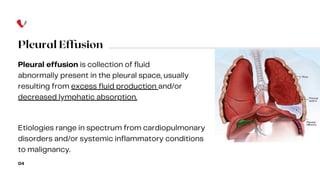
Pleural Effusion
Pleural effusion is collection of fluid
abnormally present in the pleural space, usually
resulting from excess fluid production and/or
decreased lymphatic absorption.
04
Etiologies range in spectrum from cardiopulmonary
disorders and/or systemic inflammatory conditions
to malignancy.
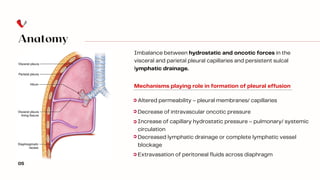
Anatomy
Altered permeability – pleural membranes/ capillaries
Decrease of intravascular oncotic pressure
Increase of capillary hydrostatic pressure – pulmonary/ systemic
circulation
Decreased lymphatic drainage or complete lymphatic vessel
blockage
Extravasation of peritoneal fluids across diaphragm
Imbalance between hydrostatic and oncotic forces in the
visceral and parietal pleural capillaries and persistent sulcal
lymphatic drainage.
05
Mechanisms playing role in formation of pleural effusion
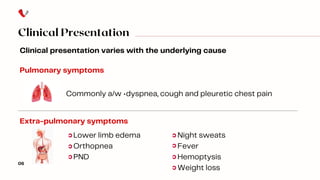
Clinical Presentation
Clinical presentation varies with the underlying cause
Pulmonary symptoms
Commonly a/w •dyspnea, cough and pleuretic chest pain
06
Extra-pulmonary symptoms
Lower limb edema
Orthopnea
PND
Night sweats
Fever
Hemoptysis
Weight loss
Physical Findings
Dullness to percussion
Decreased tactile fremitus
Asymmetrical chest expansion
Mediastinal shift away from the effusion
Diminished or inaudible breath sounds
Pleural friction rub
Physical findings are seen observed when PF >300mls.
Other physical and extrapulmonary findings may suggest the underlying
cause of the pleural effusion.
07
WorkUps
08
Before analyzing Pleural effusion , Pleural tapping or thoracentesis should be
performed.
Thoracentesis is percutaneous (sterile) procedure where pleural fluid is
removed through a needle or a catheter. Usually performed at bedside.
It's diagnostic- (nature & cause)
therapeutic – relieve dyspnea
Contraindicated – active skin infections, open wound infection, bleeding disorders
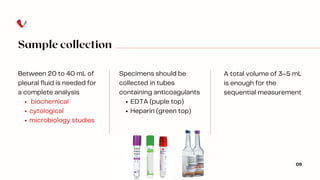
Sample collection
Specimens should be
collected in tubes
containing anticoagulants
EDTA (puple top)
Heparin (green top)
Between 20 to 40 mL of
pleural fluid is needed for
a complete analysis
biochemical
cytological
microbiology studies
09
A total volume of 3–5 mL
is enough for the
sequential measurement
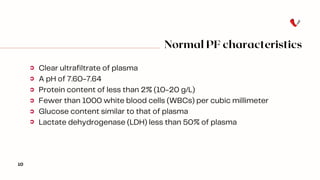
Normal PF characteristics
10
Clear ultrafiltrate of plasma
A pH of 7.60-7.64
Protein content of less than 2% (10-20 g/L)
Fewer than 1000 white blood cells (WBCs) per cubic millimeter
Glucose content similar to that of plasma
Lactate dehydrogenase (LDH) less than 50% of plasma
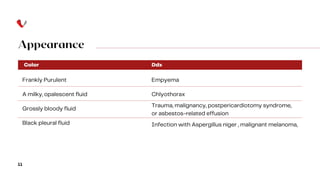
Color Ddx
Frankly Purulent
A milky, opalescent fluid
Grossly bloody fluid
Black pleural fluid
Appearance
11
Empyema
Chlyothorax
Trauma, malignancy, postpericardiotomy syndrome,
or asbestos-related effusion
Infection with Aspergillus niger , malignant melanoma,
Analysis
12
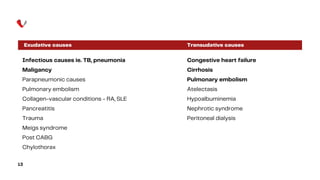
Second step is evaluating if the fluid is Transudate or Exudative.
Transudates - Imbalance in oncotic and hydrostatic pressures.
Exudates- Inflammatory processes of the pleura and/or decreased
lymphatic drainage.
Exudative causes Transudative causes
Infectious causes ie. TB, pneumonia
Maligancy
Parapneumonic causes
Pulmonary embolism
Collagen-vascular conditions - RA, SLE
Pancreatitis
Trauma
Meigs syndrome
Post CABG
Chylothorax
13
Congestive heart failure
Cirrhosis
Pulmonary embolism
Atelectasis
Hypoalbuminemia
Nephrotic syndrome
Peritoneal dialysis
14
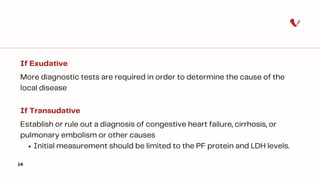
If Exudative
More diagnostic tests are required in order to determine the cause of the
local disease
If Transudative
Establish or rule out a diagnosis of congestive heart failure, cirrhosis, or
pulmonary embolism or other causes
Initial measurement should be limited to the PF protein and LDH levels.
Distinguishing Transudates From Exudates
The Light's Criteria -measures serum and pleural fluid protein and LDH
15
Pleural fluid protein/serum protein ratio greater than 0.5, or
Pleural fluid LDH/serum LDH ratio greater than 0.6, or
Pleural fluid LDH greater than two-thirds the upper limits of the
laboratory's normal serum LDH
Light's criteria yield a 97.5% sensitivity and 80% specificity.
[Reappraisal of the standard method (Light's criteria) for identifying pleural exudates]. 2006,José M Porcel et al
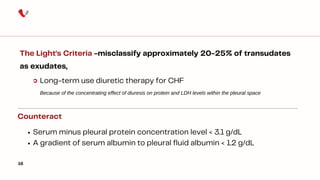
The Light's Criteria -misclassify approximately 20-25% of transudates
as exudates,
16
Long-term use diuretic therapy for CHF
Serum minus pleural protein concentration level < 3.1 g/dL
A gradient of serum albumin to pleural fluid albumin < 1.2 g/dL
Because of the concentrating effect of diuresis on protein and LDH levels within the pleural space
Counteract
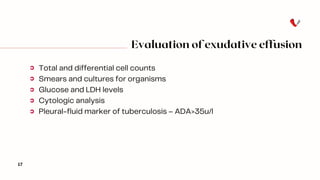
Evaluation of exudative effusion
17
Total and differential cell counts
Smears and cultures for organisms
Glucose and LDH levels
Cytologic analysis
Pleural-fluid marker of tuberculosis – ADA>35u/l
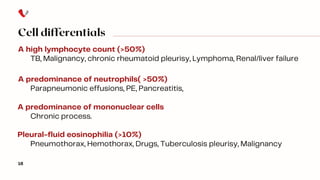
Cell differentials
18
A high lymphocyte count (>50%)
TB, Malignancy, chronic rheumatoid pleurisy, Lymphoma, Renal/liver failure
A predominance of neutrophils( >50%)
Parapneumonic effusions, PE, Pancreatitis,
A predominance of mononuclear cells
Chronic process.
Pleural-fluid eosinophilia (>10%)
Pneumothorax, Hemothorax, Drugs, Tuberculosis pleurisy, Malignancy
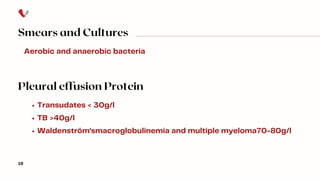
Smears and Cultures
19
Aerobic and anaerobic bacteria
Pleural effusion Protein
Transudates < 30g/l
TB >40g/l
Waldenström’smacroglobulinemia and multiple myeloma70-80g/l
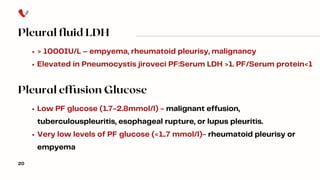
Pleural fluid LDH
20
> 1000IU/L – empyema, rheumatoid pleurisy, malignancy
Elevated in Pneumocystis jiroveci PF:Serum LDH >1. PF/Serum protein<1
Pleural effusion Glucose
Low PF glucose (1.7-2.8mmol/l) - malignant effusion,
tuberculouspleuritis, esophageal rupture, or lupus pleuritis.
Very low levels of PF glucose (<1..7 mmol/l)- rheumatoid pleurisy or
empyema
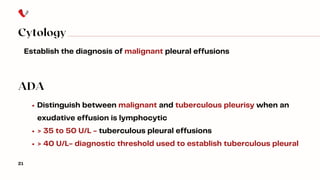
Cytology
21
Establish the diagnosis of malignant pleural effusions
ADA
Distinguish between malignant and tuberculous pleurisy when an
exudative effusion is lymphocytic
> 35 to 50 U/L - tuberculous pleural effusions
> 40 U/L- diagnostic threshold used to establish tuberculous pleural
References
Pleural Effusion - Medscape
1.
Diagnostic evaluation of pleural fluid- UpToDate
2.
Pleural Effusion: Clinical practise Richard W LIght, M.D.
3.
HANDLING PLEURAL FLUID SAMPLES FOR ROUTINE ANALYSES, José M. Porcel
4.

Pleural fluid analysis - Approach (Body fluid analysis)

  • 1.
    Prepared : DrJackson Facilitator: Dr Benson Body Fluid Analysis Tasakhtaa Hospital
  • 2.
    Body fluids ofclinical importance Pleural Effusion Anatomy Clinical presentation Physical findings 01 02 03 04 05 Contents 02 WorkUps Analysis 06 07
  • 3.
  • 4.
    Pleural Effusion Pleural effusionis collection of fluid abnormally present in the pleural space, usually resulting from excess fluid production and/or decreased lymphatic absorption. 04 Etiologies range in spectrum from cardiopulmonary disorders and/or systemic inflammatory conditions to malignancy.
  • 5.
    Anatomy Altered permeability –pleural membranes/ capillaries Decrease of intravascular oncotic pressure Increase of capillary hydrostatic pressure – pulmonary/ systemic circulation Decreased lymphatic drainage or complete lymphatic vessel blockage Extravasation of peritoneal fluids across diaphragm Imbalance between hydrostatic and oncotic forces in the visceral and parietal pleural capillaries and persistent sulcal lymphatic drainage. 05 Mechanisms playing role in formation of pleural effusion
  • 6.
    Clinical Presentation Clinical presentationvaries with the underlying cause Pulmonary symptoms Commonly a/w •dyspnea, cough and pleuretic chest pain 06 Extra-pulmonary symptoms Lower limb edema Orthopnea PND Night sweats Fever Hemoptysis Weight loss
  • 7.
    Physical Findings Dullness topercussion Decreased tactile fremitus Asymmetrical chest expansion Mediastinal shift away from the effusion Diminished or inaudible breath sounds Pleural friction rub Physical findings are seen observed when PF >300mls. Other physical and extrapulmonary findings may suggest the underlying cause of the pleural effusion. 07
  • 8.
    WorkUps 08 Before analyzing Pleuraleffusion , Pleural tapping or thoracentesis should be performed. Thoracentesis is percutaneous (sterile) procedure where pleural fluid is removed through a needle or a catheter. Usually performed at bedside. It's diagnostic- (nature & cause) therapeutic – relieve dyspnea Contraindicated – active skin infections, open wound infection, bleeding disorders
  • 9.
    Sample collection Specimens shouldbe collected in tubes containing anticoagulants EDTA (puple top) Heparin (green top) Between 20 to 40 mL of pleural fluid is needed for a complete analysis biochemical cytological microbiology studies 09 A total volume of 3–5 mL is enough for the sequential measurement
  • 10.
    Normal PF characteristics 10 Clearultrafiltrate of plasma A pH of 7.60-7.64 Protein content of less than 2% (10-20 g/L) Fewer than 1000 white blood cells (WBCs) per cubic millimeter Glucose content similar to that of plasma Lactate dehydrogenase (LDH) less than 50% of plasma
  • 11.
    Color Ddx Frankly Purulent Amilky, opalescent fluid Grossly bloody fluid Black pleural fluid Appearance 11 Empyema Chlyothorax Trauma, malignancy, postpericardiotomy syndrome, or asbestos-related effusion Infection with Aspergillus niger , malignant melanoma,
  • 12.
    Analysis 12 Second step isevaluating if the fluid is Transudate or Exudative. Transudates - Imbalance in oncotic and hydrostatic pressures. Exudates- Inflammatory processes of the pleura and/or decreased lymphatic drainage.
  • 13.
    Exudative causes Transudativecauses Infectious causes ie. TB, pneumonia Maligancy Parapneumonic causes Pulmonary embolism Collagen-vascular conditions - RA, SLE Pancreatitis Trauma Meigs syndrome Post CABG Chylothorax 13 Congestive heart failure Cirrhosis Pulmonary embolism Atelectasis Hypoalbuminemia Nephrotic syndrome Peritoneal dialysis
  • 14.
    14 If Exudative More diagnostictests are required in order to determine the cause of the local disease If Transudative Establish or rule out a diagnosis of congestive heart failure, cirrhosis, or pulmonary embolism or other causes Initial measurement should be limited to the PF protein and LDH levels.
  • 15.
    Distinguishing Transudates FromExudates The Light's Criteria -measures serum and pleural fluid protein and LDH 15 Pleural fluid protein/serum protein ratio greater than 0.5, or Pleural fluid LDH/serum LDH ratio greater than 0.6, or Pleural fluid LDH greater than two-thirds the upper limits of the laboratory's normal serum LDH Light's criteria yield a 97.5% sensitivity and 80% specificity. [Reappraisal of the standard method (Light's criteria) for identifying pleural exudates]. 2006,José M Porcel et al
  • 16.
    The Light's Criteria-misclassify approximately 20-25% of transudates as exudates, 16 Long-term use diuretic therapy for CHF Serum minus pleural protein concentration level < 3.1 g/dL A gradient of serum albumin to pleural fluid albumin < 1.2 g/dL Because of the concentrating effect of diuresis on protein and LDH levels within the pleural space Counteract
  • 17.
    Evaluation of exudativeeffusion 17 Total and differential cell counts Smears and cultures for organisms Glucose and LDH levels Cytologic analysis Pleural-fluid marker of tuberculosis – ADA>35u/l
  • 18.
    Cell differentials 18 A highlymphocyte count (>50%) TB, Malignancy, chronic rheumatoid pleurisy, Lymphoma, Renal/liver failure A predominance of neutrophils( >50%) Parapneumonic effusions, PE, Pancreatitis, A predominance of mononuclear cells Chronic process. Pleural-fluid eosinophilia (>10%) Pneumothorax, Hemothorax, Drugs, Tuberculosis pleurisy, Malignancy
  • 19.
    Smears and Cultures 19 Aerobicand anaerobic bacteria Pleural effusion Protein Transudates < 30g/l TB >40g/l Waldenström’smacroglobulinemia and multiple myeloma70-80g/l
  • 20.
    Pleural fluid LDH 20 >1000IU/L – empyema, rheumatoid pleurisy, malignancy Elevated in Pneumocystis jiroveci PF:Serum LDH >1. PF/Serum protein<1 Pleural effusion Glucose Low PF glucose (1.7-2.8mmol/l) - malignant effusion, tuberculouspleuritis, esophageal rupture, or lupus pleuritis. Very low levels of PF glucose (<1..7 mmol/l)- rheumatoid pleurisy or empyema
  • 21.
    Cytology 21 Establish the diagnosisof malignant pleural effusions ADA Distinguish between malignant and tuberculous pleurisy when an exudative effusion is lymphocytic > 35 to 50 U/L - tuberculous pleural effusions > 40 U/L- diagnostic threshold used to establish tuberculous pleural
  • 22.
    References Pleural Effusion -Medscape 1. Diagnostic evaluation of pleural fluid- UpToDate 2. Pleural Effusion: Clinical practise Richard W LIght, M.D. 3. HANDLING PLEURAL FLUID SAMPLES FOR ROUTINE ANALYSES, José M. Porcel 4.