Plastic Waste
Management in
Guwahati:
Challenges and
Solutions
SUBMITTED BY,
Name : Chandan Sarma
Course: Waste Management
Department : Botany
GUWAHATI
What is Waste and it’s type and sources..
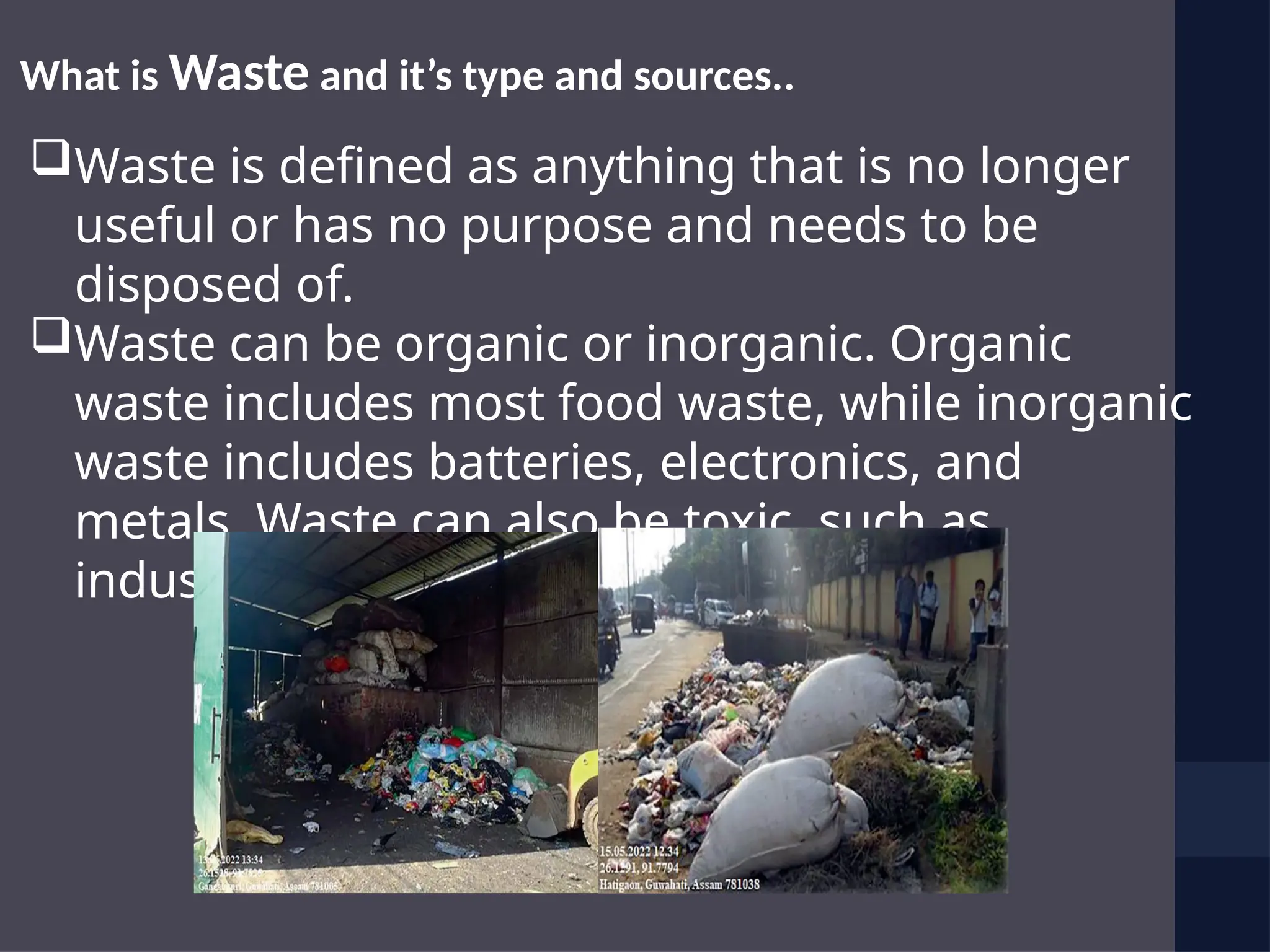
Waste is defined as anything that is no longer
useful or has no purpose and needs to be
disposed of.
Waste can be organic or inorganic. Organic
waste includes most food waste, while inorganic
waste includes batteries, electronics, and
metals. Waste can also be toxic, such as
industrial waste.
Types Of Waste
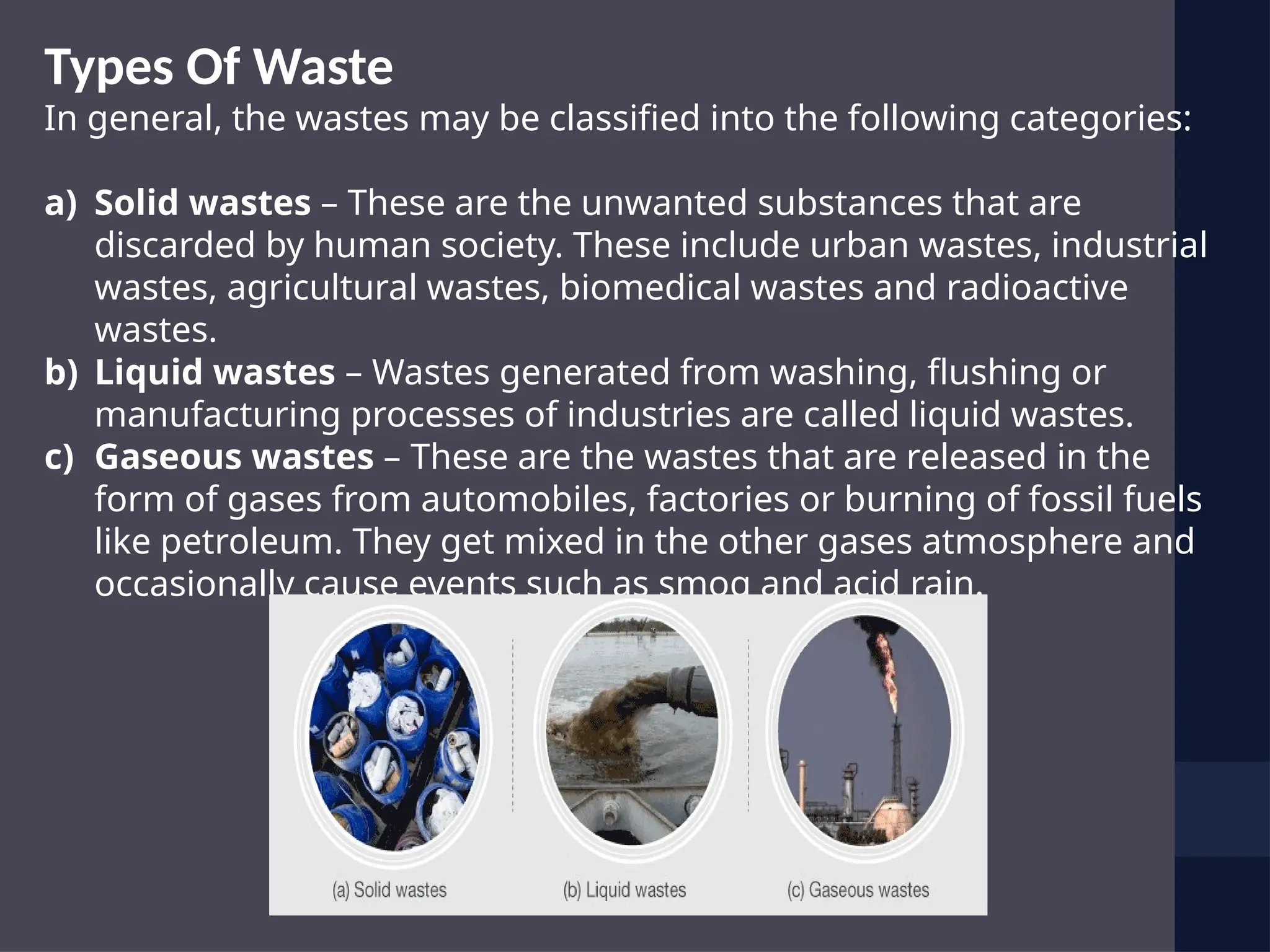
In general, the wastes may be classified into the following categories:
a) Solid wastes – These are the unwanted substances that are
discarded by human society. These include urban wastes, industrial
wastes, agricultural wastes, biomedical wastes and radioactive
wastes.
b) Liquid wastes – Wastes generated from washing, flushing or
manufacturing processes of industries are called liquid wastes.
c) Gaseous wastes – These are the wastes that are released in the
form of gases from automobiles, factories or burning of fossil fuels
like petroleum. They get mixed in the other gases atmosphere and
occasionally cause events such as smog and acid rain.
Sources Of Wastes….
 Medical/Clinical Wastes:
Includes surgical items, pharmaceuticals, blood, body
parts, wound dressing materials, needles, and syringes.
 Agricultural Wastes:
Includes empty pesticide containers, old silage wrap, out-
of-date medicines, used tires, surplus milk, cocoa pods,
and corn husks.
 Industrial Wastes:
Includes wastes from manufacturing and processing
industries like chemical plants, cement factories, power
plants, textile industries, food processing industries,
petroleum industries.
 Construction or Demolition Wastes:
Includes concrete debris, wood, large package boxes, and
plastics from building materials. Also includes demolition
waste.
Commercial Wastes:
Includes food items, disposable medical items,
textiles.
Mining Sources:
Includes overburden material, mine tailings, and
harmful gases released by blasting.
Radioactive Sources:
Includes nuclear reactors, mining of radioactive
substances, and atomic explosions.
Electronic Wastes:
Includes DVDs, music players, TVs, telephones,
computers, vacuum cleaners, and other non-use
electrical items. Some e-waste contains harmful
substances like lead, mercury, and cadmium.
Waste
Management
 Waste management shall mean “the collection,
transport, recovery and disposal of waste,
including the supervision of such operations
and aftercare of disposal sites.”…. European
Union Directive on Waste.
 However the newer concepts of ‘Waste
management’ talk about ‘Reduce, Reuse and
Recycle of waste’ over and above waste
disposal.
Introduction to Waste
Management in Guwahati
Guwahati, the bustling capital of Assam, faces a
significant challenge in managing its growing
waste generation. This document delves into the
complexities of waste management in Guwahati,
exploring its various aspects and shedding light on
the initiatives, challenges, and future possibilities.
From the source of the waste to its final disposal,
we examine the existing systems and policies,
highlighting opportunities for improvement.
Understanding the intricacies of waste
management is crucial for ensuring a sustainable
Plastic Waste: A Global Concern
Plastic products have become an integral
part of our daily life as a result of which
the polymer is produced at a massive
scale worldwide. On an average,
production of plastic globally crosses 150
Million tonnes per year. Its broad range
of application is in packaging films,
wrapping materials, shopping and
garbage bags, fluid containers, clothing,
toys, household and industrial products,
and building materials.
* Only 60% of the plastic produced
is recycled, balance 9400 Tonnes
of plastic is left unattended in
environment causing land, air
and water pollution.
* 70% of Plastics packaging
products are converted into
plastic waste in a short span.
In Guwahati alone, generation of
plastic waste worsen the situation
with more than 5000 kg/day as per
the report (Anonymous, 2004) among
the plastic waste generation carry bag
accounts for 15% only. Whereas
plastic carry bag is considered as the
major responsible for clogging of
drain and artificial water logging due
to the use and throw practices by the
citizens. Accordingly Government of
Assam has banned use of plastic carry
But in reality all plastic carry bags even
below 20 microns are also recyclable and
collected by the rag pickers. Moreover
citizens are selling most of the recyclable
plastic to the waste pickers and usually they
throw away the multi layered non recyclable
plastic. Even due to lack of knowledge
people throw recyclable plastic like carry
bag, pouch pack of vegetable oil, ‘Tata salt’,
bread etc. Therefore it is becoming
necessary to study about the generation of
plastic waste type and its potentiality for
the urban poor development specially the
Solid waste generation in Guwahati
During the study, various solid waste types are
collected and differentiated as biodegradable,
plastic, glass and metal waste and accordingly
compiled the total generation; which is
contributing as 57%, 1%, 14% and 28%
respectably in the total waste generation scenario
(shown in Fig. 1)
Figure 1. The
generation of
different Solid
waste types in
the Guwahati
Collection of plastic waste
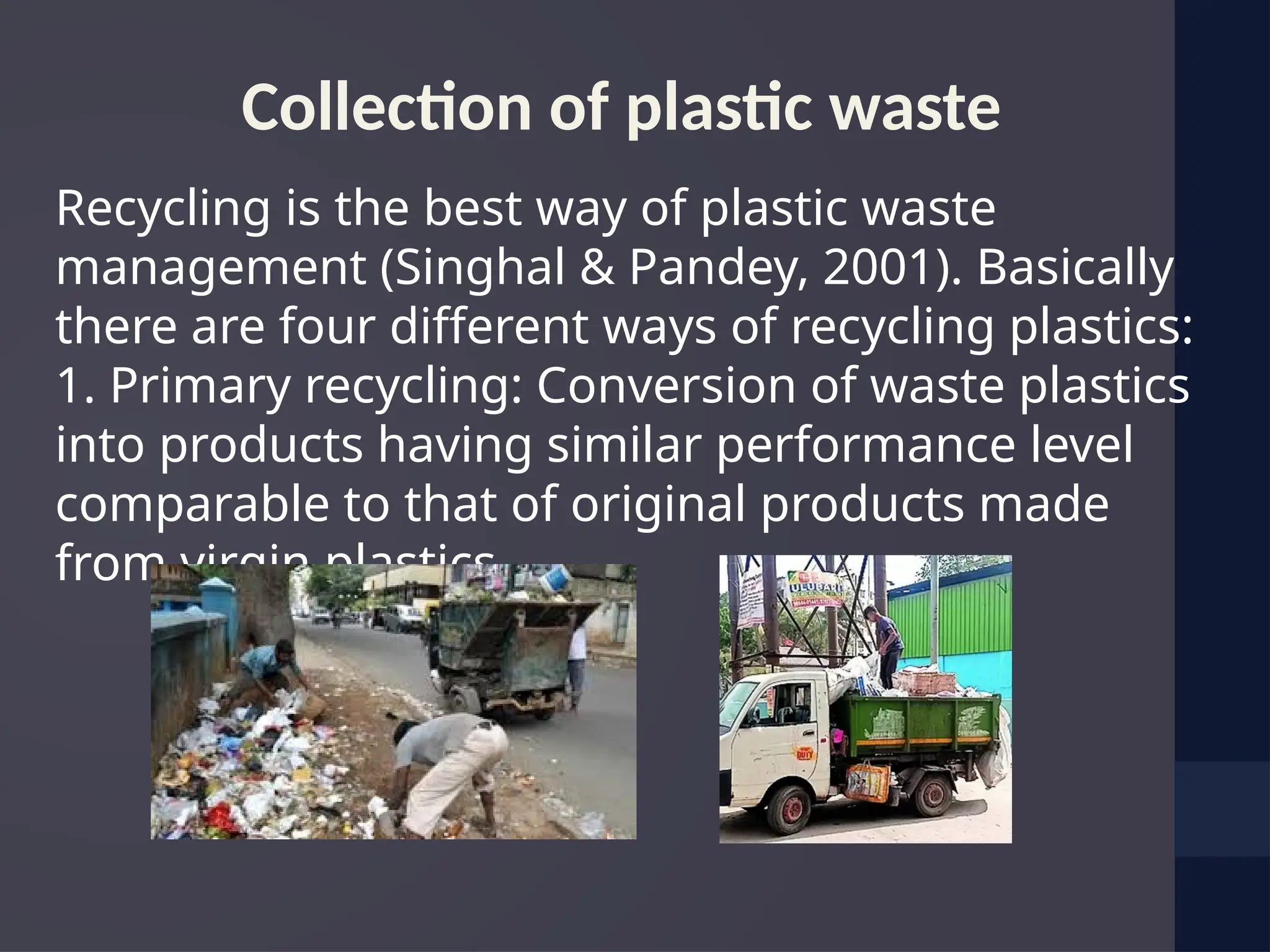
Recycling is the best way of plastic waste
management (Singhal & Pandey, 2001). Basically
there are four different ways of recycling plastics:
1. Primary recycling: Conversion of waste plastics
into products having similar performance level
comparable to that of original products made
from virgin plastics.
2. Secondary recycling: Conversion of waste plastics
into products having less demanding performance
requirements than the original material.
3. Tertiary recycling: The process of producing
chemicals, fuels or similar products from waste
plastics.
4. Quaternary recycling: The process of recovering
energy from waste plastics by incineration.
In Guwahati only primary and secondary plastic
recycling industries are available with 10 nos. of
plastic recycling industries and 10% of the total
plastic waste generated inside the city goes to
these industries.
Differentiation of the plastic waste
On the basis of present recycling scenario of Guwahati, recyclable
and non-recyclable plastics are systematically differentiated
(Kashyap et al., 2006, 2009a). There are two types of plastics ---- (i)
Recyclable plastic (RP)
(ii) Non-recyclable plastic (NRP)
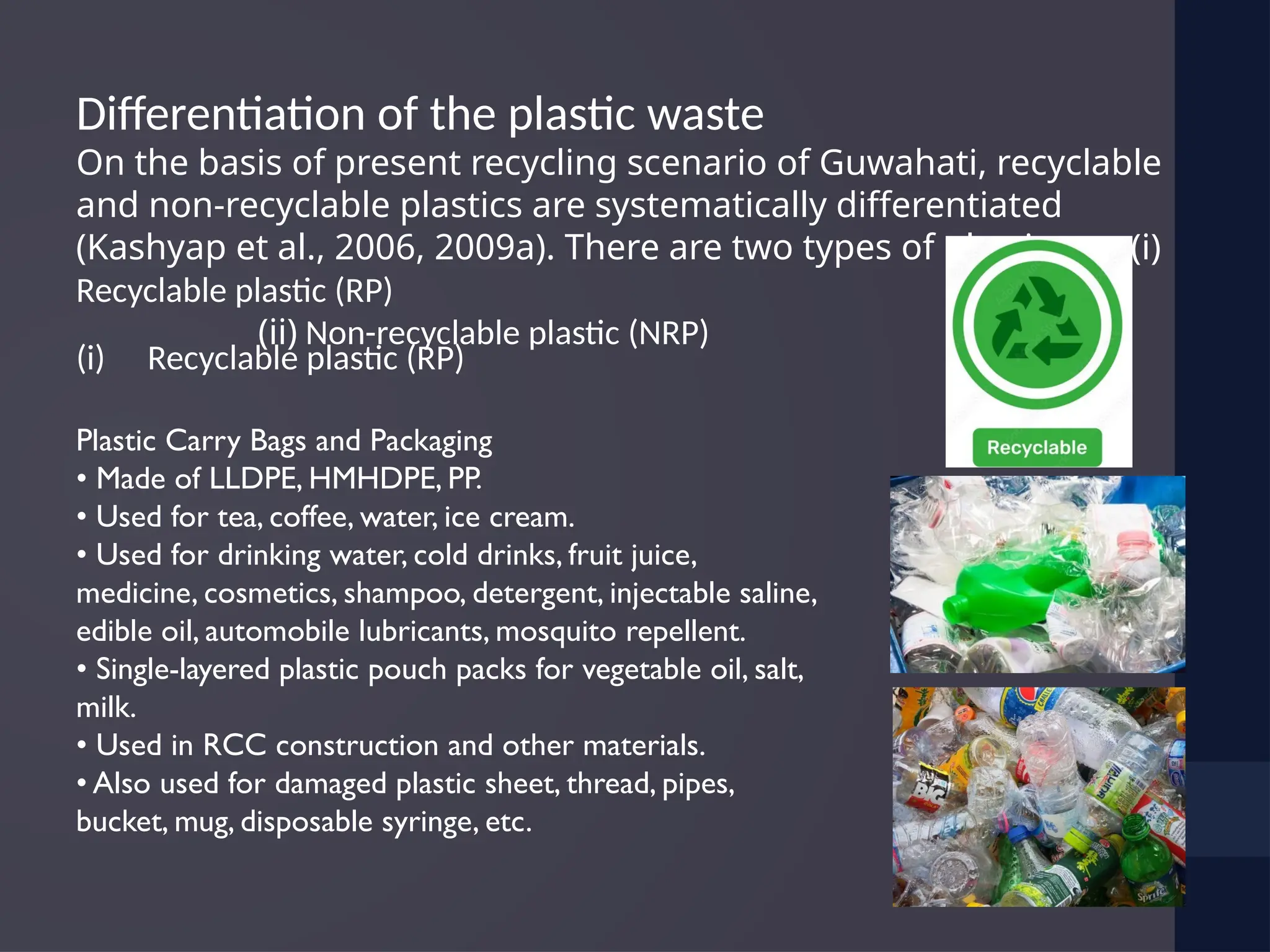
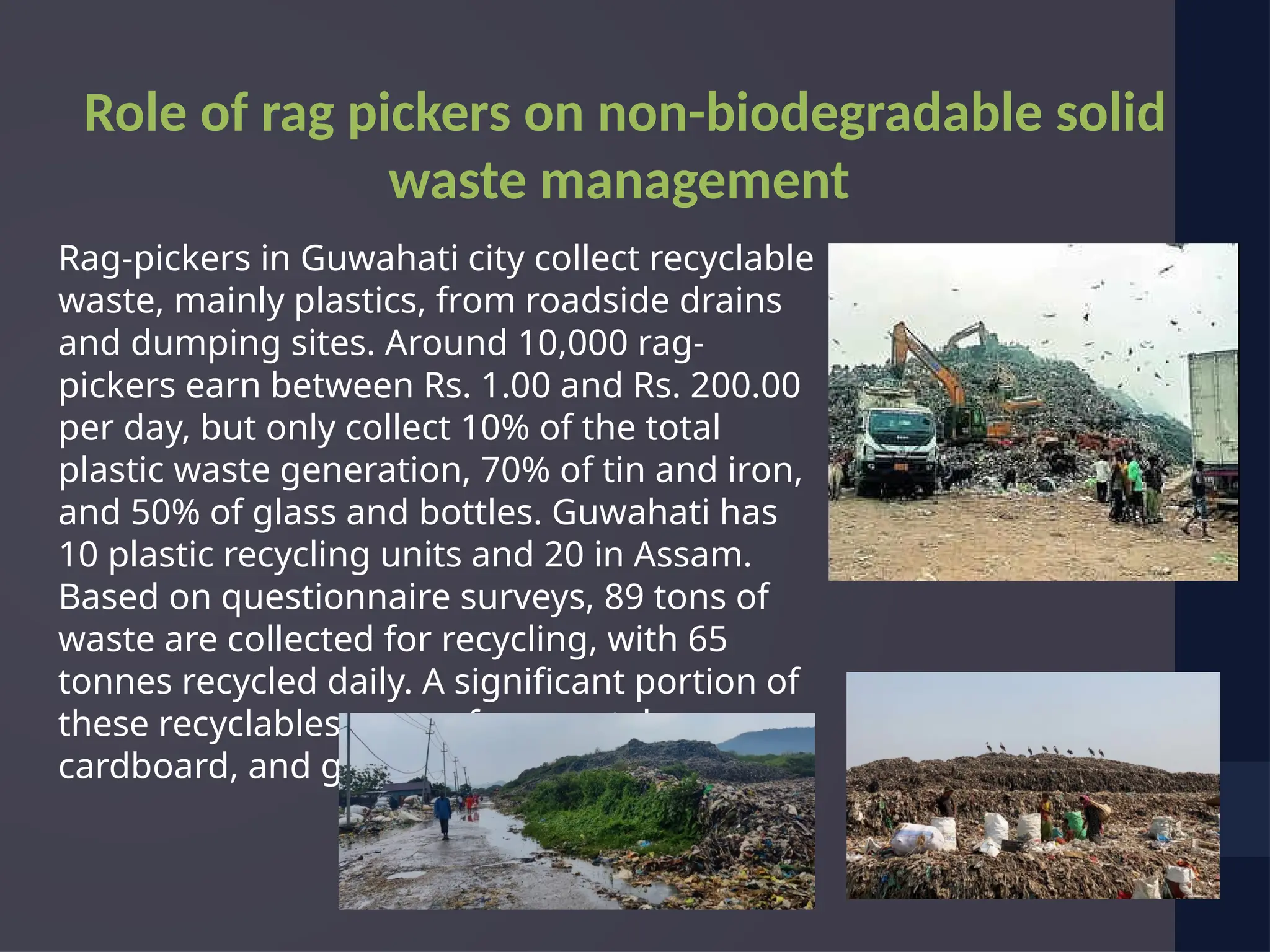
(i) Recyclable plastic (RP)
Plastic Carry Bags and Packaging
• Made of LLDPE, HMHDPE, PP.
• Used for tea, coffee, water, ice cream.
• Used for drinking water, cold drinks, fruit juice,
medicine, cosmetics, shampoo, detergent, injectable saline,
edible oil, automobile lubricants, mosquito repellent.
• Single-layered plastic pouch packs for vegetable oil, salt,
milk.
• Used in RCC construction and other materials.
• Also used for damaged plastic sheet, thread, pipes,
bucket, mug, disposable syringe, etc.
(ii)Non-recyclable plastic (NRP)
Plastic Packaging Overview
• Multi-layered plastic packaging for various products including
potato chips, tea, coffee, biscuits, snacks, spices, noodles,
chocolate, etc.
• Medicine blister strip made of PE and aluminum foil.
• Plastic laminated on paper packs made of paper, PET, or PE.
• Laminated cover pages of books, magazines, and souvenirs.
• Combination of plastic and paper in battery cases.
• Mixture of PVC, Polyester, PET in tooth paste, medicine,
cosmetics tubes, pen, comb.
• Aseptic packaging for liquid substances like milk, vegetable oil,
fruit juice, and soft drinks.
Generation of household plastic waste
Out of the 60 wards under the Guwahati Municipal
Corporation 10 wards were considered for thorough
study of household generation of plastic waste and
differentiated as per the recycling potentiality: It is
estimated that out of the total plastic generated from
household 60% is recyclable plastic and 40% is non-
recyclable plastic.
Figure 2. The proportion of
RP and NRP in the roadside
drain (in kg per 5 kg of
sample)
Role of rag pickers on non-biodegradable solid
waste management
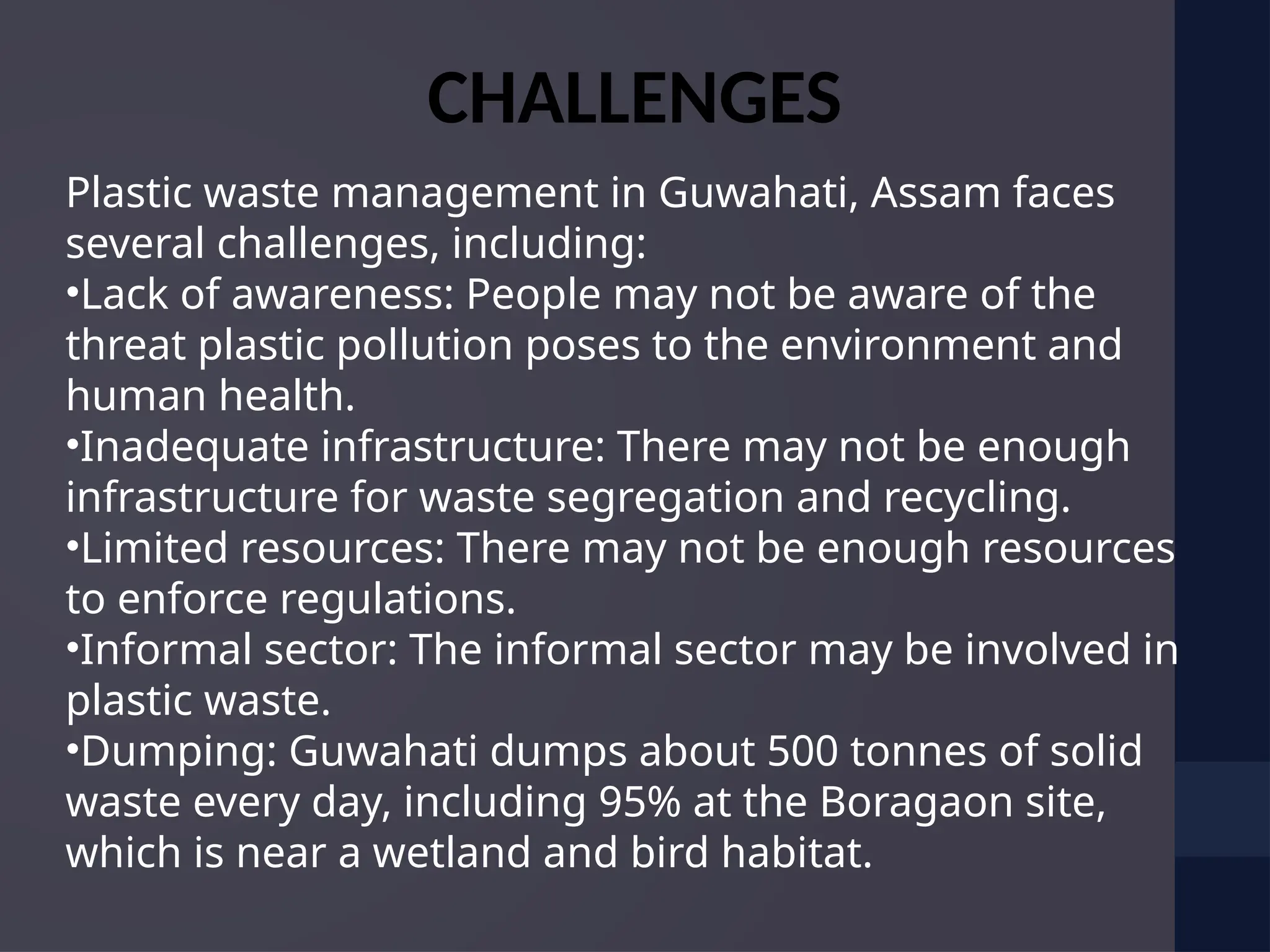
Rag-pickers in Guwahati city collect recyclable
waste, mainly plastics, from roadside drains
and dumping sites. Around 10,000 rag-
pickers earn between Rs. 1.00 and Rs. 200.00
per day, but only collect 10% of the total
plastic waste generation, 70% of tin and iron,
and 50% of glass and bottles. Guwahati has
10 plastic recycling units and 20 in Assam.
Based on questionnaire surveys, 89 tons of
waste are collected for recycling, with 65
tonnes recycled daily. A significant portion of
these recyclables comes from metal scrap,
cardboard, and glass bottles.
CHALLENGES
Plastic waste management in Guwahati, Assam faces
several challenges, including:
•Lack of awareness: People may not be aware of the
threat plastic pollution poses to the environment and
human health.
•Inadequate infrastructure: There may not be enough
infrastructure for waste segregation and recycling.
•Limited resources: There may not be enough resources
to enforce regulations.
•Informal sector: The informal sector may be involved in
plastic waste.
•Dumping: Guwahati dumps about 500 tonnes of solid
waste every day, including 95% at the Boragaon site,
which is near a wetland and bird habitat.
Waste management is the primary responsibility of Guwahati
Municipal Corporation (GMC), which overlooks the day-to-day
operations and affairs such as primary collection, secondary
collection, home composting, processing and disposal of solid waste.
The city generates approximately 550 tonnes per day (TPD) of solid
waste — more than 85 per cent of which finds its way to the dumpsite
located at Boragaon, apart from the numerous other small garbage
vulnerable points which can be seen in the city.
Guwahati has a windrow technology compost plant of 50 TPD in
Boragaon. It has been functional since 2010, and a proposal for
augmenting its capacity to 200 TPD has been proposed.
GMC initiated a project for purchasing dry waste from its citizens to
promote segregation of municipal solid waste (MSW). Awareness and
home composting is being promoted through pilot projects. Indian
Institute of Technology-Kharagpur has been engaged by GMC as
consultant to help improve the municipal waste management system
in Guwahati.
 In Guwahati the main issue in waste management is dumping
ground, around the total waste 90-95% of waste dump in
Boragaon Disposal site. And this is located in the middle of a
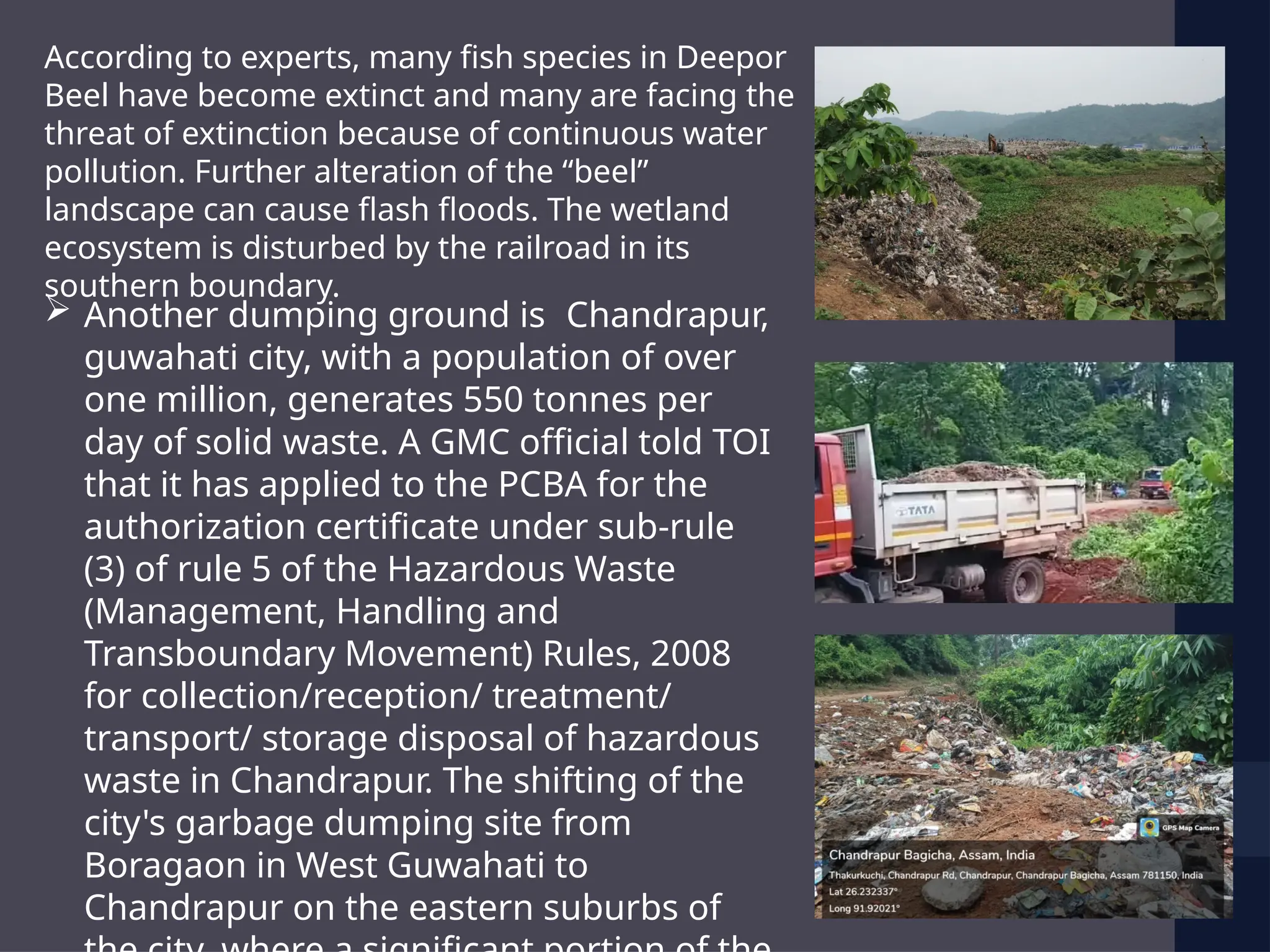
According to experts, many fish species in Deepor
Beel have become extinct and many are facing the
threat of extinction because of continuous water
pollution. Further alteration of the “beel”
landscape can cause flash floods. The wetland
ecosystem is disturbed by the railroad in its
southern boundary.
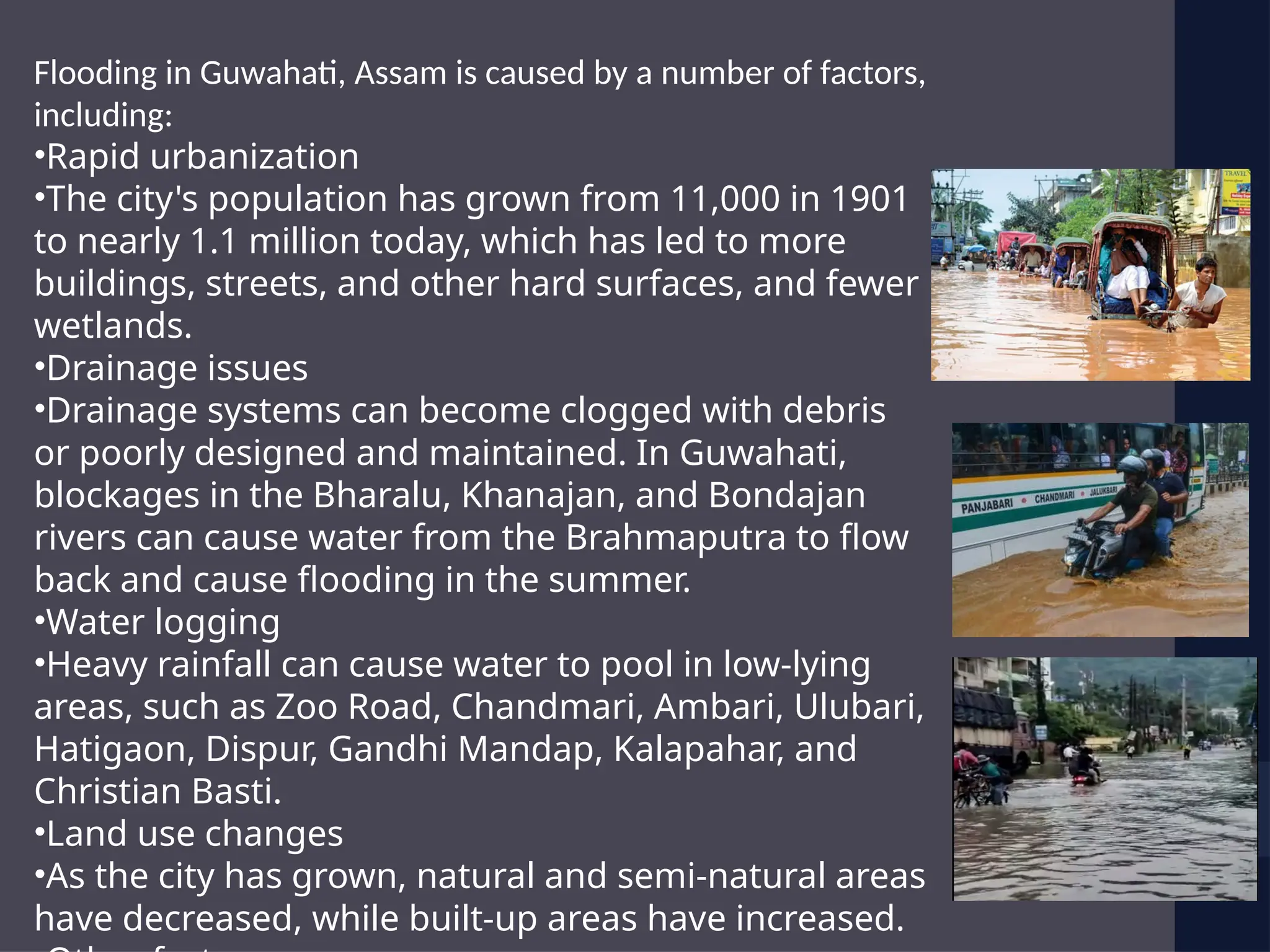
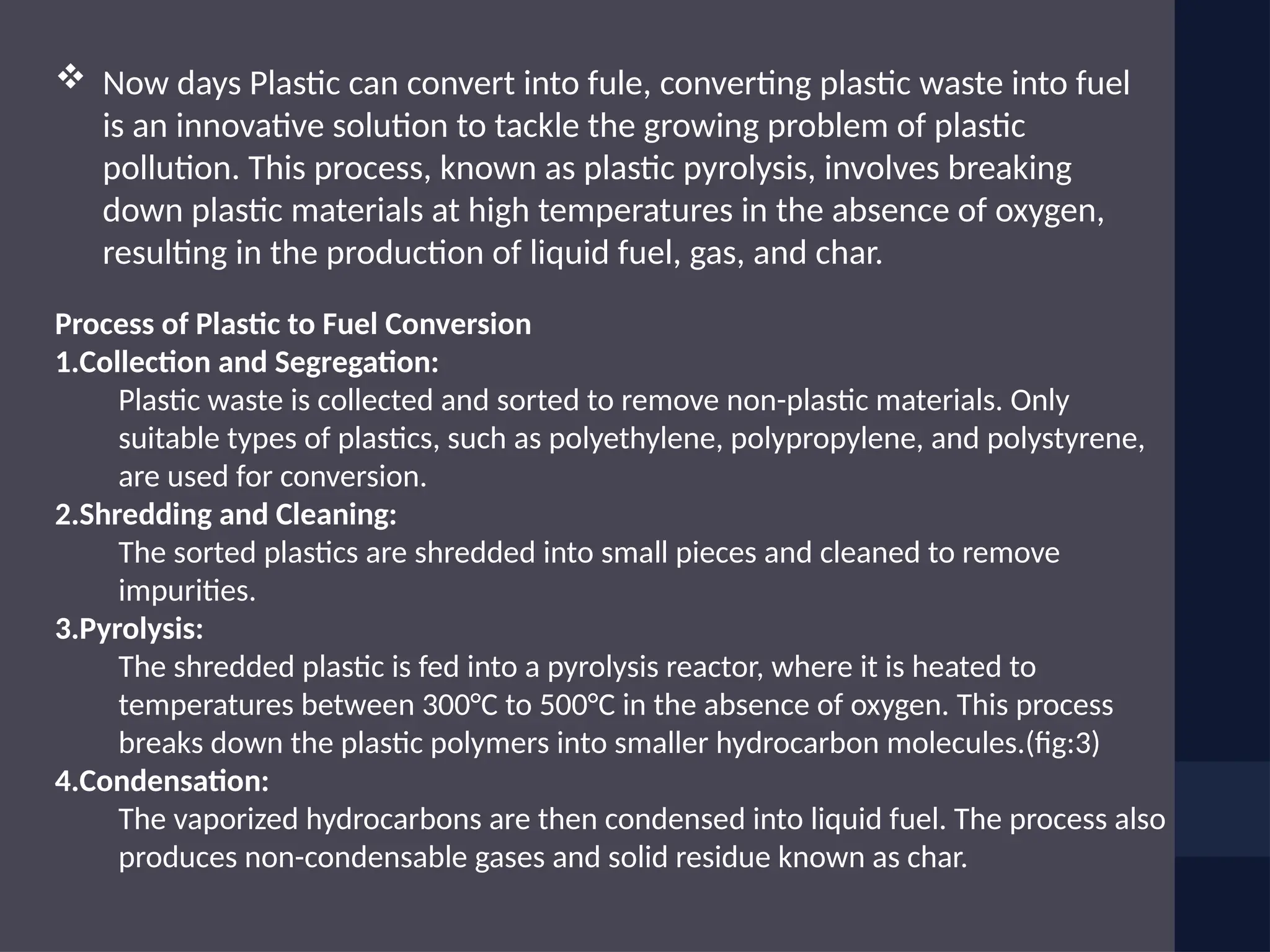
 Another dumping ground is Chandrapur,
guwahati city, with a population of over
one million, generates 550 tonnes per
day of solid waste. A GMC official told TOI
that it has applied to the PCBA for the
authorization certificate under sub-rule
(3) of rule 5 of the Hazardous Waste
(Management, Handling and
Transboundary Movement) Rules, 2008
for collection/reception/ treatment/
transport/ storage disposal of hazardous
waste in Chandrapur. The shifting of the
city's garbage dumping site from
Boragaon in West Guwahati to
Chandrapur on the eastern suburbs of
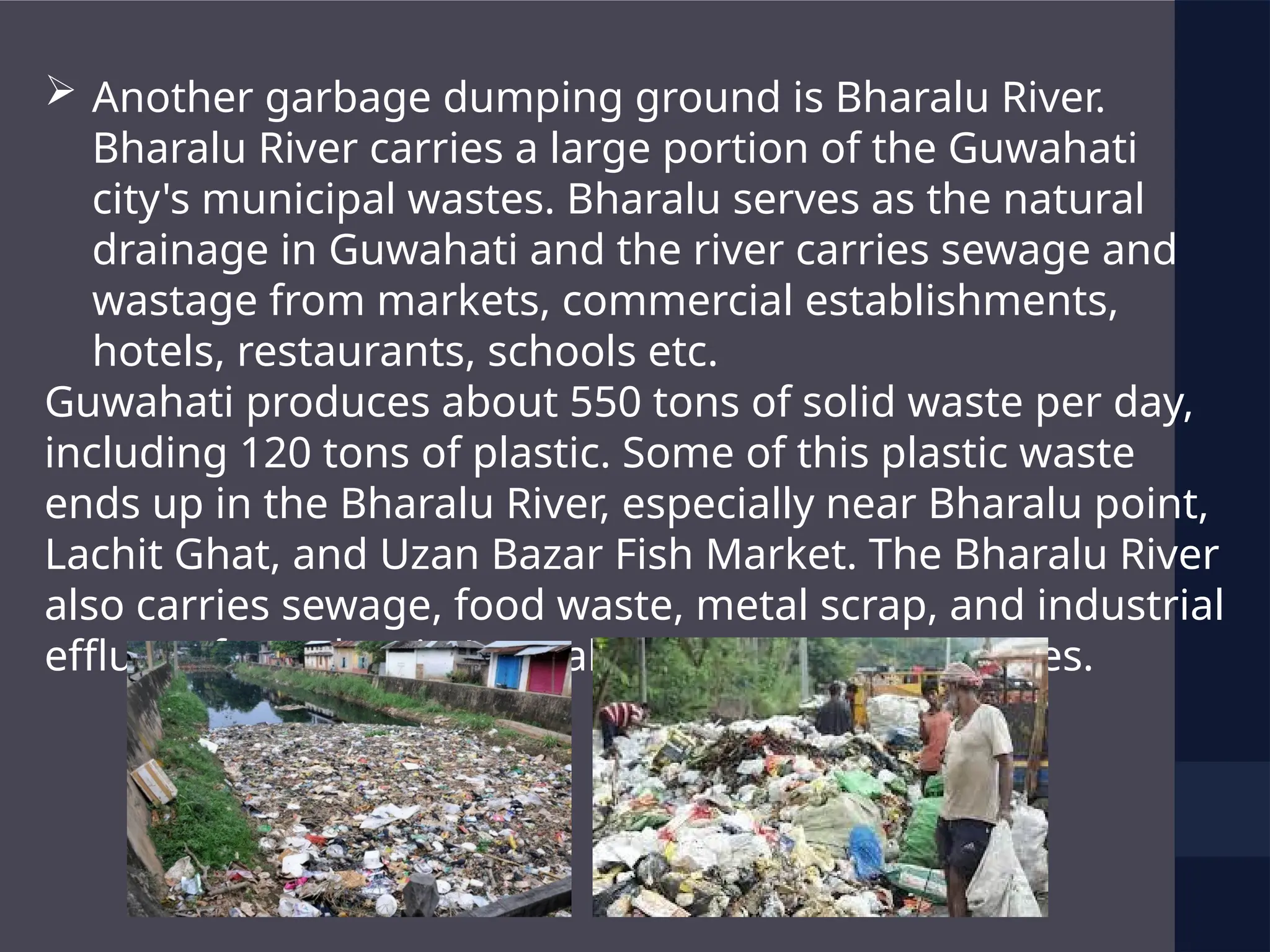
 Another garbage dumping ground is Bharalu River.
Bharalu River carries a large portion of the Guwahati
city's municipal wastes. Bharalu serves as the natural
drainage in Guwahati and the river carries sewage and
wastage from markets, commercial establishments,
hotels, restaurants, schools etc.
Guwahati produces about 550 tons of solid waste per day,
including 120 tons of plastic. Some of this plastic waste
ends up in the Bharalu River, especially near Bharalu point,
Lachit Ghat, and Uzan Bazar Fish Market. The Bharalu River
also carries sewage, food waste, metal scrap, and industrial
effluent from the city's small and medium industries.
The Guwahati Municipal
Corporation has installed
floating garbage barriers in the
city's rivulets, including Bharalu.
The barriers have been installed
to prevent waste pile-up in the
water streams and to ensure the
free flow of stormwater during
the rainy season.
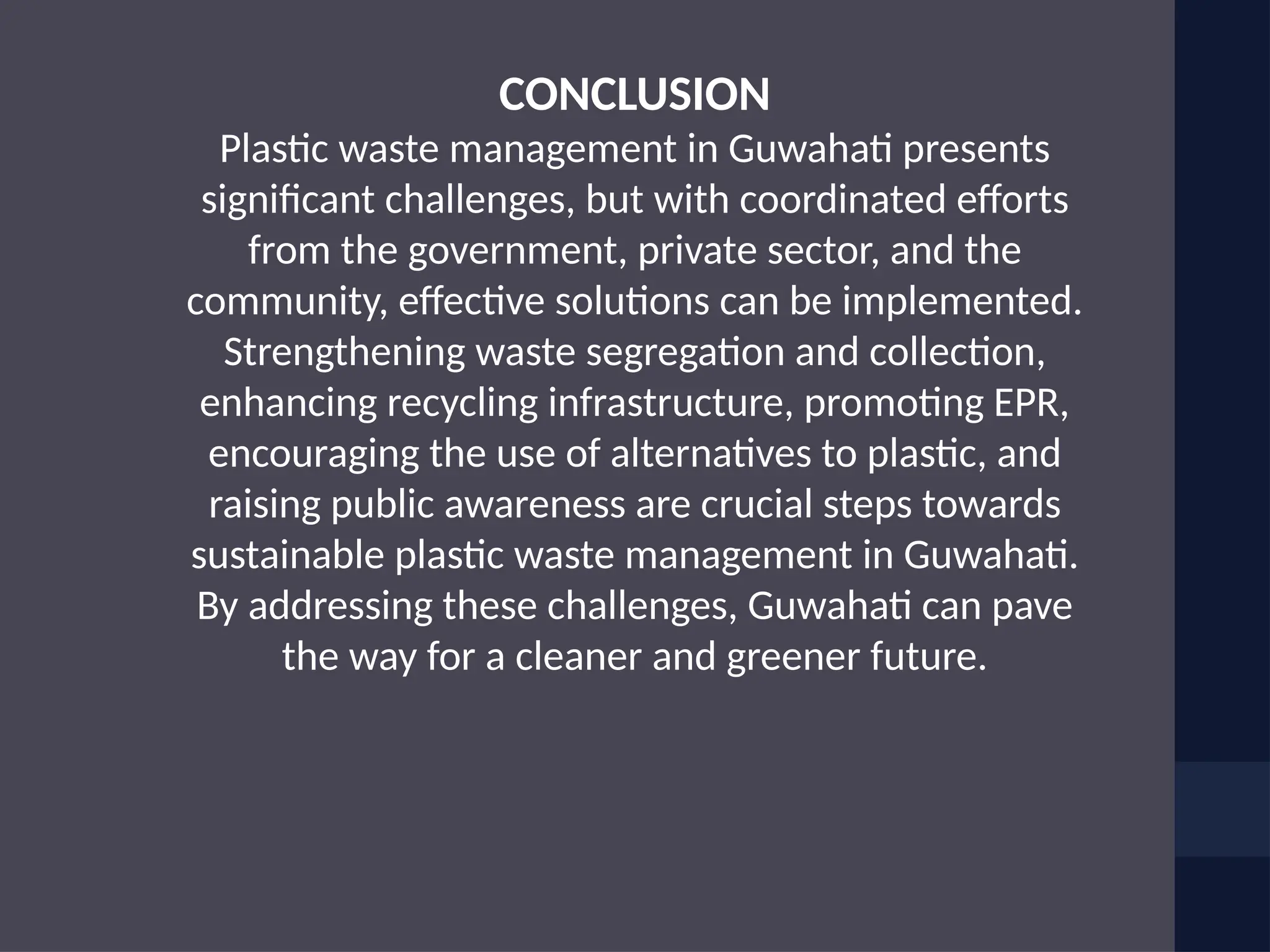
 Other Challenges in GUWAHATI is
FLOOD or else artificial flood, this
is because of poor drainage and
also the plastic that blocked the
drainage. A few drops of rain
caused major problems in
guwahati . everywhere is flooded
no transport can be occurs
Flooding in Guwahati, Assam is caused by a number of factors,
including:
•Rapid urbanization
•The city's population has grown from 11,000 in 1901
to nearly 1.1 million today, which has led to more
buildings, streets, and other hard surfaces, and fewer
wetlands.
•Drainage issues
•Drainage systems can become clogged with debris
or poorly designed and maintained. In Guwahati,
blockages in the Bharalu, Khanajan, and Bondajan
rivers can cause water from the Brahmaputra to flow
back and cause flooding in the summer.
•Water logging
•Heavy rainfall can cause water to pool in low-lying
areas, such as Zoo Road, Chandmari, Ambari, Ulubari,
Hatigaon, Dispur, Gandhi Mandap, Kalapahar, and
Christian Basti.
•Land use changes
•As the city has grown, natural and semi-natural areas
have decreased, while built-up areas have increased.
 Improving Waste Segregation and Collection
Implementing a robust waste segregation and collection system is crucial.
Providing separate bins for recyclable and non-recyclable waste and conducting
public awareness campaigns can educate citizens on the importance of waste
segregation.
 Enhancing Recycling Infrastructure
Investing in advanced recycling facilities and technologies can significantly
improve plastic waste management. Public-private partnerships can be
encouraged to set up efficient recycling plants capable of handling various types
of plastic waste.
 Promoting Extended Producer Responsibility (EPR)
EPR policies mandate that manufacturers take responsibility for the
entire lifecycle of their products, including post-consumer waste.
Implementing EPR in Guwahati can ensure that producers are involved in
the collection, recycling, and disposal of plastic waste.
 Encouraging the Use of Alternatives to Plastic
Promoting the use of eco-friendly alternatives to plastic, such as
biodegradable materials, can reduce plastic waste generation. Initiatives to
encourage businesses and consumers to adopt sustainable practices can also
make a significant impact.
 Eco-friendly materials
These include stainless steel, glass, bamboo, natural fiber cloth,
and ceramics. Stainless steel is easy to clean and can be used for
food and beverage storage. Glass can be used for plates and
containers. Bamboo can be used for straws, cutlery, and plates.
 Bioplastics
These plant-based plastics are made from renewable sources like
plants, algae, or microbial fermentation. They are considered a
greener alternative to fossil fuel-based plastics, especially for
food packaging. However, they do have their own environmental
impact, as they require land and water to grow the crops.
 Cardboard and cellulose
These are popular packaging alternatives, especially for take-
away food. They are resistant to temperature changes, which is
useful for transporting pre-prepared food.
 Community Participation and Education
Engaging the community in plastic waste management efforts is essential.
Educational programs and workshops can be conducted to raise awareness
about the environmental impact of plastic waste and the importance of
proper waste management practices.
 Government Policies and Regulations
The government should implement and enforce strict regulations on plastic
production, usage, and disposal. Policies such as bans on single-use plastics
and incentives for recycling can drive positive change.
 Now days Plastic can convert into fule, converting plastic waste into fuel
is an innovative solution to tackle the growing problem of plastic
pollution. This process, known as plastic pyrolysis, involves breaking
down plastic materials at high temperatures in the absence of oxygen,
resulting in the production of liquid fuel, gas, and char.
Process of Plastic to Fuel Conversion
1.Collection and Segregation:
Plastic waste is collected and sorted to remove non-plastic materials. Only
suitable types of plastics, such as polyethylene, polypropylene, and polystyrene,
are used for conversion.
2.Shredding and Cleaning:
The sorted plastics are shredded into small pieces and cleaned to remove
impurities.
3.Pyrolysis:
The shredded plastic is fed into a pyrolysis reactor, where it is heated to
temperatures between 300°C to 500°C in the absence of oxygen. This process
breaks down the plastic polymers into smaller hydrocarbon molecules.(fig:3)
4.Condensation:
The vaporized hydrocarbons are then condensed into liquid fuel. The process also
produces non-condensable gases and solid residue known as char.
5.Refining:
The liquid fuel is further refined to produce various types of fuel, such as diesel,
gasoline, and kerosene. The non-condensable gases can be used to fuel the pyrolysis
reactor, making the process more energy-efficient.
Fig: 3 , Plastic Pyrolysis Process
Advantages of Converting Plastic to Fuel
1.Reduction of Plastic Waste:
Converting plastic waste into fuel helps reduce the amount of plastic waste that
ends up in landfills and oceans, mitigating environmental pollution.
2.Energy Recovery:
The process recovers energy from plastic waste, transforming it into valuable fuel
that can be used for various purposes, including transportation and power
generation.
3.Economic Benefits:
The production of fuel from plastic waste can generate revenue and create jobs in
the waste management and energy sectors.
4.Reduction in Fossil Fuel Dependence:
Producing fuel from plastic waste provides an alternative source of energy,
potentially reducing dependence on conventional fossil fuels.
CONCLUSION
Plastic waste management in Guwahati presents
significant challenges, but with coordinated efforts
from the government, private sector, and the
community, effective solutions can be implemented.
Strengthening waste segregation and collection,
enhancing recycling infrastructure, promoting EPR,
encouraging the use of alternatives to plastic, and
raising public awareness are crucial steps towards
sustainable plastic waste management in Guwahati.
By addressing these challenges, Guwahati can pave
the way for a cleaner and greener future.
Ref link
1. https://gdd.assam.gov.in/portlets/solid-waste-management-sewerage.
2. https://
www.researchgate.net/publication/322538071_Municipal_Solid_Waste_M
anagement_in_Guwahati_City_India
3. https://
timesofindia.indiatimes.com/city/guwahati/gmc-to-receive-rs-1305-crore-g
rant-for-solid-waste-management-latest-news/articleshow/108313793.cms
4. https://thenewsmill.com/2017/09/garbage-woes-guwahati-residents-ngos-
refuse-waste-collection
/
5. https://
www.downtoearth.org.in/waste/why-guwahati-is-a-good-bet-for-a-zero-wa
ste-challenge-76973
6. https://link.springer.com/chapter/10.1007/978-3-031-25914-2_7

Plastic Waste Management in Guwahati: Challenges and Solutions.pptx

  • 1.
    Plastic Waste Management in Guwahati: Challengesand Solutions SUBMITTED BY, Name : Chandan Sarma Course: Waste Management Department : Botany GUWAHATI
  • 2.
    What is Wasteand it’s type and sources.. Waste is defined as anything that is no longer useful or has no purpose and needs to be disposed of. Waste can be organic or inorganic. Organic waste includes most food waste, while inorganic waste includes batteries, electronics, and metals. Waste can also be toxic, such as industrial waste.
  • 3.
    Types Of Waste Ingeneral, the wastes may be classified into the following categories: a) Solid wastes – These are the unwanted substances that are discarded by human society. These include urban wastes, industrial wastes, agricultural wastes, biomedical wastes and radioactive wastes. b) Liquid wastes – Wastes generated from washing, flushing or manufacturing processes of industries are called liquid wastes. c) Gaseous wastes – These are the wastes that are released in the form of gases from automobiles, factories or burning of fossil fuels like petroleum. They get mixed in the other gases atmosphere and occasionally cause events such as smog and acid rain.
  • 4.
    Sources Of Wastes…. Medical/Clinical Wastes: Includes surgical items, pharmaceuticals, blood, body parts, wound dressing materials, needles, and syringes.  Agricultural Wastes: Includes empty pesticide containers, old silage wrap, out- of-date medicines, used tires, surplus milk, cocoa pods, and corn husks.  Industrial Wastes: Includes wastes from manufacturing and processing industries like chemical plants, cement factories, power plants, textile industries, food processing industries, petroleum industries.  Construction or Demolition Wastes: Includes concrete debris, wood, large package boxes, and plastics from building materials. Also includes demolition waste.
  • 5.
    Commercial Wastes: Includes fooditems, disposable medical items, textiles. Mining Sources: Includes overburden material, mine tailings, and harmful gases released by blasting. Radioactive Sources: Includes nuclear reactors, mining of radioactive substances, and atomic explosions. Electronic Wastes: Includes DVDs, music players, TVs, telephones, computers, vacuum cleaners, and other non-use electrical items. Some e-waste contains harmful substances like lead, mercury, and cadmium.
  • 6.
    Waste Management  Waste managementshall mean “the collection, transport, recovery and disposal of waste, including the supervision of such operations and aftercare of disposal sites.”…. European Union Directive on Waste.  However the newer concepts of ‘Waste management’ talk about ‘Reduce, Reuse and Recycle of waste’ over and above waste disposal.
  • 7.
    Introduction to Waste Managementin Guwahati Guwahati, the bustling capital of Assam, faces a significant challenge in managing its growing waste generation. This document delves into the complexities of waste management in Guwahati, exploring its various aspects and shedding light on the initiatives, challenges, and future possibilities. From the source of the waste to its final disposal, we examine the existing systems and policies, highlighting opportunities for improvement. Understanding the intricacies of waste management is crucial for ensuring a sustainable
  • 8.
    Plastic Waste: AGlobal Concern Plastic products have become an integral part of our daily life as a result of which the polymer is produced at a massive scale worldwide. On an average, production of plastic globally crosses 150 Million tonnes per year. Its broad range of application is in packaging films, wrapping materials, shopping and garbage bags, fluid containers, clothing, toys, household and industrial products, and building materials.
  • 9.
    * Only 60%of the plastic produced is recycled, balance 9400 Tonnes of plastic is left unattended in environment causing land, air and water pollution. * 70% of Plastics packaging products are converted into plastic waste in a short span.
  • 10.
    In Guwahati alone,generation of plastic waste worsen the situation with more than 5000 kg/day as per the report (Anonymous, 2004) among the plastic waste generation carry bag accounts for 15% only. Whereas plastic carry bag is considered as the major responsible for clogging of drain and artificial water logging due to the use and throw practices by the citizens. Accordingly Government of Assam has banned use of plastic carry
  • 11.
    But in realityall plastic carry bags even below 20 microns are also recyclable and collected by the rag pickers. Moreover citizens are selling most of the recyclable plastic to the waste pickers and usually they throw away the multi layered non recyclable plastic. Even due to lack of knowledge people throw recyclable plastic like carry bag, pouch pack of vegetable oil, ‘Tata salt’, bread etc. Therefore it is becoming necessary to study about the generation of plastic waste type and its potentiality for the urban poor development specially the
  • 12.
    Solid waste generationin Guwahati During the study, various solid waste types are collected and differentiated as biodegradable, plastic, glass and metal waste and accordingly compiled the total generation; which is contributing as 57%, 1%, 14% and 28% respectably in the total waste generation scenario (shown in Fig. 1) Figure 1. The generation of different Solid waste types in the Guwahati
  • 13.
    Collection of plasticwaste Recycling is the best way of plastic waste management (Singhal & Pandey, 2001). Basically there are four different ways of recycling plastics: 1. Primary recycling: Conversion of waste plastics into products having similar performance level comparable to that of original products made from virgin plastics.
  • 14.
    2. Secondary recycling:Conversion of waste plastics into products having less demanding performance requirements than the original material. 3. Tertiary recycling: The process of producing chemicals, fuels or similar products from waste plastics. 4. Quaternary recycling: The process of recovering energy from waste plastics by incineration. In Guwahati only primary and secondary plastic recycling industries are available with 10 nos. of plastic recycling industries and 10% of the total plastic waste generated inside the city goes to these industries.
  • 15.
    Differentiation of theplastic waste On the basis of present recycling scenario of Guwahati, recyclable and non-recyclable plastics are systematically differentiated (Kashyap et al., 2006, 2009a). There are two types of plastics ---- (i) Recyclable plastic (RP) (ii) Non-recyclable plastic (NRP) (i) Recyclable plastic (RP) Plastic Carry Bags and Packaging • Made of LLDPE, HMHDPE, PP. • Used for tea, coffee, water, ice cream. • Used for drinking water, cold drinks, fruit juice, medicine, cosmetics, shampoo, detergent, injectable saline, edible oil, automobile lubricants, mosquito repellent. • Single-layered plastic pouch packs for vegetable oil, salt, milk. • Used in RCC construction and other materials. • Also used for damaged plastic sheet, thread, pipes, bucket, mug, disposable syringe, etc.
  • 16.
    (ii)Non-recyclable plastic (NRP) PlasticPackaging Overview • Multi-layered plastic packaging for various products including potato chips, tea, coffee, biscuits, snacks, spices, noodles, chocolate, etc. • Medicine blister strip made of PE and aluminum foil. • Plastic laminated on paper packs made of paper, PET, or PE. • Laminated cover pages of books, magazines, and souvenirs. • Combination of plastic and paper in battery cases. • Mixture of PVC, Polyester, PET in tooth paste, medicine, cosmetics tubes, pen, comb. • Aseptic packaging for liquid substances like milk, vegetable oil, fruit juice, and soft drinks.
  • 17.
    Generation of householdplastic waste Out of the 60 wards under the Guwahati Municipal Corporation 10 wards were considered for thorough study of household generation of plastic waste and differentiated as per the recycling potentiality: It is estimated that out of the total plastic generated from household 60% is recyclable plastic and 40% is non- recyclable plastic. Figure 2. The proportion of RP and NRP in the roadside drain (in kg per 5 kg of sample)
  • 18.
    Role of ragpickers on non-biodegradable solid waste management Rag-pickers in Guwahati city collect recyclable waste, mainly plastics, from roadside drains and dumping sites. Around 10,000 rag- pickers earn between Rs. 1.00 and Rs. 200.00 per day, but only collect 10% of the total plastic waste generation, 70% of tin and iron, and 50% of glass and bottles. Guwahati has 10 plastic recycling units and 20 in Assam. Based on questionnaire surveys, 89 tons of waste are collected for recycling, with 65 tonnes recycled daily. A significant portion of these recyclables comes from metal scrap, cardboard, and glass bottles.
  • 19.
    CHALLENGES Plastic waste managementin Guwahati, Assam faces several challenges, including: •Lack of awareness: People may not be aware of the threat plastic pollution poses to the environment and human health. •Inadequate infrastructure: There may not be enough infrastructure for waste segregation and recycling. •Limited resources: There may not be enough resources to enforce regulations. •Informal sector: The informal sector may be involved in plastic waste. •Dumping: Guwahati dumps about 500 tonnes of solid waste every day, including 95% at the Boragaon site, which is near a wetland and bird habitat.
  • 20.
    Waste management isthe primary responsibility of Guwahati Municipal Corporation (GMC), which overlooks the day-to-day operations and affairs such as primary collection, secondary collection, home composting, processing and disposal of solid waste. The city generates approximately 550 tonnes per day (TPD) of solid waste — more than 85 per cent of which finds its way to the dumpsite located at Boragaon, apart from the numerous other small garbage vulnerable points which can be seen in the city. Guwahati has a windrow technology compost plant of 50 TPD in Boragaon. It has been functional since 2010, and a proposal for augmenting its capacity to 200 TPD has been proposed. GMC initiated a project for purchasing dry waste from its citizens to promote segregation of municipal solid waste (MSW). Awareness and home composting is being promoted through pilot projects. Indian Institute of Technology-Kharagpur has been engaged by GMC as consultant to help improve the municipal waste management system in Guwahati.  In Guwahati the main issue in waste management is dumping ground, around the total waste 90-95% of waste dump in Boragaon Disposal site. And this is located in the middle of a
  • 21.
    According to experts,many fish species in Deepor Beel have become extinct and many are facing the threat of extinction because of continuous water pollution. Further alteration of the “beel” landscape can cause flash floods. The wetland ecosystem is disturbed by the railroad in its southern boundary.  Another dumping ground is Chandrapur, guwahati city, with a population of over one million, generates 550 tonnes per day of solid waste. A GMC official told TOI that it has applied to the PCBA for the authorization certificate under sub-rule (3) of rule 5 of the Hazardous Waste (Management, Handling and Transboundary Movement) Rules, 2008 for collection/reception/ treatment/ transport/ storage disposal of hazardous waste in Chandrapur. The shifting of the city's garbage dumping site from Boragaon in West Guwahati to Chandrapur on the eastern suburbs of
  • 22.
     Another garbagedumping ground is Bharalu River. Bharalu River carries a large portion of the Guwahati city's municipal wastes. Bharalu serves as the natural drainage in Guwahati and the river carries sewage and wastage from markets, commercial establishments, hotels, restaurants, schools etc. Guwahati produces about 550 tons of solid waste per day, including 120 tons of plastic. Some of this plastic waste ends up in the Bharalu River, especially near Bharalu point, Lachit Ghat, and Uzan Bazar Fish Market. The Bharalu River also carries sewage, food waste, metal scrap, and industrial effluent from the city's small and medium industries.
  • 23.
    The Guwahati Municipal Corporationhas installed floating garbage barriers in the city's rivulets, including Bharalu. The barriers have been installed to prevent waste pile-up in the water streams and to ensure the free flow of stormwater during the rainy season.  Other Challenges in GUWAHATI is FLOOD or else artificial flood, this is because of poor drainage and also the plastic that blocked the drainage. A few drops of rain caused major problems in guwahati . everywhere is flooded no transport can be occurs
  • 24.
    Flooding in Guwahati,Assam is caused by a number of factors, including: •Rapid urbanization •The city's population has grown from 11,000 in 1901 to nearly 1.1 million today, which has led to more buildings, streets, and other hard surfaces, and fewer wetlands. •Drainage issues •Drainage systems can become clogged with debris or poorly designed and maintained. In Guwahati, blockages in the Bharalu, Khanajan, and Bondajan rivers can cause water from the Brahmaputra to flow back and cause flooding in the summer. •Water logging •Heavy rainfall can cause water to pool in low-lying areas, such as Zoo Road, Chandmari, Ambari, Ulubari, Hatigaon, Dispur, Gandhi Mandap, Kalapahar, and Christian Basti. •Land use changes •As the city has grown, natural and semi-natural areas have decreased, while built-up areas have increased.
  • 25.
     Improving WasteSegregation and Collection Implementing a robust waste segregation and collection system is crucial. Providing separate bins for recyclable and non-recyclable waste and conducting public awareness campaigns can educate citizens on the importance of waste segregation.
  • 26.
     Enhancing RecyclingInfrastructure Investing in advanced recycling facilities and technologies can significantly improve plastic waste management. Public-private partnerships can be encouraged to set up efficient recycling plants capable of handling various types of plastic waste.
  • 27.
     Promoting ExtendedProducer Responsibility (EPR) EPR policies mandate that manufacturers take responsibility for the entire lifecycle of their products, including post-consumer waste. Implementing EPR in Guwahati can ensure that producers are involved in the collection, recycling, and disposal of plastic waste.
  • 28.
     Encouraging theUse of Alternatives to Plastic Promoting the use of eco-friendly alternatives to plastic, such as biodegradable materials, can reduce plastic waste generation. Initiatives to encourage businesses and consumers to adopt sustainable practices can also make a significant impact.  Eco-friendly materials These include stainless steel, glass, bamboo, natural fiber cloth, and ceramics. Stainless steel is easy to clean and can be used for food and beverage storage. Glass can be used for plates and containers. Bamboo can be used for straws, cutlery, and plates.  Bioplastics These plant-based plastics are made from renewable sources like plants, algae, or microbial fermentation. They are considered a greener alternative to fossil fuel-based plastics, especially for food packaging. However, they do have their own environmental impact, as they require land and water to grow the crops.  Cardboard and cellulose These are popular packaging alternatives, especially for take- away food. They are resistant to temperature changes, which is useful for transporting pre-prepared food.
  • 29.
     Community Participationand Education Engaging the community in plastic waste management efforts is essential. Educational programs and workshops can be conducted to raise awareness about the environmental impact of plastic waste and the importance of proper waste management practices.  Government Policies and Regulations The government should implement and enforce strict regulations on plastic production, usage, and disposal. Policies such as bans on single-use plastics and incentives for recycling can drive positive change.
  • 30.
     Now daysPlastic can convert into fule, converting plastic waste into fuel is an innovative solution to tackle the growing problem of plastic pollution. This process, known as plastic pyrolysis, involves breaking down plastic materials at high temperatures in the absence of oxygen, resulting in the production of liquid fuel, gas, and char. Process of Plastic to Fuel Conversion 1.Collection and Segregation: Plastic waste is collected and sorted to remove non-plastic materials. Only suitable types of plastics, such as polyethylene, polypropylene, and polystyrene, are used for conversion. 2.Shredding and Cleaning: The sorted plastics are shredded into small pieces and cleaned to remove impurities. 3.Pyrolysis: The shredded plastic is fed into a pyrolysis reactor, where it is heated to temperatures between 300°C to 500°C in the absence of oxygen. This process breaks down the plastic polymers into smaller hydrocarbon molecules.(fig:3) 4.Condensation: The vaporized hydrocarbons are then condensed into liquid fuel. The process also produces non-condensable gases and solid residue known as char.
  • 31.
    5.Refining: The liquid fuelis further refined to produce various types of fuel, such as diesel, gasoline, and kerosene. The non-condensable gases can be used to fuel the pyrolysis reactor, making the process more energy-efficient. Fig: 3 , Plastic Pyrolysis Process
  • 32.
    Advantages of ConvertingPlastic to Fuel 1.Reduction of Plastic Waste: Converting plastic waste into fuel helps reduce the amount of plastic waste that ends up in landfills and oceans, mitigating environmental pollution. 2.Energy Recovery: The process recovers energy from plastic waste, transforming it into valuable fuel that can be used for various purposes, including transportation and power generation. 3.Economic Benefits: The production of fuel from plastic waste can generate revenue and create jobs in the waste management and energy sectors. 4.Reduction in Fossil Fuel Dependence: Producing fuel from plastic waste provides an alternative source of energy, potentially reducing dependence on conventional fossil fuels.
  • 33.
    CONCLUSION Plastic waste managementin Guwahati presents significant challenges, but with coordinated efforts from the government, private sector, and the community, effective solutions can be implemented. Strengthening waste segregation and collection, enhancing recycling infrastructure, promoting EPR, encouraging the use of alternatives to plastic, and raising public awareness are crucial steps towards sustainable plastic waste management in Guwahati. By addressing these challenges, Guwahati can pave the way for a cleaner and greener future.
  • 34.
    Ref link 1. https://gdd.assam.gov.in/portlets/solid-waste-management-sewerage. 2.https:// www.researchgate.net/publication/322538071_Municipal_Solid_Waste_M anagement_in_Guwahati_City_India 3. https:// timesofindia.indiatimes.com/city/guwahati/gmc-to-receive-rs-1305-crore-g rant-for-solid-waste-management-latest-news/articleshow/108313793.cms 4. https://thenewsmill.com/2017/09/garbage-woes-guwahati-residents-ngos- refuse-waste-collection / 5. https:// www.downtoearth.org.in/waste/why-guwahati-is-a-good-bet-for-a-zero-wa ste-challenge-76973 6. https://link.springer.com/chapter/10.1007/978-3-031-25914-2_7