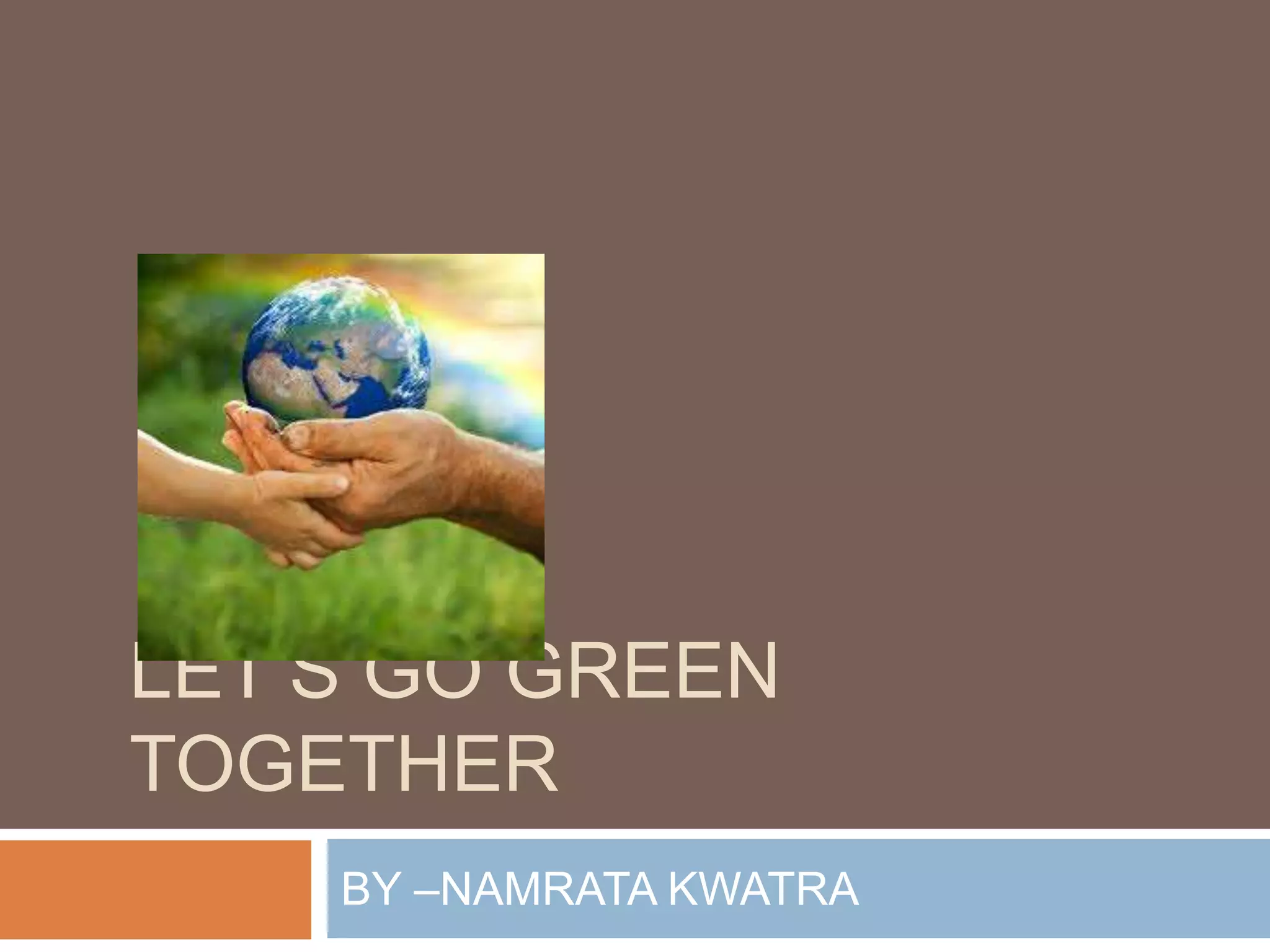
LET’S GO GREEN
TOGETHER
BY –NAMRATA KWATRA
SWACHH BHARAT
WE HAVE TO THINK-
• WHAT WE ARE USING?
• WHAT IS ACTUALLY HAPPENING TO THE WASTE THAT WE
DISPOSE OFF?
SWACHH BHARAT CAN NOT ONLY BE ACHIEVED BY KEEPING OUR HOUSES AND
ROADS CLEAN.
WHY WE SHOULD
CARE
Delhi, the sixth-most populated metropolis in the
world, is one of the most heavily polluted cities in
India, having for instance one of the country's highest
volumes of particulate matter pollution. In May 2014
the World Health Organization announced New
Delhi as the most polluted city in the world
CHEMICAL INTRUDERS
After World War II thousands of synthetic chemicals were
introduced in commercial use for the boom in industrial
production. Many of these chemicals proved beneficial in pest
and disease control, crop production, and industry. These same
chemicals, however, have had unforeseen effects on human
health and the environment.
Intentionally produced chemicals currently or once used in
agriculture, disease control, manufacturing, or industrial
processes.
Unintentionally produced chemicals, such as dioxins, that
result from some industrial processes and from combustion (for
example, municipal and medical waste incineration and
backyard burning of trash, manufacturing and processing of
plastic)
CHEMICAL INTRUDERS
•Persistent in environment
•Long-range transport leads to global
pollution
•Tendency to remain in fat-rich tissues
•Accumulate in food chain
•High levels in fish and marine mammals
•Acute toxicity well characterized
CHEMICAL INTRUDERS
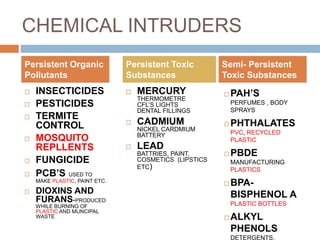
 INSECTICIDES
 PESTICIDES
 TERMITE
CONTROL
 MOSQUITO
REPLLENTS
 FUNGICIDE
 PCB’S USED TO
MAKE PLASTIC, PAINT ETC.
 DIOXINS AND
FURANS-PRODUCED
WHILE BURNING OF
PLASTIC AND MUNCIPAL
WASTE
 MERCURY
THERMOMETRE
CFL’S LIGHTS
DENTAL FILLINGS
 CADMIUM
NICKEL CARDMIUM
BATTERY
 LEAD
BATTRIES, PAINT,
COSMETICS (LIPSTICS
ETC)
Semi- Persistent
Toxic Substances
Persistent Toxic
Substances
Persistent Organic
Pollutants
 PAH’S
PERFUMES , BODY
SPRAYS
 PHTHALATES
PVC, RECYCLED
PLASTIC
 PBDE
MANUFACTURING
PLASTICS
 BPA-
BISPHENOL A
PLASTIC BOTTLES
 ALKYL
PHENOLS
DETERGENTS,
ROUTES OF ENTRY OF TOXIC
SUBSTANCES
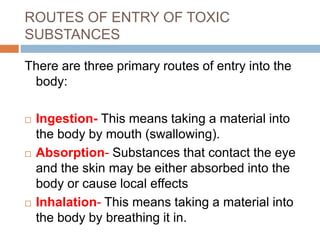
There are three primary routes of entry into the
body:
 Ingestion- This means taking a material into
the body by mouth (swallowing).
 Absorption- Substances that contact the eye
and the skin may be either absorbed into the
body or cause local effects
 Inhalation- This means taking a material into
the body by breathing it in.
COMMONLY USED POISIONS
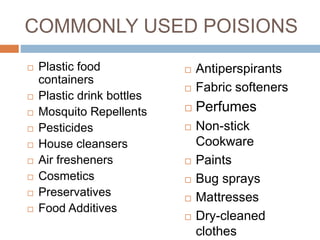
 Plastic food
containers
 Plastic drink bottles
 Mosquito Repellents
 Pesticides
 House cleansers
 Air fresheners
 Cosmetics
 Preservatives
 Food Additives
 Antiperspirants
 Fabric softeners
 Perfumes
 Non-stick
Cookware
 Paints
 Bug sprays
 Mattresses
 Dry-cleaned
clothes
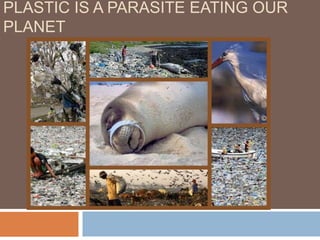
PLASTIC IS A PARASITE EATING OUR
PLANET
•NON BIODEGRADABLE-PERMANENT DUMP ON EARTH
•HIGHLY TOXIC TO BODY AND ENVIRONMENT
•PETROLEUM PRODUCT
•SERIOUSLY IMPAIRING AN ALREADY FRAGILE
ECOSYSTEM
•HOT FOOD IN CONTACT WITH PLASTIC IS
CARCINOGENIC
•MICROWAVING FOOD IN PLASTIC IS CARCINOGENIC
•ACTS AS XENOESTROGEN
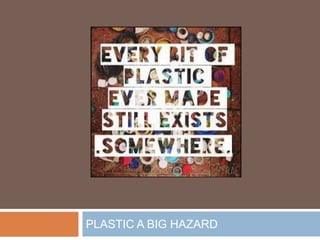
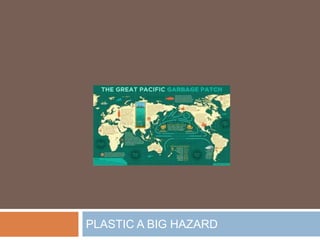
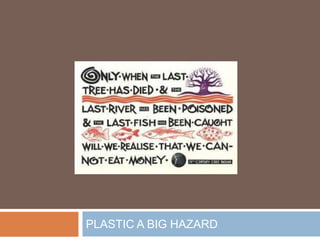
PLASTIC A BIG HAZARD
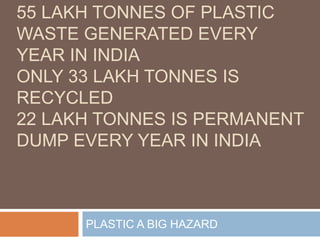
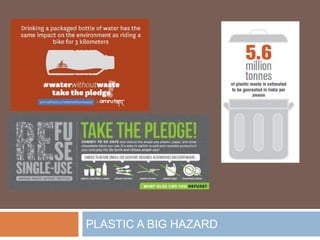
55 LAKH TONNES OF PLASTIC
WASTE GENERATED EVERY
YEAR IN INDIA
ONLY 33 LAKH TONNES IS
RECYCLED
22 LAKH TONNES IS PERMANENT
DUMP EVERY YEAR IN INDIA
PLASTIC A BIG HAZARD
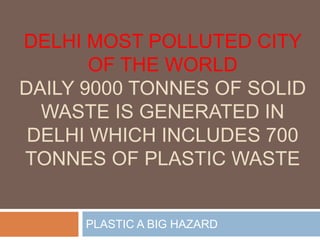
DELHI MOST POLLUTED CITY
OF THE WORLD
DAILY 9000 TONNES OF SOLID
WASTE IS GENERATED IN
DELHI WHICH INCLUDES 700
TONNES OF PLASTIC WASTE
PLASTIC A BIG HAZARD
WHILE MAKING AND BURNING PLASTIC
WHICH IS ONE OF THE PERSISTENT
ORGANIC POLLUTENT
PHALATES A CHEMICAL USED TO MAKE
PLASTIC IS A ENDOCRINE DISRUPTER
ALSO LINKED TO CANCER, DIABETES ,
HEART PROBLEM, OBESITY. AS IT
ENTERS FOOD CHAIN BY LEACHING IN
FOOD OR BY INGESTED BY SEA AND
LAND ANIMALS.
PLASTIC A BIG HAZARD
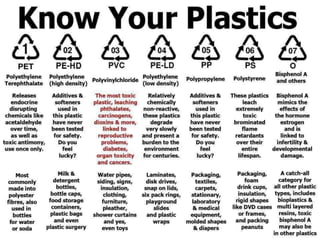
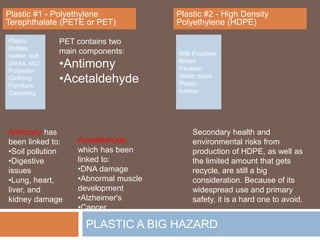
Antimony has
been linked to:
•Soil pollution
•Digestive
issues
•Lung, heart,
liver, and
kidney damage
PET contains two
main components:
•Antimony
•Acetaldehyde
Plastic #1 - Polyethylene
Terephthalate (PETE or PET)
Plastic
Bottles
(water, soft
drinks, etc)
Polyester
Clothing
Furniture
Carpeting
Acetaldehyde
which has been
linked to:
•DNA damage
•Abnormal muscle
development
•Alzheimer's
•Cancer.
Plastic #2 - High Density
Polyethylene (HDPE)
Milk Pouches
Bread
Packets
Water pipes
Plastic
lumber
Secondary health and
environmental risks from
production of HDPE, as well as
the limited amount that gets
recycle, are still a big
consideration. Because of its
widespread use and primary
safety, it is a hard one to avoid.
PLASTIC A BIG HAZARD
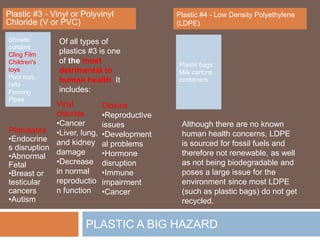
Phthalates
•Endocrine
s disruption
•Abnormal
Fetal
•Breast or
testicular
cancers
•Autism
Of all types of
plastics #3 is one
of the most
detrimental to
human health. It
includes:
Plastic #3 - Vinyl or Polyvinyl
Chloride (V or PVC)
Shower
curtains
Cling Film
Children's
toys
Pool toys,
rafts
Fencing
Pipes
Vinyl
chloride
•Cancer
•Liver, lung,
and kidney
damage
•Decrease
in normal
reproductio
n function
Plastic #4 - Low Density Polyethylene
(LDPE)
Plastic bags
Milk cartons
containers
Although there are no known
human health concerns, LDPE
is sourced for fossil fuels and
therefore not renewable, as well
as not being biodegradable and
poses a large issue for the
environment since most LDPE
(such as plastic bags) do not get
recycled.
Dioxins
•Reproductive
issues
•Development
al problems
•Hormone
disruption
•Immune
impairment
•Cancer
PLASTIC A BIG HAZARD
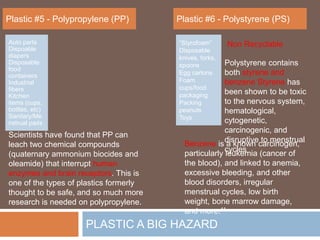
Scientists have found that PP can
leach two chemical compounds
(quaternary ammonium biocides and
oleamide) that interrupt human
enzymes and brain receptors. This is
one of the types of plastics formerly
thought to be safe, and so much more
research is needed on polypropylene.
Polystyrene contains
both styrene and
benzene Styrene has
been shown to be toxic
to the nervous system,
hematological,
cytogenetic,
carcinogenic, and
disruptive to menstrual
cycles
Plastic #5 - Polypropylene (PP)
Auto parts
Dispoable
diapers
Disposable
food
containers
Industrial
fibers
Kitchen
items (cups,
bottles, etc)
Sanitary/Me
nstrual pads
Plastic #6 - Polystyrene (PS)
“Styrofoam”
Disposable
knives, forks,
spoons
Egg cartons
Foam
cups/food
packaging
Packing
peanuts
Toys
Benzene is a known carcinogen,
particularly leukemia (cancer of
the blood), and linked to anemia,
excessive bleeding, and other
blood disorders, irregular
menstrual cycles, low birth
weight, bone marrow damage,
and more.11
Non Recyclable
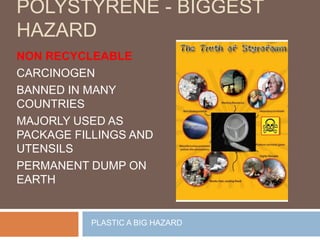
POLYSTYRENE - BIGGEST
HAZARD
NON RECYCLEABLE
CARCINOGEN
BANNED IN MANY
COUNTRIES
MAJORLY USED AS
PACKAGE FILLINGS AND
UTENSILS
PERMANENT DUMP ON
EARTH
PLASTIC A BIG HAZARD
FOOD COMING INTO CONTACT WITH
PLASTIC
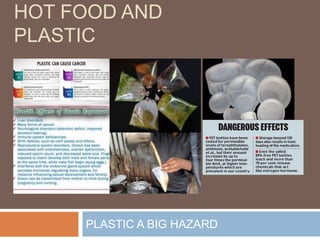
Plastic leach chemicals into the food
Hot foods when served in plastic
Storage of food in plastic
Packed food in hot climate speeds up the leaching
Microwaving food in plastic
When it is consumed by us it accumulates in our body which is toxic and may harm us in future.
PLASTIC A BIG HAZARD
Phthalates—Used as plasticizers -Endocrine Distrupter
Impotency, sterility, Testicular cancer, Prostate in males
Fibroids, Breast cancer Early menopause, Osteoporosis in females
Obesity, Early puberty, Neuropsychiatric disorders, Endocrine disturbances in
children.
It is a reason behind higher incidence of Diabetes, Hypertension and Coronary artery
disease.in relation to endocrine disrupting compounds is the potential time lag between
exposure and the manifestations of the clinical disorders. In humans, this period may
be years or decades and hence consequences of developmental exposure may be
manifested in adulthood or during aging process.
PLASTIC A BIG HAZARD
FOOD COMING INTO CONTACT WITH
PLASTIC
•RECYCLED PLASTIC WHICH IS
WIDELY
USED TO SERVE HOT TEA AND
HOT
FOOD
•POLYSTYRENE /STYROFOAM
•PE LAYERED CONTAINERS
•LAMINATED PAPER PLATES AND
CUPS
•PLASTIC TIFFINS
•PLASTIC WATER BOTTLES
•PAPER PLATES MADE OF
PRINTED MATERIAL(AS
PRINTING DYES CONTAIN TOXIC
CHEMICALS)
•RECYCLED PLASTIC
CONTAINERS
•POYTHENE BAGS
•PP CONTAINERS
•STYROFOAM CONTAINERS
•PVC IN CLING FILM THAT COME IN
CONTACT OF FOOD.
FOOD SERVED IN FOOD PACKED IN.
HOT FOOD AND
PLASTIC
PLASTIC A BIG HAZARD
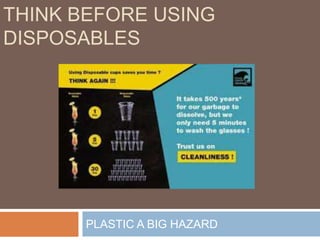
THINK BEFORE USING
DISPOSABLES
PLASTIC A BIG HAZARD
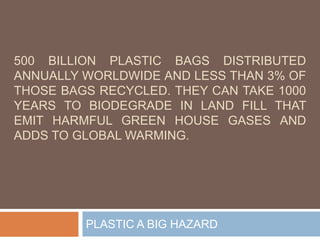
500 BILLION PLASTIC BAGS DISTRIBUTED
ANNUALLY WORLDWIDE AND LESS THAN 3% OF
THOSE BAGS RECYCLED. THEY CAN TAKE 1000
YEARS TO BIODEGRADE IN LAND FILL THAT
EMIT HARMFUL GREEN HOUSE GASES AND
ADDS TO GLOBAL WARMING.
PLASTIC A BIG HAZARD
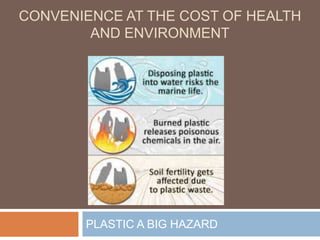
CONVENIENCE AT THE COST OF HEALTH
AND ENVIRONMENT
PLASTIC A BIG HAZARD
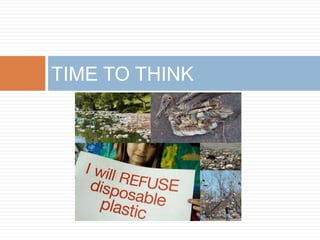
TIME TO THINK
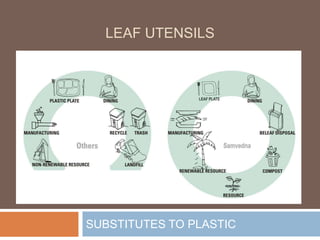
SUBSTITUTES TO PLASTIC
LEAF UTENSILS
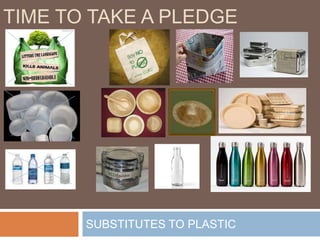
TIME TO TAKE A PLEDGE
SUBSTITUTES TO PLASTIC

Plastic

  • 1.
  • 2.
    SWACHH BHARAT WE HAVETO THINK- • WHAT WE ARE USING? • WHAT IS ACTUALLY HAPPENING TO THE WASTE THAT WE DISPOSE OFF? SWACHH BHARAT CAN NOT ONLY BE ACHIEVED BY KEEPING OUR HOUSES AND ROADS CLEAN.
  • 3.
    WHY WE SHOULD CARE Delhi,the sixth-most populated metropolis in the world, is one of the most heavily polluted cities in India, having for instance one of the country's highest volumes of particulate matter pollution. In May 2014 the World Health Organization announced New Delhi as the most polluted city in the world
  • 4.
    CHEMICAL INTRUDERS After WorldWar II thousands of synthetic chemicals were introduced in commercial use for the boom in industrial production. Many of these chemicals proved beneficial in pest and disease control, crop production, and industry. These same chemicals, however, have had unforeseen effects on human health and the environment. Intentionally produced chemicals currently or once used in agriculture, disease control, manufacturing, or industrial processes. Unintentionally produced chemicals, such as dioxins, that result from some industrial processes and from combustion (for example, municipal and medical waste incineration and backyard burning of trash, manufacturing and processing of plastic)
  • 5.
    CHEMICAL INTRUDERS •Persistent inenvironment •Long-range transport leads to global pollution •Tendency to remain in fat-rich tissues •Accumulate in food chain •High levels in fish and marine mammals •Acute toxicity well characterized
  • 6.
    CHEMICAL INTRUDERS  INSECTICIDES PESTICIDES  TERMITE CONTROL  MOSQUITO REPLLENTS  FUNGICIDE  PCB’S USED TO MAKE PLASTIC, PAINT ETC.  DIOXINS AND FURANS-PRODUCED WHILE BURNING OF PLASTIC AND MUNCIPAL WASTE  MERCURY THERMOMETRE CFL’S LIGHTS DENTAL FILLINGS  CADMIUM NICKEL CARDMIUM BATTERY  LEAD BATTRIES, PAINT, COSMETICS (LIPSTICS ETC) Semi- Persistent Toxic Substances Persistent Toxic Substances Persistent Organic Pollutants  PAH’S PERFUMES , BODY SPRAYS  PHTHALATES PVC, RECYCLED PLASTIC  PBDE MANUFACTURING PLASTICS  BPA- BISPHENOL A PLASTIC BOTTLES  ALKYL PHENOLS DETERGENTS,
  • 7.
    ROUTES OF ENTRYOF TOXIC SUBSTANCES There are three primary routes of entry into the body:  Ingestion- This means taking a material into the body by mouth (swallowing).  Absorption- Substances that contact the eye and the skin may be either absorbed into the body or cause local effects  Inhalation- This means taking a material into the body by breathing it in.
  • 8.
    COMMONLY USED POISIONS Plastic food containers  Plastic drink bottles  Mosquito Repellents  Pesticides  House cleansers  Air fresheners  Cosmetics  Preservatives  Food Additives  Antiperspirants  Fabric softeners  Perfumes  Non-stick Cookware  Paints  Bug sprays  Mattresses  Dry-cleaned clothes
  • 9.
    PLASTIC IS APARASITE EATING OUR PLANET
  • 10.
    •NON BIODEGRADABLE-PERMANENT DUMPON EARTH •HIGHLY TOXIC TO BODY AND ENVIRONMENT •PETROLEUM PRODUCT •SERIOUSLY IMPAIRING AN ALREADY FRAGILE ECOSYSTEM •HOT FOOD IN CONTACT WITH PLASTIC IS CARCINOGENIC •MICROWAVING FOOD IN PLASTIC IS CARCINOGENIC •ACTS AS XENOESTROGEN
  • 11.
  • 12.
  • 13.
    55 LAKH TONNESOF PLASTIC WASTE GENERATED EVERY YEAR IN INDIA ONLY 33 LAKH TONNES IS RECYCLED 22 LAKH TONNES IS PERMANENT DUMP EVERY YEAR IN INDIA PLASTIC A BIG HAZARD
  • 14.
    DELHI MOST POLLUTEDCITY OF THE WORLD DAILY 9000 TONNES OF SOLID WASTE IS GENERATED IN DELHI WHICH INCLUDES 700 TONNES OF PLASTIC WASTE PLASTIC A BIG HAZARD
  • 16.
    WHILE MAKING ANDBURNING PLASTIC WHICH IS ONE OF THE PERSISTENT ORGANIC POLLUTENT PHALATES A CHEMICAL USED TO MAKE PLASTIC IS A ENDOCRINE DISRUPTER ALSO LINKED TO CANCER, DIABETES , HEART PROBLEM, OBESITY. AS IT ENTERS FOOD CHAIN BY LEACHING IN FOOD OR BY INGESTED BY SEA AND LAND ANIMALS. PLASTIC A BIG HAZARD
  • 18.
    PLASTIC A BIGHAZARD Antimony has been linked to: •Soil pollution •Digestive issues •Lung, heart, liver, and kidney damage PET contains two main components: •Antimony •Acetaldehyde Plastic #1 - Polyethylene Terephthalate (PETE or PET) Plastic Bottles (water, soft drinks, etc) Polyester Clothing Furniture Carpeting Acetaldehyde which has been linked to: •DNA damage •Abnormal muscle development •Alzheimer's •Cancer. Plastic #2 - High Density Polyethylene (HDPE) Milk Pouches Bread Packets Water pipes Plastic lumber Secondary health and environmental risks from production of HDPE, as well as the limited amount that gets recycle, are still a big consideration. Because of its widespread use and primary safety, it is a hard one to avoid.
  • 19.
    PLASTIC A BIGHAZARD Phthalates •Endocrine s disruption •Abnormal Fetal •Breast or testicular cancers •Autism Of all types of plastics #3 is one of the most detrimental to human health. It includes: Plastic #3 - Vinyl or Polyvinyl Chloride (V or PVC) Shower curtains Cling Film Children's toys Pool toys, rafts Fencing Pipes Vinyl chloride •Cancer •Liver, lung, and kidney damage •Decrease in normal reproductio n function Plastic #4 - Low Density Polyethylene (LDPE) Plastic bags Milk cartons containers Although there are no known human health concerns, LDPE is sourced for fossil fuels and therefore not renewable, as well as not being biodegradable and poses a large issue for the environment since most LDPE (such as plastic bags) do not get recycled. Dioxins •Reproductive issues •Development al problems •Hormone disruption •Immune impairment •Cancer
  • 20.
    PLASTIC A BIGHAZARD Scientists have found that PP can leach two chemical compounds (quaternary ammonium biocides and oleamide) that interrupt human enzymes and brain receptors. This is one of the types of plastics formerly thought to be safe, and so much more research is needed on polypropylene. Polystyrene contains both styrene and benzene Styrene has been shown to be toxic to the nervous system, hematological, cytogenetic, carcinogenic, and disruptive to menstrual cycles Plastic #5 - Polypropylene (PP) Auto parts Dispoable diapers Disposable food containers Industrial fibers Kitchen items (cups, bottles, etc) Sanitary/Me nstrual pads Plastic #6 - Polystyrene (PS) “Styrofoam” Disposable knives, forks, spoons Egg cartons Foam cups/food packaging Packing peanuts Toys Benzene is a known carcinogen, particularly leukemia (cancer of the blood), and linked to anemia, excessive bleeding, and other blood disorders, irregular menstrual cycles, low birth weight, bone marrow damage, and more.11 Non Recyclable
  • 21.
    POLYSTYRENE - BIGGEST HAZARD NONRECYCLEABLE CARCINOGEN BANNED IN MANY COUNTRIES MAJORLY USED AS PACKAGE FILLINGS AND UTENSILS PERMANENT DUMP ON EARTH PLASTIC A BIG HAZARD
  • 22.
    FOOD COMING INTOCONTACT WITH PLASTIC Plastic leach chemicals into the food Hot foods when served in plastic Storage of food in plastic Packed food in hot climate speeds up the leaching Microwaving food in plastic When it is consumed by us it accumulates in our body which is toxic and may harm us in future. PLASTIC A BIG HAZARD Phthalates—Used as plasticizers -Endocrine Distrupter Impotency, sterility, Testicular cancer, Prostate in males Fibroids, Breast cancer Early menopause, Osteoporosis in females Obesity, Early puberty, Neuropsychiatric disorders, Endocrine disturbances in children. It is a reason behind higher incidence of Diabetes, Hypertension and Coronary artery disease.in relation to endocrine disrupting compounds is the potential time lag between exposure and the manifestations of the clinical disorders. In humans, this period may be years or decades and hence consequences of developmental exposure may be manifested in adulthood or during aging process.
  • 23.
    PLASTIC A BIGHAZARD FOOD COMING INTO CONTACT WITH PLASTIC •RECYCLED PLASTIC WHICH IS WIDELY USED TO SERVE HOT TEA AND HOT FOOD •POLYSTYRENE /STYROFOAM •PE LAYERED CONTAINERS •LAMINATED PAPER PLATES AND CUPS •PLASTIC TIFFINS •PLASTIC WATER BOTTLES •PAPER PLATES MADE OF PRINTED MATERIAL(AS PRINTING DYES CONTAIN TOXIC CHEMICALS) •RECYCLED PLASTIC CONTAINERS •POYTHENE BAGS •PP CONTAINERS •STYROFOAM CONTAINERS •PVC IN CLING FILM THAT COME IN CONTACT OF FOOD. FOOD SERVED IN FOOD PACKED IN.
  • 24.
  • 25.
  • 26.
    500 BILLION PLASTICBAGS DISTRIBUTED ANNUALLY WORLDWIDE AND LESS THAN 3% OF THOSE BAGS RECYCLED. THEY CAN TAKE 1000 YEARS TO BIODEGRADE IN LAND FILL THAT EMIT HARMFUL GREEN HOUSE GASES AND ADDS TO GLOBAL WARMING. PLASTIC A BIG HAZARD
  • 27.
  • 28.
    PLASTIC A BIGHAZARD CONVENIENCE AT THE COST OF HEALTH AND ENVIRONMENT
  • 29.
  • 30.
  • 31.
  • 32.
    TIME TO TAKEA PLEDGE SUBSTITUTES TO PLASTIC