
SOLID WASTES 
By: 
Dr. (Smt) REKHA DAS 
Secretary 
Odisha Bigyan Academy 
BHUBANESWAR
SOLID WASTES 
 Unwanted, discarded and left-over garbages 
generated from different sources in day to day 
life, thrown anywhere and any time. 
 Harmful, toxic, poisonous causing environmental 
pollution and concern for living organisms 
including man. 
 Collection, storage, transfer and transport, 
processing and disposal should be done with the 
best principles of public health, economics, 
engineering, conservation, aesthetics and other 
environmental considerations.
TTYYPPEESS OOFF SSOOLLIIDD WWAASSTTEESS 
• Domestic wastes, 
• Municipal wastes, 
• Commercial wastes, 
• Institutional wastes, 
• Garbage, Rubbish, Ashes, 
• Hazardous wastes, 
• Hospital wastes 
• Agrowastes 
• Radioactive wastes
Domestic wastes : 
These wastes are generated by 
household activities such as 
cooking, cleaning, repairs, 
redecoration, empty containers, 
packaging, clothing, old books, 
newspapers, old furnishings, etc.
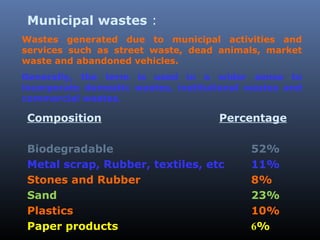
Municipal wastes : 
Wastes generated due to municipal activities and 
services such as street waste, dead animals, market 
waste and abandoned vehicles. 
Generally, the term is used in a wider sense to 
incorporate domestic wastes, institutional wastes and 
commercial wastes. 
Composition Percentage 
Biodegradable 52% 
Metal scrap, Rubber, textiles, etc 11% 
Stones and Rubber 8% 
Sand 23% 
Plastics 10% 
Paper products 6%
Commercial wastes : 
Solid wastes generated in offices, 
wholesale stores, restaurants, 
hotels, markets, warehouses and 
other commercial establishments. 
These are further classified into 
garbage and rubbish.
Institutional wastes : 
Wastes generated from institutions 
such as schools, colleges, hospitals, 
research institutions. The waste 
includes garbage, rubbish and 
hazardous wastes.
Garbage: 
It includes animal and vegetable wastes due to 
various activities like storage, preparation and sale, 
cooking and serving. These are biodegradable. 
Ashes: 
Residues from the burning of wood, charcoal and coke for 
cooking and heating in houses, institutions and 
industries. Ashes consist of a fine powdery residue, 
cinders and clinker often mixed with small pieces of 
metal and glass. 
Rubbish : : 
Apart from garbage and ashes, other solid wastes 
produced in households, commercial establishments, and 
institutions are termed as rubbish.
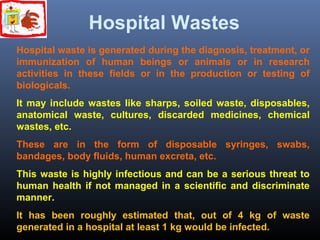
Hospital Wastes 
Hospital waste is generated during the diagnosis, treatment, or 
immunization of human beings or animals or in research 
activities in these fields or in the production or testing of 
biologicals. 
It may include wastes like sharps, soiled waste, disposables, 
anatomical waste, cultures, discarded medicines, chemical 
wastes, etc. 
These are in the form of disposable syringes, swabs, 
bandages, body fluids, human excreta, etc. 
This waste is highly infectious and can be a serious threat to 
human health if not managed in a scientific and discriminate 
manner. 
It has been roughly estimated that, out of 4 kg of waste 
generated in a hospital at least 1 kg would be infected.
Hazardous Wastes 
Industrial and hospital wastes are considered to 
be hazardous as they may contain toxic 
substances. 
Certain types of household wastes are also 
hazardous. 
Hazardous wastes could be highly toxic to 
humans, animals, and plants; are corrosive, 
highly inflammable, or explosive; and react when 
exposed to certain things e.g. gases.
Garbage - Categories 
Organic waste: 
kitchen waste, vegetables, flowers, leaves, fruits. 
Toxic waste: 
old medicines, paints, chemicals, bulbs, spray cans, 
fertilizer and pesticide containers, batteries, shoe 
polish. 
Recyclable: 
paper, glass, metals, plastics. 
Soiled: 
hospital waste such as cloth soiled with blood and 
other body fluids.
Segregation of wastes 
Waste can be segregated as 
1. Biodegradable and 
2. Nonbiodegradable. 
Biodegradable waste include organic waste, e.g. kitchen waste, 
vegetables, fruits, flowers, leaves from the garden, and paper. 
Non-biodegradable waste can be further segregated into: 
a) Recyclable waste – plastics, paper, glass, metal, etc. 
b) Toxic waste – old medicines, paints, chemicals, bulbs, spray 
cans, fertilizer and pesticide containers, batteries, shoe polish. 
c) Soiled – hospital waste such as cloth soiled with blood and 
other body fluids. 
Toxic and soiled wastes must be disposed of with utmost 
care.
Segregation of Domestic wastes 
Household waste should be separated daily into different 
bags for the different categories of waste such as wet and 
dry waste, which should be disposed of separately. 
One should also keep a bin for toxic wastes such as 
medicines, batteries, dried paint, old bulbs, and dried shoe 
polish. 
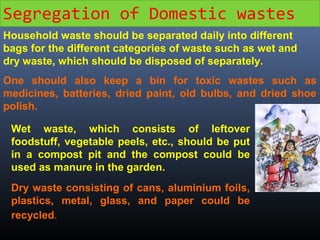
Wet waste, which consists of leftover 
foodstuff, vegetable peels, etc., should be put 
in a compost pit and the compost could be 
used as manure in the garden. 
Dry waste consisting of cans, aluminium foils, 
plastics, metal, glass, and paper could be 
recycled.
Composting 
Organic matter constitutes 35%–40% of the municipal solid waste 
generated in India. 
This waste can be recycled by the method of composting, one of the 
oldest forms of disposal. 
It is the natural process of decomposition of organic waste that yields 
manure or compost, which is very rich in nutrients. 
Composting is a biological process in which micro-organisms, mainly 
fungi and bacteria, convert degradable organic waste into humus like 
substance. 
This finished product, which looks like soil, is high in carbon and 
nitrogen and is an excellent medium for growing plants. 
The process of composting ensures the waste that is produced in the 
kitchens is not carelessly thrown and left to rot. It recycles the nutrients 
and returns them to the soil as nutrients.
Composting: some benefits 
Compost allows the soil to retain more plant nutrients over a 
longer period. 
It supplies part of the essential elements needed by the plants. 
It helps reduce the adverse effects of excessive alkalinity, 
acidity, or the excessive use of chemical fertilizer. 
It makes soil easier to cultivate. 
It helps keep the soil cool in summer and warm in winter. 
It aids in preventing soil erosion by keeping the soil covered. 
It helps in controlling the growth of weeds in the garden.
Plastics 
Plastic with its exclusive qualities of being light yet strong 
and economical, has invaded every aspect of our day-to-day 
life. 
It has many advantages: it is durable, light, easy to mould, 
and can be adapted to different user requirements. 
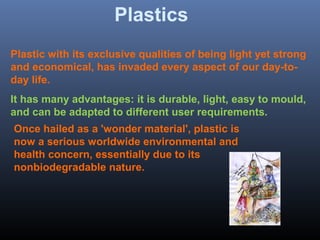
Once hailed as a 'wonder material', plastic is 
now a serious worldwide environmental and 
health concern, essentially due to its 
nonbiodegradable nature.
Problems Associated With 
Solid Wastes 
Lack of Dumping-yards and Land-filling space. 
Hospital wastes contains pathogens, toxic substances, 
medical equipments and instruments causing diseases, soil 
and water pollution. 
Industrial wastes cause air, water, soil pollution and 
contamination of groundwater. 
Conventional plastics exhibit Carcinogenic and Teratogenic 
(embryotoxic) properties. 
Dioxin and Furans are highly carcinogenic and toxic by-product 
of the manufacturing process of plastics.
Four “R”s (Refuse, Reuse, Recycle, Reduce) to be followed 
for waste management : 
 Reduction : Reduce the generation of unnecessary 
waste, e.g. carry your own shopping bag when you go to the market 
and put all your purchases directly into it. 
 Re-use : Do not throw away the soft drink cans or the 
bottles; cover them with homemade paper or paint on them and use 
them as pencil stands or small vases. 
 Re-cycle : Use shopping bags made of cloth or jute, 
which can be used over and over. Segregate your waste to make sure 
that it is collected and taken for recycling. Studies have revealed that 
7 -15% of the waste is recycled. 
 Refuse : Instead of buying new containers from the 
market, use the ones that are in the house. Refuse to buy new items 
though you may think they are prettier than the ones you already have.
AGROCHEMICALS : 
• To meet the food requirement of rapidly 
increasing population in India, advanced farm-technology 
started during 1966-67. 
•William S. Gaud (1968) coined the term ‘Green 
Revolution’ to describe the growth in agricultural 
production. 
•Crop production is doubled or even tripled by 
widespread irrigation, use of high yield varieties of 
cereals and pulses and extensive use of 
agrochemicals. 
•Agrochemicals include pesticides and 
inorganic/chemical fertilisers. 
•They are not eco-friendly.
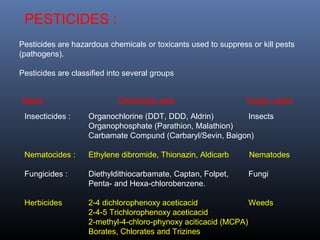
PESTICIDES : 
Pesticides are hazardous chemicals or toxicants used to suppress or kill pests 
(pathogens). 
Pesticides are classified into several groups 
Name Chemicals used Target pests 
Insecticides : Organochlorine (DDT, DDD, Aldrin) Insects 
Organophosphate (Parathion, Malathion) 
Carbamate Compund (Carbaryl/Sevin, Baigon) 
Nematocides : Ethylene dibromide, Thionazin, Aldicarb Nematodes 
Fungicides : Diethyldithiocarbamate, Captan, Folpet, Fungi 
Penta- and Hexa-chlorobenzene. 
Herbicides 2-4 dichlorophenoxy aceticacid Weeds 
2-4-5 Trichlorophenoxy aceticacid 
2-methyl-4-chloro-phynoxy aciticacid (MCPA) 
Borates, Chlorates and Trizines
PROBLEMS ASSOCIATED WITH THE USE OF PESTICIDES : 
 Most Pesticides are poisonous and cause soil, air, water pollution 
 Damage and kill microbes, earthworms etc. 
 Residual pesticides washed into water bodies and contaminate groundwater by 
leaching 
 Use of pesticides for storage of food items, consumed by human beings causes 
harm to alimentary canal, nervous system, reproductie system, urinary system etc. 
 Pesticides passing through food chain causes bioaccumulation and 
biomagnification. Eg. 1 kg of soil may contain 0.001 mg of pesticides whereas carrot 
grown may contain 2-6mg/kg and rabbit eating those carrot may contain 
20-35mg/kg. 
 Ex. of bioaccumulationa and biomagnification is the high conc. of DDT in birds 
which interfere in calcium metabolism, so that egg shell can not be hardened. 
 After several generations pests become pesticide resistant. Pests multiply rapidly-pesticide 
resurgence. 
 Pesticides like DDT, toxaphene, captan are carcinogenic. 
 Pesticides like carbaryl, folpet, pentachloronitrobenzene are teratogenic (embryo 
toxic). 
 Pesticides causes mutation. 
 Zinc, lead, cadmium used in spinach and cauliflower causes cramps, nausia, 
interfere brain development, high blood-pressure and heart diseases.
CHEMICAL FERTILISERS : 
Plants require macro and micro nutrients 
•Macro nutrients : 
• Primary : N, P, K, 
• Secondary : Ca, Mg, S 
(N – promotes plant growth, P-promote root development , K - retain water in plants) 
•Micro nutrients : B, Cl, Cu, Fe, Mn, Mo, Zn, Na, Co 
Effect of Chemical Fertilisers : 
 Several application of Agrochemicals kill beneficial microbes so that soil turns into a 
dead heap of silt, clay and sand. 
 Each year the physiological capacity of crop increases, so quality of fertiliser use also 
increases. 
 Repeated application of chemical fertiliser gradually suppresses natural nutrient 
regeneration capacity of crop-land. 
 Excess NPK fertilisers declines protein content of corn, maize, wheat , gram etc. 
 Excess use of fertiliser damages roots and leaves become yellow- Fertiliser burn 
 Major portion of fertiliser is lost by leaching, denitrification and volatilization, thus 
polluting soil, air and water. 
Deposition of NH3 and SO4 causes acidification of soil. 
 Nitrobactor reduces nitrate to nitrite. Nitrate when absorbed in bloodstream reacts with 
oxyhaemoglobin to produce methamoglobin and causes methamoglobinemia 
(blueboby syndrom). 
High amount of fertiliser accelerates algal growth – eutrophication.
RADIO-ACTIVE WASTES : 
Radioactive wastes are by-products of nuclear power generation and other 
applications of nuclear fission or nuclear technoogy. 
Comprises a number of radioisotopes which are unstable, emit radiations 
harmful to men and environment. 
Radiations are of two types: 
Ionising 
Non-ionising 
Ionising Radition : Radioisotopes able to remove electrons from an atom and 
attach them to other atom, thus producing +ve & -ve ion pairs.eg X-ray, Y-ray, 
a-, b- particles. 
Non-ionising Radiation : Don not cause ionisation. Radio wave, micro wave, 
infrared, visible light, UV radiation. 
Half-life : Time required for one half of a given number of atom to decay to 
another form – 
 I131- 8 days, C14 – 5568 years, Plutonium 239 – 7,10,100 years, 
Uranium 235- 704 million years. 
 Long half-life radioisotopes are most dangerous than Low-energy 
short-life isotopes.
Laws For Solid Waste 
Management 
• Hazardous waste (Management & Handling) Rules, 1989 
• Bio-medical wastes (Management & Handling) Rules, 1998 
* Recycled Plastics (Manufacture and Usage) Rules, 1999 
* Municipal Waste (Management and Handling) Rules 2000 
* Manufacture, storage and Import of Hazardous Chemicals Rules, 
1989 
* Batteries (Management and Handling) Rules, 2001
Conclusion 
“Anything else you’re 
interested in is not going to 
happen if you can’t breathe 
fresh air and drink pure water. 
Don’t sit idle, do something. 
You are by accident of fate 
alive at an absolutely critical 
moment in the history of our 
planet”.
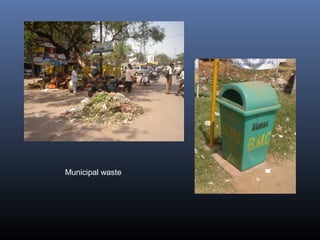
Municipal waste
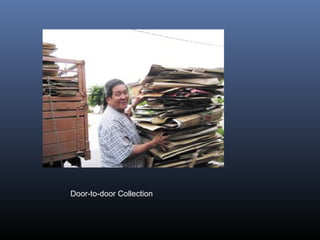
Door-to-door Collection
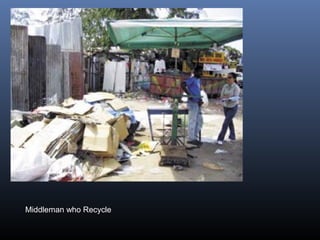
Middleman who Recycle
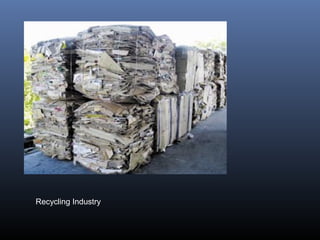
Recycling Industry
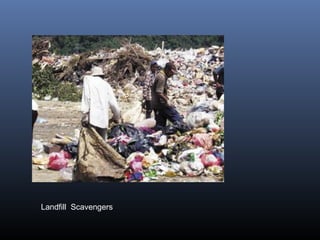
Landfill Scavengers
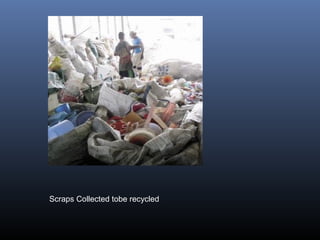
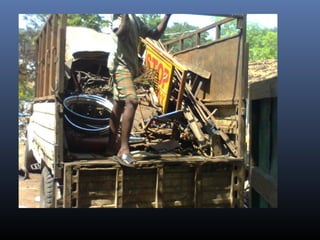
Scraps Collected tobe recycled
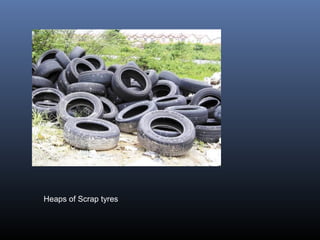
Heaps of Scrap tyres
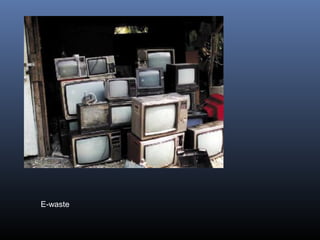
E-waste
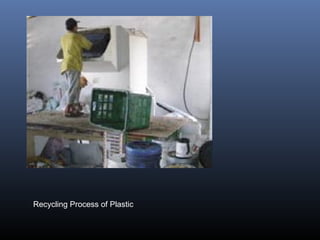
Recycling Process of Plastic
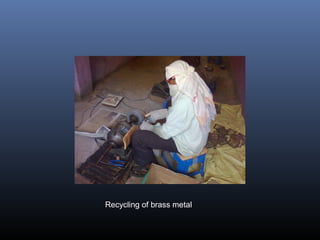
Recycling of brass metal
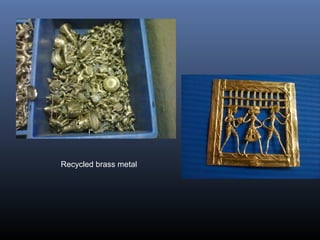
Recycled brass metal
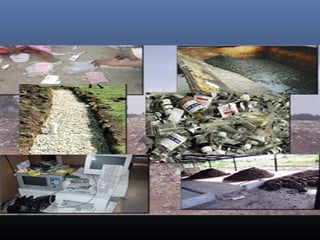
biomedical waste management

biomedical waste management

  • 1.
    SOLID WASTES By: Dr. (Smt) REKHA DAS Secretary Odisha Bigyan Academy BHUBANESWAR
  • 2.
    SOLID WASTES Unwanted, discarded and left-over garbages generated from different sources in day to day life, thrown anywhere and any time.  Harmful, toxic, poisonous causing environmental pollution and concern for living organisms including man.  Collection, storage, transfer and transport, processing and disposal should be done with the best principles of public health, economics, engineering, conservation, aesthetics and other environmental considerations.
  • 3.
    TTYYPPEESS OOFF SSOOLLIIDDWWAASSTTEESS • Domestic wastes, • Municipal wastes, • Commercial wastes, • Institutional wastes, • Garbage, Rubbish, Ashes, • Hazardous wastes, • Hospital wastes • Agrowastes • Radioactive wastes
  • 4.
    Domestic wastes : These wastes are generated by household activities such as cooking, cleaning, repairs, redecoration, empty containers, packaging, clothing, old books, newspapers, old furnishings, etc.
  • 5.
    Municipal wastes : Wastes generated due to municipal activities and services such as street waste, dead animals, market waste and abandoned vehicles. Generally, the term is used in a wider sense to incorporate domestic wastes, institutional wastes and commercial wastes. Composition Percentage Biodegradable 52% Metal scrap, Rubber, textiles, etc 11% Stones and Rubber 8% Sand 23% Plastics 10% Paper products 6%
  • 6.
    Commercial wastes : Solid wastes generated in offices, wholesale stores, restaurants, hotels, markets, warehouses and other commercial establishments. These are further classified into garbage and rubbish.
  • 7.
    Institutional wastes : Wastes generated from institutions such as schools, colleges, hospitals, research institutions. The waste includes garbage, rubbish and hazardous wastes.
  • 8.
    Garbage: It includesanimal and vegetable wastes due to various activities like storage, preparation and sale, cooking and serving. These are biodegradable. Ashes: Residues from the burning of wood, charcoal and coke for cooking and heating in houses, institutions and industries. Ashes consist of a fine powdery residue, cinders and clinker often mixed with small pieces of metal and glass. Rubbish : : Apart from garbage and ashes, other solid wastes produced in households, commercial establishments, and institutions are termed as rubbish.
  • 9.
    Hospital Wastes Hospitalwaste is generated during the diagnosis, treatment, or immunization of human beings or animals or in research activities in these fields or in the production or testing of biologicals. It may include wastes like sharps, soiled waste, disposables, anatomical waste, cultures, discarded medicines, chemical wastes, etc. These are in the form of disposable syringes, swabs, bandages, body fluids, human excreta, etc. This waste is highly infectious and can be a serious threat to human health if not managed in a scientific and discriminate manner. It has been roughly estimated that, out of 4 kg of waste generated in a hospital at least 1 kg would be infected.
  • 10.
    Hazardous Wastes Industrialand hospital wastes are considered to be hazardous as they may contain toxic substances. Certain types of household wastes are also hazardous. Hazardous wastes could be highly toxic to humans, animals, and plants; are corrosive, highly inflammable, or explosive; and react when exposed to certain things e.g. gases.
  • 11.
    Garbage - Categories Organic waste: kitchen waste, vegetables, flowers, leaves, fruits. Toxic waste: old medicines, paints, chemicals, bulbs, spray cans, fertilizer and pesticide containers, batteries, shoe polish. Recyclable: paper, glass, metals, plastics. Soiled: hospital waste such as cloth soiled with blood and other body fluids.
  • 12.
    Segregation of wastes Waste can be segregated as 1. Biodegradable and 2. Nonbiodegradable. Biodegradable waste include organic waste, e.g. kitchen waste, vegetables, fruits, flowers, leaves from the garden, and paper. Non-biodegradable waste can be further segregated into: a) Recyclable waste – plastics, paper, glass, metal, etc. b) Toxic waste – old medicines, paints, chemicals, bulbs, spray cans, fertilizer and pesticide containers, batteries, shoe polish. c) Soiled – hospital waste such as cloth soiled with blood and other body fluids. Toxic and soiled wastes must be disposed of with utmost care.
  • 13.
    Segregation of Domesticwastes Household waste should be separated daily into different bags for the different categories of waste such as wet and dry waste, which should be disposed of separately. One should also keep a bin for toxic wastes such as medicines, batteries, dried paint, old bulbs, and dried shoe polish. Wet waste, which consists of leftover foodstuff, vegetable peels, etc., should be put in a compost pit and the compost could be used as manure in the garden. Dry waste consisting of cans, aluminium foils, plastics, metal, glass, and paper could be recycled.
  • 14.
    Composting Organic matterconstitutes 35%–40% of the municipal solid waste generated in India. This waste can be recycled by the method of composting, one of the oldest forms of disposal. It is the natural process of decomposition of organic waste that yields manure or compost, which is very rich in nutrients. Composting is a biological process in which micro-organisms, mainly fungi and bacteria, convert degradable organic waste into humus like substance. This finished product, which looks like soil, is high in carbon and nitrogen and is an excellent medium for growing plants. The process of composting ensures the waste that is produced in the kitchens is not carelessly thrown and left to rot. It recycles the nutrients and returns them to the soil as nutrients.
  • 15.
    Composting: some benefits Compost allows the soil to retain more plant nutrients over a longer period. It supplies part of the essential elements needed by the plants. It helps reduce the adverse effects of excessive alkalinity, acidity, or the excessive use of chemical fertilizer. It makes soil easier to cultivate. It helps keep the soil cool in summer and warm in winter. It aids in preventing soil erosion by keeping the soil covered. It helps in controlling the growth of weeds in the garden.
  • 16.
    Plastics Plastic withits exclusive qualities of being light yet strong and economical, has invaded every aspect of our day-to-day life. It has many advantages: it is durable, light, easy to mould, and can be adapted to different user requirements. Once hailed as a 'wonder material', plastic is now a serious worldwide environmental and health concern, essentially due to its nonbiodegradable nature.
  • 17.
    Problems Associated With Solid Wastes Lack of Dumping-yards and Land-filling space. Hospital wastes contains pathogens, toxic substances, medical equipments and instruments causing diseases, soil and water pollution. Industrial wastes cause air, water, soil pollution and contamination of groundwater. Conventional plastics exhibit Carcinogenic and Teratogenic (embryotoxic) properties. Dioxin and Furans are highly carcinogenic and toxic by-product of the manufacturing process of plastics.
  • 18.
    Four “R”s (Refuse,Reuse, Recycle, Reduce) to be followed for waste management :  Reduction : Reduce the generation of unnecessary waste, e.g. carry your own shopping bag when you go to the market and put all your purchases directly into it.  Re-use : Do not throw away the soft drink cans or the bottles; cover them with homemade paper or paint on them and use them as pencil stands or small vases.  Re-cycle : Use shopping bags made of cloth or jute, which can be used over and over. Segregate your waste to make sure that it is collected and taken for recycling. Studies have revealed that 7 -15% of the waste is recycled.  Refuse : Instead of buying new containers from the market, use the ones that are in the house. Refuse to buy new items though you may think they are prettier than the ones you already have.
  • 19.
    AGROCHEMICALS : •To meet the food requirement of rapidly increasing population in India, advanced farm-technology started during 1966-67. •William S. Gaud (1968) coined the term ‘Green Revolution’ to describe the growth in agricultural production. •Crop production is doubled or even tripled by widespread irrigation, use of high yield varieties of cereals and pulses and extensive use of agrochemicals. •Agrochemicals include pesticides and inorganic/chemical fertilisers. •They are not eco-friendly.
  • 20.
    PESTICIDES : Pesticidesare hazardous chemicals or toxicants used to suppress or kill pests (pathogens). Pesticides are classified into several groups Name Chemicals used Target pests Insecticides : Organochlorine (DDT, DDD, Aldrin) Insects Organophosphate (Parathion, Malathion) Carbamate Compund (Carbaryl/Sevin, Baigon) Nematocides : Ethylene dibromide, Thionazin, Aldicarb Nematodes Fungicides : Diethyldithiocarbamate, Captan, Folpet, Fungi Penta- and Hexa-chlorobenzene. Herbicides 2-4 dichlorophenoxy aceticacid Weeds 2-4-5 Trichlorophenoxy aceticacid 2-methyl-4-chloro-phynoxy aciticacid (MCPA) Borates, Chlorates and Trizines
  • 21.
    PROBLEMS ASSOCIATED WITHTHE USE OF PESTICIDES :  Most Pesticides are poisonous and cause soil, air, water pollution  Damage and kill microbes, earthworms etc.  Residual pesticides washed into water bodies and contaminate groundwater by leaching  Use of pesticides for storage of food items, consumed by human beings causes harm to alimentary canal, nervous system, reproductie system, urinary system etc.  Pesticides passing through food chain causes bioaccumulation and biomagnification. Eg. 1 kg of soil may contain 0.001 mg of pesticides whereas carrot grown may contain 2-6mg/kg and rabbit eating those carrot may contain 20-35mg/kg.  Ex. of bioaccumulationa and biomagnification is the high conc. of DDT in birds which interfere in calcium metabolism, so that egg shell can not be hardened.  After several generations pests become pesticide resistant. Pests multiply rapidly-pesticide resurgence.  Pesticides like DDT, toxaphene, captan are carcinogenic.  Pesticides like carbaryl, folpet, pentachloronitrobenzene are teratogenic (embryo toxic).  Pesticides causes mutation.  Zinc, lead, cadmium used in spinach and cauliflower causes cramps, nausia, interfere brain development, high blood-pressure and heart diseases.
  • 22.
    CHEMICAL FERTILISERS : Plants require macro and micro nutrients •Macro nutrients : • Primary : N, P, K, • Secondary : Ca, Mg, S (N – promotes plant growth, P-promote root development , K - retain water in plants) •Micro nutrients : B, Cl, Cu, Fe, Mn, Mo, Zn, Na, Co Effect of Chemical Fertilisers :  Several application of Agrochemicals kill beneficial microbes so that soil turns into a dead heap of silt, clay and sand.  Each year the physiological capacity of crop increases, so quality of fertiliser use also increases.  Repeated application of chemical fertiliser gradually suppresses natural nutrient regeneration capacity of crop-land.  Excess NPK fertilisers declines protein content of corn, maize, wheat , gram etc.  Excess use of fertiliser damages roots and leaves become yellow- Fertiliser burn  Major portion of fertiliser is lost by leaching, denitrification and volatilization, thus polluting soil, air and water. Deposition of NH3 and SO4 causes acidification of soil.  Nitrobactor reduces nitrate to nitrite. Nitrate when absorbed in bloodstream reacts with oxyhaemoglobin to produce methamoglobin and causes methamoglobinemia (blueboby syndrom). High amount of fertiliser accelerates algal growth – eutrophication.
  • 23.
    RADIO-ACTIVE WASTES : Radioactive wastes are by-products of nuclear power generation and other applications of nuclear fission or nuclear technoogy. Comprises a number of radioisotopes which are unstable, emit radiations harmful to men and environment. Radiations are of two types: Ionising Non-ionising Ionising Radition : Radioisotopes able to remove electrons from an atom and attach them to other atom, thus producing +ve & -ve ion pairs.eg X-ray, Y-ray, a-, b- particles. Non-ionising Radiation : Don not cause ionisation. Radio wave, micro wave, infrared, visible light, UV radiation. Half-life : Time required for one half of a given number of atom to decay to another form –  I131- 8 days, C14 – 5568 years, Plutonium 239 – 7,10,100 years, Uranium 235- 704 million years.  Long half-life radioisotopes are most dangerous than Low-energy short-life isotopes.
  • 24.
    Laws For SolidWaste Management • Hazardous waste (Management & Handling) Rules, 1989 • Bio-medical wastes (Management & Handling) Rules, 1998 * Recycled Plastics (Manufacture and Usage) Rules, 1999 * Municipal Waste (Management and Handling) Rules 2000 * Manufacture, storage and Import of Hazardous Chemicals Rules, 1989 * Batteries (Management and Handling) Rules, 2001
  • 25.
    Conclusion “Anything elseyou’re interested in is not going to happen if you can’t breathe fresh air and drink pure water. Don’t sit idle, do something. You are by accident of fate alive at an absolutely critical moment in the history of our planet”.
  • 27.
  • 28.
  • 29.
  • 30.
  • 31.
  • 32.
  • 33.
  • 34.
  • 36.
  • 37.
  • 38.

Editor's Notes

  • #12 So, what is a WAN? A WAN is a data communications network that serves users across a broad geographic area and often uses transmission facilities provided by common carriers such as telephone companies. These providers are companies like MCI, AT&T, UuNet, and Sprint. There are also many small service providers that provide connectivity to one of the larger carriers’ networks and may even have email servers to store clients mail until it is retrieved. Telephone service is commonly referred to as plain old telephone service (POTS). WAN technologies function at the lower three layers of the OSI reference model: the physical layer, the data link layer, and the network layer.
  • #13 In addition to network operating software, each network device must also have a network interface card. These cards today are also referred to as adapters, as in “Ethernet adapter card” or “Token Ring adapter card.” The NIC card amplifies electronic signals which are generally very weak within the computer system itself. The NIC is also responsible for packaging data for transmission, and for controlling access to the network cable. When the data is packaged properly, and the timing is right, the NIC will push the data stream onto the cable. The NIC also provides the physical connection between the computer and the transmission cable (also called “media”). This connection is made through the connector port. Examples of transmission media are Ethernet, Token Ring, and FDDI.