The Plastic Epidemic
Debjyoti Bhattacharyya
The drug addict’s lament
I know it’s going to kill
me but I cannot live
without it!!it!!
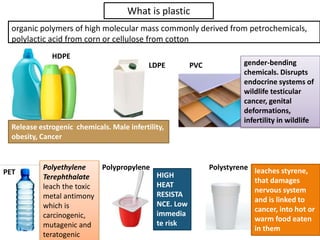
What is plastic
organic polymers of high molecular mass commonly derived from petrochemicals,
polylactic acid from corn or cellulose from cotton
HDPE
PET
PVCLDPE
Polypropylene Polystyrene
Release estrogenic chemicals. Male infertility,
obesity, Cancer
gender-bending
chemicals. Disrupts
endocrine systems of
wildlife testicular
cancer, genital
deformations,
infertility in wildlife
Polyethylene
Terephthalate
leach the toxic
metal antimony
which is
carcinogenic,
mutagenic and
teratogenic
HIGH
HEAT
RESISTA
NCE. Low
immedia
te risk
leaches styrene,
that damages
nervous system
and is linked to
cancer, into hot or
warm food eaten
in them
The main killer
• Bisphenol A
• primary constituent of almost all plastic.
• hormone disruptor, particularly for the human
estrogen hormones. Affects cellular function,
reproduction, development and behaviour.
• baby bottles, water bottles, food and beverage
can liners, baby toys, dental fillings
• it readily breaks down and leaches from products
when old, washed, contains oily/acidic food.
• LESSER THE DOSE GREATER THE EFFECT.
1950:
world population: 2.5 billion
plastic produced 1.5 million tons
2016:
Population :more than 7 billion
Plastic :more than 320 million tons
This is set to double by 2034.
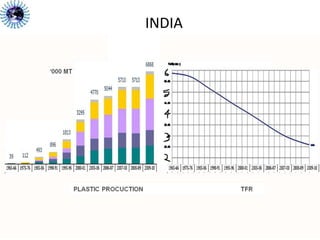
How much plastic per capita?
Does this have anything to do with
globally Falling Fertility ?
Lets make some comparative analysis, over
decades , of relationship between
accelerating plastic production and declining
fertility
global
USA
INDIA
American Society for Reproductive Health report of Annual
meeting in November, 2008:
BPA inhibits the embryos ability to attach to the uterine lining.
This causes early miscarriage before the patient knows she is
pregnant.
Nuisance correlation?? What is nuisance correlation
Effect on would be moms
Effect on would be dads
The study has given conclusive evidence that estrogenic exposure
(similar to that exuded by BPA) reduces sperm count and hence
male fertility drastically in mice.
Nuisance correlation??
Li DK, Zhou Z, Miao M, He Y, Wang J, Ferber J, et al. Urine
bisphenol-A (BPA) level in relation to semen quality. Fertility and
sterility. 2011;95:625–30. e1–4.
Explored the association of urinary BPA concentration on
semen parameters among 218 plastic factory workers from
four regions in China. This study found a negative
association between urinary BPA concentrations and sperm
concentration, total sperm count, sperm vitality, and sperm
motility.
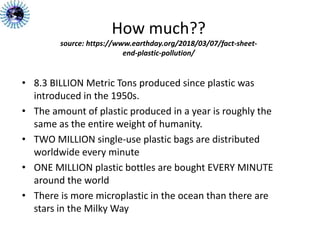
How much??
source: https://www.earthday.org/2018/03/07/fact-sheet-
end-plastic-pollution/
• 8.3 BILLION Metric Tons produced since plastic was
introduced in the 1950s.
• The amount of plastic produced in a year is roughly the
same as the entire weight of humanity.
• TWO MILLION single-use plastic bags are distributed
worldwide every minute
• ONE MILLION plastic bottles are bought EVERY MINUTE
around the world
• There is more microplastic in the ocean than there are
stars in the Milky Way
Where?
• EVRYWHERE
• Journey begins in 1950.
• Within 68 years it has pervaded everywhere.
• From paper clip to spacecraft
• From a feeding bottles to body bags for corpse
• There is no human activity that is not touched by
plastic.
How does plastic affect non humans?
FUNNY, eh! Now look at these!!
It is hard to estimate exactly how many animals are affected by plastic in the oceans each year,
though some have put the number as high as 100,000.
They suffocate,
they strangle,
they block
digestive tracts.
finally, they kill.
Mightier than any microbe
• Microplastics are small plastic pieces less than five
millimeters long
• sources: larger plastic debris that degrades into
microplastics.
• Microbeads, very tiny pieces of manufactured PE
plastic are added to many cleansers and
toothpastes.
• These tiny particles easily pass through water
filtration systems and end up in the environment.
Microplastics: How do they infect?
• Zooplankton ingest microplastics beads (1.7–
30.6 μm) It integrates into their body and
enters the food chain.
• Finally it climbs to the top of the pyramid—
into human body.
• Through Table salt
FROM THE SEA
How do they infect?
• A LANCET Study: Volume 1, No. 7, e254, October 2017
– tap water contains a high proportion of micro
plastic (83% of samples collected worldwide, up to
94% in the USA)
– 2014 study of German beer brands found that
microplastics were present in all of the samples
– A Parisian study showed microplastics not just in
water but also in the air.
The water we drink, the air we breathe
But most tap water comes from
underground water tables!!
• American Association for the Advancement of Science
(AAAS), study :
– 79% of the total plastic waste of 6,300 million metric
tons (MMT) is accumulated in landfills or in the natural
environment (river system and oceans).
– During recharging of water table, downward seeping
water carries degraded microplastic of landfills to the
water tables.
– Degraded microplastic granules on land and ocean
surface infuse into air.
Enemy at a glance
• They trigger Cancer , Neural disorder, Obesity
• Gradually evidence is coming in that they have a distinct
negative correlation with human fertility.
• They are everywhere. We eat drink and breathe them every
moment, either leached from containers or as microplastics
present in food , water and air.
• They attack us from our toothpaste, face and body cleansers.
• They donot biodegrade.
Towards a solution
• The good news:
BPA does not stay in our systems for more than a
few hours.
• The Bad news:
They are renewable. Every moment we keep
getting fresh dosage from our plastic
companions, visible or invisible.
Towards remedy- institutional
With every sphere of life invaded with plastic , abandoning
plastic from Human life is not conceivable at this moment.
Hence two approaches are being tried:
A. Mitigation
B. Replacement of harmful ingredient
Mitigation
1. Ocean clean up
2. Encouraging use of non-plastic substances in personal
lives.
3. Recycling
4. Incineration of used plastic.
Ocean cleanup
• OVER 5 TRILLION
PIECES OF PLASTIC
CURRENTLY LITTER
THE OCEAN
• Trash accumulates
in 5 ocean garbage
patches, the
largest one being
the Great Pacific
Garbage Patch,
located between
Hawaii and
California.
This year the scientists are
preparing to launch the
world's first machine to clean
up the planet's largest mass
of ocean plastic.
Ocean cleanup
It is a simple method
devised by a Danish
student named Boyar Slat
works via massive floating
booms that sit on top of
the water and act like a
mini-coastline. Just like
beaches collect our plastic
waste, the boom can
passively gather plastic
waste and pull it to its
center. Once a month or
so, a boat would go collect
the garbage.
Replacement
Chicken Feathers : Contains Keratin that can be used to make
a water-resistant thermoplastic.
Prodegradant concentrates (PDCs): creating biodegradable,
bacteria friendly plastic y adding metallic additives called PDC.
Milk Protein : Milk protein (Casein) produces a biodegradable
plastic to make insulation, furniture cushions, packaging, and
other products.
PCL /PHA/PLA Polyesters :
Polycaprolactone :a synthetic polyester. Degrades within weeks
Polyhydroxyalkanoate resembles PP. Biodegradable.
Polylactic acid (PLA) Biodegradable polyester. Made from
lactic acid, wheat or sugarcane.
Replacement: Liquid wood (lingin)
• It is an organic substance binding the cells, fibres
and vessels which constitute wood.
• Second most abundant renewable carbon source on
Earth.
• Between 40 and 50 million tons per annum are
produced worldwide and discarded as waste.
• It looks, feels and can substitute plastics but is
biodegradable and suitable for various product
packaging.
Not enough
• All these efforts can mitigate the effect of macro plastic.
• And while they gather momentum, the society will keep
adding more harmful plastic in the system.
• Also the microplastics circulating in the food chain will
not be managable.
• While institutions gear up for the mega measures, all we
can do is to mitigate its effects at personal level.
Personal actions
• Fresh is best
– BPA migrates from the linings of cans and plastic packaging into food and drinks.
– Opt for fresh or frozen instead of canned food as much as possible.
• Eat in
– Studies have shown that people who eat more meals prepared outside the home have higher
levels of BPA. Reduce eating out.
• Store it safe
– Transfer your grocery from plastic bags and containers in glass or stainless steel ones. Replace
your plastic freeze pots and wraps with glass, metal, cloth.
• Don’t microwave in plastic
– Warmer temperatures increase the rate of chemicals leaching . The label “microwave safe”
means safety for the container, not your health.
• Brew the old-fashioned way
– Automatic coffee makers may have BPA and phthalates in their plastic containers and tubing.
Avoid tea/coffee vending machines. Old fashioned kettles are better.
• Banish Styrofoam plates and glasses from your public and private feasts.
Though we cannot bring the intake to zero we can reduce
them considerably by reducing use of plastic.
For the sake of a better future
• Our suffering shall not end in our lifetime.
• But our concerted efforts can, within a period of five or six
decades, create an environment free of harmful plastics.
• Maybe our successors will have a better world.
• Tackling plastic at both institutional as well as personal levels
is for a better present but more importantly for a better
future.
The Plastic addict’s lament
I know it’s going to kill me but I cannot live without
it!!it!!
Yes we can. There is no monster that
cannot be killed or tamed. It’s just a
question of time, determination and
innovations

Plastic pollution and beyond

  • 1.
  • 2.
    The drug addict’slament I know it’s going to kill me but I cannot live without it!!it!!
  • 3.
    What is plastic organicpolymers of high molecular mass commonly derived from petrochemicals, polylactic acid from corn or cellulose from cotton HDPE PET PVCLDPE Polypropylene Polystyrene Release estrogenic chemicals. Male infertility, obesity, Cancer gender-bending chemicals. Disrupts endocrine systems of wildlife testicular cancer, genital deformations, infertility in wildlife Polyethylene Terephthalate leach the toxic metal antimony which is carcinogenic, mutagenic and teratogenic HIGH HEAT RESISTA NCE. Low immedia te risk leaches styrene, that damages nervous system and is linked to cancer, into hot or warm food eaten in them
  • 4.
    The main killer •Bisphenol A • primary constituent of almost all plastic. • hormone disruptor, particularly for the human estrogen hormones. Affects cellular function, reproduction, development and behaviour. • baby bottles, water bottles, food and beverage can liners, baby toys, dental fillings • it readily breaks down and leaches from products when old, washed, contains oily/acidic food. • LESSER THE DOSE GREATER THE EFFECT.
  • 5.
    1950: world population: 2.5billion plastic produced 1.5 million tons 2016: Population :more than 7 billion Plastic :more than 320 million tons This is set to double by 2034. How much plastic per capita?
  • 6.
    Does this haveanything to do with globally Falling Fertility ? Lets make some comparative analysis, over decades , of relationship between accelerating plastic production and declining fertility
  • 7.
  • 8.
  • 9.
  • 10.
    American Society forReproductive Health report of Annual meeting in November, 2008: BPA inhibits the embryos ability to attach to the uterine lining. This causes early miscarriage before the patient knows she is pregnant. Nuisance correlation?? What is nuisance correlation Effect on would be moms Effect on would be dads The study has given conclusive evidence that estrogenic exposure (similar to that exuded by BPA) reduces sperm count and hence male fertility drastically in mice.
  • 11.
    Nuisance correlation?? Li DK,Zhou Z, Miao M, He Y, Wang J, Ferber J, et al. Urine bisphenol-A (BPA) level in relation to semen quality. Fertility and sterility. 2011;95:625–30. e1–4. Explored the association of urinary BPA concentration on semen parameters among 218 plastic factory workers from four regions in China. This study found a negative association between urinary BPA concentrations and sperm concentration, total sperm count, sperm vitality, and sperm motility.
  • 12.
    How much?? source: https://www.earthday.org/2018/03/07/fact-sheet- end-plastic-pollution/ •8.3 BILLION Metric Tons produced since plastic was introduced in the 1950s. • The amount of plastic produced in a year is roughly the same as the entire weight of humanity. • TWO MILLION single-use plastic bags are distributed worldwide every minute • ONE MILLION plastic bottles are bought EVERY MINUTE around the world • There is more microplastic in the ocean than there are stars in the Milky Way
  • 13.
    Where? • EVRYWHERE • Journeybegins in 1950. • Within 68 years it has pervaded everywhere. • From paper clip to spacecraft • From a feeding bottles to body bags for corpse • There is no human activity that is not touched by plastic.
  • 14.
    How does plasticaffect non humans? FUNNY, eh! Now look at these!!
  • 15.
    It is hardto estimate exactly how many animals are affected by plastic in the oceans each year, though some have put the number as high as 100,000. They suffocate, they strangle, they block digestive tracts. finally, they kill.
  • 16.
    Mightier than anymicrobe • Microplastics are small plastic pieces less than five millimeters long • sources: larger plastic debris that degrades into microplastics. • Microbeads, very tiny pieces of manufactured PE plastic are added to many cleansers and toothpastes. • These tiny particles easily pass through water filtration systems and end up in the environment.
  • 17.
    Microplastics: How dothey infect? • Zooplankton ingest microplastics beads (1.7– 30.6 μm) It integrates into their body and enters the food chain. • Finally it climbs to the top of the pyramid— into human body. • Through Table salt FROM THE SEA
  • 18.
    How do theyinfect? • A LANCET Study: Volume 1, No. 7, e254, October 2017 – tap water contains a high proportion of micro plastic (83% of samples collected worldwide, up to 94% in the USA) – 2014 study of German beer brands found that microplastics were present in all of the samples – A Parisian study showed microplastics not just in water but also in the air. The water we drink, the air we breathe
  • 19.
    But most tapwater comes from underground water tables!! • American Association for the Advancement of Science (AAAS), study : – 79% of the total plastic waste of 6,300 million metric tons (MMT) is accumulated in landfills or in the natural environment (river system and oceans). – During recharging of water table, downward seeping water carries degraded microplastic of landfills to the water tables. – Degraded microplastic granules on land and ocean surface infuse into air.
  • 20.
    Enemy at aglance • They trigger Cancer , Neural disorder, Obesity • Gradually evidence is coming in that they have a distinct negative correlation with human fertility. • They are everywhere. We eat drink and breathe them every moment, either leached from containers or as microplastics present in food , water and air. • They attack us from our toothpaste, face and body cleansers. • They donot biodegrade.
  • 21.
    Towards a solution •The good news: BPA does not stay in our systems for more than a few hours. • The Bad news: They are renewable. Every moment we keep getting fresh dosage from our plastic companions, visible or invisible.
  • 22.
    Towards remedy- institutional Withevery sphere of life invaded with plastic , abandoning plastic from Human life is not conceivable at this moment. Hence two approaches are being tried: A. Mitigation B. Replacement of harmful ingredient
  • 23.
    Mitigation 1. Ocean cleanup 2. Encouraging use of non-plastic substances in personal lives. 3. Recycling 4. Incineration of used plastic.
  • 24.
    Ocean cleanup • OVER5 TRILLION PIECES OF PLASTIC CURRENTLY LITTER THE OCEAN • Trash accumulates in 5 ocean garbage patches, the largest one being the Great Pacific Garbage Patch, located between Hawaii and California. This year the scientists are preparing to launch the world's first machine to clean up the planet's largest mass of ocean plastic.
  • 25.
    Ocean cleanup It isa simple method devised by a Danish student named Boyar Slat works via massive floating booms that sit on top of the water and act like a mini-coastline. Just like beaches collect our plastic waste, the boom can passively gather plastic waste and pull it to its center. Once a month or so, a boat would go collect the garbage.
  • 26.
    Replacement Chicken Feathers :Contains Keratin that can be used to make a water-resistant thermoplastic. Prodegradant concentrates (PDCs): creating biodegradable, bacteria friendly plastic y adding metallic additives called PDC. Milk Protein : Milk protein (Casein) produces a biodegradable plastic to make insulation, furniture cushions, packaging, and other products. PCL /PHA/PLA Polyesters : Polycaprolactone :a synthetic polyester. Degrades within weeks Polyhydroxyalkanoate resembles PP. Biodegradable. Polylactic acid (PLA) Biodegradable polyester. Made from lactic acid, wheat or sugarcane.
  • 27.
    Replacement: Liquid wood(lingin) • It is an organic substance binding the cells, fibres and vessels which constitute wood. • Second most abundant renewable carbon source on Earth. • Between 40 and 50 million tons per annum are produced worldwide and discarded as waste. • It looks, feels and can substitute plastics but is biodegradable and suitable for various product packaging.
  • 28.
    Not enough • Allthese efforts can mitigate the effect of macro plastic. • And while they gather momentum, the society will keep adding more harmful plastic in the system. • Also the microplastics circulating in the food chain will not be managable. • While institutions gear up for the mega measures, all we can do is to mitigate its effects at personal level.
  • 29.
    Personal actions • Freshis best – BPA migrates from the linings of cans and plastic packaging into food and drinks. – Opt for fresh or frozen instead of canned food as much as possible. • Eat in – Studies have shown that people who eat more meals prepared outside the home have higher levels of BPA. Reduce eating out. • Store it safe – Transfer your grocery from plastic bags and containers in glass or stainless steel ones. Replace your plastic freeze pots and wraps with glass, metal, cloth. • Don’t microwave in plastic – Warmer temperatures increase the rate of chemicals leaching . The label “microwave safe” means safety for the container, not your health. • Brew the old-fashioned way – Automatic coffee makers may have BPA and phthalates in their plastic containers and tubing. Avoid tea/coffee vending machines. Old fashioned kettles are better. • Banish Styrofoam plates and glasses from your public and private feasts. Though we cannot bring the intake to zero we can reduce them considerably by reducing use of plastic.
  • 30.
    For the sakeof a better future • Our suffering shall not end in our lifetime. • But our concerted efforts can, within a period of five or six decades, create an environment free of harmful plastics. • Maybe our successors will have a better world. • Tackling plastic at both institutional as well as personal levels is for a better present but more importantly for a better future.
  • 31.
    The Plastic addict’slament I know it’s going to kill me but I cannot live without it!!it!! Yes we can. There is no monster that cannot be killed or tamed. It’s just a question of time, determination and innovations