PLANT- FORMS AND FUNCTIONS
Book exercises
class – vi
CHECK POINT - 1
True / False:
1. Raddish and turnip are biennial plants. True
2. Grasses are non flowering plants. False
3. Mint plant is a creeper. True
4. Bougainvillea has woody stems. True
CHECK POINT - 2
Answer the following questions:
1. What are the characteristics of roots?
Ans- Roots are non green under ground parts of a plant.
-They develop from radicle of the seed.
-They grow towards soil and water.
-They grow away from sunlight.
-They do not have nodes and internodes.
-They have many lateral branches called secondary and tertiary roots.
2. Name atleast two plants which have fibrous roots?
Ans- Maize and wheat
CHECK POINT - 2
3. In which plant roots are modified to store food?
Ans- Radish, turnip, beetroot, carrot
4. What are prop roots?
Ans- The rope like roots which grow from the horizontal branches of
Banyan and Rubber trees are called prop roots. They support the
heavy branches of the trees.
CHECK POINT - 3
Answer the following questions:-
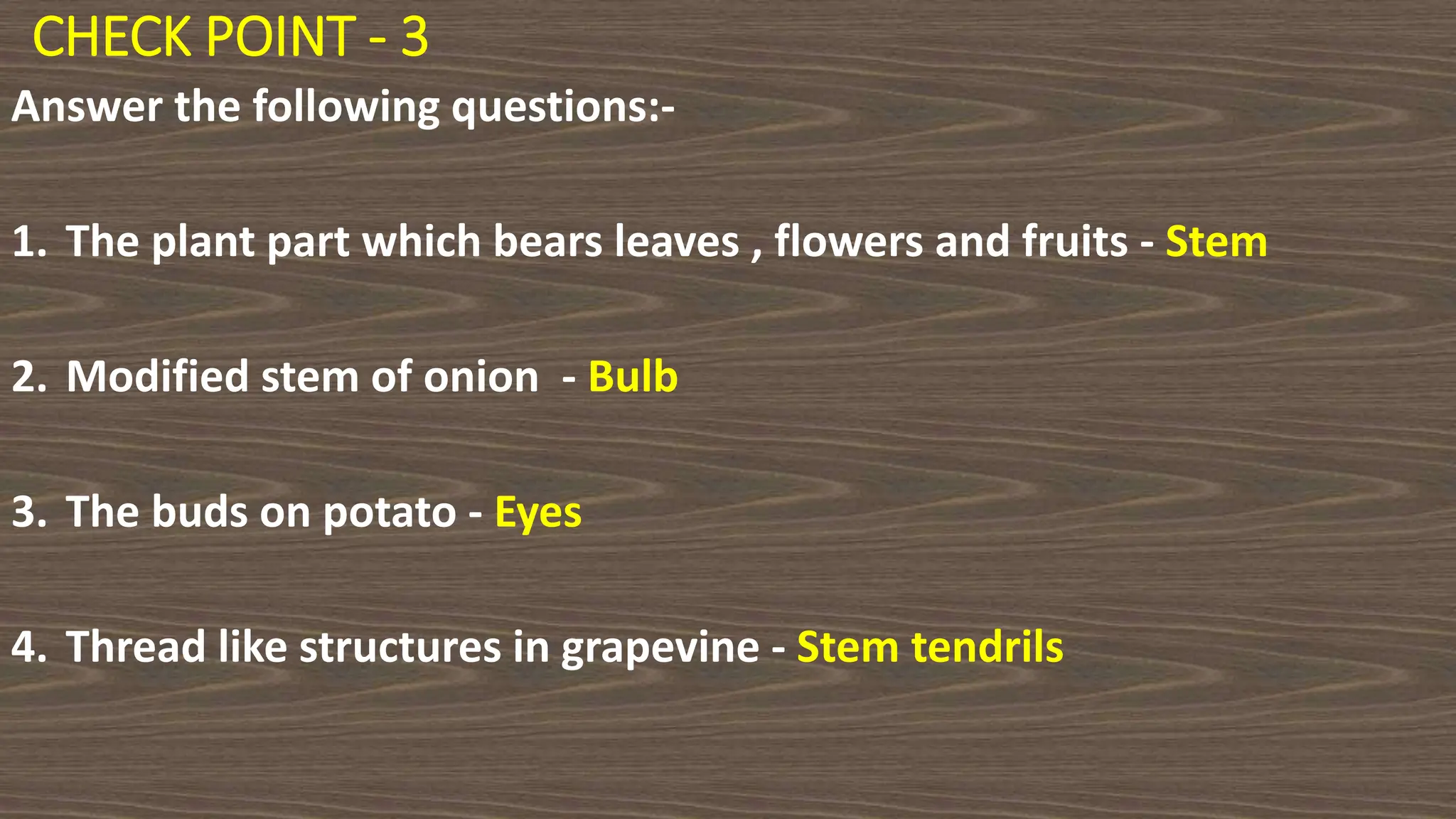
1. The plant part which bears leaves , flowers and fruits - Stem
2. Modified stem of onion - Bulb
3. The buds on potato - Eyes
4. Thread like structures in grapevine - Stem tendrils
Fill in the blanks
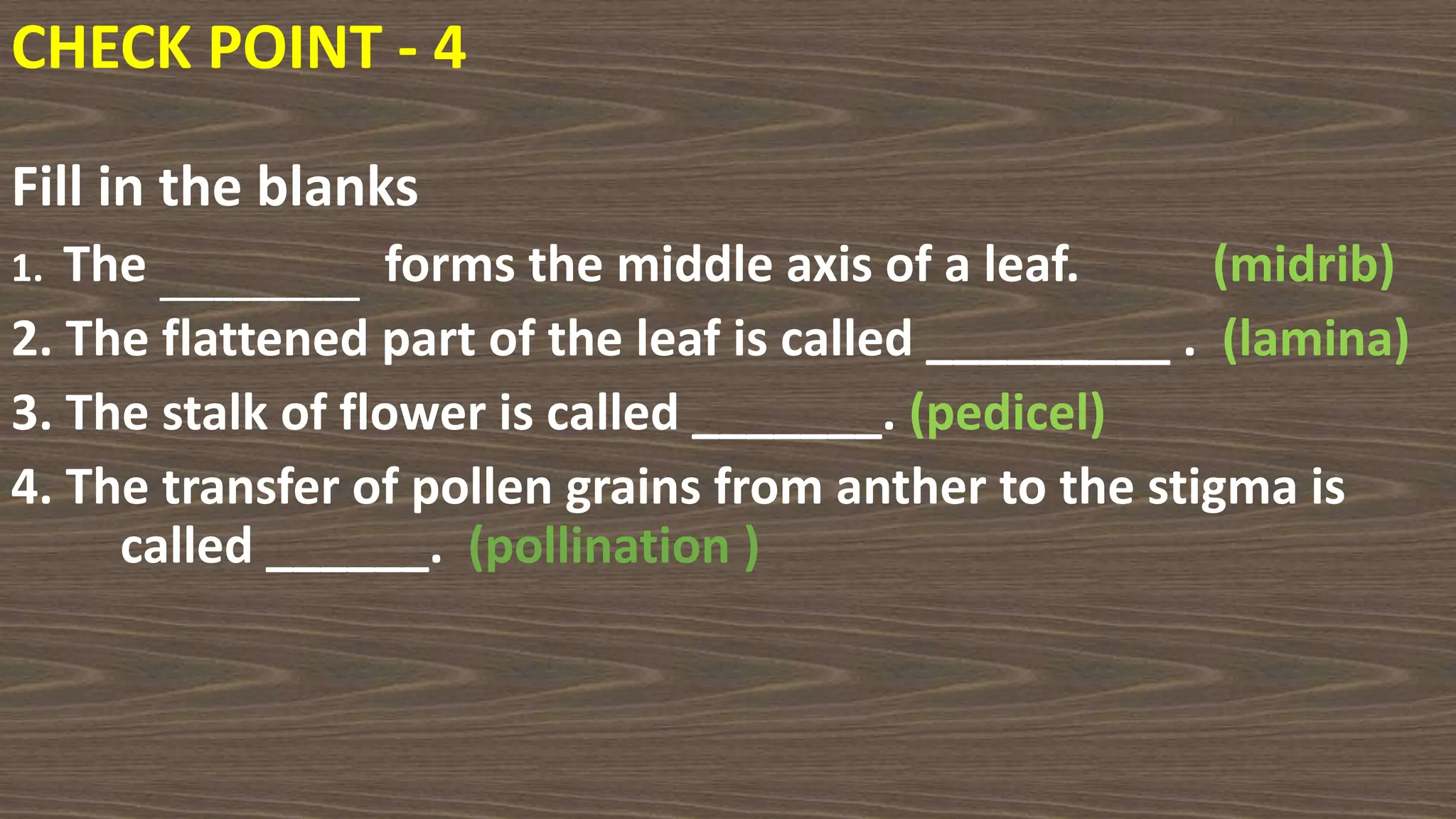
1. The ___________ forms the middle axis of a leaf. (midrib)
2. The flattened part of the leaf is called _________ . (lamina)
3. The stalk of flower is called _______. (pedicel)
4. The transfer of pollen grains from anther to the stigma is
called ______. (pollination )
CHECK POINT - 4
A. Tick the correct answer
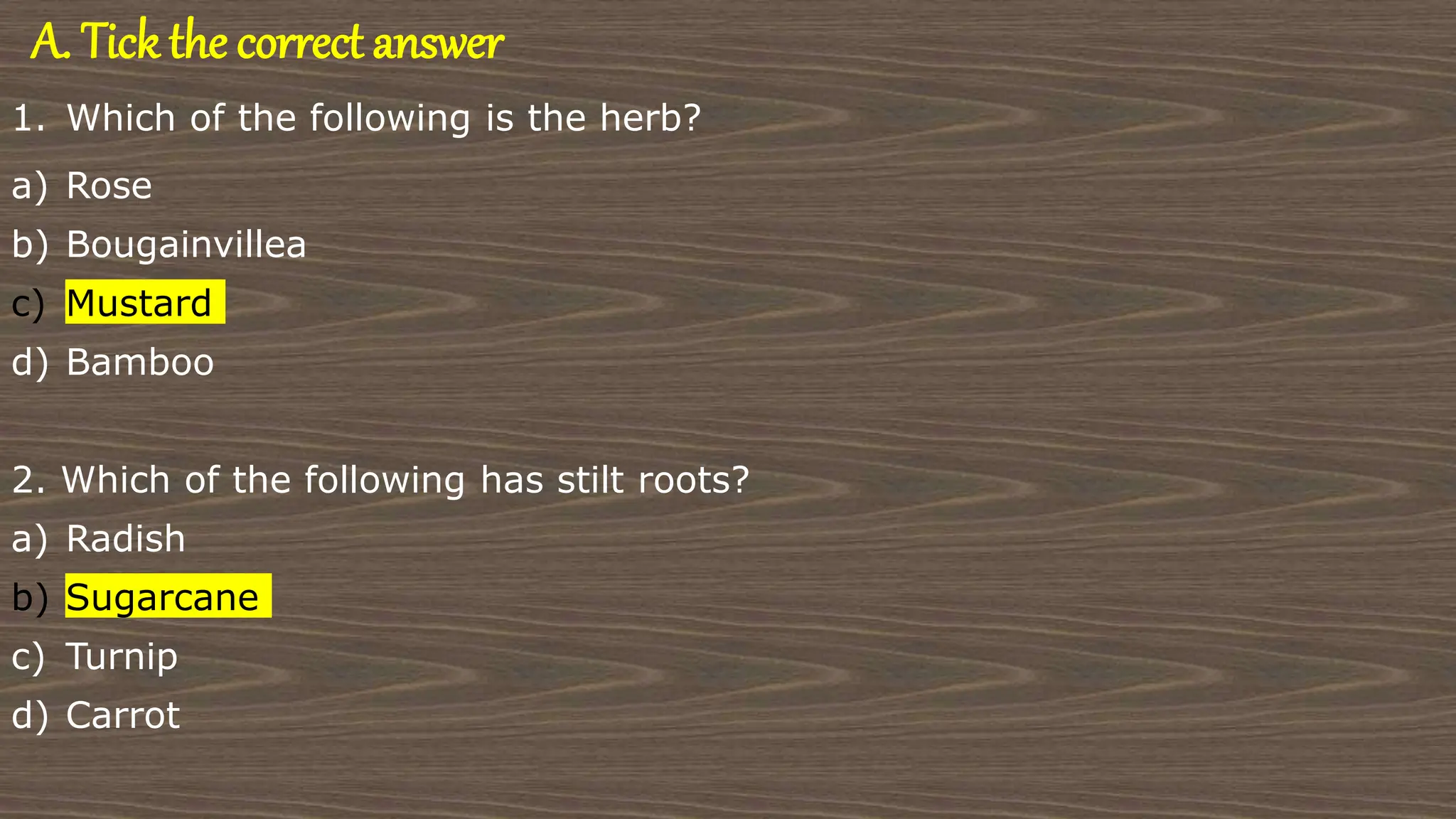
1. Which of the following is the herb?
a) Rose
b) Bougainvillea
c) Mustard
d) Bamboo
2. Which of the following has stilt roots?
a) Radish
b) Sugarcane
c) Turnip
d) Carrot
A. Tick the correct answer
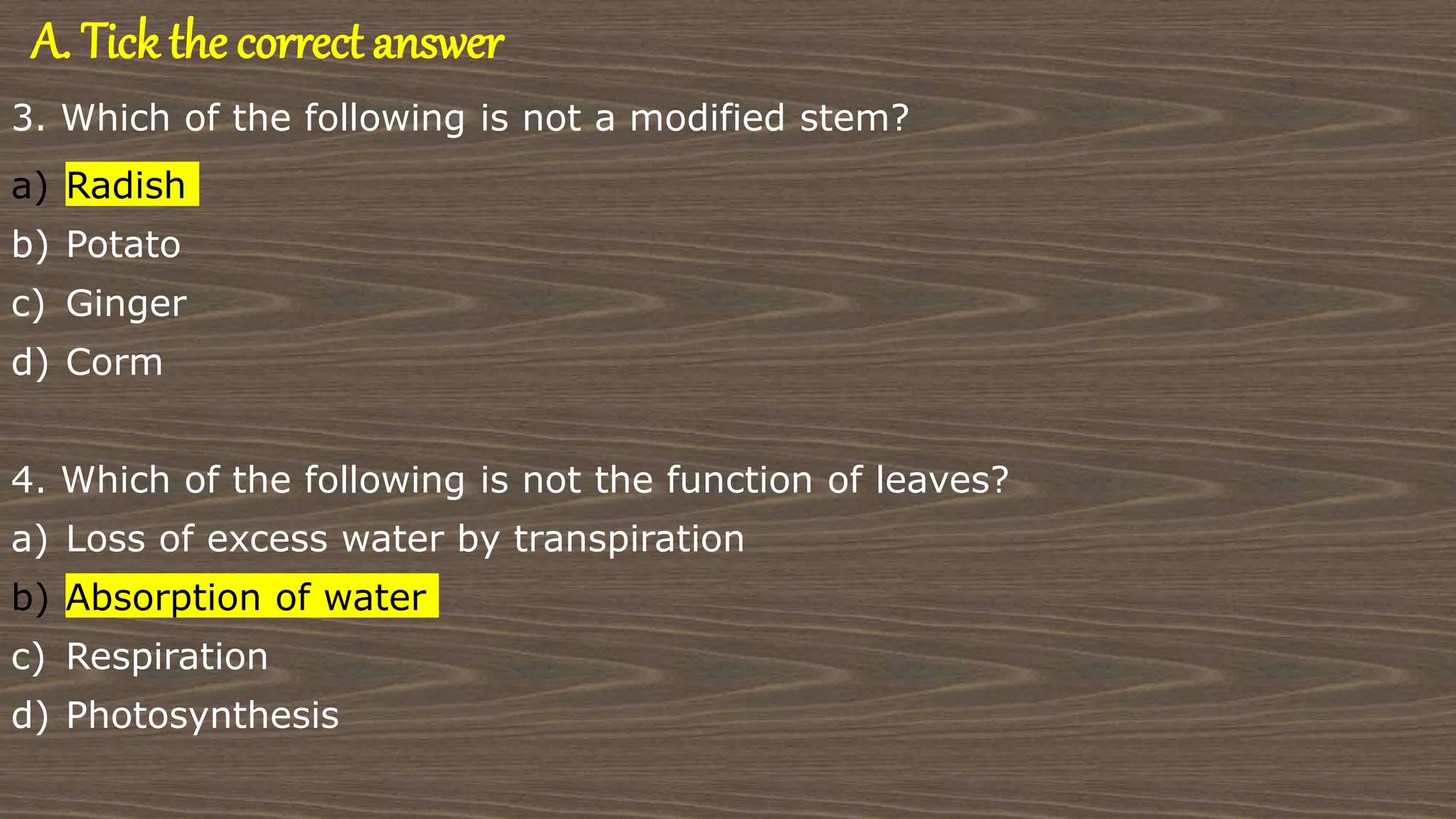
3. Which of the following is not a modified stem?
a) Radish
b) Potato
c) Ginger
d) Corm
4. Which of the following is not the function of leaves?
a) Loss of excess water by transpiration
b) Absorption of water
c) Respiration
d) Photosynthesis
A. Tick the correct answer
5. Pattern of distribution of veins in the lamina is called
a) Venation
b) Transpiration
c) Pollination
d) Fixation
6. Green leaves that protects the floral parts in bud stage are called
a) Petals
b) Sepals
c) Leaves
d) Scale leaves
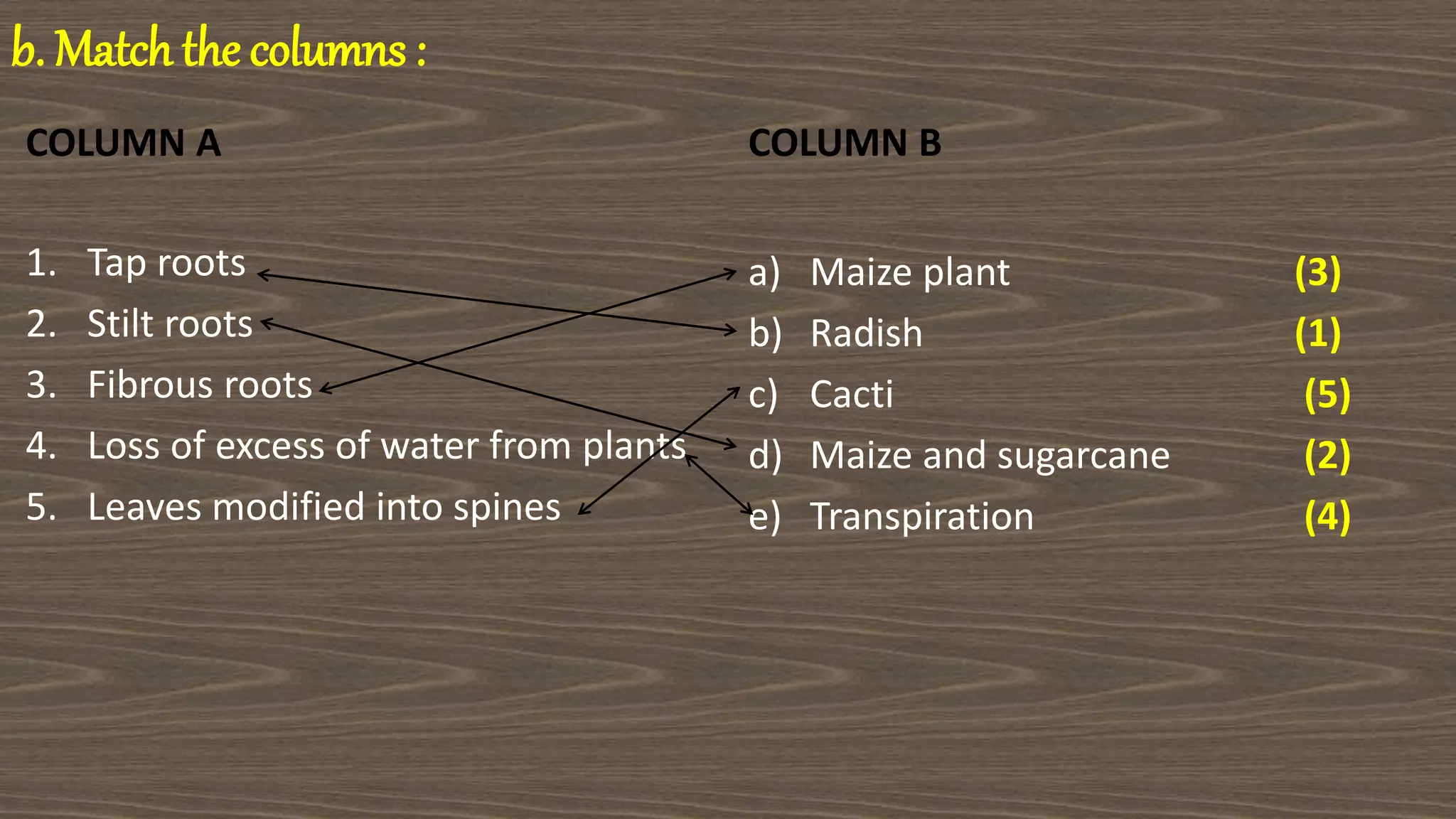
b. Match the columns :
COLUMN A
1. Tap roots
2. Stilt roots
3. Fibrous roots
4. Loss of excess of water from plants
5. Leaves modified into spines
COLUMN B
a) Maize plant (3)
b) Radish (1)
c) Cacti (5)
d) Maize and sugarcane (2)
e) Transpiration (4)
C. Very Short Answer Type Questions
1. Which part of potato plant stores food ?
Ans- Underground stem (tuber).
2. Give one example each of leaf tendril and stem tendril.
Ans- Pea ; Grapevine
3. Name a plant in which leaf is modified into tendril .
Ans- Pea
4. What is the function of spines ?
Ans- Spines prevent the loss of water due to transpiration and also protect the
plant from grazing animals .
5. Name the whorl of the flower which attracts insect for pollination .
Ans- Corolla (petals).
Short Answer Type Questions
1. Give main difference between herbs and shrubs ?
Ans- Herbs are small plants with soft green stem , less than a
metre high. For example- balsam , sweet pea etc.
Shrubs are medium sized woody plants , about 1 – 3 metres high.
For example ; rose , lemon etc.
2. Differentiate between tap roots and fibrous root.
Ans- A tap root has primary root which is long and thick; branches
into secondary and tertiary roots and grows vertically downwards
in the soil . For example; mango , carrot , etc.
In fibrous root, primary is short – lived and is replaced by a cluster
of fibre – like root. For example, maize , wheat , grass , etc.
Short Answer Type Questions
3. Define fertilisation?
Ans- The fusion of male gamete with the female gamete is called fertilisation.
4. What are pollen grains? Where are they formed?
Ans- Pollen grains are male reproductive structures of plant that contain male
gametes . They are formed in anthers of flower.
5. Give some example of plants in which stem stores food ?
Ans-Potato , ginger , zimikand etc.
6. Which part of a plant conducts food and water to different parts of it ?
Ans- Stem .
Long Answer Type Questions
1. Describe specialized function of the stem?
Ans-(a) -stem of some plants such as cactus becomes green and
makes food for the plant.
(b) Stem of potato , ginger , turmeric etc. modifies and stores food for
the plant to grow in the next season.
(c) Some branches of weak stem of grapevine and passion flower
change into thread – like structure called stem tendril. They support
the plant to stand erect.
(d) Stem of rose , lemon , bougainvillea etc. bear thorns to protect the
plant from grazing animals.
Long Answer Type Questions
2. Why is stem in cacti green and fleshy?
Ans- The leaves of cacti change into spines to prevent the water loss. To carry out
the function of leaves and to store water , the stem becomes green and fleshy.
3. Define pollination. Explain the types of pollination?
Ans- The transfer of pollen grains from the anther to the stigma is called
pollination.
It is of two types:
Self pollination:- when the pollen grains from the anther of a flower are transferred
to the stigma of the same flower or to the stigma of another flower on the same
plant , it is called self pollination.
Cross pollination:- when the pollen grains from the anther of the flower of one
plant are transferred to the stigma of the flower of another plant of the same type
through different agencies such as wind , water , insects , etc. it is called cross –
pollination.
.
Long Answer Type Questions
4. How does a plant give rise to fruit? Explain the process involved.
Ans- A plant gives rise to fruit after fertilisation when petals , sepals and stamen fall
off and ovary grows into a fruit.
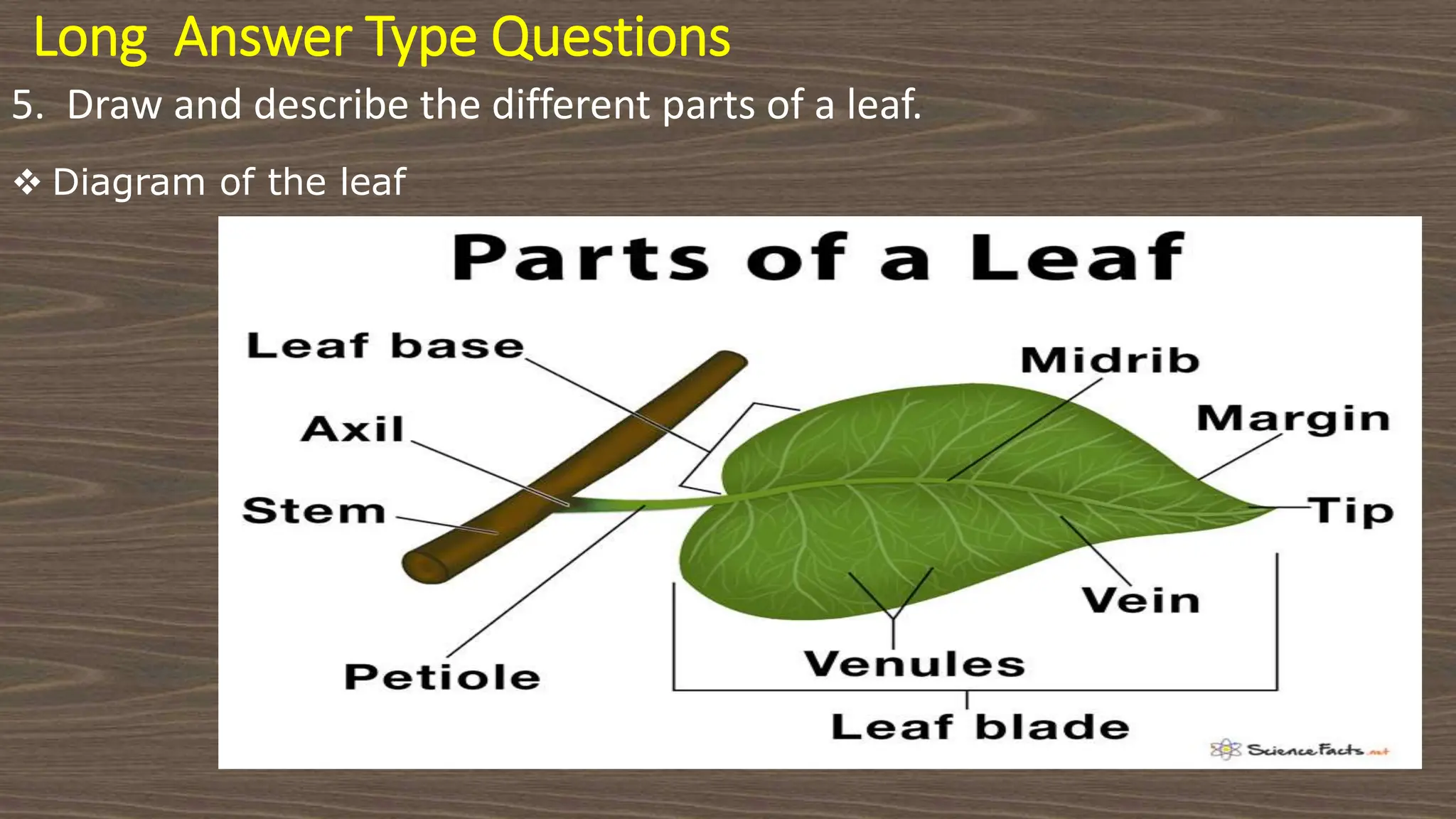
5. Draw and describe the different parts of a leaf.
Ans- The leaf has following parts:
1. Leaf base – A leaf is attached to the stem with its leaf base.
2. Petiole – It is the stalk of the leaf. It connects the leaf blade with the leaf base.
3. Lamina or leaf blade – It is the green , flat and expanded part of the leaf .
4. Midrib and veins – It is the extension of petiole into the lamina. It divides into
many lateral branches called veins.
5. Stomata – these are tiny pores on the surface of leaves which can be seen only
under a microscope.
Long Answer Type Questions
5. Draw and describe the different parts of a leaf.
 Diagram of the leaf
Hots questions
1. Potatoes are formed underground. How do they contain starch when
photosynthesis occurs in the green leaves above the ground?
Ans – Potato is a modified underground stem. The food formed by
green leaves of potato plant is transported to the underground stem
and is stored there in the form of starch.
2. Out of two plants one has fibrous roots and another has tap roots.
How will you distinguish monocot and dicot plants?
Ans – The plant which has fibrous roots is a monocot plant , whereas
the one which has tap roots is a dicot plant.

plants form and function class 6th quesans.pptx

  • 1.
    PLANT- FORMS ANDFUNCTIONS Book exercises class – vi
  • 2.
    CHECK POINT -1 True / False: 1. Raddish and turnip are biennial plants. True 2. Grasses are non flowering plants. False 3. Mint plant is a creeper. True 4. Bougainvillea has woody stems. True
  • 3.
    CHECK POINT -2 Answer the following questions: 1. What are the characteristics of roots? Ans- Roots are non green under ground parts of a plant. -They develop from radicle of the seed. -They grow towards soil and water. -They grow away from sunlight. -They do not have nodes and internodes. -They have many lateral branches called secondary and tertiary roots. 2. Name atleast two plants which have fibrous roots? Ans- Maize and wheat
  • 4.
    CHECK POINT -2 3. In which plant roots are modified to store food? Ans- Radish, turnip, beetroot, carrot 4. What are prop roots? Ans- The rope like roots which grow from the horizontal branches of Banyan and Rubber trees are called prop roots. They support the heavy branches of the trees.
  • 5.
    CHECK POINT -3 Answer the following questions:- 1. The plant part which bears leaves , flowers and fruits - Stem 2. Modified stem of onion - Bulb 3. The buds on potato - Eyes 4. Thread like structures in grapevine - Stem tendrils
  • 6.
    Fill in theblanks 1. The ___________ forms the middle axis of a leaf. (midrib) 2. The flattened part of the leaf is called _________ . (lamina) 3. The stalk of flower is called _______. (pedicel) 4. The transfer of pollen grains from anther to the stigma is called ______. (pollination ) CHECK POINT - 4
  • 7.
    A. Tick thecorrect answer 1. Which of the following is the herb? a) Rose b) Bougainvillea c) Mustard d) Bamboo 2. Which of the following has stilt roots? a) Radish b) Sugarcane c) Turnip d) Carrot
  • 8.
    A. Tick thecorrect answer 3. Which of the following is not a modified stem? a) Radish b) Potato c) Ginger d) Corm 4. Which of the following is not the function of leaves? a) Loss of excess water by transpiration b) Absorption of water c) Respiration d) Photosynthesis
  • 9.
    A. Tick thecorrect answer 5. Pattern of distribution of veins in the lamina is called a) Venation b) Transpiration c) Pollination d) Fixation 6. Green leaves that protects the floral parts in bud stage are called a) Petals b) Sepals c) Leaves d) Scale leaves
  • 10.
    b. Match thecolumns : COLUMN A 1. Tap roots 2. Stilt roots 3. Fibrous roots 4. Loss of excess of water from plants 5. Leaves modified into spines COLUMN B a) Maize plant (3) b) Radish (1) c) Cacti (5) d) Maize and sugarcane (2) e) Transpiration (4)
  • 11.
    C. Very ShortAnswer Type Questions 1. Which part of potato plant stores food ? Ans- Underground stem (tuber). 2. Give one example each of leaf tendril and stem tendril. Ans- Pea ; Grapevine 3. Name a plant in which leaf is modified into tendril . Ans- Pea 4. What is the function of spines ? Ans- Spines prevent the loss of water due to transpiration and also protect the plant from grazing animals . 5. Name the whorl of the flower which attracts insect for pollination . Ans- Corolla (petals).
  • 12.
    Short Answer TypeQuestions 1. Give main difference between herbs and shrubs ? Ans- Herbs are small plants with soft green stem , less than a metre high. For example- balsam , sweet pea etc. Shrubs are medium sized woody plants , about 1 – 3 metres high. For example ; rose , lemon etc. 2. Differentiate between tap roots and fibrous root. Ans- A tap root has primary root which is long and thick; branches into secondary and tertiary roots and grows vertically downwards in the soil . For example; mango , carrot , etc. In fibrous root, primary is short – lived and is replaced by a cluster of fibre – like root. For example, maize , wheat , grass , etc.
  • 13.
    Short Answer TypeQuestions 3. Define fertilisation? Ans- The fusion of male gamete with the female gamete is called fertilisation. 4. What are pollen grains? Where are they formed? Ans- Pollen grains are male reproductive structures of plant that contain male gametes . They are formed in anthers of flower. 5. Give some example of plants in which stem stores food ? Ans-Potato , ginger , zimikand etc. 6. Which part of a plant conducts food and water to different parts of it ? Ans- Stem .
  • 14.
    Long Answer TypeQuestions 1. Describe specialized function of the stem? Ans-(a) -stem of some plants such as cactus becomes green and makes food for the plant. (b) Stem of potato , ginger , turmeric etc. modifies and stores food for the plant to grow in the next season. (c) Some branches of weak stem of grapevine and passion flower change into thread – like structure called stem tendril. They support the plant to stand erect. (d) Stem of rose , lemon , bougainvillea etc. bear thorns to protect the plant from grazing animals.
  • 15.
    Long Answer TypeQuestions 2. Why is stem in cacti green and fleshy? Ans- The leaves of cacti change into spines to prevent the water loss. To carry out the function of leaves and to store water , the stem becomes green and fleshy. 3. Define pollination. Explain the types of pollination? Ans- The transfer of pollen grains from the anther to the stigma is called pollination. It is of two types: Self pollination:- when the pollen grains from the anther of a flower are transferred to the stigma of the same flower or to the stigma of another flower on the same plant , it is called self pollination. Cross pollination:- when the pollen grains from the anther of the flower of one plant are transferred to the stigma of the flower of another plant of the same type through different agencies such as wind , water , insects , etc. it is called cross – pollination. .
  • 16.
    Long Answer TypeQuestions 4. How does a plant give rise to fruit? Explain the process involved. Ans- A plant gives rise to fruit after fertilisation when petals , sepals and stamen fall off and ovary grows into a fruit. 5. Draw and describe the different parts of a leaf. Ans- The leaf has following parts: 1. Leaf base – A leaf is attached to the stem with its leaf base. 2. Petiole – It is the stalk of the leaf. It connects the leaf blade with the leaf base. 3. Lamina or leaf blade – It is the green , flat and expanded part of the leaf . 4. Midrib and veins – It is the extension of petiole into the lamina. It divides into many lateral branches called veins. 5. Stomata – these are tiny pores on the surface of leaves which can be seen only under a microscope.
  • 17.
    Long Answer TypeQuestions 5. Draw and describe the different parts of a leaf.  Diagram of the leaf
  • 18.
    Hots questions 1. Potatoesare formed underground. How do they contain starch when photosynthesis occurs in the green leaves above the ground? Ans – Potato is a modified underground stem. The food formed by green leaves of potato plant is transported to the underground stem and is stored there in the form of starch. 2. Out of two plants one has fibrous roots and another has tap roots. How will you distinguish monocot and dicot plants? Ans – The plant which has fibrous roots is a monocot plant , whereas the one which has tap roots is a dicot plant.