ENDANGERED ANIMALS
PILEATED GIBBONS
MEXICAN AXOLOTLS
PILEATED GIBBONS
WHY PILEATED ARE ENDANGERED ?
• Gibbons not only include the
most endangered apes but also the
most endangered primate species of the
world.
• The main reasons for this are habitat
loss and degradation, hunting and illegal
trade.
• Preservation of the tropical forest is
imperative to gibbon survival.
INTERESTING FACTS OF PILEATED
GIBBONS
HABITAT
•The gibbons live in evergreen tropical
rainforest of Southeast Asia.
•They adapted to live treetops.
•Gibbons eat mainly fruit,leaves,flowers and
insects.
LOCOMOTION
• Gibbons move mainly by swinging by their arms but they can
also walk on two legs.
• When in a hurry, gibbons seem to be virtually flying through
the treetops.
• On branches and the ground, gibbons walk on two legs.
DISTRIBUTION
•Gibbons have a large range that extends over
almost all of Southeast Asia.
•Gibbons are distributed over most of Indo-
Burma and Sundaland.
•These are two of earth's biologically richest and
most endangered terrestrial ecoregions.
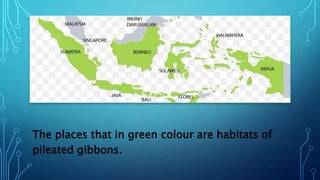
The places that in green colour are habitats of
pileated gibbons.
Gibbon songs
•Early in the morning, gibbons produce
spectacular songs, which can be heard as far as
1-2 km away.
•Singing is very rare in mammals.
•Song-bouts usually last about 10-30 mins.
•The songs probably serve to mark territorial
boundaries and find partners.
MEXICAN AXOLOTLS
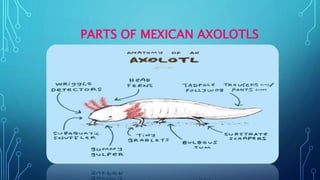
PARTS OF MEXICAN AXOLOTLS
WHY MEXICAN AXOLOTLS ARE
ENDANGERED
•Accustomed to being a top predator in its
habitat, this species has begun to suffer from
the introduction of large fish into its lake
habitat.
• Nowadays, it is critically endangered in the
wild because of the pollution and urban sprawl
that threaten its habitat in the Mexican Basin.
Habitat: Freshwater lakes & ponds
Location: Mexico
Lifespan: 10 – 15 Years
Size: 15 – 45 cm
Weight: 2 – 8 ounces
Colour: White, pink & dark brown
Diet:
Worms, tadpoles, insects, small
fish
Top Speed: 15 kph
Conservation Status:
Critically Endangered
MORE INFORMATION
Axolotl can regrow the same limb up to 5 times.
Then it stops.
• There appears to be a limit of how many times the
Axolotl is capable of regrowing a limb.
• Scientists discovered that by the fifth time, few limbs
could regrow to their previous potential and instead,
scar tissue started to form.
The female Axolotl lays a massive amount of eggs in a
protective cover.
• There will be between 300 and 1,000 eggs deposited
in the water by the female.
• Each is attached to a protective substrate.
• The eggs are individually laid and are typically placed
on plants or rocks in order to protect them from
predators.
• The eggs will hatch in about two weeks and the young
Axolotl are independent from the moment they
emerge from their eggs.
This axolotls does not chew it’s food, it feeds by
suction.
•It does this by using rakers that interlock and
close the gills silts as food is sucked into the
mouth.
•They are carnivorous, and eat
worms,tadpoles,insects and even small fish.
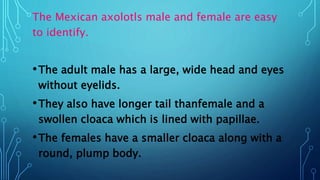
The Mexican axolotls male and female are easy
to identify.
•The adult male has a large, wide head and eyes
without eyelids.
•They also have longer tail thanfemale and a
swollen cloaca which is lined with papillae.
•The females have a smaller cloaca along with a
round, plump body.
The Mexican axolotl’s breeding process including a
dance.
• The male and female axolotls begin the breeding
process with a waltz.
• Both the male and female will rub and slide against
the other’s cloaca with dancing in a circular fashion.
• He does this following about 30-seconds of vigorous
tail shaking.
• The female will pick up the deposit with her cloaca
following a tail shaking display and fertilization
begins.
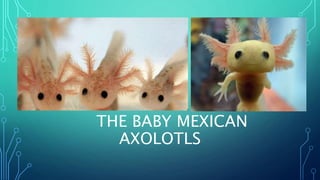
THE BABY MEXICAN
AXOLOTLS
GROUP MEMBERS
DEEPALOSSINI SRI PRIYA
PRIYA DHARSHINI

Endangered animals

  • 1.
  • 2.
  • 3.
    WHY PILEATED AREENDANGERED ? • Gibbons not only include the most endangered apes but also the most endangered primate species of the world. • The main reasons for this are habitat loss and degradation, hunting and illegal trade. • Preservation of the tropical forest is imperative to gibbon survival.
  • 4.
    INTERESTING FACTS OFPILEATED GIBBONS HABITAT •The gibbons live in evergreen tropical rainforest of Southeast Asia. •They adapted to live treetops. •Gibbons eat mainly fruit,leaves,flowers and insects.
  • 5.
    LOCOMOTION • Gibbons movemainly by swinging by their arms but they can also walk on two legs. • When in a hurry, gibbons seem to be virtually flying through the treetops. • On branches and the ground, gibbons walk on two legs.
  • 6.
    DISTRIBUTION •Gibbons have alarge range that extends over almost all of Southeast Asia. •Gibbons are distributed over most of Indo- Burma and Sundaland. •These are two of earth's biologically richest and most endangered terrestrial ecoregions.
  • 7.
    The places thatin green colour are habitats of pileated gibbons.
  • 8.
    Gibbon songs •Early inthe morning, gibbons produce spectacular songs, which can be heard as far as 1-2 km away. •Singing is very rare in mammals. •Song-bouts usually last about 10-30 mins. •The songs probably serve to mark territorial boundaries and find partners.
  • 10.
  • 11.
  • 12.
    WHY MEXICAN AXOLOTLSARE ENDANGERED •Accustomed to being a top predator in its habitat, this species has begun to suffer from the introduction of large fish into its lake habitat. • Nowadays, it is critically endangered in the wild because of the pollution and urban sprawl that threaten its habitat in the Mexican Basin.
  • 13.
    Habitat: Freshwater lakes& ponds Location: Mexico Lifespan: 10 – 15 Years Size: 15 – 45 cm Weight: 2 – 8 ounces Colour: White, pink & dark brown Diet: Worms, tadpoles, insects, small fish Top Speed: 15 kph Conservation Status: Critically Endangered
  • 14.
    MORE INFORMATION Axolotl canregrow the same limb up to 5 times. Then it stops. • There appears to be a limit of how many times the Axolotl is capable of regrowing a limb. • Scientists discovered that by the fifth time, few limbs could regrow to their previous potential and instead, scar tissue started to form.
  • 15.
    The female Axolotllays a massive amount of eggs in a protective cover. • There will be between 300 and 1,000 eggs deposited in the water by the female. • Each is attached to a protective substrate. • The eggs are individually laid and are typically placed on plants or rocks in order to protect them from predators. • The eggs will hatch in about two weeks and the young Axolotl are independent from the moment they emerge from their eggs.
  • 16.
    This axolotls doesnot chew it’s food, it feeds by suction. •It does this by using rakers that interlock and close the gills silts as food is sucked into the mouth. •They are carnivorous, and eat worms,tadpoles,insects and even small fish.
  • 17.
    The Mexican axolotlsmale and female are easy to identify. •The adult male has a large, wide head and eyes without eyelids. •They also have longer tail thanfemale and a swollen cloaca which is lined with papillae. •The females have a smaller cloaca along with a round, plump body.
  • 18.
    The Mexican axolotl’sbreeding process including a dance. • The male and female axolotls begin the breeding process with a waltz. • Both the male and female will rub and slide against the other’s cloaca with dancing in a circular fashion. • He does this following about 30-seconds of vigorous tail shaking. • The female will pick up the deposit with her cloaca following a tail shaking display and fertilization begins.
  • 19.
  • 20.
    GROUP MEMBERS DEEPALOSSINI SRIPRIYA PRIYA DHARSHINI