Capybara
Scientific Name : Hydrochaeris


      By Mac Mcphee
         Ms. Seo
        Fessenden
         Grade 6
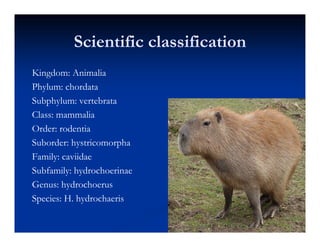
Scientific classification
Kingdom: Animalia
Phylum: chordata
Subphylum: vertebrata
Class: mammalia
Order: rodentia
Suborder: hystricomorpha
Family: caviidae
Subfamily: hydrochoerinae
Genus: hydrochoerus
Species: H. hydrochaeris
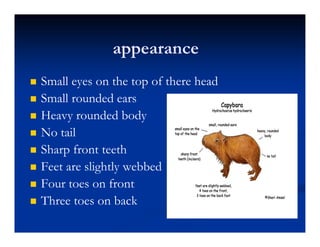
appearance
Small eyes on the top of there head
Small rounded ears
Heavy rounded body
No tail
Sharp front teeth
Feet are slightly webbed
Four toes on front
Three toes on back
Location in world

Capybaras are located in south America and also
panama.
Capybaras are found in dense forests near water
sources such as streams, rivers, ponds, swamps
and lakes.
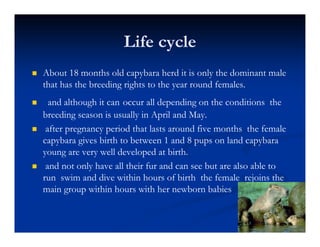
Life cycle
About 18 months old capybara herd it is only the dominant male
that has the breeding rights to the year round females.
  and although it can occur all depending on the conditions the
breeding season is usually in April and May.
 after pregnancy period that lasts around five months the female
capybara gives birth to between 1 and 8 pups on land capybara
young are very well developed at birth.
 and not only have all their fur and can see but are also able to
run swim and dive within hours of birth the female rejoins the
main group within hours with her newborn babies
What does it eat

Capybaras are herbivores they eat leaves and
fruit and also plants from the bottom of rivers
and lakes? Capybaras are strictly vegetarian
Predators
Their predators are jaguars, caimans, and snakes
like anacondas which usually eat small capybaras
How does it contribute to the
        diversity of life
Capybara play a number of important roles in
their ecosystem.
In many parts of their range they are the only
large grazing species so they have a huge impact
on the vegetation of the area
They also serve as a prey animal for many large
carnivores many birds eat the insects found in
capybara fur and insects
How do humans continue to impact
  the natural environment of the
             capybara
They are often killed in certain areas for their
meat and skin which has led to population
declines in these regions
The capybara has also been affected by human
activity in their native regions in general
including both growing human settlements
Land clearance for agriculture it is in these areas
that when there is not an adequate supply of
food available
What can be done to help this
    species continue to survive
Don’t pollute in capybara water and do not
pollute in there forest or it will kill them
Interesting facts
The capybara is the worlds largest rodent
Three toes on the back
Four on the front
Final slide
Rainforest animals www.rainforestanimals.net
Wikipedia www.Wikipedia.com
Smithsonian animals (David buhie and don e
Wilson)
Animals of the world (tom Jackson)
The end

Mac capybara3

  • 1.
    Capybara Scientific Name :Hydrochaeris By Mac Mcphee Ms. Seo Fessenden Grade 6
  • 2.
    Scientific classification Kingdom: Animalia Phylum:chordata Subphylum: vertebrata Class: mammalia Order: rodentia Suborder: hystricomorpha Family: caviidae Subfamily: hydrochoerinae Genus: hydrochoerus Species: H. hydrochaeris
  • 3.
    appearance Small eyes onthe top of there head Small rounded ears Heavy rounded body No tail Sharp front teeth Feet are slightly webbed Four toes on front Three toes on back
  • 4.
    Location in world Capybarasare located in south America and also panama. Capybaras are found in dense forests near water sources such as streams, rivers, ponds, swamps and lakes.
  • 5.
    Life cycle About 18months old capybara herd it is only the dominant male that has the breeding rights to the year round females. and although it can occur all depending on the conditions the breeding season is usually in April and May. after pregnancy period that lasts around five months the female capybara gives birth to between 1 and 8 pups on land capybara young are very well developed at birth. and not only have all their fur and can see but are also able to run swim and dive within hours of birth the female rejoins the main group within hours with her newborn babies
  • 6.
    What does iteat Capybaras are herbivores they eat leaves and fruit and also plants from the bottom of rivers and lakes? Capybaras are strictly vegetarian
  • 7.
    Predators Their predators arejaguars, caimans, and snakes like anacondas which usually eat small capybaras
  • 8.
    How does itcontribute to the diversity of life Capybara play a number of important roles in their ecosystem. In many parts of their range they are the only large grazing species so they have a huge impact on the vegetation of the area They also serve as a prey animal for many large carnivores many birds eat the insects found in capybara fur and insects
  • 9.
    How do humanscontinue to impact the natural environment of the capybara They are often killed in certain areas for their meat and skin which has led to population declines in these regions The capybara has also been affected by human activity in their native regions in general including both growing human settlements Land clearance for agriculture it is in these areas that when there is not an adequate supply of food available
  • 10.
    What can bedone to help this species continue to survive Don’t pollute in capybara water and do not pollute in there forest or it will kill them
  • 11.
    Interesting facts The capybarais the worlds largest rodent Three toes on the back Four on the front
  • 12.
    Final slide Rainforest animalswww.rainforestanimals.net Wikipedia www.Wikipedia.com Smithsonian animals (David buhie and don e Wilson) Animals of the world (tom Jackson)
  • 13.