

Presented by Dr.Himadri Banerji Ex CEO in Reliance Energy and Leader GLG at the PlanTech 2010 Mumbai, 4th and 5th Feb  Performance-Based Regulation in Electric Utilities: Reliability Improvement Using Integrated Asset Management Standard PAS 55.  Dr. Himadri Banerji PlanTech 2010 Mumbai 4 th  and 5 th  February
Presentation Agenda Restructuring of Electricity Industry What is Performance Based Regulations Why PBR:  Moving away from Rate Case Major Structural Options for PBR,  Targeted PBR Service Standards, Reliability , Penalties and Cost of ENS Asset Management Defined PAS 55 Asset Management BS Standard Integrated System Scope and Interfaces Organizational Strategic Plan Management System Structure Asset Risk Analysis and Control Design and Development Phase Operational Phase: Probabilistic Risk Assessment Thank You Presented by Dr.Himadri Banerji Ex CEO in Reliance Energy and Leader GLG at the PlanTech 2010 Mumbai, 4th and 5th Feb
Targeted PBR and Targeted Incentives: Service Standards Presented by Dr.Himadri Banerji Ex CEO in Reliance Energy and Leader GLG at the PlanTech 2010 Mumbai, 4th and 5th Feb  If distribution were a competitive market, providers would compete on the basis of price, service quality, and customer service.  But there is no meaningful competition for distribution services.  Consequently, the quest for lower costs and higher profits will drive utilities to cut service quality and customer service.  Setting standards with built-in incentives (rewards and penalties) will encourage utilities to find acceptable lower cost ways to provide a specified level of service.
Background: Electricity Industry Restructuring Presented by Dr.Himadri Banerji Ex CEO in Reliance Energy and Leader GLG at the PlanTech 2010 Mumbai, 4th and 5th Feb  The restructuring and liberalization of electricity industry worldwide have increased the incentives for a cost effective and efficient use of available assets in all segments of the power industry.
What is performance-based regulation Presented by Dr.Himadri Banerji Ex CEO in Reliance Energy and Leader GLG at the PlanTech 2010 Mumbai, 4th and 5th Feb  The term – performance-based regulation – is the most recent in a long line of vocabulary used to describe regulatory approaches that rely on financial incentives and disincentives to induce desired behavior by a regulated firm.  The desired behaviors, or outcomes, are generally 1) lower costs, 2) improved service, and 3) more rational allocation of risks and rewards.  The renewed interest in PBR largely reflects dissatisfaction with cost-of-service or rate-of-return regulation, especially the perception that cost-of-service regulation stifles utility innovation and causes utility managers to be more responsive to regulators than to customers.  PBR may also be pursued by utilities seeking higher profits, more flexibility, or less risk.
PBR Structures :  Price and Revenue Caps Presented by Dr.Himadri Banerji Ex CEO in Reliance Energy and Leader GLG at the PlanTech 2010 Mumbai, 4th and 5th Feb  The major structural options are price caps and revenue caps.  Both options create the same incentives to cut costs, but revenue caps create much better incentives for investment in distributed resources.  Also, revenue and price caps merge as rate design for distribution utilities moves toward fixed monthly fees.  Revenue caps provide an opportunity to achieve many of the purposes of fixed charge rate designs while avoiding the substantial economic and public acceptance problems associated with such rate designs. However Most regulators start with Target Based PBR.
Service Standards: Service Reliability Presented by Dr.Himadri Banerji Ex CEO in Reliance Energy and Leader GLG at the PlanTech 2010 Mumbai, 4th and 5th Feb  1.  Reliability.  This includes a long list of specific standards including the extent and duration of outages, service restoration time, frequency of planned outages, performance of worst circuits, and voltage variations. 2.  Call Center Performance.  This addresses how quickly and how fully calls to the utility are answered and how well consumer questions or complaints are resolved. 3.  Field Service.  This covers a wide range of situations in which utility employees make visits to the customers location. Standards may include how well appointments are kept and time to connect new service, test meters, and replace street lights. 4.  Billing and Complaints.  This includes billing accuracy, metering accuracy, complaint rates to the utility and regulator, overall customer satisfaction, and power quality complaints.
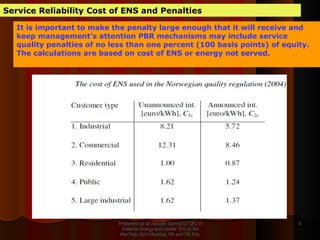
Presented by Dr.Himadri Banerji Ex CEO in Reliance Energy and Leader GLG at the PlanTech 2010 Mumbai, 4th and 5th Feb  It is important to make the penalty large enough that it will receive and keep management’s attention   PBR mechanisms may include service quality penalties of no less than one percent (100 basis points) of equity. The calculations are based on cost of ENS or energy not served. Service Reliability Cost of ENS and Penalties
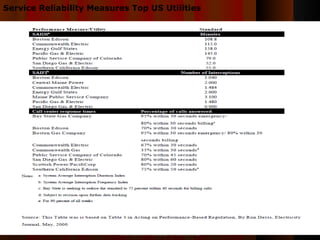
Presented by Dr.Himadri Banerji Ex CEO in Reliance Energy and Leader GLG at the PlanTech 2010 Mumbai, 4th and 5th Feb  Service Reliability Measures Top US Utilities
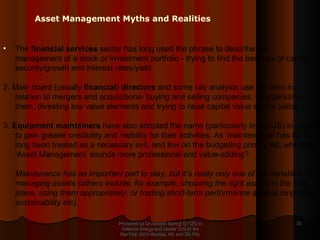
Presented by Dr.Himadri Banerji Ex CEO in Reliance Energy and Leader GLG at the PlanTech 2010 Mumbai, 4th and 5th Feb  The  financial services  sector has long used the phrase to describe the management of a stock or investment portfolio - trying to find the best mix of capital security/growth and interest rates/yield. 2. Main board (usually  financial) directors  and some city analysts use the term in relation to mergers and acquisitions- buying and selling companies, re-organizing them, divesting low value elements and trying to raise capital value and/or yields. 3.  Equipment maintainers  have also adopted the name (particularly in the US) in order to gain greater credibility and visibility for their activities. As ‘maintenance’ has for so long been treated as a necessary evil, and low on the budgeting priority list, whereas ‘Asset Management’ sounds more professional and value-adding?  Maintenance has an important part to play, but it’s really only one of the variables in managing assets (others include, for example, choosing the right assets in the first place, using them appropriately, or trading short-term performance against long-term sustainability etc).   Asset Management Myths and Realities
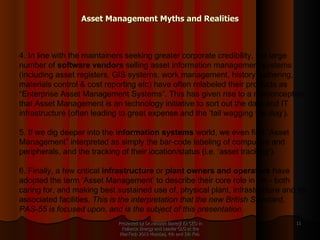
Asset Management Myths and Realities Presented by Dr.Himadri Banerji Ex CEO in Reliance Energy and Leader GLG at the PlanTech 2010 Mumbai, 4th and 5th Feb  4. In line with the maintainers seeking greater corporate credibility, the large number of  software vendors  selling asset information management systems (including asset registers, GIS systems, work management, history gathering, materials control & cost reporting etc) have often relabeled their products as “Enterprise Asset Management Systems”. This has given rise to a misconception that Asset Management is an technology initiative to sort out the data and IT infrastructure (often leading to great expense and the ‘tail wagging the dog’).   5. If we dig deeper into the  information systems  world, we even find “Asset Management” interpreted as simply the bar-code labeling of computers and peripherals, and the tracking of their location/status (i.e. ‘asset tracking’).   6. Finally, a few critical  infrastructure  or  plant owners and operators  have adopted the term ‘Asset Management’ to describe their core role in life - both caring for, and making best sustained use of, physical plant, infrastructure and its associated facilities.  This is the interpretation that the new British Standard, PAS-55 is focused upon, and is the subject of this presentation.  
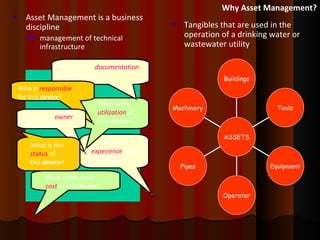
Why Asset Management? Asset Management is a business discipline management of technical infrastructure Tangibles that are used in the operation of a drinking water or wastewater utility Where is the  documentation of this  device ? Who is  responsible for this  device ? What is the utilization  of this  device ? Who is the  owner of this  device ? What is the status  of  this  device ? Is there experience  with this  device ? What is the total cost  of this  device ? Machinery Pipes Operator Equipment Tools Buildings ASSETS
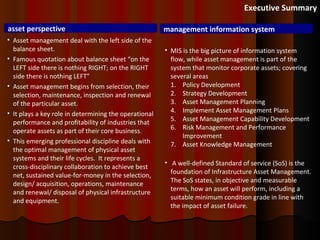
Executive Summary asset perspective management information system Asset management deal with the left side of the balance sheet.  Famous quotation about balance sheet “on the LEFT side there is nothing RIGHT; on the RIGHT side there is nothing LEFT” Asset management begins from selection,  their selection, maintenance, inspection and renewal of the particular asset. It plays a key role in determining the operational performance and profitability of industries that operate assets as part of their core business. This emerging professional discipline deals with the optimal management of physical asset systems and their life cycles.  It represents a cross-disciplinary collaboration to achieve best net, sustained value-for-money in the selection, design/ acquisition, operations, maintenance and renewal/ disposal of physical infrastructure and equipment.  MIS is the big picture of information system flow, while asset management is part of the system that monitor corporate assets; covering several areas Policy Development Strategy Development Asset Management Planning Implement Asset Management Plans Asset Management Capability Development Risk Management and Performance Improvement Asset Knowledge Management A well-defined Standard of service (SoS) is the foundation of Infrastructure Asset Management. The SoS states, in objective and measurable terms, how an asset will perform, including a suitable minimum condition grade in line with the impact of asset failure.
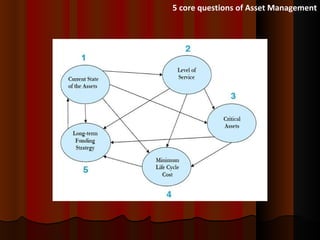
5 core questions of Asset Management
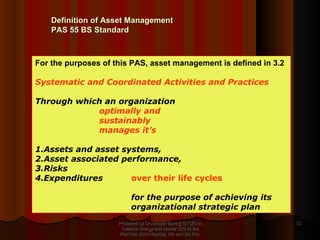
Presented by Dr.Himadri Banerji Ex CEO in Reliance Energy and Leader GLG at the PlanTech 2010 Mumbai, 4th and 5th Feb  For the purposes of this PAS, asset management is defined in 3.2 Systematic and Coordinated Activities and Practices   Through which an organization  optimally and  sustainably  manages it’s  1.Assets and asset systems,  2.Asset associated performance,  3.Risks  4.Expenditures  over their life cycles  for the purpose of achieving its  organizational strategic plan Definition of Asset Management PAS 55 BS Standard
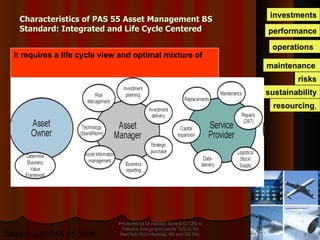
Characteristics of PAS 55 Asset Management BS Standard: Integrated and Life Cycle Centered Presented by Dr.Himadri Banerji Ex CEO in Reliance Energy and Leader GLG at the PlanTech 2010 Mumbai, 4th and 5th Feb  It  requires a life cycle view and optimal mixture of   investments operations maintenance resourcing , risks performance sustainability Source: BSI PAS 55:2008
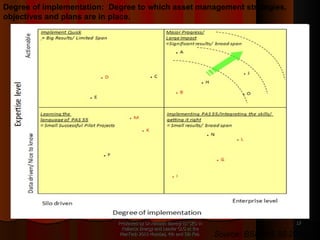
Presented by Dr.Himadri Banerji Ex CEO in Reliance Energy and Leader GLG at the PlanTech 2010 Mumbai, 4th and 5th Feb  Degree of implementation:  Degree to which asset management strategies, objectives and plans are in place. Source: BSI PAS 55:2008
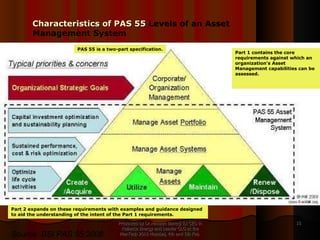
Presented by Dr.Himadri Banerji Ex CEO in Reliance Energy and Leader GLG at the PlanTech 2010 Mumbai, 4th and 5th Feb  Characteristics of PAS 55  Levels of an Asset Management System                                                                                                                          Source: BSI PAS 55:2008 Part 1 contains the core requirements against which an organization's Asset Management capabilities can be assessed.  Part 2 expands on these requirements with examples and guidance designed to aid the understanding of the intent of the Part 1 requirements. PAS 55 is a two-part specification.
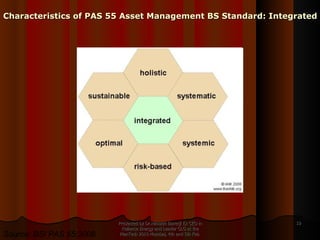
Presented by Dr.Himadri Banerji Ex CEO in Reliance Energy and Leader GLG at the PlanTech 2010 Mumbai, 4th and 5th Feb  Characteristics of PAS 55 Asset Management BS Standard: Integrated Source: BSI PAS 55:2008
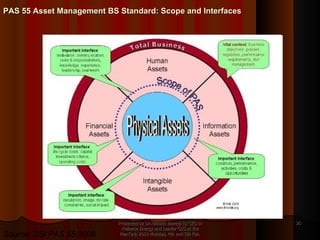
Presented by Dr.Himadri Banerji Ex CEO in Reliance Energy and Leader GLG at the PlanTech 2010 Mumbai, 4th and 5th Feb  PAS 55 Asset Management BS Standard: Scope and Interfaces Source: BSI PAS 55:2008
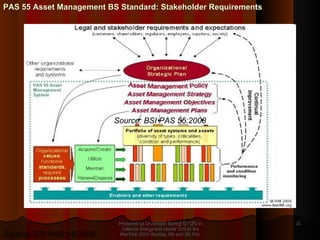
Presented by Dr.Himadri Banerji Ex CEO in Reliance Energy and Leader GLG at the PlanTech 2010 Mumbai, 4th and 5th Feb  PAS 55 Asset Management BS Standard: Stakeholder Requirements  Source: BSI PAS 55:2008 Source: BSI PAS 55:2008
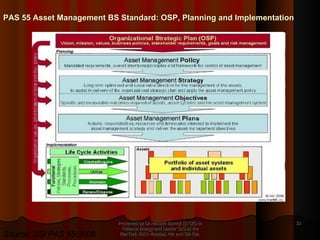
Presented by Dr.Himadri Banerji Ex CEO in Reliance Energy and Leader GLG at the PlanTech 2010 Mumbai, 4th and 5th Feb  PAS 55 Asset Management BS Standard: OSP, Planning and Implementation Source: BSI PAS 55:2008
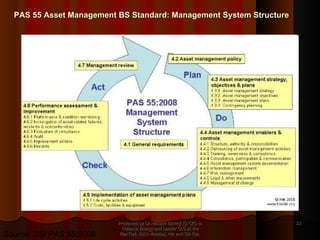
Presented by Dr.Himadri Banerji Ex CEO in Reliance Energy and Leader GLG at the PlanTech 2010 Mumbai, 4th and 5th Feb  PAS 55 Asset Management BS Standard: Management System Structure Source: BSI PAS 55:2008
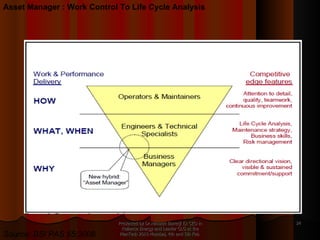
Presented by Dr.Himadri Banerji Ex CEO in Reliance Energy and Leader GLG at the PlanTech 2010 Mumbai, 4th and 5th Feb  Asset Manager : Work Control To Life Cycle Analysis   Source: BSI PAS 55:2008
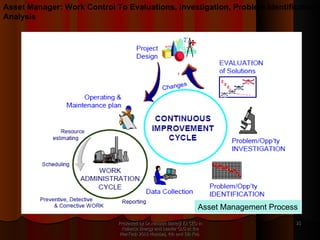
Presented by Dr.Himadri Banerji Ex CEO in Reliance Energy and Leader GLG at the PlanTech 2010 Mumbai, 4th and 5th Feb  Asset   Management Process Asset Manager: Work Control To Evaluations, Investigation, Problem Identification Analysis
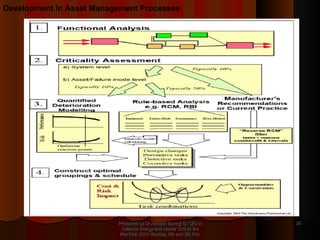
Presented by Dr.Himadri Banerji Ex CEO in Reliance Energy and Leader GLG at the PlanTech 2010 Mumbai, 4th and 5th Feb  Development in Asset Management Processes
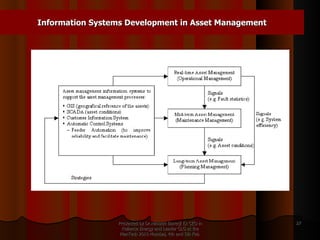
Information Systems Development in Asset Management Presented by Dr.Himadri Banerji Ex CEO in Reliance Energy and Leader GLG at the PlanTech 2010 Mumbai, 4th and 5th Feb
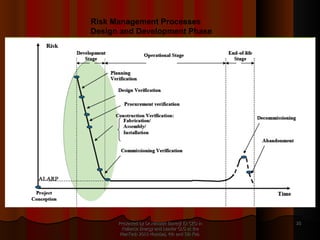
Presented by Dr.Himadri Banerji Ex CEO in Reliance Energy and Leader GLG at the PlanTech 2010 Mumbai, 4th and 5th Feb  Risk Management Processes Design and Development Phase
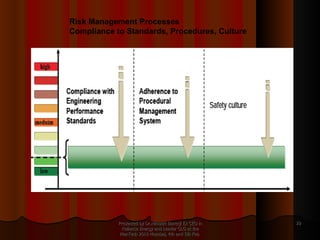
Presented by Dr.Himadri Banerji Ex CEO in Reliance Energy and Leader GLG at the PlanTech 2010 Mumbai, 4th and 5th Feb  Risk Management Processes Compliance to Standards, Procedures, Culture
Probabilistic Risk Management   Operational Phase Presented by Dr.Himadri Banerji Ex CEO in Reliance Energy and Leader GLG at the PlanTech 2010 Mumbai, 4th and 5th Feb  Probabilistic risk assessments have the following characteristics: •  explicitly consider a broad set of potential challenges to safety; •  logically prioritize these challenges; •  consider a wide range of options to mitigate these challenges; •  assess sensitivity of results to key assumptions; •  identify and potentially quantify uncertainties in results. Performance requirements have the following characteristics: •  based on measurable, quantifiable parameters that are directly related to safety; •  timing of measurements is specified; •  numerical performance criteria are set for each parameter; •  corrective actions are required to be taken if performance criteria are not met; •  performance trends are monitored; •  performance criteria and/or corrective actions are adjusted based on performance trends.
Presented by Dr.Himadri Banerji Ex CEO in Reliance Energy and Leader GLG at the PlanTech 2010 Mumbai, 4th and 5th Feb  Questions Discussions Thank You

Performance Based Regulation, Implementing an Asset Management Standards and Systems

  • 1.
    Presented by Dr.HimadriBanerji Ex CEO in Reliance Energy and Leader GLG at the PlanTech 2010 Mumbai, 4th and 5th Feb Performance-Based Regulation in Electric Utilities: Reliability Improvement Using Integrated Asset Management Standard PAS 55. Dr. Himadri Banerji PlanTech 2010 Mumbai 4 th and 5 th February
  • 2.
    Presentation Agenda Restructuringof Electricity Industry What is Performance Based Regulations Why PBR: Moving away from Rate Case Major Structural Options for PBR, Targeted PBR Service Standards, Reliability , Penalties and Cost of ENS Asset Management Defined PAS 55 Asset Management BS Standard Integrated System Scope and Interfaces Organizational Strategic Plan Management System Structure Asset Risk Analysis and Control Design and Development Phase Operational Phase: Probabilistic Risk Assessment Thank You Presented by Dr.Himadri Banerji Ex CEO in Reliance Energy and Leader GLG at the PlanTech 2010 Mumbai, 4th and 5th Feb
  • 3.
    Targeted PBR andTargeted Incentives: Service Standards Presented by Dr.Himadri Banerji Ex CEO in Reliance Energy and Leader GLG at the PlanTech 2010 Mumbai, 4th and 5th Feb If distribution were a competitive market, providers would compete on the basis of price, service quality, and customer service. But there is no meaningful competition for distribution services. Consequently, the quest for lower costs and higher profits will drive utilities to cut service quality and customer service. Setting standards with built-in incentives (rewards and penalties) will encourage utilities to find acceptable lower cost ways to provide a specified level of service.
  • 4.
    Background: Electricity IndustryRestructuring Presented by Dr.Himadri Banerji Ex CEO in Reliance Energy and Leader GLG at the PlanTech 2010 Mumbai, 4th and 5th Feb The restructuring and liberalization of electricity industry worldwide have increased the incentives for a cost effective and efficient use of available assets in all segments of the power industry.
  • 5.
    What is performance-basedregulation Presented by Dr.Himadri Banerji Ex CEO in Reliance Energy and Leader GLG at the PlanTech 2010 Mumbai, 4th and 5th Feb The term – performance-based regulation – is the most recent in a long line of vocabulary used to describe regulatory approaches that rely on financial incentives and disincentives to induce desired behavior by a regulated firm. The desired behaviors, or outcomes, are generally 1) lower costs, 2) improved service, and 3) more rational allocation of risks and rewards. The renewed interest in PBR largely reflects dissatisfaction with cost-of-service or rate-of-return regulation, especially the perception that cost-of-service regulation stifles utility innovation and causes utility managers to be more responsive to regulators than to customers. PBR may also be pursued by utilities seeking higher profits, more flexibility, or less risk.
  • 6.
    PBR Structures : Price and Revenue Caps Presented by Dr.Himadri Banerji Ex CEO in Reliance Energy and Leader GLG at the PlanTech 2010 Mumbai, 4th and 5th Feb The major structural options are price caps and revenue caps. Both options create the same incentives to cut costs, but revenue caps create much better incentives for investment in distributed resources. Also, revenue and price caps merge as rate design for distribution utilities moves toward fixed monthly fees. Revenue caps provide an opportunity to achieve many of the purposes of fixed charge rate designs while avoiding the substantial economic and public acceptance problems associated with such rate designs. However Most regulators start with Target Based PBR.
  • 7.
    Service Standards: ServiceReliability Presented by Dr.Himadri Banerji Ex CEO in Reliance Energy and Leader GLG at the PlanTech 2010 Mumbai, 4th and 5th Feb 1. Reliability. This includes a long list of specific standards including the extent and duration of outages, service restoration time, frequency of planned outages, performance of worst circuits, and voltage variations. 2. Call Center Performance. This addresses how quickly and how fully calls to the utility are answered and how well consumer questions or complaints are resolved. 3. Field Service. This covers a wide range of situations in which utility employees make visits to the customers location. Standards may include how well appointments are kept and time to connect new service, test meters, and replace street lights. 4. Billing and Complaints. This includes billing accuracy, metering accuracy, complaint rates to the utility and regulator, overall customer satisfaction, and power quality complaints.
  • 8.
    Presented by Dr.HimadriBanerji Ex CEO in Reliance Energy and Leader GLG at the PlanTech 2010 Mumbai, 4th and 5th Feb It is important to make the penalty large enough that it will receive and keep management’s attention PBR mechanisms may include service quality penalties of no less than one percent (100 basis points) of equity. The calculations are based on cost of ENS or energy not served. Service Reliability Cost of ENS and Penalties
  • 9.
    Presented by Dr.HimadriBanerji Ex CEO in Reliance Energy and Leader GLG at the PlanTech 2010 Mumbai, 4th and 5th Feb Service Reliability Measures Top US Utilities
  • 10.
    Presented by Dr.HimadriBanerji Ex CEO in Reliance Energy and Leader GLG at the PlanTech 2010 Mumbai, 4th and 5th Feb The financial services sector has long used the phrase to describe the management of a stock or investment portfolio - trying to find the best mix of capital security/growth and interest rates/yield. 2. Main board (usually financial) directors and some city analysts use the term in relation to mergers and acquisitions- buying and selling companies, re-organizing them, divesting low value elements and trying to raise capital value and/or yields. 3. Equipment maintainers have also adopted the name (particularly in the US) in order to gain greater credibility and visibility for their activities. As ‘maintenance’ has for so long been treated as a necessary evil, and low on the budgeting priority list, whereas ‘Asset Management’ sounds more professional and value-adding? Maintenance has an important part to play, but it’s really only one of the variables in managing assets (others include, for example, choosing the right assets in the first place, using them appropriately, or trading short-term performance against long-term sustainability etc).   Asset Management Myths and Realities
  • 11.
    Asset Management Mythsand Realities Presented by Dr.Himadri Banerji Ex CEO in Reliance Energy and Leader GLG at the PlanTech 2010 Mumbai, 4th and 5th Feb 4. In line with the maintainers seeking greater corporate credibility, the large number of software vendors selling asset information management systems (including asset registers, GIS systems, work management, history gathering, materials control & cost reporting etc) have often relabeled their products as “Enterprise Asset Management Systems”. This has given rise to a misconception that Asset Management is an technology initiative to sort out the data and IT infrastructure (often leading to great expense and the ‘tail wagging the dog’).   5. If we dig deeper into the information systems world, we even find “Asset Management” interpreted as simply the bar-code labeling of computers and peripherals, and the tracking of their location/status (i.e. ‘asset tracking’).   6. Finally, a few critical infrastructure or plant owners and operators have adopted the term ‘Asset Management’ to describe their core role in life - both caring for, and making best sustained use of, physical plant, infrastructure and its associated facilities. This is the interpretation that the new British Standard, PAS-55 is focused upon, and is the subject of this presentation.  
  • 12.
    Why Asset Management?Asset Management is a business discipline management of technical infrastructure Tangibles that are used in the operation of a drinking water or wastewater utility Where is the documentation of this device ? Who is responsible for this device ? What is the utilization of this device ? Who is the owner of this device ? What is the status of this device ? Is there experience with this device ? What is the total cost of this device ? Machinery Pipes Operator Equipment Tools Buildings ASSETS
  • 13.
    Executive Summary assetperspective management information system Asset management deal with the left side of the balance sheet. Famous quotation about balance sheet “on the LEFT side there is nothing RIGHT; on the RIGHT side there is nothing LEFT” Asset management begins from selection, their selection, maintenance, inspection and renewal of the particular asset. It plays a key role in determining the operational performance and profitability of industries that operate assets as part of their core business. This emerging professional discipline deals with the optimal management of physical asset systems and their life cycles. It represents a cross-disciplinary collaboration to achieve best net, sustained value-for-money in the selection, design/ acquisition, operations, maintenance and renewal/ disposal of physical infrastructure and equipment. MIS is the big picture of information system flow, while asset management is part of the system that monitor corporate assets; covering several areas Policy Development Strategy Development Asset Management Planning Implement Asset Management Plans Asset Management Capability Development Risk Management and Performance Improvement Asset Knowledge Management A well-defined Standard of service (SoS) is the foundation of Infrastructure Asset Management. The SoS states, in objective and measurable terms, how an asset will perform, including a suitable minimum condition grade in line with the impact of asset failure.
  • 14.
    5 core questionsof Asset Management
  • 15.
    Presented by Dr.HimadriBanerji Ex CEO in Reliance Energy and Leader GLG at the PlanTech 2010 Mumbai, 4th and 5th Feb For the purposes of this PAS, asset management is defined in 3.2 Systematic and Coordinated Activities and Practices Through which an organization optimally and sustainably manages it’s 1.Assets and asset systems, 2.Asset associated performance, 3.Risks 4.Expenditures over their life cycles for the purpose of achieving its organizational strategic plan Definition of Asset Management PAS 55 BS Standard
  • 16.
    Characteristics of PAS55 Asset Management BS Standard: Integrated and Life Cycle Centered Presented by Dr.Himadri Banerji Ex CEO in Reliance Energy and Leader GLG at the PlanTech 2010 Mumbai, 4th and 5th Feb It requires a life cycle view and optimal mixture of investments operations maintenance resourcing , risks performance sustainability Source: BSI PAS 55:2008
  • 17.
    Presented by Dr.HimadriBanerji Ex CEO in Reliance Energy and Leader GLG at the PlanTech 2010 Mumbai, 4th and 5th Feb Degree of implementation:  Degree to which asset management strategies, objectives and plans are in place. Source: BSI PAS 55:2008
  • 18.
    Presented by Dr.HimadriBanerji Ex CEO in Reliance Energy and Leader GLG at the PlanTech 2010 Mumbai, 4th and 5th Feb Characteristics of PAS 55 Levels of an Asset Management System                                                                                                                        Source: BSI PAS 55:2008 Part 1 contains the core requirements against which an organization's Asset Management capabilities can be assessed. Part 2 expands on these requirements with examples and guidance designed to aid the understanding of the intent of the Part 1 requirements. PAS 55 is a two-part specification.
  • 19.
    Presented by Dr.HimadriBanerji Ex CEO in Reliance Energy and Leader GLG at the PlanTech 2010 Mumbai, 4th and 5th Feb Characteristics of PAS 55 Asset Management BS Standard: Integrated Source: BSI PAS 55:2008
  • 20.
    Presented by Dr.HimadriBanerji Ex CEO in Reliance Energy and Leader GLG at the PlanTech 2010 Mumbai, 4th and 5th Feb PAS 55 Asset Management BS Standard: Scope and Interfaces Source: BSI PAS 55:2008
  • 21.
    Presented by Dr.HimadriBanerji Ex CEO in Reliance Energy and Leader GLG at the PlanTech 2010 Mumbai, 4th and 5th Feb PAS 55 Asset Management BS Standard: Stakeholder Requirements Source: BSI PAS 55:2008 Source: BSI PAS 55:2008
  • 22.
    Presented by Dr.HimadriBanerji Ex CEO in Reliance Energy and Leader GLG at the PlanTech 2010 Mumbai, 4th and 5th Feb PAS 55 Asset Management BS Standard: OSP, Planning and Implementation Source: BSI PAS 55:2008
  • 23.
    Presented by Dr.HimadriBanerji Ex CEO in Reliance Energy and Leader GLG at the PlanTech 2010 Mumbai, 4th and 5th Feb PAS 55 Asset Management BS Standard: Management System Structure Source: BSI PAS 55:2008
  • 24.
    Presented by Dr.HimadriBanerji Ex CEO in Reliance Energy and Leader GLG at the PlanTech 2010 Mumbai, 4th and 5th Feb Asset Manager : Work Control To Life Cycle Analysis Source: BSI PAS 55:2008
  • 25.
    Presented by Dr.HimadriBanerji Ex CEO in Reliance Energy and Leader GLG at the PlanTech 2010 Mumbai, 4th and 5th Feb Asset Management Process Asset Manager: Work Control To Evaluations, Investigation, Problem Identification Analysis
  • 26.
    Presented by Dr.HimadriBanerji Ex CEO in Reliance Energy and Leader GLG at the PlanTech 2010 Mumbai, 4th and 5th Feb Development in Asset Management Processes
  • 27.
    Information Systems Developmentin Asset Management Presented by Dr.Himadri Banerji Ex CEO in Reliance Energy and Leader GLG at the PlanTech 2010 Mumbai, 4th and 5th Feb
  • 28.
    Presented by Dr.HimadriBanerji Ex CEO in Reliance Energy and Leader GLG at the PlanTech 2010 Mumbai, 4th and 5th Feb Risk Management Processes Design and Development Phase
  • 29.
    Presented by Dr.HimadriBanerji Ex CEO in Reliance Energy and Leader GLG at the PlanTech 2010 Mumbai, 4th and 5th Feb Risk Management Processes Compliance to Standards, Procedures, Culture
  • 30.
    Probabilistic Risk Management Operational Phase Presented by Dr.Himadri Banerji Ex CEO in Reliance Energy and Leader GLG at the PlanTech 2010 Mumbai, 4th and 5th Feb Probabilistic risk assessments have the following characteristics: • explicitly consider a broad set of potential challenges to safety; • logically prioritize these challenges; • consider a wide range of options to mitigate these challenges; • assess sensitivity of results to key assumptions; • identify and potentially quantify uncertainties in results. Performance requirements have the following characteristics: • based on measurable, quantifiable parameters that are directly related to safety; • timing of measurements is specified; • numerical performance criteria are set for each parameter; • corrective actions are required to be taken if performance criteria are not met; • performance trends are monitored; • performance criteria and/or corrective actions are adjusted based on performance trends.
  • 31.
    Presented by Dr.HimadriBanerji Ex CEO in Reliance Energy and Leader GLG at the PlanTech 2010 Mumbai, 4th and 5th Feb Questions Discussions Thank You

Editor's Notes

  • #8 Performance benchmarks may be set at the most recent three-year average performance. Such benchmarks should be established for a limited number of broad measures that are easily tracked and important to customers, including: • customer complaints • outage duration, • outage frequency (five minutes or longer), • frequency of momentaries, • storm outage response time, and • hours lost due to accidents.
  • #16 A multi-sector initiative in Europe, backed by the British Standards Institute has now published PAS-55, to clear the air a bit and define what a joined-up physical asset management system needs to include. Adopted by industry regulators as a checklist of good governance. (As per advise of OFGEM the British Regulator all electricity and gas distributors must be PAS 55 by 2010 to reduce regulatory oversight). Certification to the PAS 55 specification is a very significant achievement and confirms the connection between corporate goals and asset management activity at all levels