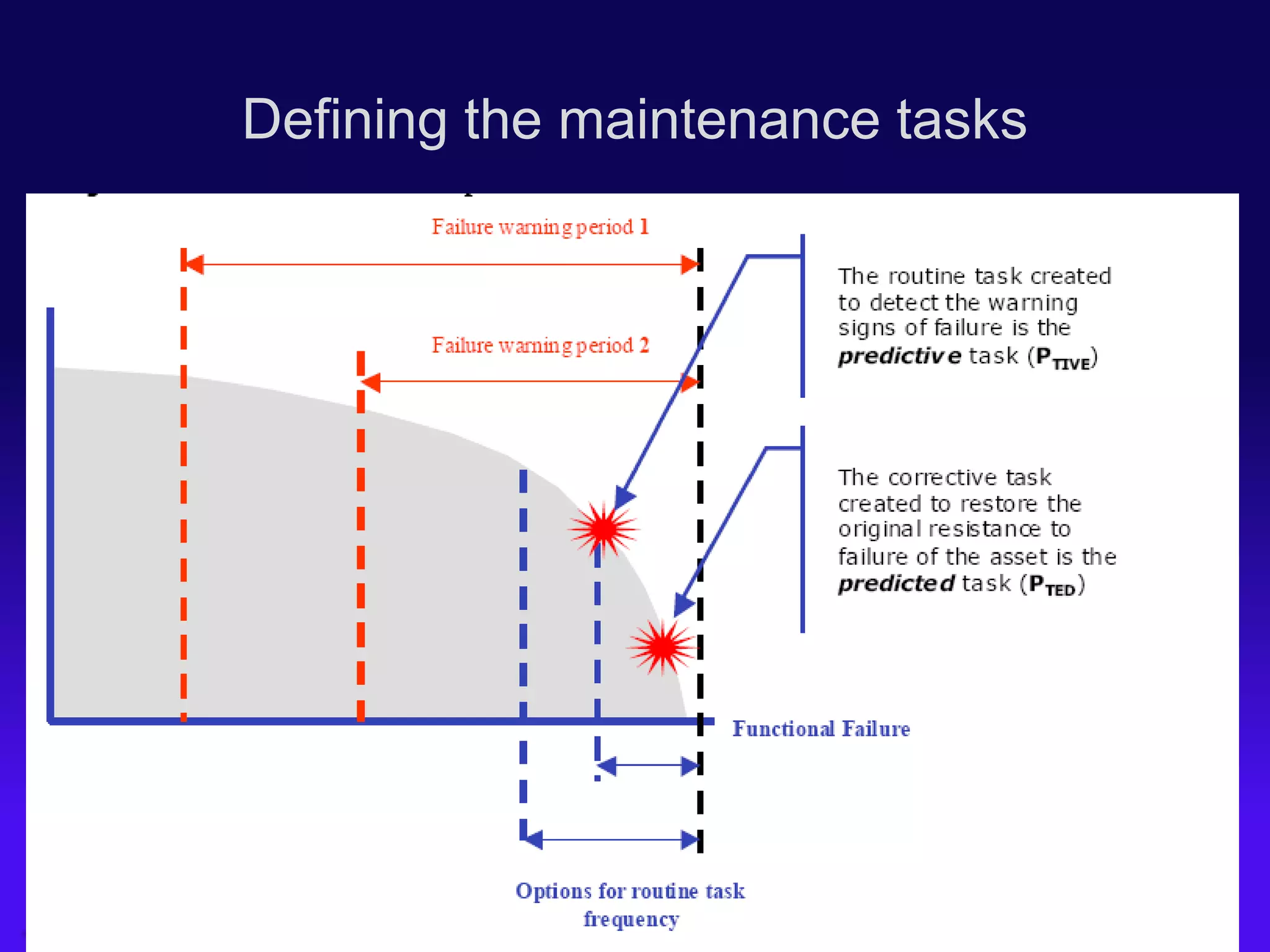
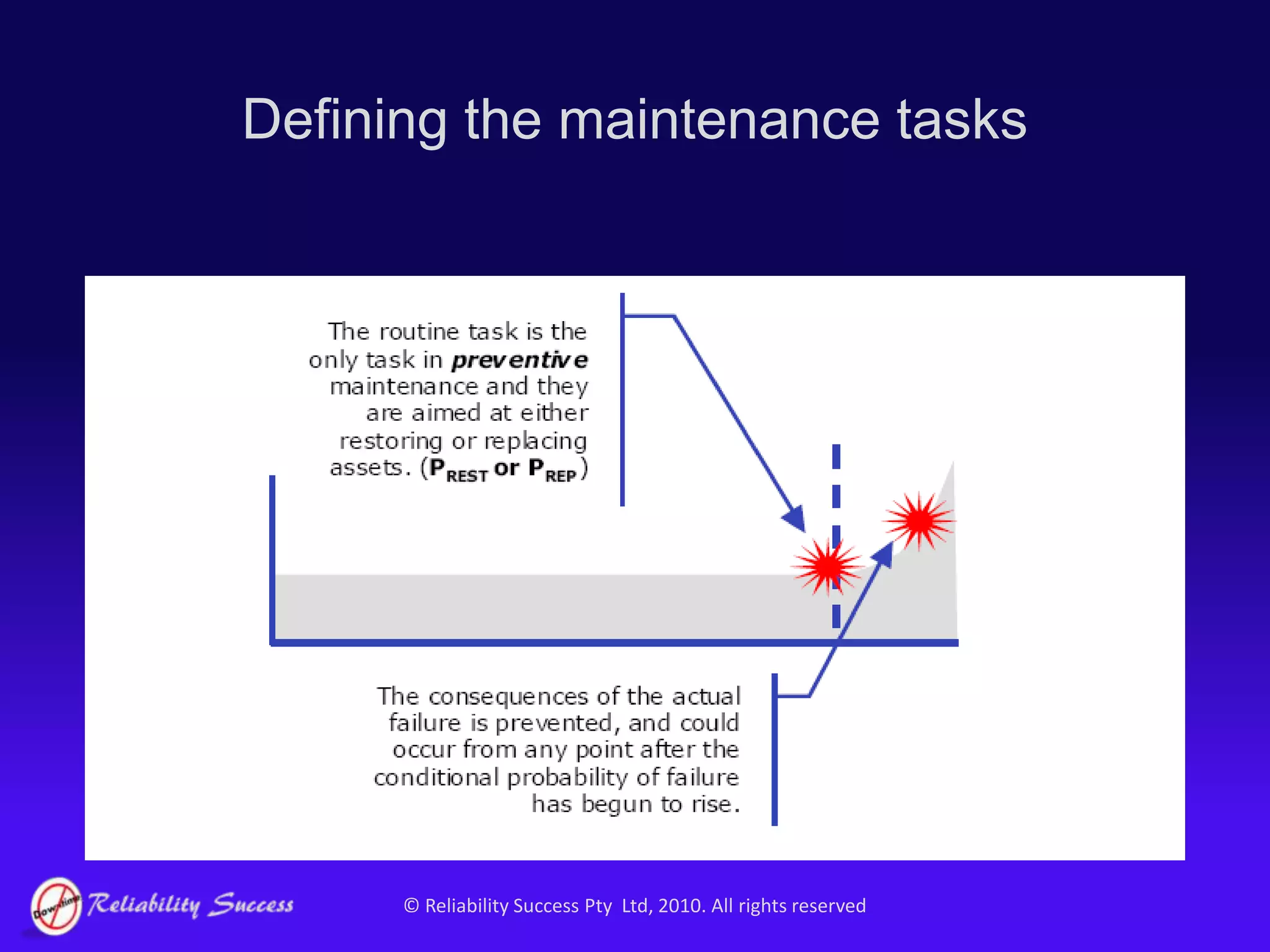
The 4th Generation of Asset ManagementAn overview of leading practices in modern asset management
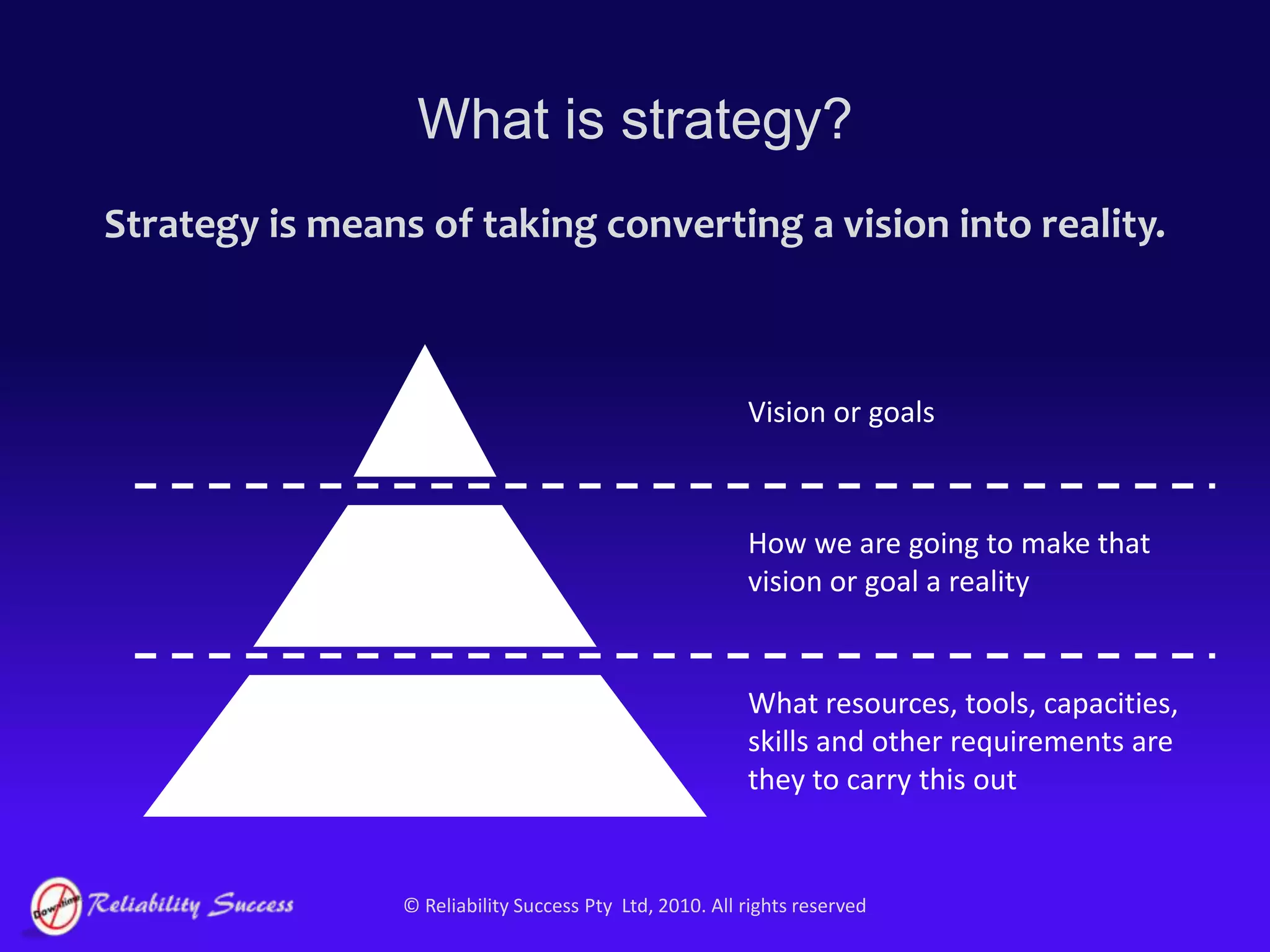
What is strategy?Vision or goalsHow we are going to make that vision or goal a realityWhat resources, tools, capacities, skills and other requirements are they to carry this outStrategy is means of taking converting a vision into reality.
What is strategy?Strategy is means of taking converting a vision into reality.For example:
In the context of RCM a strategy is the management plan for a specific failure mode. (E.g. A detective maintenance task on Oil-filled circuit breakers)
The corporate vision will revolve around either reduced cost, improved performance or reduced risk
The strategy is what we are going to do to achieve that vision (Task type and frequency)
And the tactics are how we are going to achieve that vision:
What task, with what resources, having which skills, with which spares, with which tools, using what procedure etcetera, etcetera…What is strategy?Strategy is means of taking converting a vision into reality.For example:
In the context of strategic asset planning it could mean something like “We will implement comprehensive risk profiling for each critical asset group”
The corporate vision or requirement could be regarding a response to the passage of C-45, or potentially for capital planning purposes…
The strategy is the decision of what we are going to do (What end goal and initiative possibly)
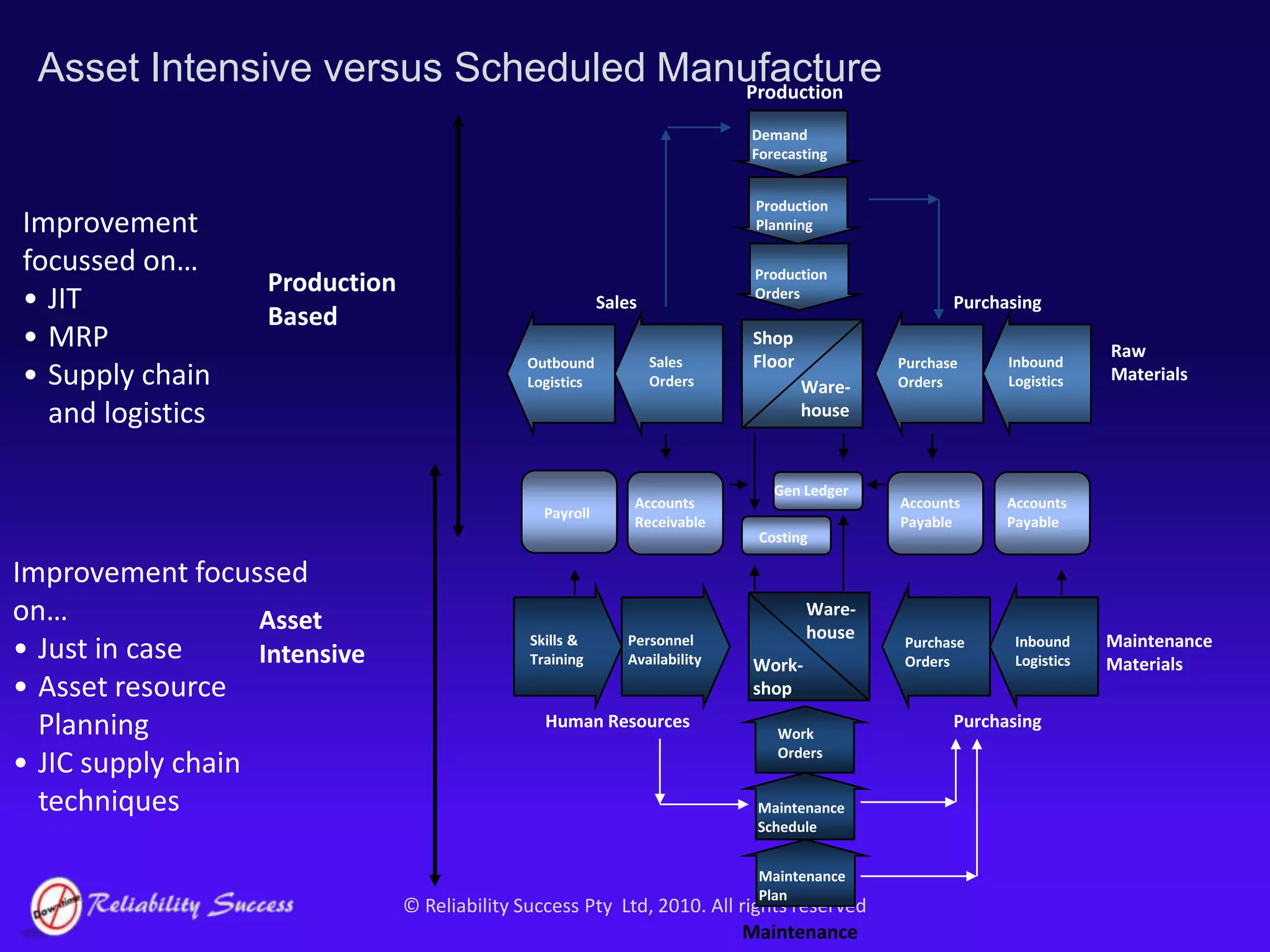
The tactics here are then the skills, people, timeframe allowed, meeting times and rooms, the initiative that has been chosen, and other relevant resources required to make this vision a reality.ProductionDemandForecastingProductionPlanningProduction BasedProductionOrdersPurchasingSalesShopFloorRawMaterialsInboundLogisticsSalesOrdersPurchaseOrdersOutboundLogisticsWare-houseWare-houseAsset IntensiveMaintenanceMaterialsPersonnelAvailabilitySkills &TrainingInboundLogisticsPurchaseOrdersWork-shopPurchasingHuman ResourcesWorkOrdersMaintenanceScheduleMaintenancePlanMaintenanceAsset Intensive versus Scheduled ManufactureImprovement focussed on…JIT
MRP
Supply chain and logisticsGen LedgerAccountsReceivableAccountsPayableAccountsPayablePayrollCostingImprovement focussed on…Just in case
Asset resource Planning
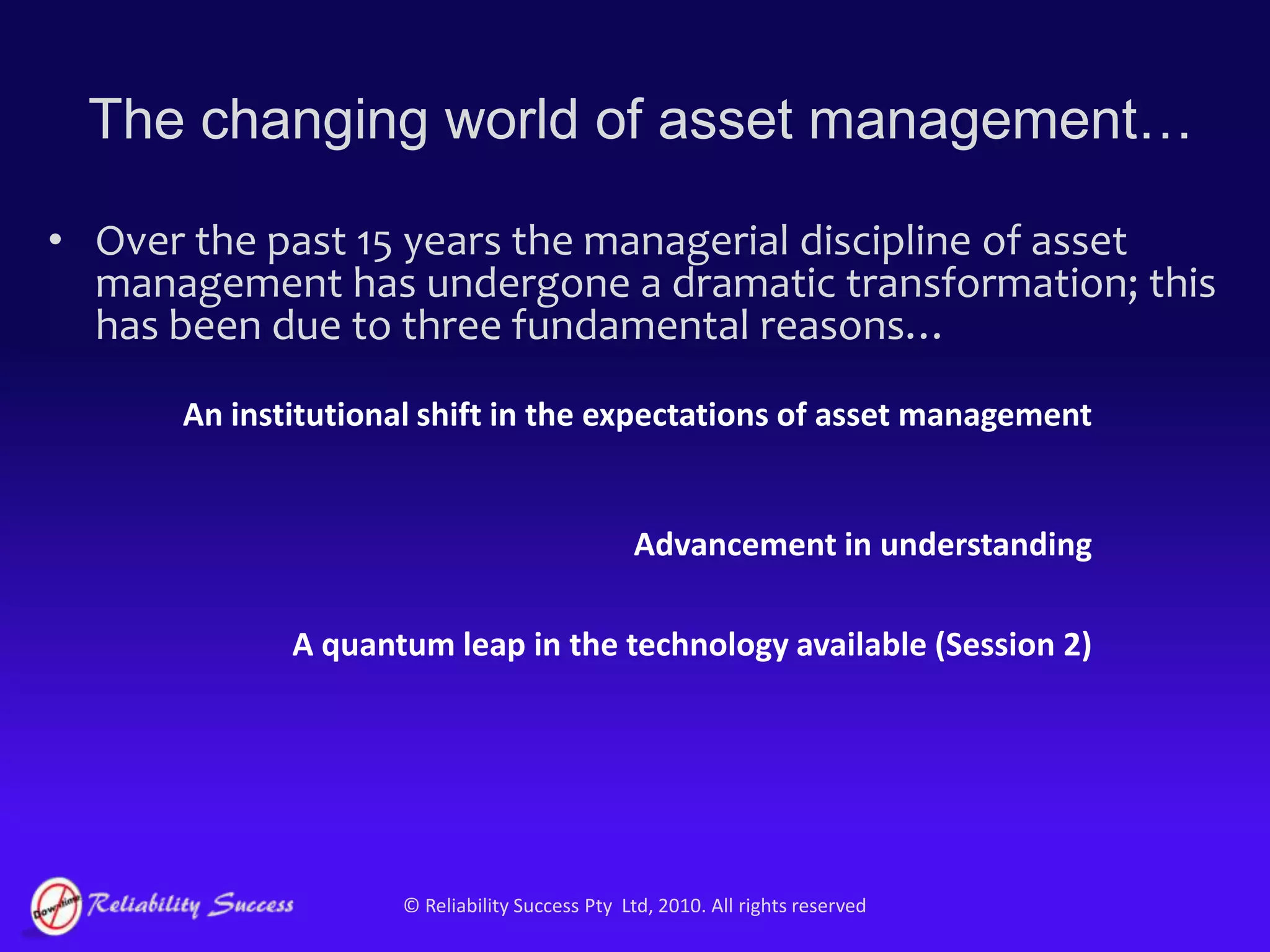
JIC supply chain techniquesThe changing world of asset management…Over the past 15 years the managerial discipline of asset management has undergone a dramatic transformation; this has been due to three fundamental reasons…An institutional shift in the expectations of asset managementAdvancement in understandingA quantum leap in the technology available (Session 2)
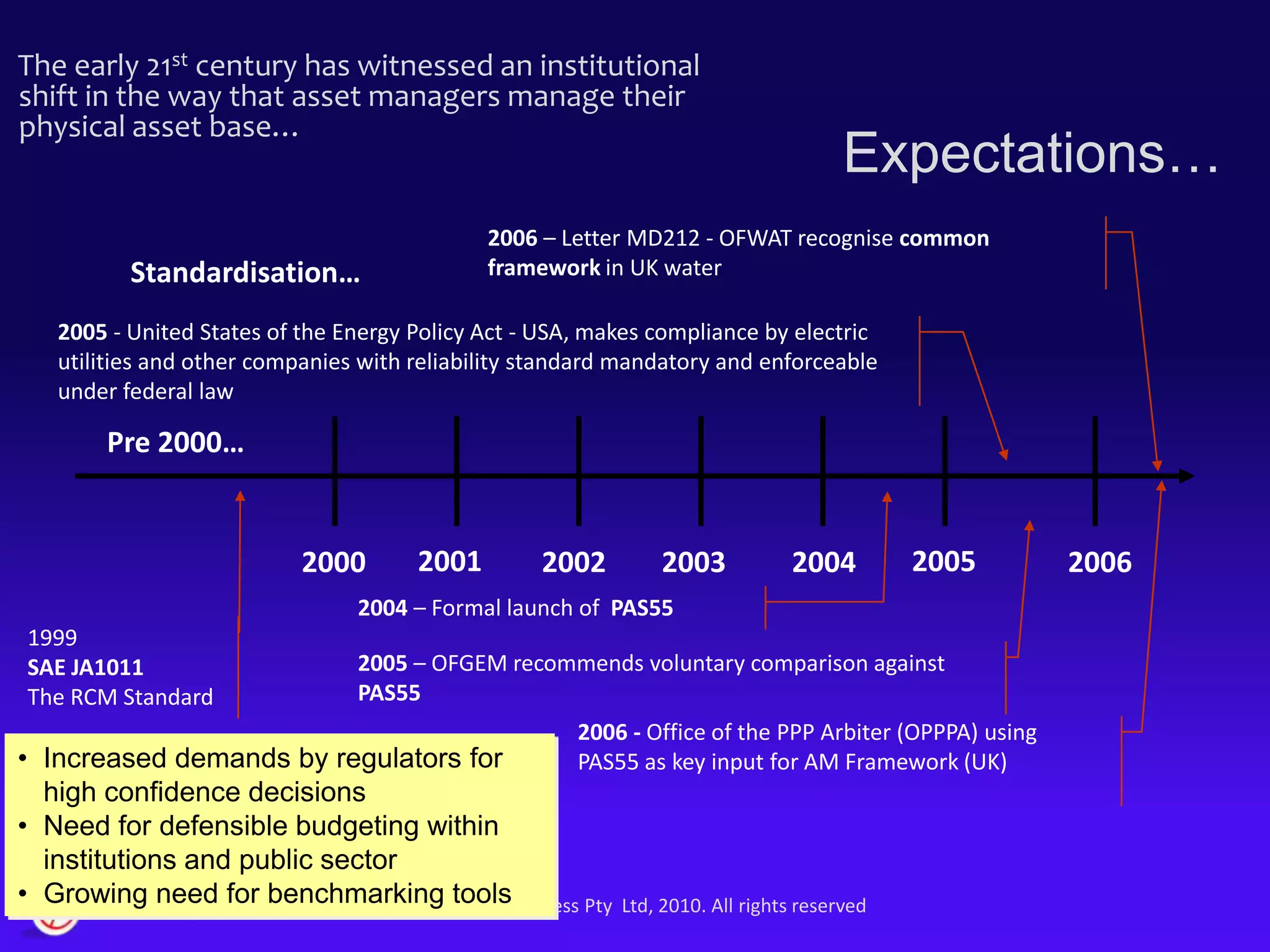
The early 21st century has witnessed an institutional shift in the way that asset managers manage their physical asset base…Expectations…2006 – Letter MD212 - OFWAT recognise common framework in UK waterStandardisation…2005 - United States of the Energy Policy Act - USA, makes compliance by electric utilities and other companies with reliability standard mandatory and enforceable under federal lawPre 2000…20012005200020022003200420062004 – Formal launch of  PAS551999SAE JA1011The RCM Standard2005 – OFGEM recommends voluntary comparison against PAS552006 - Office of the PPP Arbiter (OPPPA) using PAS55 as key input for AM Framework (UK)Increased demands by regulators for high confidence decisions
Need for defensible budgeting within institutions and public sector
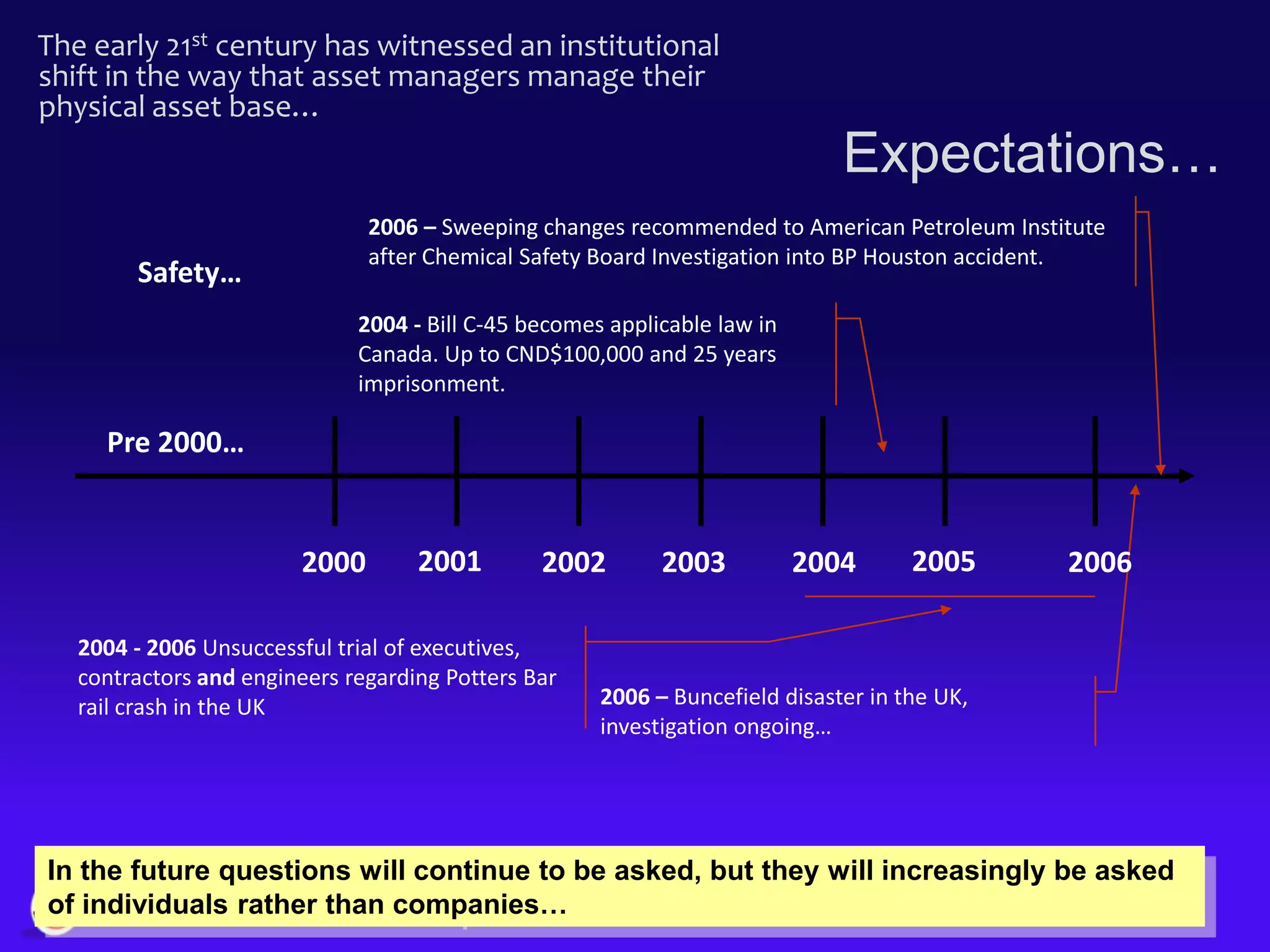
Growing need for benchmarking tools2004 - 2006 Unsuccessful trial of executives, contractors and engineersregarding Potters Bar rail crash in the UKThe early 21st century has witnessed an institutional shift in the way that asset managers manage their physical asset base…Expectations…2006 – Sweeping changes recommended to American Petroleum Institute after Chemical Safety Board Investigation into BP Houston accident. Safety…2004 - Bill C-45 becomes applicable law in Canada. Up to CND$100,000 and 25 years imprisonment.Pre 2000…20012005200020022003200420062006 – Buncefield disaster in the UK, investigation ongoing…In the future questions will continue to be asked, but they will increasingly be asked of individuals rather than companies…
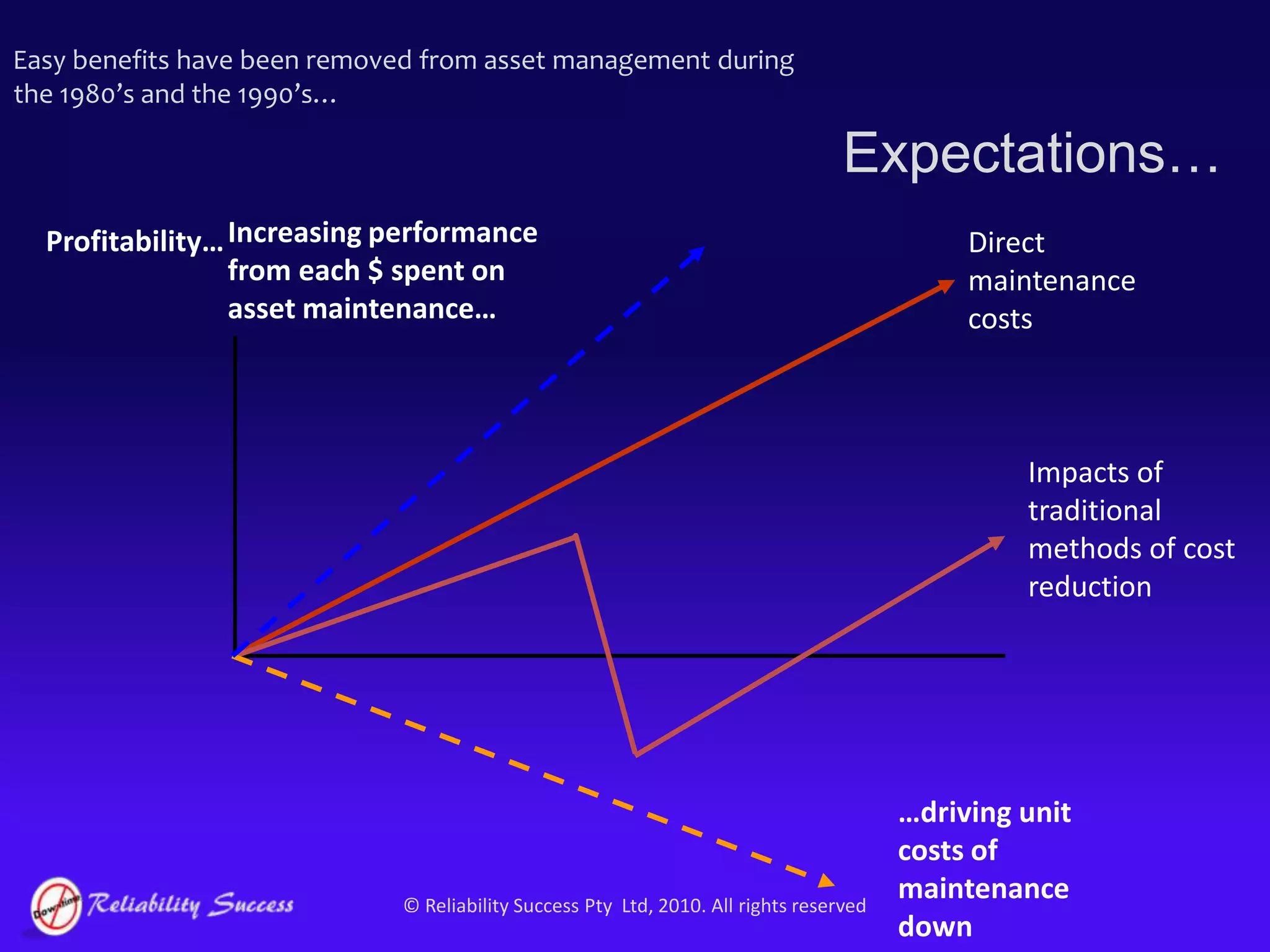
Increasing performance from each $ spent on asset maintenance…Direct maintenance costsImpacts of traditional methods of cost reduction…driving unit costs of maintenance downEasy benefits have been removed from asset management during the 1980’s and the 1990’s…Expectations…Profitability…
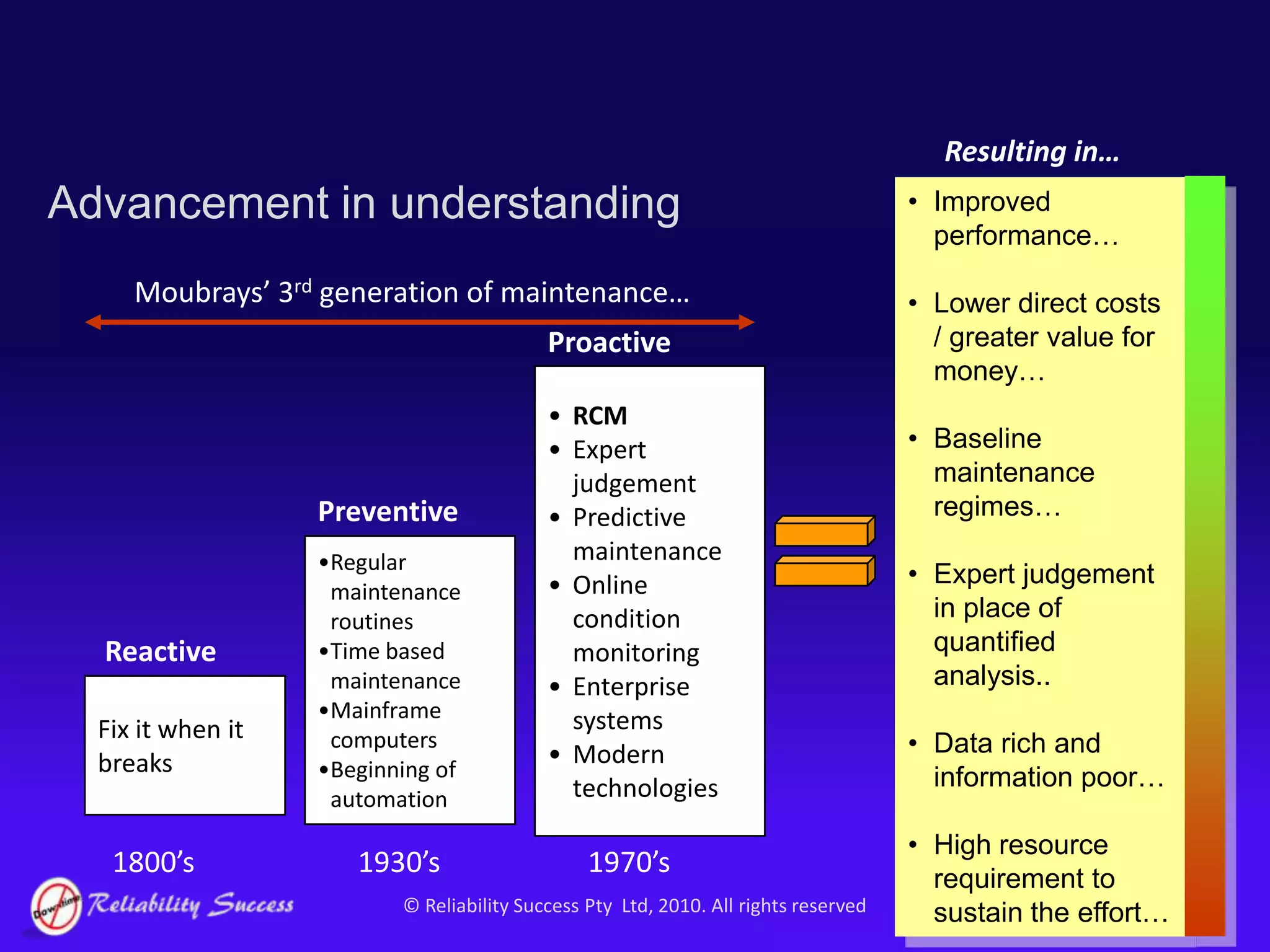
Resulting in…Improved performance…
Lower direct costs / greater value for money…
Baseline maintenance regimes…
Expert judgement in place of quantified analysis..
Data rich and information poor…
High resource requirement to sustain the effort…Moubrays’ 3rd generation of maintenance…ProactiveRCM
Expert judgement
Predictive maintenance
Online condition monitoring
Enterprise systems
Modern technologiesPreventiveRegular maintenance routines
Time based maintenance
Mainframe computers

Reliability success 4th generation (2)

  • 1.
    The 4th Generationof Asset ManagementAn overview of leading practices in modern asset management
  • 2.
    What is strategy?Visionor goalsHow we are going to make that vision or goal a realityWhat resources, tools, capacities, skills and other requirements are they to carry this outStrategy is means of taking converting a vision into reality.
  • 3.
    What is strategy?Strategyis means of taking converting a vision into reality.For example:
  • 4.
    In the contextof RCM a strategy is the management plan for a specific failure mode. (E.g. A detective maintenance task on Oil-filled circuit breakers)
  • 5.
    The corporate visionwill revolve around either reduced cost, improved performance or reduced risk
  • 6.
    The strategy iswhat we are going to do to achieve that vision (Task type and frequency)
  • 7.
    And the tacticsare how we are going to achieve that vision:
  • 8.
    What task, withwhat resources, having which skills, with which spares, with which tools, using what procedure etcetera, etcetera…What is strategy?Strategy is means of taking converting a vision into reality.For example:
  • 9.
    In the contextof strategic asset planning it could mean something like “We will implement comprehensive risk profiling for each critical asset group”
  • 10.
    The corporate visionor requirement could be regarding a response to the passage of C-45, or potentially for capital planning purposes…
  • 11.
    The strategy isthe decision of what we are going to do (What end goal and initiative possibly)
  • 12.
    The tactics hereare then the skills, people, timeframe allowed, meeting times and rooms, the initiative that has been chosen, and other relevant resources required to make this vision a reality.ProductionDemandForecastingProductionPlanningProduction BasedProductionOrdersPurchasingSalesShopFloorRawMaterialsInboundLogisticsSalesOrdersPurchaseOrdersOutboundLogisticsWare-houseWare-houseAsset IntensiveMaintenanceMaterialsPersonnelAvailabilitySkills &TrainingInboundLogisticsPurchaseOrdersWork-shopPurchasingHuman ResourcesWorkOrdersMaintenanceScheduleMaintenancePlanMaintenanceAsset Intensive versus Scheduled ManufactureImprovement focussed on…JIT
  • 13.
  • 14.
    Supply chain andlogisticsGen LedgerAccountsReceivableAccountsPayableAccountsPayablePayrollCostingImprovement focussed on…Just in case
  • 15.
  • 16.
    JIC supply chaintechniquesThe changing world of asset management…Over the past 15 years the managerial discipline of asset management has undergone a dramatic transformation; this has been due to three fundamental reasons…An institutional shift in the expectations of asset managementAdvancement in understandingA quantum leap in the technology available (Session 2)
  • 17.
    The early 21stcentury has witnessed an institutional shift in the way that asset managers manage their physical asset base…Expectations…2006 – Letter MD212 - OFWAT recognise common framework in UK waterStandardisation…2005 - United States of the Energy Policy Act - USA, makes compliance by electric utilities and other companies with reliability standard mandatory and enforceable under federal lawPre 2000…20012005200020022003200420062004 – Formal launch of PAS551999SAE JA1011The RCM Standard2005 – OFGEM recommends voluntary comparison against PAS552006 - Office of the PPP Arbiter (OPPPA) using PAS55 as key input for AM Framework (UK)Increased demands by regulators for high confidence decisions
  • 18.
    Need for defensiblebudgeting within institutions and public sector
  • 19.
    Growing need forbenchmarking tools2004 - 2006 Unsuccessful trial of executives, contractors and engineersregarding Potters Bar rail crash in the UKThe early 21st century has witnessed an institutional shift in the way that asset managers manage their physical asset base…Expectations…2006 – Sweeping changes recommended to American Petroleum Institute after Chemical Safety Board Investigation into BP Houston accident. Safety…2004 - Bill C-45 becomes applicable law in Canada. Up to CND$100,000 and 25 years imprisonment.Pre 2000…20012005200020022003200420062006 – Buncefield disaster in the UK, investigation ongoing…In the future questions will continue to be asked, but they will increasingly be asked of individuals rather than companies…
  • 20.
    Increasing performance fromeach $ spent on asset maintenance…Direct maintenance costsImpacts of traditional methods of cost reduction…driving unit costs of maintenance downEasy benefits have been removed from asset management during the 1980’s and the 1990’s…Expectations…Profitability…
  • 21.
  • 22.
    Lower direct costs/ greater value for money…
  • 23.
  • 24.
    Expert judgement inplace of quantified analysis..
  • 25.
    Data rich andinformation poor…
  • 26.
    High resource requirementto sustain the effort…Moubrays’ 3rd generation of maintenance…ProactiveRCM
  • 27.
  • 28.
  • 29.
  • 30.
  • 31.
  • 32.
  • 33.
  • 34.
    Beginning of automationReactiveFixit when it breaks1800’s1930’s1970’sAdvancement in understanding
  • 35.
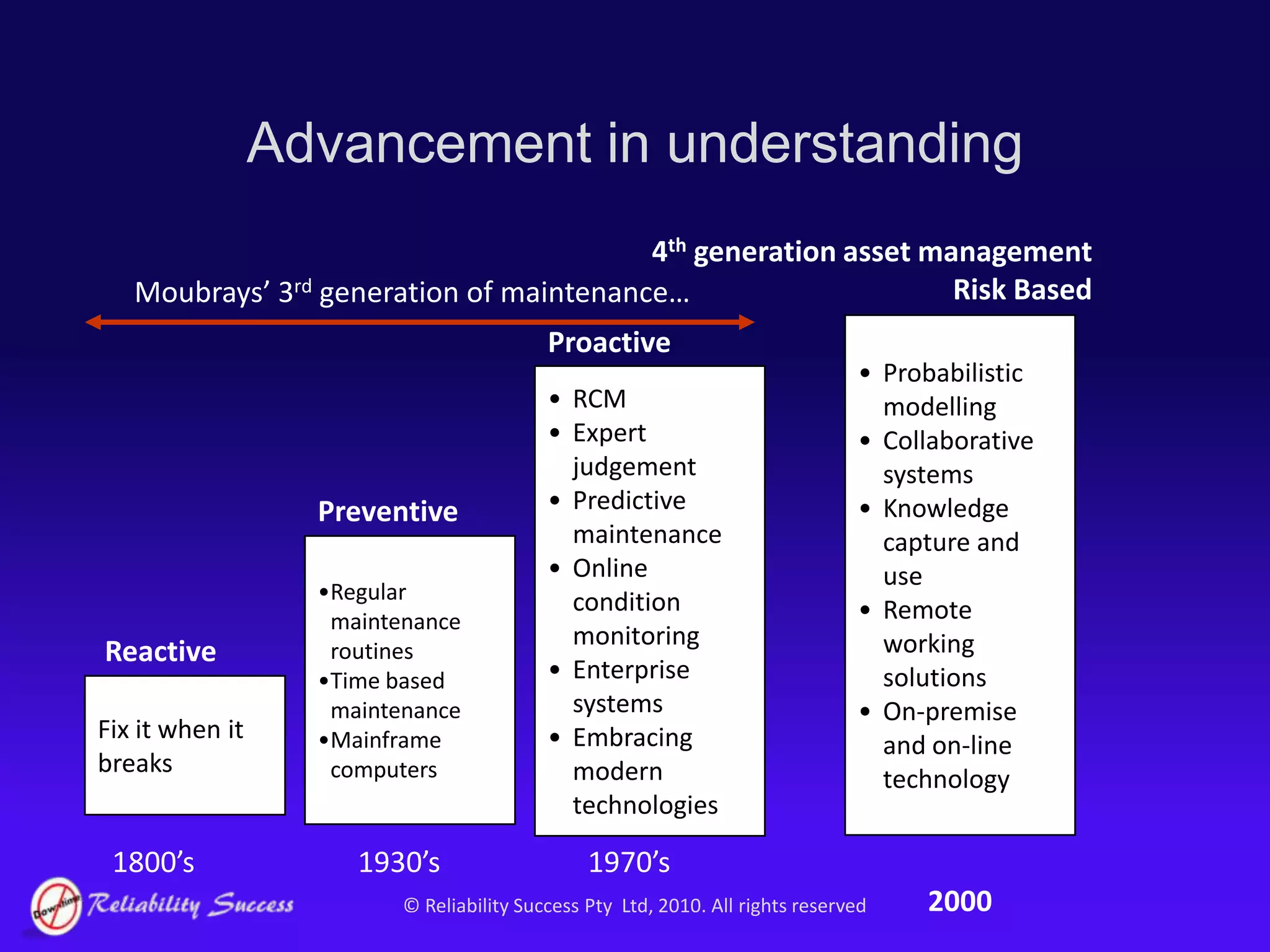
    4th generation assetmanagementRisk BasedMoubrays’ 3rd generation of maintenance…Probabilistic modelling
  • 36.
  • 37.
  • 38.
  • 39.
    On-premise and on-linetechnologyProactiveRCM
  • 40.
  • 41.
  • 42.
  • 43.
  • 44.
  • 45.
  • 46.
    Mainframe computersReactiveFix itwhen it breaks1800’s1930’s1970’s2000Advancement in understanding
  • 47.
  • 48.
  • 49.
  • 50.
  • 51.
  • 52.
  • 53.
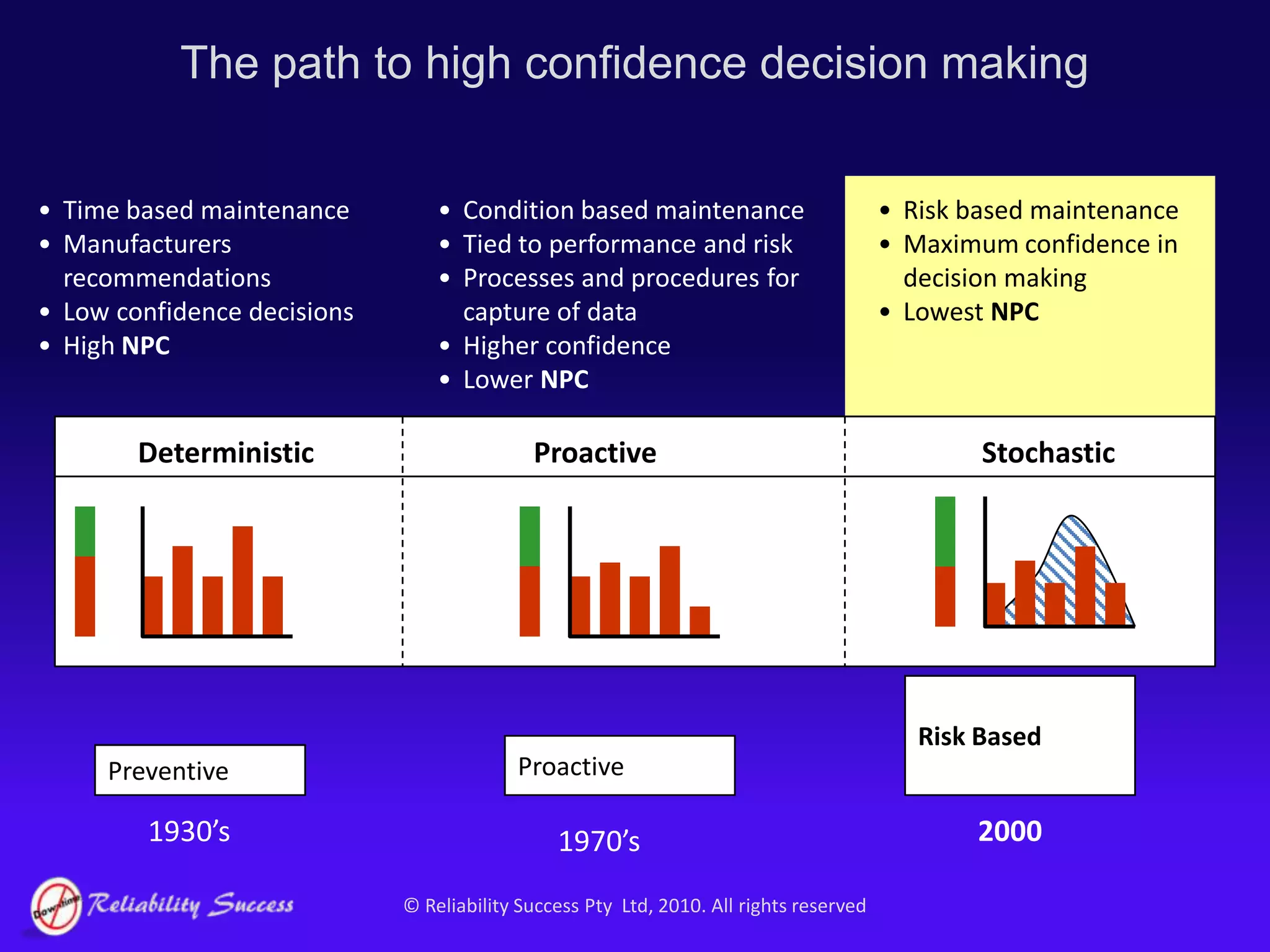
    Processes and proceduresfor capture of data
  • 54.
  • 55.
  • 56.
  • 57.
    Maximum confidence indecision making
  • 58.
  • 59.
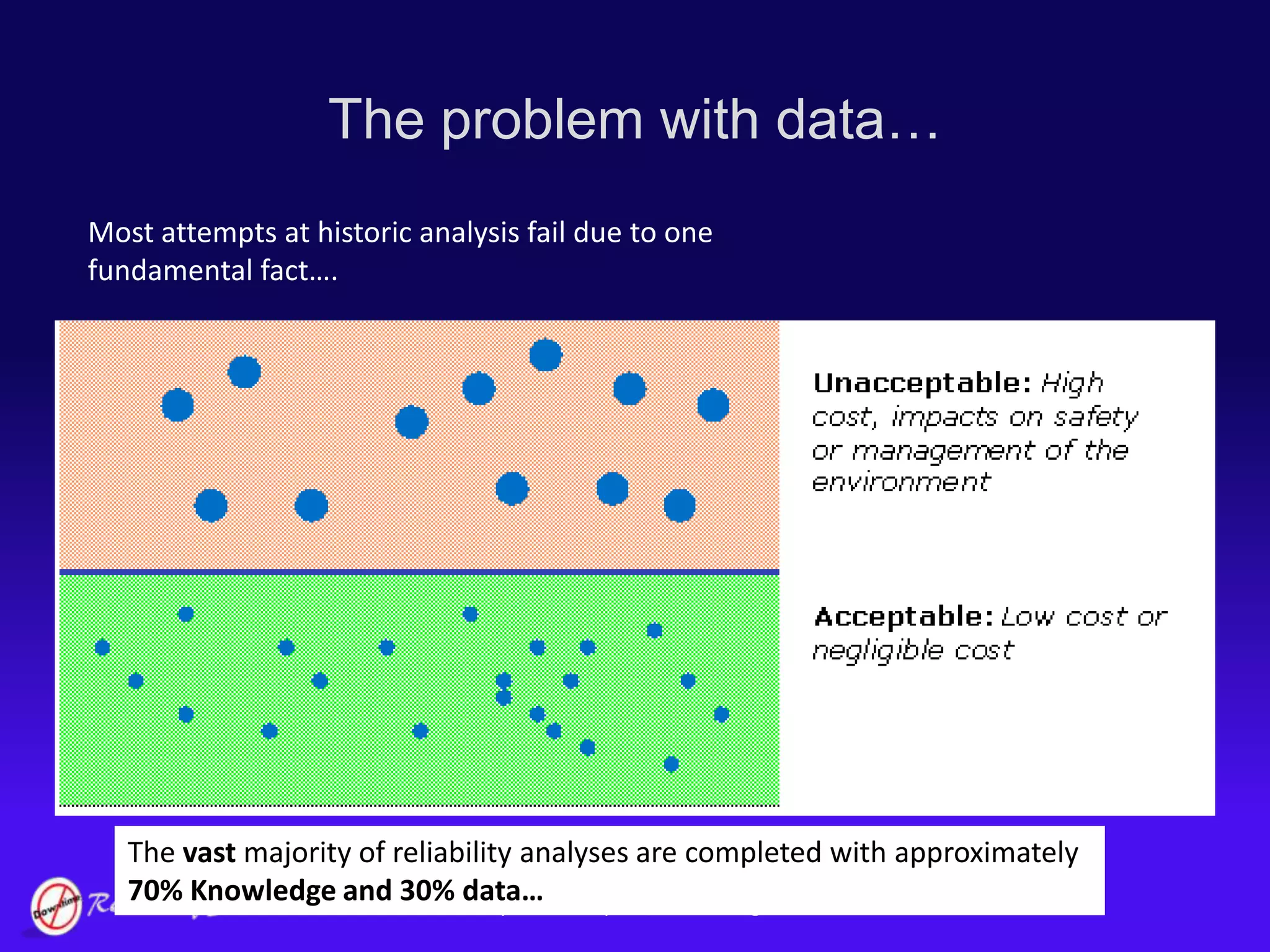
    The problem withdata…Most attempts at historic analysis fail due to one fundamental fact….The vast majority of reliability analyses are completed with approximately 70% Knowledge and 30% data…
  • 60.
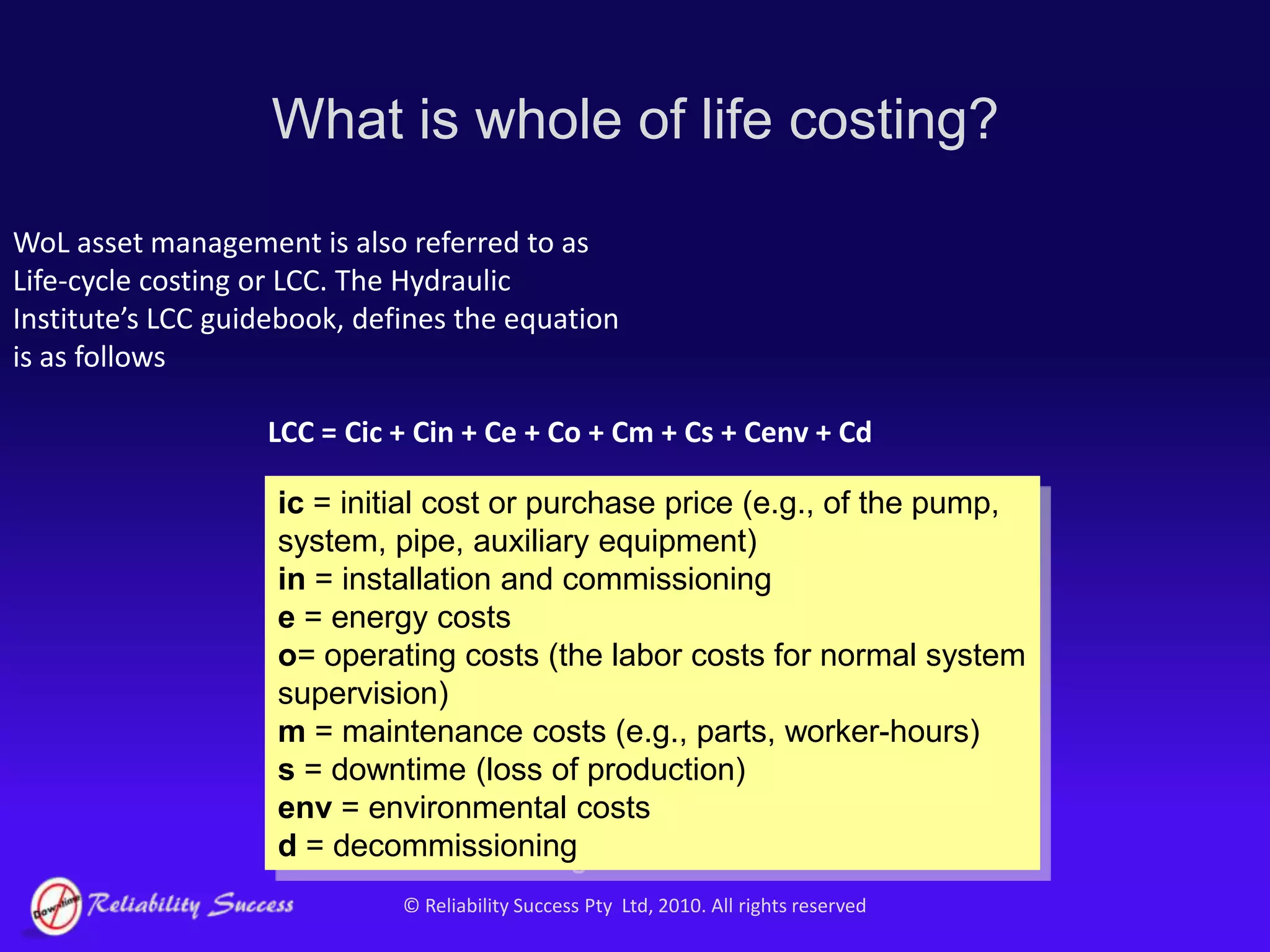
    What is wholeof life costing?WoL asset management is also referred to as Life-cycle costing or LCC. The Hydraulic Institute’s LCC guidebook, defines the equation is as followsLCC = Cic + Cin + Ce + Co + Cm + Cs + Cenv + Cdic = initial cost or purchase price (e.g., of the pump, system, pipe, auxiliary equipment)in = installation and commissioninge = energy costso= operating costs (the labor costs for normal system supervision)m = maintenance costs (e.g., parts, worker-hours)s = downtime (loss of production)env = environmental costsd = decommissioning
  • 61.
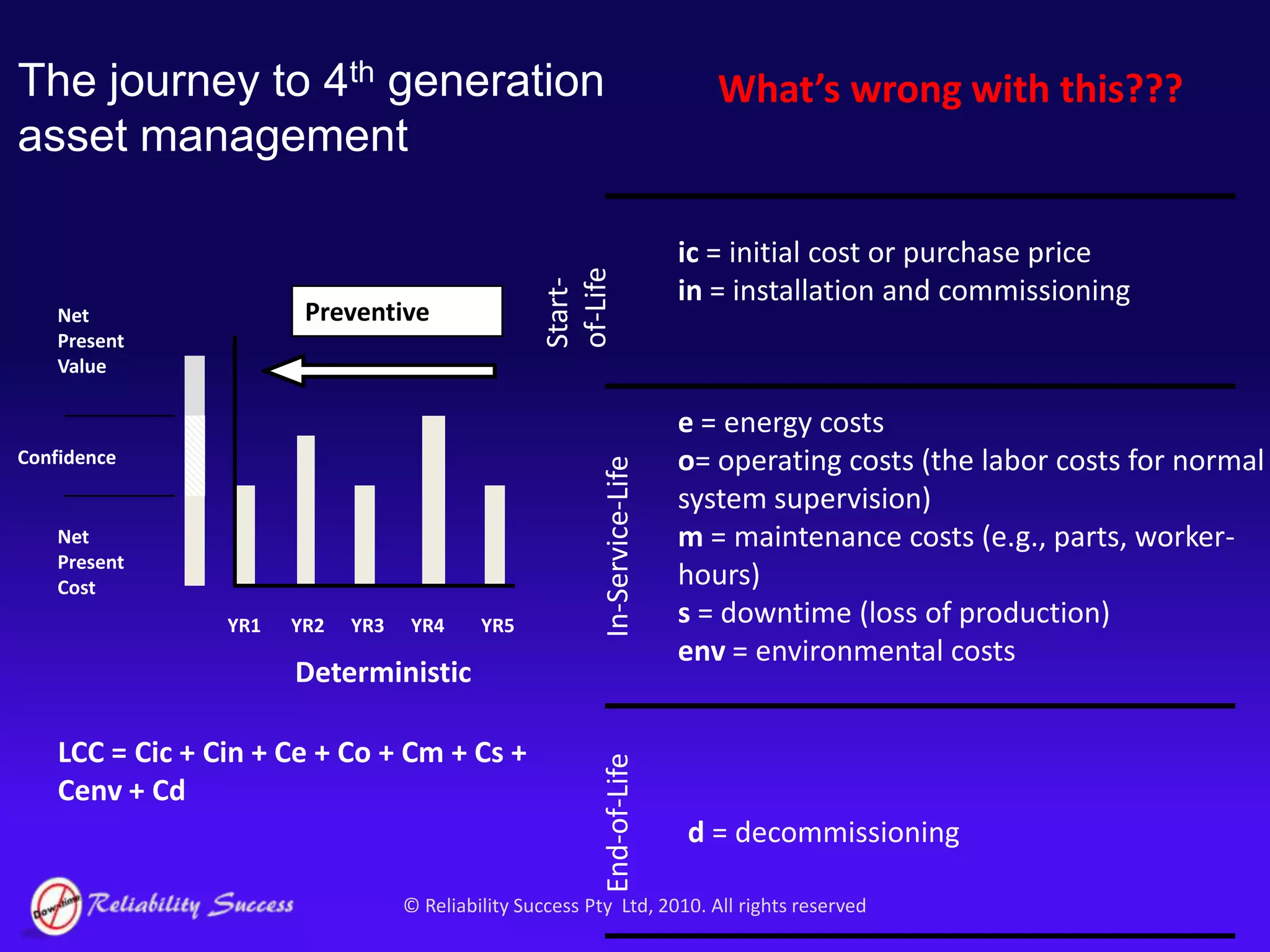
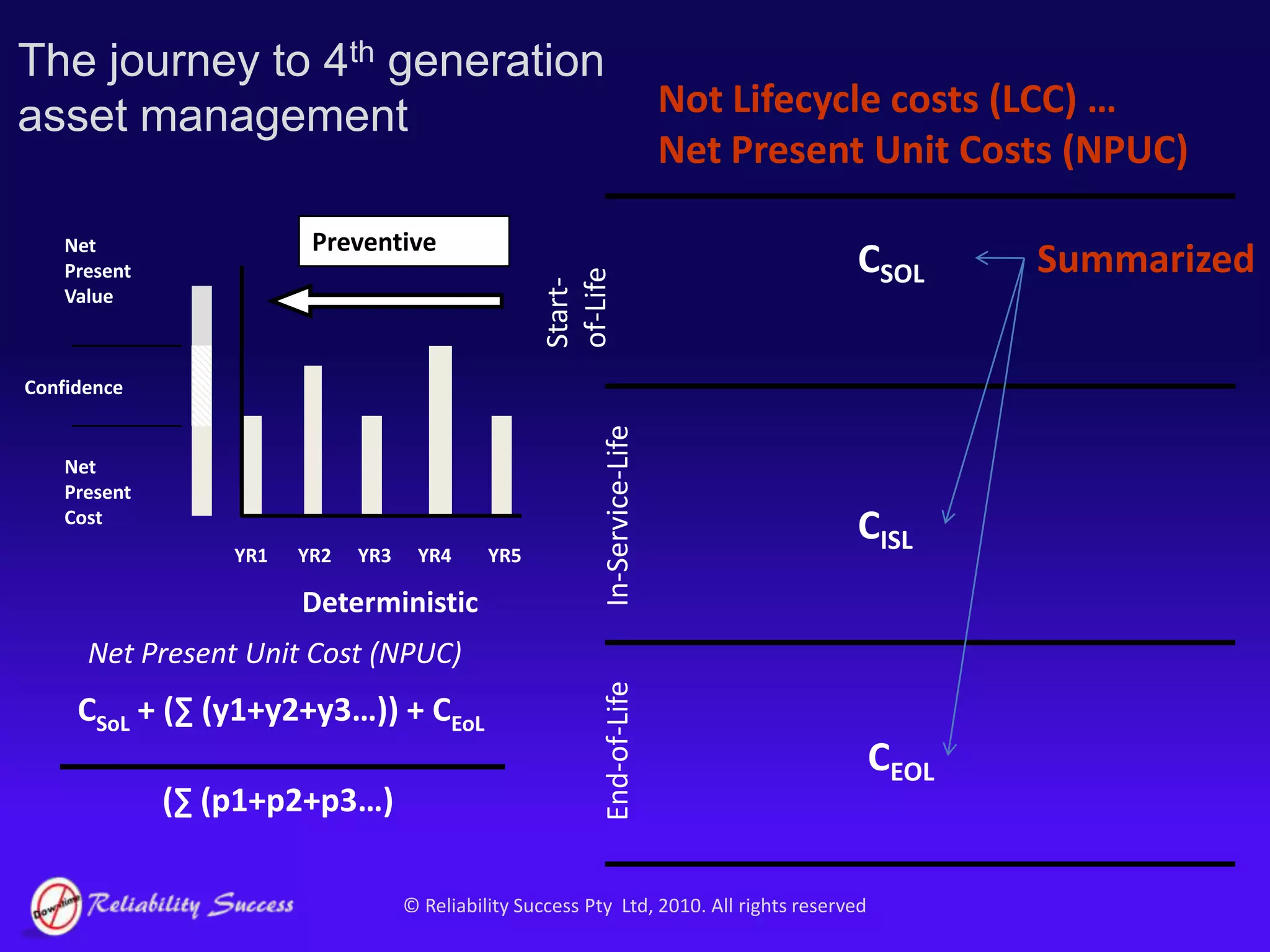
    ic = initialcost or purchase price in = installation and commissioningStart-of-LifePreventiveNet Present Valuee = energy costso= operating costs (the labor costs for normal system supervision)m = maintenance costs (e.g., parts, worker-hours)s = downtime (loss of production)env = environmental costsConfidenceIn-Service-LifeNet Present CostYR1YR2YR3YR4YR5DeterministicEnd-of-Lifed = decommissioningThe journey to 4th generation asset managementWhat’s wrong with this???LCC = Cic + Cin + Ce + Co + Cm + Cs + Cenv + Cd
  • 62.
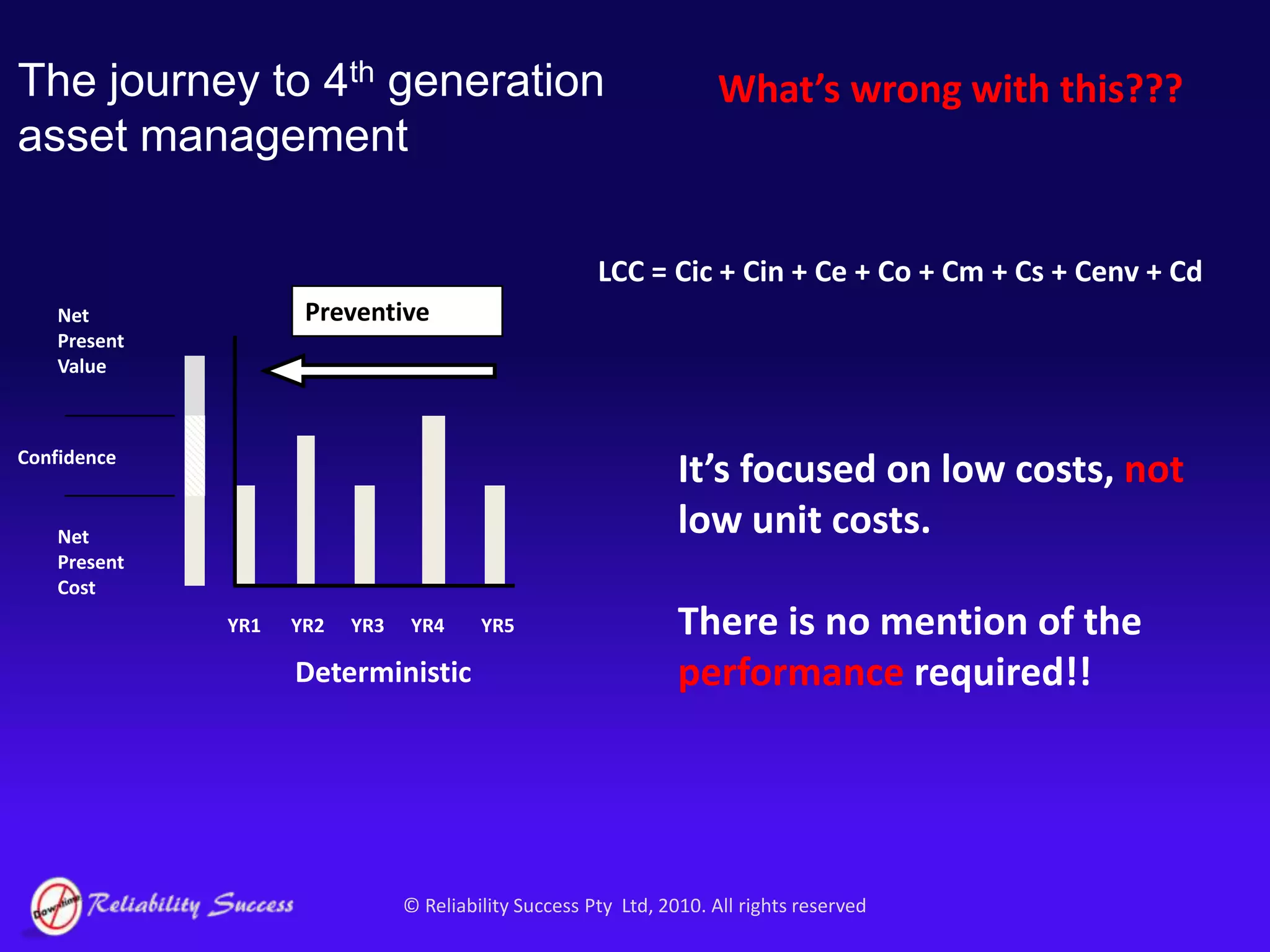
    PreventiveNet Present ValueConfidenceNetPresent CostYR1YR2YR3YR4YR5DeterministicThe journey to 4th generation asset managementWhat’s wrong with this???LCC = Cic + Cin + Ce + Co + Cm + Cs + Cenv + CdIt’s focused on low costs, not low unit costs. There is no mention of the performance required!!
  • 63.
    The journey to4th generation asset managementStart-of-LifePreventiveNet Present ValueConfidenceNet Present CostYR1YR2YR3YR4YR5DeterministicNot Lifecycle costs (LCC) …Net Present Unit Costs (NPUC)CSOLSummarizedIn-Service-LifeCISLNet Present Unit Cost (NPUC)End-of-LifeCSoL + (∑ (y1+y2+y3…)) + CEoLCEOL(∑ (p1+p2+p3…)
  • 64.
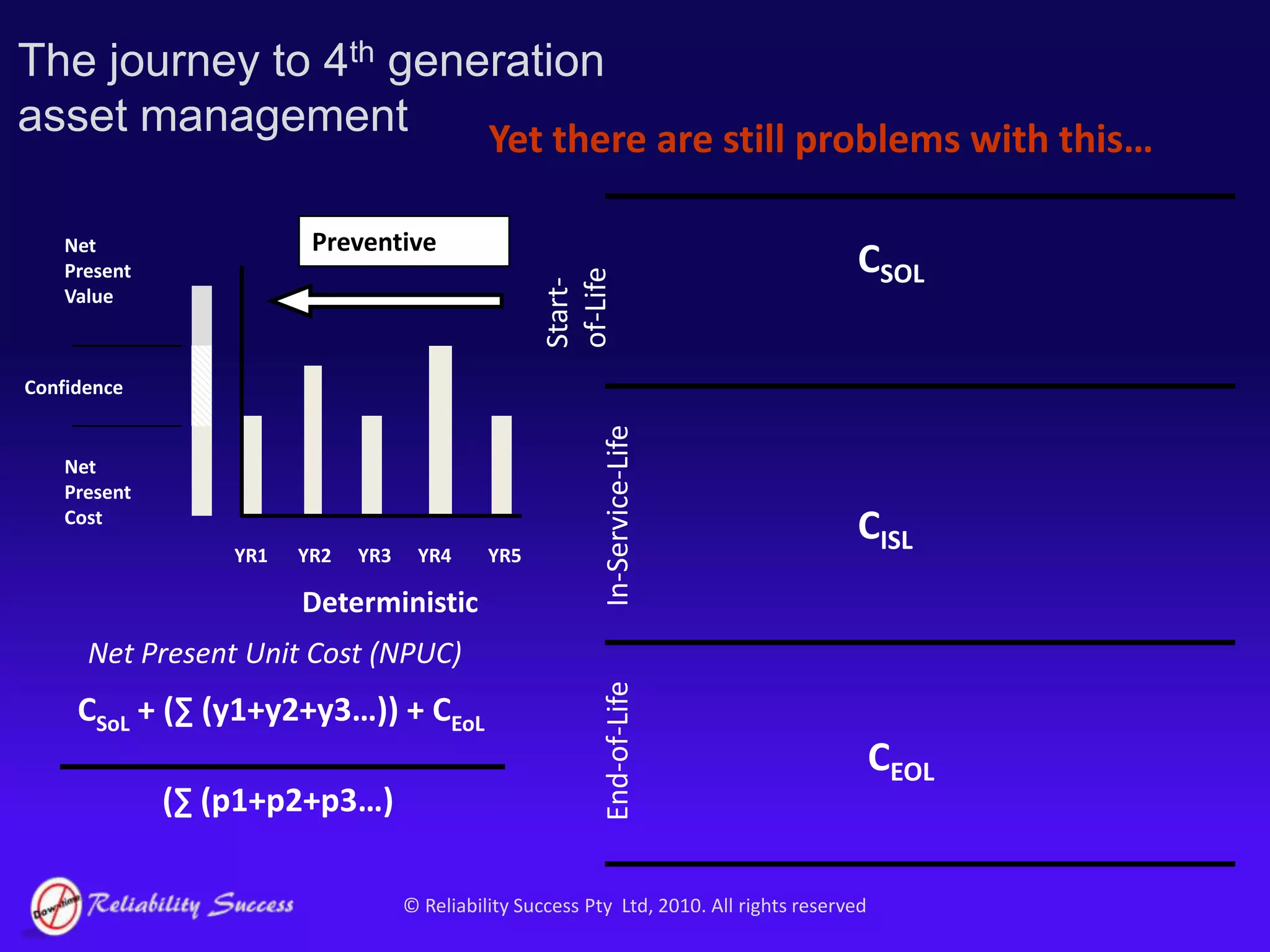
    The journey to4th generation asset managementStart-of-LifePreventiveNet Present ValueConfidenceNet Present CostYR1YR2YR3YR4YR5DeterministicYet there are still problems with this…CSOLIn-Service-LifeCISLNet Present Unit Cost (NPUC)End-of-LifeCSoL + (∑ (y1+y2+y3…)) + CEoLCEOL(∑ (p1+p2+p3…)
  • 65.
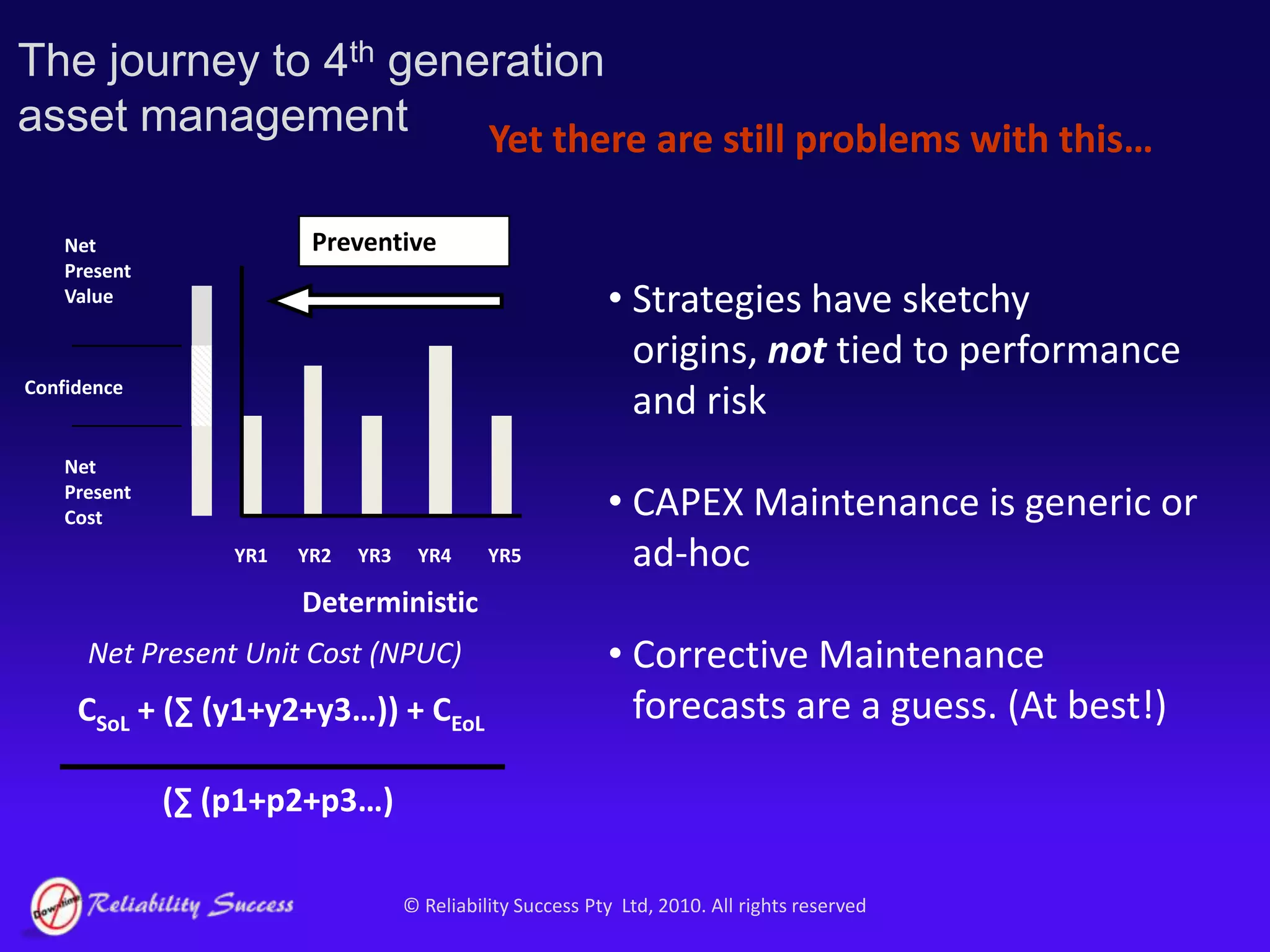
    The journey to4th generation asset managementPreventiveNet Present ValueConfidenceNet Present CostYR1YR2YR3YR4YR5DeterministicYet there are still problems with this…Strategies have sketchy origins, not tied to performance and risk
  • 66.
    CAPEX Maintenance isgeneric or ad-hoc
  • 67.
    Corrective Maintenance forecastsare a guess. (At best!) Net Present Unit Cost (NPUC)CSoL + (∑ (y1+y2+y3…)) + CEoL(∑ (p1+p2+p3…)
  • 68.
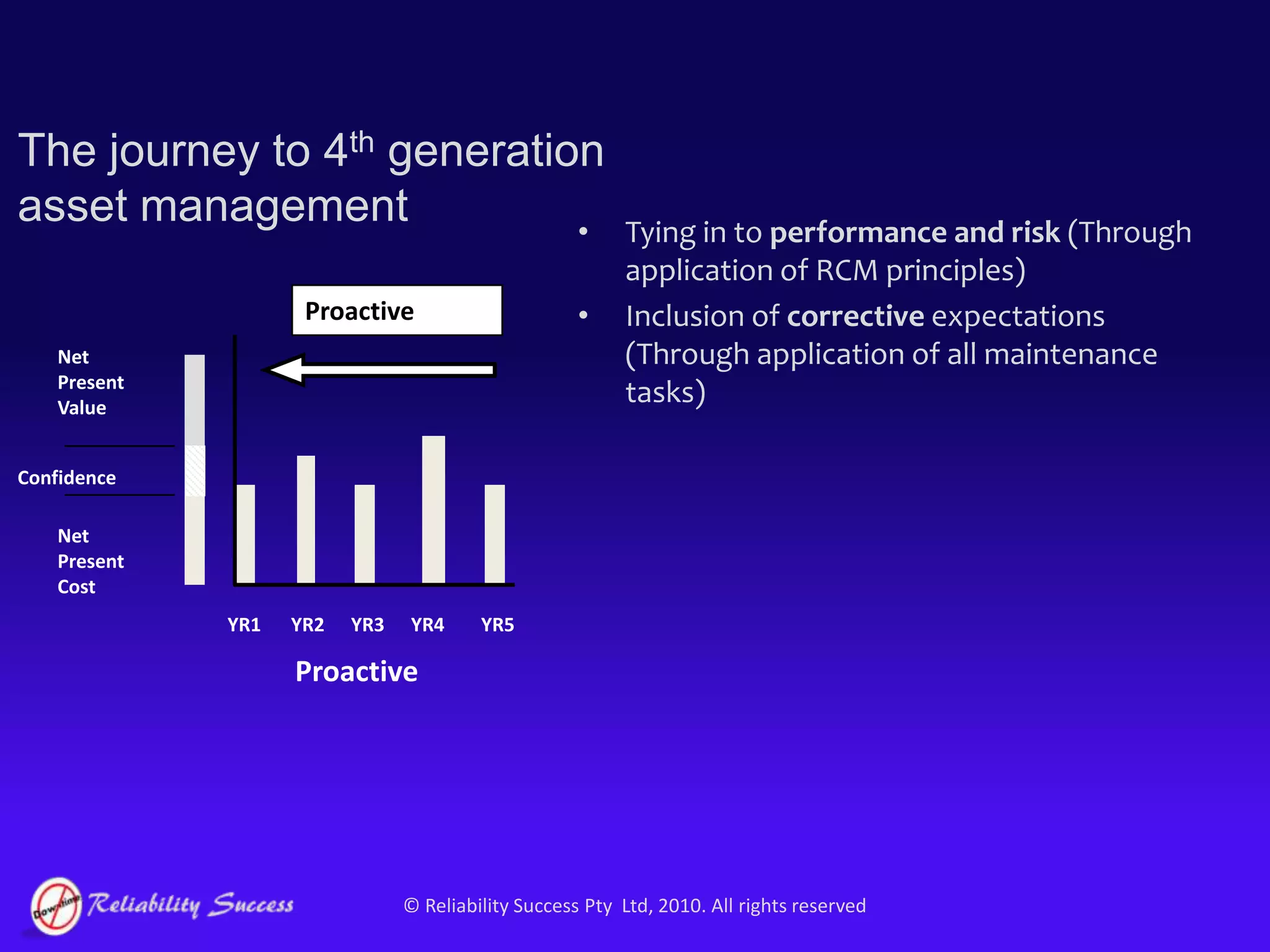
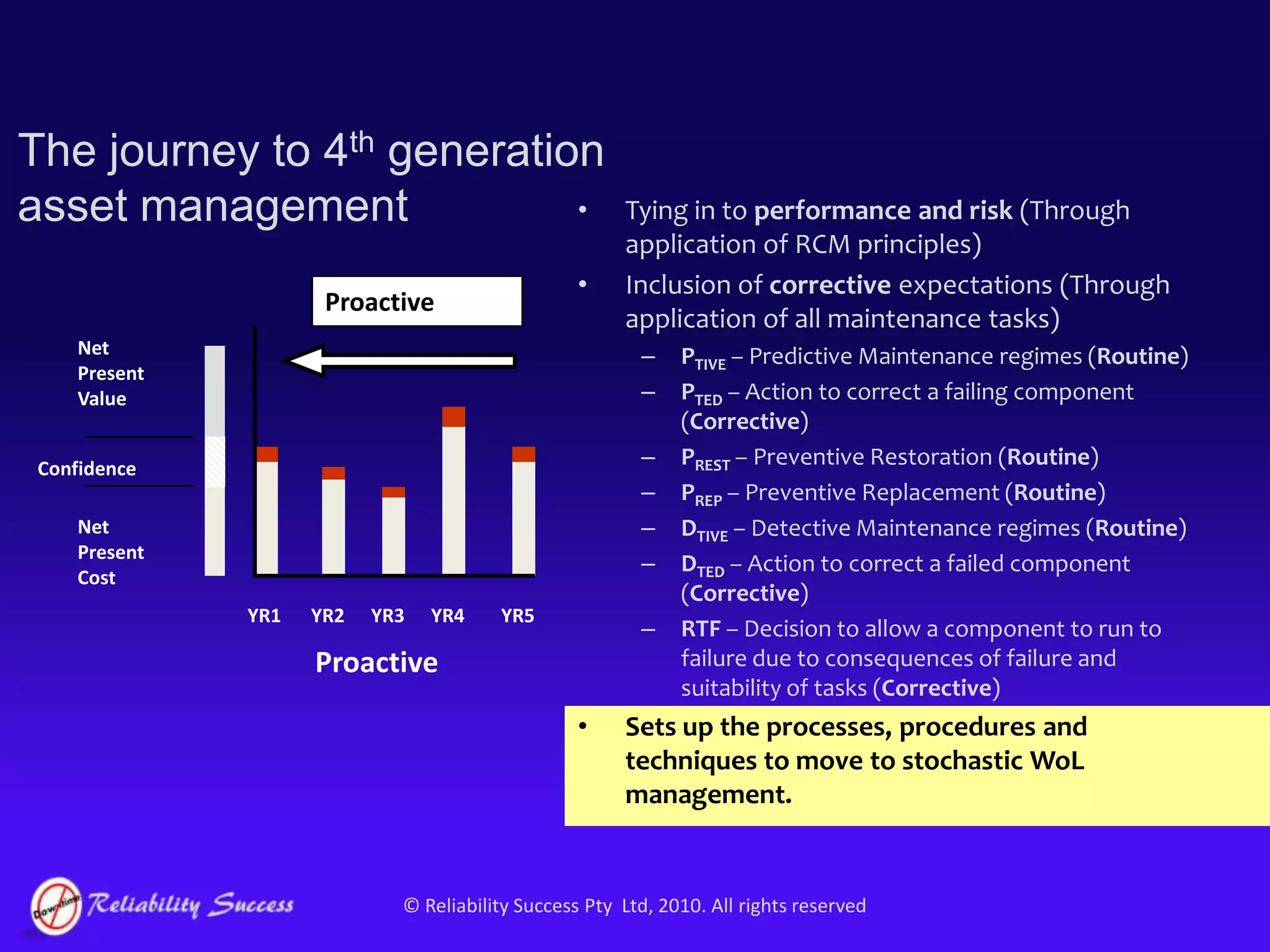
    The journey to4th generation asset managementTying in to performance and risk (Through application of RCM principles)Inclusion of corrective expectations (Through application of all maintenance tasks)ProactiveNet Present ValueConfidenceNet Present CostYR1YR2YR3YR4YR5Proactive
  • 69.
  • 70.
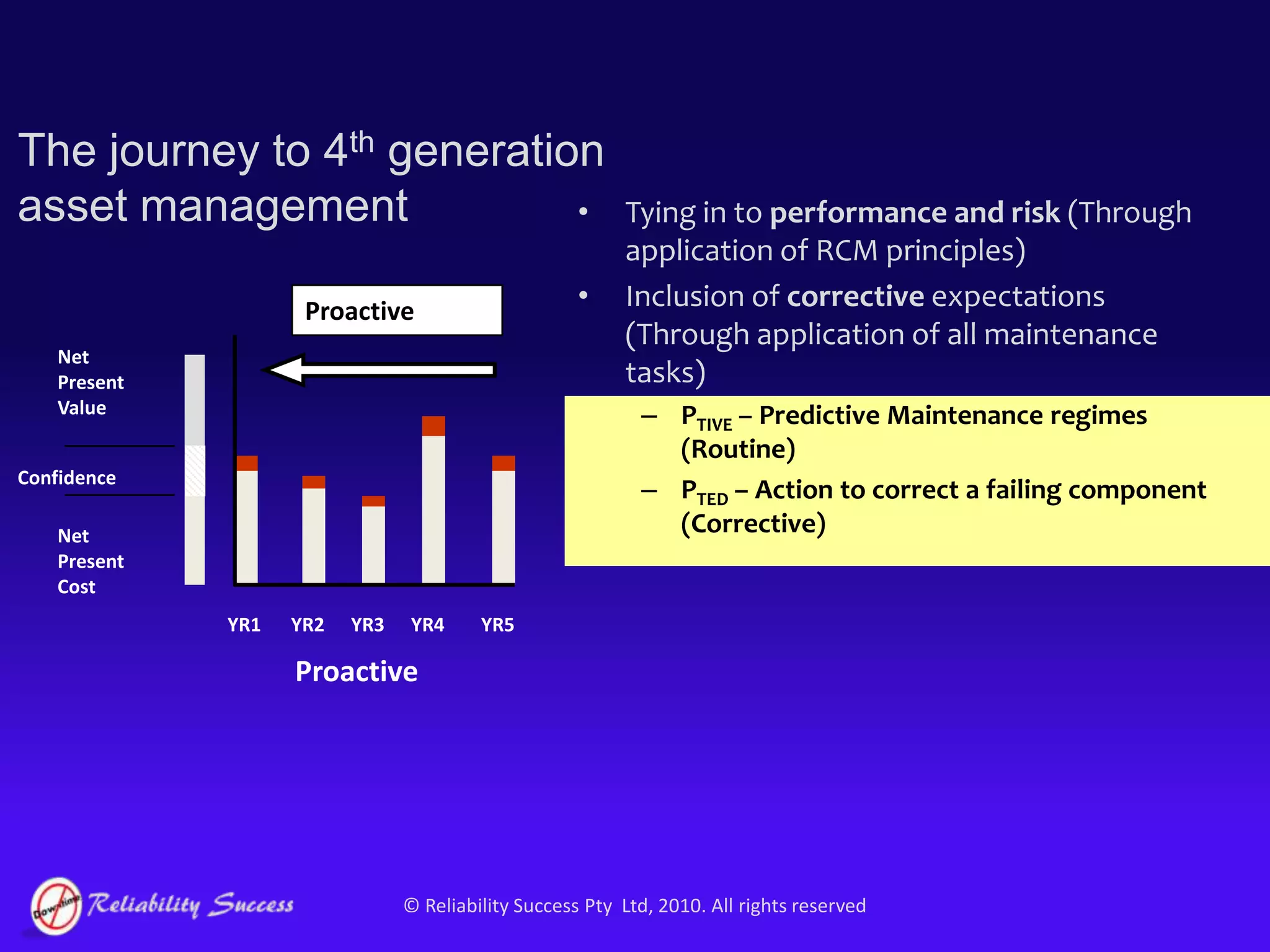
    The journey to4th generation asset managementTying in to performance and risk (Through application of RCM principles)Inclusion of corrective expectations (Through application of all maintenance tasks)PTIVE – Predictive Maintenance regimes (Routine)PTED – Action to correct a failing component (Corrective)ProactiveNet Present ValueConfidenceNet Present CostYR1YR2YR3YR4YR5Proactive
  • 71.
  • 72.
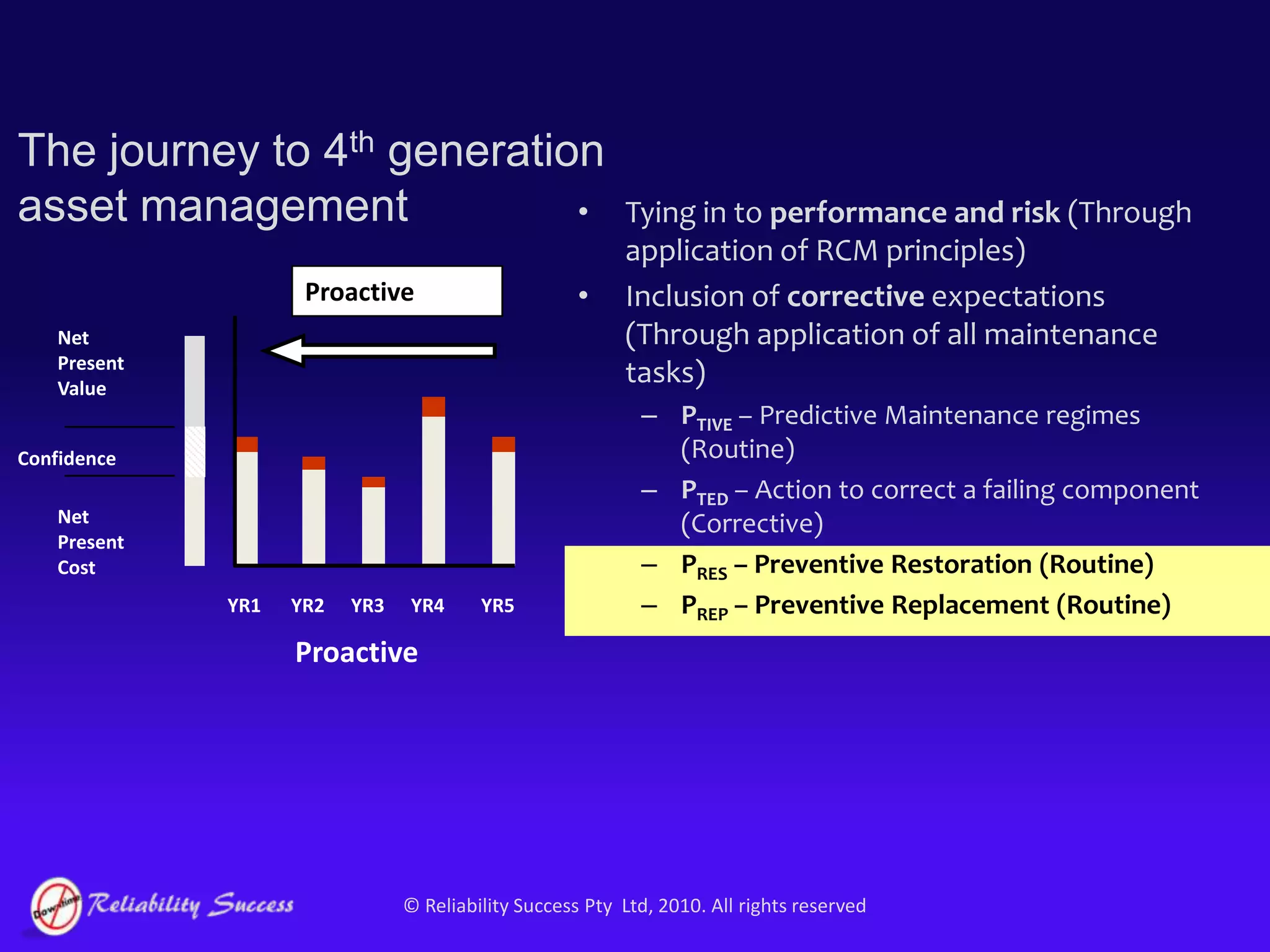
    The journey to4th generation asset managementTying in to performance and risk (Through application of RCM principles)Inclusion of corrective expectations (Through application of all maintenance tasks)PTIVE – Predictive Maintenance regimes (Routine)PTED– Action to correct a failing component (Corrective)PRES – Preventive Restoration (Routine)PREP – Preventive Replacement (Routine)ProactiveNet Present ValueConfidenceNet Present CostYR1YR2YR3YR4YR5Proactive
  • 73.
  • 74.
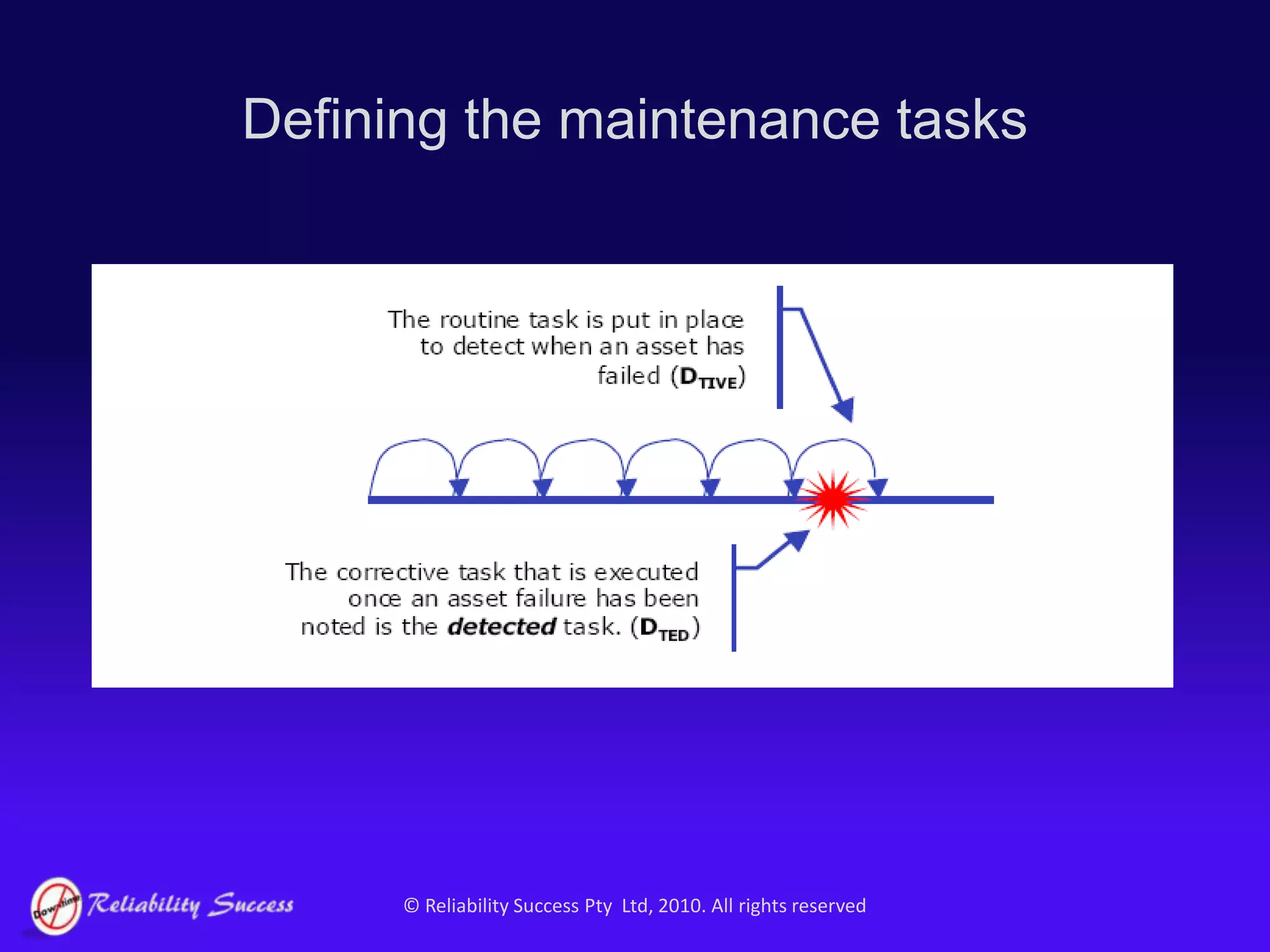
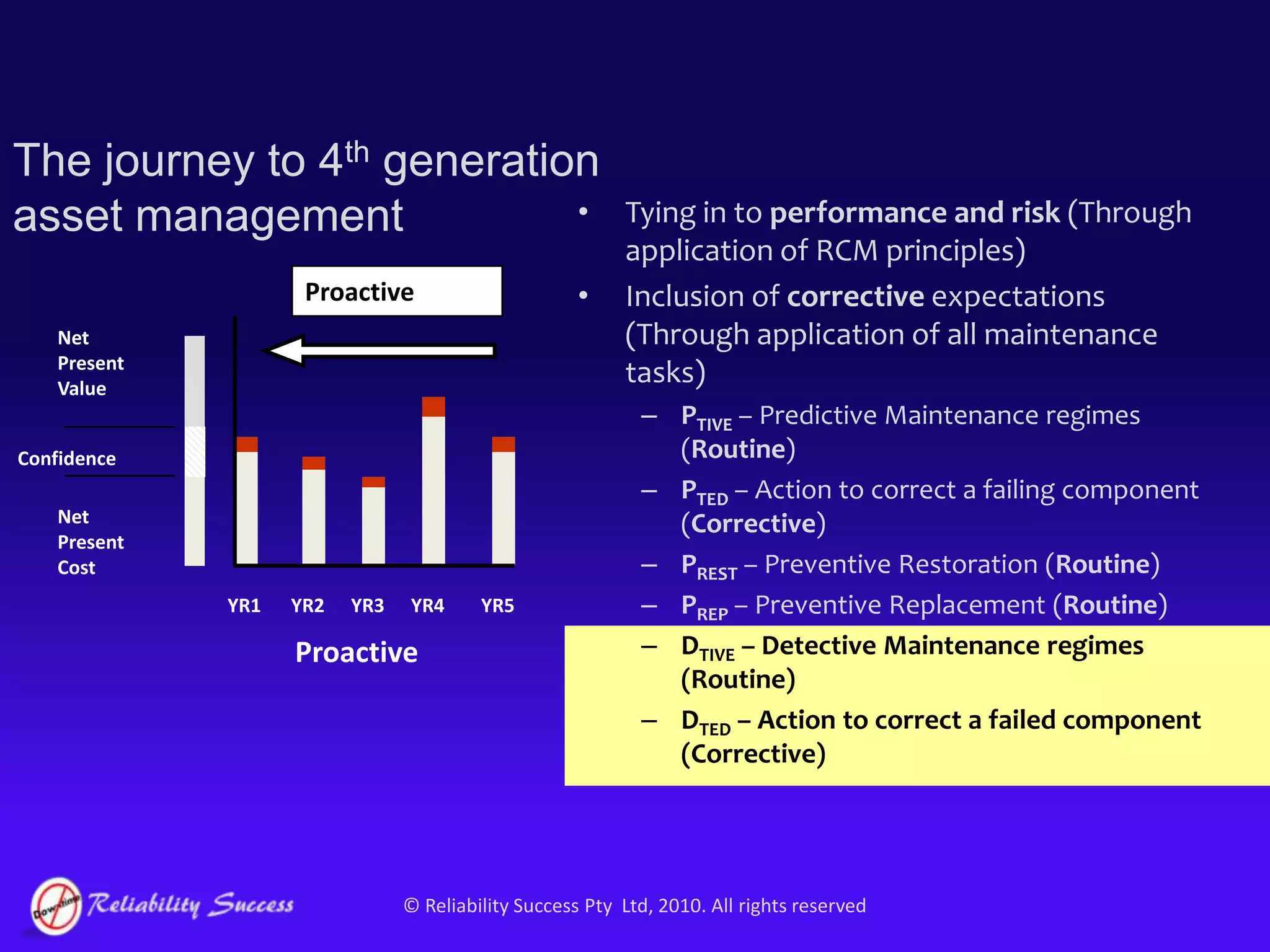
    The journey to4th generation asset managementTying in to performance and risk (Through application of RCM principles)Inclusion of corrective expectations (Through application of all maintenance tasks)PTIVE – Predictive Maintenance regimes (Routine)PTED– Action to correct a failing component (Corrective)PREST – Preventive Restoration (Routine)PREP – Preventive Replacement (Routine)DTIVE – Detective Maintenance regimes (Routine)DTED – Action to correct a failed component (Corrective)ProactiveNet Present ValueConfidenceNet Present CostYR1YR2YR3YR4YR5Proactive
  • 75.
  • 76.
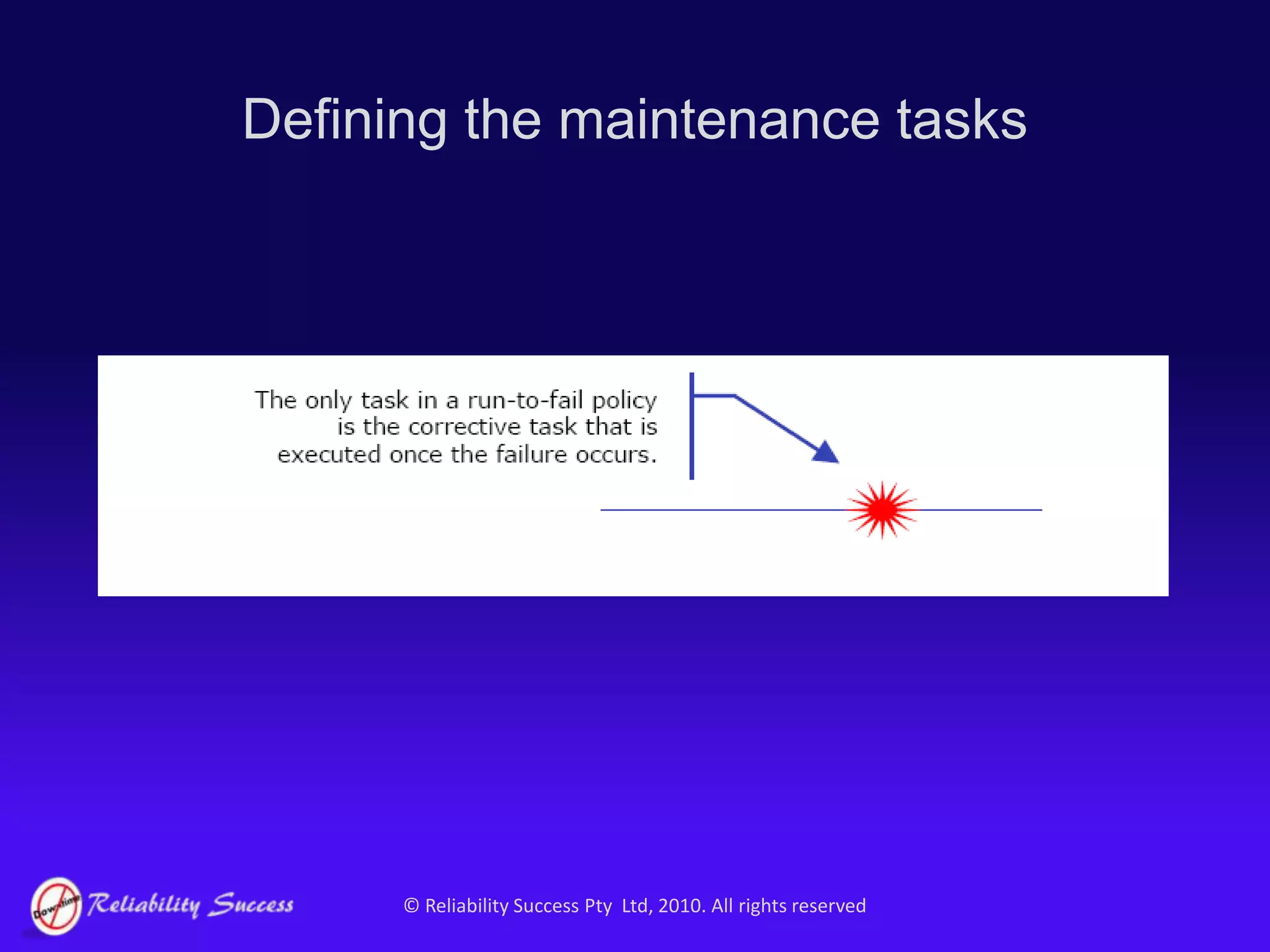
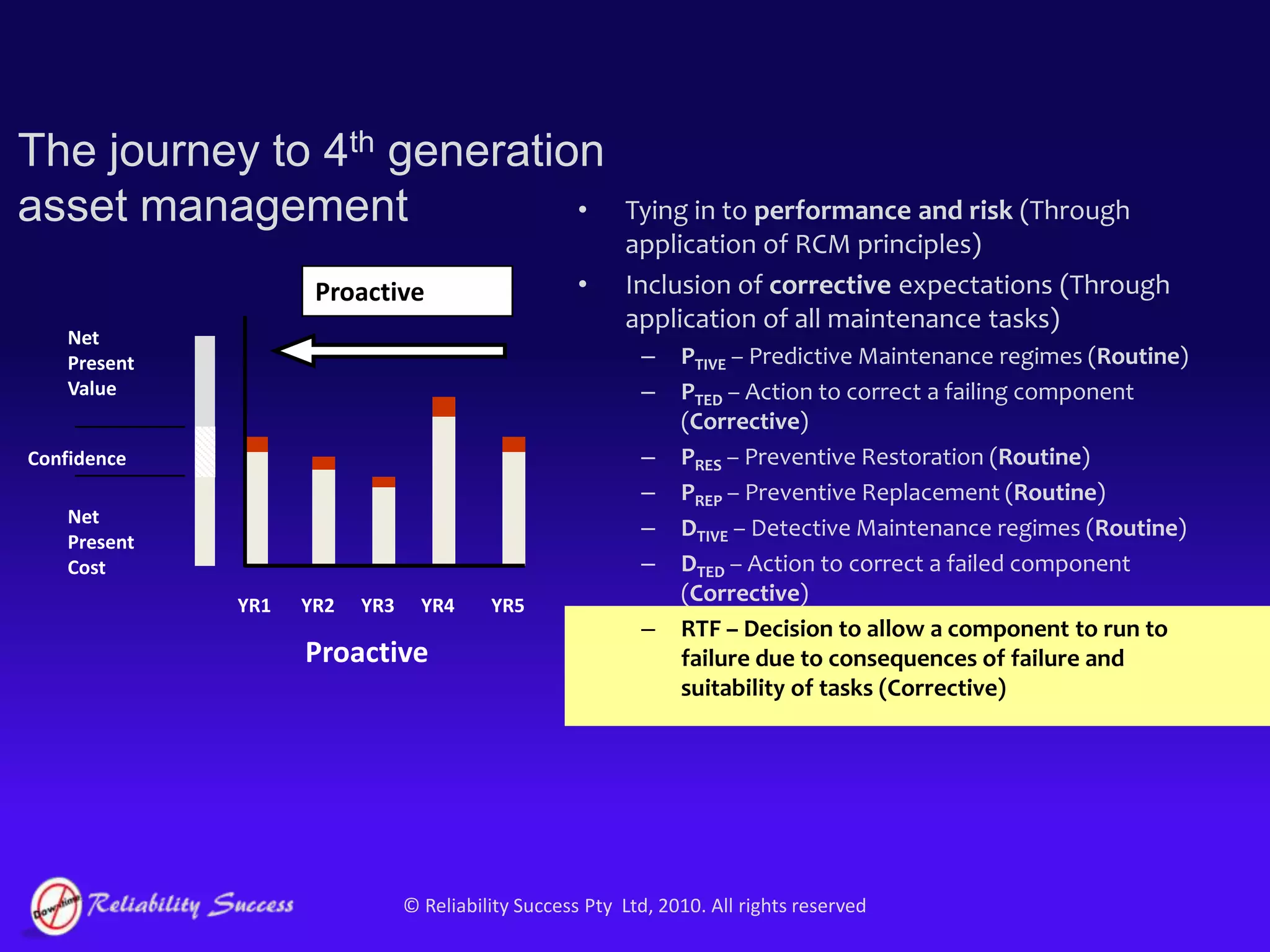
    The journey to4th generation asset managementTying in to performance and risk (Through application of RCM principles)Inclusion of corrective expectations (Through application of all maintenance tasks)PTIVE – Predictive Maintenance regimes (Routine)PTED– Action to correct a failing component (Corrective)PRES – Preventive Restoration (Routine)PREP – Preventive Replacement (Routine)DTIVE – Detective Maintenance regimes (Routine)DTED– Action to correct a failed component (Corrective)RTF – Decision to allow a component to run to failure due to consequences of failure and suitability of tasks (Corrective)ProactiveNet Present ValueConfidenceNet Present CostYR1YR2YR3YR4YR5Proactive
  • 77.
    The journey to4th generation asset managementTying in to performance and risk (Through application of RCM principles)Inclusion of corrective expectations (Through application of all maintenance tasks)PTIVE – Predictive Maintenance regimes (Routine)PTED– Action to correct a failing component (Corrective)PREST – Preventive Restoration (Routine)PREP – Preventive Replacement (Routine)DTIVE – Detective Maintenance regimes (Routine)DTED– Action to correct a failed component (Corrective)RTF – Decision to allow a component to run to failure due to consequences of failure and suitability of tasks (Corrective)Sets up the processes, procedures and techniques to move to stochastic WoL management.ProactiveNet Present ValueConfidenceNet Present CostYR1YR2YR3YR4YR5Proactive
  • 78.
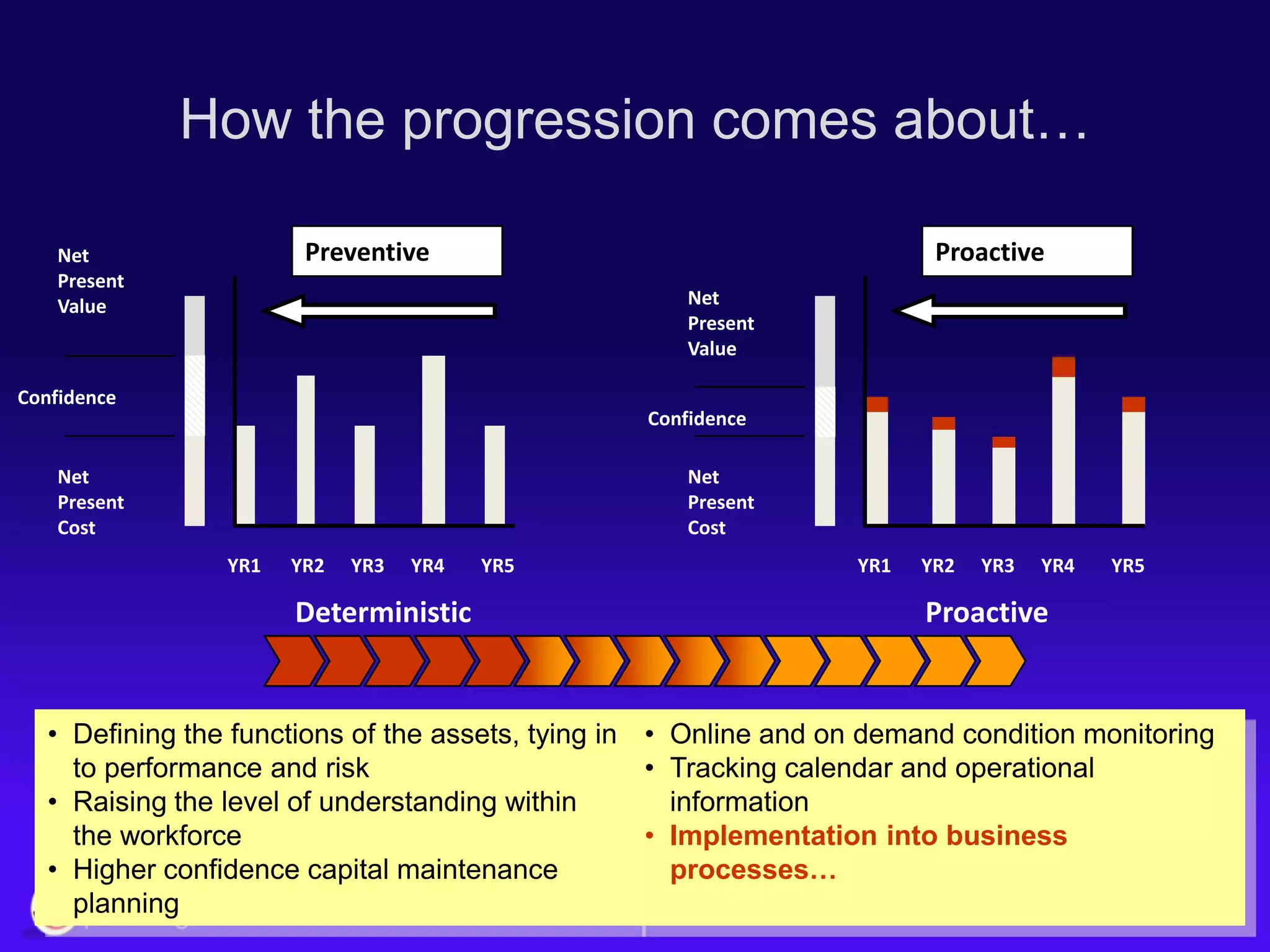
    How the progressioncomes about…PreventiveNet Present ValueProactiveConfidenceNet Present ValueNet Present CostConfidenceYR1YR2YR3YR4YR5Net Present CostDeterministicYR1YR2YR3YR4YR5ProactiveDefining the functions of the assets, tying in to performance and risk
  • 79.
    Raising the levelof understanding within the workforce
  • 80.
    Higher confidence capitalmaintenance planning
  • 81.
    Online and ondemand condition monitoring
  • 82.
    Tracking calendar andoperational information
  • 83.
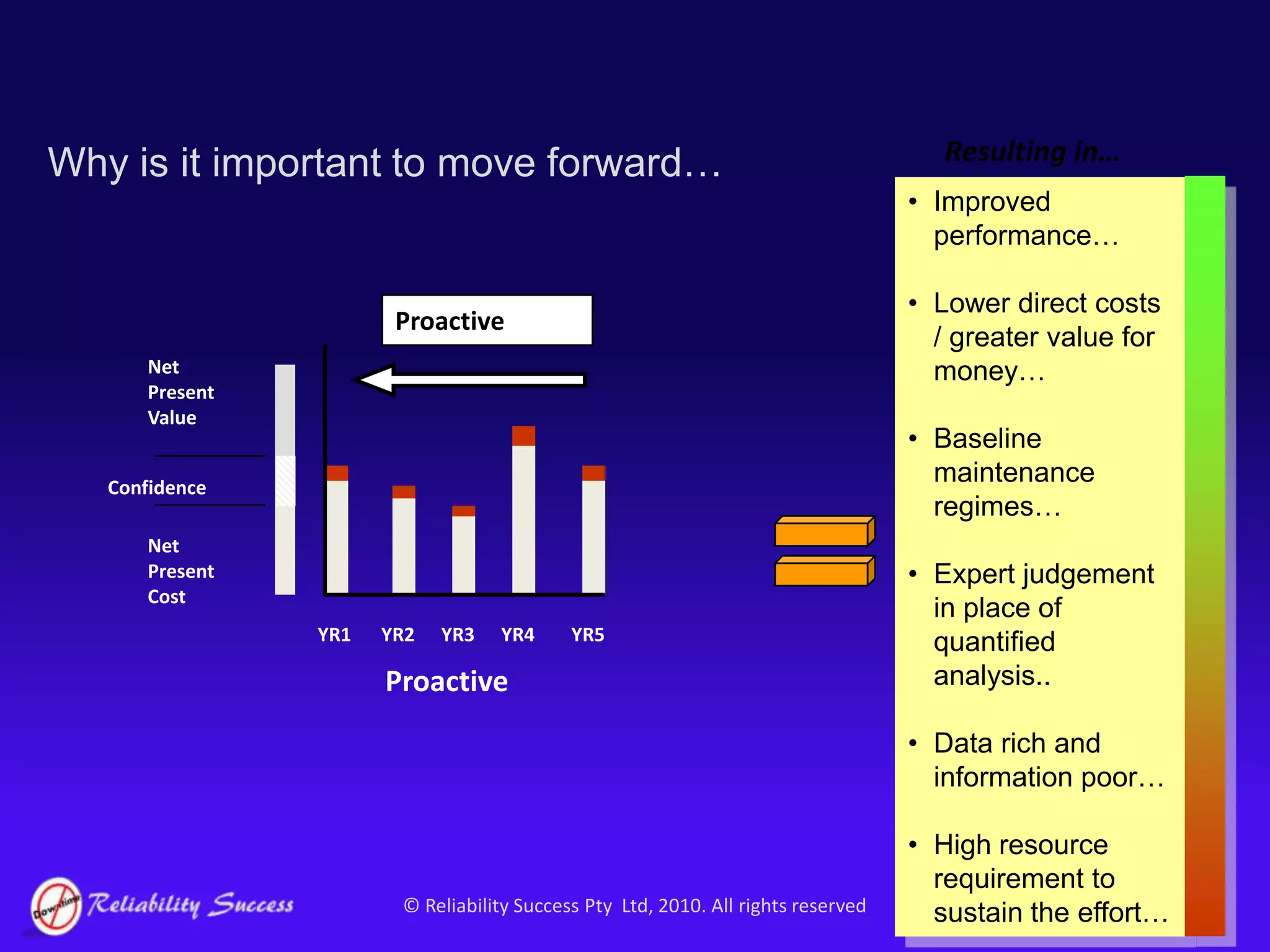
    Implementation into businessprocesses…Resulting in…Improved performance…
  • 84.
    Lower direct costs/ greater value for money…
  • 85.
  • 86.
    Expert judgement inplace of quantified analysis..
  • 87.
    Data rich andinformation poor…
  • 88.
    High resource requirementto sustain the effort…ProactiveNet Present ValueConfidenceNet Present CostYR1YR2YR3YR4YR5ProactiveWhy is it important to move forward…
  • 89.
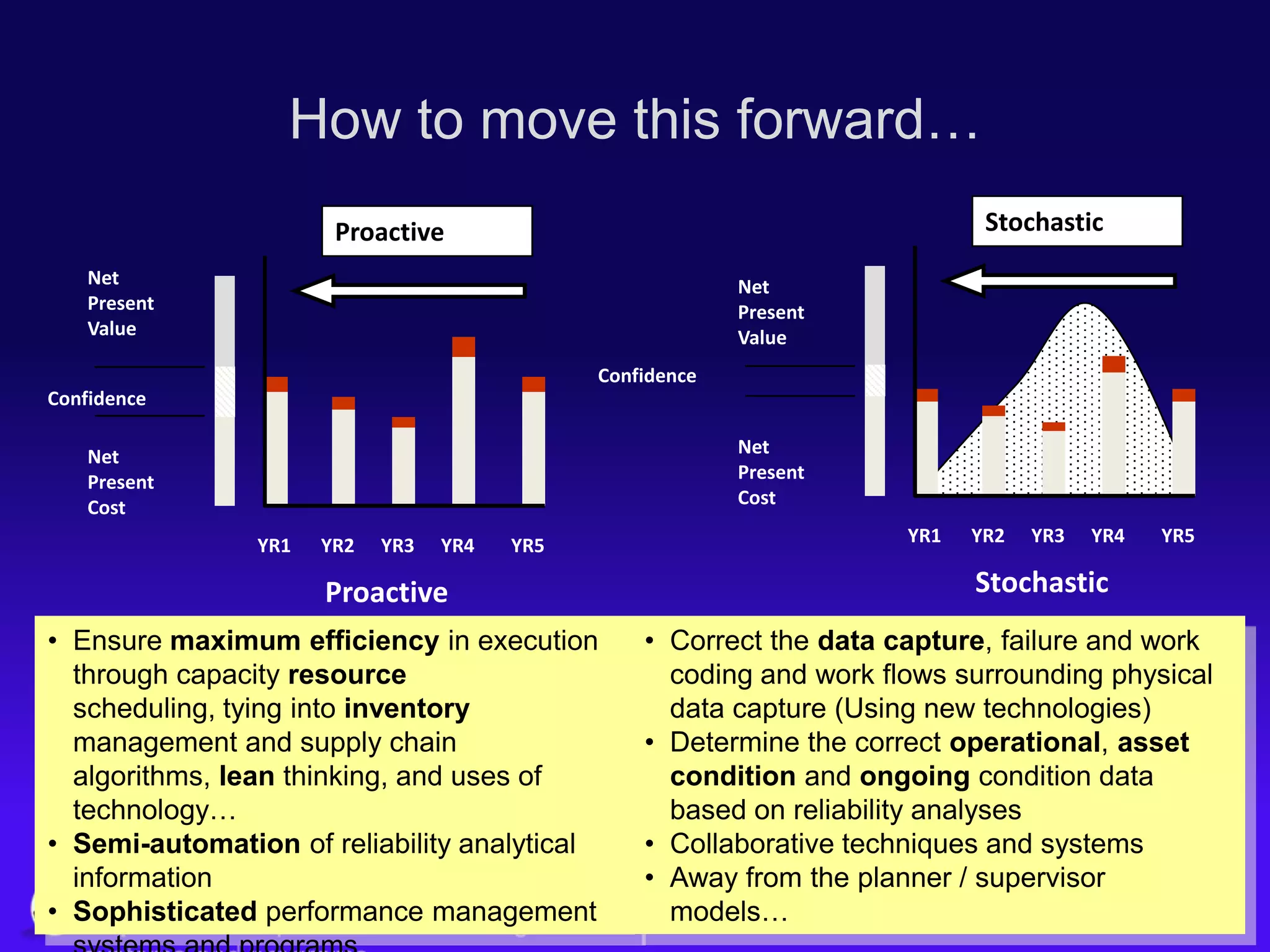
    How to movethis forward…StochasticProactiveNet Present ValueNet Present ValueConfidenceConfidenceNet Present CostNet Present CostYR1YR2YR3YR4YR5YR1YR2YR3YR4YR5Stochastic ProactiveEnsure maximum efficiency in execution through capacity resource scheduling, tying into inventory management and supply chain algorithms, lean thinking, and uses of technology…
  • 90.
    Semi-automation of reliabilityanalytical information
  • 91.
  • 92.
    Correct the datacapture, failure and work coding and work flows surrounding physical data capture (Using new technologies)
  • 93.
    Determine the correctoperational, asset condition and ongoing condition data based on reliability analyses
  • 94.
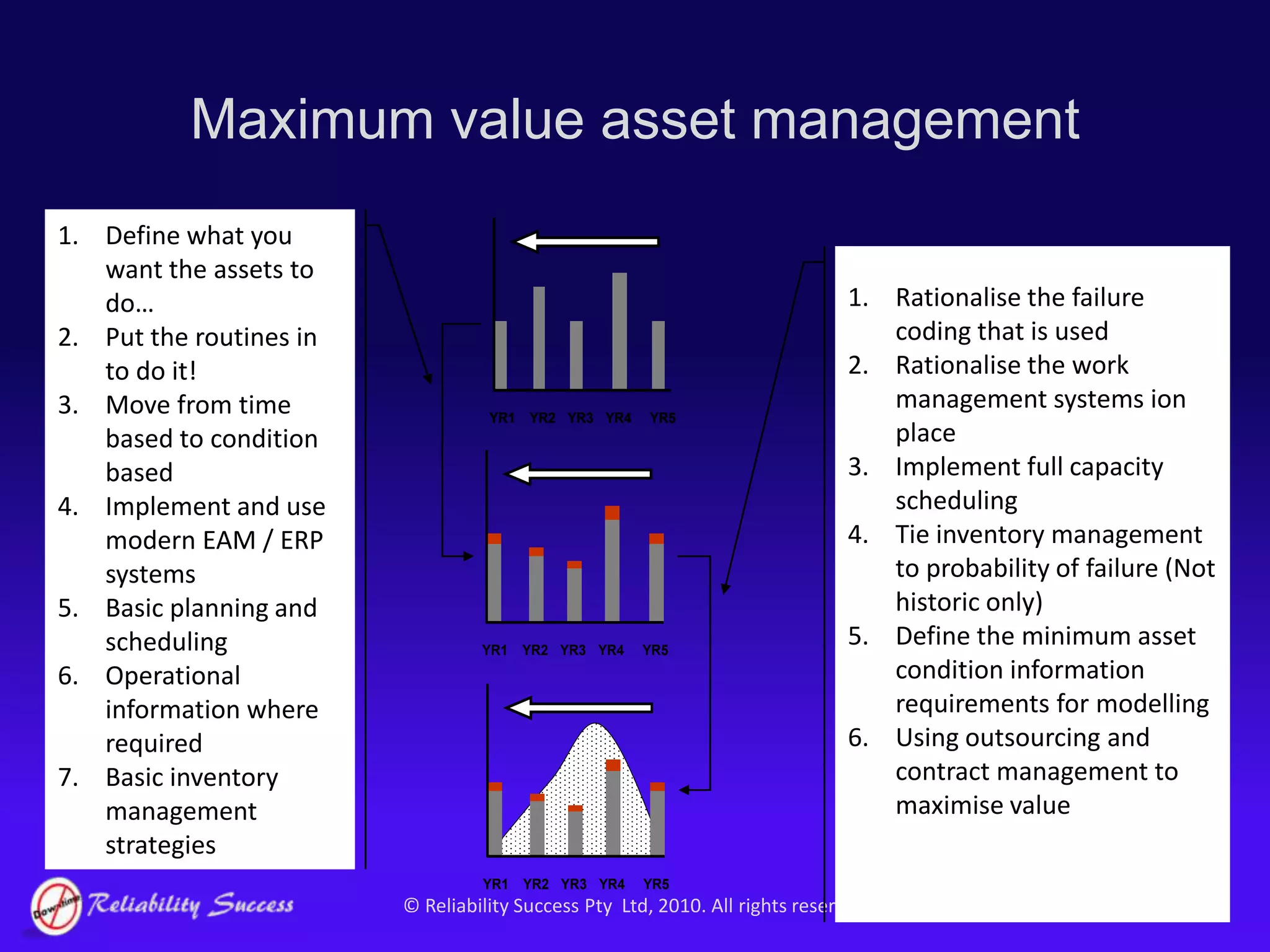
  • 95.
    Away from theplanner / supervisor models…Maximum value asset managementDefine what you want the assets to do…Put the routines in to do it!Move from time based to condition basedImplement and use modern EAM / ERP systemsBasic planning and schedulingOperational information where requiredBasic inventory management strategiesRationalise the failure coding that is usedRationalise the work management systems ion placeImplement full capacity schedulingTie inventory management to probability of failure (Not historic only)Define the minimum asset condition information requirements for modellingUsing outsourcing and contract management to maximise value