Principles of Plant Disease Control - Exclusion
Submitted by :- Manoj Kumar Saini
ID No. :- Ag/Pg/0016/19
Submitted to :- Dr. Sunaina Bisht
College of Agriculture
Rani Lakshmi Bai Central Agricultural University, NH-75, Near Pahuj Dam,
Gwalior Road, Jhansi (Uttar Pradesh) - 284003
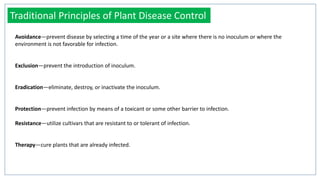
Avoidance—prevent disease by selecting a time of the year or a site where there is no inoculum or where the
environment is not favorable for infection.
Exclusion—prevent the introduction of inoculum.
Eradication—eliminate, destroy, or inactivate the inoculum.
Protection—prevent infection by means of a toxicant or some other barrier to infection.
Resistance—utilize cultivars that are resistant to or tolerant of infection.
Therapy—cure plants that are already infected.
Traditional Principles of Plant Disease Control
Exclusion
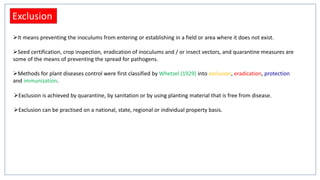
It means preventing the inoculums from entering or establishing in a field or area where it does not exist.
Seed certification, crop inspection, eradication of inoculums and / or insect vectors, and quarantine measures are
some of the means of preventing the spread for pathogens.
Methods for plant diseases control were first classified by Whetzel (1929) into exclusion, eradication, protection
and immunization.
Exclusion is achieved by quarantine, by sanitation or by using planting material that is free from disease.
Exclusion can be practised on a national, state, regional or individual property basis.
Plant Quarantine
Plant quarantine is defined as the legal enforcement of the measures aimed to prevent disease from spreading or to
prevent them from multiplying further in case they have already gained entry and have established in new restricted
areas.
It is generally accepted that the first international quarantine measures were imposed in 1374 when the city
of Venice banned the entry of travellers suspected of being infected with bubonic plague.
In fact, the term 'quarantine' is derived from the Italian word 'quarantina' referring to a 4O-day detention
period applied to ships arriving in certain countries from areas where diseases such as bubonic plague,
cholera and yellow fever occurred.
History
In world first time plant quarantine law was promulgated in Rollen, France in 1860 to suppress and prevent
the spread of common barberry, the alternate host of wheat stem rust.
In India legislative measure against disease and pest was started under the Destructive Insects Pest Act of 1914 by
governor general of India on 3rd February 1914.
International plant protection convention the first effort towards international agreement on Plant Protection was
made in 1914 under the auspices of the International Institute of Agriculture in Rome.
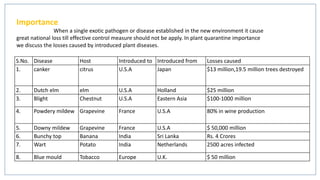
Importance
When a single exotic pathogen or disease established in the new environment it cause
great national loss till effective control measure should not be apply. In plant quarantine importance
we discuss the losses caused by introduced plant diseases.
S.No. Disease Host Introduced to Introduced from Losses caused
1. canker citrus U.S.A Japan $13 million,19.5 million trees destroyed
2. Dutch elm elm U.S.A Holland $25 million
3. Blight Chestnut U.S.A Eastern Asia $100-1000 million
4. Powdery mildew Grapevine France U.S.A 80% in wine production
5. Downy mildew Grapevine France U.S.A $ 50,000 million
6. Bunchy top Banana India Sri Lanka Rs. 4 Crores
7. Wart Potato India Netherlands 2500 acres infected
8. Blue mould Tobacco Europe U.K. $ 50 million
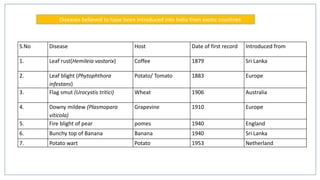
S.No Disease Host Date of first record Introduced from
1. Leaf rust(Hemileia vastarix) Coffee 1879 Sri Lanka
2. Leaf blight (Phytophthora
infestans)
Potato/ Tomato 1883 Europe
3. Flag smut (Urocystis tritici) Wheat 1906 Australia
4. Downy mildew (Plasmopara
viticola)
Grapevine 1910 Europe
5. Fire blight of pear pomes 1940 England
6. Bunchy top of Banana Banana 1940 Sri Lanka
7. Potato wart Potato 1953 Netherland
Diseases believed to have been introduced into India from exotic countries
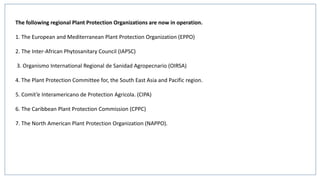
The following regional Plant Protection Organizations are now in operation.
1. The European and Mediterranean Plant Protection Organization (EPPO)
2. The Inter-African Phytosanitary Council (IAPSC)
3. Organismo International Regional de Sanidad Agropecnario (OIRSA)
4. The Plant Protection Committee for, the South East Asia and Pacific region.
5. Comit’e Interamericano de Protection Agricola. (CIPA)
6. The Caribbean Plant Protection Commission (CPPC)
7. The North American Plant Protection Organization (NAPPO).
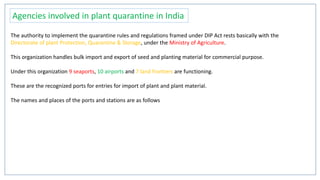
Agencies involved in plant quarantine in India
The authority to implement the quarantine rules and regulations framed under DIP Act rests basically with the
Directorate of plant Protection, Quarantine & Storage, under the Ministry of Agriculture.
This organization handles bulk import and export of seed and planting material for commercial purpose.
Under this organization 9 seaports, 10 airports and 7 land frontiers are functioning.
These are the recognized ports for entries for import of plant and plant material.
The names and places of the ports and stations are as follows
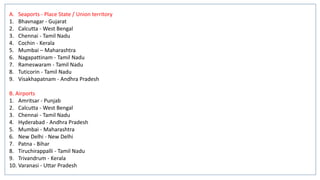
A. Seaports - Place State / Union territory
1. Bhavnagar - Gujarat
2. Calcutta - West Bengal
3. Chennai - Tamil Nadu
4. Cochin - Kerala
5. Mumbai – Maharashtra
6. Nagapattinam - Tamil Nadu
7. Rameswaram - Tamil Nadu
8. Tuticorin - Tamil Nadu
9. Visakhapatnam - Andhra Pradesh
B. Airports
1. Amritsar - Punjab
2. Calcutta - West Bengal
3. Chennai - Tamil Nadu
4. Hyderabad - Andhra Pradesh
5. Mumbai - Maharashtra
6. New Delhi - New Delhi
7. Patna - Bihar
8. Tiruchirappalli - Tamil Nadu
9. Trivandrum - Kerala
10. Varanasi - Uttar Pradesh
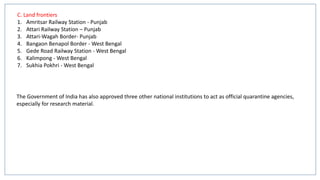
C. Land frontiers
1. Amritsar Railway Station - Punjab
2. Attari Railway Station – Punjab
3. Attari-Wagah Border- Punjab
4. Bangaon Benapol Border - West Bengal
5. Gede Road Railway Station - West Bengal
6. Kalimpong - West Bengal
7. Sukhia Pokhri - West Bengal
The Government of India has also approved three other national institutions to act as official quarantine agencies,
especially for research material.
1. National Bureau of Plant Genetic Resources (NBPGR)
The NBPGR in New Delhi and its regional station at Hyderabad in the agency involved in processing of
Germplasm, seed, plant material of agricultural, horticultural, and silvicultural crops of all the institutions of
Indian Council of Agricultural Research (ICAR) functioning in the country.
It is also responsible for quarantine clearance of seed and plant material received from International Agricultural
Research Centers viz., ICRISAT, ICARDA, CIMMYT, etc.
ICRISAT was established in 1972 at Patancheru (near Hyderabad) to work on improvement of sorghum,
Pearlmillet, chickpea, pigeon pea and groundnut.
The quarantine clearance of all its exchanges was handled by Central Plant Protection Training Institute of
Directorate of Plant Protection, Quarantine & Storage, until July 1986.
This authority was later passed on to NBPGR in August 1986.
2. Forest Research Institute (FRI), Dehra Dun, for forestry plants
3. Botanical Survey of India (BSI) for other plants
The Directorate of Plant Protection, Quarantine and storage has the responsibility to take the necessary steps and
regulate the inter-state movement of plants and plant material in order to prevent the further spread of destructive
insects and diseases that have already entered the country.
The sole object of enforcing domestic quarantine is to prevent the spread of these diseases from infected to non-
infected areas.
Currently, domestic plant quarantine exists in four diseases,
1. Wart (Synchytrium endobioticum) of potato from 1959,
2. Bunchy top (virus) of banana from 1959,
3. Mosaic (virus) of banana from 1961 and
4. Apple scab (Venturia inaequalis) from 1979.
Domestic Quarantine Under the DIP Act
There are number of plant quarantine methods which are used separately or collectively to prevent or retard the
introduction and establishment of exotic pests and pathogens.
The components of plant quarantine activities are:
Plant quarantine methods
1. Complete embargoes
It involves absolute prohibition or exclusion of specified plants and plant products from
a country infected or infested with highly destructive pests or diseases that could be transmitted by the plant
or plant products under consideration and against which no effective plant quarantine treatment can be
applied or is not available for application.
2. Partial embargoes
Partial embargoes, applying when a pest or disease of quarantine importance to an importing
country is known to occur only in well defined area of the exporting country and an effectively operating
internal plant quarantine service exists that is able to contain the pest or disease within this area.
3. Inspection and treatment at point of origin
It involves the inspection and treatment of a given commodity when it
originates from a country where pest/disease of quarantine importance to importing country is known to
occur.
4. Inspection and certification at point of origin
It involves pre-shipment inspection by the importing country in
cooperation with exporting country and certification in accordance with quarantine requirements of importing country.
5. Inspection at the point of entry
It involves inspection of plant material immediately upon arrival at the prescribed port
of entry and if necessary subject to treatment before the same related.
6. Utilization of post entry plant quarantine facilities
It involves growing of introduced plant propagating material under isolated or confined conditions.
In recent time COVID-19 a pandemic disease spread throughout the world from Wuhan city (China) due to lack of
proper exclusion knowledge .
Quarantine is helping to spread the Novel Corona Virus (COVID-19) in community transmission.
Around 400crore people are lockdown into their home to control the transmission of COVID-19.
Exclusion

Exclusion

  • 1.
    Principles of PlantDisease Control - Exclusion Submitted by :- Manoj Kumar Saini ID No. :- Ag/Pg/0016/19 Submitted to :- Dr. Sunaina Bisht College of Agriculture Rani Lakshmi Bai Central Agricultural University, NH-75, Near Pahuj Dam, Gwalior Road, Jhansi (Uttar Pradesh) - 284003
  • 2.
    Avoidance—prevent disease byselecting a time of the year or a site where there is no inoculum or where the environment is not favorable for infection. Exclusion—prevent the introduction of inoculum. Eradication—eliminate, destroy, or inactivate the inoculum. Protection—prevent infection by means of a toxicant or some other barrier to infection. Resistance—utilize cultivars that are resistant to or tolerant of infection. Therapy—cure plants that are already infected. Traditional Principles of Plant Disease Control
  • 3.
    Exclusion It means preventingthe inoculums from entering or establishing in a field or area where it does not exist. Seed certification, crop inspection, eradication of inoculums and / or insect vectors, and quarantine measures are some of the means of preventing the spread for pathogens. Methods for plant diseases control were first classified by Whetzel (1929) into exclusion, eradication, protection and immunization. Exclusion is achieved by quarantine, by sanitation or by using planting material that is free from disease. Exclusion can be practised on a national, state, regional or individual property basis.
  • 4.
    Plant Quarantine Plant quarantineis defined as the legal enforcement of the measures aimed to prevent disease from spreading or to prevent them from multiplying further in case they have already gained entry and have established in new restricted areas. It is generally accepted that the first international quarantine measures were imposed in 1374 when the city of Venice banned the entry of travellers suspected of being infected with bubonic plague. In fact, the term 'quarantine' is derived from the Italian word 'quarantina' referring to a 4O-day detention period applied to ships arriving in certain countries from areas where diseases such as bubonic plague, cholera and yellow fever occurred.
  • 5.
    History In world firsttime plant quarantine law was promulgated in Rollen, France in 1860 to suppress and prevent the spread of common barberry, the alternate host of wheat stem rust. In India legislative measure against disease and pest was started under the Destructive Insects Pest Act of 1914 by governor general of India on 3rd February 1914. International plant protection convention the first effort towards international agreement on Plant Protection was made in 1914 under the auspices of the International Institute of Agriculture in Rome.
  • 6.
    Importance When a singleexotic pathogen or disease established in the new environment it cause great national loss till effective control measure should not be apply. In plant quarantine importance we discuss the losses caused by introduced plant diseases. S.No. Disease Host Introduced to Introduced from Losses caused 1. canker citrus U.S.A Japan $13 million,19.5 million trees destroyed 2. Dutch elm elm U.S.A Holland $25 million 3. Blight Chestnut U.S.A Eastern Asia $100-1000 million 4. Powdery mildew Grapevine France U.S.A 80% in wine production 5. Downy mildew Grapevine France U.S.A $ 50,000 million 6. Bunchy top Banana India Sri Lanka Rs. 4 Crores 7. Wart Potato India Netherlands 2500 acres infected 8. Blue mould Tobacco Europe U.K. $ 50 million
  • 7.
    S.No Disease HostDate of first record Introduced from 1. Leaf rust(Hemileia vastarix) Coffee 1879 Sri Lanka 2. Leaf blight (Phytophthora infestans) Potato/ Tomato 1883 Europe 3. Flag smut (Urocystis tritici) Wheat 1906 Australia 4. Downy mildew (Plasmopara viticola) Grapevine 1910 Europe 5. Fire blight of pear pomes 1940 England 6. Bunchy top of Banana Banana 1940 Sri Lanka 7. Potato wart Potato 1953 Netherland Diseases believed to have been introduced into India from exotic countries
  • 8.
    The following regionalPlant Protection Organizations are now in operation. 1. The European and Mediterranean Plant Protection Organization (EPPO) 2. The Inter-African Phytosanitary Council (IAPSC) 3. Organismo International Regional de Sanidad Agropecnario (OIRSA) 4. The Plant Protection Committee for, the South East Asia and Pacific region. 5. Comit’e Interamericano de Protection Agricola. (CIPA) 6. The Caribbean Plant Protection Commission (CPPC) 7. The North American Plant Protection Organization (NAPPO).
  • 9.
    Agencies involved inplant quarantine in India The authority to implement the quarantine rules and regulations framed under DIP Act rests basically with the Directorate of plant Protection, Quarantine & Storage, under the Ministry of Agriculture. This organization handles bulk import and export of seed and planting material for commercial purpose. Under this organization 9 seaports, 10 airports and 7 land frontiers are functioning. These are the recognized ports for entries for import of plant and plant material. The names and places of the ports and stations are as follows
  • 10.
    A. Seaports -Place State / Union territory 1. Bhavnagar - Gujarat 2. Calcutta - West Bengal 3. Chennai - Tamil Nadu 4. Cochin - Kerala 5. Mumbai – Maharashtra 6. Nagapattinam - Tamil Nadu 7. Rameswaram - Tamil Nadu 8. Tuticorin - Tamil Nadu 9. Visakhapatnam - Andhra Pradesh B. Airports 1. Amritsar - Punjab 2. Calcutta - West Bengal 3. Chennai - Tamil Nadu 4. Hyderabad - Andhra Pradesh 5. Mumbai - Maharashtra 6. New Delhi - New Delhi 7. Patna - Bihar 8. Tiruchirappalli - Tamil Nadu 9. Trivandrum - Kerala 10. Varanasi - Uttar Pradesh
  • 11.
    C. Land frontiers 1.Amritsar Railway Station - Punjab 2. Attari Railway Station – Punjab 3. Attari-Wagah Border- Punjab 4. Bangaon Benapol Border - West Bengal 5. Gede Road Railway Station - West Bengal 6. Kalimpong - West Bengal 7. Sukhia Pokhri - West Bengal The Government of India has also approved three other national institutions to act as official quarantine agencies, especially for research material.
  • 12.
    1. National Bureauof Plant Genetic Resources (NBPGR) The NBPGR in New Delhi and its regional station at Hyderabad in the agency involved in processing of Germplasm, seed, plant material of agricultural, horticultural, and silvicultural crops of all the institutions of Indian Council of Agricultural Research (ICAR) functioning in the country. It is also responsible for quarantine clearance of seed and plant material received from International Agricultural Research Centers viz., ICRISAT, ICARDA, CIMMYT, etc. ICRISAT was established in 1972 at Patancheru (near Hyderabad) to work on improvement of sorghum, Pearlmillet, chickpea, pigeon pea and groundnut. The quarantine clearance of all its exchanges was handled by Central Plant Protection Training Institute of Directorate of Plant Protection, Quarantine & Storage, until July 1986. This authority was later passed on to NBPGR in August 1986. 2. Forest Research Institute (FRI), Dehra Dun, for forestry plants 3. Botanical Survey of India (BSI) for other plants
  • 13.
    The Directorate ofPlant Protection, Quarantine and storage has the responsibility to take the necessary steps and regulate the inter-state movement of plants and plant material in order to prevent the further spread of destructive insects and diseases that have already entered the country. The sole object of enforcing domestic quarantine is to prevent the spread of these diseases from infected to non- infected areas. Currently, domestic plant quarantine exists in four diseases, 1. Wart (Synchytrium endobioticum) of potato from 1959, 2. Bunchy top (virus) of banana from 1959, 3. Mosaic (virus) of banana from 1961 and 4. Apple scab (Venturia inaequalis) from 1979. Domestic Quarantine Under the DIP Act
  • 14.
    There are numberof plant quarantine methods which are used separately or collectively to prevent or retard the introduction and establishment of exotic pests and pathogens. The components of plant quarantine activities are: Plant quarantine methods 1. Complete embargoes It involves absolute prohibition or exclusion of specified plants and plant products from a country infected or infested with highly destructive pests or diseases that could be transmitted by the plant or plant products under consideration and against which no effective plant quarantine treatment can be applied or is not available for application. 2. Partial embargoes Partial embargoes, applying when a pest or disease of quarantine importance to an importing country is known to occur only in well defined area of the exporting country and an effectively operating internal plant quarantine service exists that is able to contain the pest or disease within this area. 3. Inspection and treatment at point of origin It involves the inspection and treatment of a given commodity when it originates from a country where pest/disease of quarantine importance to importing country is known to occur.
  • 15.
    4. Inspection andcertification at point of origin It involves pre-shipment inspection by the importing country in cooperation with exporting country and certification in accordance with quarantine requirements of importing country. 5. Inspection at the point of entry It involves inspection of plant material immediately upon arrival at the prescribed port of entry and if necessary subject to treatment before the same related. 6. Utilization of post entry plant quarantine facilities It involves growing of introduced plant propagating material under isolated or confined conditions. In recent time COVID-19 a pandemic disease spread throughout the world from Wuhan city (China) due to lack of proper exclusion knowledge . Quarantine is helping to spread the Novel Corona Virus (COVID-19) in community transmission. Around 400crore people are lockdown into their home to control the transmission of COVID-19.