Significance of Nematodes in
International Trade of
Agricultural Commodities
by
Vikas Bamel
Aims of Plant Quarantine
1. To prevent introduction and spread of QPs and
RNQPs
2. To prevent the economic losses to useful plant
resources (agrihorticultural and forestry)
--------------------------------------------------------
To meet above aims PQ carries out inspection of plants
(crops) and plant products (including seeds, scion,
rootstocks, bulbs, fruits, vegetables, food grains, feed
stocks, dried hay, spices, wood etc.) and prohibit or
restrict international or domestic movement
Quarantine Pest
• A pest of potential economic importance to the
area endangered
• Not yet present there
• Present but not widely distributed, and
• Being officially controlled
(Definition of FAO)
Glaring Examples of International
Spread of Nematodes
• Potato cyst nematodes Peru World over
• Soybean cyst nematode Japan USA
• Stem & Bulb nematode Europe World over
• White tip nematode-rice ? Most Asia
• Pine wilt nematode USA Japan
• Burrowing nematode Sri Lanka India
Destructive Insects and Pests
Act, 1914
Amended through notifications
from time to time
•Plants, Fruits and Seeds (Regulations of Import
into India) Order 1984 or in short PFS Order 1984
• Revised to accommodate provisions of New Policy on
Seed Development of GOI 1988 and the New order was
called as PFS Order 1989
• Revised to meet the requirements of WTO agreement
on application of SPS measures. The present order is
called Plant Quarantine ( Regulations of Import into
India) Order 2003 or in short PQ Order 2003
DIP Act 1914
Revisions/ Amendments
PQ Order 2003- Definitions
• Germplasm: A collection of seed or planting
material representing individual plant species/
variety that may be held in a repository or
collected from wild and to be utilised for crop
improvement.
• Plant: Any plant or part thereof whether dead or
living and includes herbs, shrubs, trees, saplings,
cuttings, grafts, buds, suckers, rhizomes, corms,
cormlets, tissue cultures, transgenics and
germplasm
Definitions …….contd
Import: Bringing into any part or place of territory of
Republic of India any kind of seed or plant /plant product
from a place outside India either by sea, land, air or across
any custom frontier
Point of entry:Any seaport, airport, land border checkpost
or rail station, river port, container freight station as
envisaged under schedule I which is increased from 59 in
PFS order 1989 to 130 in PQ Order 2003
• For all germplasm- New Delhi
• Seeds & Planting material- Delhi, Kolkota, Chennai,
Mumbai, Amritsar airports only
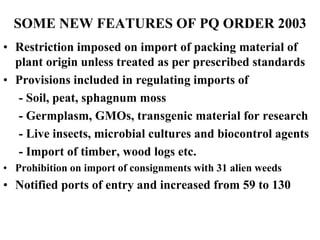
SOME NEW FEATURES OF PQ ORDER 2003
• Restriction imposed on import of packing material of
plant origin unless treated as per prescribed standards
• Provisions included in regulating imports of
- Soil, peat, sphagnum moss
- Germplasm, GMOs, transgenic material for research
- Live insects, microbial cultures and biocontrol agents
- Import of timber, wood logs etc.
• Prohibition on import of consignments with 31 alien weeds
• Notified ports of entry and increased from 59 to 130
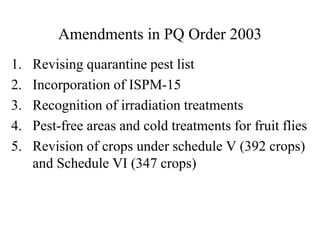
Amendments in PQ Order 2003
1. Revising quarantine pest list
2. Incorporation of ISPM-15
3. Recognition of irradiation treatments
4. Pest-free areas and cold treatments for fruit flies
5. Revision of crops under schedule V (392 crops)
and Schedule VI (347 crops)
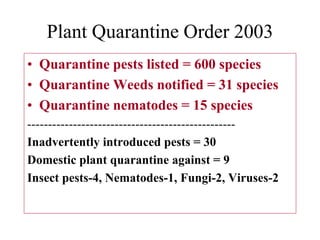
Plant Quarantine Order 2003
• Quarantine pests listed = 600 species
• Quarantine Weeds notified = 31 species
• Quarantine nematodes = 15 species
--------------------------------------------------
Inadvertently introduced pests = 30
Domestic plant quarantine against = 9
Insect pests-4, Nematodes-1, Fungi-2, Viruses-2
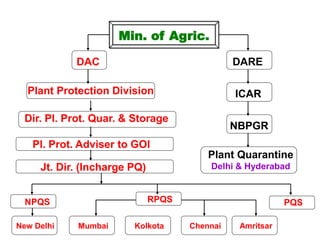
Min. of Agric.
DAC DARE
Plant Protection Division ICAR
NBPGR
Dir. Pl. Prot. Quar. & Storage
Pl. Prot. Adviser to GOI
Jt. Dir. (Incharge PQ)
New Delhi
NPQS
Mumbai Kolkota Chennai Amritsar
Plant Quarantine
Delhi & Hyderabad
RPQS PQS
International Plant Protection
Convention (IPPC)
• International cooperation is essential for effective
enforcement of PQ
• Member countries cooperate in conducting export PQ
services
• Issuing Phytosanitary certificate as per FAO guidelines
• Exchanging information on outbreaks of pests
---------------------------------------------------------
Most countries are either signatories of Rome convention or
follow its mandate
The Sanitary and Phytosanitary (SPS) Agreement
• The SPS Agreement was part of WTO (1995)
• SPS measures are defined as any measure applied
within the territory of the Member State to protect
plants/ animals/ humans from the risks of pests,
disease carrying/ causing organisms and humans or
animals from risks arising from contaminants, toxins,
additives or disease causing organisms in food,
beverages or feedstuff.
Major elements of SPS agreement
1. Transparency in acts to avoid unfair trading practices
2. Reduction of arbitrariness
3. Measures to provide appropriate protection
Pest Risk Analysis (PRA)
• Identification of pest for its categorization
• Definition of the PRA area
• Distribution of the pest and official country program
within the PRA area
• Potential of the pest for its establishment and spread
in the PRA area
• Economic impact in the PRA area
• Endangered area
PATHWAYS FOR MOVEMENT
OF PESTS
• Natural pathways
- Hurricanes, Wind, Rains, Running water
- Living vectors other than man
• Man made pathways
– Exchange of plants & planting material for research
as well as for trade
– Inter-state movement
– Germplasm collection, evaluation
Components of PQ programs
• To prevent introduction of pests of PQ and
economic importance
• To reduce pest risk to an acceptable level
• To contain, suppress and eradicate the
recently introduced pest in a area
• To provide assistance to exporters of plants
/plant products in meeting PQ requirements
Requirements of Quarantine Programs:
Common Features
• Embargo- Specify prohibitions on certain crops/ regions
• Grant exceptions to prohibitions for scientific uses
• Require import permits
• Require Phytosanitary certificates from exporting
country as per FAO guidelines
• Inspection and treatment prior to export
• Prescribe treatments on arrival
• Prescribe post-entry quarantine isolation growing
GLOBAL TRADE OF AGRICULTURAL
COMMODITIES
• BULK QUANTITY > 2 KG
– For planting/ propagation viz., Custom seed
production, commercial planting
– For consumption- as grains, fresh vegetables & fruits,
oil extraction, other uses
• SMALL QUANTITY AS GERMPLASM
– For research/ experimental purposes viz., breeding
HYV, pest resistant lines, improving quality traits,
etc.
ALL ARE POTENTIAL SOURCE AS PATHWAYS
FOR INTRODUCING EXOTIC NEMATODE PESTS
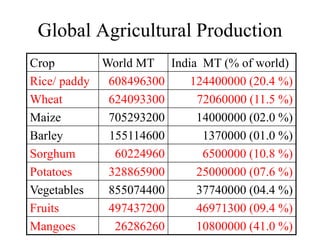
Global Agricultural Production
Crop World MT India MT (% of world)
Rice/ paddy 608496300 124400000 (20.4 %)
Wheat 624093300 72060000 (11.5 %)
Maize 705293200 14000000 (02.0 %)
Barley 155114600 1370000 (01.0 %)
Sorghum 60224960 6500000 (10.8 %)
Potatoes 328865900 25000000 (07.6 %)
Vegetables 855074400 37740000 (04.4 %)
Fruits 497437200 46971300 (09.4 %)
Mangoes 26286260 10800000 (41.0 %)
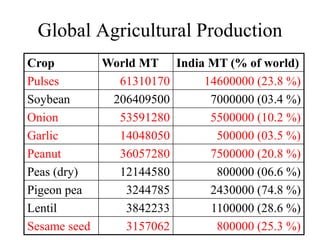
Global Agricultural Production
Crop World MT India MT (% of world)
Pulses 61310170 14600000 (23.8 %)
Soybean 206409500 7000000 (03.4 %)
Onion 53591280 5500000 (10.2 %)
Garlic 14048050 500000 (03.5 %)
Peanut 36057280 7500000 (20.8 %)
Peas (dry) 12144580 800000 (06.6 %)
Pigeon pea 3244785 2430000 (74.8 %)
Lentil 3842233 1100000 (28.6 %)
Sesame seed 3157062 800000 (25.3 %)
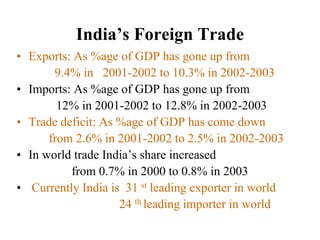
India’s Foreign Trade
• Exports: As %age of GDP has gone up from
9.4% in 2001-2002 to 10.3% in 2002-2003
• Imports: As %age of GDP has gone up from
12% in 2001-2002 to 12.8% in 2002-2003
• Trade deficit: As %age of GDP has come down
from 2.6% in 2001-2002 to 2.5% in 2002-2003
• In world trade India’s share increased
from 0.7% in 2000 to 0.8% in 2003
• Currently India is 31 st leading exporter in world
24 th leading importer in world
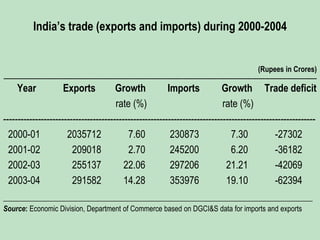
India’s trade (exports and imports) during 2000-2004
(Rupees in Crores)
-------------------------------------------------------------------------------------------------------------------------------------------------------------------------------------------------------------------------
Year Exports Growth Imports Growth Trade deficit
rate (%) rate (%)
------------------------------------------------------------------------------------------------------------
2000-01 2035712 7.60 230873 7.30 -27302
2001-02 209018 2.70 245200 6.20 -36182
2002-03 255137 22.06 297206 21.21 -42069
2003-04 291582 14.28 353976 19.10 -62394
__________________________________________________________
Source: Economic Division, Department of Commerce based on DGCI&S data for imports and exports
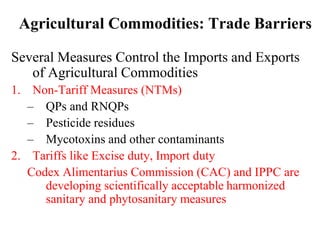
Agricultural Commodities: Trade Barriers
Several Measures Control the Imports and Exports
of Agricultural Commodities
1. Non-Tariff Measures (NTMs)
– QPs and RNQPs
– Pesticide residues
– Mycotoxins and other contaminants
2. Tariffs like Excise duty, Import duty
Codex Alimentarius Commission (CAC) and IPPC are
developing scientifically acceptable harmonized
sanitary and phytosanitary measures
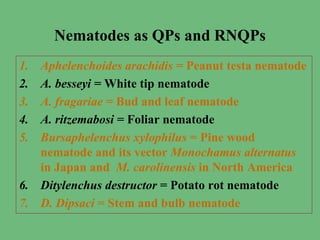
Nematodes as QPs and RNQPs
1. Aphelenchoides arachidis = Peanut testa nematode
2. A. besseyi = White tip nematode
3. A. fragariae = Bud and leaf nematode
4. A. ritzemabosi = Foliar nematode
5. Bursaphelenchus xylophilus = Pine wood
nematode and its vector Monochamus alternatus
in Japan and M. carolinensis in North America
6. Ditylenchus destructor = Potato rot nematode
7. D. Dipsaci = Stem and bulb nematode
Nematodes as QP and RNQPs
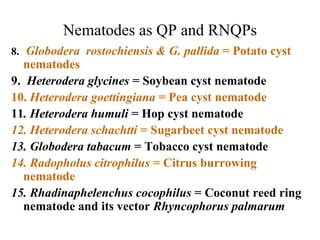
8. Globodera rostochiensis & G. pallida = Potato cyst
nematodes
9. Heterodera glycines = Soybean cyst nematode
10. Heterodera goettingiana = Pea cyst nematode
11. Heterodera humuli = Hop cyst nematode
12. Heterodera schachtti = Sugarbeet cyst nematode
13. Globodera tabacum = Tobacco cyst nematode
14. Radopholus citrophilus = Citrus burrowing
nematode
15. Rhadinaphelenchus cocophilus = Coconut reed ring
nematode and its vector Rhyncophorus palmarum
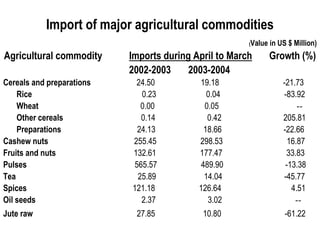
Import of major agricultural commodities
(Value in US $ Million)
Agricultural commodity Imports during April to March Growth (%)
2002-2003 2003-2004
Cereals and preparations 24.50 19.18 -21.73
Rice 0.23 0.04 -83.92
Wheat 0.00 0.05 --
Other cereals 0.14 0.42 205.81
Preparations 24.13 18.66 -22.66
Cashew nuts 255.45 298.53 16.87
Fruits and nuts 132.61 177.47 33.83
Pulses 565.57 489.90 -13.38
Tea 25.89 14.04 -45.77
Spices 121.18 126.64 4.51
Oil seeds 2.37 3.02 --
Jute raw 27.85 10.80 -61.22
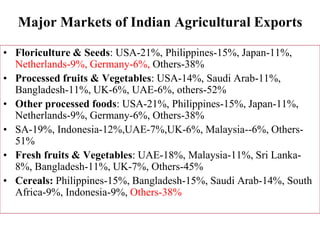
Major Markets of Indian Agricultural Exports
• Floriculture & Seeds: USA-21%, Philippines-15%, Japan-11%,
Netherlands-9%, Germany-6%, Others-38%
• Processed fruits & Vegetables: USA-14%, Saudi Arab-11%,
Bangladesh-11%, UK-6%, UAE-6%, others-52%
• Other processed foods: USA-21%, Philippines-15%, Japan-11%,
Netherlands-9%, Germany-6%, Others-38%
• SA-19%, Indonesia-12%,UAE-7%,UK-6%, Malaysia--6%, Others-
51%
• Fresh fruits & Vegetables: UAE-18%, Malaysia-11%, Sri Lanka-
8%, Bangladesh-11%, UK-7%, Others-45%
• Cereals: Philippines-15%, Bangladesh-15%, Saudi Arab-14%, South
Africa-9%, Indonesia-9%, Others-38%
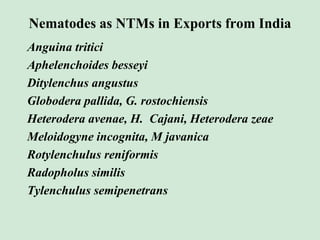
Nematodes as NTMs in Exports from India
Anguina tritici
Aphelenchoides besseyi
Ditylenchus angustus
Globodera pallida, G. rostochiensis
Heterodera avenae, H. Cajani, Heterodera zeae
Meloidogyne incognita, M javanica
Rotylenchulus reniformis
Radopholus similis
Tylenchulus semipenetrans
National Bureau of Plant Genetic
Resources
For germplasm/research material/transgenic
planting material
Nodal agency for
• issue of import permit
• quarantine processing
• issue of Phytosanitary Certificate
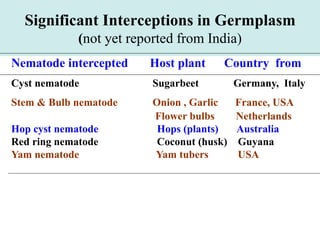
Significant Interceptions in Germplasm
(not yet reported from India)
Nematode intercepted Host plant Country from
Cyst nematode Sugarbeet Germany, Italy
Stem & Bulb nematode Onion , Garlic France, USA
Flower bulbs Netherlands
Hop cyst nematode Hops (plants) Australia
Red ring nematode Coconut (husk) Guyana
Yam nematode Yam tubers USA
Nematological Research Areas to
Promote Agricultural Exports
• Identification and mapping of PFA
• Standardizing sampling and detection methods for
issuance of Phytosanitary Certificate
• Nematode management in organic farming system
• Strategic research for nematode disinfestations
– HWT, VHT
– Electron beam irradiation
– Other physical methods
Plant quarantine is a filter
and
not a barrier
Thank you

Nemas in trade by Vikas Bamel (2012)

  • 1.
    Significance of Nematodesin International Trade of Agricultural Commodities by Vikas Bamel
  • 2.
    Aims of PlantQuarantine 1. To prevent introduction and spread of QPs and RNQPs 2. To prevent the economic losses to useful plant resources (agrihorticultural and forestry) -------------------------------------------------------- To meet above aims PQ carries out inspection of plants (crops) and plant products (including seeds, scion, rootstocks, bulbs, fruits, vegetables, food grains, feed stocks, dried hay, spices, wood etc.) and prohibit or restrict international or domestic movement
  • 3.
    Quarantine Pest • Apest of potential economic importance to the area endangered • Not yet present there • Present but not widely distributed, and • Being officially controlled (Definition of FAO)
  • 4.
    Glaring Examples ofInternational Spread of Nematodes • Potato cyst nematodes Peru World over • Soybean cyst nematode Japan USA • Stem & Bulb nematode Europe World over • White tip nematode-rice ? Most Asia • Pine wilt nematode USA Japan • Burrowing nematode Sri Lanka India
  • 5.
    Destructive Insects andPests Act, 1914 Amended through notifications from time to time
  • 6.
    •Plants, Fruits andSeeds (Regulations of Import into India) Order 1984 or in short PFS Order 1984 • Revised to accommodate provisions of New Policy on Seed Development of GOI 1988 and the New order was called as PFS Order 1989 • Revised to meet the requirements of WTO agreement on application of SPS measures. The present order is called Plant Quarantine ( Regulations of Import into India) Order 2003 or in short PQ Order 2003 DIP Act 1914 Revisions/ Amendments
  • 7.
    PQ Order 2003-Definitions • Germplasm: A collection of seed or planting material representing individual plant species/ variety that may be held in a repository or collected from wild and to be utilised for crop improvement. • Plant: Any plant or part thereof whether dead or living and includes herbs, shrubs, trees, saplings, cuttings, grafts, buds, suckers, rhizomes, corms, cormlets, tissue cultures, transgenics and germplasm
  • 8.
    Definitions …….contd Import: Bringinginto any part or place of territory of Republic of India any kind of seed or plant /plant product from a place outside India either by sea, land, air or across any custom frontier Point of entry:Any seaport, airport, land border checkpost or rail station, river port, container freight station as envisaged under schedule I which is increased from 59 in PFS order 1989 to 130 in PQ Order 2003 • For all germplasm- New Delhi • Seeds & Planting material- Delhi, Kolkota, Chennai, Mumbai, Amritsar airports only
  • 9.
    SOME NEW FEATURESOF PQ ORDER 2003 • Restriction imposed on import of packing material of plant origin unless treated as per prescribed standards • Provisions included in regulating imports of - Soil, peat, sphagnum moss - Germplasm, GMOs, transgenic material for research - Live insects, microbial cultures and biocontrol agents - Import of timber, wood logs etc. • Prohibition on import of consignments with 31 alien weeds • Notified ports of entry and increased from 59 to 130
  • 10.
    Amendments in PQOrder 2003 1. Revising quarantine pest list 2. Incorporation of ISPM-15 3. Recognition of irradiation treatments 4. Pest-free areas and cold treatments for fruit flies 5. Revision of crops under schedule V (392 crops) and Schedule VI (347 crops)
  • 11.
    Plant Quarantine Order2003 • Quarantine pests listed = 600 species • Quarantine Weeds notified = 31 species • Quarantine nematodes = 15 species -------------------------------------------------- Inadvertently introduced pests = 30 Domestic plant quarantine against = 9 Insect pests-4, Nematodes-1, Fungi-2, Viruses-2
  • 12.
    Min. of Agric. DACDARE Plant Protection Division ICAR NBPGR Dir. Pl. Prot. Quar. & Storage Pl. Prot. Adviser to GOI Jt. Dir. (Incharge PQ) New Delhi NPQS Mumbai Kolkota Chennai Amritsar Plant Quarantine Delhi & Hyderabad RPQS PQS
  • 13.
    International Plant Protection Convention(IPPC) • International cooperation is essential for effective enforcement of PQ • Member countries cooperate in conducting export PQ services • Issuing Phytosanitary certificate as per FAO guidelines • Exchanging information on outbreaks of pests --------------------------------------------------------- Most countries are either signatories of Rome convention or follow its mandate
  • 14.
    The Sanitary andPhytosanitary (SPS) Agreement • The SPS Agreement was part of WTO (1995) • SPS measures are defined as any measure applied within the territory of the Member State to protect plants/ animals/ humans from the risks of pests, disease carrying/ causing organisms and humans or animals from risks arising from contaminants, toxins, additives or disease causing organisms in food, beverages or feedstuff. Major elements of SPS agreement 1. Transparency in acts to avoid unfair trading practices 2. Reduction of arbitrariness 3. Measures to provide appropriate protection
  • 15.
    Pest Risk Analysis(PRA) • Identification of pest for its categorization • Definition of the PRA area • Distribution of the pest and official country program within the PRA area • Potential of the pest for its establishment and spread in the PRA area • Economic impact in the PRA area • Endangered area
  • 16.
    PATHWAYS FOR MOVEMENT OFPESTS • Natural pathways - Hurricanes, Wind, Rains, Running water - Living vectors other than man • Man made pathways – Exchange of plants & planting material for research as well as for trade – Inter-state movement – Germplasm collection, evaluation
  • 17.
    Components of PQprograms • To prevent introduction of pests of PQ and economic importance • To reduce pest risk to an acceptable level • To contain, suppress and eradicate the recently introduced pest in a area • To provide assistance to exporters of plants /plant products in meeting PQ requirements
  • 18.
    Requirements of QuarantinePrograms: Common Features • Embargo- Specify prohibitions on certain crops/ regions • Grant exceptions to prohibitions for scientific uses • Require import permits • Require Phytosanitary certificates from exporting country as per FAO guidelines • Inspection and treatment prior to export • Prescribe treatments on arrival • Prescribe post-entry quarantine isolation growing
  • 19.
    GLOBAL TRADE OFAGRICULTURAL COMMODITIES • BULK QUANTITY > 2 KG – For planting/ propagation viz., Custom seed production, commercial planting – For consumption- as grains, fresh vegetables & fruits, oil extraction, other uses • SMALL QUANTITY AS GERMPLASM – For research/ experimental purposes viz., breeding HYV, pest resistant lines, improving quality traits, etc. ALL ARE POTENTIAL SOURCE AS PATHWAYS FOR INTRODUCING EXOTIC NEMATODE PESTS
  • 20.
    Global Agricultural Production CropWorld MT India MT (% of world) Rice/ paddy 608496300 124400000 (20.4 %) Wheat 624093300 72060000 (11.5 %) Maize 705293200 14000000 (02.0 %) Barley 155114600 1370000 (01.0 %) Sorghum 60224960 6500000 (10.8 %) Potatoes 328865900 25000000 (07.6 %) Vegetables 855074400 37740000 (04.4 %) Fruits 497437200 46971300 (09.4 %) Mangoes 26286260 10800000 (41.0 %)
  • 21.
    Global Agricultural Production CropWorld MT India MT (% of world) Pulses 61310170 14600000 (23.8 %) Soybean 206409500 7000000 (03.4 %) Onion 53591280 5500000 (10.2 %) Garlic 14048050 500000 (03.5 %) Peanut 36057280 7500000 (20.8 %) Peas (dry) 12144580 800000 (06.6 %) Pigeon pea 3244785 2430000 (74.8 %) Lentil 3842233 1100000 (28.6 %) Sesame seed 3157062 800000 (25.3 %)
  • 22.
    India’s Foreign Trade •Exports: As %age of GDP has gone up from 9.4% in 2001-2002 to 10.3% in 2002-2003 • Imports: As %age of GDP has gone up from 12% in 2001-2002 to 12.8% in 2002-2003 • Trade deficit: As %age of GDP has come down from 2.6% in 2001-2002 to 2.5% in 2002-2003 • In world trade India’s share increased from 0.7% in 2000 to 0.8% in 2003 • Currently India is 31 st leading exporter in world 24 th leading importer in world
  • 23.
    India’s trade (exportsand imports) during 2000-2004 (Rupees in Crores) ------------------------------------------------------------------------------------------------------------------------------------------------------------------------------------------------------------------------- Year Exports Growth Imports Growth Trade deficit rate (%) rate (%) ------------------------------------------------------------------------------------------------------------ 2000-01 2035712 7.60 230873 7.30 -27302 2001-02 209018 2.70 245200 6.20 -36182 2002-03 255137 22.06 297206 21.21 -42069 2003-04 291582 14.28 353976 19.10 -62394 __________________________________________________________ Source: Economic Division, Department of Commerce based on DGCI&S data for imports and exports
  • 24.
    Agricultural Commodities: TradeBarriers Several Measures Control the Imports and Exports of Agricultural Commodities 1. Non-Tariff Measures (NTMs) – QPs and RNQPs – Pesticide residues – Mycotoxins and other contaminants 2. Tariffs like Excise duty, Import duty Codex Alimentarius Commission (CAC) and IPPC are developing scientifically acceptable harmonized sanitary and phytosanitary measures
  • 25.
    Nematodes as QPsand RNQPs 1. Aphelenchoides arachidis = Peanut testa nematode 2. A. besseyi = White tip nematode 3. A. fragariae = Bud and leaf nematode 4. A. ritzemabosi = Foliar nematode 5. Bursaphelenchus xylophilus = Pine wood nematode and its vector Monochamus alternatus in Japan and M. carolinensis in North America 6. Ditylenchus destructor = Potato rot nematode 7. D. Dipsaci = Stem and bulb nematode
  • 26.
    Nematodes as QPand RNQPs 8. Globodera rostochiensis & G. pallida = Potato cyst nematodes 9. Heterodera glycines = Soybean cyst nematode 10. Heterodera goettingiana = Pea cyst nematode 11. Heterodera humuli = Hop cyst nematode 12. Heterodera schachtti = Sugarbeet cyst nematode 13. Globodera tabacum = Tobacco cyst nematode 14. Radopholus citrophilus = Citrus burrowing nematode 15. Rhadinaphelenchus cocophilus = Coconut reed ring nematode and its vector Rhyncophorus palmarum
  • 27.
    Import of majoragricultural commodities (Value in US $ Million) Agricultural commodity Imports during April to March Growth (%) 2002-2003 2003-2004 Cereals and preparations 24.50 19.18 -21.73 Rice 0.23 0.04 -83.92 Wheat 0.00 0.05 -- Other cereals 0.14 0.42 205.81 Preparations 24.13 18.66 -22.66 Cashew nuts 255.45 298.53 16.87 Fruits and nuts 132.61 177.47 33.83 Pulses 565.57 489.90 -13.38 Tea 25.89 14.04 -45.77 Spices 121.18 126.64 4.51 Oil seeds 2.37 3.02 -- Jute raw 27.85 10.80 -61.22
  • 28.
    Major Markets ofIndian Agricultural Exports • Floriculture & Seeds: USA-21%, Philippines-15%, Japan-11%, Netherlands-9%, Germany-6%, Others-38% • Processed fruits & Vegetables: USA-14%, Saudi Arab-11%, Bangladesh-11%, UK-6%, UAE-6%, others-52% • Other processed foods: USA-21%, Philippines-15%, Japan-11%, Netherlands-9%, Germany-6%, Others-38% • SA-19%, Indonesia-12%,UAE-7%,UK-6%, Malaysia--6%, Others- 51% • Fresh fruits & Vegetables: UAE-18%, Malaysia-11%, Sri Lanka- 8%, Bangladesh-11%, UK-7%, Others-45% • Cereals: Philippines-15%, Bangladesh-15%, Saudi Arab-14%, South Africa-9%, Indonesia-9%, Others-38%
  • 29.
    Nematodes as NTMsin Exports from India Anguina tritici Aphelenchoides besseyi Ditylenchus angustus Globodera pallida, G. rostochiensis Heterodera avenae, H. Cajani, Heterodera zeae Meloidogyne incognita, M javanica Rotylenchulus reniformis Radopholus similis Tylenchulus semipenetrans
  • 30.
    National Bureau ofPlant Genetic Resources For germplasm/research material/transgenic planting material Nodal agency for • issue of import permit • quarantine processing • issue of Phytosanitary Certificate
  • 31.
    Significant Interceptions inGermplasm (not yet reported from India) Nematode intercepted Host plant Country from Cyst nematode Sugarbeet Germany, Italy Stem & Bulb nematode Onion , Garlic France, USA Flower bulbs Netherlands Hop cyst nematode Hops (plants) Australia Red ring nematode Coconut (husk) Guyana Yam nematode Yam tubers USA
  • 32.
    Nematological Research Areasto Promote Agricultural Exports • Identification and mapping of PFA • Standardizing sampling and detection methods for issuance of Phytosanitary Certificate • Nematode management in organic farming system • Strategic research for nematode disinfestations – HWT, VHT – Electron beam irradiation – Other physical methods
  • 33.
    Plant quarantine isa filter and not a barrier
  • 34.