
Plant Pathology
Introduction
Lecture 1.
ShumailaAhmad
Lecturer Botany
GPGC(W)CTN
Points to discuss …
• Introduction-Definition
• Objectives of plant pathology
• Plant disease and history of plant disease
study
• Plant Pathogens and its Types
• Classification of plant disease
Introduction
• Pathology word derive from Greek word
“Pathos” meaning ailment or disease and “logos”
means study. So Plant Pathology is “Study of
Plant disease”.
DEFINITION:
“Plant pathology is branch of botany, life science
or agriculture which deals with the cause,
etiology resulting in losses and management
methods of plant disease”
Objectives of plant Pathology
• To study causes of plant disease or disorders
• To study mechanism of development of disease
• To study plant Host interaction in relation to
enviornment
• To develop methods of management of plant
diseases.
Plant Disease and history of
plant Disease
• The term Plant disease signifies the condition of
plant due to disease or cause of disease
• A plant is said to be “diseased” when there is a
harmful deviation from normal functioning of
physiological process (FBPP-1973)
• Disease is malfunctioning processt hat is caused
by continuous irritation, which result in some
suffering producing symptoms.(APS &BMS)
Plant Disease and history of
plant Disease cont.…
• Ancient religious literature gives a lot of
information about history of plant disease
• The Greek philosopher , Theophrastus(370-286
B.C) was the first to study and write about the
disease of trees , cereals and legumes in his book
‘ Inquiry into plants’.
• History of plant pathology by several aspect
related to the history of Mycology, plant
Bacteriology, Plant Virology , phytoplasma and
Spiro plasma .
Plant pathogens and its types
• Plant diseases are classified on basis of plant pathogens.
• Plant Pathogens are agents which cause diseases in plants ,
e.g fungi, Bacteria, protozoa etc.
Plant pathogens are of three basic types
A. Biotic Agents
B. Mesobiotic Agents
C. A Biotic agents
Biotic Agents
• Biotic agents include all living agents causes disease in plants.
On Basis of their cell organization they are of two types.
1. Prokaryotes
2. Eukaryotes
Prokaryotes include following categories of organism cause
disease in plants
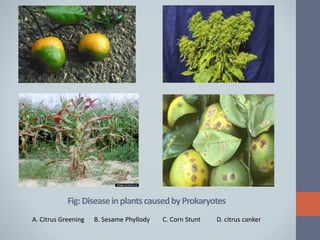
i. True Bacteria (facultative parasite e.g Citrus Canker
ii. Rickrttsia-like bacteria (RLB) e.g Citrus Greening
iii. Mollicutes or wall less prokaryotes
iv. Mycoplasma –like organisms(MLO) e.g Seasme phyllody
v. Spiroplasma e.g Corn stunt
Fig:DiseaseinplantscausedbyProkaryotes
A. Citrus Greening B. Sesame Phyllody C. Corn Stunt D. citrus canker
Biotic Agents
• Eukaryotes include following organisms.
a) Protists (Unicellular, or multicellular with no tissue
differentiation)
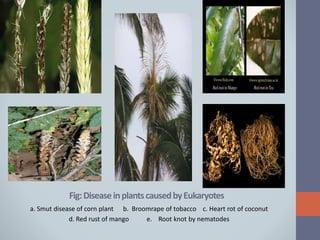
i. Fungi e.g Smut disease of wheat
ii. Protozoa e.g Heart rot of coconut
iii. Algae e.g red rust of mango
b) Plants – Phanerogamic parasite e.g Broomrape of
tobacco
c) Animals – Nematodes cause Root k not nematodes
disease
Fig:DiseaseinplantscausedbyEukaryotes
a. Smut disease of corn plant b. Broomrape of tobacco c. Heart rot of coconut
d. Red rust of mango e. Root knot by nematodes
Mesobiotic Agents
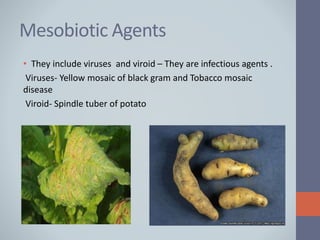
• They include viruses and viroid – They are infectious agents .
Viruses- Yellow mosaic of black gram and Tobacco mosaic
disease
Viroid- Spindle tuber of potato
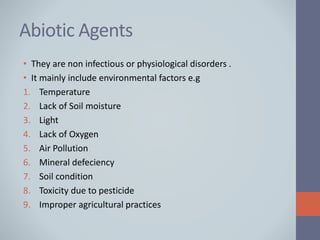
Abiotic Agents
• They are non infectious or physiological disorders .
• It mainly include environmental factors e.g
1. Temperature
2. Lack of Soil moisture
3. Light
4. Lack of Oxygen
5. Air Pollution
6. Mineral defeciency
7. Soil condition
8. Toxicity due to pesticide
9. Improper agricultural practices
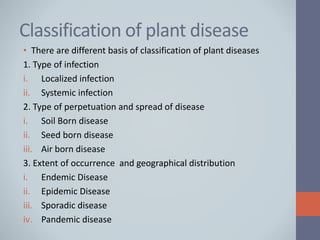
Classification of plant disease
• There are different basis of classification of plant diseases
1. Type of infection
i. Localized infection
ii. Systemic infection
2. Type of perpetuation and spread of disease
i. Soil Born disease
ii. Seed born disease
iii. Air born disease
3. Extent of occurrence and geographical distribution
i. Endemic Disease
ii. Epidemic Disease
iii. Sporadic disease
iv. Pandemic disease
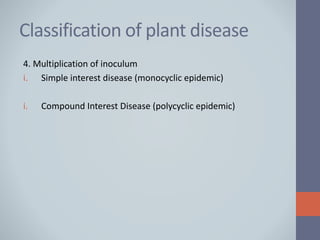
Classification of plant disease
4. Multiplication of inoculum
i. Simple interest disease (monocyclic epidemic)
i. Compound Interest Disease (polycyclic epidemic)
Thanks

Plant pathology (lecture 1)

  • 1.
  • 2.
    Points to discuss… • Introduction-Definition • Objectives of plant pathology • Plant disease and history of plant disease study • Plant Pathogens and its Types • Classification of plant disease
  • 3.
    Introduction • Pathology wordderive from Greek word “Pathos” meaning ailment or disease and “logos” means study. So Plant Pathology is “Study of Plant disease”. DEFINITION: “Plant pathology is branch of botany, life science or agriculture which deals with the cause, etiology resulting in losses and management methods of plant disease”
  • 4.
    Objectives of plantPathology • To study causes of plant disease or disorders • To study mechanism of development of disease • To study plant Host interaction in relation to enviornment • To develop methods of management of plant diseases.
  • 5.
    Plant Disease andhistory of plant Disease • The term Plant disease signifies the condition of plant due to disease or cause of disease • A plant is said to be “diseased” when there is a harmful deviation from normal functioning of physiological process (FBPP-1973) • Disease is malfunctioning processt hat is caused by continuous irritation, which result in some suffering producing symptoms.(APS &BMS)
  • 6.
    Plant Disease andhistory of plant Disease cont.… • Ancient religious literature gives a lot of information about history of plant disease • The Greek philosopher , Theophrastus(370-286 B.C) was the first to study and write about the disease of trees , cereals and legumes in his book ‘ Inquiry into plants’. • History of plant pathology by several aspect related to the history of Mycology, plant Bacteriology, Plant Virology , phytoplasma and Spiro plasma .
  • 7.
    Plant pathogens andits types • Plant diseases are classified on basis of plant pathogens. • Plant Pathogens are agents which cause diseases in plants , e.g fungi, Bacteria, protozoa etc. Plant pathogens are of three basic types A. Biotic Agents B. Mesobiotic Agents C. A Biotic agents
  • 8.
    Biotic Agents • Bioticagents include all living agents causes disease in plants. On Basis of their cell organization they are of two types. 1. Prokaryotes 2. Eukaryotes Prokaryotes include following categories of organism cause disease in plants i. True Bacteria (facultative parasite e.g Citrus Canker ii. Rickrttsia-like bacteria (RLB) e.g Citrus Greening iii. Mollicutes or wall less prokaryotes iv. Mycoplasma –like organisms(MLO) e.g Seasme phyllody v. Spiroplasma e.g Corn stunt
  • 9.
    Fig:DiseaseinplantscausedbyProkaryotes A. Citrus GreeningB. Sesame Phyllody C. Corn Stunt D. citrus canker
  • 10.
    Biotic Agents • Eukaryotesinclude following organisms. a) Protists (Unicellular, or multicellular with no tissue differentiation) i. Fungi e.g Smut disease of wheat ii. Protozoa e.g Heart rot of coconut iii. Algae e.g red rust of mango b) Plants – Phanerogamic parasite e.g Broomrape of tobacco c) Animals – Nematodes cause Root k not nematodes disease
  • 11.
    Fig:DiseaseinplantscausedbyEukaryotes a. Smut diseaseof corn plant b. Broomrape of tobacco c. Heart rot of coconut d. Red rust of mango e. Root knot by nematodes
  • 12.
    Mesobiotic Agents • Theyinclude viruses and viroid – They are infectious agents . Viruses- Yellow mosaic of black gram and Tobacco mosaic disease Viroid- Spindle tuber of potato
  • 13.
    Abiotic Agents • Theyare non infectious or physiological disorders . • It mainly include environmental factors e.g 1. Temperature 2. Lack of Soil moisture 3. Light 4. Lack of Oxygen 5. Air Pollution 6. Mineral defeciency 7. Soil condition 8. Toxicity due to pesticide 9. Improper agricultural practices
  • 14.
    Classification of plantdisease • There are different basis of classification of plant diseases 1. Type of infection i. Localized infection ii. Systemic infection 2. Type of perpetuation and spread of disease i. Soil Born disease ii. Seed born disease iii. Air born disease 3. Extent of occurrence and geographical distribution i. Endemic Disease ii. Epidemic Disease iii. Sporadic disease iv. Pandemic disease
  • 15.
    Classification of plantdisease 4. Multiplication of inoculum i. Simple interest disease (monocyclic epidemic) i. Compound Interest Disease (polycyclic epidemic)
  • 16.