Classification of Plant
Diseases and Plant
Pathogens
HPP-5121 3(2+1)
Fundamentals of Plant Pathology
Classification of Plant Diseases
• Based on plant part affected.
• Based on perpetuation and spread
• Based on the signs and symptoms produced
by the pathogens
• Based on the host plants affected
• Based on major Causes
• Based on Infection Process
• Based on pathogen generation
Based on plant part affected
• Localized: if they affect only specific organs or
parts of the plants.
• Systemic, if entire plant is affected. or
They can be classified as root diseases, stem
diseases, foliage/foliar diseases, etc.
Based on perpetuation and spread
• Soil borne -when the pathogen perpetuates
through the agency of soil.
• Seed borne -when the pathogen perpetuates
through seed (or any propagation material).
• Air borne -when they are disseminated by
wind e.g. rusts and powdery mildews.
Based on the signs and symptoms
produced by the pathogens
• Diseases are classified as rusts, smuts,
powdery mildews, downy mildews, root rots,
wilts, blights, cankers, fruit rots, leaf spots,
etc.
• In all these examples, the disease are named
after the most conspicuous symptom of the
disease appearing on the host surface.
Based on the host plants affected
• They can be classified as: cereal crop diseases,
forage crop diseases, flax diseases, millet
diseases, plantation crop diseases, fruit crop
diseases, vegetable crop diseases, flowering
plant diseases, etc.
• Cereal
• Vegetable
• Fruit
• Forest
• ornamental
Based on major Causes
They can be classified as
• fungal diseases,
• bacterial diseases,
• viral diseases,
• Mycoplasmal diseases, etc.
Based on Infection Process
• Infectious -All the diseases caused by animate causes, viruses
and viroids can be transmitted from infected host plants to
the healthy plants and are called infectious.
• Non-infectious- Non-infectious diseases can not be
transmitted to a healthy plant.
Also referred as non-parasitic disorders or simply
physiological disorders, and are incited by abiotic or inanimate
causes like nutrient deficiency or excess or unfavorable
weather conditions of soil and air or injurious mechanical
influences.
Classification of Animate Diseases
in Relation to Their Occurrence
• Endemic diseases -which are more or less constantly present
from year to year in an moderate to severe form in a
particular geographical region, i.e. country, district or location.
• Epidemic or epiphytotic diseases -which occur widely but
periodically particularly in a severe form. They might be
occurring in the locality every year but assume severe form
only on occasions due to the favourable environmental
conditions occurring in some years.
• Sporadic diseases occur at irregular intervals and
locations and in relatively few instances.
• Pandemic diseases: A disease may be endemic in
one region and epidemic in another.
• When epiphytotics become prevalent through out a
country, continent or the world, the disease may be
termed as pandemic.
Based on pathogen generation
• Simple interest/monocyclic disease
The increase of these disease is analogous of
increase in money due to simple interest i. e. those
disease which complete only one life cycle in one
cropping season. e.g. loose smut of wheat, wilt of
tomato.
• Compound interest disease/polycyclic disease
diseases which have more than one generation in
one cropping season. e.g. late blight of potato
• Polyetic disease
these are also polycyclic diseases but they
complete their disease cycle in more than one
year over years e.g. cedar rust of apple
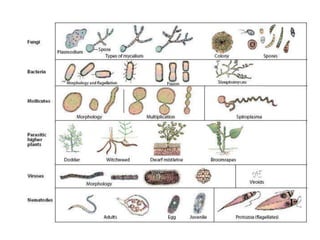
Plant Pathogens
WHAT IS PATHOGEN?
Pathogen:
• Any entity that can cause disease in a host
eg. Fungus, Bacteria, virus, Phytoplasma, Viroids,
RLO’s, Parasitic Plants, Nematodes
Parasite
• An organism that lives on or in another organism and
obtains food from the second organism
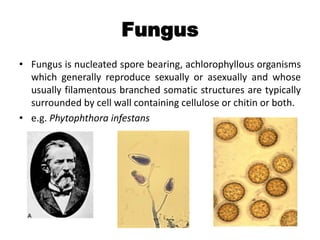
Fungus
• Fungus is nucleated spore bearing, achlorophyllous organisms
which generally reproduce sexually or asexually and whose
usually filamentous branched somatic structures are typically
surrounded by cell wall containing cellulose or chitin or both.
• e.g. Phytophthora infestans
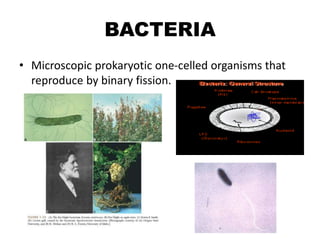
BACTERIA
• Microscopic prokaryotic one-celled organisms that
reproduce by binary fission.
VIRUSES
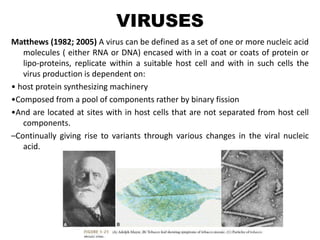
Matthews (1982; 2005) A virus can be defined as a set of one or more nucleic acid
molecules ( either RNA or DNA) encased with in a coat or coats of protein or
lipo-proteins, replicate within a suitable host cell and with in such cells the
virus production is dependent on:
• host protein synthesizing machinery
•Composed from a pool of components rather by binary fission
•And are located at sites with in host cells that are not separated from host cell
components.
–Continually giving rise to variants through various changes in the viral nucleic
acid.
Viroids
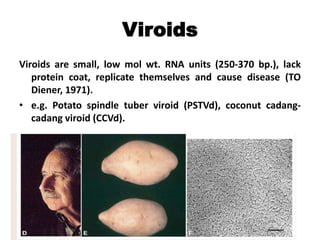
Viroids are small, low mol wt. RNA units (250-370 bp.), lack
protein coat, replicate themselves and cause disease (TO
Diener, 1971).
• e.g. Potato spindle tuber viroid (PSTVd), coconut cadang-
cadang viroid (CCVd).
MYCOPLASMA (PHYTOPLSMA): (DOI
ET AL., 1970)
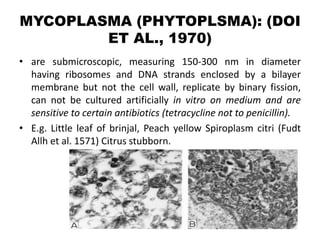
• are submicroscopic, measuring 150-300 nm in diameter
having ribosomes and DNA strands enclosed by a bilayer
membrane but not the cell wall, replicate by binary fission,
can not be cultured artificially in vitro on medium and are
sensitive to certain antibiotics (tetracycline not to penicillin).
• E.g. Little leaf of brinjal, Peach yellow Spiroplasm citri (Fudt
Allh et al. 1571) Citrus stubborn.
Virusoids: (Keese & Simon
1986)
• A circular, single stranded voroid like satellite
RNA measuring 300-400 base long,
encapsidated with single stranded linear RNA
( 450 bp) of velvet tobacco mottle virus.
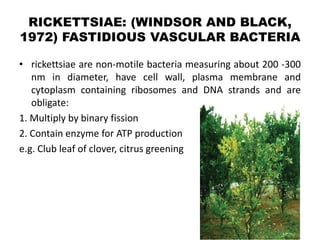
RICKETTSIAE: (WINDSOR AND BLACK,
1972) FASTIDIOUS VASCULAR BACTERIA
• rickettsiae are non-motile bacteria measuring about 200 -300
nm in diameter, have cell wall, plasma membrane and
cytoplasm containing ribosomes and DNA strands and are
obligate:
1. Multiply by binary fission
2. Contain enzyme for ATP production
e.g. Club leaf of clover, citrus greening
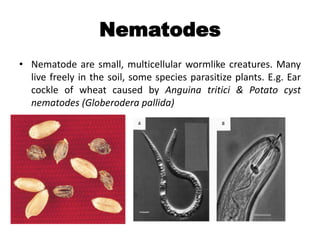
Nematodes
• Nematode are small, multicellular wormlike creatures. Many
live freely in the soil, some species parasitize plants. E.g. Ear
cockle of wheat caused by Anguina tritici & Potato cyst
nematodes (Globerodera pallida)
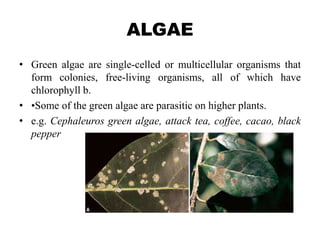
ALGAE
• Green algae are single-celled or multicellular organisms that
form colonies, free-living organisms, all of which have
chlorophyll b.
• •Some of the green algae are parasitic on higher plants.
• e.g. Cephaleuros green algae, attack tea, coffee, cacao, black
pepper
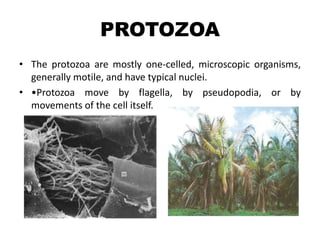
PROTOZOA
• The protozoa are mostly one-celled, microscopic organisms,
generally motile, and have typical nuclei.
• •Protozoa move by flagella, by pseudopodia, or by
movements of the cell itself.
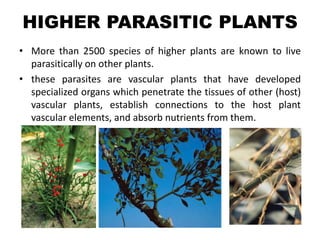
HIGHER PARASITIC PLANTS
• More than 2500 species of higher plants are known to live
parasitically on other plants.
• these parasites are vascular plants that have developed
specialized organs which penetrate the tissues of other (host)
vascular plants, establish connections to the host plant
vascular elements, and absorb nutrients from them.
Infectious disease agents are called pathogens.
Pathogens can be classified as :
Obligate parasites
Biotrophs,
Facultative Parasites
Facultative Saprophytes
Necrotrophs
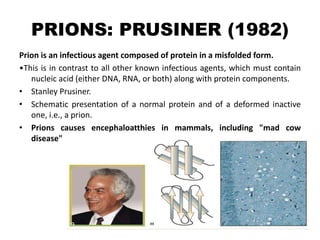
PRIONS: PRUSINER (1982)
Prion is an infectious agent composed of protein in a misfolded form.
•This is in contrast to all other known infectious agents, which must contain
nucleic acid (either DNA, RNA, or both) along with protein components.
• Stanley Prusiner.
• Schematic presentation of a normal protein and of a deformed inactive
one, i.e., a prion.
• Prions causes encephaloatthies in mammals, including "mad cow
disease"
PROOF OF PATHOGENECITY
KOCH’S POSTULATES
• Pathogen must ALWAYS be associated with disease in ALL
diseased plants.
• •Pathogen must be isolated and established in PURE culture.
• •Inoculation of a healthy plant of the same variety must
reproduce EXACTLY the same symptom(s).
• •Pathogen must be re-isolated from inoculated plant and its
identity confirmed as the same as the original isolate.
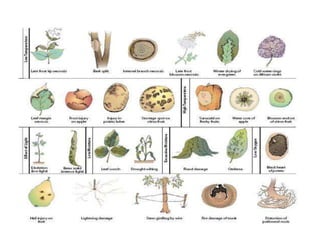
DISORDER
Abnormalities in plants caused by abiotic or
noninfectious agents are termed as disorders
•Unfavourable environmental conditions
•High or low temperature
•Moisture stress or excess
•Hail injury
•Nutritional deficiencies
•Nitrogen deficiency
•Zn deficiency
•Soil conditions
•Air pollution
classificationofplantdisease-200509093109.pdf

classificationofplantdisease-200509093109.pdf

  • 1.
    Classification of Plant Diseasesand Plant Pathogens HPP-5121 3(2+1) Fundamentals of Plant Pathology
  • 2.
    Classification of PlantDiseases • Based on plant part affected. • Based on perpetuation and spread • Based on the signs and symptoms produced by the pathogens • Based on the host plants affected • Based on major Causes • Based on Infection Process • Based on pathogen generation
  • 3.
    Based on plantpart affected • Localized: if they affect only specific organs or parts of the plants. • Systemic, if entire plant is affected. or They can be classified as root diseases, stem diseases, foliage/foliar diseases, etc.
  • 4.
    Based on perpetuationand spread • Soil borne -when the pathogen perpetuates through the agency of soil. • Seed borne -when the pathogen perpetuates through seed (or any propagation material). • Air borne -when they are disseminated by wind e.g. rusts and powdery mildews.
  • 5.
    Based on thesigns and symptoms produced by the pathogens • Diseases are classified as rusts, smuts, powdery mildews, downy mildews, root rots, wilts, blights, cankers, fruit rots, leaf spots, etc. • In all these examples, the disease are named after the most conspicuous symptom of the disease appearing on the host surface.
  • 6.
    Based on thehost plants affected • They can be classified as: cereal crop diseases, forage crop diseases, flax diseases, millet diseases, plantation crop diseases, fruit crop diseases, vegetable crop diseases, flowering plant diseases, etc. • Cereal • Vegetable • Fruit • Forest • ornamental
  • 7.
    Based on majorCauses They can be classified as • fungal diseases, • bacterial diseases, • viral diseases, • Mycoplasmal diseases, etc.
  • 8.
    Based on InfectionProcess • Infectious -All the diseases caused by animate causes, viruses and viroids can be transmitted from infected host plants to the healthy plants and are called infectious. • Non-infectious- Non-infectious diseases can not be transmitted to a healthy plant. Also referred as non-parasitic disorders or simply physiological disorders, and are incited by abiotic or inanimate causes like nutrient deficiency or excess or unfavorable weather conditions of soil and air or injurious mechanical influences.
  • 9.
    Classification of AnimateDiseases in Relation to Their Occurrence • Endemic diseases -which are more or less constantly present from year to year in an moderate to severe form in a particular geographical region, i.e. country, district or location. • Epidemic or epiphytotic diseases -which occur widely but periodically particularly in a severe form. They might be occurring in the locality every year but assume severe form only on occasions due to the favourable environmental conditions occurring in some years.
  • 10.
    • Sporadic diseasesoccur at irregular intervals and locations and in relatively few instances. • Pandemic diseases: A disease may be endemic in one region and epidemic in another. • When epiphytotics become prevalent through out a country, continent or the world, the disease may be termed as pandemic.
  • 11.
    Based on pathogengeneration • Simple interest/monocyclic disease The increase of these disease is analogous of increase in money due to simple interest i. e. those disease which complete only one life cycle in one cropping season. e.g. loose smut of wheat, wilt of tomato. • Compound interest disease/polycyclic disease diseases which have more than one generation in one cropping season. e.g. late blight of potato
  • 12.
    • Polyetic disease theseare also polycyclic diseases but they complete their disease cycle in more than one year over years e.g. cedar rust of apple
  • 13.
  • 14.
    WHAT IS PATHOGEN? Pathogen: •Any entity that can cause disease in a host eg. Fungus, Bacteria, virus, Phytoplasma, Viroids, RLO’s, Parasitic Plants, Nematodes Parasite • An organism that lives on or in another organism and obtains food from the second organism
  • 15.
    Fungus • Fungus isnucleated spore bearing, achlorophyllous organisms which generally reproduce sexually or asexually and whose usually filamentous branched somatic structures are typically surrounded by cell wall containing cellulose or chitin or both. • e.g. Phytophthora infestans
  • 16.
    BACTERIA • Microscopic prokaryoticone-celled organisms that reproduce by binary fission.
  • 17.
    VIRUSES Matthews (1982; 2005)A virus can be defined as a set of one or more nucleic acid molecules ( either RNA or DNA) encased with in a coat or coats of protein or lipo-proteins, replicate within a suitable host cell and with in such cells the virus production is dependent on: • host protein synthesizing machinery •Composed from a pool of components rather by binary fission •And are located at sites with in host cells that are not separated from host cell components. –Continually giving rise to variants through various changes in the viral nucleic acid.
  • 18.
    Viroids Viroids are small,low mol wt. RNA units (250-370 bp.), lack protein coat, replicate themselves and cause disease (TO Diener, 1971). • e.g. Potato spindle tuber viroid (PSTVd), coconut cadang- cadang viroid (CCVd).
  • 19.
    MYCOPLASMA (PHYTOPLSMA): (DOI ETAL., 1970) • are submicroscopic, measuring 150-300 nm in diameter having ribosomes and DNA strands enclosed by a bilayer membrane but not the cell wall, replicate by binary fission, can not be cultured artificially in vitro on medium and are sensitive to certain antibiotics (tetracycline not to penicillin). • E.g. Little leaf of brinjal, Peach yellow Spiroplasm citri (Fudt Allh et al. 1571) Citrus stubborn.
  • 20.
    Virusoids: (Keese &Simon 1986) • A circular, single stranded voroid like satellite RNA measuring 300-400 base long, encapsidated with single stranded linear RNA ( 450 bp) of velvet tobacco mottle virus.
  • 21.
    RICKETTSIAE: (WINDSOR ANDBLACK, 1972) FASTIDIOUS VASCULAR BACTERIA • rickettsiae are non-motile bacteria measuring about 200 -300 nm in diameter, have cell wall, plasma membrane and cytoplasm containing ribosomes and DNA strands and are obligate: 1. Multiply by binary fission 2. Contain enzyme for ATP production e.g. Club leaf of clover, citrus greening
  • 22.
    Nematodes • Nematode aresmall, multicellular wormlike creatures. Many live freely in the soil, some species parasitize plants. E.g. Ear cockle of wheat caused by Anguina tritici & Potato cyst nematodes (Globerodera pallida)
  • 23.
    ALGAE • Green algaeare single-celled or multicellular organisms that form colonies, free-living organisms, all of which have chlorophyll b. • •Some of the green algae are parasitic on higher plants. • e.g. Cephaleuros green algae, attack tea, coffee, cacao, black pepper
  • 24.
    PROTOZOA • The protozoaare mostly one-celled, microscopic organisms, generally motile, and have typical nuclei. • •Protozoa move by flagella, by pseudopodia, or by movements of the cell itself.
  • 25.
    HIGHER PARASITIC PLANTS •More than 2500 species of higher plants are known to live parasitically on other plants. • these parasites are vascular plants that have developed specialized organs which penetrate the tissues of other (host) vascular plants, establish connections to the host plant vascular elements, and absorb nutrients from them.
  • 27.
    Infectious disease agentsare called pathogens. Pathogens can be classified as : Obligate parasites Biotrophs, Facultative Parasites Facultative Saprophytes Necrotrophs
  • 28.
    PRIONS: PRUSINER (1982) Prionis an infectious agent composed of protein in a misfolded form. •This is in contrast to all other known infectious agents, which must contain nucleic acid (either DNA, RNA, or both) along with protein components. • Stanley Prusiner. • Schematic presentation of a normal protein and of a deformed inactive one, i.e., a prion. • Prions causes encephaloatthies in mammals, including "mad cow disease"
  • 29.
    PROOF OF PATHOGENECITY KOCH’SPOSTULATES • Pathogen must ALWAYS be associated with disease in ALL diseased plants. • •Pathogen must be isolated and established in PURE culture. • •Inoculation of a healthy plant of the same variety must reproduce EXACTLY the same symptom(s). • •Pathogen must be re-isolated from inoculated plant and its identity confirmed as the same as the original isolate.
  • 30.
    DISORDER Abnormalities in plantscaused by abiotic or noninfectious agents are termed as disorders •Unfavourable environmental conditions •High or low temperature •Moisture stress or excess •Hail injury •Nutritional deficiencies •Nitrogen deficiency •Zn deficiency •Soil conditions •Air pollution