Plans for Creative Writing Group
Session Plan
The sessions will be between 2-3 hours – the first third of the session being dedicated to teaching and
discussing, the second third being dedicated to writing and bouncing ideas, and the final third being used for
presenting and reviewing the work that has been begun or even completed.
We would like to have a focus group of a maximum of ten people to learn and write with us – being aged
from 16 and above.
The last third of the session can be open to all just to read and present their work – whether they are in the
study group or not.
Lesson Plan
As part of the Creative Writing program, we intend to study different forms of creative written work –
alternating between 5 weeks of story writing and 5 weeks of poetry writing.
Story Writing
Lesson Standard Program Adjustments made for novice to
intermediate/advanced writer
Week 1:
Introduction to
Story Writing
- Introduce ourselves and briefly outline
what we expect peers/students to achieve
by the end of the course.
- Incorporate games and puzzles to get
creative juices flowing, e.g. Finish My
Sentence, etc.
- Handout or display extracts from famous
works of literature and task the
students/peers to rehash or re-write them
in their own style.
-By the end of the session, each
student/peer should be able to create
simple (perhaps even silly) stories from
singular ideas or simple inspiration.
- Intermediate/Advanced writers will be
asked to describe their preferred writing
style and genre (if they have written in the
past), or they will be asked what their
favourite authors/stories are so as to
understand the style which they intend to
mimic.
- Novice writers will be similarly asked
what types of books they enjoy reading,
or – if they aren't avid readers – they
genre of films or video games they enjoy
watching or playing.
Week 2:
Creating Setting and
Scenes
- Begin by introducing popular genres and
sub-genres of standard fiction.
- Discuss which genres some people are
more inclined to and explain why. What
do they read and /or write more of?
- Set a task for students/peers to being
building a setting – use a slideshow to
give examples of settings in various
genres.
- By the end of the session, peers/students
should be able to describe varying
settings in a chosen genre – which should
act as a foundation or base for the story
they intend to write. They will also be
introduced to the next session about
character development, so that they might
- Novice writers will be given an outline a
basic plot structure/purpose – so that they
understand why a story requires a base
before characters and conflict. They will
then be tasked to describe their setting.
-Intermediate/Advanced writers will be
asked to go straight to describing their
setting.
begin working on this.
Week 3:
Creating Characters
- Begin by introducing different types of
basic characters: protagonist/s,
antagonist/s, sidekicks, etc.
- Discuss the basic physical description as
well as the importance of the
psychological make-up of a character.
- Think of a backstory – regardless of
whether it is mentioned in the story – as
this is pertinent to character development!
- By the end of the session, students/peers
will have developed their main characters
and possibly even some minor ones, and
they will have thought about how they fit
into their chosen genre/setting.
Students/peers will also be asked to begin
writing their stories.
- Novice writers may be asked to think
about the different TV shows or films and
their favourite characters within them.
Perhaps they can use those characters as a
base to create their own.
- All students/peers will be asked to think
about how their characters find
themselves in the setting they've already
created. E.g. how would a teenage girl
find herself trapped in a haunted house?
Week 4:
Discussing Conflicts
and Love Interests
- By now, introductions for the stories will
have been written.
- In this session, varying conflicts will be
discussed – the discussion being perhaps
even on an individual level as conflict can
change from genre to genre, e.g. what
kind of conflicts would characters face in
their given setting? In fantasy genre, you
might find there are political conflicts that
don't exist in romance genre.
- Discuss universal conflict, e.g. conflict
between friends and families.
- Discuss internal conflict.
- Discuss the element of romance being
key to all genres of fiction, and also its
relevance and appeal to a greater
audience.
- By the end of the session, students/peers
will be able to create and/or solve major
and minor conflicts that exist in their
fictional world. They will also be
encouraged to continue writing their
stories for the last and final session.
N/A
Week 5:
Read and Review
- In the last and final session of the
course, we would like students/peers to
read out their stories. This will encourage
confidence and will enhance performance
and annunciation. It will also be key in
identifying the difference between an
author reading their own story and the
story being read by a third party.
- Feedback will be given in the form of a
peer-review.
- We do not expect to have completed
stories by the end of this session, but we
N/A
do expect stories to have some form of
development.
-We also have contacts with publishers, so
we may ask them to come in for the
session and listen or give their own
feedback.
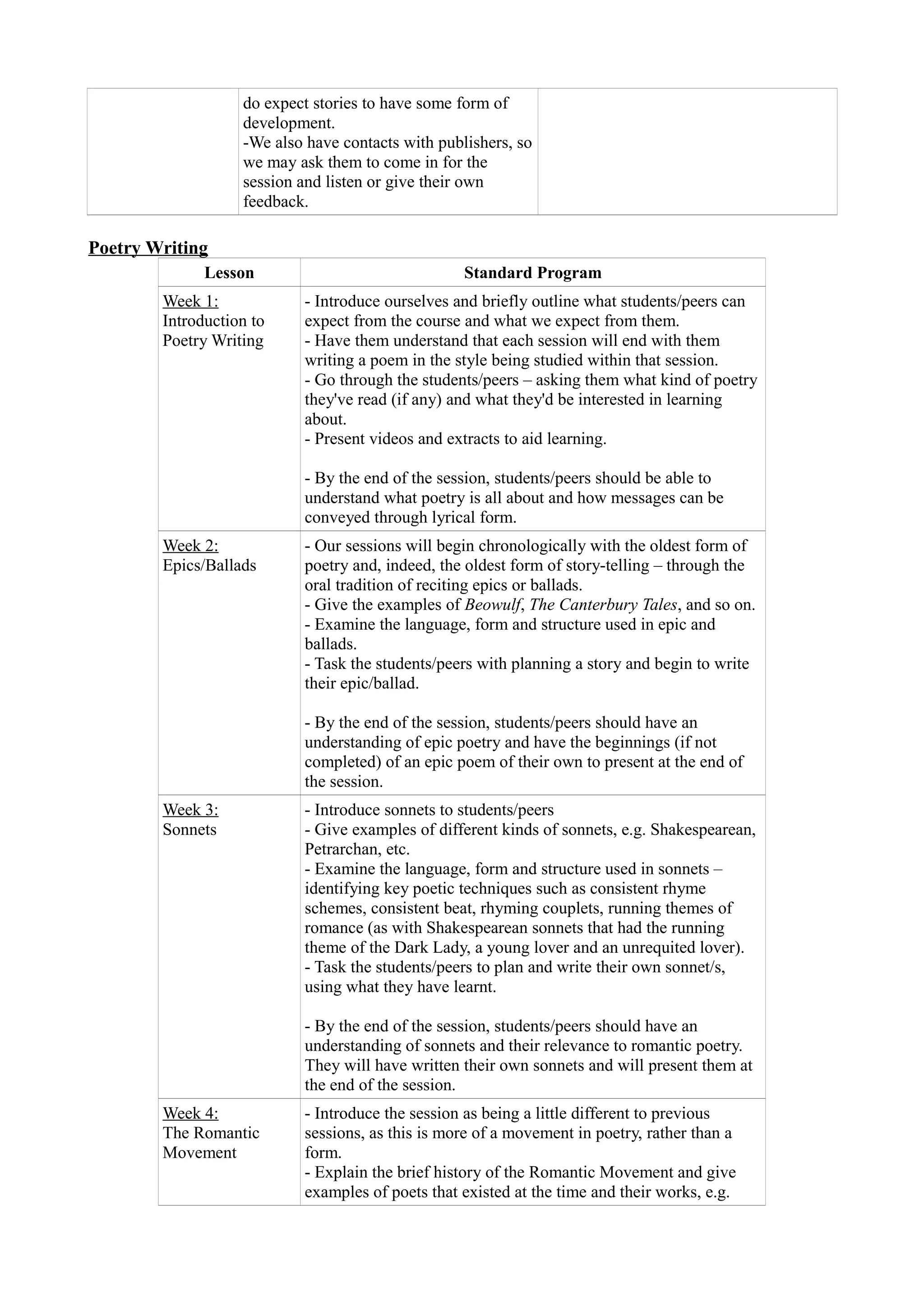
Poetry Writing
Lesson Standard Program
Week 1:
Introduction to
Poetry Writing
- Introduce ourselves and briefly outline what students/peers can
expect from the course and what we expect from them.
- Have them understand that each session will end with them
writing a poem in the style being studied within that session.
- Go through the students/peers – asking them what kind of poetry
they've read (if any) and what they'd be interested in learning
about.
- Present videos and extracts to aid learning.
- By the end of the session, students/peers should be able to
understand what poetry is all about and how messages can be
conveyed through lyrical form.
Week 2:
Epics/Ballads
- Our sessions will begin chronologically with the oldest form of
poetry and, indeed, the oldest form of story-telling – through the
oral tradition of reciting epics or ballads.
- Give the examples of Beowulf, The Canterbury Tales, and so on.
- Examine the language, form and structure used in epic and
ballads.
- Task the students/peers with planning a story and begin to write
their epic/ballad.
- By the end of the session, students/peers should have an
understanding of epic poetry and have the beginnings (if not
completed) of an epic poem of their own to present at the end of
the session.
Week 3:
Sonnets
- Introduce sonnets to students/peers
- Give examples of different kinds of sonnets, e.g. Shakespearean,
Petrarchan, etc.
- Examine the language, form and structure used in sonnets –
identifying key poetic techniques such as consistent rhyme
schemes, consistent beat, rhyming couplets, running themes of
romance (as with Shakespearean sonnets that had the running
theme of the Dark Lady, a young lover and an unrequited lover).
- Task the students/peers to plan and write their own sonnet/s,
using what they have learnt.
- By the end of the session, students/peers should have an
understanding of sonnets and their relevance to romantic poetry.
They will have written their own sonnets and will present them at
the end of the session.
Week 4:
The Romantic
Movement
- Introduce the session as being a little different to previous
sessions, as this is more of a movement in poetry, rather than a
form.
- Explain the brief history of the Romantic Movement and give
examples of poets that existed at the time and their works, e.g.
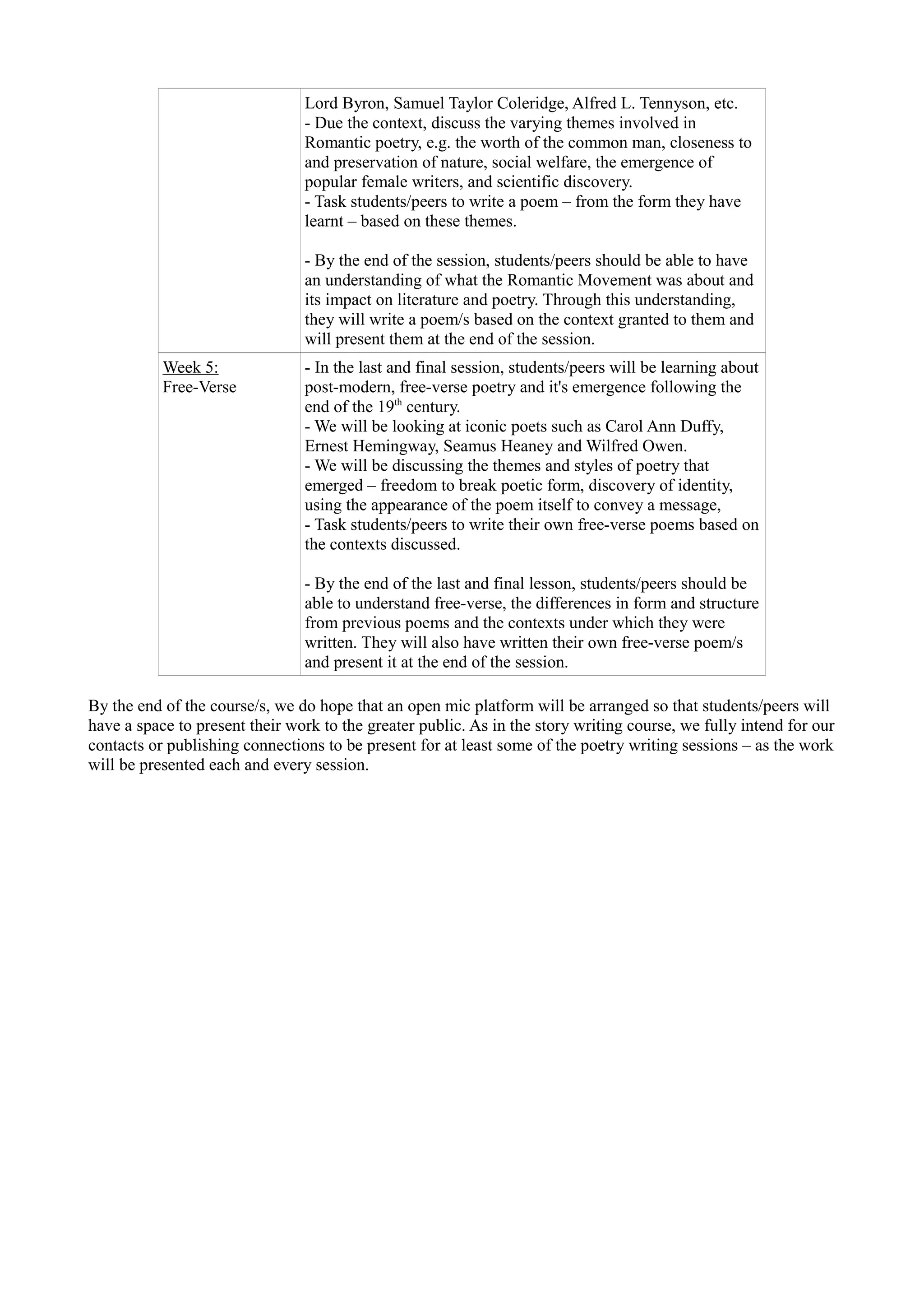
Lord Byron, Samuel Taylor Coleridge, Alfred L. Tennyson, etc.
- Due the context, discuss the varying themes involved in
Romantic poetry, e.g. the worth of the common man, closeness to
and preservation of nature, social welfare, the emergence of
popular female writers, and scientific discovery.
- Task students/peers to write a poem – from the form they have
learnt – based on these themes.
- By the end of the session, students/peers should be able to have
an understanding of what the Romantic Movement was about and
its impact on literature and poetry. Through this understanding,
they will write a poem/s based on the context granted to them and
will present them at the end of the session.
Week 5:
Free-Verse
- In the last and final session, students/peers will be learning about
post-modern, free-verse poetry and it's emergence following the
end of the 19th
century.
- We will be looking at iconic poets such as Carol Ann Duffy,
Ernest Hemingway, Seamus Heaney and Wilfred Owen.
- We will be discussing the themes and styles of poetry that
emerged – freedom to break poetic form, discovery of identity,
using the appearance of the poem itself to convey a message,
- Task students/peers to write their own free-verse poems based on
the contexts discussed.
- By the end of the last and final lesson, students/peers should be
able to understand free-verse, the differences in form and structure
from previous poems and the contexts under which they were
written. They will also have written their own free-verse poem/s
and present it at the end of the session.
By the end of the course/s, we do hope that an open mic platform will be arranged so that students/peers will
have a space to present their work to the greater public. As in the story writing course, we fully intend for our
contacts or publishing connections to be present for at least some of the poetry writing sessions – as the work
will be presented each and every session.

Plans for Creative Writing

  • 1.
    Plans for CreativeWriting Group Session Plan The sessions will be between 2-3 hours – the first third of the session being dedicated to teaching and discussing, the second third being dedicated to writing and bouncing ideas, and the final third being used for presenting and reviewing the work that has been begun or even completed. We would like to have a focus group of a maximum of ten people to learn and write with us – being aged from 16 and above. The last third of the session can be open to all just to read and present their work – whether they are in the study group or not. Lesson Plan As part of the Creative Writing program, we intend to study different forms of creative written work – alternating between 5 weeks of story writing and 5 weeks of poetry writing. Story Writing Lesson Standard Program Adjustments made for novice to intermediate/advanced writer Week 1: Introduction to Story Writing - Introduce ourselves and briefly outline what we expect peers/students to achieve by the end of the course. - Incorporate games and puzzles to get creative juices flowing, e.g. Finish My Sentence, etc. - Handout or display extracts from famous works of literature and task the students/peers to rehash or re-write them in their own style. -By the end of the session, each student/peer should be able to create simple (perhaps even silly) stories from singular ideas or simple inspiration. - Intermediate/Advanced writers will be asked to describe their preferred writing style and genre (if they have written in the past), or they will be asked what their favourite authors/stories are so as to understand the style which they intend to mimic. - Novice writers will be similarly asked what types of books they enjoy reading, or – if they aren't avid readers – they genre of films or video games they enjoy watching or playing. Week 2: Creating Setting and Scenes - Begin by introducing popular genres and sub-genres of standard fiction. - Discuss which genres some people are more inclined to and explain why. What do they read and /or write more of? - Set a task for students/peers to being building a setting – use a slideshow to give examples of settings in various genres. - By the end of the session, peers/students should be able to describe varying settings in a chosen genre – which should act as a foundation or base for the story they intend to write. They will also be introduced to the next session about character development, so that they might - Novice writers will be given an outline a basic plot structure/purpose – so that they understand why a story requires a base before characters and conflict. They will then be tasked to describe their setting. -Intermediate/Advanced writers will be asked to go straight to describing their setting.
  • 2.
    begin working onthis. Week 3: Creating Characters - Begin by introducing different types of basic characters: protagonist/s, antagonist/s, sidekicks, etc. - Discuss the basic physical description as well as the importance of the psychological make-up of a character. - Think of a backstory – regardless of whether it is mentioned in the story – as this is pertinent to character development! - By the end of the session, students/peers will have developed their main characters and possibly even some minor ones, and they will have thought about how they fit into their chosen genre/setting. Students/peers will also be asked to begin writing their stories. - Novice writers may be asked to think about the different TV shows or films and their favourite characters within them. Perhaps they can use those characters as a base to create their own. - All students/peers will be asked to think about how their characters find themselves in the setting they've already created. E.g. how would a teenage girl find herself trapped in a haunted house? Week 4: Discussing Conflicts and Love Interests - By now, introductions for the stories will have been written. - In this session, varying conflicts will be discussed – the discussion being perhaps even on an individual level as conflict can change from genre to genre, e.g. what kind of conflicts would characters face in their given setting? In fantasy genre, you might find there are political conflicts that don't exist in romance genre. - Discuss universal conflict, e.g. conflict between friends and families. - Discuss internal conflict. - Discuss the element of romance being key to all genres of fiction, and also its relevance and appeal to a greater audience. - By the end of the session, students/peers will be able to create and/or solve major and minor conflicts that exist in their fictional world. They will also be encouraged to continue writing their stories for the last and final session. N/A Week 5: Read and Review - In the last and final session of the course, we would like students/peers to read out their stories. This will encourage confidence and will enhance performance and annunciation. It will also be key in identifying the difference between an author reading their own story and the story being read by a third party. - Feedback will be given in the form of a peer-review. - We do not expect to have completed stories by the end of this session, but we N/A
  • 3.
    do expect storiesto have some form of development. -We also have contacts with publishers, so we may ask them to come in for the session and listen or give their own feedback. Poetry Writing Lesson Standard Program Week 1: Introduction to Poetry Writing - Introduce ourselves and briefly outline what students/peers can expect from the course and what we expect from them. - Have them understand that each session will end with them writing a poem in the style being studied within that session. - Go through the students/peers – asking them what kind of poetry they've read (if any) and what they'd be interested in learning about. - Present videos and extracts to aid learning. - By the end of the session, students/peers should be able to understand what poetry is all about and how messages can be conveyed through lyrical form. Week 2: Epics/Ballads - Our sessions will begin chronologically with the oldest form of poetry and, indeed, the oldest form of story-telling – through the oral tradition of reciting epics or ballads. - Give the examples of Beowulf, The Canterbury Tales, and so on. - Examine the language, form and structure used in epic and ballads. - Task the students/peers with planning a story and begin to write their epic/ballad. - By the end of the session, students/peers should have an understanding of epic poetry and have the beginnings (if not completed) of an epic poem of their own to present at the end of the session. Week 3: Sonnets - Introduce sonnets to students/peers - Give examples of different kinds of sonnets, e.g. Shakespearean, Petrarchan, etc. - Examine the language, form and structure used in sonnets – identifying key poetic techniques such as consistent rhyme schemes, consistent beat, rhyming couplets, running themes of romance (as with Shakespearean sonnets that had the running theme of the Dark Lady, a young lover and an unrequited lover). - Task the students/peers to plan and write their own sonnet/s, using what they have learnt. - By the end of the session, students/peers should have an understanding of sonnets and their relevance to romantic poetry. They will have written their own sonnets and will present them at the end of the session. Week 4: The Romantic Movement - Introduce the session as being a little different to previous sessions, as this is more of a movement in poetry, rather than a form. - Explain the brief history of the Romantic Movement and give examples of poets that existed at the time and their works, e.g.
  • 4.
    Lord Byron, SamuelTaylor Coleridge, Alfred L. Tennyson, etc. - Due the context, discuss the varying themes involved in Romantic poetry, e.g. the worth of the common man, closeness to and preservation of nature, social welfare, the emergence of popular female writers, and scientific discovery. - Task students/peers to write a poem – from the form they have learnt – based on these themes. - By the end of the session, students/peers should be able to have an understanding of what the Romantic Movement was about and its impact on literature and poetry. Through this understanding, they will write a poem/s based on the context granted to them and will present them at the end of the session. Week 5: Free-Verse - In the last and final session, students/peers will be learning about post-modern, free-verse poetry and it's emergence following the end of the 19th century. - We will be looking at iconic poets such as Carol Ann Duffy, Ernest Hemingway, Seamus Heaney and Wilfred Owen. - We will be discussing the themes and styles of poetry that emerged – freedom to break poetic form, discovery of identity, using the appearance of the poem itself to convey a message, - Task students/peers to write their own free-verse poems based on the contexts discussed. - By the end of the last and final lesson, students/peers should be able to understand free-verse, the differences in form and structure from previous poems and the contexts under which they were written. They will also have written their own free-verse poem/s and present it at the end of the session. By the end of the course/s, we do hope that an open mic platform will be arranged so that students/peers will have a space to present their work to the greater public. As in the story writing course, we fully intend for our contacts or publishing connections to be present for at least some of the poetry writing sessions – as the work will be presented each and every session.