Vilnius, 2024
Introduction to Management
2
Management 101
• Understanding the very Concept of management
• Identifying Characteristics of management
• Understanding main Functions of management
Management
• Management is the attainment of organizational goals
in an effective and efficient manner through planning,
organizing, directing and controlling organizational
resources.
• Organizational resources include men (human beings),
money, machines and materials.
Definitions
• Louis E Boone & David L Kurtz- The use of people and
other resources to accomplish objectives.
• Mary Parker Follet- the act of getting things done
through people.
• Frederick Taylor defines Management as the art of
knowing what you want to do in the best and cheapest
way.
Characteristics
• Management is a distinct process.
• Management is an organized activity
• Management aims at the accomplishment of
predetermined objectives
• Management is both a science and an art
• Management is a group activity
• Management principles are universal in nature
• Management integrates human and other resources.
Features
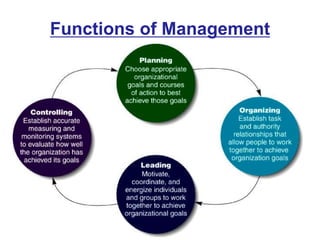
• Management involves four main functions
• These functions are organised to achieve
organisational goals.
• Management involves effective and efficient use of
resources
Functions of Management
• Planning
• Organizing
• Directing (influencing; leading)
• Controlling
Functions of Management
Planning is defined as the process of determining how
the organization can get where it wants to go and what
it will do to accomplish its objectives
More formal approach:
Planning is systematic development of action
programs aimed at reaching agreed-upon
business objectives
Planning
• Planning is determining the objectives and formulating the
methods to achieve them. It is more simply said than
done. A job well planned is half done. During planning one
needs to ask oneself the following:
• What am I trying to accomplish i.e. what is my objective?
• What resources do I have and do I need to accomplish the
same?
• What are the methods and means to achieve the
objectives?
• Is this the optimal path?
Planning
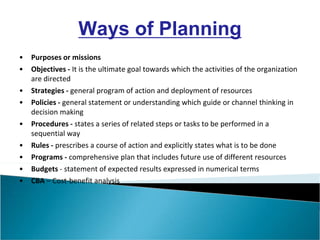
• Purposes or missions
• Objectives - It is the ultimate goal towards which the activities of the organization
are directed
• Strategies - general program of action and deployment of resources
• Policies - general statement or understanding which guide or channel thinking in
decision making
• Procedures - states a series of related steps or tasks to be performed in a
sequential way
• Rules - prescribes a course of action and explicitly states what is to be done
• Programs - comprehensive plan that includes future use of different resources
• Budgets - statement of expected results expressed in numerical terms
• CBA – Cost-benefit analysis
Ways of Planning
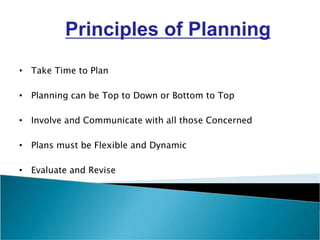
• Take Time to Plan
• Planning can be Top to Down or Bottom to Top
• Involve and Communicate with all those Concerned
• Plans must be Flexible and Dynamic
• Evaluate and Revise
Principles of Planning
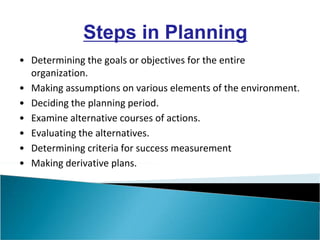
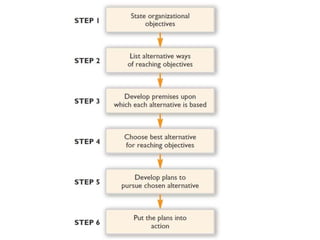
• Determining the goals or objectives for the entire
organization.
• Making assumptions on various elements of the environment.
• Deciding the planning period.
• Examine alternative courses of actions.
• Evaluating the alternatives.
• Determining criteria for success measurement
• Making derivative plans.
Steps in Planning
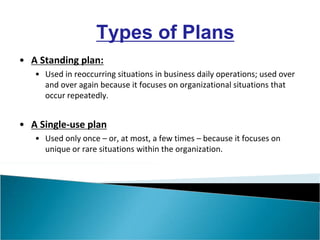
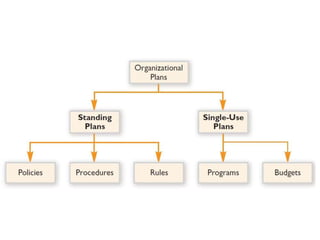
• A Standing plan:
• Used in reoccurring situations in business daily operations; used over
and over again because it focuses on organizational situations that
occur repeatedly.
• A Single-use plan
• Used only once – or, at most, a few times – because it focuses on
unique or rare situations within the organization.
Types of Plans
• Policies
• A policy is a standing plan that furnishes broad guidelines for
taking action consistent with reaching organizational objectives.
• Example: an organizational policy relating to personnel might be
worded as follows: “Our organization will strive to recruit only the
most talented employees.”
• Note: Organizational policies can be both formal and informal;
some parts of it reflects in mission statements.
Standing plans
• Procedures
• A procedure is a standing plan that outlines a series of related
actions that must be taken to accomplish a particular task.
• Basically, it is an operational algorithm for given situations with
varieties of implementation options.
• Example: Apple changed its manufacturing procedures to integrate green
principles into its operations. To eliminate lead in its computer displays, Apple
eliminated cathode-ray tubes from its designs.
• Note: Organizational procedures should always be formal.
Standing plans
• Rules
• A rule is a standing plan that designates specific required action.
In essence, a rule indicates what an organization member
should or should not do and allows no room for interpretation.
• Basically, it is a strict operational algorithm for given situations.
• Example: many companies are now establishing is no smoking.
• Note: Rules should always be formal and strictly followed.
Standing plans
• Programs
• A program is a single-use plan designed to carry out a special project
within an organization.
• The project itself is not intended to remain in existence over the
entire life of the organization.
• Exists to achieve some purpose that, if accomplished, will contribute
to the organization’s long-term success.
• Example: management development program found in many
organizations. This program exists to raise the skill levels of managers in
one or more of the competence areas (technical, conceptual, or human
relations skills)
A Single-use plans
• Budgets
• A financial plan that covers a specified length of time.
• It details spending on labor, raw materials, capital goods, information
systems, marketing, ect.
• Important: budgets also covers how the funds will be obtained.
• Note: budgets are very convenient tools for controlling management, it has
objectively measured result and indicators
A Single-use plans
While planning, a professional Manager has to take into account
these points:
• What needs to be done and how the work should be divided
into separate parts? (if such division is clear before Organizing
process)
• Are separated work parts dependent in production process?
• If so, which parts are simultaneously done, and which are
subsequent?
Important notes in Planning
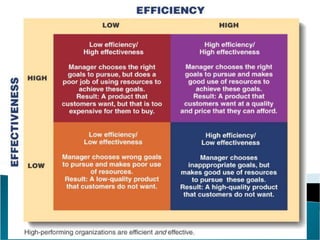
Organizational Performance
• Efficiency
• A measure of how well or how productively
resources are used to achieve a goal
• Effectiveness
• A measure of the appropriateness of the goals an
organization is pursuing and the degree to which
they are achieved.
• Organizing is as important part of management as
planning, just a step ahead in the managing process;
• Task managers perform to create a structure of
working relationships that allow organizational
members to interact and cooperate to achieve
organizational goals
Organizing
• Process involves grouping people into departments according
to the kinds of job-specific tasks they perform
• Managers lay out lines of authority and responsibility
• Decide how to coordinate organizational resources
Process of Organizing
• Determine what is to be done/ Division of Work;
• Assign Tasks: Departmentalization;
• Link Departments: Hierarchy Development;
• Decide how much Authority to Designate/ Authority,
Responsibility and Delegation;
• Decide the Levels at which Decisions are to be made
/Centralization vs. Decentralization;
• Decide how to Achieve Coordination;
Process of Organizing

Planning-Organizing-slideshow-for-lectures.ppt

  • 1.
  • 2.
  • 3.
    Management 101 • Understandingthe very Concept of management • Identifying Characteristics of management • Understanding main Functions of management
  • 4.
    Management • Management isthe attainment of organizational goals in an effective and efficient manner through planning, organizing, directing and controlling organizational resources. • Organizational resources include men (human beings), money, machines and materials.
  • 5.
    Definitions • Louis EBoone & David L Kurtz- The use of people and other resources to accomplish objectives. • Mary Parker Follet- the act of getting things done through people. • Frederick Taylor defines Management as the art of knowing what you want to do in the best and cheapest way.
  • 6.
    Characteristics • Management isa distinct process. • Management is an organized activity • Management aims at the accomplishment of predetermined objectives • Management is both a science and an art • Management is a group activity • Management principles are universal in nature • Management integrates human and other resources.
  • 7.
    Features • Management involvesfour main functions • These functions are organised to achieve organisational goals. • Management involves effective and efficient use of resources
  • 8.
  • 9.
    Functions of Management •Planning • Organizing • Directing (influencing; leading) • Controlling
  • 10.
  • 11.
    Planning is definedas the process of determining how the organization can get where it wants to go and what it will do to accomplish its objectives More formal approach: Planning is systematic development of action programs aimed at reaching agreed-upon business objectives Planning
  • 12.
    • Planning isdetermining the objectives and formulating the methods to achieve them. It is more simply said than done. A job well planned is half done. During planning one needs to ask oneself the following: • What am I trying to accomplish i.e. what is my objective? • What resources do I have and do I need to accomplish the same? • What are the methods and means to achieve the objectives? • Is this the optimal path? Planning
  • 13.
    • Purposes ormissions • Objectives - It is the ultimate goal towards which the activities of the organization are directed • Strategies - general program of action and deployment of resources • Policies - general statement or understanding which guide or channel thinking in decision making • Procedures - states a series of related steps or tasks to be performed in a sequential way • Rules - prescribes a course of action and explicitly states what is to be done • Programs - comprehensive plan that includes future use of different resources • Budgets - statement of expected results expressed in numerical terms • CBA – Cost-benefit analysis Ways of Planning
  • 14.
    • Take Timeto Plan • Planning can be Top to Down or Bottom to Top • Involve and Communicate with all those Concerned • Plans must be Flexible and Dynamic • Evaluate and Revise Principles of Planning
  • 15.
    • Determining thegoals or objectives for the entire organization. • Making assumptions on various elements of the environment. • Deciding the planning period. • Examine alternative courses of actions. • Evaluating the alternatives. • Determining criteria for success measurement • Making derivative plans. Steps in Planning
  • 16.
    • A Standingplan: • Used in reoccurring situations in business daily operations; used over and over again because it focuses on organizational situations that occur repeatedly. • A Single-use plan • Used only once – or, at most, a few times – because it focuses on unique or rare situations within the organization. Types of Plans
  • 18.
    • Policies • Apolicy is a standing plan that furnishes broad guidelines for taking action consistent with reaching organizational objectives. • Example: an organizational policy relating to personnel might be worded as follows: “Our organization will strive to recruit only the most talented employees.” • Note: Organizational policies can be both formal and informal; some parts of it reflects in mission statements. Standing plans
  • 19.
    • Procedures • Aprocedure is a standing plan that outlines a series of related actions that must be taken to accomplish a particular task. • Basically, it is an operational algorithm for given situations with varieties of implementation options. • Example: Apple changed its manufacturing procedures to integrate green principles into its operations. To eliminate lead in its computer displays, Apple eliminated cathode-ray tubes from its designs. • Note: Organizational procedures should always be formal. Standing plans
  • 20.
    • Rules • Arule is a standing plan that designates specific required action. In essence, a rule indicates what an organization member should or should not do and allows no room for interpretation. • Basically, it is a strict operational algorithm for given situations. • Example: many companies are now establishing is no smoking. • Note: Rules should always be formal and strictly followed. Standing plans
  • 21.
    • Programs • Aprogram is a single-use plan designed to carry out a special project within an organization. • The project itself is not intended to remain in existence over the entire life of the organization. • Exists to achieve some purpose that, if accomplished, will contribute to the organization’s long-term success. • Example: management development program found in many organizations. This program exists to raise the skill levels of managers in one or more of the competence areas (technical, conceptual, or human relations skills) A Single-use plans
  • 22.
    • Budgets • Afinancial plan that covers a specified length of time. • It details spending on labor, raw materials, capital goods, information systems, marketing, ect. • Important: budgets also covers how the funds will be obtained. • Note: budgets are very convenient tools for controlling management, it has objectively measured result and indicators A Single-use plans
  • 24.
    While planning, aprofessional Manager has to take into account these points: • What needs to be done and how the work should be divided into separate parts? (if such division is clear before Organizing process) • Are separated work parts dependent in production process? • If so, which parts are simultaneously done, and which are subsequent? Important notes in Planning
  • 25.
    Organizational Performance • Efficiency •A measure of how well or how productively resources are used to achieve a goal • Effectiveness • A measure of the appropriateness of the goals an organization is pursuing and the degree to which they are achieved.
  • 27.
    • Organizing isas important part of management as planning, just a step ahead in the managing process; • Task managers perform to create a structure of working relationships that allow organizational members to interact and cooperate to achieve organizational goals Organizing
  • 28.
    • Process involvesgrouping people into departments according to the kinds of job-specific tasks they perform • Managers lay out lines of authority and responsibility • Decide how to coordinate organizational resources Process of Organizing
  • 29.
    • Determine whatis to be done/ Division of Work; • Assign Tasks: Departmentalization; • Link Departments: Hierarchy Development; • Decide how much Authority to Designate/ Authority, Responsibility and Delegation; • Decide the Levels at which Decisions are to be made /Centralization vs. Decentralization; • Decide how to Achieve Coordination; Process of Organizing