Objectives of this project:
• To look on the Solar System.
•The difference and similarities between the outer and
inner planets.
•The position of the sun
Definitions of the Solar System
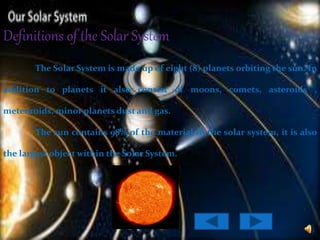
The Solar System is made up of eight (8) planets orbiting the sun. In
addition to planets it also consist of moons, comets, asteroids ,
meteoroids, minor planets dust and gas.
The sun contains 98% of the material in the solar system, it is also
the largest object within the Solar System.
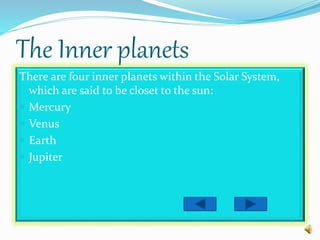
The Inner planets
There are four inner planets within the Solar System,
which are said to be closet to the sun:
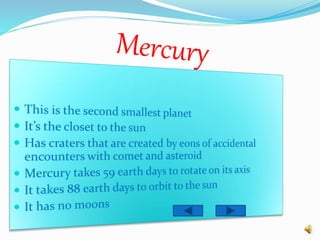
 Mercury
 Venus
 Earth
 Jupiter
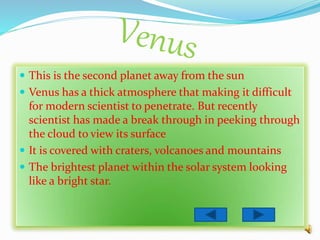
 This is the second planet away from the sun
 Venus has a thick atmosphere that making it difficult
for modern scientist to penetrate. But recently
scientist has made a break through in peeking through
the cloud to view its surface
 It is covered with craters, volcanoes and mountains
 The brightest planet within the solar system looking
like a bright star.
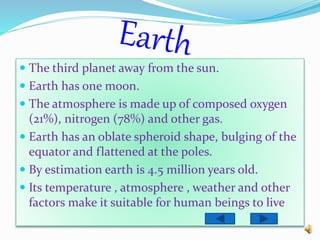
 The third planet away from the sun.
 Earth has one moon.
 The atmosphere is made up of composed oxygen
(21%), nitrogen (78%) and other gas.
 Earth has an oblate spheroid shape, bulging of the
equator and flattened at the poles.
 By estimation earth is 4.5 million years old.
 Its temperature , atmosphere , weather and other
factors make it suitable for human beings to live
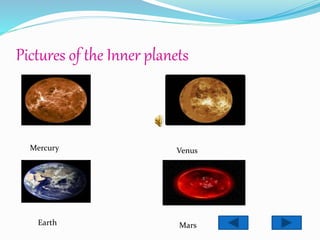
Pictures of the Inner planets
Mercury Venus
Earth Mars
Difference and similarities between
inner and outer planet
Similarities:
1)they are all larger than the earths moon.
2) they are all within a 30 astronomical unit (AU)
radius of the sun.
3) they are positioned between the asteroids belt and
the sun.
Differences between the outer
planets
1)They are further away from the sun, larger in size and lies
outside the asteroids belt. These planets are different in
many ways such as:
2)The inner planets spins very quickly. The different in speed
is so noticeable, for example as if you were in Jupiter your
days would be 9 hours and 55 minutes long, while if u were
in Venus you would have to wait 243 hours for the
equivalent earths day to pass.
3)Spin Speed
4)Sun orbit rate
The Outer planets
Jupiter
Saturn
 The second largest planet.
 Saturn is made up of hydrogen and helium the two(2)
most lightest gas making Saturn the lightest planet.
 Saturn is most known for its rings.
 Has 53 official moon and 9 provisional one.
 It takes 46 earth days for Saturn to orbit around the
sun.
 It has nine (9) band of rings.
Uranus
Neptune
 8th planet from the sun.
 4th largest in diameter.
 Neptune orbit the sun every 165 years.
 It was discovered on September 23,1846 by Johann
Galle and Heinen, D’ Arrest
 Neptune was visited by a spacecraft voyager 2 on
August 25,1989
 Has 13 moon.
 It has six rings that circle the planet.
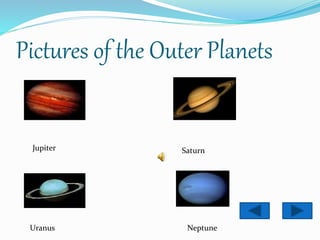
Pictures of the Outer Planets
Jupiter Saturn
Uranus Neptune
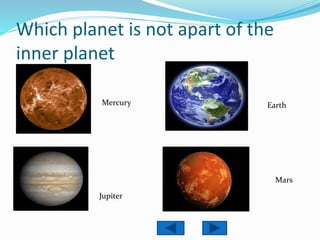
Which planet is not apart of the
inner planet
Mercury
Jupiter
Earth
Mars
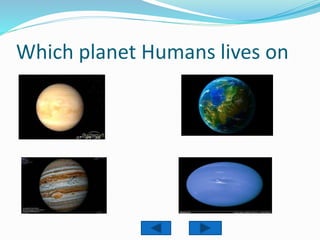
Which planet Humans lives on
The End

Solar system yanique

  • 2.
    Objectives of thisproject: • To look on the Solar System. •The difference and similarities between the outer and inner planets. •The position of the sun
  • 3.
    Definitions of theSolar System The Solar System is made up of eight (8) planets orbiting the sun. In addition to planets it also consist of moons, comets, asteroids , meteoroids, minor planets dust and gas. The sun contains 98% of the material in the solar system, it is also the largest object within the Solar System.
  • 5.
    The Inner planets Thereare four inner planets within the Solar System, which are said to be closet to the sun:  Mercury  Venus  Earth  Jupiter
  • 7.
     This isthe second planet away from the sun  Venus has a thick atmosphere that making it difficult for modern scientist to penetrate. But recently scientist has made a break through in peeking through the cloud to view its surface  It is covered with craters, volcanoes and mountains  The brightest planet within the solar system looking like a bright star.
  • 8.
     The thirdplanet away from the sun.  Earth has one moon.  The atmosphere is made up of composed oxygen (21%), nitrogen (78%) and other gas.  Earth has an oblate spheroid shape, bulging of the equator and flattened at the poles.  By estimation earth is 4.5 million years old.  Its temperature , atmosphere , weather and other factors make it suitable for human beings to live
  • 10.
    Pictures of theInner planets Mercury Venus Earth Mars
  • 11.
    Difference and similaritiesbetween inner and outer planet Similarities: 1)they are all larger than the earths moon. 2) they are all within a 30 astronomical unit (AU) radius of the sun. 3) they are positioned between the asteroids belt and the sun.
  • 12.
    Differences between theouter planets 1)They are further away from the sun, larger in size and lies outside the asteroids belt. These planets are different in many ways such as: 2)The inner planets spins very quickly. The different in speed is so noticeable, for example as if you were in Jupiter your days would be 9 hours and 55 minutes long, while if u were in Venus you would have to wait 243 hours for the equivalent earths day to pass. 3)Spin Speed 4)Sun orbit rate
  • 13.
  • 14.
  • 15.
    Saturn  The secondlargest planet.  Saturn is made up of hydrogen and helium the two(2) most lightest gas making Saturn the lightest planet.  Saturn is most known for its rings.  Has 53 official moon and 9 provisional one.  It takes 46 earth days for Saturn to orbit around the sun.  It has nine (9) band of rings.
  • 16.
  • 17.
    Neptune  8th planetfrom the sun.  4th largest in diameter.  Neptune orbit the sun every 165 years.  It was discovered on September 23,1846 by Johann Galle and Heinen, D’ Arrest  Neptune was visited by a spacecraft voyager 2 on August 25,1989  Has 13 moon.  It has six rings that circle the planet.
  • 18.
    Pictures of theOuter Planets Jupiter Saturn Uranus Neptune
  • 19.
    Which planet isnot apart of the inner planet Mercury Jupiter Earth Mars
  • 20.
  • 23.