Plagiarism & APA Format

           A Brief Tutorial
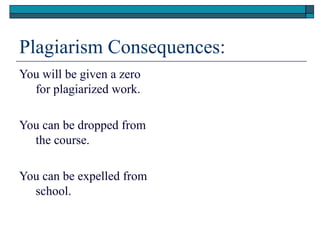
Plagiarism Consequences:
You will be given a zero
  for plagiarized work.

You can be dropped from
  the course.

You can be expelled from
  school.
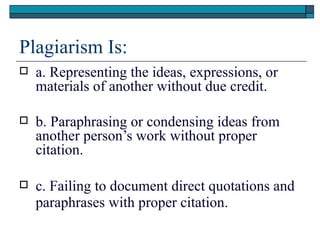
Plagiarism Is:
   a. Representing the ideas, expressions, or
    materials of another without due credit.

   b. Paraphrasing or condensing ideas from
    another person’s work without proper
    citation.

   c. Failing to document direct quotations and
    paraphrases with proper citation.
Sounds scary, doesn’t it?
                     But it doesn’t have to
                      be if you know how to
                      avoid it!

                     And the best way to
                      avoid plagiarism is to
                      give credit where credit
                      is due!
But, how do we give credit where credit is
due?
   Always cite your sources in the body of the
    report.

   Always create a reference page.

   Always use quotation marks when quoting.
Avoid Plagiarism Always:
   To avoid plagiarism, you must cite your
    sources within the body of your paper and
    create a properly formatted reference page.
   Even if you paraphrase from a source, you
    still must cite – you are borrowing someone
    else’s ideas, so you must give him/her credit!
So, how do we do that?
                    By using APA format
                     to add in-text citations
                     and a reference page at
                     the end.
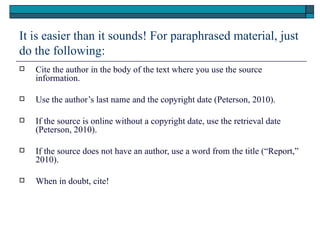
It is easier than it sounds! For paraphrased material, just
do the following:
   Cite the author in the body of the text where you use the source
    information.

   Use the author’s last name and the copyright date (Peterson, 2010).

   If the source is online without a copyright date, use the retrieval date
    (Peterson, 2010).

   If the source does not have an author, use a word from the title (“Report,”
    2010).

   When in doubt, cite!
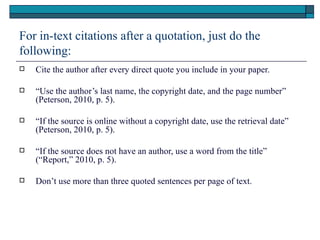
For in-text citations after a quotation, just do the
following:
   Cite the author after every direct quote you include in your paper.

   “Use the author’s last name, the copyright date, and the page number”
    (Peterson, 2010, p. 5).

   “If the source is online without a copyright date, use the retrieval date”
    (Peterson, 2010, p. 5).

   “If the source does not have an author, use a word from the title”
    (“Report,” 2010, p. 5).

   Don’t use more than three quoted sentences per page of text.
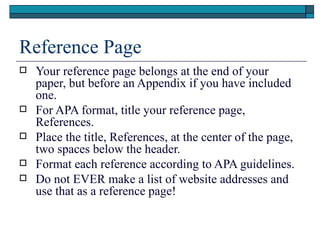
Reference Page
   Your reference page belongs at the end of your
    paper, but before an Appendix if you have included
    one.
   For APA format, title your reference page,
    References.
   Place the title, References, at the center of the page,
    two spaces below the header.
   Format each reference according to APA guidelines.
   Do not EVER make a list of website addresses and
    use that as a reference page!
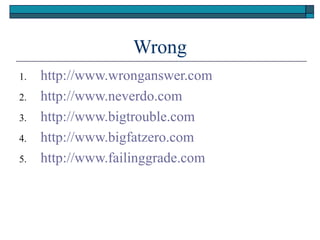
Wrong
1.   http://www.wronganswer.com
2.   http://www.neverdo.com
3.   http://www.bigtrouble.com
4.   http://www.bigfatzero.com
5.   http://www.failinggrade.com
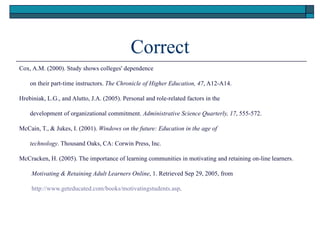
Correct
Cox, A.M. (2000). Study shows colleges' dependence

    on their part-time instructors. The Chronicle of Higher Education, 47, A12-A14.

Hrebiniak, L.G., and Alutto, J.A. (2005). Personal and role-related factors in the

    development of organizational commitment. Administrative Science Quarterly, 17, 555-572.

McCain, T., & Jukes, I. (2001). Windows on the future: Education in the age of

    technology. Thousand Oaks, CA: Corwin Press, Inc.

McCracken, H. (2005). The importance of learning communities in motivating and retaining on-line learners.

     Motivating & Retaining Adult Learners Online, 1. Retrieved Sep 29, 2005, from

     http://www.geteducated.com/books/motivatingstudents.asp.
Was that so hard?
   Just follow those
    simple rules and you
    will never get into any
    trouble!

   And remember, when
    in doubt, cite!

Plagiarism and APA format

  • 1.
    Plagiarism & APAFormat A Brief Tutorial
  • 2.
    Plagiarism Consequences: You willbe given a zero for plagiarized work. You can be dropped from the course. You can be expelled from school.
  • 3.
    Plagiarism Is:  a. Representing the ideas, expressions, or materials of another without due credit.  b. Paraphrasing or condensing ideas from another person’s work without proper citation.  c. Failing to document direct quotations and paraphrases with proper citation.
  • 4.
    Sounds scary, doesn’tit?  But it doesn’t have to be if you know how to avoid it!  And the best way to avoid plagiarism is to give credit where credit is due!
  • 5.
    But, how dowe give credit where credit is due?  Always cite your sources in the body of the report.  Always create a reference page.  Always use quotation marks when quoting.
  • 6.
    Avoid Plagiarism Always:  To avoid plagiarism, you must cite your sources within the body of your paper and create a properly formatted reference page.  Even if you paraphrase from a source, you still must cite – you are borrowing someone else’s ideas, so you must give him/her credit!
  • 7.
    So, how dowe do that?  By using APA format to add in-text citations and a reference page at the end.
  • 8.
    It is easierthan it sounds! For paraphrased material, just do the following:  Cite the author in the body of the text where you use the source information.  Use the author’s last name and the copyright date (Peterson, 2010).  If the source is online without a copyright date, use the retrieval date (Peterson, 2010).  If the source does not have an author, use a word from the title (“Report,” 2010).  When in doubt, cite!
  • 9.
    For in-text citationsafter a quotation, just do the following:  Cite the author after every direct quote you include in your paper.  “Use the author’s last name, the copyright date, and the page number” (Peterson, 2010, p. 5).  “If the source is online without a copyright date, use the retrieval date” (Peterson, 2010, p. 5).  “If the source does not have an author, use a word from the title” (“Report,” 2010, p. 5).  Don’t use more than three quoted sentences per page of text.
  • 10.
    Reference Page  Your reference page belongs at the end of your paper, but before an Appendix if you have included one.  For APA format, title your reference page, References.  Place the title, References, at the center of the page, two spaces below the header.  Format each reference according to APA guidelines.  Do not EVER make a list of website addresses and use that as a reference page!
  • 11.
    Wrong 1. http://www.wronganswer.com 2. http://www.neverdo.com 3. http://www.bigtrouble.com 4. http://www.bigfatzero.com 5. http://www.failinggrade.com
  • 12.
    Correct Cox, A.M. (2000).Study shows colleges' dependence on their part-time instructors. The Chronicle of Higher Education, 47, A12-A14. Hrebiniak, L.G., and Alutto, J.A. (2005). Personal and role-related factors in the development of organizational commitment. Administrative Science Quarterly, 17, 555-572. McCain, T., & Jukes, I. (2001). Windows on the future: Education in the age of technology. Thousand Oaks, CA: Corwin Press, Inc. McCracken, H. (2005). The importance of learning communities in motivating and retaining on-line learners. Motivating & Retaining Adult Learners Online, 1. Retrieved Sep 29, 2005, from http://www.geteducated.com/books/motivatingstudents.asp.
  • 13.
    Was that sohard?  Just follow those simple rules and you will never get into any trouble!  And remember, when in doubt, cite!