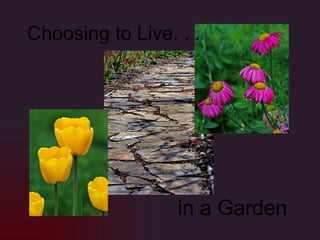
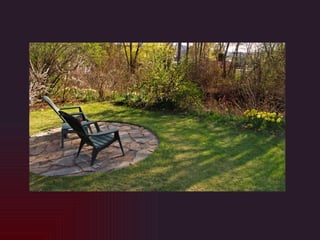











Choosing to Live. . . in a Garden
The Montana Heritage Project Place, Story and Identity All materials related to this presentation are here: http://place-based.wikispaces.com/ Michael L. Umphrey
“ The Heritage Project isn’t a program. It’s the  way I live my life .” Phil Leonardi Corvallis teacher
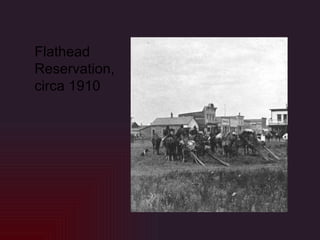
Flathead Reservation, circa 1910
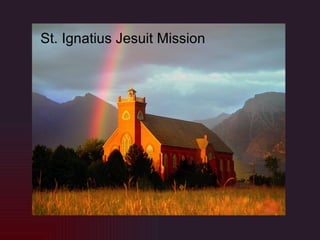
St. Ignatius Jesuit Mission
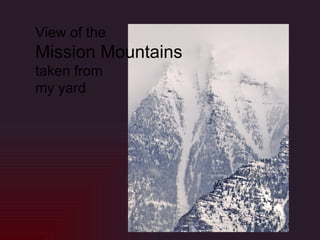
View of the Mission Mountains taken from my yard


Celebrating 10 Years
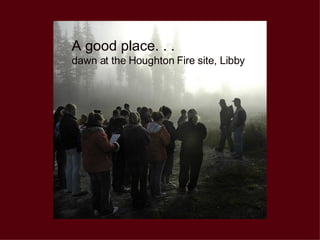
A good place.   . . dawn at the Houghton Fire site, Libby
 
Essential Question: How are we shaped by place?
Are there aspects of your psyche that you think were influenced by the place you grew up? A landscape of vistas or a cityscape of enclosed views? Family gatherings at the ocean or indoors? Occupational culture: surrounded by loggers or lawyers? Religion & Ethnicity: Norwegian Lutherans or Irish Catholics?
Unit Question: How are your students being shaped by the place  they  live?
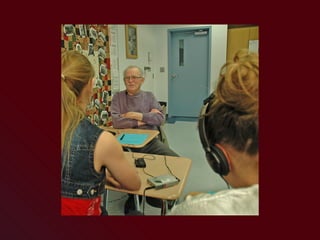
Using Oral History as the main research strategy, how could students begin to form answers to that question? What could they read as preliminary research that brings the issues into clearer view? Who could they interview? What could they ask?
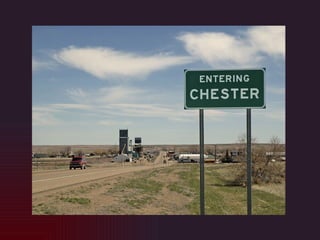
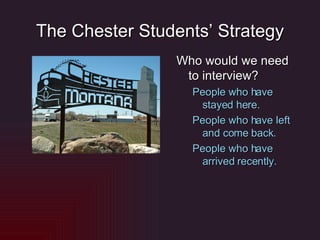
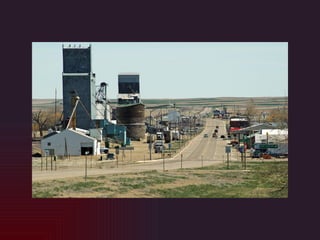
The Chester Students’ Strategy Who would we need to interview? People who have stayed here. People who have left and come back. People who have arrived recently.
Philip Aaberg
Philip Aaberg
 
 
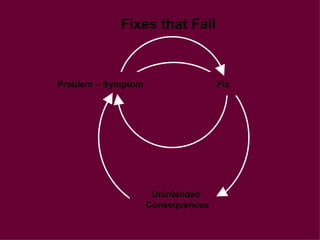
Problem – Symptom  Fix Unintended  Consequences Fixes that Fail


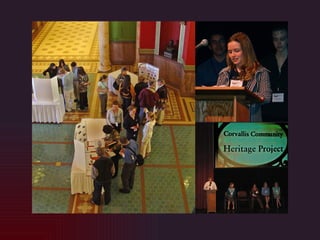
Youth Heritage Festival
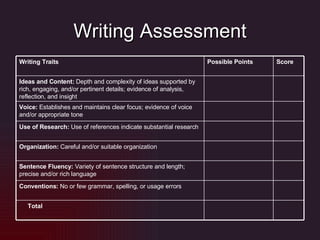
Writing Assessment       Total   Conventions:  No or few grammar, spelling, or usage errors  Sentence Fluency:  Variety of sentence structure and length; precise and/or rich language  Organization:  Careful and/or suitable organization  Use of Research:  Use of references indicate substantial research  Voice:  Establishes and maintains clear focus; evidence of voice and/or appropriate tone  Ideas and Content:  Depth and complexity of ideas supported by rich, engaging, and/or pertinent details; evidence of analysis, reflection, and insight  Score   Possible Points   Writing Traits
Rachel Reckin
 
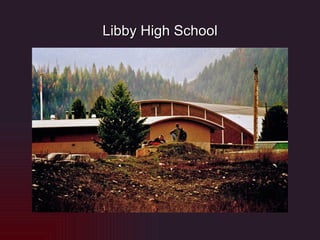
Libby High School
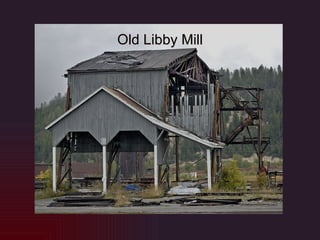
Old Libby Mill
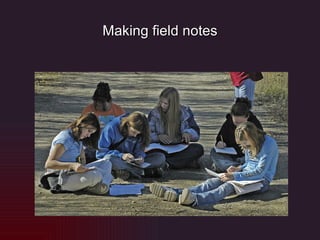
Making field notes
 
 
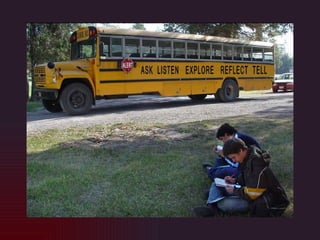
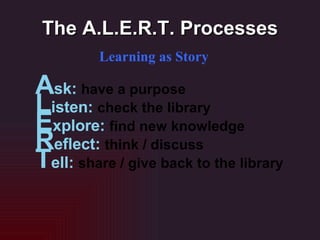
The A.L.E.R.T. Processes A sk:  have a purpose L isten:  check the library E xplore:  find new knowledge R eflect:  think / discuss T ell:  share / give back to the library Learning as Story
Montana Heritage Project Place, Story and Identity Placemaking  You never do just one thing  Identity and the narrative environment  The ALERT Processes: learning as story  Three levels of questions  Misusing essential questions  What is a story?  A story-form outline  Writing for story  Fabulous realities  Cliches and universal truths  The profundity of happy endings
Essential Questions Adapted from  Understanding by Design By  Grant Wiggins And Jay McTighe Association for Supervision and Curriculum Design Copyright  © 1998
Essential Questions Represents a big idea Resides at the heart of the discipline Requires uncoverage Potentially engaging for students
If the textbook is the answer. . . What was the question?
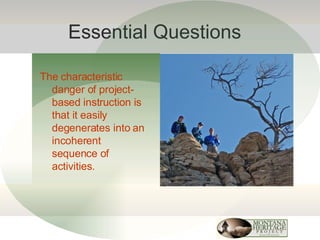
Essential Questions The characteristic danger of project-based instruction is that it easily degenerates into an incoherent sequence of activities.
Essential Questions Questions that “pose dilemmas, subvert obvious or canonical ‘truths’ or force incongruities upon our attention.” Jerome Bruner From whose viewpoint are we seeing this? How do we know when we know? What’s the evidence? How are things, events, or people connected? What is cause and what is effect? What’s new and what’s old. Have we encountered this idea before? So what? Why does it matter? Deborah Meier
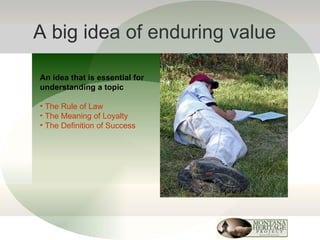
A big idea of enduring value An idea that is essential for understanding a topic The Rule of Law The Meaning of Loyalty The Definition of Success
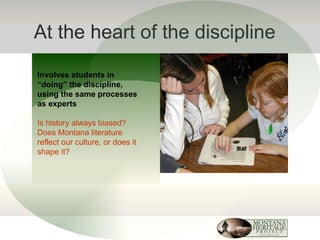
At the heart of the discipline Involves students in “doing” the discipline, using the same processes as experts Is history always biased? Does Montana literature reflect our culture, or does it shape it?
Requires uncoverage Uncover  non-obvious  meanings Question it Prove it Generalize it Connect it Picture it Extend it
Requires uncoverage “ Washington had the daring to put [his Patriots] to good use, too, as he broke the rules of war by ordering a surprise attack on the enemy in its winter quarters”
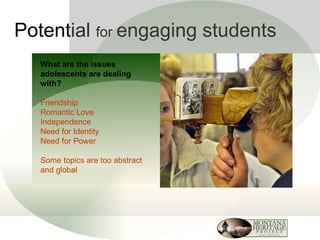
Potential  for  engaging students What are the issues adolescents are dealing with? Friendship Romantic Love Independence Need for Identity Need for Power Some topics are too abstract and global
Unit Questions More topic specific than essential questions: Essential Question : Who is a friend? Unit Questions : In  A Separate Peace , is Gene a friend to Phineas? Is Phineas a friend to Gene?
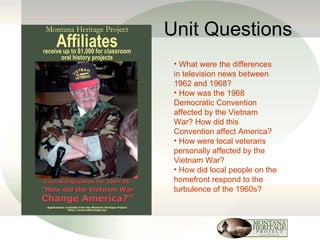
Unit Questions What were the differences in television news between 1962 and 1968? How was the 1968 Democratic Convention affected by the Vietnam War? How did this Convention affect America? How were local veterans personally affected by the Vietnam War? How did local people on the homefront respond to the turbulence of the 1960s?
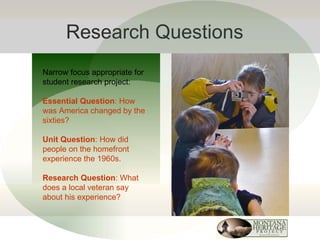
Research Questions Narrow focus appropriate for student research project: Essential Question : How was America changed by the sixties? Unit Question : How did people on the homefront experience the 1960s. Research Question : What does a local veteran say about his experience?
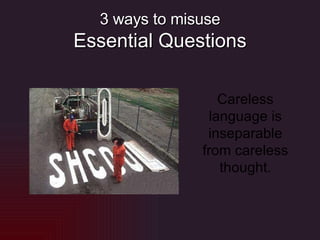
3 ways to misuse Essential Questions Careless language is inseparable from careless thought.
Call every question “essential”
Ask big questions then leave kids on their own
Suggest that having an opinion is what’s important
Writing for Story M ONTANA  H ERITAGE  P ROJECT
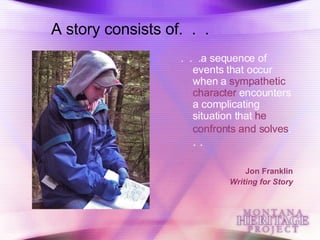
A story consists of.  .  . .  .  .a sequence of events that occur when a  sympathetic character  encounters a complicating situation that  he confronts and solves .  . . Jon Franklin Writing for Story
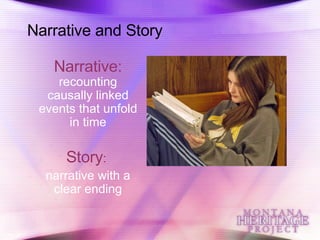
Narrative and Story Narrative:  recounting causally linked events that unfold in time Story :   narrative with a clear ending
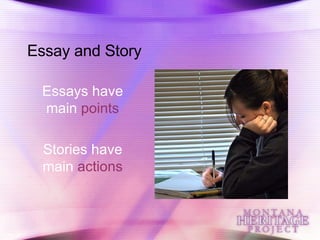
Essay and Story Essays have main  points Stories have main  actions
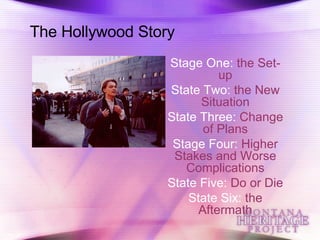
The Hollywood Story Stage One:  the Set-up State Two:  the New Situation State Three:  Change of Plans Stage Four:  Higher Stakes and Worse Complications State Five:  Do or Die State Six:  the Aftermath
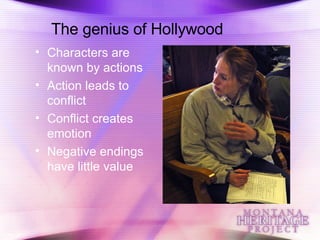
The genius of Hollywood Characters are known by actions Action leads to conflict Conflict creates emotion Negative endings have little value
Montana Heritage Project Place, Story and Identity Placemaking  You never do just one thing  Identity and the narrative environment  The ALERT Processes: learning as story  Three levels of questions  Misusing essential questions  What is a story?  A story-form outline   Writing for story  Fabulous realities  Cliches and universal truths  The profundity of happy endings
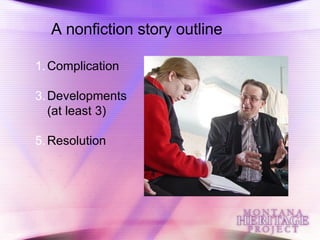
A nonfiction story outline Complication Developments (at least 3) Resolution
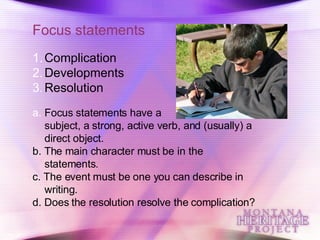
Focus statements Complication Developments Resolution Focus statements have a  subject, a strong, active verb, and (usually) a direct object. b. The main character must be in the statements. c. The event must be one you can describe in writing. d. Does the resolution resolve the complication?
Montana Heritage Project Place, Story and Identity Placemaking  You never do just one thing  Identity and the narrative environment  The ALERT Processes: learning as story  Three levels of questions  Misusing essential questions  What is a story?  A story-form outline   Writing for story  Fabulous realities  Cliches and universal truths  The profundity of happy endings
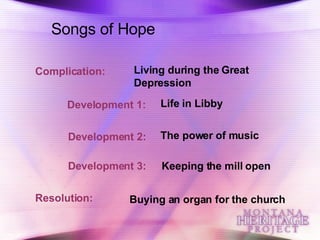
Songs of Hope Complication: Development 1: Development 2: Development 3: Resolution: Living during the Great Depression Life in Libby The power of music Keeping the mill open Buying an organ for the church
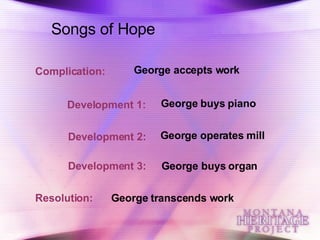
Songs of Hope Complication: Development 1: Development 2: Development 3: Resolution: George accepts work George buys piano George operates mill George buys organ George transcends work
Montana Heritage Project Place, Story and Identity Placemaking  You never do just one thing  Identity and the narrative environment  The ALERT Processes: learning as story  Three levels of questions  Misusing essential questions  What is a story?  A story-form outline  Writing for story  Fabulous realities   Cliches and universal truths  The profundity of happy endings
Finding Stories: Look for fabulous realities "Shams and delusions are esteemed for the soundest truth, while  reality  is  fabulous . We . . . live this mean life . . .because our vision does not penetrate the surface of things.  Thoreau
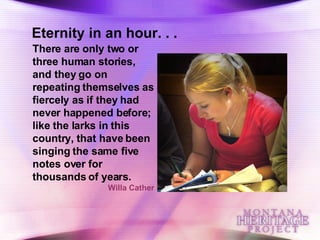
There are only two or three human stories, and they go on repeating themselves as fiercely as if they had never happened before; like the larks in this country, that have been singing the same five notes over for thousands of years.   Willa Cather Eternity in an hour. . .
The resolution is an action by the character He lays the sandwich, the banana and the fig newtons on the table before him, neatly, the way the scrub nurse laid out the instruments. "It was triple jeopardy," he says finally, staring at his peanut butter sandwich the same way he stared at the x-rays. "It was triple jeopardy." It is 1:43, and it's over. Dr. Ducker bites, grimly, into the sandwich. The monster won.
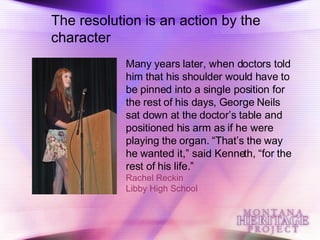
The resolution is an action by the character Many years later, when doctors told him that his shoulder would have to be pinned into a single position for the rest of his days, George Neils sat down at the doctor’s table and positioned his arm as if he were playing the organ. “That’s the way he wanted it,” said Kenneth, “for the rest of his life.” Rachel Reckin Libby High School
Montana Heritage Project Place, Story and Identity Placemaking  You never do just one thing  Identity and the narrative environment  The ALERT Processes: learning as story  Three levels of questions  Misusing essential questions  What is a story?  A story-form outline  Writing for story  Fabulous realities  Cliches and universal truths   The profundity of happy endings
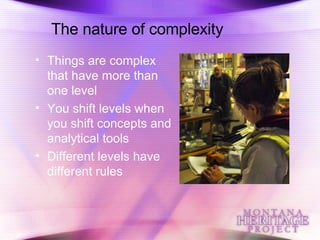
The nature of complexity Things are complex that have more than one level You shift levels when you shift concepts and analytical tools Different levels have different rules
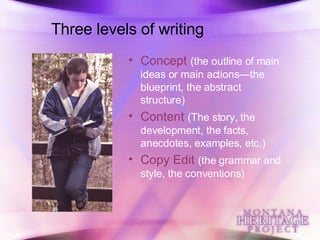
Three levels of writing Concept   (the outline of main ideas or main actions—the blueprint, the abstract structure) Content   (The story, the development, the facts, anecdotes, examples, etc.) Copy Edit   (the grammar and style, the conventions)
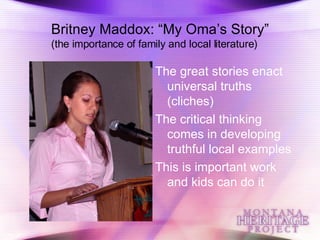
Britney Maddox: “My Oma’s Story” (the importance of family and local literature) The great stories enact universal truths (cliches) The critical thinking comes in developing truthful local examples This is important work and kids can do it
Britney Maddox
Montana Heritage Project Place, Story and Identity Placemaking  You never do just one thing  Identity and the narrative environment  The ALERT Processes: learning as story  Three levels of questions  Misusing essential questions  What is a story?  A story-form outline  Writing for story  Fabulous realities  Cliches and universal truths  The profundity of happy endings
Children learn what they most need to know from happy stories of the birth of kings, and grown-ups learn again and again what they most need to remember from sad stories of the death of kings. The birth of the king is the coming into the world of Justice, and the death of the king is its passing.   In the birth of the king, children recognize the Right, and in his death, grown-ups recognize the Wrong, and, having been children, know where to look for the return of the Right.   Richard Mitchell The Gift of Fire The importance of happy stories
Finding Stories: Look for an ending See the resolution What problem was solved? What actions were taken?
When you can’t find the information Make your quest the story Put background info in the foreground
Chennell Brewer Complication:  Mystery intrigues Chennell Development 1:  Chennell researches sources Development 2:  Community helps Chennell Development 3:  Chennell stymied Resolution:  Chennell continues search
Use background for foreground Ann Wroe’s biography of Pontius Pilate What do we know about Roman prefects from the time? What do we know about the Pontii family? What reasonable speculations can we offer?
Michael L Umphrey http://www.montanaheritageproject.org

Place, Story and Identity

  • 1.
    Choosing to Live.. . in a Garden
  • 2.
    The Montana HeritageProject Place, Story and Identity All materials related to this presentation are here: http://place-based.wikispaces.com/ Michael L. Umphrey
  • 3.
    “ The HeritageProject isn’t a program. It’s the way I live my life .” Phil Leonardi Corvallis teacher
  • 4.
  • 5.
  • 6.
    View of theMission Mountains taken from my yard
  • 7.
  • 8.
  • 9.
  • 10.
  • 11.
  • 12.
  • 13.
  • 14.
  • 15.
  • 16.
  • 17.
  • 18.
  • 19.
  • 20.
  • 21.
  • 22.
  • 23.
    A good place. . . dawn at the Houghton Fire site, Libby
  • 24.
  • 25.
    Essential Question: Howare we shaped by place?
  • 26.
    Are there aspectsof your psyche that you think were influenced by the place you grew up? A landscape of vistas or a cityscape of enclosed views? Family gatherings at the ocean or indoors? Occupational culture: surrounded by loggers or lawyers? Religion & Ethnicity: Norwegian Lutherans or Irish Catholics?
  • 27.
    Are there aspectsof your psyche that you think were influenced by the place you grew up? A landscape of vistas or a cityscape of enclosed views? Family gatherings at the ocean or indoors? Occupational culture: surrounded by loggers or lawyers? Religion & Ethnicity: Norwegian Lutherans or Irish Catholics?
  • 28.
    Are there aspectsof your psyche that you think were influenced by the place you grew up? A landscape of vistas or a cityscape of enclosed views? Family gatherings at the ocean or indoors? Occupational culture: surrounded by loggers or lawyers? Religion & Ethnicity: Norwegian Lutherans or Irish Catholics?
  • 29.
    Are there aspectsof your psyche that you think were influenced by the place you grew up? A landscape of vistas or a cityscape of enclosed views? Family gatherings at the ocean or indoors? Occupational culture: surrounded by loggers or lawyers? Religion & Ethnicity: Norwegian Lutherans or Irish Catholics?
  • 30.
    Are there aspectsof your psyche that you think were influenced by the place you grew up? A landscape of vistas or a cityscape of enclosed views? Family gatherings at the ocean or indoors? Occupational culture: surrounded by loggers or lawyers? Religion & Ethnicity: Norwegian Lutherans or Irish Catholics?
  • 31.
    Unit Question: Howare your students being shaped by the place they live?
  • 32.
    Using Oral Historyas the main research strategy, how could students begin to form answers to that question? What could they read as preliminary research that brings the issues into clearer view? Who could they interview? What could they ask?
  • 33.
    Using Oral Historyas the main research strategy, how could students begin to form answers to that question? What could they read as preliminary research that brings the issues into clearer view? Who could they interview? What could they ask?
  • 34.
    Using Oral Historyas the main research strategy, how could students begin to form answers to that question? What could they read as preliminary research that brings the issues into clearer view? Who could they interview? What could they ask?
  • 35.
    Using Oral Historyas the main research strategy, how could students begin to form answers to that question? What could they read as preliminary research that brings the issues into clearer view? Who could they interview? What could they ask?
  • 36.
    The Chester Students’Strategy Who would we need to interview? People who have stayed here. People who have left and come back. People who have arrived recently.
  • 37.
  • 38.
  • 39.
  • 40.
  • 41.
    Problem – Symptom Fix Unintended Consequences Fixes that Fail
  • 42.
  • 43.
  • 44.
  • 45.
  • 46.
  • 47.
  • 48.
    Writing Assessment      Total Conventions: No or few grammar, spelling, or usage errors Sentence Fluency: Variety of sentence structure and length; precise and/or rich language Organization: Careful and/or suitable organization Use of Research: Use of references indicate substantial research Voice: Establishes and maintains clear focus; evidence of voice and/or appropriate tone Ideas and Content: Depth and complexity of ideas supported by rich, engaging, and/or pertinent details; evidence of analysis, reflection, and insight Score Possible Points Writing Traits
  • 49.
  • 50.
  • 51.
  • 52.
  • 53.
  • 54.
  • 55.
  • 56.
    The A.L.E.R.T. ProcessesA sk: have a purpose L isten: check the library E xplore: find new knowledge R eflect: think / discuss T ell: share / give back to the library Learning as Story
  • 57.
    Montana Heritage ProjectPlace, Story and Identity Placemaking You never do just one thing Identity and the narrative environment The ALERT Processes: learning as story Three levels of questions Misusing essential questions What is a story? A story-form outline Writing for story Fabulous realities Cliches and universal truths The profundity of happy endings
  • 58.
    Essential Questions Adaptedfrom Understanding by Design By Grant Wiggins And Jay McTighe Association for Supervision and Curriculum Design Copyright © 1998
  • 59.
    Essential Questions Representsa big idea Resides at the heart of the discipline Requires uncoverage Potentially engaging for students
  • 60.
    If the textbookis the answer. . . What was the question?
  • 61.
    Essential Questions Thecharacteristic danger of project-based instruction is that it easily degenerates into an incoherent sequence of activities.
  • 62.
    Essential Questions Questionsthat “pose dilemmas, subvert obvious or canonical ‘truths’ or force incongruities upon our attention.” Jerome Bruner From whose viewpoint are we seeing this? How do we know when we know? What’s the evidence? How are things, events, or people connected? What is cause and what is effect? What’s new and what’s old. Have we encountered this idea before? So what? Why does it matter? Deborah Meier
  • 63.
    A big ideaof enduring value An idea that is essential for understanding a topic The Rule of Law The Meaning of Loyalty The Definition of Success
  • 64.
    At the heartof the discipline Involves students in “doing” the discipline, using the same processes as experts Is history always biased? Does Montana literature reflect our culture, or does it shape it?
  • 65.
    Requires uncoverage Uncover non-obvious meanings Question it Prove it Generalize it Connect it Picture it Extend it
  • 66.
    Requires uncoverage “Washington had the daring to put [his Patriots] to good use, too, as he broke the rules of war by ordering a surprise attack on the enemy in its winter quarters”
  • 67.
    Potential for engaging students What are the issues adolescents are dealing with? Friendship Romantic Love Independence Need for Identity Need for Power Some topics are too abstract and global
  • 68.
    Unit Questions Moretopic specific than essential questions: Essential Question : Who is a friend? Unit Questions : In A Separate Peace , is Gene a friend to Phineas? Is Phineas a friend to Gene?
  • 69.
    Unit Questions Whatwere the differences in television news between 1962 and 1968? How was the 1968 Democratic Convention affected by the Vietnam War? How did this Convention affect America? How were local veterans personally affected by the Vietnam War? How did local people on the homefront respond to the turbulence of the 1960s?
  • 70.
    Research Questions Narrowfocus appropriate for student research project: Essential Question : How was America changed by the sixties? Unit Question : How did people on the homefront experience the 1960s. Research Question : What does a local veteran say about his experience?
  • 71.
    3 ways tomisuse Essential Questions Careless language is inseparable from careless thought.
  • 72.
    Call every question“essential”
  • 73.
    Ask big questionsthen leave kids on their own
  • 74.
    Suggest that havingan opinion is what’s important
  • 75.
    Writing for StoryM ONTANA H ERITAGE P ROJECT
  • 76.
    Writing for StoryM ONTANA H ERITAGE P ROJECT
  • 77.
    A story consistsof. . . . . .a sequence of events that occur when a sympathetic character encounters a complicating situation that he confronts and solves . . . Jon Franklin Writing for Story
  • 78.
    Narrative and StoryNarrative: recounting causally linked events that unfold in time Story : narrative with a clear ending
  • 79.
    Essay and StoryEssays have main points Stories have main actions
  • 80.
    The Hollywood StoryStage One: the Set-up State Two: the New Situation State Three: Change of Plans Stage Four: Higher Stakes and Worse Complications State Five: Do or Die State Six: the Aftermath
  • 81.
    The genius ofHollywood Characters are known by actions Action leads to conflict Conflict creates emotion Negative endings have little value
  • 82.
    Montana Heritage ProjectPlace, Story and Identity Placemaking You never do just one thing Identity and the narrative environment The ALERT Processes: learning as story Three levels of questions Misusing essential questions What is a story? A story-form outline Writing for story Fabulous realities Cliches and universal truths The profundity of happy endings
  • 83.
    A nonfiction storyoutline Complication Developments (at least 3) Resolution
  • 84.
    Focus statements ComplicationDevelopments Resolution Focus statements have a subject, a strong, active verb, and (usually) a direct object. b. The main character must be in the statements. c. The event must be one you can describe in writing. d. Does the resolution resolve the complication?
  • 85.
    Montana Heritage ProjectPlace, Story and Identity Placemaking You never do just one thing Identity and the narrative environment The ALERT Processes: learning as story Three levels of questions Misusing essential questions What is a story? A story-form outline Writing for story Fabulous realities Cliches and universal truths The profundity of happy endings
  • 86.
    Songs of HopeComplication: Development 1: Development 2: Development 3: Resolution: Living during the Great Depression Life in Libby The power of music Keeping the mill open Buying an organ for the church
  • 87.
    Songs of HopeComplication: Development 1: Development 2: Development 3: Resolution: George accepts work George buys piano George operates mill George buys organ George transcends work
  • 88.
    Montana Heritage ProjectPlace, Story and Identity Placemaking You never do just one thing Identity and the narrative environment The ALERT Processes: learning as story Three levels of questions Misusing essential questions What is a story? A story-form outline Writing for story Fabulous realities Cliches and universal truths The profundity of happy endings
  • 89.
    Finding Stories: Lookfor fabulous realities "Shams and delusions are esteemed for the soundest truth, while reality is fabulous . We . . . live this mean life . . .because our vision does not penetrate the surface of things. Thoreau
  • 90.
    There are onlytwo or three human stories, and they go on repeating themselves as fiercely as if they had never happened before; like the larks in this country, that have been singing the same five notes over for thousands of years. Willa Cather Eternity in an hour. . .
  • 91.
    The resolution isan action by the character He lays the sandwich, the banana and the fig newtons on the table before him, neatly, the way the scrub nurse laid out the instruments. "It was triple jeopardy," he says finally, staring at his peanut butter sandwich the same way he stared at the x-rays. "It was triple jeopardy." It is 1:43, and it's over. Dr. Ducker bites, grimly, into the sandwich. The monster won.
  • 92.
    The resolution isan action by the character Many years later, when doctors told him that his shoulder would have to be pinned into a single position for the rest of his days, George Neils sat down at the doctor’s table and positioned his arm as if he were playing the organ. “That’s the way he wanted it,” said Kenneth, “for the rest of his life.” Rachel Reckin Libby High School
  • 93.
    Montana Heritage ProjectPlace, Story and Identity Placemaking You never do just one thing Identity and the narrative environment The ALERT Processes: learning as story Three levels of questions Misusing essential questions What is a story? A story-form outline Writing for story Fabulous realities Cliches and universal truths The profundity of happy endings
  • 94.
    The nature ofcomplexity Things are complex that have more than one level You shift levels when you shift concepts and analytical tools Different levels have different rules
  • 95.
    Three levels ofwriting Concept (the outline of main ideas or main actions—the blueprint, the abstract structure) Content (The story, the development, the facts, anecdotes, examples, etc.) Copy Edit (the grammar and style, the conventions)
  • 96.
    Britney Maddox: “MyOma’s Story” (the importance of family and local literature) The great stories enact universal truths (cliches) The critical thinking comes in developing truthful local examples This is important work and kids can do it
  • 97.
  • 98.
    Montana Heritage ProjectPlace, Story and Identity Placemaking You never do just one thing Identity and the narrative environment The ALERT Processes: learning as story Three levels of questions Misusing essential questions What is a story? A story-form outline Writing for story Fabulous realities Cliches and universal truths The profundity of happy endings
  • 99.
    Children learn whatthey most need to know from happy stories of the birth of kings, and grown-ups learn again and again what they most need to remember from sad stories of the death of kings. The birth of the king is the coming into the world of Justice, and the death of the king is its passing. In the birth of the king, children recognize the Right, and in his death, grown-ups recognize the Wrong, and, having been children, know where to look for the return of the Right. Richard Mitchell The Gift of Fire The importance of happy stories
  • 100.
    Finding Stories: Lookfor an ending See the resolution What problem was solved? What actions were taken?
  • 101.
    When you can’tfind the information Make your quest the story Put background info in the foreground
  • 102.
    Chennell Brewer Complication: Mystery intrigues Chennell Development 1: Chennell researches sources Development 2: Community helps Chennell Development 3: Chennell stymied Resolution: Chennell continues search
  • 103.
    Use background forforeground Ann Wroe’s biography of Pontius Pilate What do we know about Roman prefects from the time? What do we know about the Pontii family? What reasonable speculations can we offer?
  • 104.
    Michael L Umphreyhttp://www.montanaheritageproject.org