1


                                             UNDERSTANDING INDIAN CLASSICAL MUSIC

                                                                   COMPILED BY


                                                                  PRABIR DATTA
UNDERSTANDING INDIAN CLASSICAL MUSIC          pdfMachine
                       A pdf writer that produces quality PDF files with ease!
PRABIRquality PDF files in seconds and preserve the integrity of your original documents. Compatible across
 Produce
         DATTA                                                                                                Page 1 of 87
      nearly all Windows platforms, if you can print from a windows application you can use pdfMachine.
                                                Get yours now!
2


                                                                   PREFACE
This document does not need any introduction.This is itself a self explanatory and a compilation document on Indian Classical Music
& Tala.Many of my friends and relatives asked me why I am compiling this document with so much of strain and pain at this age.I am
touching 63(sixty three) years.I am also engaged in my Engineering Consultancy work & that is why this work is delayed.I am
collecting the materials for more than last 12 to 15 years or may be more,I don’t remember.My personal feeling is that it may not be
mandatory for anyone of any profession,that he or she must be a renowned person or a performer of the classical music and belong to
the same community.He or she may be a good& avid listener,learner,reader,collector&so on.He or she may understand the music in
his/her own way of learning,grasping,updating self,diligent reading,listening to great maestros etc. I took up this work in the same
light.After scruitinising a number of course study materials,I observed that the published books cover mainly the college and
university syllabus,which contain a few common ragas,raginis& even talas& those are not always very illustrative and complete in
nature.More so,one cannot find many ragas compiled at one place with their timings&seasons of performance.All are lying scattered
through in a number of literatures& even in the form of manuscripts.I had to search extensively in libraries,acquaintances,websites of
Indian and foreign origins.Also,it is very difficult to get hold of the renowned people in the community due to their
commitments&paucity of time,to get some of my queries answered.I could not.Everything,I had to find out of my own interest.While
carrying with the work,my personal experience is that though Indian performers are the best in the world for Indian classical music,the
research work carried out remains far better&scientific in the foreign countries than that in India.

Still,one question remains—Why I took up this task?

A bit of explanation and background is necessary,I feel.

I am extremely fortunate and blessed for being born in a joint family full of musical talents.Revered Late Nikunja Behari Dutta of
Baje Shibpur,Howrah,West Bengal, India,was a renowned Classical& Tappa singer in his time.It was said that he could play all the
instruments related to Indian classical music.His name was associated with respected late Kalipada Pathak,the great Bangla tappa
singer. He was the uncle of my late father-Prabhakar Dutta.Revered Late Baroda Kanta Dutta of our family was also a renowned
Pakhwaji during his time.He was also another uncle of my father.My grand father,revered late Manmatha Nath Dutta,was having very
sweet voice and under training with his brothers,he sang a few very good songs.He died at a very early age & my father had to stay
with his maternal uncles Boses at Jhamapukur area.There my father learnt classical vocal as a pupil of Revered late Sachin Das
Motilal.He was also in close association with Revered late Murari Dutta and Bibhuti Dutta.But for his social and family
commitments& responsibilities,he had to join service and after about 15 years of learning classical music,he could not take the music

UNDERSTANDING INDIAN CLASSICAL MUSIC          pdfMachine
                       A pdf writer that produces quality PDF files with ease!
PRABIRquality PDF files in seconds and preserve the integrity of your original documents. Compatible across
 Produce
         DATTA                                                                                                       Page 2 of 87
      nearly all Windows platforms, if you can print from a windows application you can use pdfMachine.
                                                Get yours now!
3
much forward for himself.But even at old age also, he used to sing for his own enjoyment and for the family members only but not for
earning.

I am also blessed with the fact that,one of my aunt(PISHIMA) Smt.Uttara Devi alias Uma Ghosh was a regular artist for Kirtans in
the All India Radio,Calcutta(now AKASHBANI,KOLKATA) & she was a very renowned Kirtan singer of her time.My another aunt
was a short span singer in the AIR,Calcutta-Smt.Sunanda Devi alias Aparajita Ghosh,who could not continue for long due to
commitments in the family.All the family members, mentioned above,had the distinction of recording their songs at the
PATHEPHONE CO.,GRAMOPHONE CO.,HINDUSTAN RECORDING CO.etc.We had a few of them in our collection but some of
the records had been taken on loan by some persons but never returned back and majority of the recordings had been spoiled by the
passage of time.

There were others in our family also,who had beautiful GOD gifted voices and knowledges of classical music but did not care much
about their genius.So,for us,the kids in the family,music was not the cup of tea and we had chosen different professions for bread
earning.But,we,from our very childhood,were blessed to get the rare opportunity to hear beautiful songs of all types,from morning to
night,at our home.Even our domestic help,sometimes in the morning, during cleaning the utensils,could sing a line or two of”Guru
Bina Kaise Guna Gabe”or”Phula Rahi Belaria”etc.At times,we used to accompany our seniors to attend musical soirees,specially
classical.This scenario has given us a deep insight,inclination&interest in Indian Classical.Though I am not a so called performer,yet I
can identify good performances and love to hear great maestros as well as present Ustads&Pandits of the class of music. It is my
passion and a no. of good collection keep me busy in listening to them.

One day one of our close family friend,Smt.Shyamali Sarkar,a retired English teacher of Bethune Collegiate School, told me that she
liked listening to the classical music but she did’nt understand what it was all going on during the rendition.

This is the incident that struck to me and led me to compile a kind of writeup,which will be easily understandable about—
HOW,WHY,WHEN,WHAT—of Indian classical music for the commoners,the theory and the science behind it.Deliberately,the
chapterisation has not been made so that this document remains a seamless reading material for one and all.

While making this compilation,I thought that when I am compiling something,let me explore into some more areas and I really
drowned into the deep sea of unknown depth.Therefore,to cut short,I stopped somewhere in between, where I don’t know.I could be
able to gather only 478 nos Ragas &those have been put into the THAAT/RAGA classification with time.86 Ragas have been briefly
detailed and the rest are in my record.When I shall get sufficient time,I intend to put all of them in this single collection.Any body
interested may contact me,if need so arises.

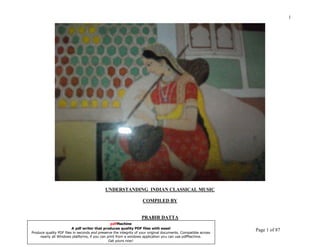
The cover picture, I have chosen,is a painting drawn by my daughter at the age of 12 or 13 years.

UNDERSTANDING INDIAN CLASSICAL MUSIC          pdfMachine
                       A pdf writer that produces quality PDF files with ease!
PRABIRquality PDF files in seconds and preserve the integrity of your original documents. Compatible across
 Produce
         DATTA                                                                                                        Page 3 of 87
      nearly all Windows platforms, if you can print from a windows application you can use pdfMachine.
                                                Get yours now!
4
I am greatly indebted to Bhaskar of Shrutinandan,Ms.Ratnabali Bose of ITC—SRA and many others whose names will make another
big book.But a special mention should be made for my cousin,Sri Sebabrata Ghosh of P.K.Raichowdhury lane,Botanical Garden
,Howrah,West Bengal,India,who was an engineer by profession and was a very good Sarod player by passion,a pupil of Late revered
Ravi Laha of Howrah.He painstakingly went through the manuscript and guided me all through and his wife, loving BOURANI,for
serving me with refreshments during the visits I made and disturbed them.Needless to mention about RUBY DI &B.N.GHOSH
DA,who took all the pain & printed out my first copy by emptying the whole printer ink cartridge,for onward transmission to my
cousin for his appraisal.

I enjoyed full support from my family members all through in completing this compilation document,adjusting with the high and lows
of my temperament.

If this document serves the purpose of easy understanding of the subject for commoners and increase the population of Indian
Classical Music lovers and audience,then I shall feel greatly accomplished.This document will be continually revised with the help of
corrective suggestions from one and all.Any discrepancy found in this document may please be intimated for which I shall remain
ever grateful to the critics and music lovers.

Kolkata/Hyderabad                                                                                                         PRABIR DATTA

22nd August,2009                                                                                                  Mobile No.-- 09903886778

                                                                                                              E mail:datta.pk2003@gmail.com


UNDERSTANDING INDIAN CLASSICAL MUSIC          pdfMachine
                       A pdf writer that produces quality PDF files with ease!
PRABIRquality PDF files in seconds and preserve the integrity of your original documents. Compatible across
 Produce
         DATTA                                                                                                                   Page 4 of 87
      nearly all Windows platforms, if you can print from a windows application you can use pdfMachine.
                                                Get yours now!
5


                                                                              This document is dedicated
                                                                                                     To
                                                                                    My deceased parents
                                                                                                    And
                                                                Shakuntala(Wife),Anindita(Daughter) and
                                                                          Abhishek(Son)
                                                                                                    And
                                                         My Predecessors,Brothers,Sisters and Cousins of
                                                        DUTTA family of Baje Shibpur,Howrah,India
                                                                                                    And
                                                                           All the Classical Music Lovers


UNDERSTANDING INDIAN CLASSICAL MUSIC          pdfMachine
                       A pdf writer that produces quality PDF files with ease!
PRABIRquality PDF files in seconds and preserve the integrity of your original documents. Compatible across
 Produce
         DATTA                                                                                                Page 5 of 87
      nearly all Windows platforms, if you can print from a windows application you can use pdfMachine.
                                                Get yours now!
6

                                                           Classical Indian Music
 A classical Indian music performance generally comprises of the vocalist and the instrument- playing musicians. Certain classical
ensembles would probably not have a vocalist, as is the case with classical instrumental performances. Traditionally the classical
music of India was distinguished into two forms:

           Those compositions comprising of alaps, which is basically movements that are free in time and do not require percussion
           instruments

           Those musical performances that were fixed in time and required a percussion instrument.

However, presently classical Indian music classified as

          Hindustani: This form of classical music has been continuously evolving over time and originates from all other parts of India,
           except the southern states

          Carnatic: This classification of music hails from the southern part of India and has continued to maintain its original form as it
           has traveled through centuries since its origination.

    Mainly,Hindustani North Indian Classical portion has been dealt with in this document.

The origins of classical Indian music is said to date back to over 5000 years ago. Basically this genre of music came about to serve a
spiritual purpose. The melodies that were composed brought about feelings of peace, calm, tranquility, serenity, bliss and a closer
bond with god. In fact according to the Vedas, music is considered to be a divine gift to humanity.

Prior to the invasion of the Mughals, India had more or less uniform musical creations. However, the invasion of the Mughals brought
with it the influence of Arabic and Persian culture. This is when Hindustani music took birth and shifted the north Indian musical
compositions from spiritual to entertaining. The Carnatic style of music continues to be purely classical, till date.

The composition of Hindustani music is based on ragas, which are the scales that comprise of the seven basic notes. These are sa, re,
ga, ma pa, dha and ni. The commonly played musical instruments of this genre of Indian classical music include the sitar, surbahar,
sarod, sarangi, santoor, bansuri, pakhavaj and tabla.


UNDERSTANDING INDIAN CLASSICAL MUSIC          pdfMachine
                       A pdf writer that produces quality PDF files with ease!
PRABIRquality PDF files in seconds and preserve the integrity of your original documents. Compatible across
 Produce
         DATTA                                                                                                            Page 6 of 87
         nearly all Windows platforms, if you can print from a windows application you can use pdfMachine.
                                                   Get yours now!
7
This genre of Indian classical music is said to have originated in the 13th and 14th centuries when north India was invaded by the
Mughals. It was at then that influences of Arabia and Persia permeated into the north Indian classical compositions, distinguishing it
from that of south India. As the south Indian states remained untouched by these invasions their compositions continued to progress
maintaining the ancient heritage. However, there did develop a distinction in the kind of music composed by the northern and southern
regions of India.

CONCEPT OF RAGA

     The musical scale contains 7 + 5 notes. (7-shuddha & 5 komal and tivra)( flat and sharp).

     From these 12 notes selected notes (minimum 5) are used to build up a melodic structure and are called a Raga. It is believed that
there are about 300 Ragas. However, only around 50 are heard in performances. The lesser known and difficult to perform Ragas are
called “Achhop’ and ‘Anavat’ or ‘Aprachalit’ respectively.

     Every Raga has melodic centers, two of which include - one of principal importance and the other a little less important and are
called Vadi’ and ‘Samvadi respectively. Notes which support Vadi and Samvadi notes are called Anuvadi notes. Notes that are
excluded from the Raga structure are called Vivadi notes.

     Ragas with melodic movements centered in the first half of the scale (Sa to Pa) is called “Purvang Ragas and the second half of
the scale (Ma to upper octave Sa) are called ‘Uttarang Ragas’.

      According to tradition, every Raga has a definite time period for performance during a time cycle of 24 hours. A large section of
the music community accepts this concept even at present. Some believe that the concept is scientifically based on an intimate
relationship between sound and light.

     Tradition also has it that specific Ragas are performed during specific seasons such as spring, monsoon, etc. E.g. Basant, Bahar in
spring time and Miyan Malhar and Desh in monsoon.

      It is generally accepted that there are 9 basic emotions (Rasas), which form essential ingredient of any performance in the field of
music, dance and theater. Every Raga, therefore has a basic emotion (Rasa) as an undercurrent of its exposition. It is however
incorrect to believe that a complete Raga exposition from Alap to Jhala is based on only one Rasa. Allied Rasas do play significant
role in Raga development depending upon the area of the melodic development, or the speed and the tempo at which the Raga is
performed.


UNDERSTANDING INDIAN CLASSICAL MUSIC          pdfMachine
                       A pdf writer that produces quality PDF files with ease!
PRABIRquality PDF files in seconds and preserve the integrity of your original documents. Compatible across
 Produce
         DATTA                                                                                                         Page 7 of 87
      nearly all Windows platforms, if you can print from a windows application you can use pdfMachine.
                                                Get yours now!
8
         In the Indian Classical Music,RAGA is the basis of melody & TALA is the basis of rhythm.Each melodic structureof RAGA has
         something akin to a distinct personality subject to a prevailing mood.

         Ragas involve several important elements.The first element is SOUND---metaphysical and physical,which is referred as NADA.Nada
         is the manifestation of the first of five elements of creation—the elements of SPACE.There are 2(two) types of Nadas—ANAHATA
         NADA or unstruck sound & AHATA NADA or struck sound.The next element of Raga is PITCH,relegated to SWARA(whole and
         half tones) and SHRUTI(micro tones).Raga also involves the production of emotional effects in the perfomer and listener,which are
         known as RASAS.The aim of Raga is to elicit emotional and psychological responses from the listener.The production of these
         specific responses can be understood exploring the concept of RASA.Rasa has been referred to as’AESTHETIC DELIGHT’ and is
         free from the limitations of personal feelings.There are NINE(9) RASAS—
         LOVE(Shringar),HUMOUR(Hasya),PATHOS(Karuna),ANGER(Rudra),HEROISM(Vir),TERROR(Bhayanka),DISGUST(Veebhatsa
         ), WONDER(Adbhuta) and PEACEFUL(Shanta).
         Raga is the basis of Classical Music.Raga is neither a SCALE nor a MODE.It is based on the principle of a combination of notes
         selected out of 22(twentytwo) note intervals of OCTAVE.

         Relationship between SHRUTIS AND SWARAS

Sa                                        Re                     Ga                Ma                              Pa                              Dha                     Ni
1         2            3       4          5        6      7      8        9        10 11          12        13     14     15     16      17        18         19     20    21       22
Teevra    Kumudwati    Manda   ChanDob    Daya     Ranj   Rak    Raudri   Krodhi   Vaj    Pras    Pri       Marj   Khit   Rakt   Sand    Alapini   madant     Rohi   Ram   Ugra     Khobhi
                               ati        bati     ani    tika                     rika   arini   ti        oni    i      a      ipani             i          ni     ya             ni


         Shrutis:The smallest possible distance between audio frequencies that is distinguishable to the human ear.There are 22 shrutis in an
         OCTAVE.
         Swaras:
         i)Seven notes:Sa(Sadaj),Re(Rishav),Ga(Gandhar),Ma(Madhyam),Pa(Pancham),Dha(Dhaivat),Ni(Nishad).
         ii)Shuddha and Vikrit swaras.Vikrit swaras consist of Komal and Teevra.
         OCTAVES:MANDRA(lower),MADHYA(middle),TAAR(upper)
         AROHA:Sa Re Ga Ma Pa Dha Ni Sa’ and AVAROHA:Sa’ Ni Dha Pa Ma Ga Re Sa
         POORVANG is Sa Re Ga Ma and UTTARANG is Pa Dha Ni Sa’.
         Raga has its own principal mood such as tranquility,devotion,erotism,loneliness,pathos and heroism.Each Raga is associated
         according to its mood, with a particular time of the day,night or a season.A performer with sufficient training and knowledge,
         alone,can create the desired emotions through the combination of Shrutis and notes.


         UNDERSTANDING INDIAN CLASSICAL MUSIC          pdfMachine
                                A pdf writer that produces quality PDF files with ease!
         PRABIRquality PDF files in seconds and preserve the integrity of your original documents. Compatible across
          Produce
                  DATTA                                                                                                                                     Page 8 of 87
               nearly all Windows platforms, if you can print from a windows application you can use pdfMachine.
                                                         Get yours now!
                                                                                                        ’
9
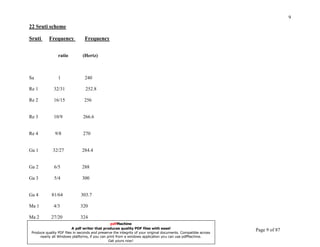
22 Sruti scheme

Sruti       Frequency            Frequency


                 ratio          (Hertz)


Sa               1               240

Re 1           32/31              252.8

Re 2           16/15             256


Re 3           10/9             266.6


Re 4           9/8              270


Ga 1          32/27             284.4


Ga 2           6/5              288

Ga 3           5/4              300


Ga 4         81/64             303.7

Ma 1           4/3             320

Ma 2      27/20              324
UNDERSTANDING INDIAN CLASSICAL MUSIC          pdfMachine
                       A pdf writer that produces quality PDF files with ease!
PRABIRquality PDF files in seconds and preserve the integrity of your original documents. Compatible across
 Produce
         DATTA                                                                                                Page 9 of 87
       nearly all Windows platforms, if you can print from a windows application you can use pdfMachine.
                                                 Get yours now!
10

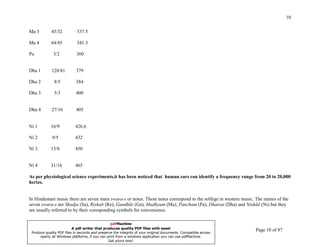
Ma 3         45/32           337.5

Ma 4         64/45           341.3

Pa            3/2           360


Dha 1        128/81         379

Dha 2          8/5          384

Dha 3          5/3          400


Dha 4        27/16          405


Ni 1         16/9           426.6

Ni 2          9/5           432

Ni 3         15/8           450


Ni 4         31/16          465

As per physiological science experiments,it has been noticed that human ears can identify a frequency range from 20 to 20,000
hertzs.


In Hindustani music there are seven main swara-s or notes. These notes correspond to the solfege in western music. The names of the
seven swara-s are Shadja (Sa), Rishab (Re), Gandhãr (Ga), Madhyam (Ma), Pancham (Pa), Dhaivat (Dha) and Nishãd (Ni) but they
are usually referred to by their coresponding symbols for convenience.

UNDERSTANDING INDIAN CLASSICAL MUSIC          pdfMachine
                       A pdf writer that produces quality PDF files with ease!
PRABIRquality PDF files in seconds and preserve the integrity of your original documents. Compatible across
 Produce
         DATTA                                                                                                    Page 10 of 87
       nearly all Windows platforms, if you can print from a windows application you can use pdfMachine.
                                                 Get yours now!
11
This group of seven notes is called the saptak (sapt=seven). The eighth note is the repitition of the first, but is one octave higher. This
scale is analogous to the Western major scale.

If we consider C note(the first white key) on a piano or keyboard as the tonic or the Sa, then the position of the other notes would be
as follows. The seven swara-s occupy the seven white keys of the keyboard. This is shown below.


It can be seen above that in between the seven swara-s we have five intermediate notes. These notes are called vikrit swara-s (altered
notes). In this context, the original notes are referred to as the shudha swara-s (pure notes).

The swara-s between the pairs Sa and Re, Re and Ga, Pa and Dha and Dha and Ni are known as komal Re, komal Ga, komal Dha and
komal Ni. The term komal means soft or flat. The swara between Ma and Pa is called tĩvra Ma; tĩvra meaning sharp. The swara-s Sa
and Pa do not have altered forms and they are known as achal or immovable swara-s. The following table shows the twelve swaras,
their western couterparts and the notes if C is taken as the Sa.

Hindustani Name (Symbol)                                                   Solfa             Scale of C         Ratio to Sa

Shadja (Sa)                                                                Doh               C                  1

Komal RIshabh (Re)                                                                           C#,Db              256/243

Shuddha Rishabh (Re)                                                       Re                D                  9/8

Komal Gandhãr (Ga)                                                                           D#,Eb              32/27

Shuddha Gandhãr (Ga)                                                       Mi                E                  5/4

Shuddha Madhyam (Ma)                                                       Fa                F                  4/3

UNDERSTANDING INDIAN CLASSICAL MUSIC          pdfMachine
                       A pdf writer that produces quality PDF files with ease!
PRABIRquality PDF files in seconds and preserve the integrity of your original documents. Compatible across
 Produce
         DATTA                                                                                                            Page 11 of 87
      nearly all Windows platforms, if you can print from a windows application you can use pdfMachine.
                                                Get yours now!
12

Tĩvra Madhyam (Mȃ)                                                                           F#,Gb               45/32

Pancham (Pa)                                                               Sol               G                   3/2

Komal Dhaivat (Dha)                                                                          G#,Ab               128/81

Shuddha Dhaivat (Dha)                                                      La                A                   5/3

Komal Nishãd (Ni)                                                                            A#,Bb               16/9

Shuddha Nishãd (Ni)                                                        Ti                B                   15/8

Shadja (S°a)                                                               Doh               C'                  2
It should be noted here that this analogy to the keyboard is not technically correct. In western music the instruments are tuned to the
chromatic or the even-tempered scale whereas in Indian music the notes are based on the natural or the diatonic scale. For this reason
the harmonium is not considered correct by many classical musicians.

Every Raga is derived from some THAAT or Scale.
According to Vishnu Narayan Bhatkhande (1860-1936), one of the most influential musicologists in the field of North Indian classical
music in the twentieth century, each one of the several traditional ragas is based on, or is a variation of, ten basic thaats, or musical
scales or frameworks. The ten thaats are Bilawal, Kalyan, Khamaj, Bhairav, Poorvi, Marwa, Kafi, Asavari, Bhairavi and Todi; if one
were to pick a raga at random, it should be possible to find that it is based on one or the other of these thaats. For instance, the ragas
Shree and Puriya Dhanashri are based on the Poorvi thaat, Malkauns on the Bhairavi, and Darbari Kanada on the Asavari thaat. It is
important to point out that Bhatkande's thaat-raga theory is hardly infallible, but it is nevertheless an important classificatory device
with which to order, and make sense of, a bewildering array of ragas; and it is also a useful tool in the dissemination of the music to
students.It is worth noting that almost all the thaats mentioned above are also ragas; and yet a thaat is a very different musical entity
from a raga, and in this difference may lie, crucially, a definition of what a raga is or is not. A thaat is a musical scale, conceived of as
a Western musical scale might be, with the seven notes presented in their order of ascent (arohan). For instance, Asavari is presented,
and notated, as Sa Re Ga (flat or komal) Ma Pa Dha (flat) Ni (flat) in ascent, or arohan. This is, however, only the skeletal musical
structure of the raga Asavari, an abstraction that is to be found nowhere but on the printed page or inside a textbook; the raga Asavari,
in reality, and in exposition, is a very different thing. It goes straight from Re to Ma, and comes down to touch Ga, as it ascends;
having touched Ni later, it returns to Pa, and, touching the upper Sa, returns to Dha and Pa again and again. Arohan and avarohan are,
thus, inextricably and inseparably intermingled in the structure of this raga. The raga, then, is not a musical scale in the Western sense;
it is a characteristic arrangement or progression of notes whose full potential and complexity can be realised only in exposition, and
not upon the printed page. A condensed version of this characteristic arrangement of notes, peculiar to each raga, may be called the
UNDERSTANDING INDIAN CLASSICAL MUSIC          pdfMachine
                       A pdf writer that produces quality PDF files with ease!
PRABIRquality PDF files in seconds and preserve the integrity of your original documents. Compatible across
 Produce
         DATTA                                                                                                            Page 12 of 87
      nearly all Windows platforms, if you can print from a windows application you can use pdfMachine.
                                                Get yours now!
13
pakad, by which a listener hears the phrase Sa Re Ga Ma Pa Ga, none of these notes being flat or sharp. Repeated in a recital, they
will know that they are listening to the raga Gaud Sarang.
Two ragas may have identical notes and yet be very different ragas; for example, two ragas mentioned earlier, Shree and Puriya
Dhanashri, have exactly the same notes, but are unmistakably different in structure and temperament. The first can be identified by its
continual exploration of the relationship of the note Re to the note Paa; while the repetition of the phrase Ma Re Ga Re Ma Ga, a
phrase that would be inadmissible in the first raga, is an enduring feature of the latter. Certain arrangements of notes, then, are
opposite to particular ragas and taboo to all others. A simple and abstract knowledge, thus of the notes of a raga or the thaat on which
it is based, is hardly enough to ensure a true familiarity or engagement with the raga, although it may serve as a convenient starting
point. Thaat familiarity can only come from a constant exposure to, and critical engagement, with raga's exposition.

Ragas are placed in 3(three) categories:-
a)ODAVA or PENTATONIC; a composition of 5(FIVE) NOTES.[Simlar to BLUES scales in western system]
b)SHADAVA or HEXATONIC; a composition of 6(SIX) NOTES
c)SAMPOORNA or HEPTATONIC; a composition of 7(SEVEN) NOTES
Every Raga must have atleast 5(five) notes,starting at ‘SA’,one principal note,a second important note and a few helping notes.The
principal note,”KING” is the note on which the Raga is built.It is emphasized in various ways,such as,stopping for sometime on the
note or stressing it.
The second important note or the”QUEEN” corresponds to the KING as the FOURTH or FIFTH note in relation to it.The ascent &
descent of the notes in every Raga is very important.Some Ragas in the same scale differ in ascent & descent.
The SPEED of a Raga is divided into 3(THREE) parts:-
a)VILAMBIT(Slow)
b)MADHYA(Medium)
c)DRUT(Fast)
Another aspect of the Ragas is the appropriate distribution in time during the 24 hrs of the day for its performance,i.e,the time of the
day denotes the type of the raga to be sung.Based on this,the ragas are divided into following types----
i)SANDI PRAKASH—Twilight Ragas
ii)Midday ragas
iii)Midnight ragas
iv)Ragas for the first quarter of the morning and night
v)Ragas for last quarter of the day and night

All the Ragas are divided in two broad groups
a)POOR RAGAS:-The POOR ragas are sung between 12 noon&12 midnight
b)UTTAR RAGAS:-The UTTAR Ragas are sung between 12 midnight & 12 noon.

UNDERSTANDING INDIAN CLASSICAL MUSIC          pdfMachine
                       A pdf writer that produces quality PDF files with ease!
PRABIRquality PDF files in seconds and preserve the integrity of your original documents. Compatible across
 Produce
         DATTA                                                                                                          Page 13 of 87
      nearly all Windows platforms, if you can print from a windows application you can use pdfMachine.
                                                Get yours now!
14
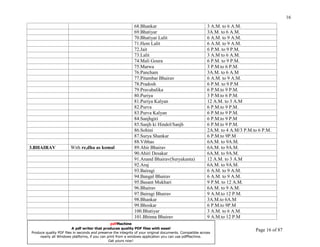
CLASSIFICATION OF RAGAS IN RELATON TO THAATS.
THAATS                CHARACTERISTICS                         RAGAS                                      TIMINGS OF THE DAY
1.BILAWAL             All Shudh or natural notes              1.Alahiya bilawal                          10 A.M. to 12 Noon
                                                              2.Aarvi                                    12 A.M. to 3 A.M
                                                              3.Asha                                     12 A.M. to 3 A.M
                                                              4.Bhabani                                  12 A.M. to 3 A.M
                                                              5.Bhaskari                                 12 A.M. to 3 A.M
                                                              6.Bihag                                    10P.M. to 12 Midnight
                                                              7.Bihagda                                  10P.M. to 12 Midnight
                                                              8.Bilahari                                 9 P.M. to 12 A.M.
                                                              9.Bilawal                                  9 A.M. to 12 P.M.
                                                              10.Chakradhar                              12 A.M. to 3 A.M
                                                              11.Chandrika                               12 A.M. to 3 A.M
                                                              12.Chaya                                   12 A.M. to 3 A.M
                                                              13.ChayaNat                                9 P.M. to 12 A.M.
                                                              14.Chaya Tilak                             12 A.M. to 3 A.M
                                                              15.Chitta Mohini                           9 P.M. to 12 A.M.
                                                              16.Debarati                                12 A.M. to 3 A.M
                                                              17.Deebabati                               12 A.M. to 3 A.M.
                                                              18.Deepak                                  9 P.M. to 12 A.M.
                                                              19.Deshkar                                 6 A.M. to 9 A.M.
                                                              20.Deep Sikha                              9 A.M. to 12 P.M.
                                                              21.Durga                                   9 P.M. to 12 A.M.
                                                              22.Gaud Bilawal                            6A.M. to 9 A.M.
                                                              23.Gaud Shankara                           12 A.M. to 3 A.M
                                                              24.Gaud Shankaravaran                      9 P.M. to 12 A.M.
                                                              25.Hamswadhwani                            6 P.M. to 9 P.M.
                                                              26.Hamswa Kalyan                           9 P.M. to 12 A.M.
                                                              27.Hem Bihag                               12 A.M. to 3 A.M
                                                              28.HemKalyan                               12 A.M. to 3 A.M
                                                              29.Jairaj                                  12 A.M. to 3 A.M
                                                              30.Jaladhar/Jaladhar Kedar                 12 A.M. to 3 A.M
                                                              31.Jana Ranjani                            12 A.M. to 3 A.M
                                                              32.Kalavarana                              9 P.M. to 12 A.M.
UNDERSTANDING INDIAN CLASSICAL MUSIC          pdfMachine
                       A pdf writer that produces quality PDF files with ease!
PRABIRquality PDF files in seconds and preserve the integrity of your original documents. Compatible across
 Produce
         DATTA                                                                                                                 Page 14 of 87
      nearly all Windows platforms, if you can print from a windows application you can use pdfMachine.
                                                Get yours now!
15
                                                   33.Kamal Ranjani                                       6A.M. to 9 A.M.
                                                   34.Kamod Nat                                           12 A.M. to 3 A.M
                                                   35.Kaushikdhwani                                       9 P.M. to 12 A.M.
                                                   36.Kedari                                              12 A.M. to 3 A.M
                                                   37.Kedar Nat                                           12 A.M. to 3 A.M
                                                   38.Kukubh                                              6A.M. to 9 A.M.
                                                   39.Lachasakh                                           6A.M. to 9 A.M.
                                                   40.Lajwanti                                            12 A.M. to 3 A.M.
                                                   41.Lum                                                 12 A.M. to 3 A.M
                                                   42.Maluha Kedar                                        12 A.M. to 3 A.M.
                                                   43.Mand                                                Any time/6 P.M. to 9 P.M.
                                                   44.Maru bihag                                          3 P.M. to 6 P.M.
                                                   45.Mewara                                              Any Time
                                                   46.Nag Durga                                           12 A.M. to 3 A.M.
                                                   47.Nat                                                 12 A.M. to 3 A.M.
                                                   48.NatBihag                                            9 P.M. to 12 A.M.
                                                   49.Nat Bilawal                                         12 P.M. to 3 P.M.
                                                   50.Nat Narayan                                         12 A.M. to 3 A.M.
                                                   51.Nat Nagswarabali                                    12 A.M. to 3 A.M.
                                                   52.Pahari                                              Evening
                                                   53.Pat Bihag                                           9 P.M. to 12 A.M.
                                                   54.Pat Manjari                                         12 A.M. to 3 A.M.
                                                   55.Rasa Chandra                                        6A.M. to 9 A.M.
                                                   56.Rasa Ranjani                                        12 A.M. to 3 A.M
                                                   57.Sarang Bilawal                                      12 P.M. to 3 P.M.
                                                   58.Sarparda                                            9 A.M. to 12 P.M.
                                                   59.Saoni Kalyan                                        9 P.M. to 12 A.M.
                                                   60.Shankara                                            6 P.M. to 9 P.M.
                                                   62.Shankaravaranam                                     6A.M. to 9 A.M.
                                                   63.Shukla Bilawal                                      6A.M. to 9 A.M.
                                                   64.Yamani Bilawal                                      6A.M. to 9 A.M.
2.MARWA                 re as Komal & ma as Teevra 65.Barati/Barari                                       6 P.M.to 9 P.M.
                                                   66.Basant                                              3 A.M. to 6 A.M.
                                                   67.Bibhashi                                            6 P.M. to 9 P.M
UNDERSTANDING INDIAN CLASSICAL MUSIC          pdfMachine
                       A pdf writer that produces quality PDF files with ease!
PRABIRquality PDF files in seconds and preserve the integrity of your original documents. Compatible across
 Produce
         DATTA                                                                                                                   Page 15 of 87
      nearly all Windows platforms, if you can print from a windows application you can use pdfMachine.
                                                Get yours now!
16
                                                              68.Bhankar                                  3 A.M. to 6 A.M.
                                                              69.Bhatiyar                                 3A.M. to 6 A.M.
                                                              70.Bhatiyar Lalit                           6 A.M. to 9 A.M.
                                                              71.Hem Lalit                                6 A.M. to 9 A.M.
                                                              72.Jait                                     6 P.M. to 9 P.M.
                                                              73.Lalit                                    3 A.M to 6 A.M.
                                                              74.Mali Goura                               6 P.M. to 9 P.M.
                                                              75.Marwa                                    3 P.M.to 6 P.M.
                                                              76.Pancham                                  3A.M. to 6 A.M
                                                              77.Pitambar Bhairav                         6 A.M. to 9 A.M.
                                                              78.Pradosh                                  6 P.M. to 9 P.M
                                                              79.Pravabalika                              6 P.M.to 9 P.M.
                                                              80.Puriya                                   3 P.M.to 6 P.M.
                                                              81.Puriya Kalyan                            12 A.M. to 3 A.M
                                                              82.Purva                                    6 P.M.to 9 P.M.
                                                              83.Purva Kalyan                             6 P.M.to 9 P.M.
                                                              84.Sanjhgiri                                6 P.M.to 9 P.M
                                                              85.Sanjh ki Hindol/Sanjh                    6 P.M.to 9 P.M.
                                                              86.Sohini                                   2A.M. to 4 A.M/3 P.M.to 6 P.M.
                                                              87.Surya Shankar                            6 P.M.to 9P.M
                                                              88.Vibhas                                   6A.M. to 9A.M.
3.BHAIRAV               With re,dha as komal                  89.Ahir Bhairav                             6A.M. to 9A.M.
                                                              90.Ahiri Desakar                            6A.M. to 9A.M.
                                                              91.Anand Bhairav(Suryakanta)                12 A.M. to 3 A.M
                                                              92.Araj                                     6A.M. to 9A.M.
                                                              93.Bairagi                                  6 A.M. to 9 A.M.
                                                              94.Bangal Bhairav                           6 A.M. to 9 A.M.
                                                              95.Basant Mukhari                           9 P.M. to 12 A.M.
                                                              96.Bhairav                                  6A.M. to 9 A.M.
                                                              97.Bairagi Bhairav                          9 A.M.to 12 P.M.
                                                              98.Bhankar                                  3A.M.to 6A.M
                                                              99.Bhoskar                                  6 P.M.to 9P.M
                                                              100.Bhatiyar                                3 A.M. to 6 A.M.
                                                              101.Bhinna Bhairav                          9 A.M.to 12 P.M
UNDERSTANDING INDIAN CLASSICAL MUSIC          pdfMachine
                       A pdf writer that produces quality PDF files with ease!
PRABIRquality PDF files in seconds and preserve the integrity of your original documents. Compatible across
 Produce
         DATTA                                                                                                                  Page 16 of 87
      nearly all Windows platforms, if you can print from a windows application you can use pdfMachine.
                                                Get yours now!
17
                                                              102.Bhupal Gunakari                         3 A.M. to 6 A.M
                                                              103.Bibhas                                  6 A.M. to 9 A.M.
                                                              104.Bibhabati                               3A.M.to 6A.M
                                                              105.Dev Ranjani                             6 A.M. to 9 A.M.
                                                              106.Gauri                                   3 P.M. to 6 P.M.
                                                              107.Gunkali                                 6 A.M. to 9 A.M.
                                                              108.Gunkari/Gunakri                         6 A.M. to 9 A.M
                                                              109.Hijaj                                   12 P.M. to 3 P.M
                                                              110.Jangala                                 6 A.M. to 9 A.M
                                                              111.Jhilauf                                 6 A.M. to 9 A.M
                                                              112.Jogiya                                  6A.M. to 9 A.M.
                                                              113.Jogmaya/Jogasree                        6A.M. to 9 A.M.
                                                              114.Kalingada                               6A.M. to 9 A.M.
                                                              115.Kaushiki Bhairav                        9 A.M.to 12 P.M.
                                                              116.Komal Durga                             9 A.M.to 12 P.M.
                                                              117.Lalit Pancham                           3A.M.to 6A.M
                                                              118.Malay Maruttoma                         6A.M. to 9 A.M.
                                                              119.Malin                                   6P.M. to 9 P.M.
                                                              120.Mangalika/Mangal Bhairav                9 A.M.to 12 P.M.
                                                              121.Megh Ranjani                            3A.M.to 6A.M
                                                              122.Mohini                                  6A.M. to 9 A.M.
                                                              123.Nat Bhairav                             9 A.M.to 12 P.M.
                                                              124.Pari                                    6 A.M. to 9 A.M.
                                                              125.Prabhat/Prabhat Bhairav                 6A.M. to 9 A.M.
                                                              126.Ramkali                                 6A.M. to 9 A.M.
                                                              127.Rudra Bhairav                           6A.M. to 9 A.M
                                                              128.Saurashtra Bhairav/Taunk                6A.M. to 9 A.M
                                                              129.Saveri                                  6A.M. to 9 A.M.
                                                              130.Shib/Shibmat Bhairav                    6A.M. to 9 A.M
                                                              131.Ushangini                               6A.M. to 9 A.M.
                                                              132.Usha Ranjani                            6A.M. to 9 A.M.
                                                              133.Vibhas                                  6 A.M. to 9 A.M.
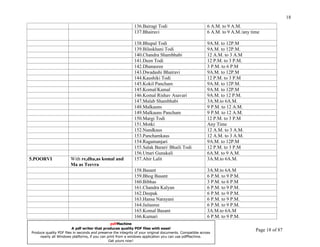
4.BHAIRAVI              With re,ga,dha,ni as komal            134.Alankar Priya                           9 A.M.to 12 P.M.
                                                              135.Asha/Asha bhairavi/Asha Todi            12 P.M. to 3 P.M.
UNDERSTANDING INDIAN CLASSICAL MUSIC          pdfMachine
                       A pdf writer that produces quality PDF files with ease!
PRABIRquality PDF files in seconds and preserve the integrity of your original documents. Compatible across
 Produce
         DATTA                                                                                                                Page 17 of 87
      nearly all Windows platforms, if you can print from a windows application you can use pdfMachine.
                                                Get yours now!
18
                                                              136.Bairagi Todi                            6 A.M. to 9 A.M.
                                                              137.Bhairavi                                6 A.M. to 9 A.M./any time

                                                              138.Bhupal Todi                             9A.M. to 12P.M
                                                              139.Bilaskhani Todi                         9A.M. to 12P.M.
                                                              140.Chandra Shambhabi                       12 A.M. to 3 A.M
                                                              141.Deen Todi                               12 P.M. to 3 P.M.
                                                              142.Dhanasree                               3 P.M. to 6 P.M
                                                              143.Dwadashi Bhairavi                       9A.M. to 12P.M
                                                              144.Kaushiki Todi                           12 P.M. to 3 P.M
                                                              145.Kokil Pancham                           9A.M. to 12P.M.
                                                              145.Komal/Kamal                             9A.M. to 12P.M
                                                              146.Komal Rishav Asavari                    9A.M. to 12 P.M.
                                                              147.Malab Shambhabi                         3A.M.to 6A.M.
                                                              148.Malkauns                                9 P.M. to 12 A.M.
                                                              149.Malkauns Pancham                        9 P.M. to 12 A.M.
                                                              150.Margi Todi                              12 P.M. to 3 P.M
                                                              151.Motki                                   Any Time
                                                              152.Nandkaus                                12 A.M. to 3 A.M.
                                                              153.Panchamkaus                             12 A.M. to 3 A.M.
                                                              154.Ragamanjari                             9A.M. to 12P.M
                                                              155.Salak Barari/ Bhaili Todi               12 P.M. to 3 P.M
                                                              156.Uttari Gunakali                         6A.M. to 9 A.M.
5.POORVI                With re,dha,as komal and              157.Ahir Lalit                              3A.M.to 6A.M.
                        Ma as Teevra
                                                              158.Basant                                  3A.M.to 6A.M
                                                              159.Bhog Basant                             6 P.M. to 9 P.M.
                                                              160.Bibhas                                  3 P.M. to 6 P.M
                                                              161.Chandra Kalyan                          6 P.M. to 9 P.M.
                                                              162.Deepak                                  6 P.M. to 9 P.M.
                                                              163.Hansa Narayani                          6 P.M. to 9 P.M.
                                                              164.Jaitasree                               6 P.M. to 9 P.M.
                                                              165.Komal Basant                            3A.M.to 6A.M
                                                              166.Kumari                                  6 P.M. to 9 P.M.
UNDERSTANDING INDIAN CLASSICAL MUSIC          pdfMachine
                       A pdf writer that produces quality PDF files with ease!
PRABIRquality PDF files in seconds and preserve the integrity of your original documents. Compatible across
 Produce
         DATTA                                                                                                                   Page 18 of 87
      nearly all Windows platforms, if you can print from a windows application you can use pdfMachine.
                                                Get yours now!
19
                                                    167.Lalit                                             4A.M to 6 A.M.
                                                    168.Lalita Gauri                                      6 P.M. to 9 P.M.
                                                    169.Malabi                                            6 P.M. to 9 P.M.
                                                    170.Manohar                                           3A.M.to 6A.M
                                                    171.Namo Narayani                                     3 P.M.to 6 P.M.
                                                    172.Paraj                                             2A.M.to4A.M.
                                                    173.Poorvi                                            3 P.M.to 6 P.M.
                                                    174.Puriya Dhaneshree                                 3 P.M.to 6 P.M.
                                                    175.Ramkri/Ramkriya                                   6 A.M. to 9 A.M.
                                                    176.Reba/Rewa                                         6 P.M. to 9 P.M.
                                                    177.Shree                                             3 P.M.to 6 P.M.
                                                    178.ShreeTaunk                                        6 P.M. to 9 P.M.
                                                    179.Taunki/Sri Taunki                                 3 P.M.to 6 P.M.
                                                    180.Triveni                                           3 P.M.to 6 P.M.
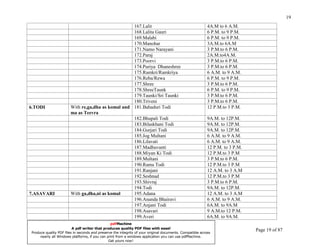
6.TODI                  With re,ga,dha as komal and 181.Bahaduri Todi                                     12 P.M.to 3 P.M.
                        ma as Teevra
                                                    182.Bhupali Todi                                      9A.M. to 12P.M.
                                                    183.Bilaskhani Todi                                   9A.M. to 12P.M.
                                                    184.Gurjari Todi                                      9A.M. to 12P.M.
                                                    185.Jog Multani                                       6 A.M. to 9 A.M.
                                                    186.Lilavati                                          6 A.M. to 9 A.M.
                                                    187.Madhuvanti                                        12 P.M. to 3 P.M.
                                                    188.Miyan Ki Todi                                     12 P.M.to 3 P.M
                                                    189.Multani                                           3 P.M.to 6 P.M.
                                                    190.Rama Todi                                         12 P.M.to 3 P.M
                                                    191.Ranjani                                           12 A.M. to 3 A.M
                                                    192.Seshnad                                           12 P.M.to 3 P.M
                                                    193.Shivraj                                           3 P.M.to 6 P.M.
                                                    194.Todi                                              9A.M. to 12P.M.
7.ASAVARI               With ga,dha,ni as komal     195.Adana                                             12 A.M. to 3 A.M
                                                    196.Ananda Bhairavi                                   6 A.M. to 9 A.M.
                                                    197.Anjani Todi                                       6A.M. to 9A.M
                                                    198.Asavari                                           9 A.M.to 12 P.M.
                                                    199.Averi                                             6A.M. to 9A.M.
UNDERSTANDING INDIAN CLASSICAL MUSIC          pdfMachine
                       A pdf writer that produces quality PDF files with ease!
PRABIRquality PDF files in seconds and preserve the integrity of your original documents. Compatible across
 Produce
         DATTA                                                                                                                Page 19 of 87
      nearly all Windows platforms, if you can print from a windows application you can use pdfMachine.
                                                Get yours now!
20
                                                              200.Bedabati                                12 A.M. to 3 A.M
                                                              201.Bhup Kanara                             12 A.M. to 3 A.M
                                                              202.Chap Ghantarab                          12 A.M. to 3 A.M
                                                              203.Chandrakaus                             9 P.M. to 12 A.M.
                                                              204.Chitra                                  12 A.M. to 3 A.M
                                                              205.Darbari Kanada                          9 P.M. to 12 A.M.
                                                              206.Desi                                    9 A.M. to 12 P.M.
                                                              207.Dev Gandhar                             12 P.M. to 3 P.M
                                                              208.Gandhari                                12 P.M. to 3 P.M.
                                                              209.Gopika Basant/Gopi Basant               6 A.M. to 9 A.M
                                                              210.Gunji Kanara                            12 A.M. to 3 A.M
                                                              211.Jangala                                 6 A.M. to 9 A.M
                                                              212.Jaunpuri                                9 A.M. to 12 P.M.
                                                              213.Jhilauf                                 6 A.M. to 9 A.M
                                                              214.Jog Barna                               12 P.M. to 3 P.M.
                                                              215.Jogkaus                                 12 A.M. to 3 A.M
                                                              216.Kalyan Basanta                          12 A.M. to 3 A.M.
                                                              217.Katyayani                               9 P.M. to 12 A.M.
                                                              218.Kaushiki Kanada                         12 A.M. to 3 A.M.
                                                              219.Khaat                                   12 P.M. to 3 P.M.
                                                              220.Komal Bahar                             12 A.M. to 3 A.M
                                                              221.Komal Desi                              12 P.M. to 3 P.M.
                                                              222.Lachari Todi                            12 P.M. to 3 P.M
                                                              223.Nat Bhairavi                            9 A.M. to 12 P.M.
                                                              224.Sarang Asavari                          12 P.M. to 3 P.M
                                                              225.Sarangi Sarang                          12 P.M. to 3 P.M.
                                                              226.Sindhu Bhairavi                         12 P.M. to 3 P.M.
                                                              227.Suddha Kanara                           3 A.M. to 6 A.M
                                                              228.Surti/Saurati Kanara                    12 A.M. to 3 A.M
8.KALYAN                With ma as Teevra only                229.Baijayanti                              6 P.M. to 9 P.M.
(YAMAN)
                                                              230.Bhupali                                 6 P.M. to 9 P.M.
                                                              231.Bihag                                   6 P.M. to 9 P.M.
                                                              232.Bhup Kalyan
UNDERSTANDING INDIAN CLASSICAL MUSIC          pdfMachine
                       A pdf writer that produces quality PDF files with ease!
PRABIRquality PDF files in seconds and preserve the integrity of your original documents. Compatible across
 Produce
         DATTA                                                                                                                Page 20 of 87
      nearly all Windows platforms, if you can print from a windows application you can use pdfMachine.
                                                Get yours now!
21
                                                              233.Chandni kedar                           9 P.M. to 12 A.M.
                                                              234.Chandrakanta                            9 P.M. to 12 A.M.
                                                              235.Chaya Malhar                            MONSOON
                                                              236.ChayaNat                                9 P.M. to 12 A.M.
                                                              237.Deepavali                               12 A.M.to 6 A.M.
                                                              238.Dhabalasree                             6 P.M. to 9 P.M.
                                                              239.Durga Kalyan                            12 A.M. to 3 A.M
                                                              240.Gaur Kalyan                             9 P.M. to 12 A.M.
                                                              241.Gaud Sarang                             12 P.M. to 3 P.M.
                                                              242.Hameer                                  9 P.M. to 12 A.M.
                                                              243.Hemant                                  6 P.M. to 9 P.M.
                                                              244.Hindol                                  3A.M.to 6A.M
                                                              245.Jait Kalyan                             9 P.M. to 12 A.M.
                                                              246.Jay Kalyan                              9 P.M. to 12 A.M.
                                                              247.Kamod                                   EVENG
                                                              248.Kedar                                   9 P.M. to 12 A.M.
                                                              249.Komal Kedar                             9 P.M. to 12 A.M
                                                              250.Kusum                                   9 P.M. to 12 A.M.
                                                              251.Lachmi Kalyan                           6 P.M. to 9 P.M.
                                                              252.Malani Basant                           9 P.M. to 12 A.M.
                                                              253.Malarani                                12 A.M. to 3 A.M
                                                              254.Malasree/Malabasree                     6 P.M. to 9 P.M.
                                                              255.Maru Bihag                              3 P.M. to 6 P.M.
                                                              256.Maru Hindol                             12 A.M. to 3 A.M
                                                              257.Maru Kalyan                             9 P.M. to 12 A.M
                                                              258.Mohan Kalyan                            12 A.M. to 3 A.M
                                                              259.Nand                                    9 P.M. to 12 A.M.
                                                              260.Panch Kalyan                            9 P.M. to 12 A.M.
                                                              261.Rabi Kalyan                             9 P.M. to 12 A.M.
                                                              262.Raj Kalyan                              9 P.M. to 12 A.M.
                                                              263.Rasa Kalyan                             9 P.M. to 12 A.M.
                                                              264.Sanjh Kalyan                            9 P.M. to 12 A.M
                                                              265.Saraswati                               12 A.M. to 3 A.M

UNDERSTANDING INDIAN CLASSICAL MUSIC          pdfMachine
                       A pdf writer that produces quality PDF files with ease!
PRABIRquality PDF files in seconds and preserve the integrity of your original documents. Compatible across
 Produce
         DATTA                                                                                                                Page 21 of 87
      nearly all Windows platforms, if you can print from a windows application you can use pdfMachine.
                                                Get yours now!
22
                                                              266.Shankar Yaman                           12 A.M. to 3 A.M
                                                              267.Shyam Kedar                             12 A.M. to 3 A.M
                                                              268.Sree Kalyan                             9 P.M. to 12 A.M.
                                                              269.Sree Kamod                              12 P.M. to 3 P.M.
                                                              270.Subha Kalyan                            9 P.M. to 12 A.M.
                                                              271.Suddha Kalyan                           9 P.M. to 12 A.M.
                                                              272.Shyam Kalyan                            6 P.M. to 9 P.M.
                                                              273.Suddh Sarang                            12 P.M. to 3 P.M.
                                                              274.Yaman                                   6 P.M. to 9 P.M.
                                                              275.Yaman Kalyan                            6 P.M. to 9 P.M.
9.KHAMAJ                With ni as komal                      276.Andhali                                 12 A.M. to 3 A.M.
                                                              277.Arun Malhar                             12 A.M. to 3 A.M
                                                              278.Bangala                                 3A.M.to6A.M.
                                                              279.Bangesree                               12 A.M. to 3 A.M
                                                              280.Bhinna Sadaj/Kaushikdhwani              9 P.M. to 12 A.M.
                                                              281.Bihari                                  12 A.M. to 3 A.M
                                                              282.Bhup Hemanta                            12 A.M. to 3 A.M
                                                              283.Champak                                 12 A.M. to 3 A.M
                                                              284.Champakali                              12 A.M. to 3 A.M
                                                              285.Debarati                                9 P.M. to 12 A.M.
                                                              286.Desh                                    6 P.M. to 9 P.M.
                                                              287.Desh Malhar                             MONSOON
                                                              288.Dhundhiki Malhar                        12 A.M. to 3 A.M.
                                                              289.Durga                                    12 A.M. to 3 A.M.
                                                              290.Gaud Malhar                             12 A.M. to 3 A.M.
                                                              291.Gara                                    12 A.M. to 3 A.M
                                                              292.Gawati                                  12 A.M. to 3 A.M
                                                              293.Gorakh Kalyan                           9 P.M. to 12 A.M.
                                                              294.Gara Kanara                             12 A.M. to 3 A.M
                                                              295.HansaSree                               12 A.M. to 3 A.M.
                                                              296.Har Shringar                            12 A.M. to 3 A.M.
                                                              297.Hom Sikha                               12 A.M. to 3 A.M.
                                                              298.Jaj                                     12 P.M. to 3 P.M
                                                              299.JanaSambodhwani                         9 P.M. to 12 A.M.
UNDERSTANDING INDIAN CLASSICAL MUSIC          pdfMachine
                       A pdf writer that produces quality PDF files with ease!
PRABIRquality PDF files in seconds and preserve the integrity of your original documents. Compatible across
 Produce
         DATTA                                                                                                                 Page 22 of 87
      nearly all Windows platforms, if you can print from a windows application you can use pdfMachine.
                                                Get yours now!
23
                                                              300.Jayjayanti                              6 P.M. to 9 P.M.
                                                              301.Jila                                    12 A.M. to 3 A.M
                                                              302.Jhinjhoti                               9 P.M. to 12 A.M.
                                                              303.Jog                                     12 A.M. to 3 A.M
                                                              304.Kalavati                                9 P.M. to 12 A.M.
                                                              305.Kalasri                                 12 A.M. to 3 A.M
                                                              306.Kamai                                   12 A.M. to 3 A.M
                                                              306.Kamasu                                  12 A.M. to 3 A.M
                                                              307.Kamboji                                 12 A.M. to 3 A.M
                                                              308.Kantal                                  12 A.M. to 3 A.M
                                                              309.Karanka Barali                          12 A.M. to 3 A.M
                                                              310.Kaushikdhwani/Bhinnasadaj               9 P.M. to 12 A.M.
                                                              311.Kedar Goud                              12 A.M. to 3 A.M
                                                              312.Khamaj                                  6 P.M. to 9 P.M.
                                                              313.Khambabati                              12 A.M. to 3 A.M
                                                              314.Khaukar                                 12 P.M. to 3 P.M.
                                                              315.Kuntal Barali                           12 A.M. to 3 A.M
                                                              316.Lankeshri                               12 A.M. to 3 A.M
                                                              317.Lum                                     12 A.M. to 3 A.M
                                                              318.Madhuri                                 12 A.M. to 3 A.M
                                                              319.Madhyamad Sarang                        12 P.M. to 3 P.M.
                                                              320.Malgunji                                9 A.M. to 12 P.M.
                                                              321.Nag Swarabali                           12 A.M. to 3 A.M.
                                                              322.Narayani                                12 A.M. to 3 A.M.
                                                              323.Nat Kunjarika/Kuranjika                 12 A.M. to 3 A.M.
                                                              324.Nupur                                   12 A.M. to 3 A.M.
                                                              325.Pratapbali                              12 A.M. to 3 A.M.
                                                              326.Rabikaus                                12 A.M. to 3 A.M.
                                                              327.Rageshree                               9 P.M. to 12 A.M.
                                                              328.Raini Kalyan                            12 A.M. to 3 A.M.
                                                              329.Sajan                                   12 A.M. to 3 A.M.
                                                              330.Shree Shankar                           12 A.M. to 3 A.M.
                                                              331.Sohan Malhar                            12 A.M. to 3 A.M.
                                                              332.Sorat                                   12 A.M. to 3 A.M
UNDERSTANDING INDIAN CLASSICAL MUSIC          pdfMachine
                       A pdf writer that produces quality PDF files with ease!
PRABIRquality PDF files in seconds and preserve the integrity of your original documents. Compatible across
 Produce
         DATTA                                                                                                                Page 23 of 87
      nearly all Windows platforms, if you can print from a windows application you can use pdfMachine.
                                                Get yours now!
24
                                                              333.Surat Malhar                            12 A.M. to 3 A.M./MONSOON
                                                              334.Tilak Kamod                             6 P.M. to 9 P.M.
                                                              335.Tilang                                  6 P.M. to 9 P.M.
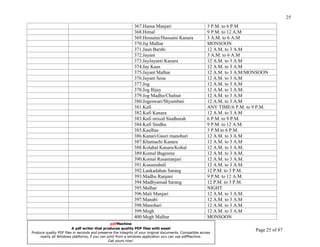
10.KAAFI                With ga,ni as komal                   336.Abhogi                                  6 P.M. to 9 P.M.
                                                              337.Abhogi Kanara                           12 A.M. to 3 A.M
                                                              338.Abhogi Malhar                           12 A.M. to 3 A.M
                                                              339.Ahang                                   12 A.M. to 3 A.M
                                                              340.Ahiri                                   9 P.M. to 12 A.M.
                                                              341.Bageshree                               12 A.M. to 3 A.M
                                                              342.Bageshree Kanara                        12 A.M. to 3 A.M
                                                              343.Bahar                                   NIGHT
                                                              344.Barahans Sarang                         12P.M. to3 P.M
                                                              345.Barwa                                   12P.M. to3 P.M
                                                              346.Bhima                                   3 P.M.to 6 P.M
                                                              347.Bhimpalasi                              3 P.M.to 6 P.M.
                                                              348.Bhogbati                                12 A.M. to 3 A.M
                                                              349.Bijay                                   6 P.M. to 9 P.M.
                                                              350.Binod                                   12 A.M. to 3 A.M.
                                                              351.Brindavani Sarang                       12 A.M. to 3 A.M.
                                                              352.Charjuki Malhar                         MONSOON
                                                              353.Chanchal saus Malhar                    MONSOON
                                                              354.Chandrakauns                            9 P.M. to 12 A.M.
                                                              355.Chaya Malhar                            MONSOON
                                                              356.Daulati Kanara                          12 A.M. to 3 A.M.
                                                              357.Desakhya/DeoSakh/Debsug                 9 A.M. to 12 P.M.
                                                              358.Desi                                    9 A.M. to 12 P.M.
                                                              359.Dhaani                                  12P.M. to3 P.M./ANY TIME
                                                              360.Dhanasree                               3 P.M. to 6 P.M
                                                              361.Dhulia/Dhuria Malhar                    MONSOON
                                                              362.Gaud                                    12 A.M. to 3 A.M
                                                              363.Goud Malhar                             MONSOON
                                                              364.Gaurhar Sarang                          12P.M. to3 P.M
                                                              365.Gop Kamboji                             12 A.M. to 3 A.M
                                                              366.Hansa Kankani                           3 P.M.to 6 P.M.
UNDERSTANDING INDIAN CLASSICAL MUSIC          pdfMachine
                       A pdf writer that produces quality PDF files with ease!
PRABIRquality PDF files in seconds and preserve the integrity of your original documents. Compatible across
 Produce
         DATTA                                                                                                               Page 24 of 87
      nearly all Windows platforms, if you can print from a windows application you can use pdfMachine.
                                                Get yours now!
25
                                                              367.Hansa Manjari                           3 P.M. to 6 P.M
                                                              368.Himal                                   9 P.M. to 12 A.M
                                                              369.Hossaini/Hussaini Kanara                3 A.M. to 6 A.M
                                                              370.Jaj Malhar                              MONSOON
                                                              371.Jaun Barshi                             12 A.M. to 3 A.M
                                                              372.Jayant                                  3 A.M. to 6 A.M
                                                              373.JayJayanti Kanara                       12 A.M. to 3 A.M
                                                              374.Jay Kaus                                12 A.M. to 3 A.M
                                                              375.Jayant Malhar                           12 A.M. to 3 A.M/MONSOON
                                                              376.Jayant Sena                             12 A.M. to 3 A.M
                                                              377.Jog                                     12 A.M. to 3 A.M
                                                              378.Jog Bijay                               12 A.M. to 3 A.M.
                                                              379.Jog Madhu/Chalnat                       12 A.M. to 3 A.M
                                                              380.Jogeswari/Shyambati                     12 A.M. to 3 A.M
                                                              381.Kafi                                    ANY TIME/6 P.M. to 9 P.M.
                                                              382.Kafi Kanara                             12 A.M. to 3 A.M
                                                              383.Kafi mixed Sindhurah                    6 P.M. to 9 P.M.
                                                              384.Kafi Sindhu                             9 P.M. to 12 A.M.
                                                              385.Kaulhas                                 3 P.M.to 6 P.M.
                                                              386.Kanari/Gauri manohari                   12 A.M. to 3 A.M
                                                              387.Khamachi Kanara                         12 A.M. to 3 A.M
                                                              388.Kolahal Kanara/Kohal                    12 A.M. to 3 A.M.
                                                              389.Komal Bagesree                          12 A.M. to 3 A.M.
                                                              390.Komal Rasamanjari                       12 A.M. to 3 A.M.
                                                              391.Kusumabali                              12 A.M. to 3 A.M.
                                                              392.Lankadahan Sarang                       12 P.M. to 3 P.M.
                                                              393.Madhu Ranjani                           9 P.M. to 12 A.M.
                                                              394.Madhyamad Sarang                        12 P.M. to 3 P.M.
                                                              395.Malhar                                  NIGHT
                                                              396.Mali Manjari                            12 A.M. to 3 A.M.
                                                              397.Manabi                                  12 A.M. to 3 A.M
                                                              398.Manohari                                12 A.M. to 3 A.M.
                                                              399.Megh                                    12 A.M. to 3 A.M
                                                              400.Megh Malhar                             MONSOON
UNDERSTANDING INDIAN CLASSICAL MUSIC          pdfMachine
                       A pdf writer that produces quality PDF files with ease!
PRABIRquality PDF files in seconds and preserve the integrity of your original documents. Compatible across
 Produce
         DATTA                                                                                                               Page 25 of 87
      nearly all Windows platforms, if you can print from a windows application you can use pdfMachine.
                                                Get yours now!
26
                                                              401.Mian Ki Malhar                          MONSOON
                                                              402.Mian Ki Sarang                          12P.M. to3 P.M
                                                              403.Mira Bai Ki Malhar                      12 A.M. to 3 A.M.
                                                              404.Misra Gara                              12 P.M. to 3 P.M.
                                                              405.Mudraki Kanara                          12 A.M. to 3 A.M
                                                              406.Nat Malhar                              MONSOON
                                                              407.Nagdhwani Kanara                        12 A.M. to 3 A.M.
                                                              408.Nilambari                               12 A.M. to 3 A.M.
                                                              409.Nayaki Kanada                           12 A.M. to 3 A.M
                                                              410.Palasi                                  12 P.M. to 3 P.M.
                                                              411.Patdeep                                 12 P.M. to 3 P.M.
                                                              412.Pat Manjari                             3 P.M.to 6 P.M.
                                                              413.Piloo                                   ANY TIME
                                                              414.Pradeepki/Patdeepki                     9 P.M.to 12 A.M.
                                                              415.Pulindika                               12 A.M. to 3 A.M
                                                              416.Pushpa                                  9 P.M.to 12 A.M.
                                                              417.Raga Ranjani                            12 A.M. to 3 A.M.
                                                              418.Raga Bijay                              3 P.M. to 6 P.M
                                                              419.Rajeswari                               12 A.M. to 3 A.M
                                                              420.Raktahansa                              3 P.M. to 6 P.M
                                                              421.Ramdasi Malhar                          MONSOON
                                                              422.Rebati(Kanara)                          6 A.M.to 9 A.M.
                                                              423.Rupamanjari Malhar                      MONSOON
                                                              424.Saindhabi/Sindhurah                     6 P.M. to 12 A.M.
                                                              425.Samanta Sarang                          12 P.M. to 3 P.M.
                                                              426.Sanjeevani                              9 P.M. to 12 A.M.
                                                              427.Saon/Saban                              MONSOON/Any time
                                                              428.Saraswat Ranjani                        12 A.M. to 3 A.M.
                                                              429.Shahana                                 12 A.M. to 3 A.M.
                                                              430.Shahana Kanara                          3 A.M.to 6 A.M.
                                                              431.Shyamkaus                               12 A.M. to 3 A.M.
                                                              432.Shibani/Abhog Ranjani                   12 A.M. to 3 A.M.
                                                              433.Shrikanthi                              12 A.M. to 3 A.M.
                                                              434.Shri Ranjani                            12 A.M. to 3 A.M.
UNDERSTANDING INDIAN CLASSICAL MUSIC          pdfMachine
                       A pdf writer that produces quality PDF files with ease!
PRABIRquality PDF files in seconds and preserve the integrity of your original documents. Compatible across
 Produce
         DATTA                                                                                                                Page 26 of 87
      nearly all Windows platforms, if you can print from a windows application you can use pdfMachine.
                                                Get yours now!
27
                                                              435.Sindhu                                  12 A.M. to 3 A.M.
                                                              436.Sivranjani                              9 P.M. to 12 A.M.
                                                              437.Suddha Malhar                           MONSOON/12A.M. to 3 A.M.
                                                              438.Suddha Sarang                           12 P.M. to 3 P.M.
                                                              439.Sughrai                                 12 P.M. to 3 P.M.
                                                              440.Suha                                    12 P.M. to 3 P.M.
                                                              441.Sur Malhar                              MONSOON
                                                              442.Surdasi Malhar                          MONSOON
                                                              443.Surki Malhar                            MONSOON
                                                              444.Sur Sarang                              12 P.M. to 3 P.M./MONSOON
                                                              445.Surti Sarang                            12 P.M. to 3 P.M.
11.MISRA THAT                                                 446.Basant Bahar                            3 A.M.to 6 A.M./SPRING
                                                              447.Bhairav Bahar                           6 A.M.to 9 A.M./SPRING
                                                              448.Hemkaus                                 3 A.M.to 6 A.M.
                                                              449.Hindol Bahar                            6 A.M.to 9 A.M./SPRING
                                                              450.Jaya                                    12A.M. to 3 A.M.
                                                              451.Kafi Multani                            6 P.M. to 9 P.M.
                                                              456.Lakshmi Todi/Lachmi Todi                6 A.M.to 9 A.M.
                                                              457.Latangi                                 6 P.M. to 9 P.M
                                                              458.Madhukaus                               12A.M. to 3 A.M.
                                                              459.Rajashri                                12A.M. to 3 A.M.
                                                              460.Shyamalanga Pawani                      12 A.M.to 3 A.M
12.NO THAT                                                    461.Bachaspati                              3 A.M.to 6 A.M.
                                                              462.Bagdhiswari                             12A.M. to 3 A.M.
                                                              463.Baruna Nandini                          12 A.M. to 6 A.M
                                                              464.Basant Bhairavi                         9 A.M. to 12 P.M.
                                                              465.Charukesi                               3 P.M. to 6 P.M./ 6 A.M. to 9 A.M
                                                              466.Dharmabati                              3 P.M. to 6 P.M
                                                              467.Dhenuka                                 9 A.M. to 12 P.M.
                                                              468.Harkaus                                 9 P.M. to 12 A.M.
                                                              469.Harikaus                                12A.M. to 3 A.M.
                                                              470.Hemabati                                6 P.M. to 9 P.M
                                                              471.Jana Sammohani                          EVENING
                                                              472.Kirwani                                 9 P.M. to 12 A.M.
UNDERSTANDING INDIAN CLASSICAL MUSIC          pdfMachine
                       A pdf writer that produces quality PDF files with ease!
PRABIRquality PDF files in seconds and preserve the integrity of your original documents. Compatible across
 Produce
         DATTA                                                                                                                   Page 27 of 87
      nearly all Windows platforms, if you can print from a windows application you can use pdfMachine.
                                                Get yours now!
28
                                                              473.Natak Priya                             9 A.M. to 12 P.M.
                                                              474.Raga Bardhini                           12A.M. to 3 A.M.
                                                              475.Rishabh Priya                           Chakra11/karnatik
                                                              476.Shambhabi/Mohankaus                     12A.M. to 3 A.M.
                                                              477.Shanmukh Priya                          Chakra10/karnatik
                                                              478.Singhendra Madhyam                      3 P.M. to 6 P.M


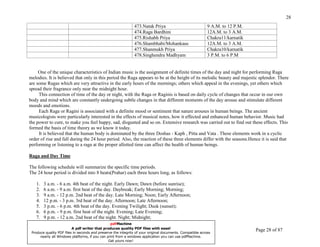
     One of the unique characteristics of Indian music is the assignment of definite times of the day and night for performing Raga
melodies. It is believed that only in this period the Raga appears to be at the height of its melodic beauty and majestic splendor. There
are some Ragas which are very attractive in the early hours of the mornings; others which appeal in the evenings, yet others which
spread their fragrance only near the midnight hour.
     This connection of time of the day or night, with the Raga or Raginis is based on daily cycle of changes that occur in our own
body and mind which are constantly undergoing subtle changes in that different moments of the day arouse and stimulate different
moods and emotions.
     Each Raga or Ragini is associated with a definite mood or sentiment that nature arouses in human beings. The ancient
musicologists were particularly interested in the effects of musical notes, how it effected and enhanced human behavior. Music had
the power to cure, to make you feel happy, sad, disgusted and so on. Extensive research was carried out to find out these effects. This
formed the basis of time theory as we know it today.
     It is believed that the human body is dominated by the three Doshas - Kaph , Pitta and Vata . These elements work in a cyclic
order of rise and fall during the 24 hour period. Also, the reaction of these three elements differ with the seasons.Hence it is said that
performing or listening to a raga at the proper allotted time can affect the health of human beings.

Raga and Day Time

The following schedule will summarize the specific time periods.
The 24 hour period is divided into 8 beats(Prahar) each three hours long, as follows:

    1. 3 a.m. - 6 a.m. 4th beat of the night. Early Dawn; Dawn (before sunrise);
    2. 6 a.m. - 9 a.m. first beat of the day. Daybreak; Early Morning; Morning;
    3. 9 a.m. - 12 p.m. 2nd beat of the day. Late Morning; Noon; Early Afternoon;
    4. 12 p.m. - 3 p.m. 3rd beat of the day. Afternoon; Late Afternoon;
    5. 3 p.m. - 6 p.m. 4th beat of the day. Evening Twilight; Dusk (sunset);
    6. 6 p.m. - 9 p.m. first beat of the night. Evening; Late Evening;
    7. 9 p.m. - 12 a.m. 2nd beat of the night. Night; Midnight;
UNDERSTANDING INDIAN CLASSICAL MUSIC          pdfMachine
                       A pdf writer that produces quality PDF files with ease!
PRABIRquality PDF files in seconds and preserve the integrity of your original documents. Compatible across
 Produce
         DATTA                                                                                                                Page 28 of 87
      nearly all Windows platforms, if you can print from a windows application you can use pdfMachine.
                                                Get yours now!
29
    8. 12 a.m. - 3 a.m. 3rd beat of the night. Late Night

      Simillarly Everyday two cycles of change pass through our body, each bringing a Vata, Pitta, or Kapha predominance.
The approximate times of these cycles are as follows:
First cycle:

         6 A.M. to 10 A.M. - Kapha
         10 A.M. to 2 P.M. - Pitta
         2 P.M. to 6 P.M. - Vata

Second cycle:

         6 P.M. to 10 P.M. - Kapha
         10 P.M. to 2 P.M. - Pitta
         2 A.M to 6 P.M. - Vata

Raga and Ritu(Seasons)

      There are Ragas associated with the rainy season,Varsha (Raga Megha and Raga Malhar), the autumn season,Basant (Raga
Basant) and the spring season (Raga Bahar). Seasonal Ragas can be sung and played any time of the day and night during the season
allotted to them. The obligation of time in case of such melodies is relaxed.
Vasanta Ritu (Spring Season)
In this season, increased kapha is liquified by the heat of sun which causes diminished agni (digestive activity) causing diseases
Grishma Ritu (Summer Season)
In this season, Sunrays become powerful. Kapha decreases vata increases day by day
Sharat Ritu (Autumn Season)
Sudden exposed to sunlight after cold season aggravates pita.
     DOSHA                    ACCUMULATION                            VITIATION                   DIMINUTION
       Kapha                          Shishir                            Vasant                       Grishma
        Pitta                        Grishma                             Varsha                        Sharad
        Vata                          Varsha                             Sharad                        Hemant

Another division of Ragas is the Classification of ragas under 6(SIX) principal Ragas,which are considered as FUNDAMENTAL
RAGAS—

UNDERSTANDING INDIAN CLASSICAL MUSIC          pdfMachine
                       A pdf writer that produces quality PDF files with ease!
PRABIRquality PDF files in seconds and preserve the integrity of your original documents. Compatible across
 Produce
         DATTA                                                                                                    Page 29 of 87
        nearly all Windows platforms, if you can print from a windows application you can use pdfMachine.
                                                  Get yours now!
30
HINDOL//DEEPAK//MEGH//SHREE//MALKAUNS//BHAIRAV.

Raga and Ritu(Seasons) Association :-

Raga                                               Ritu
Bhairav                                            Shishir
Hindol                                             Vasant
Deepak                                             Grishma
Megh                                               Varsha
Malkauns                                           Sharad
Shree                                              Hemant

Other ragas are derived from these six Ragas.The first derivatives of the Ragas are called “RAGINIS.”Each of the Six Ragas has Six
Raginis under them.All the Ragas are supposed to have been derived from their THAATS.
Every Raga has a fixed number of KOMAL(Soft) or TEEVRA(Sharp) notes from which THAAT can be recognized.
RAGA—RAGINI SYSTEM
RAGAS:-Male Ragas
RAGINI:-Female Ragas
PUTRA RAGAS:-Sons of Ragas
One of the most aesthetic aspects of Hindustani music, which either ignored or side-lined, is the Raaga-Raagini system. Medieval
musicologists like Damodar Misra, author of Sangeet Darpana, Hanuman Matta and Someshwar Matta were responsible for
popularizing this concept. This aspect is iconized in poetic form as dhyanamantram and in visual form as raagamalika paintings. A
musician is supposed to mediate on this composite visual and verbal media and derive inspiration from them. Following this he
proceeds to portray the raaga, line by line, contour by contour evoking both its outward form (rupa) and also its inbuilt attributes
(guna). For instance, the early dawn Raaga Bhairav is depicted as follows:
"Shiva seated as a sage atop Himalayas. Ganga falls on his matted locks. His head is adorned with the crescent moon. In the centre of
his forehead - the third eye which reduced Kama to ashes. Serpents twine around his body and are smeared with ashes. He holds a
trident in one hand and a skull in the other. He mounts Nandi which stands before him."
Raagas Megh and Malhar, associated with the monsoon season, are also depicted using evocative language and complemented with
lovely miniature paintings, which often provide the guiding lines for raaga elaboration:
"Megh-Malhar is a good, wise king. He dances well and enjoys the pleasures of life with gay abandon. Of a slightly dusky complexion
UNDERSTANDING INDIAN CLASSICAL MUSIC          pdfMachine
                       A pdf writer that produces quality PDF files with ease!
PRABIRquality PDF files in seconds and preserve the integrity of your original documents. Compatible across
 Produce
         DATTA                                                                                                     Page 30 of 87
        nearly all Windows platforms, if you can print from a windows application you can use pdfMachine.
                                                  Get yours now!
31
with bright shining eyes, King Megh-Malhar is dressed handsomely, wearing a tiger skin, and adorned with all kinds of bright
ornaments. He is in the company of beautiful maidens bedecked with jewels. The king dances with them to the resounding beat of
drums and clapping. The dancing and music bring forth clouds of various colours in the sky. The moving clouds thicken to the
accompaniment of thunder and lightning which brings the rain."
Similarly raagas are also associated with emotions and feelings. In the raaga-raagini system, the masculine raagas embodied and
portrayed feelings like wonder, courage and anger; while raaginis, or the feminine counterparts of the raagas, personified feelings like
love, laughter and sorrow. In Sangeet Darpana, Damodar Misra maintains that there were six raagas, which were considered as
masculine and 26 raaginis, which were feminine. The reasons for making such distinctions are not are not stated. The six masculine
raagas comprise - Shree, Vasant, Bahirav, Panchama, Megh and Nat-Narayan. Each raaga affiliates with specific raaginis - usually six
raaginis for one raaga. The raaga becomes a nayaka and the raagini the nayaki and their love-pranks were translated into miniature
paintings by artists who belonged to the Rajasthan, Mughal, Kangra and Pahadi schools of painting. These paintings were reinforced
by couplets, which describe the themes depicting the mood, the visualized figures and situations. A singer has to keep both the icon
and the couplet in mind to help him evoke the mood of the raaga. For instance, the touch of mysterious sorrow inherent in the morning
raaga Lalit is depicted in paintings, illustrating a woman waiting for her lover early in the morning and wondering with whom she
should share the dream of her night (captured poignantly in the popular bandish, Raina ka sapna). Similarly, when artists sing the
Malhar group of raagas, they evoke the dark clouds or snaking lightning seen in the raagamalika paintings and capture these
musically, using words like dhoom and jhoom and make references to damini (lightning). The onomatopoeic references to the song of
koels in spring-time raagas like Basant and Bahar, greatly punctuate the mood. Imaginative composers coalesce such visual and
symbolic details into their bandishes; and sensitive singers endeavour to transmute these pictorial and poetic details into a melodic
array. Strangely, some of the raagas depicted in the miniatures have vanished from the midst. Only the delightful pictorial depictions
of these vanished melodies remain as mute testimonies of invigorating and colourful times.
North Indian classical music, as a system, came into being around the 14th and 15th centuries with the publication of important
musical treatises like Raga Tarangini by Pandit Lochana and Raga Tatva Vibodha by Shrinivas Pandit. They wholly rejected the
raaga-raagini system and put a more studied system into place. Pandit Lochana detailed the 12 thaats or the parent-scales for the
classification of various raagas as also the 75 janya raagas, most of which are recognizable to this day. Shrinivas Pandit drew the
fundamentals of raaga formation by relating their fundamental notes to melas or thaats. The notes to be included or excluded in raagas
were rationalized using the logic of parent-scales to which they belonged. The foundation was thus set for the evolution of Hindustani
music along ways and lines different from the past.
To create any Misra raga,though the name implies combination of 2(Two) ragas or raginis,one school of thoughts suggests that
it must contain atleast a combination of minimum 3(Three) or at times more ragas which may or may not belong to the same
Thaat.

86(EIGHTY SIX) Ragas are given below with details.The details of balance Ragas are available with the writer and will be given
on request by the interested Classical music loving community on personal visit in person.
1.Raga Name: Ahir Lalita
UNDERSTANDING INDIAN CLASSICAL MUSIC          pdfMachine
                       A pdf writer that produces quality PDF files with ease!
PRABIRquality PDF files in seconds and preserve the integrity of your original documents. Compatible across
 Produce
         DATTA                                                                                                       Page 31 of 87
      nearly all Windows platforms, if you can print from a windows application you can use pdfMachine.
                                                Get yours now!
32
That Name: Purvi
Aroha: S r G m M m G M D n S’
Avaroha: S’ r’ S’ n D M D G M m G M G r ‘n ‘D r S
Jati: Sadava – Sadava
Vadi: m
Samvadi: S
Swarupa: m M G G M G r S ‘n ‘D r S
Raga Information:
Raga Ahir Lalita is a version of Raga Lalita with the “ahiranga” or the “D n S” notes in the latter half of the scale. It gives the raga a
unique flavor to the raga.

2.Raga Name: Bangala
That Name: Khammaja
Aroha: ‘N S ‘n S R m m P D n S’
Avaroha: S’ N S’ n D m m P G R m R S’
Jati: Sadava – Sampurna
Vadi: m
Samvadi: S
Swarupa: m D P m G R S R m m
Raga Information:
This is a morning raga that is found in many Bengali morning bhajans including Samsara Davanala Lida Loka. For this reason, this
raga is known by Bengalis as “Mangala Aratik raga.” This song has strong focus on ma that it is easy to lose focus on which is the real
tonic. As the morning progresses, the Pa and suddha Ni can have more presence.
3.Raga Name: Basanta
That Name: Purvi
Aroha: S G M d r' S'
Avaroha: S' N d P M G m G M G r S
Jati: Audava-Sampurna
Vadi: S
Samvadi: P
Swarupa: M d r' S' N d P M G M G
Raga Information:
The other spring time raga, besides Bahar, is Raga Basanta. It is sometimes a confusion for academic scholars of music to see how
Raga Bahar, with notes in the Kafi That, can emote the same season as Raga Basanta which is in Purvi That. Those who study ragas in
the totality scope will notice that Bahar precedes Basanta by one full prahar. Bahar, the Kafi That raga, falls in the time period where
UNDERSTANDING INDIAN CLASSICAL MUSIC          pdfMachine
                       A pdf writer that produces quality PDF files with ease!
PRABIRquality PDF files in seconds and preserve the integrity of your original documents. Compatible across
 Produce
         DATTA                                                                                                         Page 32 of 87
      nearly all Windows platforms, if you can print from a windows application you can use pdfMachine.
                                                Get yours now!
33
many Kafi That ragas exist, like Bagesri, Malhar, and Megha. Raga Basanta falls in the prahar where komal re might be more
predominant like Lalita.

Even within its own that, Basanta is unlike the rest of the family, due to the fact it is uttaranga oriented. The aroha jumps quickly to
touch the komal re in the tar saptak, its only upward allocation allowed. The downward scale has a higher preference for the
uttaranga. Following rules of raga, it’ll have to come down to middle Sa. Singers will hardly ever hit the lower Sa, and will hover on
upper notes.

4.Raga Name: Bhankara
That Name: Bhairava
Aroha: ‘N r S G m P G M D M G M D S’ N r’ S’
Avaroha: S’ r’ N D M m G m G r S
Jati: Sampurna – Sadava
Vadi: S
Samvadi: P
Swarupa: S’ r’ N D M m G m r S
Raga Information:
Raga Bhankara is a very rare and unusual raga. It has shades of evening raga Marwa and raga Bhairava, which occurs later than the
typical time for Bhairava to be sung. To make and even more confusing, this has a Lalitanga, or the consecutive use of both
madhyama forms (M m).

5.Raga Name: Bhatiyara
That Name: Marwa
Aroha: S r S S m P G M P m D P N D S'
Avaroha: S' r' N D m D N D P D P m P G r S
Jati: Sampurna – Sampurna
Vadi: m
Samvadi: S
Swarupa: S’ D m P G P G r S
Raga Information:
This is a very beautiful and ancient raga which is often debated when classifying information on this. The raga has characteristics of
Bhairava as it has faint Bhairava characteristics. However, the strengths of the notes used and that pinch of tivra Ma in the aroha make
it feel as if it is Marwa. This raga is nominally sung in the late night, however when studying each aspect of the raga, it can be in the
sung in the evening, if D was given strength. It is a beautiful union of Raga Bhairava, Marwa, and Raga Mand.

UNDERSTANDING INDIAN CLASSICAL MUSIC          pdfMachine
                       A pdf writer that produces quality PDF files with ease!
PRABIRquality PDF files in seconds and preserve the integrity of your original documents. Compatible across
 Produce
         DATTA                                                                                                         Page 33 of 87
      nearly all Windows platforms, if you can print from a windows application you can use pdfMachine.
                                                Get yours now!
34
6.Raga Name: Hindol
That Name: Kalyana
Aroha: S G M D N M D S’
Avaroha: S’ D M D N D M G M G S
Jati: Audava – Audava
Vadi: D
Samvadi: G
Swarupa: S G M D M G M G S ‘D S
Raga Information:
Raga Hindol is one of the most interesting ragas in the Hindustani musical scene. Originally, this raga comprised of four notes,
excluding the N. As four note melodies would be quite difficult to make songs, the “Ni” was included to adhere to the definition of
“raga” (i.e. minimum of five distinct notes). Therefore, this raga is a notable exception. Raga Hindol is a janak raga (raga based on
seasons) denoted for spring time. In singing this raga, one must be careful of few points.

1) Sing it according it to chalan in such a way, that over-emphasis of D and G are not made. If they are made, this raga will sound like
Sivaranjani.

2) Be very careful about doing the mînd (glissando) from S to G or vice versa. A mînd done incorrectly will confuse the listener into
believing that this raga is Sohini, or some other raga of the Marwa That.

3) Ni is not originally in the raga, as this was meant to be a four-note raga. Ni should be used the least amount of times as possible.

7.Raga Name: Lalita
That Name: Marwa
Aroha: ‘N r G m M m G M D N S’
Avaroha: N r’ N D M D M m G M G r S ‘N S
Jati: Sadava – Sadava
Vadi: m
Samvadi: S
Swarupa: ‘N r G m M m G M G r S
Raga Information:
Raga Lalita is a North Indian raga with an unusual structure. This raga has a chromatic formation of ma, with strength of suddha ma.
The uttaranga presented here uses suddha Dha, hence this raga is in Marwa that. Many musicians use komal dha instead, thus singing
Raga Lalita in Purvi that. The raga is named after the gopi, Lalita, who wakes up Krsna in the middle of the night (hence the timing of
the prahar of the raga). This raga is used in the song from the film “Meera (1979)” with the song “Jago Bansurivale.”
UNDERSTANDING INDIAN CLASSICAL MUSIC          pdfMachine
                       A pdf writer that produces quality PDF files with ease!
PRABIRquality PDF files in seconds and preserve the integrity of your original documents. Compatible across
 Produce
         DATTA                                                                                                          Page 34 of 87
      nearly all Windows platforms, if you can print from a windows application you can use pdfMachine.
                                                Get yours now!
35

8.Raga Name: Ahir Bhairava
That Name: Bhairava
Aroha: S r G m P G m D n S’
Avaroha: S’ n D P m G m r S ‘D ‘n r S
Jati: Sampurna – Sampurna
Vadi: m
Samvadi: S
Swarupa: D P-m G m r S 'D 'n r S
Raga Information:
This is a beloved raga from the Bhairava that, which has a variety of emotions attached to it. Some will find devotion, while others
find melancholy. Some find love and happiness through this raga. This raga was originally thought to be from the Carnatic raga
“Cakravaham.” The raga from the technical standpoint is known as Ahir Bhairava in the Hindustani musical scene, because it has the
Bhairavanga (G m r S) along with the Ahiranga (D n S’).

9.Raga Name: Bhairava
That Name: Bhairava
Aroha: S G m P (N) d* N S’
Avaroha: S’ N S’ (N)d* P m P G m (G)r* S’
Jati: Sadava-Sampurna
Vadi: r
Samvadi: d
Swarupa: S G m P m P G m d P G m P G m r S

Raga Information:
It is believed to be the first raga created after forming all of the seven notes. Hence, this raga is also known as adi-raga or the
primordial raga. This raga is also very dear to Lord Siva. With so much Vedic history backing this raga, it has become a very difficult
raga to sing. It is a morning raga and singing this must represent a devotional atmosphere with some element of pathos included. Many
people incorrectly relate the scale of this raga to Egyptian or Mid-Eastern melodies. Those melodies lack many of the important vakra,
or zig-zag features, of the raga. In addition, they don’t account for andolans (light shake of the notes) and mînds (glissandos). As this
raga is a difficult one, not many people sing this. Most people sing an easier night version of this raga known as Raga Kalingada.

10.Raga Name: Bhairavi
That Name: Bhairavi
Aroha: S r g m P d n S’
UNDERSTANDING INDIAN CLASSICAL MUSIC          pdfMachine
                       A pdf writer that produces quality PDF files with ease!
PRABIRquality PDF files in seconds and preserve the integrity of your original documents. Compatible across
 Produce
         DATTA                                                                                                        Page 35 of 87
      nearly all Windows platforms, if you can print from a windows application you can use pdfMachine.
                                                Get yours now!
36
Avaroha: S’ n d P m g r S
Jati: Sampurna-Sampurna
Vadi: P
Samvadi: S
Swarupa: ‘n S g m d P g m g r S
Raga Information:
This is one of the most beautiful ragas in Indian classical music. The scale, except for Sa and Pa which are immoveable, consists of all
flat notes. Even though the aroha and avaroha depict that this is a straight-chained raga, the raga is not necessarily. Bhairavi is
considered the freest raga, as there are many ways to go about performing this raga. Artists even will include vivadis, or grace notes,
to sweeten the flavor. The most common grace notes are the usage of Re and Dha. Bengali artists use Ga, especially in the Baul
bhajans. Ma and Ni are used less frequently, but are found here and there. Another factor that adds to its freedom status is that even
though it is recommended for the morning, it is really sung at any time. Usually, after a long performance, this raga is almost always
used as a grand-finale raga. Majority of classical based numbers are in Bhairavi. Even popular and folk music employ Bhairavi in
unique ways. Most of them tend to use “ma” as the strong vadi and the samvadi being “Sa.”

11.Raga Name: Desakara
That Name: Bilavala
Aroha: S R G P D S’
Avaroha: S’ D P R G R S ‘D S
Jati: Audava – Audava
Vadi: D
Samvadi: G
Swarupa: P D (n)D P G P D P
Raga Information:
Raga Desakara is one of the lesser known and one of the most confusing ragas in North Indian music. Raga Desakara shares the same
notes as Bhupali and often, it is quite difficult to tell the real difference between the two ragas. The rule of thumb is that Raga
Desakara is uttaranga oriented with D as its vadi, while Bhupali is purvanga oriented with G as its vadi. Note the svarupa of the raga
to see the orientation of the two ragas.

12.Raga Name: Gunakri
That Name: Bhairava
Aroha: S r m P d S’
Avaroha: S’ d P m r S
Jati: Audava – Audava
Vadi: P
UNDERSTANDING INDIAN CLASSICAL MUSIC          pdfMachine
                       A pdf writer that produces quality PDF files with ease!
PRABIRquality PDF files in seconds and preserve the integrity of your original documents. Compatible across
 Produce
         DATTA                                                                                                       Page 36 of 87
      nearly all Windows platforms, if you can print from a windows application you can use pdfMachine.
                                                Get yours now!
37
Samvadi: S
Swarupa: m P d P m r S

Raga Information:
This raga is a morning raga heard in the daybreak around 9 AM. The raga has heavy emotions of melancholy, pining for love, and
unity embedded in it. The vadi is Pa and emphasis on the notes Sa and Pa are used to remove any characteristics of a very similar raga
Jogiya.

13.Raga Name: Jogiya
That Name: Bhairava
Aroha: S r m P d S’
Avaroha: S’ N d P m P m (G)r S
Jati: Audava – Sampurna
Vadi: S
Samvadi: m
Swarupa: S r m (G)r S
Raga Information:
Raga Jogiya is a morning raga sung from the Bhairava family of ragas. Raga Jogiya shares its form with Raga Gunakri with its only
differences being in the harmony of S and m (as opposed to S and P), and latching Ni and Ga in the minds of the avaroha. This raga
has a more devotional atmosphere than Raga Gunakri, which has a more emotional feel.

14.Raga Name: Ramakali
That Name: Bhairava
Aroha: S G m P G m d N S’
Avaroha: S’ N d n d P M P d d P G m (G)r S
Jati: Sadava – Sampurna
Vadi: S
Samvadi: P
Swarupa: S G m P M P d n d P G m d N S’ r’ N S’ N d n d P d M P G m (G)r S

Raga Information:
Raga Ramakali (“the flower of Lord Rama”) is a raga of the Bhairava Thât that is played in the mornings. Specifically, this raga is
played around the time that Gunakri is played. The flow of Ramakali is a very unique one that differs greatly from other Bhairava
ragas. First, no other Bhairava that raga (except for schools that include Raga Lalita in this family) has a raga that contains both tivra

UNDERSTANDING INDIAN CLASSICAL MUSIC          pdfMachine
                       A pdf writer that produces quality PDF files with ease!
PRABIRquality PDF files in seconds and preserve the integrity of your original documents. Compatible across
 Produce
         DATTA                                                                                                         Page 37 of 87
      nearly all Windows platforms, if you can print from a windows application you can use pdfMachine.
                                                Get yours now!
38
Ma and suddha ma. Although the suddha ma has the stronger and frequent use, the tivra Ma slips in. This will give a “Purvi-esque”
feel to the raga. In addition, both suddha Ni and komal ni are used. The suddha Ni has the greater strength.

15.Raga Name: Vibhasa
That Name: Bhairava
Aroha: S r G P d S’
Avaroha: S’ d P G r S
Jati: Audava – Audava
Vadi: d
Samvadi: r
Swarupa: G P G P d P G r S
Raga Information:
Raga Vibhasa is a very diverse raga heard in the early morning hours, slightly before the actual prahar time. In fact, some people
classify this raga to be in the first prahar. The stability of this raga seems to be fixed on S and P, as none of the other notes can remain
on hold for a long time. Some musical gharanas, or succession, will use a D instead of d. Thus, this raga would be placed in the
Marwa That, since the properties fit the flow of a Marwa That raga than a Bhairava That. The audio clip below features both varieties.
16.Raga Name: Alankara Priya
That Name: Bhairavi
Aroha: S r g m D n S’
Avaroha: S’ n D m g r g r S
Jati: Sadava – Sadava
Vadi: m
Samvadi: S
Swarupa: S’ n S’ D n D m r g r S
Raga Information:
This morning raga is derived from the South Indian raga, Alankara Priya. It is not commonly used in North Indian musical system.
This raga omits P and emphasizes ma throughout the raga. This raga will give one a great shade of a similar raga, Charukesi.

17.Raga Name: Asavari
That Name: Asavari
Aroha: S R m P d S’
Avaroha: S’ n d P m g R S
Jati: Sampurna – Sampurna
Vadi: d
Samvadi: g
UNDERSTANDING INDIAN CLASSICAL MUSIC          pdfMachine
                       A pdf writer that produces quality PDF files with ease!
PRABIRquality PDF files in seconds and preserve the integrity of your original documents. Compatible across
 Produce
         DATTA                                                                                                           Page 38 of 87
      nearly all Windows platforms, if you can print from a windows application you can use pdfMachine.
                                                Get yours now!
39
Swarupa: R m P S’ (n)d P R m P n d P
Raga Information:
This morning raga is the representative of the Asavari That. The overall mood is perceived as either a sad raga or just a serious raga.
Raga Asavari shares a very similar scale to Raga Jaunpuri, but Asavari has more simplistic flow and fewer notes in the aroha than
Jaunpuri. Generally, most artists use suddha re for this raga. Some older artists, especially rudra vina players, use komal re instead.
Thus, this raga is known as Raga Komal Risabha Asavari.

18.Raga Name: Bairagi
That Name: Bhairava
Aroha: S r m P n S’
Avaroha: S’ n P m P m r S ‘n S
Jati: Audava – Audava
Vadi: m
Samvadi: S
Swarupa: m P n P m r 'n r S
Raga Information:
Raga Bairagi, also known as Raga Bairaga Bhairava, is a raga based on the South Indian raga, Revati. Some say this raga was
introduced by Ravi Shankar, although there are many musicians who refute this idea, saying that the origins of this raga in the North
Indian system was found well before Ravi Shankar. Nonetheless, Raga Bairagi has an enchanting and devotional property, beyond
most of the Bhairava That ragas. The raga contains five notes with a great level of harmony between each notes, S, r, m, P, n and S.
This raga is heard usually in light classical musical areas and devotional settings. Many hymns of Lord Siva are found in this raga, as
this is considered a Bhairava that.

19.Raga Name: Bhupala Todi
That Name: Todi
Aroha: S r g P d S'
Avaroha: S' d P g r g r S
Jati: Audava – Audava
Vadi: d
Samvadi: g
Swarupa: S r 'd S r g r g r S

Raga Information:
Raga Bhupala Todi is pentatonic raga sharing the same swarsthanas as Bhupala, with the only differences being the re, dha and ga are
komal instead of suddha. Due to the notes, it can be considered that this raga is either Bhairavi or Todi that. However, the svarupa
UNDERSTANDING INDIAN CLASSICAL MUSIC          pdfMachine
                       A pdf writer that produces quality PDF files with ease!
PRABIRquality PDF files in seconds and preserve the integrity of your original documents. Compatible across
 Produce
         DATTA                                                                                                      Page 39 of 87
      nearly all Windows platforms, if you can print from a windows application you can use pdfMachine.
                                                Get yours now!
40
(pakkad) of this raga, it can be deduced that this is based on more on the Todi realm, due to purvanga of the avaroha. The
characteristic “g r g r S.”

20.Raga Name: Bilas Khani Todi
That Name: Bhairavi/Todi
Aroha: S r g P d S'
Avaroha: S' r' n d m g r g r S
Jati: Audava – Sampurna
Vadi: d
Samvadi: g
Swarupa: S' r' n d,m P d n d m g r g r S
Raga Information:
Raga Bilas Khani Todi is a very interesting raga, as many confusion has come from it. This raga is based on Carnatic raga Hanumana
Todi, which is the Carnatic equivalent of North Indian Bhairavi. However, it wasn’t recognized by Bilas Khan, son of famous
musician Miyan Tansen, hence the name “Bilas-Khani Todi.” The format of the raga is very similar to ragas that are Bhairavi in notes
(no tivra ma), but have the flow of Todi. Bhupala Todi is also in this format as well.
21.Raga Name: Bilawala
That Name: Bilawala
Aroha: S G R G m P D N S'
Avaroha: S' N D n D P m G R G m G R S
Jati: Sampurna – Sampurna
Vadi: G
Samvadi: N
Swarupa: S’ D m D P D n D P m G G m R S
Raga Information:
The raga is pretty much the major scale, as it is appropriately placed in the Bilawal That. The catch is the pinch-usage of the komal ni
in the avaroha. It should not be used excessively or else it is will be confused with Raga Khamaja. This raga is so freely used that is
heard in countless forms.

22.Raga Name: Desi
That Name: Kafi
Aroha: S R m P D m P S’
Avaroha: S’ P D m P R g S R ‘n S
Jati: Audava – Sampurna
Vadi: P
UNDERSTANDING INDIAN CLASSICAL MUSIC          pdfMachine
                       A pdf writer that produces quality PDF files with ease!
PRABIRquality PDF files in seconds and preserve the integrity of your original documents. Compatible across
 Produce
         DATTA                                                                                                       Page 40 of 87
      nearly all Windows platforms, if you can print from a windows application you can use pdfMachine.
                                                Get yours now!
41
Samvadi: S
Swarupa: P g R g S R 'n S
Raga Information:
Despite its name resembling the more popular Raga Desa, the raga has nothing similar to it. Raga Desi (“countryperson”) is a Kafi
based raga with an Asavari touch to it. The most notable aspect of the avaroha has a patterned combination format downwards.

23.Raga Name: Gujari Todi
That Name: Todi
Aroha: S r g M d N S’
Avaroha: S’ N d M g r g r S
Jati: Sadava – Sadava
Vadi: d
Samvadi: g
Swarupa: M d N d M g r g r S
Raga Information:
Raga Gujari Todi is one of the most famous ragas in the Todi that. This raga lacks a Pa, thus placing all of its harmonic strength on
komal dha.

24.Raga Name: Jaunpuri
That Name: Asavari
Aroha: S R m P d m P d n S’
Avaroha: S’ n d P d m P g R S
Jati: Sadava – Sampurna
Vadi: S
Samvadi: P
Swarupa: d m P d n S’ d P d m P R m P

Raga Information:
Raga Jaunpuri is a raga very similar to Raga Asavari with the only difference being the harmonic points and the subtle de-emphasis of
ma and its upper harmony with komal ni.

25.Raga Name: Malgunji
That Name: Khammaja
Aroha: S R G m D N S'
Avaroha: S' n D P m G m g R S
UNDERSTANDING INDIAN CLASSICAL MUSIC          pdfMachine
                       A pdf writer that produces quality PDF files with ease!
PRABIRquality PDF files in seconds and preserve the integrity of your original documents. Compatible across
 Produce
         DATTA                                                                                                     Page 41 of 87
      nearly all Windows platforms, if you can print from a windows application you can use pdfMachine.
                                                Get yours now!
42
Jati: Sadava – Sampurna
Vadi: m
Samvadi: S
Swarupa: G m g R S 'N S 'D 'n S G m

Raga Information:
Raga Malgunji is a light raga from the Khamaja family of raga. This raga is considered special as this song with predominantly major
notes is sung in the morning, when ragas with komal re and komal ga are considered supreme. Depending on some artists, they will
make this raga sound more like Jhinjhoti. Others will make it sound like an altered version of Bagesri.

26.Raga Name: Nata Bhairava
That Name: Bhairava
Aroha: S R G m P d N S’
Avaroha: S’ N d P m G R S
Jati: Sampurna – Sampurna
Vadi: P
Samvadi: S
Swarupa: S R G m d P G G m R S R 'N 'd S
Raga Information:
Raga Nata Bhairava is a light raga in the Bhairava That. Its form has the svarasthanas of Raga Bhairava’s uttaranga and the purvanga
reversed. This raga is more purvanga oriented with its Sa stressed. Those who are not well versed in music will make this raga sound
like Ahir Bhairava, which has different harmonic points. In addition, the starting paces will remind one of Carukesi.

27.Raga Name: Todi
That Name: Todi
Aroha: S r g M d N S’
Avaroha: S’ N d P M g r g r S
Jati: Audava – Audava
Vadi: d
Samvadi: g
Swarupa: g M d M g r g r S
Raga Information:
Raga Todi is the representative raga of the Todi That. The realm of Raga Todi, as well as many Todi That ragas have questionable
origins. Some say the scale shown above was the original. Others believe that Todi came in two forms: Todi and Suddha Todi. Suddha
Todi is a scale to which we now know as Bhairavi. Some ragas will have the term Todi latched on, even though the scale resembles a
UNDERSTANDING INDIAN CLASSICAL MUSIC          pdfMachine
                       A pdf writer that produces quality PDF files with ease!
PRABIRquality PDF files in seconds and preserve the integrity of your original documents. Compatible across
 Produce
         DATTA                                                                                                    Page 42 of 87
      nearly all Windows platforms, if you can print from a windows application you can use pdfMachine.
                                                Get yours now!
43
Bhairavi scale. Today, Raga Todi, also known as Miyan Ki Todi, uses the Bhairavi scale with madhyama and nisada both having the
sharpened forms. In this raga, Pa is extremely weak.

Another unique feature about this raga is the special flattened form of komal re. In fact, many ragas in the Todi That have a super-
flattened komal re used.

28.Raga Name: Dhani
That Name: Kafi
Aroha: S g m P n S’
Avaroha: S' n P m g S
Jati: Audava – Audava
Vadi: g
Samvadi: n
Swarupa: g m P n P g S
Raga Information:
Raga Dhani is considered as a “sweet and romantic version of Raga Malkauns.” Raga Malkauns is very devotional in nature, while
Raga Dhani is very romantic in nature. One can study the notes and see the transposition of Malkauns’ Sa to Dhani’s Pa. To add some
difference, some musicians sparingly include shuddha Re. This has some hidden moments where it can confuse the listener to think it
is Raga Malkauns or even Raga Bhimpalasi.

29.Raga Name: Gaura Saranga
That Name: Kalyana
Aroha: S G R m G P M D P S'
Avaroha: S' N D P M P m G R G R m G P R S
Jati: Sadava – Sampurna
Vadi: G
Samvadi: D
Swarupa: S G R m G P R S
30.Raga Name: Madhuwanti
That Name: Todi
Aroha: ‘N S g M P N S’
Avaroha: S’ N D P M g M g R S
Jati: Audava – Sampurna
Vadi: P
Samvadi: S
UNDERSTANDING INDIAN CLASSICAL MUSIC          pdfMachine
                       A pdf writer that produces quality PDF files with ease!
PRABIRquality PDF files in seconds and preserve the integrity of your original documents. Compatible across
 Produce
         DATTA                                                                                                    Page 43 of 87
      nearly all Windows platforms, if you can print from a windows application you can use pdfMachine.
                                                Get yours now!
44
Swarupa: D P(M) P g M g R S
Raga Information:
Considered to be in the Todi That due to the tivra Ma and komal ga, Raga Madhuvanti is one of the ragas which bend many rules of
being classified into Bhatkhande’s ten that system. This raga emotes a feeling of sadness and distress due to the tivra Ma and komal
ga, followed by the pure notes. This raga tends to fill in the missing notes that Raga Sivaranjani does not fill.

31.Raga Name: Madhyamad Saranga
That Name: Khammaja
Aroha: ‘n S R m P n S’
Avaroha: S’ n P m R m R ‘n S
Jati: Audava – Audava
Vadi: S
Samvadi: m
Swarupa: ‘n S R m P R m R S ‘n S

Raga Information:
Although very similar to Megha, this is a lighter version which does not create the intensity or thunder feel that Raga Megha has. As
this is a Khamaja-based raga, the vivadis have greater freedom that with Raga Megha. Therefore, it is not unusual to hear an
occasional suddha Dha or suddha Ga in a light-rendition of Madhyamad Saranga. Although the name of the raga (“the honey-like
Saranga”) has nothing to with the note madhyama (“ma”), the preferred orientation is centered around ma and Pa.
32.Raga Name: Misra Gara
That Name: Kafi
Aroha: S R m P D n D S’
Avaroha: S’ n D P D m P m G R g R S
Jati: Sadava – Sampurna
Vadi: P
Samvadi: S
Swarupa: S G m P G m R g R S ‘n S
Raga Information:
This raga is heard occasionally in bhajans glorifying Lord Ramacandra by Tulsi-dasa, along with a good number of Bengali and
Gaudiya bhajans. This is a raga of the Kafi that, although its parent raga, Gara, is of the Khamaja That. The sweet feature is the trade
off weight of the suddha ga and komal ga. A common chant people relate this raga to is “Raghupati Raghava Raja Rama.”
33.Raga Name: Patdipa
That Name: Kafi
Aroha: ‘N S g m P N S’
UNDERSTANDING INDIAN CLASSICAL MUSIC          pdfMachine
                       A pdf writer that produces quality PDF files with ease!
PRABIRquality PDF files in seconds and preserve the integrity of your original documents. Compatible across
 Produce
         DATTA                                                                                                       Page 44 of 87
      nearly all Windows platforms, if you can print from a windows application you can use pdfMachine.
                                                Get yours now!
45
Avaroha: S’ N D P m g R S ‘N S g R S
Jati: Audava – Sampurna
Vadi: P
Samvadi: S
Swarupa: P N S’ D m P g m g R S
Raga Information:
Coming from the origins of Carnatic music, Raga Patdipa is essentially like a Hindustani Kafi or Raga Misra Pilu sort. The main
feature of this raga that separates it from other Kafi That ragas is that it only has suddha Ni and no instances of komal Ni. Such a
change in notes gives this a unique feel compared to other Kafi That ragas. A famous song in this raga is “Srila Prabhupada Gurudeva
Tihare Carano Men Pranam.”

34.Raga Name: Suddha Saranga
That Name: Kalyana
Aroha: ‘N S R M P N S’
Avaroha: S N P M P R m R S ‘N S
Jati: Audava – Audava
Vadi: R
Samvadi: P
Swarupa: R M P R m R S ‘N S

Raga Information:
This raga is essentially the pentatonic Saranga family of ragas under the constraint of Kalyana That notes, with the exception of
avaroha “suddha ma.”

35.Raga Name: Bhimpalasi
That Name: Kafi
Aroha: ’n S g m P n S’
Avaroha: S’ n D P D m P g m g R S
Jati: Audava – Sampurna
Vadi: m
Samvadi: S
Swarupa: ’n S g m P g m g R ’n S
Raga Information:


UNDERSTANDING INDIAN CLASSICAL MUSIC          pdfMachine
                       A pdf writer that produces quality PDF files with ease!
PRABIRquality PDF files in seconds and preserve the integrity of your original documents. Compatible across
 Produce
         DATTA                                                                                                    Page 45 of 87
      nearly all Windows platforms, if you can print from a windows application you can use pdfMachine.
                                                Get yours now!
46
This is a common raga which describes the ecstatic nature of the mid-afternoon’s time, right before the twilight ragas (sandhya-
prakasa ragas) take place. The aroha is similar to that of Raga Dhani with its pentatonic nature excluding Re and Dha. This raga is
used in many genres of Indian music from classical to popular music.

36.Raga Name: Charukesi
That Name: N/A
Aroha: S R G m P d n S’
Avaroha: S’ n d P m G R S
Jati: Sampurna – Sampurna
Vadi: P
Samvadi: S
Swarupa: G m P n d P G m G R ‘n S
Raga Information:
Raga Charukesi is a very famous raga from the Carnatic system of music. It is a seven-note raga with flat notes at dha and ni. It evokes
moods of devotion, love, or despair.

37.Raga Name: Maru Bihaga
That Name: Bilavala
Aroha: ‘N S G M P N S
Avaroha: S’ N D P M G M G R S m G P M G M G R S
Jati: Audava – Sampurna
Vadi: G
Samvadi: N
Swarupa: P G M G R S m G S G M P
Raga Information:
Maru Bihaga is an evening raga from the Kalyana That. There are two big features to note about this raga. Firstly, the name implies
that it has a relationship with Raga Bihaga. Raga Bihaga’s aroha and avaroha are similar in the respect that the notes used are the
same. However, the approach is different. In Raga Bihaga, D was used in a glance. In addition, the M and m usage was allowed a
chromatic feel. The m swar had not much of an impact in the whole scope of the raga, but it was needed. In Maru-Bihaga, D has a
little more importance. Even though it is not used as often as the purvanga, it has a full value, instead of a glimpse-value. In addition,
m has its own sustain when used in the avaroha. It is not used in a chromatic sense or even attempt to try to reproduce a chromatic feel
as Raga Bihaga does. It is a very lovely raga depicting devotion and love.


38.Raga Name: Marwa
UNDERSTANDING INDIAN CLASSICAL MUSIC          pdfMachine
                       A pdf writer that produces quality PDF files with ease!
PRABIRquality PDF files in seconds and preserve the integrity of your original documents. Compatible across
 Produce
         DATTA                                                                                                         Page 46 of 87
      nearly all Windows platforms, if you can print from a windows application you can use pdfMachine.
                                                Get yours now!
47
That Name: Marwa
Aroha: ‘N r G M D N D S’
Avaroha: N r’ N D M D M G r ‘N ‘D S
Jati: Sadava – Sadava
Vadi: r
Samvadi: D
Swarupa: D M G r ‘N ‘D S

Raga Information:
Raga Marwa is famous amongst classical musicians, as it is one of the most peculiar ragas in Indian music. The first unique feature of
this raga is that there is no Pa or suddha Ma. These two notes imply stability with the Sa. The most likely reason why Pa and suddha
ma do not take place is because, Sa, in this raga, is avoided a lot. It will be confusing for one to listen to this raga, as the tonic seems to
disappear. Thus, the mood of this raga can be said to describe anxiety or melancholy, as there is no stability. There is no harmonic
stability, as the komal re and dha form the vadi-samvadi pair. Since komal re is the vadi (the strongest note), the komal re in this
particular raga creates an otherworldly ghastly feel. Hence, another mood of this raga is fear. Lastly, this raga is the supposed
representative raga of the Marwa that. Marwa that has a Pa in it, however, Marwa’s behavior and scale is absolutely different. Usually,
almost all representative ragas will share the same notes as its that.

It is sung during the twilight hours, just in the process of the sunset. The tanpura can be tuned in two ways. The primary note can be
either D or N. Ni is usually preferred with lower pitches, while D is used with higher pitches.

39.Raga Name: Multani
That Name: Todi
Aroha: ‘N S g M P N S’
Avaroha: S’ N d P M P d M g M g r S
Jati: Audava – Sampurna
Vadi: P
Samvadi: S
Swarupa: ‘N S g M P M g M g r S
Raga Information:
Raga Multani is a very unique raga in its family of Todi ragas. Unlike most Todi ragas, this one is in the evening right before the
night. The differences are far more significant that timings. In the avaroha, the komal re is incredibly flattened that it sound so close to
Sa. It is even flatter than Gujari Todi or Raga Todi. Another unique feature is that unlike most Todi ragas, the stress is on Sa and Pa,
which has a greater harmonic strength than the ga and dha felt in Todi and Gujari Todi. Hence, this raga has different expression than
Todi’s.
UNDERSTANDING INDIAN CLASSICAL MUSIC          pdfMachine
                       A pdf writer that produces quality PDF files with ease!
PRABIRquality PDF files in seconds and preserve the integrity of your original documents. Compatible across
 Produce
         DATTA                                                                                                             Page 47 of 87
      nearly all Windows platforms, if you can print from a windows application you can use pdfMachine.
                                                Get yours now!
48

40.Raga Name: Namo Narayani
That Name: Purvi
Aroha: S r G M P d n S’
Avaroha: S’ n d P M G r S
Jati: Sampurna – Sampurna
Vadi: P
Samvadi: S
Swarupa: G M d P M d n d n P
Raga Information:
This raga is from the Carnatic system of music having its scale share the same scale as the Purvi That. The only difference is that
Namo Narayani (“Obeisances to Laksmi”) has a komal ni which has a lighter feel that its relative Purvi That. This is why one who is
used to listening to Puriya Dhanasri will not be able to digest a komal ni which further disrupts the Ga-Ni harmony Puriya Dhanasri
has.

41.Raga Name: Puriya
That Name: Marwa
Aroha: 'N r G M D N D N r' S'
Avaroha: N r' N D N M D G M G,M G r S
Jati: Sadava – Sadava
Vadi: G
Samvadi: N
Swarupa: G M D G M G M G r S 'N 'D 'N
Raga Information:
Raga Puriya, the descendent of the Marwa matrix, and the ancestor of ragas like Puriya Dhanasri and Puriya Kalyana, is the almost
forgotten raga which interestingly unusual properties. This raga behaves very similarly like Raga Marwa in the respect that it tends to
the skip the Sa, although it can tolerate some presence of Sa. However, the focal points in this raga are the Ga and Ni, while Dha is
underemphasized. It favors Ni to the point that the swarupa ends at Ni, rather than a note that has a harmonic relation with Sa. (The
notes “N”, “r”, and “M” have the most dissonant relationship with Sa.) Unlike Marwa, the mood of this raga is more playful than and
not as serious as Marwa.

42.Raga Name: Puriya Dhanasri
That Name: Purvi
Aroha: ‘N r G M d N S’ r’ S’
Avaroha: N r’ N d P M G r G r S ‘N
UNDERSTANDING INDIAN CLASSICAL MUSIC          pdfMachine
                       A pdf writer that produces quality PDF files with ease!
PRABIRquality PDF files in seconds and preserve the integrity of your original documents. Compatible across
 Produce
         DATTA                                                                                                      Page 48 of 87
      nearly all Windows platforms, if you can print from a windows application you can use pdfMachine.
                                                Get yours now!
49
Jati: Sadava – Sampurna
Vadi: P
Samvadi: S
Swarupa: ‘N r G M P M d P M G r G r S
Raga Information:
Raga Puriya Dhanasri is actually a mix of two ragas, Puriya and Dhanasri. This is one of the twilight ragas sung in the evening. Even
though most of the evening ragas like Marwa and Puriya lack the stability, this raga is one of the rare harmonically stable ragas in the
evening. Even though Sa and Pa are the strongest harmonic pair in this raga, another noteworthy pair is to consider is that of Ga and
Ni. Whenever Ga is played, the shadow of Ni comes. This actually comes from Raga Puriya, which makes up the component of this
raga. In Raga Puriya, Ga and Ni are the vadi-samvadi pair. It should come as no surprise that this pair will be apparent in this raga.
Even though there are other ragas which will use the same notes as Raga Puriya Dhanasri, the multiplex of Sa and Pa vs. Ga and Ni is
unique to this raga.

43.Raga Name: Purvi
That Name: Purvi
Aroha: N r G M d N S’
Avaroha: S’ r’ N d P M G m G M G r S’
Jati: Sadava – Sampurna
Vadi: G
Samvadi: N
Swarupa: P d P M G m G r G M G r S

Raga Information:
Raga Purvi, a rare raga, is the representative of the Purvi That. A famous song which uses this raga is from the film “Meera” called
“Karuna Suno Syam More.” The raga is like a similar raga “Puriya Dhanasri.” In fact, the inventor of the ten thats, Visnu Narayana
Bhatkhande, debated on which raga would be representative of the raga “which resembles Yaman with komal re and komal dha.”
Puriya Dhanasri is the ideal choice; however, that raga is created as a result of two ragas. Therefore, Purvi was used, which had the
flow just like Puriya Dhanasri, except with one exception: there was a shuddha ma used sparingly. The suddha ma produces a
haunting harmony with Sa, as the other strongest harmonic pair is Ga with Ni. The raga should be sung in the first part of the prahar in
conjunction with Raga Sri.
44.Raga Name: Sohini
That Name: Marwa
Aroha: S G M D N S' r' S'
Avaroha: S' N D N D, G M D M G M G r S
Jati: Sadava – Sadava
UNDERSTANDING INDIAN CLASSICAL MUSIC          pdfMachine
                       A pdf writer that produces quality PDF files with ease!
PRABIRquality PDF files in seconds and preserve the integrity of your original documents. Compatible across
 Produce
         DATTA                                                                                                       Page 49 of 87
      nearly all Windows platforms, if you can print from a windows application you can use pdfMachine.
                                                Get yours now!
50
Vadi: D
Samvadi: G
Swarupa: S' N D N D G M D N S'
Raga Information:
Raga Sohini is a hexatonic raga from the Marwa that. Unlike the two other Marwa that ragas, Marwa and Puriya, Raga Sohini starts
and ends with Sa, and has more stability on Sa. The komal re in the aroha is found in tar saptak, while it is featured once in the
avaroha. This raga tends to confuse listeners to the lines of Raga Hindol (due to the exclusion of komal re in the avaroha, lack of
komal re in svarupa) and Raga Sivaranjani (Vadi and Samvadi being D and G, confusing Da to be the Sa of Sivaranjani). The overall
mood of this raga is romantic and melancholy. It is much lighter to sing than unstable Marwa or Puriya.

45.Raga Name: Sri
That Name: Purvi (some will say Sri That)
Aroha: S r M P M P d P N S’
Avaroha: S’ r’ N d P (M)P (P)r (P)r G r S
Jati: Sadava – Sampurna
Vadi: r
Samvadi: P
Swarupa: r P M P d P (P)r G r S
Raga Information:
Sri (another name of “Laksmi”) is one of the original six “janaka-ragas.” The janaka ragas represent the six seasons of the year. This
raga represents the winter season. If one takes special note of the prahar, one will know that around this time frame, the sun sets earlier
than before, thus creating a twilight feel. Usually, the Purvi That ragas of this prahar are performed toward the latter half. This one,
however, is performed earlier in the prahar, to depict the sunset that is impending. As far as raga structure is concerned, this raga is not
like the Purvi ragas, where Ni has great importance. This raga is similar to Raga Lalita, where Sa starts the raga off. Some Vaisnava
musicians accept the Bhatkhande thats, with an additional Sri That. If this is the case, this represent the Sri That.

As far as harmonic structure is concerned, the vadi-samvadi pair is quite unusual as komal re and Pa are the vadi-samvadi pair, despite
the fact that the interval is quite unfavorable. This raga probably has the biggest mind, or glissando, from komal re and Pa.

46.Raga Name: Abhogi
That Name: Kafi
Aroha: S R g m D S’
Avaroha: S’ D m g R S
Jati: Audava-Audava
Vadi: S
UNDERSTANDING INDIAN CLASSICAL MUSIC          pdfMachine
                       A pdf writer that produces quality PDF files with ease!
PRABIRquality PDF files in seconds and preserve the integrity of your original documents. Compatible across
 Produce
         DATTA                                                                                                           Page 50 of 87
      nearly all Windows platforms, if you can print from a windows application you can use pdfMachine.
                                                Get yours now!
51
Samvadi: m
Swarupa: ‘D S m g m D D m g m g R S

Raga Information:
Raga Abhogi is derived from the Carnatic system of ragas. It is a pentatonic raga that is very close to Raga Bagesri. Unlike Bagesri,
it’s straight-chained that omits komal ni and any chance of Pa’s existence.
47.Raga Name: Bhupali
That Name: Kalyana
Aroha: S R G P D S’
Avaroha: S’ D P G R S
Jati: Audava – Audava
Vadi: G
Samvadi: D
Swarupa: S G R S ‘D S R G
Raga Information:
Raga Bhupali, also known as Bhupa, is a common evening raga describing melancholy. It is believed to be named “Bhupali”, as the
raga comes from the Bhupa area, which is near India and China. Hence, music from China, Bhutan, and Nepal all seem to have that
melodic shape in their melodies. Raga Bhupali is sometimes confused with Raga Desakara, since the ragas both use the exact same
swara set. Desakara, however, has a different swarupa, which causes it to be a different raga. The focus of this raga is on the first half,
or the purvanga, while Desakara focuses on the second half, or the uttaranga. What harmonium players tend to do to differentiate this
raga is to use a chord of D, S, and G to give Bhupali its unique flavor.

48.Raga Name: Bihag
That Name: Kalyana
Aroha: ’N S G m P N S’
Avaroha: S’ N (D) P M P G m G R S
Jati: Audava – Sadava
Vadi: G
Samvadi: N
Swarupa: ’N S G m P, P M P G m G (R)S ’N S
Raga Information:
Bihag is a famous raga found in the Kalyan That. Unlike most of the Kalyana That ragas, this raga does not really put too much
emphasis on the tivra Ma, as most other Kalyana That ragas do. The upward direction of the raga omits Re and Dha, while the
downward direction only allows a spice or bare-touch (kans-swara) of Re and Dha. This really lets Ga and Ni stand out harmonically

UNDERSTANDING INDIAN CLASSICAL MUSIC          pdfMachine
                       A pdf writer that produces quality PDF files with ease!
PRABIRquality PDF files in seconds and preserve the integrity of your original documents. Compatible across
 Produce
         DATTA                                                                                                          Page 51 of 87
      nearly all Windows platforms, if you can print from a windows application you can use pdfMachine.
                                                Get yours now!
52
and that creates a powerful tension and release format using major notes, except for Tivra Ma. Even that is no worry, as there is a
suddha ma that creates a nice buffer from the uttaranga territory of this raga.

49.Raga Name: Des
That Name: Khammaja
Aroha: S R m P N S’
Avaroha: S’ R’ n D P m G R G ‘N S
Jati: Audava – Sampurna
Vadi: R
Samvadi: P
Swarupa: R m P n D P D m G R G ‘N S
Raga Information:
Raga Des is a raga heard in the night, like all of the ragas in the Khamaja that. The origin of the name of the raga is not known,
although des means “country.” The Indian national anthem, “vande mataram” is heard in this raga. Raga Des has a special place in
Bengali folk and devotional music as many bhajans in Bengali are heard in Des. Bengali singers use komal ga when singing it the high
octaves as a grace note, but ultimately hit the high suddha ga when expressing emotion in the downfall of notes.

50.Raga Name: Hamsadhwani
That Name: Bilavala
Aroha: S R G P N S’
Avaroha: S’ N P G R S
Jati: Audava – Audava
Vadi: R
Samvadi: P
Swarupa: R G P (G)R G P N P G R S
Raga Information:
Raga Hamsadhwani is a raga which came from the Carnatic or South Indian system of music. Its flow is that of a simple pentatonic
raga. Some will try to place it in the Bilavala Thât while it has many properties and flows of the Kalyan Thât. As it is very confusing
to classify a “foreign” raga, it is often considered by musicians to be “thât-less.” Nonetheless, it is a raga many musicians use in
Hindustani music using Hindustani methods of rendering a raga.

51.Raga Name: Hemanta
That Name: Kalyana
Aroha: ‘D ‘ N S R G m D N S’
Avaroha: S’ N D P m N S’ N D m P m G R S
UNDERSTANDING INDIAN CLASSICAL MUSIC          pdfMachine
                       A pdf writer that produces quality PDF files with ease!
PRABIRquality PDF files in seconds and preserve the integrity of your original documents. Compatible across
 Produce
         DATTA                                                                                                      Page 52 of 87
      nearly all Windows platforms, if you can print from a windows application you can use pdfMachine.
                                                Get yours now!
53
Jati: Sadava – Sampurna
Vadi: m
Samvadi: S
Swarupa: D m P m G m D N D S’

Raga Information:
Raga Hemanta is a rare raga which combines the qualities of Raga Kausikdhwani (Bhinna Sadja) and elements of the Kalyana That
together. This is another pain-filled raga that is played in the night.

52.Raga Name: Jaya Jayanti
That Name: Khammaja
Aroha: S R G m P m G m P N S'
Avaroha: S' n D P m G R g R S
Jati: Sadava – Sampurna
Vadi: R
Samvadi: P
Swarupa: R g R S,'N S 'D 'n R
Raga Information:
Raga Jaya Jayanti is a famous raga used especially in Northern and Eastern portions of India. It employs the use of sandwiched suddha
ga notes and suddha ni notes. It shows shades of Kafi and Khamaja, but it is placed in the Khamaja That, due to its abundance of
Khamaja characteristics. A famous song in Raga Jaya Jayanti is Vaiyasaki Dasa’s Raga Jaya Jayanti Kirtan on his Carana Kamal
album (1994).

53.Raga Name: Kafi
That Name: Kafi
Aroha: S R g m P D n S’
Avaroha: S’ n D P m g R S
Jati: Sampurna – Sampurna
Vadi: P
Samvadi: S
Swarupa: S R R g m P
Raga Information:
Raga Kafi is the representative of the Kafi That, which produces the most versatile ragas in Hindustani music. Even though it is noted
in writing that the raga is in the sixth prahar, the style of this raga is very free. It is a straight-chained raga. Sometimes, artists will

UNDERSTANDING INDIAN CLASSICAL MUSIC          pdfMachine
                       A pdf writer that produces quality PDF files with ease!
PRABIRquality PDF files in seconds and preserve the integrity of your original documents. Compatible across
 Produce
         DATTA                                                                                                           Page 53 of 87
      nearly all Windows platforms, if you can print from a windows application you can use pdfMachine.
                                                Get yours now!
54
insert shuddha ga, komal dha, and shuddha ni for embellishment. It is okay, but use those notes very sparingly. Overdoing those notes
will make listeners think this is a different raga known as Pilu, which uses those notes frequently.

54.Raga Name: Khammaja
That Name: Khammaja
Aroha: S G m P D N S’
Avaroha: S’ n D P m G R S
Jati: Sadava – Sampurna
Vadi: G
Samvadi: N
Swarupa: G m P n D m P D m G

Raga Information:
Raga Khammaja is a representative of the Khammaja That. Notice that this raga differs from its that’s scale in the sense that suddha ni
is a standard note in the aroha. This raga is used in a wide variety of compositions, especially in Bengali and Vaisnava devotional
music. Like Raga Kafi, this really can be sung anytime, however the best time is to sing it in the sixth prahar.
55.Raga Name: Mand
That Name: Bilavala
Aroha: S G m P D N S’
Avaroha: S' S' N D P D P N D P G m G R S
Jati: Sadava – Sampurna
Vadi: G
Samvadi: D
Swarupa: G m P D N S' P N D P G G m G R S

Raga Information:
The culture of Rajasthan is shown in one way by Raga Mand. This raga uses an all major scale with a zig-zag form in its descent that
gives it unique structure. Many Bengali bhajans, as well as many Braja Bhasa bhajans are in Raga Mand. Due to its free form, it can
be sung at any time outside its prahar.

56.Raga Name: Sankara
That Name: Bilavala
Aroha: S G R G P N D S’
Avaroha: S’ N D P G P G R S
Jati: Sadava – Sadava
UNDERSTANDING INDIAN CLASSICAL MUSIC          pdfMachine
                       A pdf writer that produces quality PDF files with ease!
PRABIRquality PDF files in seconds and preserve the integrity of your original documents. Compatible across
 Produce
         DATTA                                                                                                      Page 54 of 87
      nearly all Windows platforms, if you can print from a windows application you can use pdfMachine.
                                                Get yours now!
55
Vadi: P
Samvadi: S
Swarupa: G P N (D)S’ N P G P G (R)S
Raga Information:
Raga Subha Kalyana (“auspicious fortune”), popularly known as Jana-Sammohini, is a popular raga, which was assumed to be
brought from the Carnatic system. It is essentially similar as Raga Kalavati with an additional and significant use of suddha Re. This
raga is sung in the night as the welcoming of the night. A famous bhajan in this raga is “Pathika Tuma Itno Kahiyo Jaye.”
57.Raga Name: Shyama Kalyana
That Name: Kalyana
Aroha: ‘N S R M P N S’
Avaroha: S’ N D P M P G m R S
Jati: Audava – Sampurna
Vadi: R
Samvadi: P
Swarupa: R P G m R ‘N S

Raga Information:
The “auspiciousness of night”, better known as Syama Kalyana, is a raga from the Kalyana That. While the structural information is
quite self explanatory, the special feature in this raga is the Re and Pa harmony. Hardly any raga from the Kalyana That favors such
harmony.

58.Raga Name: Tilaka Kamod
That Name: Khammaja
Aroha: ‘N S R m P (N)S’
Avaroha: P D m G R S R G ‘N ‘P ‘P ‘N S R G S
Jati: Audava – Sampurna
Vadi: S
Samvadi: P
Swarupa: S R G S ‘N ‘P ‘P ‘N S R G S

Raga Information:
Raga Tilaka Kamod is a raga welcoming the auspicious celebrations in the night. This auspicious raga has an unusual form, as the
original form of this raga is said to have four notes in aroha and avaroha starts midway barely going upwards. Due to Bharata Muni’s
standards in his musical treatise “Brhad-desi,” the raga had to include the Ni in the aroha, and the flexibility of the avaroha had to be

UNDERSTANDING INDIAN CLASSICAL MUSIC          pdfMachine
                       A pdf writer that produces quality PDF files with ease!
PRABIRquality PDF files in seconds and preserve the integrity of your original documents. Compatible across
 Produce
         DATTA                                                                                                        Page 55 of 87
      nearly all Windows platforms, if you can print from a windows application you can use pdfMachine.
                                                Get yours now!
56
incorporated. Still, the raga is still strongly purvanga based and it will barely ever hit any note beyond komal ni of the madhya saptak.
A famous bhajan in this raga is “Ohe Harinam Tava Mahima Apar.”

59.Raga Name: Tilanga
That Name: Khammaja
Aroha: S G m P N S’
Avaroha: S’ n P m G m G S
Jati: Audava – Audava
Vadi: P
Samvadi: S
Swarupa: G m P n m P N P S’ n P m G m G S G S

Raga Information:
Raga Tilanga is an evening pentatonic raga which is used in light classical music. This raga is usually sung in the late evening (around
8 or 8:30 PM) when the sun has fully set. Singing Raga Tilanga when the sun is not quite set does not create the proper atmosphere of
this raga. The pentatonic scale and the re-introduction of the Pa implies some stability in the raga. In rendering this raga, there is a
subtle point that must be adhered to prevent mistakes. The mistake many musicians tend to do is overdo the weight used on Ga. This
can force the song to sound like Raga Todi, which has a totally different mood and time.

60.Raga Name: Yaman
That Name: Kalyana
Aroha: ‘N R G M D N S’
Avaroha: S’ N D P M G R S
Jati: Sadava – Sampurna
Vadi: G
Samvadi: N
Swarupa: ‘N R G M P R G R ‘N R S
Raga Information:
Raga Yaman, also known as Raga Iman, is a night raga which is very romantic in nature. Some say its origin is from the Persian mode
“Ei’man” from which “Yaman” came about. Others say it has Vedic origins as Raga Yamuna which through time had its
pronunciation altered as Yaman. Nonetheless, this raga is often taught to beginners in North Indian music.

There is another similar raga called Yaman Kalyana, which is the exact same structure, except there is an addition of suddha ma which
is so skillfully sandwiched by a suddha ga and suddha re.

UNDERSTANDING INDIAN CLASSICAL MUSIC          pdfMachine
                       A pdf writer that produces quality PDF files with ease!
PRABIRquality PDF files in seconds and preserve the integrity of your original documents. Compatible across
 Produce
         DATTA                                                                                                        Page 56 of 87
      nearly all Windows platforms, if you can print from a windows application you can use pdfMachine.
                                                Get yours now!
57
61.Raga Name: Yaman Kalyana
That Name: Kalyana
Aroha: ‘N R G M D N S’
Avaroha: S’ N D P M G m G R S
Jati: Sadava – Sampurna
Vadi: G
Samvadi: N
Swarupa: ‘N R G M P R G m G R G R ‘N R S

Raga Information:
This is a lighter version of Raga Yaman. Unlike Raga Yaman, this raga includes an additional ma, which creates a good temporary
harmonic with Sa.
62.Raga Name: Suddha Kalyana
That Name: Kalyana
Aroha: S R G P D n S’
Avaroha: S’ n D P G P G R S ‘n ‘D S
Jati: Sadava – Sadava
Vadi: S
Samvadi: P
Swarupa: P D n D P G R S 'n 'D S


63.Raga Name: Basanta Mukhari
That Name: Bhairava
Aroha: S r G m P d n S’
Avaroha: S’ n d P m G r S
Jati: Sampurna-Sampurna
Vadi: P
Samvadi: S
Swarupa: P d n d P G m (G)r S
Raga Information:
Raga Basanta Mukhari (“face of spring”) is a raga whose scale is widely recognized in the Western and Indian musical worlds, yet
received very little to no credit as far as naming the scale is concerned. What Indian music scholars believe is that this raga might have
come from the Carnatic system, due to the inability to fit into one of Bhatkhande’s ten thats. The original presumed raga, Ragam

UNDERSTANDING INDIAN CLASSICAL MUSIC          pdfMachine
                       A pdf writer that produces quality PDF files with ease!
PRABIRquality PDF files in seconds and preserve the integrity of your original documents. Compatible across
 Produce
         DATTA                                                                                                         Page 57 of 87
      nearly all Windows platforms, if you can print from a windows application you can use pdfMachine.
                                                Get yours now!
58
Vakulabharanam, was the fourteenth melakarta of the mela system which was after the “Bhairava-equivalent” and before the “Ahir-
Bhairava equivalent.” By default, it got placed in the Bhairava category.

While the scale seems very lenient and straightforward, it should be known that this raga is generally rendered in moods other than
morning devotion. It would be quite difficult to churn the same Bhairava effect that exists with Basanta Mukhari due to the komal ni
and the overall leniency of the raga. This explains why this raga stays in lighter compositions.
64.Raga Name: Chandani Kedar
That Name: Kalyana
Aroha: S m M M P D N S'
Avaroha: S' N D P D P M m R S
Jati: Audava – Sadava
Vadi: m
Samvadi: S
Swarupa: D N D P D P M m R S
Raga Information:
Chandani Kedar (Moonlike rendition of Kedar) is essentially Raga Kedar with a point where there is consecutive usage of suddha ma
and Tivra Ma.

65.Raga Name: Chandrakauns
That Name: N/A
Aroha: 'N S g m d N S
Avaroha: S' N d m g m g S 'N S
Jati: Audava – Audava
Vadi: m
Samvadi: S
Swarupa: g m g 'N S

Raga Information:
Raga Chandrakauns is a raga similar to Raga Malkauns. It has the same pentatonic structure, with its only difference being with the
usage of ni. Komal ni is used in Malkauns, while suddha ni is used on Raga Chandrakauns. The raga is assumed to have come from
the Carnatic system. Due to its notes, it is not easily placed in a North Indian thât.

66.Raga Name: Chaya Nat
That Name: Bilavala
Aroha: S R R G m P P D P P S'
UNDERSTANDING INDIAN CLASSICAL MUSIC          pdfMachine
                       A pdf writer that produces quality PDF files with ease!
PRABIRquality PDF files in seconds and preserve the integrity of your original documents. Compatible across
 Produce
         DATTA                                                                                                      Page 58 of 87
      nearly all Windows platforms, if you can print from a windows application you can use pdfMachine.
                                                Get yours now!
59
Avaroha: S' N D P m G m R S
Jati: Sadava – Sampurna
Vadi: P
Samvadi: R
Swarupa: P R R G m P m G m R S

Raga Information:
This pure noted raga is very much similar to a natural scale lacking a Ni in the aroha and having a similar format of Raga Hamir or
Raga Kedar with a ma-Re-Sa format.

67.Raga Name: Darbari Kanhara
That Name: Asavari
Aroha: S R g* m P d* n S’
Avaroha: S’ d* n P – m P n g* m R S
Jati: Sampurna – Sampurna
Vadi: g*
Samvadi: d*
Swarupa: S R g* R S ‘d* ‘n S
Raga Information:
Raga Darbari Kanhada is a very unique raga heard in the last part of the night ragas. The raga was originally created by Miyan Tansen
in the royal court, or darbar, of Akbar. Hence, “darbari” (based on the court) is given. The raga requires andolan or a light shake for
komal ga and komal dha. Another feature is that komal ga and komal dha are flatter than usual. In playing sitar, instead of playing the
ga or dha notes, they are bent from re and pa notes respectively. The emotions of this raga are mostly romantic and joy, although
people have heard sad numbers in this raga before.

68.Raga Name: Durga
That Name: Bilavala
Aroha: S R m P D S’
Avaroha: S’ D m P D m R ‘D S
Jati: Audava – Audava
Vadi: D
Samvadi: R
Swarupa: m P D m R 'D S
Raga Information:

UNDERSTANDING INDIAN CLASSICAL MUSIC          pdfMachine
                       A pdf writer that produces quality PDF files with ease!
PRABIRquality PDF files in seconds and preserve the integrity of your original documents. Compatible across
 Produce
         DATTA                                                                                                      Page 59 of 87
      nearly all Windows platforms, if you can print from a windows application you can use pdfMachine.
                                                Get yours now!
60
This is a raga which is not played so frequently. The structure of this raga contains five notes with a harmonic pair forming at suddha
re and suddha dha. This raga has a hidden tan of Bhupali based off of ma. Famous songs in this raga include “Jaya Jaya Radha Krsna
Yugala Milan” and “Radhe Jaya Jaya Madhava Dayite.”

69.Raga Name: Gaurakha Kalyana
That Name: Khammaja
Aroha: S R m D n D D S’
Avaroha: S’ n D P D n D m R S ‘n ‘D S
Jati: Audava – Sadava
Vadi: S
Samvadi: m
Swarupa: P D n D m R (S)‘n ‘D S
Raga Information:
Raga Gaurakha Kalyana is an evening raga with elements of Raga Durga and Raga Ragesri.

70.Raga Name: Hamir
That Name: Kalyana
Aroha: S R G m (N)D N S’
Avaroha: S’ N D P M P D P G m R S
Jati: Sadava – Sampurna
Vadi: D
Samvadi: G
Swarupa: G m (N)D P M P G m R S
Raga Information:
Raga Hamir is a light raga from the Kalyana family of ragas which has characteristics of Raga Kedar with the addition of shuddha Ga
being an integral part of the raga. The special features of this raga are the use of two madhyams in the avaroha, harmony of Ga and
Dha, and the glissando connect suddha Ni and suddha Dha.

71.Raga Name: Jhinjhoti
That Name: Khammaja
Aroha: S R G m P D S’
Avaroha: S’ n D P D m G S R m G S R ’n ’D ’P ’D S
Jati: Sadava – Sampurna
Vadi: S
Samvadi: P
UNDERSTANDING INDIAN CLASSICAL MUSIC          pdfMachine
                       A pdf writer that produces quality PDF files with ease!
PRABIRquality PDF files in seconds and preserve the integrity of your original documents. Compatible across
 Produce
         DATTA                                                                                                      Page 60 of 87
      nearly all Windows platforms, if you can print from a windows application you can use pdfMachine.
                                                Get yours now!
61
Swarupa: S R m G S R ’n ’D ’P ’D S


Raga Information:
Raga Jhinjhoti is a raga from the Khamaja family of ragas. Unlike Raga Khamaja itself, where it incorporates a Suddha Ni, Raga
Jhinjhoti uses the swars of original that properly. Despite the complexity of the aroha and avaroha, it is fairy simple in form and easy
to be sung. One key thing to remember when rendering Jhinjhot is that it is purvanga based and not uttaranga based. Therefore, it
won’t be heard sung in high pitches.

72.Raga Name: Kalavati
That Name: Khammaja
Aroha: S G P D n D S’
Avaroha: S’ n D P G P G S
Jati: Audava – Audava
Vadi: P
Samvadi: S
Swarupa: G P D n D S' n D P G P G S
73.Raga Name: Katyayani
That Name: Asavari
Aroha: S R g P d S’
Avaroha: S’ R’ g’ R’ S’ d P g R S
Jati: Audava – Audava
Vadi: d
Samvadi: g
Swarupa: S’ R’ g’ R’ S’ d P R g R S
Raga Katyayani is a rare raga based off of the South Indian musical system. It behaves like Sivaranjani, except that it has a komal dha
instead of a Suddha Dha. The one komal dha will give this raga its pathos-filled characteristic. One must be careful to avoid excessive
emphasis on Pa, for this will make this raga sound like Gunakri or Jogiya of the Bhairava thât.
74.Raga Name: Kausikdhwani
That Name: Khammaja
Aroha: S R G m D N S’
Avaroha: S’ N D m G R S
Jati: Sadava – Sadava
Vadi: m
Samvadi: S
UNDERSTANDING INDIAN CLASSICAL MUSIC          pdfMachine
                       A pdf writer that produces quality PDF files with ease!
PRABIRquality PDF files in seconds and preserve the integrity of your original documents. Compatible across
 Produce
         DATTA                                                                                                       Page 61 of 87
      nearly all Windows platforms, if you can print from a windows application you can use pdfMachine.
                                                Get yours now!
62
Swarupa: S m G m (N) D N S’
Raga Information:
This rarely heard raga, also known as Bhookosh or Bhinna Sadja, is a sweet raga often used by Carnatic performers the most. There
are many theories on the origin of this raga. Kausikdhwani is the Carnatic name of the raga, so it may have emanated from the South
Indian musical system. Another theory suggests that it came from Raga Pancama. The hidden truth about this raga, which is one of the
many reasons why it’s beautiful, is that it hides few ragas in here. When doing melodic fills, known as tans, some will be reminded of
the joys of Bhairavi, the hurt in Jogiya/Gunakri, the pining feel or Yaman Kalyan, or separation through Sivaranjani. For the
additional feel, artists will use a chromatic approach by using komal and shuddha dha simultaneously.

75.Raga Name: Kedar
That Name: Kalyana
Aroha: S M P, M P D n D P S’
Avaroha: S’ D n D P, M P D P m,S R S
Jati: Audava – Sadava
Vadi: m
Samvadi: S
Swarupa: S M P, M P D P m, S R S
Raga Information:
Raga Kedar is an all time popular ragas from the Kalyana That. Unlike most of the Kalyana That ragas, this raga tends to completely
eliminate the Ga, and limits its use as a kans-swar (a sparing touch of a note). In the whole raga, both forms of Ma are used, but the
aroha only uses the Tivra Ma, while the avaroha only has its instance of suddha ma, on the final end of the downgrade. Tivra Ma. As
many Kalyana That ragas tend to bear Tivra Ma and made it well known of its use, this raga uses Tivra Ma but it does not make a
dominant presence as its siblings, Yaman, Yaman Kalyana, and Hindol, for instance, can do.

76.Raga Name: Kirvani
That Name: N/A
Aroha: S R g m P d N S’
Avaroha: S’ N d P m g R S
Jati: Sampurna – Sampurna
Vadi: S
Samvadi: P
Swarupa: ‘d ‘N S R g m P d P
Raga Information:
Raga Kirvani is assumed to have come from the Carnatic system of music. The notes of this raga, however, are so common in world
music that it is important to consider this raga. Generically, this is a harmonic minor raga which has moods of love, ultimate devotion,
UNDERSTANDING INDIAN CLASSICAL MUSIC          pdfMachine
                       A pdf writer that produces quality PDF files with ease!
PRABIRquality PDF files in seconds and preserve the integrity of your original documents. Compatible across
 Produce
         DATTA                                                                                                       Page 62 of 87
      nearly all Windows platforms, if you can print from a windows application you can use pdfMachine.
                                                Get yours now!
63
separation, and sadness. This raga is used in a great number of bhajans, such as Sri Guru Charana Kamala Bhaja Mana, Adharam
Madhuram, and Jo Tum Toro Rama.

77.Raga Name: Malkauns
That Name: Bhairavi
Aroha: S g m d n S’
Avaroha: S’ n d n d m g m g S ‘n S
Jati: Audava – Audava
Vadi: m
Samvadi: S
Swarupa: ‘n S g m g S ‘n S ‘d ‘n S
Raga Information:
This is one of the most popular ragas in classical music. It is a midnight raga with strong emphasis on ma. The overall mood is
devotional. The origin of this raga was created by Parvati when trying to calm Lord Siva after His anger.

78.Raga Name: Nanda
That Name: Kalyana
Aroha: S G m P D N P S’
Avaroha: S’ N D P M P G m D P (m)R S G m
Jati: Sadava – Sampurna
Vadi: S
Samvadi: P
Swarupa: G m D P (m)R S S G G m
Raga Information:
Raga Nanda, also known as Anandi (“happiness”) or Anandi Kalyana, shows the feeling of joy entering the night. After surpassing the
harmonic instabilities of the Purvi and Marwa raga families, the raga hits all of the major notes including one small cameo appearance
of tivra Ma in the avaroha. The one unusual feature of this raga is that this raga ends on ma, even though its harmonic points are Sa
and Pa.

79.Raga Name: Ragesri
That Name: Khammaja
Aroha: S G m D n S’
Avaroha: S’ n D G m R S
Jati: Audava – Sadava
Vadi: m
UNDERSTANDING INDIAN CLASSICAL MUSIC          pdfMachine
                       A pdf writer that produces quality PDF files with ease!
PRABIRquality PDF files in seconds and preserve the integrity of your original documents. Compatible across
 Produce
         DATTA                                                                                                       Page 63 of 87
      nearly all Windows platforms, if you can print from a windows application you can use pdfMachine.
                                                Get yours now!
64
Samvadi: S
Swarupa: G m D n S’ n D G m R S ‘n ‘D S

Raga Information:
Raga Ragesri (“queen of ragas”) is one of the mellowest ragas in Indian classical music. Raga Ragesri omits Pa completely, thus
developing strong harmonic forces on ma. The harmony of Sa and ma, as well as the harmony of Dha and Ga, creates an unusual
complex which creates a blissful overall environment. Some musicians will make a very spare use of suddha Ni, but not enough to
water down the essence of this raga. This raga is very similar to Bagesri in structure. However, Bagesri has komal ga, and has one
minor instance of Pa. The nature of this raga is devotional. The most famous composition of this raga is “He Govinda He Gopala He
Govinda Rakho Sarana.”

80.Raga Name: Sivaranjani
That Name: Kafi
Aroha: S R g P D S’
Avaroha: S’ D P g R S
Jati: Audava – Audava
Vadi: S
Samvadi: P
Swarupa: S R g P g R S ‘D S

Raga Information:
Originally from the Carnatic system of music, Raga Sivaranjani is a common meditative and deep raga which is sung in the nights. It
also represents melancholy and anguish due to the small number of notes in the raga. Sometimes, people tend to use shuddha ga in
conjunction with komal ga to create a tension-release feel. In addition, although rarely used, komal dha can be used as a grace note.
Those who play with shuddha ga and komal dha grace notes in this raga are known to be playing Raga Misra Sivaranjani, while the
notes S, R, g, P, and D only are found in pure Sivaranjani.

81.Raga Name: Subha Kalyana
That Name: Kalyana
Aroha: S R G P D n S’
Avaroha: S’ n D P G P G R S ‘n ‘D S
Jati: Sadava – Sadava
Vadi: S
Samvadi: P
Swarupa: P D n D P G R S 'n 'D S
UNDERSTANDING INDIAN CLASSICAL MUSIC          pdfMachine
                       A pdf writer that produces quality PDF files with ease!
PRABIRquality PDF files in seconds and preserve the integrity of your original documents. Compatible across
 Produce
         DATTA                                                                                                     Page 64 of 87
      nearly all Windows platforms, if you can print from a windows application you can use pdfMachine.
                                                Get yours now!
65
Raga Information:
Raga Subha Kalyana (“auspicious fortune”), popularly known as Jana-Sammohini, is a popular raga, which was assumed to be
brought from the Carnatic system. It is essentially similar as Raga Kalavati with an additional and significant use of suddha Re. This
raga is sung in the night as the welcoming of the night. A famous bhajan in this raga is “Pathika Tuma Itno Kahiyo Jaye.”
82.Raga Name: Adana
That Name: Asavari
Aroha: S R m P n m P S’
Avaroha: S’ d n P m P n g m R S’
Jati: Audava – Sampurna
Vadi: S
Samvadi: P
Swarupa: n n P m P S’ d n P


Raga Information:
Raga Adana is a late night raga which is very similar to Darbari, except it has no andolans, or light shakes, on ga and dha. Also, ga and
dha are not found in the aroha. The flow of this raga is similar to a mix of Madhyamad Saranga with Darbari. Another common vivadi
some artists use sparingly is suddha ni which enhances the Saranga mood of the raga.

83.Raga Name: Bagesri
That Name: Kafi
Aroha: ’n S g m D n S’
Avaroha: S’ n D m P D g m g R S
Jati: Audava – Sampurna
Vadi: m
Samvadi: S
Swarupa: ’n S m g m D n D m, m P D g m g R S
Raga Information:
This is a very common raga found in North Indian music. This raga puts a great amount of emphasis on ma. Unlike most ma-
emphasized ragas, this does include an instance of Pa in the avaroha. The Pa lacks the emphasis in such a way that many artists and
musicians tend to just avoid the Pa, altogether.

84.Raga Name: Megha
That Name: Kafi
UNDERSTANDING INDIAN CLASSICAL MUSIC          pdfMachine
                       A pdf writer that produces quality PDF files with ease!
PRABIRquality PDF files in seconds and preserve the integrity of your original documents. Compatible across
 Produce
         DATTA                                                                                                        Page 65 of 87
      nearly all Windows platforms, if you can print from a windows application you can use pdfMachine.
                                                Get yours now!
66
Aroha: ‘P ‘n S R* m P n* P n* S’
Avaroha: S’ R*’ n* P R m P n* P m R ‘n ‘P ‘n R* S
Jati: Audava – Audava
Vadi: R
Samvadi: P
Swarupa: S R* ‘n ‘P R* S
Raga Information:
This is a loved raga by many people. This raga is heard in the monsoon season when thunderbolts rock the sky and rain fall on the
ground. Even though on occasion, it rains in the autumn and winter seasons, the same effect of the rain is not the same. Raga Megha,
thus, was considered a janak raga. Raga Megha and a very similar raga, Raga Malhara, have very similar ecstatic properties.
According to the janak ragas, Raga Dipaka came to burn and enflame people during the summer. When the summer (June-early July)
season ended, the monsoon season started and Raga Megha extinguished the flames and fire caused by Raga Dipaka. It is truly the
raga to extinguish fires of the heart.

85.Raga Name: Puriya Kalyana
That Name: Marwa
Aroha: S r G M P M D P D N S’
Avaroha: N r’ N D M D P M G r S
Jati: Sampurna – Sampurna
Vadi: P
Samvadi: S
Swarupa: G M D P M P M G r S
Raga Information:
This raga is a mixture between two ragas: Puriya (in purvanga) and Kalyana (in uttaranga). Even though theoretically, representations
of both ragas are represented equally, the aesthetic properties give more dominance to the Kalyana feature, as the nature of this raga is
uttaranga based.

86.Raga Name: Vrindavani Saranga
That Name: Kafi
Aroha: S R m P N S’
Avaroha: S’ n P m R m R S N S
Jati: Audava – Audava
Vadi: R
Samvadi: P
Swarupa: P n P m R m R ‘N S
UNDERSTANDING INDIAN CLASSICAL MUSIC          pdfMachine
                       A pdf writer that produces quality PDF files with ease!
PRABIRquality PDF files in seconds and preserve the integrity of your original documents. Compatible across
 Produce
         DATTA                                                                                                        Page 66 of 87
      nearly all Windows platforms, if you can print from a windows application you can use pdfMachine.
                                                Get yours now!
67
Raga Information:
Raga Vrindavani Saranga is a raga from the “Saranga” class of ragas which are performed at late night. It’s scale is very similar
Madhyamad Saranga, with the N having more importance. Like the class of the Saranga ragas, it is not usual to add a grace note of D
when working with P or n.


CLASSIFICATION BY PARENT SCALES:

The more recent and mostly accepted method is the Bhatkhande That system. Musician Vishnu Narayan Bhatkhande recognized ten

parent scales, or thâ৬s, to represent the fundamental ragas in Indian music. The ten thâ৬s are as follows:

                                 THÂ৫ NAME                       WESTERN NAME                                   SCALE
                                   Asavari                           Aeolian                               S R g m P d n S’
                                   Bhairava                           None                                 S r G m P d N S’
                                   Bhairavi                         Phyrgian                                S r g m P d n S’
                                   Bilavala                          Ionian                               S R G m P D N S’
                                     Kafi                            Dorian                                S R g m P D n S’
                                   Kalyana                           Lydian                               S R G M P D N S’
                                  Khammaja                         Mixolydian                             S R G m P D n S’
                                    Marwa                             None                                S r G M P D N S’
                                    Purvi                             None                                 S r G M P d N S’
                                     Todi                             None                                 S r g M P d N S’

Note the names in parenthesis are Western equivalents of the thâ৬. The thâ৬is merely a scale. There is no emotions felt by the scale,

and scales are never performed. Only ragas are performed. All ragas in Hindustani music are attempted to confine themselves to these

ten. Even though this is the most accepted way of classifying ragas, there are some shortcomings.


UNDERSTANDING INDIAN CLASSICAL MUSIC          pdfMachine
                       A pdf writer that produces quality PDF files with ease!
PRABIRquality PDF files in seconds and preserve the integrity of your original documents. Compatible across
 Produce
         DATTA                                                                                                                 Page 67 of 87
      nearly all Windows platforms, if you can print from a windows application you can use pdfMachine.
                                                Get yours now!
68
First, just because a thâ৬has a certain name, doesn’t mean its representative raga will be the same. For example, Raga Khammaja has

an upward and downward flow as such: S R G m P D N S’ S’ n D P m G R S. Both nis are used, even though the thâ৬implies that

komal ni is used.


Secondly, it is a trend to see a raga with “deviated notes” fit into one of the ten thâ৬s. For instance, Raga Ahir Bhairava has a swar set

of S r G m P D n S’. Because of the overall flow and its striking resemblance to Bhairava, it’s placed in the Bhairava That.


Thirdly, a raga that lacks two notes can become a challenge to classify. For instance, Raga Gunakri has the notes S r m P d and S’.

From these, the two choices of thâ৬s are easily Bhairava and Bhairavi. Because of the overall flow of the raga, it’s more likely to be of

the Bhairava thâ৬than the Bhairavi thâ৬.


Lastly, there will be some ragas which will not fit at all like Raga Kirvani and Chandrakauns. They are not placed in any thâ৬, as most

of these “thâ৬-less” ragas are from the South Indian musical system.


Today, when ragas are being described, all features of classification take place. The raga-ragini system takes place by telling when to

sing it. The beauty of Indian music is that ragas are sung at particular seasons, and times of day. There are eight sets of three hours,

known as prahars. Several ragas may fit into a particular prahar, but those ragas have certain times allocated for them. The jati


UNDERSTANDING INDIAN CLASSICAL MUSIC          pdfMachine
                       A pdf writer that produces quality PDF files with ease!
PRABIRquality PDF files in seconds and preserve the integrity of your original documents. Compatible across
 Produce
         DATTA                                                                                                         Page 68 of 87
      nearly all Windows platforms, if you can print from a windows application you can use pdfMachine.
                                                Get yours now!
69
classification takes place through understanding the upward and downward flow of scales. The thâ৬is used to describe the mode and

notes used. By using these three methods, understanding ragas can make a little more sense.

BENEFIT OF CERTAIN RAGAS FOR THE HUMAN BEING


       Time                  Raga                                                      Benefit

                             Raga Bhairavi                                             emotional strength ,Devotion and Peace
       3am - 6am             Raga Bhairava                                             Peace Integration, Compassion
                             Ragas Ramakali  Jogiya                                   Peace  Serenity

                             Raga Komala Rishabha Asawari                              Serenity
                             Raga Deshkara                                             Increased Energy
                             Raga Jaita                                                Dynamism
       6am - 9am
                             Raga Gurjari Todi                                         Compassion ,Patience
                             Raga Todi                                                 Joy
                             Raga Alahiya Bilavala                                     Peace and Happiness
                             Ragas Gauda  Vrindavani Saranga                          Wisdom
                             Raga Shuddha Saranga                                      Success, Knowledge
       9am - 12pm
                             Raga Ahir Lalita                                          Joyfulness
                             Raga Vrindavani Saranga                                   Greater Energy
                             Raga Multani                                              Achievement, Affluence
                             Raga Madhuvanti                                           Happiness
       12pm – 3pm
                             Raga Samanta Saranga                                      Creativity
                             Raga Bhimapalasi                                          Life
                             Ragas Kafi  Madhuvanti                                   Creativity and Happiness
                             Raga Mishra Pilu                                          Celebration  Joyfulness
       3pm - 6pm             Raga Puriya Dhanashri                                     Relaxation
                             Raga Marwa                                                Coherence ,Happiness
                             Raga Puriya Kalyana                                       Harmony

UNDERSTANDING INDIAN CLASSICAL MUSIC          pdfMachine
                       A pdf writer that produces quality PDF files with ease!
PRABIRquality PDF files in seconds and preserve the integrity of your original documents. Compatible across
 Produce
         DATTA                                                                                                                  Page 69 of 87
      nearly all Windows platforms, if you can print from a windows application you can use pdfMachine.
                                                Get yours now!
70

                            Ragas Puriya  Rageshri                                    Harmony and Rejuvenation
                            Raga Hansadhwani                                           Celebration  Happiness
                            Raga Maru Bihaga                                           Compassion
       6pm - 9pm
                            Raga Desh                                                  Joy
                            Raga Durga                                                 Integration
                            Raga Maru Bihaga                                           Compassion
                            Raga Darbari-Kanhra                                        Restful Quality of Sleep
                            Raga Bageshvari                                            Relaxation  Rest
       9pm - 12am           Raga Gunji Kanada                                          Better Sleep
                            Raga Abhogi                                                Peaceful Slumber
                            Raga Malkaunsa                                             Restful Sleep ,Tranquility
                            Raga Sohini  Bhatiyara                                    Healthy Mind and Body
                            Raga Basanta                                               Love  Happiness
       12am – 3am           Raga Sindhu Bhairavi                                       Gentleness
                            Raga Lalita                                                Peace  Tranquillity
                            Raga Nata Bhairava                                         Serenity


ALANKARAS:-

In India, Alankar or Alankara means ornaments or adornments. In the context of Indian classical music, the application of an alankar
is essentially to embellish or enhance the inherent beauty of the genre. The earliest reference to the term Alankar has been found in
Bharata’s Natyashastra written sometime between 200 BC and 200 AD. This treatise on dramaturgy mentions 33 types of Alankars.
Subsequent musical treatises like Sharangdev’s Sangeet Ratnakar in the thirteenth century and Ahobal’s Sangeet Parijat in the
seventeenth century mention 63 and 68 types of Alankars respectively.

The Shastras or ancient texts have categorized alankars into two broad groups – Varnalankar and Shabdalankar. The former
comprised the varna based alankars of earlier times. The four Varnas, sthayi, arohi, avarohi, and sanchari were arrangements of notes
in a particular sequence or four kinds of movements among notes. Sthayi refers to halting at a single note, arohi to an upward
movement, avarohi to a downward movement and sanchari is a mixed (upward and downward) movement. This classification of
alankars related to the structural aspect of a raga. The latter classification, Shabdalankar, comprised the aesthetic aspect. It referred to
UNDERSTANDING INDIAN CLASSICAL MUSIC          pdfMachine
                       A pdf writer that produces quality PDF files with ease!
PRABIRquality PDF files in seconds and preserve the integrity of your original documents. Compatible across
 Produce
           DATTA                                                                                                         Page 70 of 87
      nearly all Windows platforms, if you can print from a windows application you can use pdfMachine.
                                                Get yours now!
71
the sound production technique utilised by either the human voice or on an instrument. Shabdalankar had a wide connotation and
would actually include everything that a performer wove both melodically and rhythmically outside the periphery of the fixed
composition. In other words, all the extempore variations that a performer created during a performance within the raga and tala limits
could be termed as alankar, because these variations embellished and enhanced the beauty of the raga, the tala and the composition.

But going by current performance practices, printed and audio material and the personal opinions of musicians and musicologists over
the last 100 to 150 years, the definition and gamut of shabdalankars seems to have changed. Besides the raga, the tala and the bandish
which are the fixed portions in a performance, the process of elaboration has been divided into several angas or stages. These stages
comprise the alaap-vistaar , behelawa, bol-bant, sargams, taans, in vilambit laya and drut laya in case of khayal and Alaap, jod and
gats in case of instrumental music. These may further vary from one gharana to another. Therefore, when we talk about alankars
today, we specifically refer to embellishments to a swar or a note.

In Indian music and especially in raga sangeet, staccato or straight isolated notes are almost unheard of. In instrumental music too,
with the exception of some instruments, the notes are never static either. Each note has some link with its preceding or succeeding
note. It is this extra note or grace note that lays the foundation of all alankars. The shrutis or microtones that are so important in raga
sangeet demand this ‘mobile’ nature of the swaras in Indian music.

In the Shastras, a grace note has been referred to as alankarik swar. When a group or cluster of notes embellishes another swar, they
form the alankarik pad. The alankars in practice today and those that have been earmarked for this page include both types.

The alankars in common use today comprise Meend (varieties of glides linking two or more notes), Kan (grace note), Sparsh and
Krintan (both dealing with grace notes - especially as applied in plucked stringed instruments), Andolan (a slow oscillation between
adjacent notes and shrutis), Gamak (heavy forceful oscillations between adjacent and distant notes), Kampit (an oscillation or a vibrato
on a single note), Gitkari or Khatka (cluster of notes embellishing a single note), Zamzama (addition of notes, with sharp gamaks) and
Murki (a swift and subtle taan-like movement).

Alankars are different sets of the swars that will enable to practice and familiarize with the different sounds.Students should practice
these till they can play them correctly without looking at the keyboard. While practicing how to play, sing-along too so that one can
improve the voice and can learn how to sing more in tune.

The term Alankar literally means an ornament or decoration; it is the repetition of musical notes from a Raga in a particular pattern.

Alankaras are of four types:-

            1.     Asthai Alankars, which returns to the initial note
UNDERSTANDING INDIAN CLASSICAL MUSIC          pdfMachine
                       A pdf writer that produces quality PDF files with ease!
PRABIRquality PDF files in seconds and preserve the integrity of your original documents. Compatible across
 Produce
         DATTA                                                                                                            Page 71 of 87
      nearly all Windows platforms, if you can print from a windows application you can use pdfMachine.
                                                Get yours now!
72
             2. Arohi Alankars, which is a ascending sequence of notes
             3. Amrohi Alankars, which is a descending sequence of notes
             4. Sanchari Alankars, which combines elements of the above types.
In the context of Indian classical music, the application of an alankar is essentially to enhance the inherent beauty of the genre. Or
we can say when a group or cluster of notes embellishes another swar, they form the alankar. There are almost 33 types of alankars
but few are being used these days.
 √ Meend is an unbroken flow of a musical progression, from higher to lower notes. When, on a fretted plucked instrument, a note is
struck and the string is pulled outwards or transversely across a fret to reach a higher note or several higher notes from that single
stroke, it is called a Meend (pronounced as meenrh). This definition is applicable to the Sitar, Surbahar, various types of Veenas and
other fretted instruments. However, the term meend now has a wider implication. It is generally understood as a glide from one note to
another, not only on the sitar or other such fretted instruments but also on other instruments as well as vocal music.
Different kinds of meends form the single most important component in raga sangeet and other forms of Indian music. Ghaseet and
Soonth also belong to the Meend family. Overall, the Meend is one of the most difficult elements in raga music. Proper rendition of
meends not only depends on the accuracy of the starting and ending swars but also on the exacting knowledge of the kan-swars of the
ragas, the speed of these meends and the accents on intermediate swars.
√Kan— Kan is the grace note of a musical composition. In order to expound the shrutis in Indian music, the swars applied in raga
sangeet are never static and rarely in staccato form except in the case of some instruments. Each note has some link with its preceding
and succeeding note. These linking notes are called grace notes or Kan-swars. The Kan-swar is never fully pronounced and is sung or
played in a very subtle manner. Kan-swars are very important for the proper rendition of a raga. In fact, two or more ragas sharing a
common note or phrase differ vastly from each other primarily due to the application of their Kan-swars. Also, a Kan-swar is very
often the starting point of a meend.
√ Sparsh--Sparsh (the technique) is a special way of playing a note on plucked stringed instruments. The direction of note is
ascending. For playing R G, the forefinger of the left-hand is placed on R and plucked and before the sound dies out, the middle or
ring finger is placed with force on G so that G is clearly audible without right-hand plucking. Here the main note is G while R is the
sparsh-swar.
√Krintan--Krintan is the opposite of Sparsh. The movement of notes in the Krintan is descending. For example in G R, the forefinger
is placed on R and the middle or ring finger is placed on G and immediately after plucking G, the finger on it is moved transversely
across the string to produce a secondary plucking (without the help of the right hand) so that R is sounded. Here, R is the main note
and G is the sparsh-swar.
√Andolan-- Andolan refers to a slow alternation between the notes and shrutis that are next to each other. The Andolan alankar is a gentle
swing or oscillation that starts from a fixed note and touches the periphery of an adjacent note. What is special about the Andolan is,
that in the course of the oscillation, it touches the microtones or shrutis that exist in between. The note that is being oscillated within
an Andolan is known as andolit swar. It must be noted that these andolit swars are raga specific and should not be applied to any raga
that uses these notes.

UNDERSTANDING INDIAN CLASSICAL MUSIC          pdfMachine
                       A pdf writer that produces quality PDF files with ease!
PRABIRquality PDF files in seconds and preserve the integrity of your original documents. Compatible across
 Produce
         DATTA                                                                                                          Page 72 of 87
      nearly all Windows platforms, if you can print from a windows application you can use pdfMachine.
                                                Get yours now!
73
√Gamak--- An important embellishment in music-making, vocal as well as instrumental. In it, musical notes are so produced as to
touch upon the lower as well as the upper adjacent notes by resorting to a vibratory mode of vocalizing or playing. A gamak can be
defined as a fast meend (spanning 2-3 notes normally) delivered with deliberate force and vigour and repeated in an oscillatory
manner. R G is a meend if it is a glide from R to G at a moderately slow tempo. But the same R G repeated twice or more at a
relatively faster tempo, often forcefully, is termed as gamak. The gamak is distinguishable from the andolan because of its faster speed
and its clearly audible starting and ending points. It is swar–based while the andolan is more shruti-based.
√Kampit--There is a school of musicians that would say kampit is a defect in the voice. A long note rendered in vibrato because
uniform sur and intensity cannot be sustained indicates a defect in the voice and should not be treated as an alankar.
A kampit has also been defined as two or more short gamaks on one swar. It is like hammering a note from an adjacent note in quick
succession that gives it a vibrato effect.
√Khatka—Gitkari-- A musical embellishment consisting of three or more notes employed quickly, forcefully, and successively. It is
used in many forms of semi-art music. When a knot or cluster of notes is sung or played very fast and with gusto to decorate or
embellish another note, it is called a khatka or gitkari. Say for example, R S S….R where the cluster, R S S embellishes R and is
applied very swiftly. In instruments, khatkas are played not only in fast meends but also with the help of a combination of krintans and
sparshs. R S in krintan and S in sparsh when played on a single stroke of the right hand can be termed as a khatka for its musical
effect.
√Zamzama-- A musical embellishment which consists of forceful and speedy employment of a number of notes. Zamzama is an urdu
word meaning ‘addition of notes’. Like a khatka, it is once again a cluster of notes, used to embellish the landing note. Unlike a
khatka, notes in a zamzama are rendered in progressive combinations and permutations. The end result sounds like a complex taan
pattern with sharp gamaks. For example, M P, M P, M M P D D P. It must be remembered that zamzamas really form an integral part
of tappa singing, where it is applied on the ‘bols’ of the song and must be applied in khayal renditions with great caution.
√Murki--- A musical embellishment consisting of a small number of notes executed in fast tempo but with tenderness and delicacy. It is
mainly used in the 'lighter' forms of music and music-making. A murki is cluster of notes that sounds like a short, subtle taan. A murki
can also comprise a series of such short clusters. A murki is less forceful than a khatka or a zamzama. A combination like R R S S
could be a murki or a khatka or the starting point of a zamzama, depending on the force of delivery.
Although some special murkis are used in khayal singing, it is really a very handy device for a thumri singer. In fact, the bols of a
thumri, the ragas they are normally set to and the mood of this form of singing especially demand the usage of murkis. Thus, thumris
are often built around this alankar.
√Combinations---


UNDERSTANDING INDIAN CLASSICAL MUSIC          pdfMachine
                       A pdf writer that produces quality PDF files with ease!
PRABIRquality PDF files in seconds and preserve the integrity of your original documents. Compatible across
 Produce
         DATTA                                                                                                       Page 73 of 87
      nearly all Windows platforms, if you can print from a windows application you can use pdfMachine.
                                                Get yours now!
74
Construction of a RAGA----
i)ALAP:-Alap is the first movement of the Raga.It is a slow,Serene movement acting as an invocation and it gradually develops the
Raga.
ii)JOR:-Jor begins with the added elements of rhythm which,combining with the weaving of innumerable melodic patterns,gradually
grains into tempo and brings the Raga to the final movement.
iii)JHALA:-Jhala is the final movement and climax.It is played with a very fast action of the plectrum that is worn on the right
fingers(FOR INSTRUMENTS IN PARTICULAR).
iv)GAT//BANDISH:-It is the fixed composition.A Gat can be in any TAL  can be spread over 2 to 16 of its rhythmic cycles in any
tempo-slow,medium or fast.A Gat,whether VOCAL or INSTRUMENTAL,has generally two sections.First part—
ASTHAYI(HIND),which opens the composition  generally confined to lower  middle octaves.The second part is called
ANTARA,which usually extends from the middle to upper octaves.
**GHARANAS:-It literally means DYNASTY.A style of singing,usually named after the geographical location it evolved from.Each
Gharana has its own focus on presentation,its own characteristicscompositions, and its interpretation of different Ragas.A Gharana
requires atleast 3(THREE) generations continuity before it is recognized as a MAJOR GHARANA.
MAJOR GHARANAS:-
i)AGRA GHARANA
ii)GWALIOR GHARANA
iii)KIRANA GHARANA
iv)JAIPUR GHARANA
v)RAMPUR SAHASWAN GHARANA
vi)PATIALA GHARANA
vii)DELHI GHARANA
viii)BHENDI BAZAR GHARANA
ix)BANARAS GHARANA
x)MEWATI GHARANA
OTHER GHARANAS:-
i)Bishnupur Gharana(Dhrupad)
ii)Emdad Khan Gharana(SITAR)
iii)Niamutullah Khan Gharana(SAROD)
iv)Gaya gharana(Hari Singh)
v)Dagor Gharana(Dhrupad)
vi)Prasaddu-Manohar Gharana
vii)Benaras tabla Gharana(Ram Sahay)
viii)Benaras Mishra Gharana(Sarengi)
ix)Betia Gharana(Dhrupad)
UNDERSTANDING INDIAN CLASSICAL MUSIC          pdfMachine
                       A pdf writer that produces quality PDF files with ease!
PRABIRquality PDF files in seconds and preserve the integrity of your original documents. Compatible across
 Produce
         DATTA                                                                                                   Page 74 of 87
      nearly all Windows platforms, if you can print from a windows application you can use pdfMachine.
                                                Get yours now!
75
x)Lucknow Tabla gharana(Bakshu)
xi)Shahjahanpur Sarod Gharana(Enayet ali khan)
xii)Atrauli Jaipur Gharana(Branch of Agra)
xiii)Kalawanta Gharana(Baiju Bawra)
xiv)Kawal Gharana(Amir Khusroo)
xv)Imdadkhani Gharana(Instrumental)
xvi)Moradabad Gharana(Instrumental)
xvii)MAIHAR GHARANA(INSTRUMENTAL----ALAUDDIN KHAN)

FORMS OF VOCAL MUSIC—TYPES OF BANDISH
i)DHRUPADDHAMAR—Oldest form ,sung with Pakhwaj in Pre Mughal period.
ii)KHAYAL—Influence of Mughal Culture,this is the modern form.
iii)TARANA—Uses mom torm bols instead of words.
iv)NATYA SANGEET—Indian Musical(Plays)
v)SAADRA—Khayal in Madhya Jhaptal,sung in Dhrupad style.
vi)THUMRI—Light form that uses romantic themes.
vii)TAPPA—Light form that has lots of small,fast tans.
viii)DADRA—Light form similar to Thumri,sung in TAAL DADRA.
ix)CHAITI AND HORI—Seasonal songs
x)GHAZAL—Light form with themes similar to blues music.
xi)TRIVATCHATURANG—Combination of Tarana,words or lyrics,sargam,tabla bol.
xii)OTHER FORMS OF DERIVED,LOCAL,SEASONAL MUSIC etc.

Taal:-Taal is considered the rhythmic basis of Indian music, be it instrumental or vocal. There are common rhythmic patterns that are
used in various combinations to create a musical composition. The taal is defined as a rhythmic structure or time measure, also known
as time cycle. Though this is supposed to remain fixed within each composition, it can be repeated in cycles and each cycle can be
divided into either equal or unequal parts. The cycle of a taal can consist of any number of beats with the minimum being 3 and the
maximum 108. Sum or the first beat of the cycle is the most important part of a taal. In fact maximum stress has to be placed on the
sum. The setting of the taal into a composition is based on the belief that as there is a perfect balance in the universe, there should be
balance in music too. The compositions based on rhythm are generally divided into simple and complicated meters. It is usually
independent of the music that goes along with it and moves in bars. The smallest unit of a taal is the matra. Musicians consider the taal
to be the pulse of Indian classical music. The following are some of the taals that are usually used by musicians:


UNDERSTANDING INDIAN CLASSICAL MUSIC          pdfMachine
                       A pdf writer that produces quality PDF files with ease!
PRABIRquality PDF files in seconds and preserve the integrity of your original documents. Compatible across
 Produce
         DATTA                                                                                                         Page 75 of 87
      nearly all Windows platforms, if you can print from a windows application you can use pdfMachine.
                                                Get yours now!
76
            Dadra is a cycle of 6 beats

            Rupak is a cycle of 7 beats

            Jhaptal is a cycle of 10 beats

            Ektal is a cycle of 12 beats

            Adha-Chautal contains 14 beats

            Teen-Tal is comprised of 16 beats

Tala is the term used in Indian classical music for the rhythmic pattern of any composition and for the entire subject of rhythm,
roughly corresponding to metre in Western music, though closer conceptual equivalents are to be found in other Asian classical
systems such as the notion of usul in the theory of Ottoman/Turkish music.

A tala is a rhythmic cycle of beats with an ebb and flow of various types of intonations resounded on a percussive instrument. Each
such pattern has its own name. Indian classical music has complex, all-embracing rules for the elaboration of possible patterns, though
in practice a few talas are very common while others are rare. The most common tala in Hindustani classical music is Teental, a cycle
of four measures of four beats each.

The tala does not have a fixed tempo but can be played at different speeds. In Hindustani classical music a typical recital of a raga falls
into two or three parts categorized by the tempo of the music - Vilambit laya (Slow tempo), Madhya laya (Medium tempo) and Drut
laya (Fast tempo). But, although the tempo changes, the fundamental rhythm does not.

Each repeated cycle of a tala is called an avartan. A tala does not necessarily have evenly divided sections (vibhagas).

Some talas, for example Dhamaar, Ek, Jhoomra and Chau talas, lend themselves better to slow and medium tempos. Others flourish at
faster speeds, like Jhap or Rupak talas. Trital or Teental is one of the most popular, since it is as aesthetic at slower tempos as it is at
faster speeds.

Various Gharanas (literally Houses which can be inferred to be styles - basically styles of the same art with cultivated traditional
variances) also have their own preferences. For example, the Kirana Gharana uses Ektaal more frequently for Vilambit Khayal while
the Jaipur Gharana uses Trital. Jaipur Gharana is also known to use Ada Trital, a variation of Trital for transitioning from Vilambit to
Drut laya. There are many talas in Hindustani music, however only a few are in common use:
UNDERSTANDING INDIAN CLASSICAL MUSIC          pdfMachine
                       A pdf writer that produces quality PDF files with ease!
PRABIRquality PDF files in seconds and preserve the integrity of your original documents. Compatible across
 Produce
         DATTA                                                                                                           Page 76 of 87
        nearly all Windows platforms, if you can print from a windows application you can use pdfMachine.
                                                  Get yours now!
77


            Name                Beats      Division        Vibhaga


Tintal (or Trital or Teental) 16        4+4+4+4           X203


Jhoomra                         14      3+4+3+4           X203


Tilwada                         16      4+4+4+4           X203


Dhamar                          14      5+2+3+4           X203


Ektal and Chautal               12      2+2+2+2+2+2 X 0 2 0 3 4


Jhaptal and Jhampa              10      2+3+2+3           X203


Keherwa                         8       4+4


Roopak                          7       3+2+2             X23


Dhadra                          6       3+3               X2

UNDERSTANDING INDIAN CLASSICAL MUSIC          pdfMachine
                       A pdf writer that produces quality PDF files with ease!
PRABIRquality PDF files in seconds and preserve the integrity of your original documents. Compatible across
 Produce
         DATTA                                                                                                Page 77 of 87
      nearly all Windows platforms, if you can print from a windows application you can use pdfMachine.
                                                Get yours now!
78


Additional Talas

Rarer Hindustani talas


   Name       Beats                  Division                              Vibhaga


Adachoutal 14         2+2+2+2+2+2+2                             X203040


Brahmtal      28      2+2+2+2+2+2+2+2+2+2+2+2+2+2 X 0 2 3 0 4 5 6 0 7 8 9 10 0


Dipchandi 14          3+4+3+4                                   X203


Shikar        17      6+6+2+3                                   X034


Sultal        10      2+2+2+2+2                                 x0230


UNDERSTANDING INDIAN CLASSICAL MUSIC          pdfMachine
                       A pdf writer that produces quality PDF files with ease!
PRABIRquality PDF files in seconds and preserve the integrity of your original documents. Compatible across
 Produce
         DATTA                                                                                                Page 78 of 87
      nearly all Windows platforms, if you can print from a windows application you can use pdfMachine.
                                                Get yours now!
79
 TERMINOLOGY
 Aarohi It means 'ascending in order', and the progression thus described indicates movement from notes of lower pitches to those of
higher.
 Abhoga It means 'till completion' and refers to the last section of musical compositions, especially in dhrupad.
 Alankara Literally means 'that which decorates or embellishes.' In music it refers to features such as a change in the sequence of
notes, their repetition, introduction of variety in timbre in one single phrase, etc. Embellishments are employed to bring in more
beauty in presentations. A broad parallel would be figures of speech in literature.
 Alap Elaboration of a musical idea contained or implicit in the original tonal phrase, rngn-frame, composition, etc.
 Antara The second section of a composition following immediately after the first and generally highlighting the upper half of the
octave-range.
 Amivadi Those notes included in a raga but different from vadi and samvadi notes.
 Ardhatala These tala-s are regarded to be less than full-fledged on account of their inherent simplicity of construction. These are
often used in folk and other non-elite categories of music.
 Ashtapadi A song-type originally composed by the poet Jayadeva in the twelveth-thirteenth century in his dance-drama Geelgovind.
The form was revived in Hindustani vocal art music for solo performances by musicians of the Gwalior school in the nineteenth
century.
  Auchar Following from the word ucchara meaning 'articulation', it mainly refers to the initial and primary spelling out of melodic
ideas in raga-presentation.
 Avanaddha Instruments featuring a membrane for cover resonators. In the science of musical instruments they are classified as
membranophones because in such instruments membranes are the primary sound-creating agents.
 Bada Khayal The Khaya-composition in Hindustani vocal music characterized by a relatively slow tempo and, hence, conducive to
expansive melodic elaborations.
 Bal Sections of elaborations in rhythm-music mainly created by changes in dynamics and accentuation of their respective sound-
syllables.
 Bandish A common term for a musical composition, though sometimes confined incorrectly to melodic music, especially of the art
category.
 Bandish-ki-thumri A type of thumri set to teentala and designed to be used in dance-performances.
 Bani Refers to the four basic styles of singing/rendering dhrupad, mainly from the repertoire of vocal art music.

UNDERSTANDING INDIAN CLASSICAL MUSIC          pdfMachine
                       A pdf writer that produces quality PDF files with ease!
PRABIRquality PDF files in seconds and preserve the integrity of your original documents. Compatible across
 Produce
         DATTA                                                                                                          Page 79 of 87
      nearly all Windows platforms, if you can print from a windows application you can use pdfMachine.
                                                Get yours now!
80
 Barabari Tempo which is in equal measure to the tala in progression.
 Bhajan A genre of vocal devotional music also presented from the concert-stage.
 Biruda A section of a composition containing salutation to the deity, guru, etc.
 Bol Units of meaningful as well as meaningless sound-syllables used to elaborate musical ideas.
 Chaiti A genre of semi-classical vocal music based on folk-songs sung to welcome the spring season in Uttar Pradesh and adjoining
areas.
 Chaturang A genre in Hindustani art music in which the sthayi, antara, sargam and sound-syllables used in tabla or pakhawaj
compositions are used in four successive sections of a four-part composition set in raga and tala.
 Chikari High-pitched strings in instruments such as the sitar, used for creating tonal-cum-rhythmic patterns in melodic elaborations.
 Chota khayal A composition in the khayal-geme usually set in fast tempo and rendered after the bada khayal.
  Deshi Apart from being the name of a popular raga, the term refers to one of the two ancient categories of music. Deshi, as opposed
to margi, was described as essentially regional, enjoyed by all and free from the rules pertaining to raga and tala. The other type of
music, namely margi was designed to please god and relied on strict adherence to rules related to raga and tala.
 Dhala Sounds or notes low in pitch.
 Dhrupad Genre in vocal art music having a nearly four-century old history. It is regarded to be the oldest form still in circulation.
  Dhuya Natyashastra refers to dhuya, as a song-type used in drama according to prescribed rules. The term seems to indicate a
relationship with dhrupad, a genre current in art music today. However, the connection between the two in tenuous.
  Dhyana The state of contemplation. The concept and some related techniques came to be associated with music, especially raga, on
account of the influence of the philosophy of tantra. As a culmination of a process, each raga was described as an icon with a definite
posture, colours, weapons, costume, etc. The musician was expected to contemplate the icon so as to help him realize the spirit of the
raga. The concept was further extended after the sixteenth century to bring into vogue the unique series of pictures Ragamala and the
picturization styles perfected therein.
  Drut It is the tempo generally described as 'fast' though there are controversies as to the exact unit of measurement employed to
determine the validity of the description. The tradition is to differentiate tempi as vilambit, madhya, and drut. The first, vilambit
(slow) is half that of the madhya (medium) in tempo. The medium tempo, in its turn, is half of the drut (fast) tempo. In other words,
Indian musicology, for many reasons settles on the concept of relative musical time as contrasted with absolute time.
  Dugun Obtained from the Sanskrit term dvigun meaning double or twice. Refers to the doubling of the speed of a melodic or
rhythmic phase.

UNDERSTANDING INDIAN CLASSICAL MUSIC          pdfMachine
                       A pdf writer that produces quality PDF files with ease!
PRABIRquality PDF files in seconds and preserve the integrity of your original documents. Compatible across
 Produce
         DATTA                                                                                                         Page 80 of 87
      nearly all Windows platforms, if you can print from a windows application you can use pdfMachine.
                                                Get yours now!
81
  Gamaka An important embellishment in music-making, vocal as well as instrumental. In it, musical notes are so produced as to
touch upon the lower as well as the upper adjacent notes by resorting to a vibratory mode of vocalizing or playing.
 Ghana The term meaning 'solid' refers to one of the four instrumental classes, the other three being avanaddha, sushira, and tala.
Members of the ghana class are technically described as idiophones or autophones as the entire body of the concerned instrument
phonates when played. The obvious examples are cymbals, rattles, gongs, and clappers. Instruments such as jhanj, kartal, morchang, and
different kinds of bells abound in India. They are mostly employed to create rhythm. Primitive, folk, devotional, and popular categories of
music use them in appreciable measure.
  Gharana A school of thought in music which determines the nature, proportion, aim, and actual rendering of each technical feature
in music-making. It is a formulation of the basic musical philosophy or ideology which influences conception, teaching, learning, perfor-
mance, reception, and codification of music in its major aspects.
  Ghazal A popular poetico-musical form of Hindustani semi-art or light music with considerable assimilation of initial Persian and
later Urdu poetic influences.
  Grama The basic gamut of notes employed in the early music-tradition.The ancient tradition was stated to have employed three grama-
s, beginning from either shadja, madhyama, or gandhara note. Later, the third grama, based on gandhara reportedly went out of vogue as it
required moving in an usually high range of notes.
  Hori A genre of light or semi-art vocal music consisting of songs describing the well-know festival of colours, holi. Songs dealing with
the same theme are also sung in the dhrupad form of art music, but then they are composed in tala dhamar and, hence, called hori-dhamar.
Their treatment naturally differs from the hori-s sung in the semi-art category. These songs mostly celebrate Lord Krishna and his amorous
play with gopi-s.
 Jamjama A musical embellishment which consists of forceful and speedy employment of a number of notes.
 Jhala A distinctive, fast-paced, climactic, and highly rhythmic patterning of higher notes normally employed in playing string-instru-
ments such as si tar.
  Jod A distinctive way of elaborating musical ideas by combining notes (often by pairing them) while moving in a tempo faster than in
the earlier phase of the non-tala section in melodic presentations on instruments such as sitar.
 Kajri A genre in semi-art vocal music. It describes the rainy season and the associated themes of separation, reunion with the beloved,
and so on. The genre, as practiced in the concert-music, is a processed form of folk songs of similar import.
 Kalbana A genre in Muslim devotional music paired with another genre known as kaul.
 Khatka A musical embellishment consisting of three or more notes employed quickly, forcefully, and successively. It is used in
many forms of semi-art music.


UNDERSTANDING INDIAN CLASSICAL MUSIC          pdfMachine
                       A pdf writer that produces quality PDF files with ease!
PRABIRquality PDF files in seconds and preserve the integrity of your original documents. Compatible across
 Produce
         DATTA                                                                                                          Page 81 of 87
      nearly all Windows platforms, if you can print from a windows application you can use pdfMachine.
                                                Get yours now!
82
  Khayal A dominant genre in Hindustani vocal art music distinguished by expanded and often improvised statements of musical ideas
made concrete mainly through the interpretation of raga, use and exploration of tala, and creation and exploration of bandish-s. The
genre, which is a late sixteenth century phenomenon, has fruitfully accommodated features of earlier forms and epitomized noteworthy
potentialities of Hindustani music as a whole. This is why it has also encouraged emergence of numerous gharana-s, styles, and efforts of
individual musicians to remain in the great traditions and, yet, carve out a niche for themselves.
 Khayalnuma A genre of Hindustani vocal art music combining features of khayal as well as tarana.
 Kutapa Bharata in Natyashastra refers to different arrangements of instrumental groups (employed in theatric presentations) as kutapa.
 Langda Dhrupad A type of dhrupad composition more flexible than normally understood, but not as free in movement as a khayal
composition.
  Lehra A fixed instrumental and melodic composition employed to provide an unvarying reference frame to the solo performance of
rhythm instruments such as the tabla,
 Madhya The term meaning 'middle' or 'medium' is used to describe the tempo, a section of compositions, a pitch-range, etc., situated
between the low and high or between the slow and fast, etc.
 Mandra A low note or range of notes.
  Manjha It refers to the middle section of compositions and means 'positioned in the middle'.
  Margi The ancient sacred music in India, it was in contrast to the deshi, the more regional and mundane kind of music prevalent in
the land. The classification became redundant after the medieval period.
  Mat School of thought. A comprehensive philosophy of music governing nature, use and codification of a considerable number of impor-
tant musical features. This term may be taken as a precursor to the contemporary concept of gharana.
  Matra Usually means 'beaf, but it is more correctly translated as measurement, the basic minimal unit for measuring and dividing
the flow of musical time which determines the tempo of music. This, in him, leads to the fundamental phenomenon of musical rhythm.
 Meend Continuous movement from higher to lower notes in (melodic) musical progression. Regarded to be an important musical
embellishment. Instruments such as harmonium are criticized because it is not possible to execute this embellishment on them.
  Mela An early term synonymous with that in art music. It is the fundamental, generative arrangement of notes both in aroha and
avaroha. The arrangement functions as the parent scale from which raga is generated. The mela system came in vogue to replace the
murchhana-system around the fifteenth-sixteenth century. Each mela was named after the important raga it generated and such a raga was
called melakarta.
 Misra The term means 'mixed' and it is used to indicate melody, etc., partaking features of more than one raga.
 Mohra A short composition played to precede the first beat of the tala-cycle introduced on tabla, etc.
UNDERSTANDING INDIAN CLASSICAL MUSIC          pdfMachine
                       A pdf writer that produces quality PDF files with ease!
PRABIRquality PDF files in seconds and preserve the integrity of your original documents. Compatible across
 Produce
         DATTA                                                                                                        Page 82 of 87
      nearly all Windows platforms, if you can print from a windows application you can use pdfMachine.
                                                Get yours now!
83
 Mudra Informative textual part of a musical composition consisting of the name of the composer.
 Mukhada In composition-texts, it is the melodic-textual phrase repeated after every completed statement of a musical idea. In tabla and
other such instruments, it indicates a short composition played before the sam, that is, the first beat of the tala-cycle.
 Murchhana The ancient mode of extending available tonal frameworks by commencing ascents and descents, ranging over seven
notes, everytime from a new note. This mode gave way to the mela or that system around the sixteenth century.
 Murti A musical embellishment consisting of a small number of notes executed in fast tempo but with tenderness and delicacy. It is
mainly used in the 'lighter' forms of music and music-making.
  Nom-tom A phase of melodic musical elaboration presented without tala by employing meaningless syllables such as nom, torn, dir,
tana. Also employed by players of musical instruments such as veena, which follow vocal music in this respect. The phase is chiefly
associated with the singers/players of the dhrupad genre.
  Nrityanuga An early classification of musical instruments was done on the basis of their accompanying functions. Instruments were,
thus, described as followers of either song, or another instrument or dance.
 Odava Consisting of five notes.
 Pada Broadly means a song. In the earlier musicological literature, however, the term referred to the textual part of a musical
composition as contrasted with the melodic and rhythmic aspects.
 Panchapalli A type of rhythmic composition on tabla, etc., consisting of five successive sections each set in a different tempo.
  Paran A major composition-type in the rhythm-music composed for pakhaivaj. It is of many kinds and an ability to extensively
elaborate a paran is recognized as a criterion for judging a player.
 Pat Variation in the tempo of notes, rhythms, etc., in arithmetical units such as double, treble, and so on of the original tempo.
  Patakshara Onomatopoetic sound-syllables employed to identify 'notional' alphabets of various instruments. For example, in tabla,
tirkid, dha, ta, na; in pakhawaj, dhingad, gadigan, dhin dhin; or in sitar, da da, dir, dir, etc., are so identified. These and such other 'letters' are
obviously expected to give us some idea of the tonal colour produced by instruments under discussion.
 Peshkar An important genre of rhythm-music in tabla-solo. It is usually played in the initial stages of the concert and consists of select,
major sound-syllables composed to provide a basic pattern affording scope for the elaboration of rhythmic ideas.
 Prabandha Musical composition or genre. It is a generic term indicating methodical arrangement of musical components such as
melody, rhythm, words, poetry, metre, etc. The contemporary term bandish is a useful equivalent.
 Qaid It means ‘imprisonment’ or 'confinement' and refers to focusing on a note to weave around it tonal patterns for elaborating raga.
 Qawwali A popular genre of Islamic devotional music which has emerged from the Sufi tradition in India.

UNDERSTANDING INDIAN CLASSICAL MUSIC          pdfMachine
                       A pdf writer that produces quality PDF files with ease!
PRABIRquality PDF files in seconds and preserve the integrity of your original documents. Compatible across
 Produce
         DATTA                                                                                                                     Page 83 of 87
      nearly all Windows platforms, if you can print from a windows application you can use pdfMachine.
                                                Get yours now!
84
  Qayada An important form of rhythm-music on tabla, rendered solo. Composed of select sound-syllables with varied complexity die
player elaborates it further to the best of his ability.
 Rabab A string instrument not much in vogue today. A rabab player is called rababiya.
 Raga The basic arrangement of the traditionally accepted thirteen notes in the musical gamut. This basic framework is elaborated
according to the established norms in Hindustani art music. Raga is a highly sophisticated concept which distinguishes Indian art
music from other melodic systems such as Arabic and Persian.
 Ragadhyana An iconographic presentation of raga-s, probably inspired and influenced by the tantra philosophy. Coupled with shloka-s
describing raga-images these iconographic presentations were expected to help performers contemplate in order to effectively render the
concerned raga-s. This 'practical' aspect of the phenomenon was, however, soon relegated to the background. The ragadhyana tradition soon
merged into the later pictorial tradition of the Ragamala paintings.
  Ras A rare compositional variety of tarana in which sound-syllables from the dance-repertoire are composed in a certain raga and
tola.
 Rela A fast-paced compositional type for membranophonic instruments, especially the tabla and the pakhawaj.
 Rishabha The second note in the traditional gamut of musical notes.
 Sadra A sub-type of khayal in Hindustani art music composed in tola jhaptala.
 Sam The first beat of any tala-cycle. In the early tradition, one of the three ways of establishing a relationship between the beginnings
of the song and the tala-cycle was known as sama, indicating thereby an exact correspondence of the melodic and rhythmic cycles.
 Sampurna Consisting of the seven notes of the basic scale, the term is employed to describe raga-s having seven notes.
  Samvadi Notes in the basic musical gamut are divided in four classes according to their relative importance in the raga concerned. Vadi
is the most important, and samvadi, the next in order of importance, holds 'conversation' with the vadi. Anuvadi forms the third class and
consists of all other notes included in the raga. The fourth class- viadi- refers to those notes which are nearly excluded or very rarely used.
  Sanchari An early tradition of musical genres (still relevant to dhrupad-music) prescribed four subsections to a composition and
identified them as sthayi, antara, sanchari, and abhoga.
  Sansthana An early term synonymous with the modern term that which means a generative framework of seven notes arranged by
selectively including/omitting certain notes. These frameworks are used to extract raga-frames elaborated in music-making. Obviously,
that-s themselves are not expected to be presented as music. They merely function as launching-pads for the music to be created. The use
of the term marks an end to the murchhana system of music-making prevailing till about the sixteenth century.
  Sargam A short term indicating the gamut of notes included in music-making. It is also a name for a technique of music elaboration
in vocal music. In it, the note-names are themselves sung to make concrete the musical idea.

UNDERSTANDING INDIAN CLASSICAL MUSIC          pdfMachine
                       A pdf writer that produces quality PDF files with ease!
PRABIRquality PDF files in seconds and preserve the integrity of your original documents. Compatible across
 Produce
         DATTA                                                                                                             Page 84 of 87
      nearly all Windows platforms, if you can print from a windows application you can use pdfMachine.
                                                Get yours now!
85
 Sargamgeet A music composition made with the names of the notes used as components. That is to say, it does not have words.
 Sath Accompaniment in music-making, whether melodic, rhythmic, instrumental or vocal.
 Sawan Hindola Name of a genre of songs sung to welcome the rainy season. As the name suggests, the songs often describe swings
and their role in merry-making.
 Seedhi The term means 'straight-moving' and refers to rhythmic and melodic movement of a kind.
  Shabda Normally understood as 'word' in compositions, etc. In a larger philosophical perspective, the word is explained as 'the property of
the ether and the experience of the ear.'
 Shadava Consisting of six notes.
 Sher A couplet in the Urdu verse-form identified as ghazal.
 Shuddha that The that consisting of shuddha, that is, not augmented or flattened notes.
 Sruti Microtonal interval.
  Sthayi With reference to the fundamental arrangement of notes, it is a repetition of the same note. As a name of the compositional section, it
refers to the first section which normally covers the lower half of the octave space (for example, as in khayal).
 Sur Swam, that is, note.
 Suravarta A composition of note-names usually used to initiate a trainee in the intricacies of raga.
 Sushira According to Indian musicology it is the name of the class of instruments which produce sound by blowing air through sound-
holes. Instruments falling under this class are called aerophones.
 Swara Musical note.
  Swaragrama The fundamental arrangement of notes in a scale in ancient Indian musicology. Depending on the name of the first note, that is
the note from which the basic scale began, early Indian practice identified three swaragrama-s as shadjagrama, madhyamagrama, and
gandharagrama respectively.
 Swarartha A medieval compositional genre in which names of the intended notes (preferably in short forms) were used to compose
and present a piece.
 Tabli A wooden or metallic surface of the resonator of musical instruments, especially tata, that is those technically known as chordo-
phones.
  Tala A highly processed and generative arrangement of beats' in a certain tempo expected to provide an unvarying time-cycle for me-
lodic as well as rhythmic elaboration*.

UNDERSTANDING INDIAN CLASSICAL MUSIC          pdfMachine
                       A pdf writer that produces quality PDF files with ease!
PRABIRquality PDF files in seconds and preserve the integrity of your original documents. Compatible across
 Produce
         DATTA                                                                                                              Page 85 of 87
      nearly all Windows platforms, if you can print from a windows application you can use pdfMachine.
                                                Get yours now!
86
 Talapani A specialist person engaged in keeping rhythm through the actions of hands and fingers in a prescribed manner.
 Tan or taal Normally understood as the fast-paced musical and melodic elaborations in Indian music, vocal as well as instrumental.
 Tapkhayal A genre of vocal music which combines the features of tappa and khayal.
  Tappa A compositional genre in Hindustani vocal music reportedly inspired by the camel-drivers' songs in Punjab and adjoining
areas.
 Tar Usually refers to the highness of pitch. It also means a string, especially of metal.
 Taraf Sympathetic string in instruments such as sitar.
 Tarana A vocal genre in art music consisting chiefly of meaningless syllables.
  Tata According to Indian classification of instruments the class which produces sound through vibrating strings. Technically,
instruments of the class are known as chordophones.
 Tenaka In the early tradition, meaningless sounds—tenashabda—were regarded auspicious and used in composing music.
 Thapiya A style of playing membranophonic instruments such as pakhawaj with open palms.
 That See sansthana.
 Theka The basic composition for rhythm instruments such as tabla. It concretizes the otherwise abstract entity of tala.
  Thok A phase in melodic metallic elaboration on instruments such as sitar. In it, strokes on the wooden or the metallic body of the
instrument play a significant role in shaping the elaborated musical idea.
 Thumri An important form of 'light-classical' vocal music mainly characterized by the freedom it takes from the tala and raga rules in art
music, as also by its depiction of various moods associated with the sentiment of love.
 Tihai Repeating a phrase, etc., thrice for artistic effect in melodic as well as rhythmic music.
  Tipalli A composition in rhythm-music consisting of three different tempi, that is, tempo-changes or variations within a single piece,
especially for tabla.
 Tivra Pitchwise, the highest state of two notes that is, madhyama and nishad in the accepted gamut is described as tivra. Its literal
meaning is 'sharp'.
 Tivratara In the early tradition of microtonal intervals, notes higher than the tivra were known as tivratara.
 Toda A genre in the music composed for tabla and sitar.
 Tuk Section of a composition as in dhrupad, etc.

UNDERSTANDING INDIAN CLASSICAL MUSIC          pdfMachine
                       A pdf writer that produces quality PDF files with ease!
PRABIRquality PDF files in seconds and preserve the integrity of your original documents. Compatible across
 Produce
         DATTA                                                                                                          Page 86 of 87
      nearly all Windows platforms, if you can print from a windows application you can use pdfMachine.
                                                Get yours now!
87
 Udgraha An early term referring to the first section of a composition.
 Uparaga Term for a raga derived from another raga regarded more basic.
 Uthan Refers to the opening passage of rhythmic composition.
  Vadi The term indicates a note which is central to a particular raga. The majority of the elaborated patterns in that raga are woven around
it. Also see anuvadi, samvadi, and vivadi.
 Vadya Musical instrument. Literal meaning, 'that which is played upon'.
  Varna The four basic ways of organizing musical tones, viz. sthayi (repeated), arohi (ascending), avarohi (descending), and sanchari
(a mix of all the three).
 Vibhasha An early term referring to a sub-type of the main raga. Vilambit Slow in tempo. Also see madhya and drut. Vilambit-Alap
Musical elaboration, that is, alap in slow tempo.
 Vistara Elaboration. Chiefly refers to melodic as distinguished from rhythmic ideas.
 Vivadi Notes not included or used very rarely in a raga.


UNDERSTANDING INDIAN CLASSICAL MUSIC          pdfMachine
                       A pdf writer that produces quality PDF files with ease!
PRABIRquality PDF files in seconds and preserve the integrity of your original documents. Compatible across
 Produce
         DATTA                                                                                                            Page 87 of 87
      nearly all Windows platforms, if you can print from a windows application you can use pdfMachine.
                                                Get yours now!

Pkd Classical Uptodate 220809

  • 1.
    1 UNDERSTANDING INDIAN CLASSICAL MUSIC COMPILED BY PRABIR DATTA UNDERSTANDING INDIAN CLASSICAL MUSIC pdfMachine A pdf writer that produces quality PDF files with ease! PRABIRquality PDF files in seconds and preserve the integrity of your original documents. Compatible across Produce DATTA Page 1 of 87 nearly all Windows platforms, if you can print from a windows application you can use pdfMachine. Get yours now!
  • 2.
    2 PREFACE This document does not need any introduction.This is itself a self explanatory and a compilation document on Indian Classical Music & Tala.Many of my friends and relatives asked me why I am compiling this document with so much of strain and pain at this age.I am touching 63(sixty three) years.I am also engaged in my Engineering Consultancy work & that is why this work is delayed.I am collecting the materials for more than last 12 to 15 years or may be more,I don’t remember.My personal feeling is that it may not be mandatory for anyone of any profession,that he or she must be a renowned person or a performer of the classical music and belong to the same community.He or she may be a good& avid listener,learner,reader,collector&so on.He or she may understand the music in his/her own way of learning,grasping,updating self,diligent reading,listening to great maestros etc. I took up this work in the same light.After scruitinising a number of course study materials,I observed that the published books cover mainly the college and university syllabus,which contain a few common ragas,raginis& even talas& those are not always very illustrative and complete in nature.More so,one cannot find many ragas compiled at one place with their timings&seasons of performance.All are lying scattered through in a number of literatures& even in the form of manuscripts.I had to search extensively in libraries,acquaintances,websites of Indian and foreign origins.Also,it is very difficult to get hold of the renowned people in the community due to their commitments&paucity of time,to get some of my queries answered.I could not.Everything,I had to find out of my own interest.While carrying with the work,my personal experience is that though Indian performers are the best in the world for Indian classical music,the research work carried out remains far better&scientific in the foreign countries than that in India. Still,one question remains—Why I took up this task? A bit of explanation and background is necessary,I feel. I am extremely fortunate and blessed for being born in a joint family full of musical talents.Revered Late Nikunja Behari Dutta of Baje Shibpur,Howrah,West Bengal, India,was a renowned Classical& Tappa singer in his time.It was said that he could play all the instruments related to Indian classical music.His name was associated with respected late Kalipada Pathak,the great Bangla tappa singer. He was the uncle of my late father-Prabhakar Dutta.Revered Late Baroda Kanta Dutta of our family was also a renowned Pakhwaji during his time.He was also another uncle of my father.My grand father,revered late Manmatha Nath Dutta,was having very sweet voice and under training with his brothers,he sang a few very good songs.He died at a very early age & my father had to stay with his maternal uncles Boses at Jhamapukur area.There my father learnt classical vocal as a pupil of Revered late Sachin Das Motilal.He was also in close association with Revered late Murari Dutta and Bibhuti Dutta.But for his social and family commitments& responsibilities,he had to join service and after about 15 years of learning classical music,he could not take the music UNDERSTANDING INDIAN CLASSICAL MUSIC pdfMachine A pdf writer that produces quality PDF files with ease! PRABIRquality PDF files in seconds and preserve the integrity of your original documents. Compatible across Produce DATTA Page 2 of 87 nearly all Windows platforms, if you can print from a windows application you can use pdfMachine. Get yours now!
  • 3.
    3 much forward forhimself.But even at old age also, he used to sing for his own enjoyment and for the family members only but not for earning. I am also blessed with the fact that,one of my aunt(PISHIMA) Smt.Uttara Devi alias Uma Ghosh was a regular artist for Kirtans in the All India Radio,Calcutta(now AKASHBANI,KOLKATA) & she was a very renowned Kirtan singer of her time.My another aunt was a short span singer in the AIR,Calcutta-Smt.Sunanda Devi alias Aparajita Ghosh,who could not continue for long due to commitments in the family.All the family members, mentioned above,had the distinction of recording their songs at the PATHEPHONE CO.,GRAMOPHONE CO.,HINDUSTAN RECORDING CO.etc.We had a few of them in our collection but some of the records had been taken on loan by some persons but never returned back and majority of the recordings had been spoiled by the passage of time. There were others in our family also,who had beautiful GOD gifted voices and knowledges of classical music but did not care much about their genius.So,for us,the kids in the family,music was not the cup of tea and we had chosen different professions for bread earning.But,we,from our very childhood,were blessed to get the rare opportunity to hear beautiful songs of all types,from morning to night,at our home.Even our domestic help,sometimes in the morning, during cleaning the utensils,could sing a line or two of”Guru Bina Kaise Guna Gabe”or”Phula Rahi Belaria”etc.At times,we used to accompany our seniors to attend musical soirees,specially classical.This scenario has given us a deep insight,inclination&interest in Indian Classical.Though I am not a so called performer,yet I can identify good performances and love to hear great maestros as well as present Ustads&Pandits of the class of music. It is my passion and a no. of good collection keep me busy in listening to them. One day one of our close family friend,Smt.Shyamali Sarkar,a retired English teacher of Bethune Collegiate School, told me that she liked listening to the classical music but she did’nt understand what it was all going on during the rendition. This is the incident that struck to me and led me to compile a kind of writeup,which will be easily understandable about— HOW,WHY,WHEN,WHAT—of Indian classical music for the commoners,the theory and the science behind it.Deliberately,the chapterisation has not been made so that this document remains a seamless reading material for one and all. While making this compilation,I thought that when I am compiling something,let me explore into some more areas and I really drowned into the deep sea of unknown depth.Therefore,to cut short,I stopped somewhere in between, where I don’t know.I could be able to gather only 478 nos Ragas &those have been put into the THAAT/RAGA classification with time.86 Ragas have been briefly detailed and the rest are in my record.When I shall get sufficient time,I intend to put all of them in this single collection.Any body interested may contact me,if need so arises. The cover picture, I have chosen,is a painting drawn by my daughter at the age of 12 or 13 years. UNDERSTANDING INDIAN CLASSICAL MUSIC pdfMachine A pdf writer that produces quality PDF files with ease! PRABIRquality PDF files in seconds and preserve the integrity of your original documents. Compatible across Produce DATTA Page 3 of 87 nearly all Windows platforms, if you can print from a windows application you can use pdfMachine. Get yours now!
  • 4.
    4 I am greatlyindebted to Bhaskar of Shrutinandan,Ms.Ratnabali Bose of ITC—SRA and many others whose names will make another big book.But a special mention should be made for my cousin,Sri Sebabrata Ghosh of P.K.Raichowdhury lane,Botanical Garden ,Howrah,West Bengal,India,who was an engineer by profession and was a very good Sarod player by passion,a pupil of Late revered Ravi Laha of Howrah.He painstakingly went through the manuscript and guided me all through and his wife, loving BOURANI,for serving me with refreshments during the visits I made and disturbed them.Needless to mention about RUBY DI &B.N.GHOSH DA,who took all the pain & printed out my first copy by emptying the whole printer ink cartridge,for onward transmission to my cousin for his appraisal. I enjoyed full support from my family members all through in completing this compilation document,adjusting with the high and lows of my temperament. If this document serves the purpose of easy understanding of the subject for commoners and increase the population of Indian Classical Music lovers and audience,then I shall feel greatly accomplished.This document will be continually revised with the help of corrective suggestions from one and all.Any discrepancy found in this document may please be intimated for which I shall remain ever grateful to the critics and music lovers. Kolkata/Hyderabad PRABIR DATTA 22nd August,2009 Mobile No.-- 09903886778 E mail:datta.pk2003@gmail.com UNDERSTANDING INDIAN CLASSICAL MUSIC pdfMachine A pdf writer that produces quality PDF files with ease! PRABIRquality PDF files in seconds and preserve the integrity of your original documents. Compatible across Produce DATTA Page 4 of 87 nearly all Windows platforms, if you can print from a windows application you can use pdfMachine. Get yours now!
  • 5.
    5 This document is dedicated To My deceased parents And Shakuntala(Wife),Anindita(Daughter) and Abhishek(Son) And My Predecessors,Brothers,Sisters and Cousins of DUTTA family of Baje Shibpur,Howrah,India And All the Classical Music Lovers UNDERSTANDING INDIAN CLASSICAL MUSIC pdfMachine A pdf writer that produces quality PDF files with ease! PRABIRquality PDF files in seconds and preserve the integrity of your original documents. Compatible across Produce DATTA Page 5 of 87 nearly all Windows platforms, if you can print from a windows application you can use pdfMachine. Get yours now!
  • 6.
    6 Classical Indian Music A classical Indian music performance generally comprises of the vocalist and the instrument- playing musicians. Certain classical ensembles would probably not have a vocalist, as is the case with classical instrumental performances. Traditionally the classical music of India was distinguished into two forms:  Those compositions comprising of alaps, which is basically movements that are free in time and do not require percussion instruments  Those musical performances that were fixed in time and required a percussion instrument. However, presently classical Indian music classified as  Hindustani: This form of classical music has been continuously evolving over time and originates from all other parts of India, except the southern states  Carnatic: This classification of music hails from the southern part of India and has continued to maintain its original form as it has traveled through centuries since its origination. Mainly,Hindustani North Indian Classical portion has been dealt with in this document. The origins of classical Indian music is said to date back to over 5000 years ago. Basically this genre of music came about to serve a spiritual purpose. The melodies that were composed brought about feelings of peace, calm, tranquility, serenity, bliss and a closer bond with god. In fact according to the Vedas, music is considered to be a divine gift to humanity. Prior to the invasion of the Mughals, India had more or less uniform musical creations. However, the invasion of the Mughals brought with it the influence of Arabic and Persian culture. This is when Hindustani music took birth and shifted the north Indian musical compositions from spiritual to entertaining. The Carnatic style of music continues to be purely classical, till date. The composition of Hindustani music is based on ragas, which are the scales that comprise of the seven basic notes. These are sa, re, ga, ma pa, dha and ni. The commonly played musical instruments of this genre of Indian classical music include the sitar, surbahar, sarod, sarangi, santoor, bansuri, pakhavaj and tabla. UNDERSTANDING INDIAN CLASSICAL MUSIC pdfMachine A pdf writer that produces quality PDF files with ease! PRABIRquality PDF files in seconds and preserve the integrity of your original documents. Compatible across Produce DATTA Page 6 of 87 nearly all Windows platforms, if you can print from a windows application you can use pdfMachine. Get yours now!
  • 7.
    7 This genre ofIndian classical music is said to have originated in the 13th and 14th centuries when north India was invaded by the Mughals. It was at then that influences of Arabia and Persia permeated into the north Indian classical compositions, distinguishing it from that of south India. As the south Indian states remained untouched by these invasions their compositions continued to progress maintaining the ancient heritage. However, there did develop a distinction in the kind of music composed by the northern and southern regions of India. CONCEPT OF RAGA The musical scale contains 7 + 5 notes. (7-shuddha & 5 komal and tivra)( flat and sharp). From these 12 notes selected notes (minimum 5) are used to build up a melodic structure and are called a Raga. It is believed that there are about 300 Ragas. However, only around 50 are heard in performances. The lesser known and difficult to perform Ragas are called “Achhop’ and ‘Anavat’ or ‘Aprachalit’ respectively. Every Raga has melodic centers, two of which include - one of principal importance and the other a little less important and are called Vadi’ and ‘Samvadi respectively. Notes which support Vadi and Samvadi notes are called Anuvadi notes. Notes that are excluded from the Raga structure are called Vivadi notes. Ragas with melodic movements centered in the first half of the scale (Sa to Pa) is called “Purvang Ragas and the second half of the scale (Ma to upper octave Sa) are called ‘Uttarang Ragas’. According to tradition, every Raga has a definite time period for performance during a time cycle of 24 hours. A large section of the music community accepts this concept even at present. Some believe that the concept is scientifically based on an intimate relationship between sound and light. Tradition also has it that specific Ragas are performed during specific seasons such as spring, monsoon, etc. E.g. Basant, Bahar in spring time and Miyan Malhar and Desh in monsoon. It is generally accepted that there are 9 basic emotions (Rasas), which form essential ingredient of any performance in the field of music, dance and theater. Every Raga, therefore has a basic emotion (Rasa) as an undercurrent of its exposition. It is however incorrect to believe that a complete Raga exposition from Alap to Jhala is based on only one Rasa. Allied Rasas do play significant role in Raga development depending upon the area of the melodic development, or the speed and the tempo at which the Raga is performed. UNDERSTANDING INDIAN CLASSICAL MUSIC pdfMachine A pdf writer that produces quality PDF files with ease! PRABIRquality PDF files in seconds and preserve the integrity of your original documents. Compatible across Produce DATTA Page 7 of 87 nearly all Windows platforms, if you can print from a windows application you can use pdfMachine. Get yours now!
  • 8.
    8 In the Indian Classical Music,RAGA is the basis of melody & TALA is the basis of rhythm.Each melodic structureof RAGA has something akin to a distinct personality subject to a prevailing mood. Ragas involve several important elements.The first element is SOUND---metaphysical and physical,which is referred as NADA.Nada is the manifestation of the first of five elements of creation—the elements of SPACE.There are 2(two) types of Nadas—ANAHATA NADA or unstruck sound & AHATA NADA or struck sound.The next element of Raga is PITCH,relegated to SWARA(whole and half tones) and SHRUTI(micro tones).Raga also involves the production of emotional effects in the perfomer and listener,which are known as RASAS.The aim of Raga is to elicit emotional and psychological responses from the listener.The production of these specific responses can be understood exploring the concept of RASA.Rasa has been referred to as’AESTHETIC DELIGHT’ and is free from the limitations of personal feelings.There are NINE(9) RASAS— LOVE(Shringar),HUMOUR(Hasya),PATHOS(Karuna),ANGER(Rudra),HEROISM(Vir),TERROR(Bhayanka),DISGUST(Veebhatsa ), WONDER(Adbhuta) and PEACEFUL(Shanta). Raga is the basis of Classical Music.Raga is neither a SCALE nor a MODE.It is based on the principle of a combination of notes selected out of 22(twentytwo) note intervals of OCTAVE. Relationship between SHRUTIS AND SWARAS Sa Re Ga Ma Pa Dha Ni 1 2 3 4 5 6 7 8 9 10 11 12 13 14 15 16 17 18 19 20 21 22 Teevra Kumudwati Manda ChanDob Daya Ranj Rak Raudri Krodhi Vaj Pras Pri Marj Khit Rakt Sand Alapini madant Rohi Ram Ugra Khobhi ati bati ani tika rika arini ti oni i a ipani i ni ya ni Shrutis:The smallest possible distance between audio frequencies that is distinguishable to the human ear.There are 22 shrutis in an OCTAVE. Swaras: i)Seven notes:Sa(Sadaj),Re(Rishav),Ga(Gandhar),Ma(Madhyam),Pa(Pancham),Dha(Dhaivat),Ni(Nishad). ii)Shuddha and Vikrit swaras.Vikrit swaras consist of Komal and Teevra. OCTAVES:MANDRA(lower),MADHYA(middle),TAAR(upper) AROHA:Sa Re Ga Ma Pa Dha Ni Sa’ and AVAROHA:Sa’ Ni Dha Pa Ma Ga Re Sa POORVANG is Sa Re Ga Ma and UTTARANG is Pa Dha Ni Sa’. Raga has its own principal mood such as tranquility,devotion,erotism,loneliness,pathos and heroism.Each Raga is associated according to its mood, with a particular time of the day,night or a season.A performer with sufficient training and knowledge, alone,can create the desired emotions through the combination of Shrutis and notes. UNDERSTANDING INDIAN CLASSICAL MUSIC pdfMachine A pdf writer that produces quality PDF files with ease! PRABIRquality PDF files in seconds and preserve the integrity of your original documents. Compatible across Produce DATTA Page 8 of 87 nearly all Windows platforms, if you can print from a windows application you can use pdfMachine. Get yours now! ’
  • 9.
    9 22 Sruti scheme Sruti Frequency Frequency ratio (Hertz) Sa 1 240 Re 1 32/31 252.8 Re 2 16/15 256 Re 3 10/9 266.6 Re 4 9/8 270 Ga 1 32/27 284.4 Ga 2 6/5 288 Ga 3 5/4 300 Ga 4 81/64 303.7 Ma 1 4/3 320 Ma 2 27/20 324 UNDERSTANDING INDIAN CLASSICAL MUSIC pdfMachine A pdf writer that produces quality PDF files with ease! PRABIRquality PDF files in seconds and preserve the integrity of your original documents. Compatible across Produce DATTA Page 9 of 87 nearly all Windows platforms, if you can print from a windows application you can use pdfMachine. Get yours now!
  • 10.
    10 Ma 3 45/32 337.5 Ma 4 64/45 341.3 Pa 3/2 360 Dha 1 128/81 379 Dha 2 8/5 384 Dha 3 5/3 400 Dha 4 27/16 405 Ni 1 16/9 426.6 Ni 2 9/5 432 Ni 3 15/8 450 Ni 4 31/16 465 As per physiological science experiments,it has been noticed that human ears can identify a frequency range from 20 to 20,000 hertzs. In Hindustani music there are seven main swara-s or notes. These notes correspond to the solfege in western music. The names of the seven swara-s are Shadja (Sa), Rishab (Re), Gandhãr (Ga), Madhyam (Ma), Pancham (Pa), Dhaivat (Dha) and Nishãd (Ni) but they are usually referred to by their coresponding symbols for convenience. UNDERSTANDING INDIAN CLASSICAL MUSIC pdfMachine A pdf writer that produces quality PDF files with ease! PRABIRquality PDF files in seconds and preserve the integrity of your original documents. Compatible across Produce DATTA Page 10 of 87 nearly all Windows platforms, if you can print from a windows application you can use pdfMachine. Get yours now!
  • 11.
    11 This group ofseven notes is called the saptak (sapt=seven). The eighth note is the repitition of the first, but is one octave higher. This scale is analogous to the Western major scale. If we consider C note(the first white key) on a piano or keyboard as the tonic or the Sa, then the position of the other notes would be as follows. The seven swara-s occupy the seven white keys of the keyboard. This is shown below. It can be seen above that in between the seven swara-s we have five intermediate notes. These notes are called vikrit swara-s (altered notes). In this context, the original notes are referred to as the shudha swara-s (pure notes). The swara-s between the pairs Sa and Re, Re and Ga, Pa and Dha and Dha and Ni are known as komal Re, komal Ga, komal Dha and komal Ni. The term komal means soft or flat. The swara between Ma and Pa is called tĩvra Ma; tĩvra meaning sharp. The swara-s Sa and Pa do not have altered forms and they are known as achal or immovable swara-s. The following table shows the twelve swaras, their western couterparts and the notes if C is taken as the Sa. Hindustani Name (Symbol) Solfa Scale of C Ratio to Sa Shadja (Sa) Doh C 1 Komal RIshabh (Re) C#,Db 256/243 Shuddha Rishabh (Re) Re D 9/8 Komal Gandhãr (Ga) D#,Eb 32/27 Shuddha Gandhãr (Ga) Mi E 5/4 Shuddha Madhyam (Ma) Fa F 4/3 UNDERSTANDING INDIAN CLASSICAL MUSIC pdfMachine A pdf writer that produces quality PDF files with ease! PRABIRquality PDF files in seconds and preserve the integrity of your original documents. Compatible across Produce DATTA Page 11 of 87 nearly all Windows platforms, if you can print from a windows application you can use pdfMachine. Get yours now!
  • 12.
    12 Tĩvra Madhyam (Mȃ) F#,Gb 45/32 Pancham (Pa) Sol G 3/2 Komal Dhaivat (Dha) G#,Ab 128/81 Shuddha Dhaivat (Dha) La A 5/3 Komal Nishãd (Ni) A#,Bb 16/9 Shuddha Nishãd (Ni) Ti B 15/8 Shadja (S°a) Doh C' 2 It should be noted here that this analogy to the keyboard is not technically correct. In western music the instruments are tuned to the chromatic or the even-tempered scale whereas in Indian music the notes are based on the natural or the diatonic scale. For this reason the harmonium is not considered correct by many classical musicians. Every Raga is derived from some THAAT or Scale. According to Vishnu Narayan Bhatkhande (1860-1936), one of the most influential musicologists in the field of North Indian classical music in the twentieth century, each one of the several traditional ragas is based on, or is a variation of, ten basic thaats, or musical scales or frameworks. The ten thaats are Bilawal, Kalyan, Khamaj, Bhairav, Poorvi, Marwa, Kafi, Asavari, Bhairavi and Todi; if one were to pick a raga at random, it should be possible to find that it is based on one or the other of these thaats. For instance, the ragas Shree and Puriya Dhanashri are based on the Poorvi thaat, Malkauns on the Bhairavi, and Darbari Kanada on the Asavari thaat. It is important to point out that Bhatkande's thaat-raga theory is hardly infallible, but it is nevertheless an important classificatory device with which to order, and make sense of, a bewildering array of ragas; and it is also a useful tool in the dissemination of the music to students.It is worth noting that almost all the thaats mentioned above are also ragas; and yet a thaat is a very different musical entity from a raga, and in this difference may lie, crucially, a definition of what a raga is or is not. A thaat is a musical scale, conceived of as a Western musical scale might be, with the seven notes presented in their order of ascent (arohan). For instance, Asavari is presented, and notated, as Sa Re Ga (flat or komal) Ma Pa Dha (flat) Ni (flat) in ascent, or arohan. This is, however, only the skeletal musical structure of the raga Asavari, an abstraction that is to be found nowhere but on the printed page or inside a textbook; the raga Asavari, in reality, and in exposition, is a very different thing. It goes straight from Re to Ma, and comes down to touch Ga, as it ascends; having touched Ni later, it returns to Pa, and, touching the upper Sa, returns to Dha and Pa again and again. Arohan and avarohan are, thus, inextricably and inseparably intermingled in the structure of this raga. The raga, then, is not a musical scale in the Western sense; it is a characteristic arrangement or progression of notes whose full potential and complexity can be realised only in exposition, and not upon the printed page. A condensed version of this characteristic arrangement of notes, peculiar to each raga, may be called the UNDERSTANDING INDIAN CLASSICAL MUSIC pdfMachine A pdf writer that produces quality PDF files with ease! PRABIRquality PDF files in seconds and preserve the integrity of your original documents. Compatible across Produce DATTA Page 12 of 87 nearly all Windows platforms, if you can print from a windows application you can use pdfMachine. Get yours now!
  • 13.
    13 pakad, by whicha listener hears the phrase Sa Re Ga Ma Pa Ga, none of these notes being flat or sharp. Repeated in a recital, they will know that they are listening to the raga Gaud Sarang. Two ragas may have identical notes and yet be very different ragas; for example, two ragas mentioned earlier, Shree and Puriya Dhanashri, have exactly the same notes, but are unmistakably different in structure and temperament. The first can be identified by its continual exploration of the relationship of the note Re to the note Paa; while the repetition of the phrase Ma Re Ga Re Ma Ga, a phrase that would be inadmissible in the first raga, is an enduring feature of the latter. Certain arrangements of notes, then, are opposite to particular ragas and taboo to all others. A simple and abstract knowledge, thus of the notes of a raga or the thaat on which it is based, is hardly enough to ensure a true familiarity or engagement with the raga, although it may serve as a convenient starting point. Thaat familiarity can only come from a constant exposure to, and critical engagement, with raga's exposition. Ragas are placed in 3(three) categories:- a)ODAVA or PENTATONIC; a composition of 5(FIVE) NOTES.[Simlar to BLUES scales in western system] b)SHADAVA or HEXATONIC; a composition of 6(SIX) NOTES c)SAMPOORNA or HEPTATONIC; a composition of 7(SEVEN) NOTES Every Raga must have atleast 5(five) notes,starting at ‘SA’,one principal note,a second important note and a few helping notes.The principal note,”KING” is the note on which the Raga is built.It is emphasized in various ways,such as,stopping for sometime on the note or stressing it. The second important note or the”QUEEN” corresponds to the KING as the FOURTH or FIFTH note in relation to it.The ascent & descent of the notes in every Raga is very important.Some Ragas in the same scale differ in ascent & descent. The SPEED of a Raga is divided into 3(THREE) parts:- a)VILAMBIT(Slow) b)MADHYA(Medium) c)DRUT(Fast) Another aspect of the Ragas is the appropriate distribution in time during the 24 hrs of the day for its performance,i.e,the time of the day denotes the type of the raga to be sung.Based on this,the ragas are divided into following types---- i)SANDI PRAKASH—Twilight Ragas ii)Midday ragas iii)Midnight ragas iv)Ragas for the first quarter of the morning and night v)Ragas for last quarter of the day and night All the Ragas are divided in two broad groups a)POOR RAGAS:-The POOR ragas are sung between 12 noon&12 midnight b)UTTAR RAGAS:-The UTTAR Ragas are sung between 12 midnight & 12 noon. UNDERSTANDING INDIAN CLASSICAL MUSIC pdfMachine A pdf writer that produces quality PDF files with ease! PRABIRquality PDF files in seconds and preserve the integrity of your original documents. Compatible across Produce DATTA Page 13 of 87 nearly all Windows platforms, if you can print from a windows application you can use pdfMachine. Get yours now!
  • 14.
    14 CLASSIFICATION OF RAGASIN RELATON TO THAATS. THAATS CHARACTERISTICS RAGAS TIMINGS OF THE DAY 1.BILAWAL All Shudh or natural notes 1.Alahiya bilawal 10 A.M. to 12 Noon 2.Aarvi 12 A.M. to 3 A.M 3.Asha 12 A.M. to 3 A.M 4.Bhabani 12 A.M. to 3 A.M 5.Bhaskari 12 A.M. to 3 A.M 6.Bihag 10P.M. to 12 Midnight 7.Bihagda 10P.M. to 12 Midnight 8.Bilahari 9 P.M. to 12 A.M. 9.Bilawal 9 A.M. to 12 P.M. 10.Chakradhar 12 A.M. to 3 A.M 11.Chandrika 12 A.M. to 3 A.M 12.Chaya 12 A.M. to 3 A.M 13.ChayaNat 9 P.M. to 12 A.M. 14.Chaya Tilak 12 A.M. to 3 A.M 15.Chitta Mohini 9 P.M. to 12 A.M. 16.Debarati 12 A.M. to 3 A.M 17.Deebabati 12 A.M. to 3 A.M. 18.Deepak 9 P.M. to 12 A.M. 19.Deshkar 6 A.M. to 9 A.M. 20.Deep Sikha 9 A.M. to 12 P.M. 21.Durga 9 P.M. to 12 A.M. 22.Gaud Bilawal 6A.M. to 9 A.M. 23.Gaud Shankara 12 A.M. to 3 A.M 24.Gaud Shankaravaran 9 P.M. to 12 A.M. 25.Hamswadhwani 6 P.M. to 9 P.M. 26.Hamswa Kalyan 9 P.M. to 12 A.M. 27.Hem Bihag 12 A.M. to 3 A.M 28.HemKalyan 12 A.M. to 3 A.M 29.Jairaj 12 A.M. to 3 A.M 30.Jaladhar/Jaladhar Kedar 12 A.M. to 3 A.M 31.Jana Ranjani 12 A.M. to 3 A.M 32.Kalavarana 9 P.M. to 12 A.M. UNDERSTANDING INDIAN CLASSICAL MUSIC pdfMachine A pdf writer that produces quality PDF files with ease! PRABIRquality PDF files in seconds and preserve the integrity of your original documents. Compatible across Produce DATTA Page 14 of 87 nearly all Windows platforms, if you can print from a windows application you can use pdfMachine. Get yours now!
  • 15.
    15 33.Kamal Ranjani 6A.M. to 9 A.M. 34.Kamod Nat 12 A.M. to 3 A.M 35.Kaushikdhwani 9 P.M. to 12 A.M. 36.Kedari 12 A.M. to 3 A.M 37.Kedar Nat 12 A.M. to 3 A.M 38.Kukubh 6A.M. to 9 A.M. 39.Lachasakh 6A.M. to 9 A.M. 40.Lajwanti 12 A.M. to 3 A.M. 41.Lum 12 A.M. to 3 A.M 42.Maluha Kedar 12 A.M. to 3 A.M. 43.Mand Any time/6 P.M. to 9 P.M. 44.Maru bihag 3 P.M. to 6 P.M. 45.Mewara Any Time 46.Nag Durga 12 A.M. to 3 A.M. 47.Nat 12 A.M. to 3 A.M. 48.NatBihag 9 P.M. to 12 A.M. 49.Nat Bilawal 12 P.M. to 3 P.M. 50.Nat Narayan 12 A.M. to 3 A.M. 51.Nat Nagswarabali 12 A.M. to 3 A.M. 52.Pahari Evening 53.Pat Bihag 9 P.M. to 12 A.M. 54.Pat Manjari 12 A.M. to 3 A.M. 55.Rasa Chandra 6A.M. to 9 A.M. 56.Rasa Ranjani 12 A.M. to 3 A.M 57.Sarang Bilawal 12 P.M. to 3 P.M. 58.Sarparda 9 A.M. to 12 P.M. 59.Saoni Kalyan 9 P.M. to 12 A.M. 60.Shankara 6 P.M. to 9 P.M. 62.Shankaravaranam 6A.M. to 9 A.M. 63.Shukla Bilawal 6A.M. to 9 A.M. 64.Yamani Bilawal 6A.M. to 9 A.M. 2.MARWA re as Komal & ma as Teevra 65.Barati/Barari 6 P.M.to 9 P.M. 66.Basant 3 A.M. to 6 A.M. 67.Bibhashi 6 P.M. to 9 P.M UNDERSTANDING INDIAN CLASSICAL MUSIC pdfMachine A pdf writer that produces quality PDF files with ease! PRABIRquality PDF files in seconds and preserve the integrity of your original documents. Compatible across Produce DATTA Page 15 of 87 nearly all Windows platforms, if you can print from a windows application you can use pdfMachine. Get yours now!
  • 16.
    16 68.Bhankar 3 A.M. to 6 A.M. 69.Bhatiyar 3A.M. to 6 A.M. 70.Bhatiyar Lalit 6 A.M. to 9 A.M. 71.Hem Lalit 6 A.M. to 9 A.M. 72.Jait 6 P.M. to 9 P.M. 73.Lalit 3 A.M to 6 A.M. 74.Mali Goura 6 P.M. to 9 P.M. 75.Marwa 3 P.M.to 6 P.M. 76.Pancham 3A.M. to 6 A.M 77.Pitambar Bhairav 6 A.M. to 9 A.M. 78.Pradosh 6 P.M. to 9 P.M 79.Pravabalika 6 P.M.to 9 P.M. 80.Puriya 3 P.M.to 6 P.M. 81.Puriya Kalyan 12 A.M. to 3 A.M 82.Purva 6 P.M.to 9 P.M. 83.Purva Kalyan 6 P.M.to 9 P.M. 84.Sanjhgiri 6 P.M.to 9 P.M 85.Sanjh ki Hindol/Sanjh 6 P.M.to 9 P.M. 86.Sohini 2A.M. to 4 A.M/3 P.M.to 6 P.M. 87.Surya Shankar 6 P.M.to 9P.M 88.Vibhas 6A.M. to 9A.M. 3.BHAIRAV With re,dha as komal 89.Ahir Bhairav 6A.M. to 9A.M. 90.Ahiri Desakar 6A.M. to 9A.M. 91.Anand Bhairav(Suryakanta) 12 A.M. to 3 A.M 92.Araj 6A.M. to 9A.M. 93.Bairagi 6 A.M. to 9 A.M. 94.Bangal Bhairav 6 A.M. to 9 A.M. 95.Basant Mukhari 9 P.M. to 12 A.M. 96.Bhairav 6A.M. to 9 A.M. 97.Bairagi Bhairav 9 A.M.to 12 P.M. 98.Bhankar 3A.M.to 6A.M 99.Bhoskar 6 P.M.to 9P.M 100.Bhatiyar 3 A.M. to 6 A.M. 101.Bhinna Bhairav 9 A.M.to 12 P.M UNDERSTANDING INDIAN CLASSICAL MUSIC pdfMachine A pdf writer that produces quality PDF files with ease! PRABIRquality PDF files in seconds and preserve the integrity of your original documents. Compatible across Produce DATTA Page 16 of 87 nearly all Windows platforms, if you can print from a windows application you can use pdfMachine. Get yours now!
  • 17.
    17 102.Bhupal Gunakari 3 A.M. to 6 A.M 103.Bibhas 6 A.M. to 9 A.M. 104.Bibhabati 3A.M.to 6A.M 105.Dev Ranjani 6 A.M. to 9 A.M. 106.Gauri 3 P.M. to 6 P.M. 107.Gunkali 6 A.M. to 9 A.M. 108.Gunkari/Gunakri 6 A.M. to 9 A.M 109.Hijaj 12 P.M. to 3 P.M 110.Jangala 6 A.M. to 9 A.M 111.Jhilauf 6 A.M. to 9 A.M 112.Jogiya 6A.M. to 9 A.M. 113.Jogmaya/Jogasree 6A.M. to 9 A.M. 114.Kalingada 6A.M. to 9 A.M. 115.Kaushiki Bhairav 9 A.M.to 12 P.M. 116.Komal Durga 9 A.M.to 12 P.M. 117.Lalit Pancham 3A.M.to 6A.M 118.Malay Maruttoma 6A.M. to 9 A.M. 119.Malin 6P.M. to 9 P.M. 120.Mangalika/Mangal Bhairav 9 A.M.to 12 P.M. 121.Megh Ranjani 3A.M.to 6A.M 122.Mohini 6A.M. to 9 A.M. 123.Nat Bhairav 9 A.M.to 12 P.M. 124.Pari 6 A.M. to 9 A.M. 125.Prabhat/Prabhat Bhairav 6A.M. to 9 A.M. 126.Ramkali 6A.M. to 9 A.M. 127.Rudra Bhairav 6A.M. to 9 A.M 128.Saurashtra Bhairav/Taunk 6A.M. to 9 A.M 129.Saveri 6A.M. to 9 A.M. 130.Shib/Shibmat Bhairav 6A.M. to 9 A.M 131.Ushangini 6A.M. to 9 A.M. 132.Usha Ranjani 6A.M. to 9 A.M. 133.Vibhas 6 A.M. to 9 A.M. 4.BHAIRAVI With re,ga,dha,ni as komal 134.Alankar Priya 9 A.M.to 12 P.M. 135.Asha/Asha bhairavi/Asha Todi 12 P.M. to 3 P.M. UNDERSTANDING INDIAN CLASSICAL MUSIC pdfMachine A pdf writer that produces quality PDF files with ease! PRABIRquality PDF files in seconds and preserve the integrity of your original documents. Compatible across Produce DATTA Page 17 of 87 nearly all Windows platforms, if you can print from a windows application you can use pdfMachine. Get yours now!
  • 18.
    18 136.Bairagi Todi 6 A.M. to 9 A.M. 137.Bhairavi 6 A.M. to 9 A.M./any time 138.Bhupal Todi 9A.M. to 12P.M 139.Bilaskhani Todi 9A.M. to 12P.M. 140.Chandra Shambhabi 12 A.M. to 3 A.M 141.Deen Todi 12 P.M. to 3 P.M. 142.Dhanasree 3 P.M. to 6 P.M 143.Dwadashi Bhairavi 9A.M. to 12P.M 144.Kaushiki Todi 12 P.M. to 3 P.M 145.Kokil Pancham 9A.M. to 12P.M. 145.Komal/Kamal 9A.M. to 12P.M 146.Komal Rishav Asavari 9A.M. to 12 P.M. 147.Malab Shambhabi 3A.M.to 6A.M. 148.Malkauns 9 P.M. to 12 A.M. 149.Malkauns Pancham 9 P.M. to 12 A.M. 150.Margi Todi 12 P.M. to 3 P.M 151.Motki Any Time 152.Nandkaus 12 A.M. to 3 A.M. 153.Panchamkaus 12 A.M. to 3 A.M. 154.Ragamanjari 9A.M. to 12P.M 155.Salak Barari/ Bhaili Todi 12 P.M. to 3 P.M 156.Uttari Gunakali 6A.M. to 9 A.M. 5.POORVI With re,dha,as komal and 157.Ahir Lalit 3A.M.to 6A.M. Ma as Teevra 158.Basant 3A.M.to 6A.M 159.Bhog Basant 6 P.M. to 9 P.M. 160.Bibhas 3 P.M. to 6 P.M 161.Chandra Kalyan 6 P.M. to 9 P.M. 162.Deepak 6 P.M. to 9 P.M. 163.Hansa Narayani 6 P.M. to 9 P.M. 164.Jaitasree 6 P.M. to 9 P.M. 165.Komal Basant 3A.M.to 6A.M 166.Kumari 6 P.M. to 9 P.M. UNDERSTANDING INDIAN CLASSICAL MUSIC pdfMachine A pdf writer that produces quality PDF files with ease! PRABIRquality PDF files in seconds and preserve the integrity of your original documents. Compatible across Produce DATTA Page 18 of 87 nearly all Windows platforms, if you can print from a windows application you can use pdfMachine. Get yours now!
  • 19.
    19 167.Lalit 4A.M to 6 A.M. 168.Lalita Gauri 6 P.M. to 9 P.M. 169.Malabi 6 P.M. to 9 P.M. 170.Manohar 3A.M.to 6A.M 171.Namo Narayani 3 P.M.to 6 P.M. 172.Paraj 2A.M.to4A.M. 173.Poorvi 3 P.M.to 6 P.M. 174.Puriya Dhaneshree 3 P.M.to 6 P.M. 175.Ramkri/Ramkriya 6 A.M. to 9 A.M. 176.Reba/Rewa 6 P.M. to 9 P.M. 177.Shree 3 P.M.to 6 P.M. 178.ShreeTaunk 6 P.M. to 9 P.M. 179.Taunki/Sri Taunki 3 P.M.to 6 P.M. 180.Triveni 3 P.M.to 6 P.M. 6.TODI With re,ga,dha as komal and 181.Bahaduri Todi 12 P.M.to 3 P.M. ma as Teevra 182.Bhupali Todi 9A.M. to 12P.M. 183.Bilaskhani Todi 9A.M. to 12P.M. 184.Gurjari Todi 9A.M. to 12P.M. 185.Jog Multani 6 A.M. to 9 A.M. 186.Lilavati 6 A.M. to 9 A.M. 187.Madhuvanti 12 P.M. to 3 P.M. 188.Miyan Ki Todi 12 P.M.to 3 P.M 189.Multani 3 P.M.to 6 P.M. 190.Rama Todi 12 P.M.to 3 P.M 191.Ranjani 12 A.M. to 3 A.M 192.Seshnad 12 P.M.to 3 P.M 193.Shivraj 3 P.M.to 6 P.M. 194.Todi 9A.M. to 12P.M. 7.ASAVARI With ga,dha,ni as komal 195.Adana 12 A.M. to 3 A.M 196.Ananda Bhairavi 6 A.M. to 9 A.M. 197.Anjani Todi 6A.M. to 9A.M 198.Asavari 9 A.M.to 12 P.M. 199.Averi 6A.M. to 9A.M. UNDERSTANDING INDIAN CLASSICAL MUSIC pdfMachine A pdf writer that produces quality PDF files with ease! PRABIRquality PDF files in seconds and preserve the integrity of your original documents. Compatible across Produce DATTA Page 19 of 87 nearly all Windows platforms, if you can print from a windows application you can use pdfMachine. Get yours now!
  • 20.
    20 200.Bedabati 12 A.M. to 3 A.M 201.Bhup Kanara 12 A.M. to 3 A.M 202.Chap Ghantarab 12 A.M. to 3 A.M 203.Chandrakaus 9 P.M. to 12 A.M. 204.Chitra 12 A.M. to 3 A.M 205.Darbari Kanada 9 P.M. to 12 A.M. 206.Desi 9 A.M. to 12 P.M. 207.Dev Gandhar 12 P.M. to 3 P.M 208.Gandhari 12 P.M. to 3 P.M. 209.Gopika Basant/Gopi Basant 6 A.M. to 9 A.M 210.Gunji Kanara 12 A.M. to 3 A.M 211.Jangala 6 A.M. to 9 A.M 212.Jaunpuri 9 A.M. to 12 P.M. 213.Jhilauf 6 A.M. to 9 A.M 214.Jog Barna 12 P.M. to 3 P.M. 215.Jogkaus 12 A.M. to 3 A.M 216.Kalyan Basanta 12 A.M. to 3 A.M. 217.Katyayani 9 P.M. to 12 A.M. 218.Kaushiki Kanada 12 A.M. to 3 A.M. 219.Khaat 12 P.M. to 3 P.M. 220.Komal Bahar 12 A.M. to 3 A.M 221.Komal Desi 12 P.M. to 3 P.M. 222.Lachari Todi 12 P.M. to 3 P.M 223.Nat Bhairavi 9 A.M. to 12 P.M. 224.Sarang Asavari 12 P.M. to 3 P.M 225.Sarangi Sarang 12 P.M. to 3 P.M. 226.Sindhu Bhairavi 12 P.M. to 3 P.M. 227.Suddha Kanara 3 A.M. to 6 A.M 228.Surti/Saurati Kanara 12 A.M. to 3 A.M 8.KALYAN With ma as Teevra only 229.Baijayanti 6 P.M. to 9 P.M. (YAMAN) 230.Bhupali 6 P.M. to 9 P.M. 231.Bihag 6 P.M. to 9 P.M. 232.Bhup Kalyan UNDERSTANDING INDIAN CLASSICAL MUSIC pdfMachine A pdf writer that produces quality PDF files with ease! PRABIRquality PDF files in seconds and preserve the integrity of your original documents. Compatible across Produce DATTA Page 20 of 87 nearly all Windows platforms, if you can print from a windows application you can use pdfMachine. Get yours now!
  • 21.
    21 233.Chandni kedar 9 P.M. to 12 A.M. 234.Chandrakanta 9 P.M. to 12 A.M. 235.Chaya Malhar MONSOON 236.ChayaNat 9 P.M. to 12 A.M. 237.Deepavali 12 A.M.to 6 A.M. 238.Dhabalasree 6 P.M. to 9 P.M. 239.Durga Kalyan 12 A.M. to 3 A.M 240.Gaur Kalyan 9 P.M. to 12 A.M. 241.Gaud Sarang 12 P.M. to 3 P.M. 242.Hameer 9 P.M. to 12 A.M. 243.Hemant 6 P.M. to 9 P.M. 244.Hindol 3A.M.to 6A.M 245.Jait Kalyan 9 P.M. to 12 A.M. 246.Jay Kalyan 9 P.M. to 12 A.M. 247.Kamod EVENG 248.Kedar 9 P.M. to 12 A.M. 249.Komal Kedar 9 P.M. to 12 A.M 250.Kusum 9 P.M. to 12 A.M. 251.Lachmi Kalyan 6 P.M. to 9 P.M. 252.Malani Basant 9 P.M. to 12 A.M. 253.Malarani 12 A.M. to 3 A.M 254.Malasree/Malabasree 6 P.M. to 9 P.M. 255.Maru Bihag 3 P.M. to 6 P.M. 256.Maru Hindol 12 A.M. to 3 A.M 257.Maru Kalyan 9 P.M. to 12 A.M 258.Mohan Kalyan 12 A.M. to 3 A.M 259.Nand 9 P.M. to 12 A.M. 260.Panch Kalyan 9 P.M. to 12 A.M. 261.Rabi Kalyan 9 P.M. to 12 A.M. 262.Raj Kalyan 9 P.M. to 12 A.M. 263.Rasa Kalyan 9 P.M. to 12 A.M. 264.Sanjh Kalyan 9 P.M. to 12 A.M 265.Saraswati 12 A.M. to 3 A.M UNDERSTANDING INDIAN CLASSICAL MUSIC pdfMachine A pdf writer that produces quality PDF files with ease! PRABIRquality PDF files in seconds and preserve the integrity of your original documents. Compatible across Produce DATTA Page 21 of 87 nearly all Windows platforms, if you can print from a windows application you can use pdfMachine. Get yours now!
  • 22.
    22 266.Shankar Yaman 12 A.M. to 3 A.M 267.Shyam Kedar 12 A.M. to 3 A.M 268.Sree Kalyan 9 P.M. to 12 A.M. 269.Sree Kamod 12 P.M. to 3 P.M. 270.Subha Kalyan 9 P.M. to 12 A.M. 271.Suddha Kalyan 9 P.M. to 12 A.M. 272.Shyam Kalyan 6 P.M. to 9 P.M. 273.Suddh Sarang 12 P.M. to 3 P.M. 274.Yaman 6 P.M. to 9 P.M. 275.Yaman Kalyan 6 P.M. to 9 P.M. 9.KHAMAJ With ni as komal 276.Andhali 12 A.M. to 3 A.M. 277.Arun Malhar 12 A.M. to 3 A.M 278.Bangala 3A.M.to6A.M. 279.Bangesree 12 A.M. to 3 A.M 280.Bhinna Sadaj/Kaushikdhwani 9 P.M. to 12 A.M. 281.Bihari 12 A.M. to 3 A.M 282.Bhup Hemanta 12 A.M. to 3 A.M 283.Champak 12 A.M. to 3 A.M 284.Champakali 12 A.M. to 3 A.M 285.Debarati 9 P.M. to 12 A.M. 286.Desh 6 P.M. to 9 P.M. 287.Desh Malhar MONSOON 288.Dhundhiki Malhar 12 A.M. to 3 A.M. 289.Durga 12 A.M. to 3 A.M. 290.Gaud Malhar 12 A.M. to 3 A.M. 291.Gara 12 A.M. to 3 A.M 292.Gawati 12 A.M. to 3 A.M 293.Gorakh Kalyan 9 P.M. to 12 A.M. 294.Gara Kanara 12 A.M. to 3 A.M 295.HansaSree 12 A.M. to 3 A.M. 296.Har Shringar 12 A.M. to 3 A.M. 297.Hom Sikha 12 A.M. to 3 A.M. 298.Jaj 12 P.M. to 3 P.M 299.JanaSambodhwani 9 P.M. to 12 A.M. UNDERSTANDING INDIAN CLASSICAL MUSIC pdfMachine A pdf writer that produces quality PDF files with ease! PRABIRquality PDF files in seconds and preserve the integrity of your original documents. Compatible across Produce DATTA Page 22 of 87 nearly all Windows platforms, if you can print from a windows application you can use pdfMachine. Get yours now!
  • 23.
    23 300.Jayjayanti 6 P.M. to 9 P.M. 301.Jila 12 A.M. to 3 A.M 302.Jhinjhoti 9 P.M. to 12 A.M. 303.Jog 12 A.M. to 3 A.M 304.Kalavati 9 P.M. to 12 A.M. 305.Kalasri 12 A.M. to 3 A.M 306.Kamai 12 A.M. to 3 A.M 306.Kamasu 12 A.M. to 3 A.M 307.Kamboji 12 A.M. to 3 A.M 308.Kantal 12 A.M. to 3 A.M 309.Karanka Barali 12 A.M. to 3 A.M 310.Kaushikdhwani/Bhinnasadaj 9 P.M. to 12 A.M. 311.Kedar Goud 12 A.M. to 3 A.M 312.Khamaj 6 P.M. to 9 P.M. 313.Khambabati 12 A.M. to 3 A.M 314.Khaukar 12 P.M. to 3 P.M. 315.Kuntal Barali 12 A.M. to 3 A.M 316.Lankeshri 12 A.M. to 3 A.M 317.Lum 12 A.M. to 3 A.M 318.Madhuri 12 A.M. to 3 A.M 319.Madhyamad Sarang 12 P.M. to 3 P.M. 320.Malgunji 9 A.M. to 12 P.M. 321.Nag Swarabali 12 A.M. to 3 A.M. 322.Narayani 12 A.M. to 3 A.M. 323.Nat Kunjarika/Kuranjika 12 A.M. to 3 A.M. 324.Nupur 12 A.M. to 3 A.M. 325.Pratapbali 12 A.M. to 3 A.M. 326.Rabikaus 12 A.M. to 3 A.M. 327.Rageshree 9 P.M. to 12 A.M. 328.Raini Kalyan 12 A.M. to 3 A.M. 329.Sajan 12 A.M. to 3 A.M. 330.Shree Shankar 12 A.M. to 3 A.M. 331.Sohan Malhar 12 A.M. to 3 A.M. 332.Sorat 12 A.M. to 3 A.M UNDERSTANDING INDIAN CLASSICAL MUSIC pdfMachine A pdf writer that produces quality PDF files with ease! PRABIRquality PDF files in seconds and preserve the integrity of your original documents. Compatible across Produce DATTA Page 23 of 87 nearly all Windows platforms, if you can print from a windows application you can use pdfMachine. Get yours now!
  • 24.
    24 333.Surat Malhar 12 A.M. to 3 A.M./MONSOON 334.Tilak Kamod 6 P.M. to 9 P.M. 335.Tilang 6 P.M. to 9 P.M. 10.KAAFI With ga,ni as komal 336.Abhogi 6 P.M. to 9 P.M. 337.Abhogi Kanara 12 A.M. to 3 A.M 338.Abhogi Malhar 12 A.M. to 3 A.M 339.Ahang 12 A.M. to 3 A.M 340.Ahiri 9 P.M. to 12 A.M. 341.Bageshree 12 A.M. to 3 A.M 342.Bageshree Kanara 12 A.M. to 3 A.M 343.Bahar NIGHT 344.Barahans Sarang 12P.M. to3 P.M 345.Barwa 12P.M. to3 P.M 346.Bhima 3 P.M.to 6 P.M 347.Bhimpalasi 3 P.M.to 6 P.M. 348.Bhogbati 12 A.M. to 3 A.M 349.Bijay 6 P.M. to 9 P.M. 350.Binod 12 A.M. to 3 A.M. 351.Brindavani Sarang 12 A.M. to 3 A.M. 352.Charjuki Malhar MONSOON 353.Chanchal saus Malhar MONSOON 354.Chandrakauns 9 P.M. to 12 A.M. 355.Chaya Malhar MONSOON 356.Daulati Kanara 12 A.M. to 3 A.M. 357.Desakhya/DeoSakh/Debsug 9 A.M. to 12 P.M. 358.Desi 9 A.M. to 12 P.M. 359.Dhaani 12P.M. to3 P.M./ANY TIME 360.Dhanasree 3 P.M. to 6 P.M 361.Dhulia/Dhuria Malhar MONSOON 362.Gaud 12 A.M. to 3 A.M 363.Goud Malhar MONSOON 364.Gaurhar Sarang 12P.M. to3 P.M 365.Gop Kamboji 12 A.M. to 3 A.M 366.Hansa Kankani 3 P.M.to 6 P.M. UNDERSTANDING INDIAN CLASSICAL MUSIC pdfMachine A pdf writer that produces quality PDF files with ease! PRABIRquality PDF files in seconds and preserve the integrity of your original documents. Compatible across Produce DATTA Page 24 of 87 nearly all Windows platforms, if you can print from a windows application you can use pdfMachine. Get yours now!
  • 25.
    25 367.Hansa Manjari 3 P.M. to 6 P.M 368.Himal 9 P.M. to 12 A.M 369.Hossaini/Hussaini Kanara 3 A.M. to 6 A.M 370.Jaj Malhar MONSOON 371.Jaun Barshi 12 A.M. to 3 A.M 372.Jayant 3 A.M. to 6 A.M 373.JayJayanti Kanara 12 A.M. to 3 A.M 374.Jay Kaus 12 A.M. to 3 A.M 375.Jayant Malhar 12 A.M. to 3 A.M/MONSOON 376.Jayant Sena 12 A.M. to 3 A.M 377.Jog 12 A.M. to 3 A.M 378.Jog Bijay 12 A.M. to 3 A.M. 379.Jog Madhu/Chalnat 12 A.M. to 3 A.M 380.Jogeswari/Shyambati 12 A.M. to 3 A.M 381.Kafi ANY TIME/6 P.M. to 9 P.M. 382.Kafi Kanara 12 A.M. to 3 A.M 383.Kafi mixed Sindhurah 6 P.M. to 9 P.M. 384.Kafi Sindhu 9 P.M. to 12 A.M. 385.Kaulhas 3 P.M.to 6 P.M. 386.Kanari/Gauri manohari 12 A.M. to 3 A.M 387.Khamachi Kanara 12 A.M. to 3 A.M 388.Kolahal Kanara/Kohal 12 A.M. to 3 A.M. 389.Komal Bagesree 12 A.M. to 3 A.M. 390.Komal Rasamanjari 12 A.M. to 3 A.M. 391.Kusumabali 12 A.M. to 3 A.M. 392.Lankadahan Sarang 12 P.M. to 3 P.M. 393.Madhu Ranjani 9 P.M. to 12 A.M. 394.Madhyamad Sarang 12 P.M. to 3 P.M. 395.Malhar NIGHT 396.Mali Manjari 12 A.M. to 3 A.M. 397.Manabi 12 A.M. to 3 A.M 398.Manohari 12 A.M. to 3 A.M. 399.Megh 12 A.M. to 3 A.M 400.Megh Malhar MONSOON UNDERSTANDING INDIAN CLASSICAL MUSIC pdfMachine A pdf writer that produces quality PDF files with ease! PRABIRquality PDF files in seconds and preserve the integrity of your original documents. Compatible across Produce DATTA Page 25 of 87 nearly all Windows platforms, if you can print from a windows application you can use pdfMachine. Get yours now!
  • 26.
    26 401.Mian Ki Malhar MONSOON 402.Mian Ki Sarang 12P.M. to3 P.M 403.Mira Bai Ki Malhar 12 A.M. to 3 A.M. 404.Misra Gara 12 P.M. to 3 P.M. 405.Mudraki Kanara 12 A.M. to 3 A.M 406.Nat Malhar MONSOON 407.Nagdhwani Kanara 12 A.M. to 3 A.M. 408.Nilambari 12 A.M. to 3 A.M. 409.Nayaki Kanada 12 A.M. to 3 A.M 410.Palasi 12 P.M. to 3 P.M. 411.Patdeep 12 P.M. to 3 P.M. 412.Pat Manjari 3 P.M.to 6 P.M. 413.Piloo ANY TIME 414.Pradeepki/Patdeepki 9 P.M.to 12 A.M. 415.Pulindika 12 A.M. to 3 A.M 416.Pushpa 9 P.M.to 12 A.M. 417.Raga Ranjani 12 A.M. to 3 A.M. 418.Raga Bijay 3 P.M. to 6 P.M 419.Rajeswari 12 A.M. to 3 A.M 420.Raktahansa 3 P.M. to 6 P.M 421.Ramdasi Malhar MONSOON 422.Rebati(Kanara) 6 A.M.to 9 A.M. 423.Rupamanjari Malhar MONSOON 424.Saindhabi/Sindhurah 6 P.M. to 12 A.M. 425.Samanta Sarang 12 P.M. to 3 P.M. 426.Sanjeevani 9 P.M. to 12 A.M. 427.Saon/Saban MONSOON/Any time 428.Saraswat Ranjani 12 A.M. to 3 A.M. 429.Shahana 12 A.M. to 3 A.M. 430.Shahana Kanara 3 A.M.to 6 A.M. 431.Shyamkaus 12 A.M. to 3 A.M. 432.Shibani/Abhog Ranjani 12 A.M. to 3 A.M. 433.Shrikanthi 12 A.M. to 3 A.M. 434.Shri Ranjani 12 A.M. to 3 A.M. UNDERSTANDING INDIAN CLASSICAL MUSIC pdfMachine A pdf writer that produces quality PDF files with ease! PRABIRquality PDF files in seconds and preserve the integrity of your original documents. Compatible across Produce DATTA Page 26 of 87 nearly all Windows platforms, if you can print from a windows application you can use pdfMachine. Get yours now!
  • 27.
    27 435.Sindhu 12 A.M. to 3 A.M. 436.Sivranjani 9 P.M. to 12 A.M. 437.Suddha Malhar MONSOON/12A.M. to 3 A.M. 438.Suddha Sarang 12 P.M. to 3 P.M. 439.Sughrai 12 P.M. to 3 P.M. 440.Suha 12 P.M. to 3 P.M. 441.Sur Malhar MONSOON 442.Surdasi Malhar MONSOON 443.Surki Malhar MONSOON 444.Sur Sarang 12 P.M. to 3 P.M./MONSOON 445.Surti Sarang 12 P.M. to 3 P.M. 11.MISRA THAT 446.Basant Bahar 3 A.M.to 6 A.M./SPRING 447.Bhairav Bahar 6 A.M.to 9 A.M./SPRING 448.Hemkaus 3 A.M.to 6 A.M. 449.Hindol Bahar 6 A.M.to 9 A.M./SPRING 450.Jaya 12A.M. to 3 A.M. 451.Kafi Multani 6 P.M. to 9 P.M. 456.Lakshmi Todi/Lachmi Todi 6 A.M.to 9 A.M. 457.Latangi 6 P.M. to 9 P.M 458.Madhukaus 12A.M. to 3 A.M. 459.Rajashri 12A.M. to 3 A.M. 460.Shyamalanga Pawani 12 A.M.to 3 A.M 12.NO THAT 461.Bachaspati 3 A.M.to 6 A.M. 462.Bagdhiswari 12A.M. to 3 A.M. 463.Baruna Nandini 12 A.M. to 6 A.M 464.Basant Bhairavi 9 A.M. to 12 P.M. 465.Charukesi 3 P.M. to 6 P.M./ 6 A.M. to 9 A.M 466.Dharmabati 3 P.M. to 6 P.M 467.Dhenuka 9 A.M. to 12 P.M. 468.Harkaus 9 P.M. to 12 A.M. 469.Harikaus 12A.M. to 3 A.M. 470.Hemabati 6 P.M. to 9 P.M 471.Jana Sammohani EVENING 472.Kirwani 9 P.M. to 12 A.M. UNDERSTANDING INDIAN CLASSICAL MUSIC pdfMachine A pdf writer that produces quality PDF files with ease! PRABIRquality PDF files in seconds and preserve the integrity of your original documents. Compatible across Produce DATTA Page 27 of 87 nearly all Windows platforms, if you can print from a windows application you can use pdfMachine. Get yours now!
  • 28.
    28 473.Natak Priya 9 A.M. to 12 P.M. 474.Raga Bardhini 12A.M. to 3 A.M. 475.Rishabh Priya Chakra11/karnatik 476.Shambhabi/Mohankaus 12A.M. to 3 A.M. 477.Shanmukh Priya Chakra10/karnatik 478.Singhendra Madhyam 3 P.M. to 6 P.M One of the unique characteristics of Indian music is the assignment of definite times of the day and night for performing Raga melodies. It is believed that only in this period the Raga appears to be at the height of its melodic beauty and majestic splendor. There are some Ragas which are very attractive in the early hours of the mornings; others which appeal in the evenings, yet others which spread their fragrance only near the midnight hour. This connection of time of the day or night, with the Raga or Raginis is based on daily cycle of changes that occur in our own body and mind which are constantly undergoing subtle changes in that different moments of the day arouse and stimulate different moods and emotions. Each Raga or Ragini is associated with a definite mood or sentiment that nature arouses in human beings. The ancient musicologists were particularly interested in the effects of musical notes, how it effected and enhanced human behavior. Music had the power to cure, to make you feel happy, sad, disgusted and so on. Extensive research was carried out to find out these effects. This formed the basis of time theory as we know it today. It is believed that the human body is dominated by the three Doshas - Kaph , Pitta and Vata . These elements work in a cyclic order of rise and fall during the 24 hour period. Also, the reaction of these three elements differ with the seasons.Hence it is said that performing or listening to a raga at the proper allotted time can affect the health of human beings. Raga and Day Time The following schedule will summarize the specific time periods. The 24 hour period is divided into 8 beats(Prahar) each three hours long, as follows: 1. 3 a.m. - 6 a.m. 4th beat of the night. Early Dawn; Dawn (before sunrise); 2. 6 a.m. - 9 a.m. first beat of the day. Daybreak; Early Morning; Morning; 3. 9 a.m. - 12 p.m. 2nd beat of the day. Late Morning; Noon; Early Afternoon; 4. 12 p.m. - 3 p.m. 3rd beat of the day. Afternoon; Late Afternoon; 5. 3 p.m. - 6 p.m. 4th beat of the day. Evening Twilight; Dusk (sunset); 6. 6 p.m. - 9 p.m. first beat of the night. Evening; Late Evening; 7. 9 p.m. - 12 a.m. 2nd beat of the night. Night; Midnight; UNDERSTANDING INDIAN CLASSICAL MUSIC pdfMachine A pdf writer that produces quality PDF files with ease! PRABIRquality PDF files in seconds and preserve the integrity of your original documents. Compatible across Produce DATTA Page 28 of 87 nearly all Windows platforms, if you can print from a windows application you can use pdfMachine. Get yours now!
  • 29.
    29 8. 12 a.m. - 3 a.m. 3rd beat of the night. Late Night Simillarly Everyday two cycles of change pass through our body, each bringing a Vata, Pitta, or Kapha predominance. The approximate times of these cycles are as follows: First cycle:  6 A.M. to 10 A.M. - Kapha  10 A.M. to 2 P.M. - Pitta  2 P.M. to 6 P.M. - Vata Second cycle:  6 P.M. to 10 P.M. - Kapha  10 P.M. to 2 P.M. - Pitta  2 A.M to 6 P.M. - Vata Raga and Ritu(Seasons) There are Ragas associated with the rainy season,Varsha (Raga Megha and Raga Malhar), the autumn season,Basant (Raga Basant) and the spring season (Raga Bahar). Seasonal Ragas can be sung and played any time of the day and night during the season allotted to them. The obligation of time in case of such melodies is relaxed. Vasanta Ritu (Spring Season) In this season, increased kapha is liquified by the heat of sun which causes diminished agni (digestive activity) causing diseases Grishma Ritu (Summer Season) In this season, Sunrays become powerful. Kapha decreases vata increases day by day Sharat Ritu (Autumn Season) Sudden exposed to sunlight after cold season aggravates pita. DOSHA ACCUMULATION VITIATION DIMINUTION Kapha Shishir Vasant Grishma Pitta Grishma Varsha Sharad Vata Varsha Sharad Hemant Another division of Ragas is the Classification of ragas under 6(SIX) principal Ragas,which are considered as FUNDAMENTAL RAGAS— UNDERSTANDING INDIAN CLASSICAL MUSIC pdfMachine A pdf writer that produces quality PDF files with ease! PRABIRquality PDF files in seconds and preserve the integrity of your original documents. Compatible across Produce DATTA Page 29 of 87 nearly all Windows platforms, if you can print from a windows application you can use pdfMachine. Get yours now!
  • 30.
    30 HINDOL//DEEPAK//MEGH//SHREE//MALKAUNS//BHAIRAV. Raga and Ritu(Seasons)Association :- Raga Ritu Bhairav Shishir Hindol Vasant Deepak Grishma Megh Varsha Malkauns Sharad Shree Hemant Other ragas are derived from these six Ragas.The first derivatives of the Ragas are called “RAGINIS.”Each of the Six Ragas has Six Raginis under them.All the Ragas are supposed to have been derived from their THAATS. Every Raga has a fixed number of KOMAL(Soft) or TEEVRA(Sharp) notes from which THAAT can be recognized. RAGA—RAGINI SYSTEM RAGAS:-Male Ragas RAGINI:-Female Ragas PUTRA RAGAS:-Sons of Ragas One of the most aesthetic aspects of Hindustani music, which either ignored or side-lined, is the Raaga-Raagini system. Medieval musicologists like Damodar Misra, author of Sangeet Darpana, Hanuman Matta and Someshwar Matta were responsible for popularizing this concept. This aspect is iconized in poetic form as dhyanamantram and in visual form as raagamalika paintings. A musician is supposed to mediate on this composite visual and verbal media and derive inspiration from them. Following this he proceeds to portray the raaga, line by line, contour by contour evoking both its outward form (rupa) and also its inbuilt attributes (guna). For instance, the early dawn Raaga Bhairav is depicted as follows: "Shiva seated as a sage atop Himalayas. Ganga falls on his matted locks. His head is adorned with the crescent moon. In the centre of his forehead - the third eye which reduced Kama to ashes. Serpents twine around his body and are smeared with ashes. He holds a trident in one hand and a skull in the other. He mounts Nandi which stands before him." Raagas Megh and Malhar, associated with the monsoon season, are also depicted using evocative language and complemented with lovely miniature paintings, which often provide the guiding lines for raaga elaboration: "Megh-Malhar is a good, wise king. He dances well and enjoys the pleasures of life with gay abandon. Of a slightly dusky complexion UNDERSTANDING INDIAN CLASSICAL MUSIC pdfMachine A pdf writer that produces quality PDF files with ease! PRABIRquality PDF files in seconds and preserve the integrity of your original documents. Compatible across Produce DATTA Page 30 of 87 nearly all Windows platforms, if you can print from a windows application you can use pdfMachine. Get yours now!
  • 31.
    31 with bright shiningeyes, King Megh-Malhar is dressed handsomely, wearing a tiger skin, and adorned with all kinds of bright ornaments. He is in the company of beautiful maidens bedecked with jewels. The king dances with them to the resounding beat of drums and clapping. The dancing and music bring forth clouds of various colours in the sky. The moving clouds thicken to the accompaniment of thunder and lightning which brings the rain." Similarly raagas are also associated with emotions and feelings. In the raaga-raagini system, the masculine raagas embodied and portrayed feelings like wonder, courage and anger; while raaginis, or the feminine counterparts of the raagas, personified feelings like love, laughter and sorrow. In Sangeet Darpana, Damodar Misra maintains that there were six raagas, which were considered as masculine and 26 raaginis, which were feminine. The reasons for making such distinctions are not are not stated. The six masculine raagas comprise - Shree, Vasant, Bahirav, Panchama, Megh and Nat-Narayan. Each raaga affiliates with specific raaginis - usually six raaginis for one raaga. The raaga becomes a nayaka and the raagini the nayaki and their love-pranks were translated into miniature paintings by artists who belonged to the Rajasthan, Mughal, Kangra and Pahadi schools of painting. These paintings were reinforced by couplets, which describe the themes depicting the mood, the visualized figures and situations. A singer has to keep both the icon and the couplet in mind to help him evoke the mood of the raaga. For instance, the touch of mysterious sorrow inherent in the morning raaga Lalit is depicted in paintings, illustrating a woman waiting for her lover early in the morning and wondering with whom she should share the dream of her night (captured poignantly in the popular bandish, Raina ka sapna). Similarly, when artists sing the Malhar group of raagas, they evoke the dark clouds or snaking lightning seen in the raagamalika paintings and capture these musically, using words like dhoom and jhoom and make references to damini (lightning). The onomatopoeic references to the song of koels in spring-time raagas like Basant and Bahar, greatly punctuate the mood. Imaginative composers coalesce such visual and symbolic details into their bandishes; and sensitive singers endeavour to transmute these pictorial and poetic details into a melodic array. Strangely, some of the raagas depicted in the miniatures have vanished from the midst. Only the delightful pictorial depictions of these vanished melodies remain as mute testimonies of invigorating and colourful times. North Indian classical music, as a system, came into being around the 14th and 15th centuries with the publication of important musical treatises like Raga Tarangini by Pandit Lochana and Raga Tatva Vibodha by Shrinivas Pandit. They wholly rejected the raaga-raagini system and put a more studied system into place. Pandit Lochana detailed the 12 thaats or the parent-scales for the classification of various raagas as also the 75 janya raagas, most of which are recognizable to this day. Shrinivas Pandit drew the fundamentals of raaga formation by relating their fundamental notes to melas or thaats. The notes to be included or excluded in raagas were rationalized using the logic of parent-scales to which they belonged. The foundation was thus set for the evolution of Hindustani music along ways and lines different from the past. To create any Misra raga,though the name implies combination of 2(Two) ragas or raginis,one school of thoughts suggests that it must contain atleast a combination of minimum 3(Three) or at times more ragas which may or may not belong to the same Thaat. 86(EIGHTY SIX) Ragas are given below with details.The details of balance Ragas are available with the writer and will be given on request by the interested Classical music loving community on personal visit in person. 1.Raga Name: Ahir Lalita UNDERSTANDING INDIAN CLASSICAL MUSIC pdfMachine A pdf writer that produces quality PDF files with ease! PRABIRquality PDF files in seconds and preserve the integrity of your original documents. Compatible across Produce DATTA Page 31 of 87 nearly all Windows platforms, if you can print from a windows application you can use pdfMachine. Get yours now!
  • 32.
    32 That Name: Purvi Aroha:S r G m M m G M D n S’ Avaroha: S’ r’ S’ n D M D G M m G M G r ‘n ‘D r S Jati: Sadava – Sadava Vadi: m Samvadi: S Swarupa: m M G G M G r S ‘n ‘D r S Raga Information: Raga Ahir Lalita is a version of Raga Lalita with the “ahiranga” or the “D n S” notes in the latter half of the scale. It gives the raga a unique flavor to the raga. 2.Raga Name: Bangala That Name: Khammaja Aroha: ‘N S ‘n S R m m P D n S’ Avaroha: S’ N S’ n D m m P G R m R S’ Jati: Sadava – Sampurna Vadi: m Samvadi: S Swarupa: m D P m G R S R m m Raga Information: This is a morning raga that is found in many Bengali morning bhajans including Samsara Davanala Lida Loka. For this reason, this raga is known by Bengalis as “Mangala Aratik raga.” This song has strong focus on ma that it is easy to lose focus on which is the real tonic. As the morning progresses, the Pa and suddha Ni can have more presence. 3.Raga Name: Basanta That Name: Purvi Aroha: S G M d r' S' Avaroha: S' N d P M G m G M G r S Jati: Audava-Sampurna Vadi: S Samvadi: P Swarupa: M d r' S' N d P M G M G Raga Information: The other spring time raga, besides Bahar, is Raga Basanta. It is sometimes a confusion for academic scholars of music to see how Raga Bahar, with notes in the Kafi That, can emote the same season as Raga Basanta which is in Purvi That. Those who study ragas in the totality scope will notice that Bahar precedes Basanta by one full prahar. Bahar, the Kafi That raga, falls in the time period where UNDERSTANDING INDIAN CLASSICAL MUSIC pdfMachine A pdf writer that produces quality PDF files with ease! PRABIRquality PDF files in seconds and preserve the integrity of your original documents. Compatible across Produce DATTA Page 32 of 87 nearly all Windows platforms, if you can print from a windows application you can use pdfMachine. Get yours now!
  • 33.
    33 many Kafi Thatragas exist, like Bagesri, Malhar, and Megha. Raga Basanta falls in the prahar where komal re might be more predominant like Lalita. Even within its own that, Basanta is unlike the rest of the family, due to the fact it is uttaranga oriented. The aroha jumps quickly to touch the komal re in the tar saptak, its only upward allocation allowed. The downward scale has a higher preference for the uttaranga. Following rules of raga, it’ll have to come down to middle Sa. Singers will hardly ever hit the lower Sa, and will hover on upper notes. 4.Raga Name: Bhankara That Name: Bhairava Aroha: ‘N r S G m P G M D M G M D S’ N r’ S’ Avaroha: S’ r’ N D M m G m G r S Jati: Sampurna – Sadava Vadi: S Samvadi: P Swarupa: S’ r’ N D M m G m r S Raga Information: Raga Bhankara is a very rare and unusual raga. It has shades of evening raga Marwa and raga Bhairava, which occurs later than the typical time for Bhairava to be sung. To make and even more confusing, this has a Lalitanga, or the consecutive use of both madhyama forms (M m). 5.Raga Name: Bhatiyara That Name: Marwa Aroha: S r S S m P G M P m D P N D S' Avaroha: S' r' N D m D N D P D P m P G r S Jati: Sampurna – Sampurna Vadi: m Samvadi: S Swarupa: S’ D m P G P G r S Raga Information: This is a very beautiful and ancient raga which is often debated when classifying information on this. The raga has characteristics of Bhairava as it has faint Bhairava characteristics. However, the strengths of the notes used and that pinch of tivra Ma in the aroha make it feel as if it is Marwa. This raga is nominally sung in the late night, however when studying each aspect of the raga, it can be in the sung in the evening, if D was given strength. It is a beautiful union of Raga Bhairava, Marwa, and Raga Mand. UNDERSTANDING INDIAN CLASSICAL MUSIC pdfMachine A pdf writer that produces quality PDF files with ease! PRABIRquality PDF files in seconds and preserve the integrity of your original documents. Compatible across Produce DATTA Page 33 of 87 nearly all Windows platforms, if you can print from a windows application you can use pdfMachine. Get yours now!
  • 34.
    34 6.Raga Name: Hindol ThatName: Kalyana Aroha: S G M D N M D S’ Avaroha: S’ D M D N D M G M G S Jati: Audava – Audava Vadi: D Samvadi: G Swarupa: S G M D M G M G S ‘D S Raga Information: Raga Hindol is one of the most interesting ragas in the Hindustani musical scene. Originally, this raga comprised of four notes, excluding the N. As four note melodies would be quite difficult to make songs, the “Ni” was included to adhere to the definition of “raga” (i.e. minimum of five distinct notes). Therefore, this raga is a notable exception. Raga Hindol is a janak raga (raga based on seasons) denoted for spring time. In singing this raga, one must be careful of few points. 1) Sing it according it to chalan in such a way, that over-emphasis of D and G are not made. If they are made, this raga will sound like Sivaranjani. 2) Be very careful about doing the mînd (glissando) from S to G or vice versa. A mînd done incorrectly will confuse the listener into believing that this raga is Sohini, or some other raga of the Marwa That. 3) Ni is not originally in the raga, as this was meant to be a four-note raga. Ni should be used the least amount of times as possible. 7.Raga Name: Lalita That Name: Marwa Aroha: ‘N r G m M m G M D N S’ Avaroha: N r’ N D M D M m G M G r S ‘N S Jati: Sadava – Sadava Vadi: m Samvadi: S Swarupa: ‘N r G m M m G M G r S Raga Information: Raga Lalita is a North Indian raga with an unusual structure. This raga has a chromatic formation of ma, with strength of suddha ma. The uttaranga presented here uses suddha Dha, hence this raga is in Marwa that. Many musicians use komal dha instead, thus singing Raga Lalita in Purvi that. The raga is named after the gopi, Lalita, who wakes up Krsna in the middle of the night (hence the timing of the prahar of the raga). This raga is used in the song from the film “Meera (1979)” with the song “Jago Bansurivale.” UNDERSTANDING INDIAN CLASSICAL MUSIC pdfMachine A pdf writer that produces quality PDF files with ease! PRABIRquality PDF files in seconds and preserve the integrity of your original documents. Compatible across Produce DATTA Page 34 of 87 nearly all Windows platforms, if you can print from a windows application you can use pdfMachine. Get yours now!
  • 35.
    35 8.Raga Name: AhirBhairava That Name: Bhairava Aroha: S r G m P G m D n S’ Avaroha: S’ n D P m G m r S ‘D ‘n r S Jati: Sampurna – Sampurna Vadi: m Samvadi: S Swarupa: D P-m G m r S 'D 'n r S Raga Information: This is a beloved raga from the Bhairava that, which has a variety of emotions attached to it. Some will find devotion, while others find melancholy. Some find love and happiness through this raga. This raga was originally thought to be from the Carnatic raga “Cakravaham.” The raga from the technical standpoint is known as Ahir Bhairava in the Hindustani musical scene, because it has the Bhairavanga (G m r S) along with the Ahiranga (D n S’). 9.Raga Name: Bhairava That Name: Bhairava Aroha: S G m P (N) d* N S’ Avaroha: S’ N S’ (N)d* P m P G m (G)r* S’ Jati: Sadava-Sampurna Vadi: r Samvadi: d Swarupa: S G m P m P G m d P G m P G m r S Raga Information: It is believed to be the first raga created after forming all of the seven notes. Hence, this raga is also known as adi-raga or the primordial raga. This raga is also very dear to Lord Siva. With so much Vedic history backing this raga, it has become a very difficult raga to sing. It is a morning raga and singing this must represent a devotional atmosphere with some element of pathos included. Many people incorrectly relate the scale of this raga to Egyptian or Mid-Eastern melodies. Those melodies lack many of the important vakra, or zig-zag features, of the raga. In addition, they don’t account for andolans (light shake of the notes) and mînds (glissandos). As this raga is a difficult one, not many people sing this. Most people sing an easier night version of this raga known as Raga Kalingada. 10.Raga Name: Bhairavi That Name: Bhairavi Aroha: S r g m P d n S’ UNDERSTANDING INDIAN CLASSICAL MUSIC pdfMachine A pdf writer that produces quality PDF files with ease! PRABIRquality PDF files in seconds and preserve the integrity of your original documents. Compatible across Produce DATTA Page 35 of 87 nearly all Windows platforms, if you can print from a windows application you can use pdfMachine. Get yours now!
  • 36.
    36 Avaroha: S’ nd P m g r S Jati: Sampurna-Sampurna Vadi: P Samvadi: S Swarupa: ‘n S g m d P g m g r S Raga Information: This is one of the most beautiful ragas in Indian classical music. The scale, except for Sa and Pa which are immoveable, consists of all flat notes. Even though the aroha and avaroha depict that this is a straight-chained raga, the raga is not necessarily. Bhairavi is considered the freest raga, as there are many ways to go about performing this raga. Artists even will include vivadis, or grace notes, to sweeten the flavor. The most common grace notes are the usage of Re and Dha. Bengali artists use Ga, especially in the Baul bhajans. Ma and Ni are used less frequently, but are found here and there. Another factor that adds to its freedom status is that even though it is recommended for the morning, it is really sung at any time. Usually, after a long performance, this raga is almost always used as a grand-finale raga. Majority of classical based numbers are in Bhairavi. Even popular and folk music employ Bhairavi in unique ways. Most of them tend to use “ma” as the strong vadi and the samvadi being “Sa.” 11.Raga Name: Desakara That Name: Bilavala Aroha: S R G P D S’ Avaroha: S’ D P R G R S ‘D S Jati: Audava – Audava Vadi: D Samvadi: G Swarupa: P D (n)D P G P D P Raga Information: Raga Desakara is one of the lesser known and one of the most confusing ragas in North Indian music. Raga Desakara shares the same notes as Bhupali and often, it is quite difficult to tell the real difference between the two ragas. The rule of thumb is that Raga Desakara is uttaranga oriented with D as its vadi, while Bhupali is purvanga oriented with G as its vadi. Note the svarupa of the raga to see the orientation of the two ragas. 12.Raga Name: Gunakri That Name: Bhairava Aroha: S r m P d S’ Avaroha: S’ d P m r S Jati: Audava – Audava Vadi: P UNDERSTANDING INDIAN CLASSICAL MUSIC pdfMachine A pdf writer that produces quality PDF files with ease! PRABIRquality PDF files in seconds and preserve the integrity of your original documents. Compatible across Produce DATTA Page 36 of 87 nearly all Windows platforms, if you can print from a windows application you can use pdfMachine. Get yours now!
  • 37.
    37 Samvadi: S Swarupa: mP d P m r S Raga Information: This raga is a morning raga heard in the daybreak around 9 AM. The raga has heavy emotions of melancholy, pining for love, and unity embedded in it. The vadi is Pa and emphasis on the notes Sa and Pa are used to remove any characteristics of a very similar raga Jogiya. 13.Raga Name: Jogiya That Name: Bhairava Aroha: S r m P d S’ Avaroha: S’ N d P m P m (G)r S Jati: Audava – Sampurna Vadi: S Samvadi: m Swarupa: S r m (G)r S Raga Information: Raga Jogiya is a morning raga sung from the Bhairava family of ragas. Raga Jogiya shares its form with Raga Gunakri with its only differences being in the harmony of S and m (as opposed to S and P), and latching Ni and Ga in the minds of the avaroha. This raga has a more devotional atmosphere than Raga Gunakri, which has a more emotional feel. 14.Raga Name: Ramakali That Name: Bhairava Aroha: S G m P G m d N S’ Avaroha: S’ N d n d P M P d d P G m (G)r S Jati: Sadava – Sampurna Vadi: S Samvadi: P Swarupa: S G m P M P d n d P G m d N S’ r’ N S’ N d n d P d M P G m (G)r S Raga Information: Raga Ramakali (“the flower of Lord Rama”) is a raga of the Bhairava Thât that is played in the mornings. Specifically, this raga is played around the time that Gunakri is played. The flow of Ramakali is a very unique one that differs greatly from other Bhairava ragas. First, no other Bhairava that raga (except for schools that include Raga Lalita in this family) has a raga that contains both tivra UNDERSTANDING INDIAN CLASSICAL MUSIC pdfMachine A pdf writer that produces quality PDF files with ease! PRABIRquality PDF files in seconds and preserve the integrity of your original documents. Compatible across Produce DATTA Page 37 of 87 nearly all Windows platforms, if you can print from a windows application you can use pdfMachine. Get yours now!
  • 38.
    38 Ma and suddhama. Although the suddha ma has the stronger and frequent use, the tivra Ma slips in. This will give a “Purvi-esque” feel to the raga. In addition, both suddha Ni and komal ni are used. The suddha Ni has the greater strength. 15.Raga Name: Vibhasa That Name: Bhairava Aroha: S r G P d S’ Avaroha: S’ d P G r S Jati: Audava – Audava Vadi: d Samvadi: r Swarupa: G P G P d P G r S Raga Information: Raga Vibhasa is a very diverse raga heard in the early morning hours, slightly before the actual prahar time. In fact, some people classify this raga to be in the first prahar. The stability of this raga seems to be fixed on S and P, as none of the other notes can remain on hold for a long time. Some musical gharanas, or succession, will use a D instead of d. Thus, this raga would be placed in the Marwa That, since the properties fit the flow of a Marwa That raga than a Bhairava That. The audio clip below features both varieties. 16.Raga Name: Alankara Priya That Name: Bhairavi Aroha: S r g m D n S’ Avaroha: S’ n D m g r g r S Jati: Sadava – Sadava Vadi: m Samvadi: S Swarupa: S’ n S’ D n D m r g r S Raga Information: This morning raga is derived from the South Indian raga, Alankara Priya. It is not commonly used in North Indian musical system. This raga omits P and emphasizes ma throughout the raga. This raga will give one a great shade of a similar raga, Charukesi. 17.Raga Name: Asavari That Name: Asavari Aroha: S R m P d S’ Avaroha: S’ n d P m g R S Jati: Sampurna – Sampurna Vadi: d Samvadi: g UNDERSTANDING INDIAN CLASSICAL MUSIC pdfMachine A pdf writer that produces quality PDF files with ease! PRABIRquality PDF files in seconds and preserve the integrity of your original documents. Compatible across Produce DATTA Page 38 of 87 nearly all Windows platforms, if you can print from a windows application you can use pdfMachine. Get yours now!
  • 39.
    39 Swarupa: R mP S’ (n)d P R m P n d P Raga Information: This morning raga is the representative of the Asavari That. The overall mood is perceived as either a sad raga or just a serious raga. Raga Asavari shares a very similar scale to Raga Jaunpuri, but Asavari has more simplistic flow and fewer notes in the aroha than Jaunpuri. Generally, most artists use suddha re for this raga. Some older artists, especially rudra vina players, use komal re instead. Thus, this raga is known as Raga Komal Risabha Asavari. 18.Raga Name: Bairagi That Name: Bhairava Aroha: S r m P n S’ Avaroha: S’ n P m P m r S ‘n S Jati: Audava – Audava Vadi: m Samvadi: S Swarupa: m P n P m r 'n r S Raga Information: Raga Bairagi, also known as Raga Bairaga Bhairava, is a raga based on the South Indian raga, Revati. Some say this raga was introduced by Ravi Shankar, although there are many musicians who refute this idea, saying that the origins of this raga in the North Indian system was found well before Ravi Shankar. Nonetheless, Raga Bairagi has an enchanting and devotional property, beyond most of the Bhairava That ragas. The raga contains five notes with a great level of harmony between each notes, S, r, m, P, n and S. This raga is heard usually in light classical musical areas and devotional settings. Many hymns of Lord Siva are found in this raga, as this is considered a Bhairava that. 19.Raga Name: Bhupala Todi That Name: Todi Aroha: S r g P d S' Avaroha: S' d P g r g r S Jati: Audava – Audava Vadi: d Samvadi: g Swarupa: S r 'd S r g r g r S Raga Information: Raga Bhupala Todi is pentatonic raga sharing the same swarsthanas as Bhupala, with the only differences being the re, dha and ga are komal instead of suddha. Due to the notes, it can be considered that this raga is either Bhairavi or Todi that. However, the svarupa UNDERSTANDING INDIAN CLASSICAL MUSIC pdfMachine A pdf writer that produces quality PDF files with ease! PRABIRquality PDF files in seconds and preserve the integrity of your original documents. Compatible across Produce DATTA Page 39 of 87 nearly all Windows platforms, if you can print from a windows application you can use pdfMachine. Get yours now!
  • 40.
    40 (pakkad) of thisraga, it can be deduced that this is based on more on the Todi realm, due to purvanga of the avaroha. The characteristic “g r g r S.” 20.Raga Name: Bilas Khani Todi That Name: Bhairavi/Todi Aroha: S r g P d S' Avaroha: S' r' n d m g r g r S Jati: Audava – Sampurna Vadi: d Samvadi: g Swarupa: S' r' n d,m P d n d m g r g r S Raga Information: Raga Bilas Khani Todi is a very interesting raga, as many confusion has come from it. This raga is based on Carnatic raga Hanumana Todi, which is the Carnatic equivalent of North Indian Bhairavi. However, it wasn’t recognized by Bilas Khan, son of famous musician Miyan Tansen, hence the name “Bilas-Khani Todi.” The format of the raga is very similar to ragas that are Bhairavi in notes (no tivra ma), but have the flow of Todi. Bhupala Todi is also in this format as well. 21.Raga Name: Bilawala That Name: Bilawala Aroha: S G R G m P D N S' Avaroha: S' N D n D P m G R G m G R S Jati: Sampurna – Sampurna Vadi: G Samvadi: N Swarupa: S’ D m D P D n D P m G G m R S Raga Information: The raga is pretty much the major scale, as it is appropriately placed in the Bilawal That. The catch is the pinch-usage of the komal ni in the avaroha. It should not be used excessively or else it is will be confused with Raga Khamaja. This raga is so freely used that is heard in countless forms. 22.Raga Name: Desi That Name: Kafi Aroha: S R m P D m P S’ Avaroha: S’ P D m P R g S R ‘n S Jati: Audava – Sampurna Vadi: P UNDERSTANDING INDIAN CLASSICAL MUSIC pdfMachine A pdf writer that produces quality PDF files with ease! PRABIRquality PDF files in seconds and preserve the integrity of your original documents. Compatible across Produce DATTA Page 40 of 87 nearly all Windows platforms, if you can print from a windows application you can use pdfMachine. Get yours now!
  • 41.
    41 Samvadi: S Swarupa: Pg R g S R 'n S Raga Information: Despite its name resembling the more popular Raga Desa, the raga has nothing similar to it. Raga Desi (“countryperson”) is a Kafi based raga with an Asavari touch to it. The most notable aspect of the avaroha has a patterned combination format downwards. 23.Raga Name: Gujari Todi That Name: Todi Aroha: S r g M d N S’ Avaroha: S’ N d M g r g r S Jati: Sadava – Sadava Vadi: d Samvadi: g Swarupa: M d N d M g r g r S Raga Information: Raga Gujari Todi is one of the most famous ragas in the Todi that. This raga lacks a Pa, thus placing all of its harmonic strength on komal dha. 24.Raga Name: Jaunpuri That Name: Asavari Aroha: S R m P d m P d n S’ Avaroha: S’ n d P d m P g R S Jati: Sadava – Sampurna Vadi: S Samvadi: P Swarupa: d m P d n S’ d P d m P R m P Raga Information: Raga Jaunpuri is a raga very similar to Raga Asavari with the only difference being the harmonic points and the subtle de-emphasis of ma and its upper harmony with komal ni. 25.Raga Name: Malgunji That Name: Khammaja Aroha: S R G m D N S' Avaroha: S' n D P m G m g R S UNDERSTANDING INDIAN CLASSICAL MUSIC pdfMachine A pdf writer that produces quality PDF files with ease! PRABIRquality PDF files in seconds and preserve the integrity of your original documents. Compatible across Produce DATTA Page 41 of 87 nearly all Windows platforms, if you can print from a windows application you can use pdfMachine. Get yours now!
  • 42.
    42 Jati: Sadava –Sampurna Vadi: m Samvadi: S Swarupa: G m g R S 'N S 'D 'n S G m Raga Information: Raga Malgunji is a light raga from the Khamaja family of raga. This raga is considered special as this song with predominantly major notes is sung in the morning, when ragas with komal re and komal ga are considered supreme. Depending on some artists, they will make this raga sound more like Jhinjhoti. Others will make it sound like an altered version of Bagesri. 26.Raga Name: Nata Bhairava That Name: Bhairava Aroha: S R G m P d N S’ Avaroha: S’ N d P m G R S Jati: Sampurna – Sampurna Vadi: P Samvadi: S Swarupa: S R G m d P G G m R S R 'N 'd S Raga Information: Raga Nata Bhairava is a light raga in the Bhairava That. Its form has the svarasthanas of Raga Bhairava’s uttaranga and the purvanga reversed. This raga is more purvanga oriented with its Sa stressed. Those who are not well versed in music will make this raga sound like Ahir Bhairava, which has different harmonic points. In addition, the starting paces will remind one of Carukesi. 27.Raga Name: Todi That Name: Todi Aroha: S r g M d N S’ Avaroha: S’ N d P M g r g r S Jati: Audava – Audava Vadi: d Samvadi: g Swarupa: g M d M g r g r S Raga Information: Raga Todi is the representative raga of the Todi That. The realm of Raga Todi, as well as many Todi That ragas have questionable origins. Some say the scale shown above was the original. Others believe that Todi came in two forms: Todi and Suddha Todi. Suddha Todi is a scale to which we now know as Bhairavi. Some ragas will have the term Todi latched on, even though the scale resembles a UNDERSTANDING INDIAN CLASSICAL MUSIC pdfMachine A pdf writer that produces quality PDF files with ease! PRABIRquality PDF files in seconds and preserve the integrity of your original documents. Compatible across Produce DATTA Page 42 of 87 nearly all Windows platforms, if you can print from a windows application you can use pdfMachine. Get yours now!
  • 43.
    43 Bhairavi scale. Today,Raga Todi, also known as Miyan Ki Todi, uses the Bhairavi scale with madhyama and nisada both having the sharpened forms. In this raga, Pa is extremely weak. Another unique feature about this raga is the special flattened form of komal re. In fact, many ragas in the Todi That have a super- flattened komal re used. 28.Raga Name: Dhani That Name: Kafi Aroha: S g m P n S’ Avaroha: S' n P m g S Jati: Audava – Audava Vadi: g Samvadi: n Swarupa: g m P n P g S Raga Information: Raga Dhani is considered as a “sweet and romantic version of Raga Malkauns.” Raga Malkauns is very devotional in nature, while Raga Dhani is very romantic in nature. One can study the notes and see the transposition of Malkauns’ Sa to Dhani’s Pa. To add some difference, some musicians sparingly include shuddha Re. This has some hidden moments where it can confuse the listener to think it is Raga Malkauns or even Raga Bhimpalasi. 29.Raga Name: Gaura Saranga That Name: Kalyana Aroha: S G R m G P M D P S' Avaroha: S' N D P M P m G R G R m G P R S Jati: Sadava – Sampurna Vadi: G Samvadi: D Swarupa: S G R m G P R S 30.Raga Name: Madhuwanti That Name: Todi Aroha: ‘N S g M P N S’ Avaroha: S’ N D P M g M g R S Jati: Audava – Sampurna Vadi: P Samvadi: S UNDERSTANDING INDIAN CLASSICAL MUSIC pdfMachine A pdf writer that produces quality PDF files with ease! PRABIRquality PDF files in seconds and preserve the integrity of your original documents. Compatible across Produce DATTA Page 43 of 87 nearly all Windows platforms, if you can print from a windows application you can use pdfMachine. Get yours now!
  • 44.
    44 Swarupa: D P(M)P g M g R S Raga Information: Considered to be in the Todi That due to the tivra Ma and komal ga, Raga Madhuvanti is one of the ragas which bend many rules of being classified into Bhatkhande’s ten that system. This raga emotes a feeling of sadness and distress due to the tivra Ma and komal ga, followed by the pure notes. This raga tends to fill in the missing notes that Raga Sivaranjani does not fill. 31.Raga Name: Madhyamad Saranga That Name: Khammaja Aroha: ‘n S R m P n S’ Avaroha: S’ n P m R m R ‘n S Jati: Audava – Audava Vadi: S Samvadi: m Swarupa: ‘n S R m P R m R S ‘n S Raga Information: Although very similar to Megha, this is a lighter version which does not create the intensity or thunder feel that Raga Megha has. As this is a Khamaja-based raga, the vivadis have greater freedom that with Raga Megha. Therefore, it is not unusual to hear an occasional suddha Dha or suddha Ga in a light-rendition of Madhyamad Saranga. Although the name of the raga (“the honey-like Saranga”) has nothing to with the note madhyama (“ma”), the preferred orientation is centered around ma and Pa. 32.Raga Name: Misra Gara That Name: Kafi Aroha: S R m P D n D S’ Avaroha: S’ n D P D m P m G R g R S Jati: Sadava – Sampurna Vadi: P Samvadi: S Swarupa: S G m P G m R g R S ‘n S Raga Information: This raga is heard occasionally in bhajans glorifying Lord Ramacandra by Tulsi-dasa, along with a good number of Bengali and Gaudiya bhajans. This is a raga of the Kafi that, although its parent raga, Gara, is of the Khamaja That. The sweet feature is the trade off weight of the suddha ga and komal ga. A common chant people relate this raga to is “Raghupati Raghava Raja Rama.” 33.Raga Name: Patdipa That Name: Kafi Aroha: ‘N S g m P N S’ UNDERSTANDING INDIAN CLASSICAL MUSIC pdfMachine A pdf writer that produces quality PDF files with ease! PRABIRquality PDF files in seconds and preserve the integrity of your original documents. Compatible across Produce DATTA Page 44 of 87 nearly all Windows platforms, if you can print from a windows application you can use pdfMachine. Get yours now!
  • 45.
    45 Avaroha: S’ ND P m g R S ‘N S g R S Jati: Audava – Sampurna Vadi: P Samvadi: S Swarupa: P N S’ D m P g m g R S Raga Information: Coming from the origins of Carnatic music, Raga Patdipa is essentially like a Hindustani Kafi or Raga Misra Pilu sort. The main feature of this raga that separates it from other Kafi That ragas is that it only has suddha Ni and no instances of komal Ni. Such a change in notes gives this a unique feel compared to other Kafi That ragas. A famous song in this raga is “Srila Prabhupada Gurudeva Tihare Carano Men Pranam.” 34.Raga Name: Suddha Saranga That Name: Kalyana Aroha: ‘N S R M P N S’ Avaroha: S N P M P R m R S ‘N S Jati: Audava – Audava Vadi: R Samvadi: P Swarupa: R M P R m R S ‘N S Raga Information: This raga is essentially the pentatonic Saranga family of ragas under the constraint of Kalyana That notes, with the exception of avaroha “suddha ma.” 35.Raga Name: Bhimpalasi That Name: Kafi Aroha: ’n S g m P n S’ Avaroha: S’ n D P D m P g m g R S Jati: Audava – Sampurna Vadi: m Samvadi: S Swarupa: ’n S g m P g m g R ’n S Raga Information: UNDERSTANDING INDIAN CLASSICAL MUSIC pdfMachine A pdf writer that produces quality PDF files with ease! PRABIRquality PDF files in seconds and preserve the integrity of your original documents. Compatible across Produce DATTA Page 45 of 87 nearly all Windows platforms, if you can print from a windows application you can use pdfMachine. Get yours now!
  • 46.
    46 This is acommon raga which describes the ecstatic nature of the mid-afternoon’s time, right before the twilight ragas (sandhya- prakasa ragas) take place. The aroha is similar to that of Raga Dhani with its pentatonic nature excluding Re and Dha. This raga is used in many genres of Indian music from classical to popular music. 36.Raga Name: Charukesi That Name: N/A Aroha: S R G m P d n S’ Avaroha: S’ n d P m G R S Jati: Sampurna – Sampurna Vadi: P Samvadi: S Swarupa: G m P n d P G m G R ‘n S Raga Information: Raga Charukesi is a very famous raga from the Carnatic system of music. It is a seven-note raga with flat notes at dha and ni. It evokes moods of devotion, love, or despair. 37.Raga Name: Maru Bihaga That Name: Bilavala Aroha: ‘N S G M P N S Avaroha: S’ N D P M G M G R S m G P M G M G R S Jati: Audava – Sampurna Vadi: G Samvadi: N Swarupa: P G M G R S m G S G M P Raga Information: Maru Bihaga is an evening raga from the Kalyana That. There are two big features to note about this raga. Firstly, the name implies that it has a relationship with Raga Bihaga. Raga Bihaga’s aroha and avaroha are similar in the respect that the notes used are the same. However, the approach is different. In Raga Bihaga, D was used in a glance. In addition, the M and m usage was allowed a chromatic feel. The m swar had not much of an impact in the whole scope of the raga, but it was needed. In Maru-Bihaga, D has a little more importance. Even though it is not used as often as the purvanga, it has a full value, instead of a glimpse-value. In addition, m has its own sustain when used in the avaroha. It is not used in a chromatic sense or even attempt to try to reproduce a chromatic feel as Raga Bihaga does. It is a very lovely raga depicting devotion and love. 38.Raga Name: Marwa UNDERSTANDING INDIAN CLASSICAL MUSIC pdfMachine A pdf writer that produces quality PDF files with ease! PRABIRquality PDF files in seconds and preserve the integrity of your original documents. Compatible across Produce DATTA Page 46 of 87 nearly all Windows platforms, if you can print from a windows application you can use pdfMachine. Get yours now!
  • 47.
    47 That Name: Marwa Aroha:‘N r G M D N D S’ Avaroha: N r’ N D M D M G r ‘N ‘D S Jati: Sadava – Sadava Vadi: r Samvadi: D Swarupa: D M G r ‘N ‘D S Raga Information: Raga Marwa is famous amongst classical musicians, as it is one of the most peculiar ragas in Indian music. The first unique feature of this raga is that there is no Pa or suddha Ma. These two notes imply stability with the Sa. The most likely reason why Pa and suddha ma do not take place is because, Sa, in this raga, is avoided a lot. It will be confusing for one to listen to this raga, as the tonic seems to disappear. Thus, the mood of this raga can be said to describe anxiety or melancholy, as there is no stability. There is no harmonic stability, as the komal re and dha form the vadi-samvadi pair. Since komal re is the vadi (the strongest note), the komal re in this particular raga creates an otherworldly ghastly feel. Hence, another mood of this raga is fear. Lastly, this raga is the supposed representative raga of the Marwa that. Marwa that has a Pa in it, however, Marwa’s behavior and scale is absolutely different. Usually, almost all representative ragas will share the same notes as its that. It is sung during the twilight hours, just in the process of the sunset. The tanpura can be tuned in two ways. The primary note can be either D or N. Ni is usually preferred with lower pitches, while D is used with higher pitches. 39.Raga Name: Multani That Name: Todi Aroha: ‘N S g M P N S’ Avaroha: S’ N d P M P d M g M g r S Jati: Audava – Sampurna Vadi: P Samvadi: S Swarupa: ‘N S g M P M g M g r S Raga Information: Raga Multani is a very unique raga in its family of Todi ragas. Unlike most Todi ragas, this one is in the evening right before the night. The differences are far more significant that timings. In the avaroha, the komal re is incredibly flattened that it sound so close to Sa. It is even flatter than Gujari Todi or Raga Todi. Another unique feature is that unlike most Todi ragas, the stress is on Sa and Pa, which has a greater harmonic strength than the ga and dha felt in Todi and Gujari Todi. Hence, this raga has different expression than Todi’s. UNDERSTANDING INDIAN CLASSICAL MUSIC pdfMachine A pdf writer that produces quality PDF files with ease! PRABIRquality PDF files in seconds and preserve the integrity of your original documents. Compatible across Produce DATTA Page 47 of 87 nearly all Windows platforms, if you can print from a windows application you can use pdfMachine. Get yours now!
  • 48.
    48 40.Raga Name: NamoNarayani That Name: Purvi Aroha: S r G M P d n S’ Avaroha: S’ n d P M G r S Jati: Sampurna – Sampurna Vadi: P Samvadi: S Swarupa: G M d P M d n d n P Raga Information: This raga is from the Carnatic system of music having its scale share the same scale as the Purvi That. The only difference is that Namo Narayani (“Obeisances to Laksmi”) has a komal ni which has a lighter feel that its relative Purvi That. This is why one who is used to listening to Puriya Dhanasri will not be able to digest a komal ni which further disrupts the Ga-Ni harmony Puriya Dhanasri has. 41.Raga Name: Puriya That Name: Marwa Aroha: 'N r G M D N D N r' S' Avaroha: N r' N D N M D G M G,M G r S Jati: Sadava – Sadava Vadi: G Samvadi: N Swarupa: G M D G M G M G r S 'N 'D 'N Raga Information: Raga Puriya, the descendent of the Marwa matrix, and the ancestor of ragas like Puriya Dhanasri and Puriya Kalyana, is the almost forgotten raga which interestingly unusual properties. This raga behaves very similarly like Raga Marwa in the respect that it tends to the skip the Sa, although it can tolerate some presence of Sa. However, the focal points in this raga are the Ga and Ni, while Dha is underemphasized. It favors Ni to the point that the swarupa ends at Ni, rather than a note that has a harmonic relation with Sa. (The notes “N”, “r”, and “M” have the most dissonant relationship with Sa.) Unlike Marwa, the mood of this raga is more playful than and not as serious as Marwa. 42.Raga Name: Puriya Dhanasri That Name: Purvi Aroha: ‘N r G M d N S’ r’ S’ Avaroha: N r’ N d P M G r G r S ‘N UNDERSTANDING INDIAN CLASSICAL MUSIC pdfMachine A pdf writer that produces quality PDF files with ease! PRABIRquality PDF files in seconds and preserve the integrity of your original documents. Compatible across Produce DATTA Page 48 of 87 nearly all Windows platforms, if you can print from a windows application you can use pdfMachine. Get yours now!
  • 49.
    49 Jati: Sadava –Sampurna Vadi: P Samvadi: S Swarupa: ‘N r G M P M d P M G r G r S Raga Information: Raga Puriya Dhanasri is actually a mix of two ragas, Puriya and Dhanasri. This is one of the twilight ragas sung in the evening. Even though most of the evening ragas like Marwa and Puriya lack the stability, this raga is one of the rare harmonically stable ragas in the evening. Even though Sa and Pa are the strongest harmonic pair in this raga, another noteworthy pair is to consider is that of Ga and Ni. Whenever Ga is played, the shadow of Ni comes. This actually comes from Raga Puriya, which makes up the component of this raga. In Raga Puriya, Ga and Ni are the vadi-samvadi pair. It should come as no surprise that this pair will be apparent in this raga. Even though there are other ragas which will use the same notes as Raga Puriya Dhanasri, the multiplex of Sa and Pa vs. Ga and Ni is unique to this raga. 43.Raga Name: Purvi That Name: Purvi Aroha: N r G M d N S’ Avaroha: S’ r’ N d P M G m G M G r S’ Jati: Sadava – Sampurna Vadi: G Samvadi: N Swarupa: P d P M G m G r G M G r S Raga Information: Raga Purvi, a rare raga, is the representative of the Purvi That. A famous song which uses this raga is from the film “Meera” called “Karuna Suno Syam More.” The raga is like a similar raga “Puriya Dhanasri.” In fact, the inventor of the ten thats, Visnu Narayana Bhatkhande, debated on which raga would be representative of the raga “which resembles Yaman with komal re and komal dha.” Puriya Dhanasri is the ideal choice; however, that raga is created as a result of two ragas. Therefore, Purvi was used, which had the flow just like Puriya Dhanasri, except with one exception: there was a shuddha ma used sparingly. The suddha ma produces a haunting harmony with Sa, as the other strongest harmonic pair is Ga with Ni. The raga should be sung in the first part of the prahar in conjunction with Raga Sri. 44.Raga Name: Sohini That Name: Marwa Aroha: S G M D N S' r' S' Avaroha: S' N D N D, G M D M G M G r S Jati: Sadava – Sadava UNDERSTANDING INDIAN CLASSICAL MUSIC pdfMachine A pdf writer that produces quality PDF files with ease! PRABIRquality PDF files in seconds and preserve the integrity of your original documents. Compatible across Produce DATTA Page 49 of 87 nearly all Windows platforms, if you can print from a windows application you can use pdfMachine. Get yours now!
  • 50.
    50 Vadi: D Samvadi: G Swarupa:S' N D N D G M D N S' Raga Information: Raga Sohini is a hexatonic raga from the Marwa that. Unlike the two other Marwa that ragas, Marwa and Puriya, Raga Sohini starts and ends with Sa, and has more stability on Sa. The komal re in the aroha is found in tar saptak, while it is featured once in the avaroha. This raga tends to confuse listeners to the lines of Raga Hindol (due to the exclusion of komal re in the avaroha, lack of komal re in svarupa) and Raga Sivaranjani (Vadi and Samvadi being D and G, confusing Da to be the Sa of Sivaranjani). The overall mood of this raga is romantic and melancholy. It is much lighter to sing than unstable Marwa or Puriya. 45.Raga Name: Sri That Name: Purvi (some will say Sri That) Aroha: S r M P M P d P N S’ Avaroha: S’ r’ N d P (M)P (P)r (P)r G r S Jati: Sadava – Sampurna Vadi: r Samvadi: P Swarupa: r P M P d P (P)r G r S Raga Information: Sri (another name of “Laksmi”) is one of the original six “janaka-ragas.” The janaka ragas represent the six seasons of the year. This raga represents the winter season. If one takes special note of the prahar, one will know that around this time frame, the sun sets earlier than before, thus creating a twilight feel. Usually, the Purvi That ragas of this prahar are performed toward the latter half. This one, however, is performed earlier in the prahar, to depict the sunset that is impending. As far as raga structure is concerned, this raga is not like the Purvi ragas, where Ni has great importance. This raga is similar to Raga Lalita, where Sa starts the raga off. Some Vaisnava musicians accept the Bhatkhande thats, with an additional Sri That. If this is the case, this represent the Sri That. As far as harmonic structure is concerned, the vadi-samvadi pair is quite unusual as komal re and Pa are the vadi-samvadi pair, despite the fact that the interval is quite unfavorable. This raga probably has the biggest mind, or glissando, from komal re and Pa. 46.Raga Name: Abhogi That Name: Kafi Aroha: S R g m D S’ Avaroha: S’ D m g R S Jati: Audava-Audava Vadi: S UNDERSTANDING INDIAN CLASSICAL MUSIC pdfMachine A pdf writer that produces quality PDF files with ease! PRABIRquality PDF files in seconds and preserve the integrity of your original documents. Compatible across Produce DATTA Page 50 of 87 nearly all Windows platforms, if you can print from a windows application you can use pdfMachine. Get yours now!
  • 51.
    51 Samvadi: m Swarupa: ‘DS m g m D D m g m g R S Raga Information: Raga Abhogi is derived from the Carnatic system of ragas. It is a pentatonic raga that is very close to Raga Bagesri. Unlike Bagesri, it’s straight-chained that omits komal ni and any chance of Pa’s existence. 47.Raga Name: Bhupali That Name: Kalyana Aroha: S R G P D S’ Avaroha: S’ D P G R S Jati: Audava – Audava Vadi: G Samvadi: D Swarupa: S G R S ‘D S R G Raga Information: Raga Bhupali, also known as Bhupa, is a common evening raga describing melancholy. It is believed to be named “Bhupali”, as the raga comes from the Bhupa area, which is near India and China. Hence, music from China, Bhutan, and Nepal all seem to have that melodic shape in their melodies. Raga Bhupali is sometimes confused with Raga Desakara, since the ragas both use the exact same swara set. Desakara, however, has a different swarupa, which causes it to be a different raga. The focus of this raga is on the first half, or the purvanga, while Desakara focuses on the second half, or the uttaranga. What harmonium players tend to do to differentiate this raga is to use a chord of D, S, and G to give Bhupali its unique flavor. 48.Raga Name: Bihag That Name: Kalyana Aroha: ’N S G m P N S’ Avaroha: S’ N (D) P M P G m G R S Jati: Audava – Sadava Vadi: G Samvadi: N Swarupa: ’N S G m P, P M P G m G (R)S ’N S Raga Information: Bihag is a famous raga found in the Kalyan That. Unlike most of the Kalyana That ragas, this raga does not really put too much emphasis on the tivra Ma, as most other Kalyana That ragas do. The upward direction of the raga omits Re and Dha, while the downward direction only allows a spice or bare-touch (kans-swara) of Re and Dha. This really lets Ga and Ni stand out harmonically UNDERSTANDING INDIAN CLASSICAL MUSIC pdfMachine A pdf writer that produces quality PDF files with ease! PRABIRquality PDF files in seconds and preserve the integrity of your original documents. Compatible across Produce DATTA Page 51 of 87 nearly all Windows platforms, if you can print from a windows application you can use pdfMachine. Get yours now!
  • 52.
    52 and that createsa powerful tension and release format using major notes, except for Tivra Ma. Even that is no worry, as there is a suddha ma that creates a nice buffer from the uttaranga territory of this raga. 49.Raga Name: Des That Name: Khammaja Aroha: S R m P N S’ Avaroha: S’ R’ n D P m G R G ‘N S Jati: Audava – Sampurna Vadi: R Samvadi: P Swarupa: R m P n D P D m G R G ‘N S Raga Information: Raga Des is a raga heard in the night, like all of the ragas in the Khamaja that. The origin of the name of the raga is not known, although des means “country.” The Indian national anthem, “vande mataram” is heard in this raga. Raga Des has a special place in Bengali folk and devotional music as many bhajans in Bengali are heard in Des. Bengali singers use komal ga when singing it the high octaves as a grace note, but ultimately hit the high suddha ga when expressing emotion in the downfall of notes. 50.Raga Name: Hamsadhwani That Name: Bilavala Aroha: S R G P N S’ Avaroha: S’ N P G R S Jati: Audava – Audava Vadi: R Samvadi: P Swarupa: R G P (G)R G P N P G R S Raga Information: Raga Hamsadhwani is a raga which came from the Carnatic or South Indian system of music. Its flow is that of a simple pentatonic raga. Some will try to place it in the Bilavala Thât while it has many properties and flows of the Kalyan Thât. As it is very confusing to classify a “foreign” raga, it is often considered by musicians to be “thât-less.” Nonetheless, it is a raga many musicians use in Hindustani music using Hindustani methods of rendering a raga. 51.Raga Name: Hemanta That Name: Kalyana Aroha: ‘D ‘ N S R G m D N S’ Avaroha: S’ N D P m N S’ N D m P m G R S UNDERSTANDING INDIAN CLASSICAL MUSIC pdfMachine A pdf writer that produces quality PDF files with ease! PRABIRquality PDF files in seconds and preserve the integrity of your original documents. Compatible across Produce DATTA Page 52 of 87 nearly all Windows platforms, if you can print from a windows application you can use pdfMachine. Get yours now!
  • 53.
    53 Jati: Sadava –Sampurna Vadi: m Samvadi: S Swarupa: D m P m G m D N D S’ Raga Information: Raga Hemanta is a rare raga which combines the qualities of Raga Kausikdhwani (Bhinna Sadja) and elements of the Kalyana That together. This is another pain-filled raga that is played in the night. 52.Raga Name: Jaya Jayanti That Name: Khammaja Aroha: S R G m P m G m P N S' Avaroha: S' n D P m G R g R S Jati: Sadava – Sampurna Vadi: R Samvadi: P Swarupa: R g R S,'N S 'D 'n R Raga Information: Raga Jaya Jayanti is a famous raga used especially in Northern and Eastern portions of India. It employs the use of sandwiched suddha ga notes and suddha ni notes. It shows shades of Kafi and Khamaja, but it is placed in the Khamaja That, due to its abundance of Khamaja characteristics. A famous song in Raga Jaya Jayanti is Vaiyasaki Dasa’s Raga Jaya Jayanti Kirtan on his Carana Kamal album (1994). 53.Raga Name: Kafi That Name: Kafi Aroha: S R g m P D n S’ Avaroha: S’ n D P m g R S Jati: Sampurna – Sampurna Vadi: P Samvadi: S Swarupa: S R R g m P Raga Information: Raga Kafi is the representative of the Kafi That, which produces the most versatile ragas in Hindustani music. Even though it is noted in writing that the raga is in the sixth prahar, the style of this raga is very free. It is a straight-chained raga. Sometimes, artists will UNDERSTANDING INDIAN CLASSICAL MUSIC pdfMachine A pdf writer that produces quality PDF files with ease! PRABIRquality PDF files in seconds and preserve the integrity of your original documents. Compatible across Produce DATTA Page 53 of 87 nearly all Windows platforms, if you can print from a windows application you can use pdfMachine. Get yours now!
  • 54.
    54 insert shuddha ga,komal dha, and shuddha ni for embellishment. It is okay, but use those notes very sparingly. Overdoing those notes will make listeners think this is a different raga known as Pilu, which uses those notes frequently. 54.Raga Name: Khammaja That Name: Khammaja Aroha: S G m P D N S’ Avaroha: S’ n D P m G R S Jati: Sadava – Sampurna Vadi: G Samvadi: N Swarupa: G m P n D m P D m G Raga Information: Raga Khammaja is a representative of the Khammaja That. Notice that this raga differs from its that’s scale in the sense that suddha ni is a standard note in the aroha. This raga is used in a wide variety of compositions, especially in Bengali and Vaisnava devotional music. Like Raga Kafi, this really can be sung anytime, however the best time is to sing it in the sixth prahar. 55.Raga Name: Mand That Name: Bilavala Aroha: S G m P D N S’ Avaroha: S' S' N D P D P N D P G m G R S Jati: Sadava – Sampurna Vadi: G Samvadi: D Swarupa: G m P D N S' P N D P G G m G R S Raga Information: The culture of Rajasthan is shown in one way by Raga Mand. This raga uses an all major scale with a zig-zag form in its descent that gives it unique structure. Many Bengali bhajans, as well as many Braja Bhasa bhajans are in Raga Mand. Due to its free form, it can be sung at any time outside its prahar. 56.Raga Name: Sankara That Name: Bilavala Aroha: S G R G P N D S’ Avaroha: S’ N D P G P G R S Jati: Sadava – Sadava UNDERSTANDING INDIAN CLASSICAL MUSIC pdfMachine A pdf writer that produces quality PDF files with ease! PRABIRquality PDF files in seconds and preserve the integrity of your original documents. Compatible across Produce DATTA Page 54 of 87 nearly all Windows platforms, if you can print from a windows application you can use pdfMachine. Get yours now!
  • 55.
    55 Vadi: P Samvadi: S Swarupa:G P N (D)S’ N P G P G (R)S Raga Information: Raga Subha Kalyana (“auspicious fortune”), popularly known as Jana-Sammohini, is a popular raga, which was assumed to be brought from the Carnatic system. It is essentially similar as Raga Kalavati with an additional and significant use of suddha Re. This raga is sung in the night as the welcoming of the night. A famous bhajan in this raga is “Pathika Tuma Itno Kahiyo Jaye.” 57.Raga Name: Shyama Kalyana That Name: Kalyana Aroha: ‘N S R M P N S’ Avaroha: S’ N D P M P G m R S Jati: Audava – Sampurna Vadi: R Samvadi: P Swarupa: R P G m R ‘N S Raga Information: The “auspiciousness of night”, better known as Syama Kalyana, is a raga from the Kalyana That. While the structural information is quite self explanatory, the special feature in this raga is the Re and Pa harmony. Hardly any raga from the Kalyana That favors such harmony. 58.Raga Name: Tilaka Kamod That Name: Khammaja Aroha: ‘N S R m P (N)S’ Avaroha: P D m G R S R G ‘N ‘P ‘P ‘N S R G S Jati: Audava – Sampurna Vadi: S Samvadi: P Swarupa: S R G S ‘N ‘P ‘P ‘N S R G S Raga Information: Raga Tilaka Kamod is a raga welcoming the auspicious celebrations in the night. This auspicious raga has an unusual form, as the original form of this raga is said to have four notes in aroha and avaroha starts midway barely going upwards. Due to Bharata Muni’s standards in his musical treatise “Brhad-desi,” the raga had to include the Ni in the aroha, and the flexibility of the avaroha had to be UNDERSTANDING INDIAN CLASSICAL MUSIC pdfMachine A pdf writer that produces quality PDF files with ease! PRABIRquality PDF files in seconds and preserve the integrity of your original documents. Compatible across Produce DATTA Page 55 of 87 nearly all Windows platforms, if you can print from a windows application you can use pdfMachine. Get yours now!
  • 56.
    56 incorporated. Still, theraga is still strongly purvanga based and it will barely ever hit any note beyond komal ni of the madhya saptak. A famous bhajan in this raga is “Ohe Harinam Tava Mahima Apar.” 59.Raga Name: Tilanga That Name: Khammaja Aroha: S G m P N S’ Avaroha: S’ n P m G m G S Jati: Audava – Audava Vadi: P Samvadi: S Swarupa: G m P n m P N P S’ n P m G m G S G S Raga Information: Raga Tilanga is an evening pentatonic raga which is used in light classical music. This raga is usually sung in the late evening (around 8 or 8:30 PM) when the sun has fully set. Singing Raga Tilanga when the sun is not quite set does not create the proper atmosphere of this raga. The pentatonic scale and the re-introduction of the Pa implies some stability in the raga. In rendering this raga, there is a subtle point that must be adhered to prevent mistakes. The mistake many musicians tend to do is overdo the weight used on Ga. This can force the song to sound like Raga Todi, which has a totally different mood and time. 60.Raga Name: Yaman That Name: Kalyana Aroha: ‘N R G M D N S’ Avaroha: S’ N D P M G R S Jati: Sadava – Sampurna Vadi: G Samvadi: N Swarupa: ‘N R G M P R G R ‘N R S Raga Information: Raga Yaman, also known as Raga Iman, is a night raga which is very romantic in nature. Some say its origin is from the Persian mode “Ei’man” from which “Yaman” came about. Others say it has Vedic origins as Raga Yamuna which through time had its pronunciation altered as Yaman. Nonetheless, this raga is often taught to beginners in North Indian music. There is another similar raga called Yaman Kalyana, which is the exact same structure, except there is an addition of suddha ma which is so skillfully sandwiched by a suddha ga and suddha re. UNDERSTANDING INDIAN CLASSICAL MUSIC pdfMachine A pdf writer that produces quality PDF files with ease! PRABIRquality PDF files in seconds and preserve the integrity of your original documents. Compatible across Produce DATTA Page 56 of 87 nearly all Windows platforms, if you can print from a windows application you can use pdfMachine. Get yours now!
  • 57.
    57 61.Raga Name: YamanKalyana That Name: Kalyana Aroha: ‘N R G M D N S’ Avaroha: S’ N D P M G m G R S Jati: Sadava – Sampurna Vadi: G Samvadi: N Swarupa: ‘N R G M P R G m G R G R ‘N R S Raga Information: This is a lighter version of Raga Yaman. Unlike Raga Yaman, this raga includes an additional ma, which creates a good temporary harmonic with Sa. 62.Raga Name: Suddha Kalyana That Name: Kalyana Aroha: S R G P D n S’ Avaroha: S’ n D P G P G R S ‘n ‘D S Jati: Sadava – Sadava Vadi: S Samvadi: P Swarupa: P D n D P G R S 'n 'D S 63.Raga Name: Basanta Mukhari That Name: Bhairava Aroha: S r G m P d n S’ Avaroha: S’ n d P m G r S Jati: Sampurna-Sampurna Vadi: P Samvadi: S Swarupa: P d n d P G m (G)r S Raga Information: Raga Basanta Mukhari (“face of spring”) is a raga whose scale is widely recognized in the Western and Indian musical worlds, yet received very little to no credit as far as naming the scale is concerned. What Indian music scholars believe is that this raga might have come from the Carnatic system, due to the inability to fit into one of Bhatkhande’s ten thats. The original presumed raga, Ragam UNDERSTANDING INDIAN CLASSICAL MUSIC pdfMachine A pdf writer that produces quality PDF files with ease! PRABIRquality PDF files in seconds and preserve the integrity of your original documents. Compatible across Produce DATTA Page 57 of 87 nearly all Windows platforms, if you can print from a windows application you can use pdfMachine. Get yours now!
  • 58.
    58 Vakulabharanam, was thefourteenth melakarta of the mela system which was after the “Bhairava-equivalent” and before the “Ahir- Bhairava equivalent.” By default, it got placed in the Bhairava category. While the scale seems very lenient and straightforward, it should be known that this raga is generally rendered in moods other than morning devotion. It would be quite difficult to churn the same Bhairava effect that exists with Basanta Mukhari due to the komal ni and the overall leniency of the raga. This explains why this raga stays in lighter compositions. 64.Raga Name: Chandani Kedar That Name: Kalyana Aroha: S m M M P D N S' Avaroha: S' N D P D P M m R S Jati: Audava – Sadava Vadi: m Samvadi: S Swarupa: D N D P D P M m R S Raga Information: Chandani Kedar (Moonlike rendition of Kedar) is essentially Raga Kedar with a point where there is consecutive usage of suddha ma and Tivra Ma. 65.Raga Name: Chandrakauns That Name: N/A Aroha: 'N S g m d N S Avaroha: S' N d m g m g S 'N S Jati: Audava – Audava Vadi: m Samvadi: S Swarupa: g m g 'N S Raga Information: Raga Chandrakauns is a raga similar to Raga Malkauns. It has the same pentatonic structure, with its only difference being with the usage of ni. Komal ni is used in Malkauns, while suddha ni is used on Raga Chandrakauns. The raga is assumed to have come from the Carnatic system. Due to its notes, it is not easily placed in a North Indian thât. 66.Raga Name: Chaya Nat That Name: Bilavala Aroha: S R R G m P P D P P S' UNDERSTANDING INDIAN CLASSICAL MUSIC pdfMachine A pdf writer that produces quality PDF files with ease! PRABIRquality PDF files in seconds and preserve the integrity of your original documents. Compatible across Produce DATTA Page 58 of 87 nearly all Windows platforms, if you can print from a windows application you can use pdfMachine. Get yours now!
  • 59.
    59 Avaroha: S' ND P m G m R S Jati: Sadava – Sampurna Vadi: P Samvadi: R Swarupa: P R R G m P m G m R S Raga Information: This pure noted raga is very much similar to a natural scale lacking a Ni in the aroha and having a similar format of Raga Hamir or Raga Kedar with a ma-Re-Sa format. 67.Raga Name: Darbari Kanhara That Name: Asavari Aroha: S R g* m P d* n S’ Avaroha: S’ d* n P – m P n g* m R S Jati: Sampurna – Sampurna Vadi: g* Samvadi: d* Swarupa: S R g* R S ‘d* ‘n S Raga Information: Raga Darbari Kanhada is a very unique raga heard in the last part of the night ragas. The raga was originally created by Miyan Tansen in the royal court, or darbar, of Akbar. Hence, “darbari” (based on the court) is given. The raga requires andolan or a light shake for komal ga and komal dha. Another feature is that komal ga and komal dha are flatter than usual. In playing sitar, instead of playing the ga or dha notes, they are bent from re and pa notes respectively. The emotions of this raga are mostly romantic and joy, although people have heard sad numbers in this raga before. 68.Raga Name: Durga That Name: Bilavala Aroha: S R m P D S’ Avaroha: S’ D m P D m R ‘D S Jati: Audava – Audava Vadi: D Samvadi: R Swarupa: m P D m R 'D S Raga Information: UNDERSTANDING INDIAN CLASSICAL MUSIC pdfMachine A pdf writer that produces quality PDF files with ease! PRABIRquality PDF files in seconds and preserve the integrity of your original documents. Compatible across Produce DATTA Page 59 of 87 nearly all Windows platforms, if you can print from a windows application you can use pdfMachine. Get yours now!
  • 60.
    60 This is araga which is not played so frequently. The structure of this raga contains five notes with a harmonic pair forming at suddha re and suddha dha. This raga has a hidden tan of Bhupali based off of ma. Famous songs in this raga include “Jaya Jaya Radha Krsna Yugala Milan” and “Radhe Jaya Jaya Madhava Dayite.” 69.Raga Name: Gaurakha Kalyana That Name: Khammaja Aroha: S R m D n D D S’ Avaroha: S’ n D P D n D m R S ‘n ‘D S Jati: Audava – Sadava Vadi: S Samvadi: m Swarupa: P D n D m R (S)‘n ‘D S Raga Information: Raga Gaurakha Kalyana is an evening raga with elements of Raga Durga and Raga Ragesri. 70.Raga Name: Hamir That Name: Kalyana Aroha: S R G m (N)D N S’ Avaroha: S’ N D P M P D P G m R S Jati: Sadava – Sampurna Vadi: D Samvadi: G Swarupa: G m (N)D P M P G m R S Raga Information: Raga Hamir is a light raga from the Kalyana family of ragas which has characteristics of Raga Kedar with the addition of shuddha Ga being an integral part of the raga. The special features of this raga are the use of two madhyams in the avaroha, harmony of Ga and Dha, and the glissando connect suddha Ni and suddha Dha. 71.Raga Name: Jhinjhoti That Name: Khammaja Aroha: S R G m P D S’ Avaroha: S’ n D P D m G S R m G S R ’n ’D ’P ’D S Jati: Sadava – Sampurna Vadi: S Samvadi: P UNDERSTANDING INDIAN CLASSICAL MUSIC pdfMachine A pdf writer that produces quality PDF files with ease! PRABIRquality PDF files in seconds and preserve the integrity of your original documents. Compatible across Produce DATTA Page 60 of 87 nearly all Windows platforms, if you can print from a windows application you can use pdfMachine. Get yours now!
  • 61.
    61 Swarupa: S Rm G S R ’n ’D ’P ’D S Raga Information: Raga Jhinjhoti is a raga from the Khamaja family of ragas. Unlike Raga Khamaja itself, where it incorporates a Suddha Ni, Raga Jhinjhoti uses the swars of original that properly. Despite the complexity of the aroha and avaroha, it is fairy simple in form and easy to be sung. One key thing to remember when rendering Jhinjhot is that it is purvanga based and not uttaranga based. Therefore, it won’t be heard sung in high pitches. 72.Raga Name: Kalavati That Name: Khammaja Aroha: S G P D n D S’ Avaroha: S’ n D P G P G S Jati: Audava – Audava Vadi: P Samvadi: S Swarupa: G P D n D S' n D P G P G S 73.Raga Name: Katyayani That Name: Asavari Aroha: S R g P d S’ Avaroha: S’ R’ g’ R’ S’ d P g R S Jati: Audava – Audava Vadi: d Samvadi: g Swarupa: S’ R’ g’ R’ S’ d P R g R S Raga Katyayani is a rare raga based off of the South Indian musical system. It behaves like Sivaranjani, except that it has a komal dha instead of a Suddha Dha. The one komal dha will give this raga its pathos-filled characteristic. One must be careful to avoid excessive emphasis on Pa, for this will make this raga sound like Gunakri or Jogiya of the Bhairava thât. 74.Raga Name: Kausikdhwani That Name: Khammaja Aroha: S R G m D N S’ Avaroha: S’ N D m G R S Jati: Sadava – Sadava Vadi: m Samvadi: S UNDERSTANDING INDIAN CLASSICAL MUSIC pdfMachine A pdf writer that produces quality PDF files with ease! PRABIRquality PDF files in seconds and preserve the integrity of your original documents. Compatible across Produce DATTA Page 61 of 87 nearly all Windows platforms, if you can print from a windows application you can use pdfMachine. Get yours now!
  • 62.
    62 Swarupa: S mG m (N) D N S’ Raga Information: This rarely heard raga, also known as Bhookosh or Bhinna Sadja, is a sweet raga often used by Carnatic performers the most. There are many theories on the origin of this raga. Kausikdhwani is the Carnatic name of the raga, so it may have emanated from the South Indian musical system. Another theory suggests that it came from Raga Pancama. The hidden truth about this raga, which is one of the many reasons why it’s beautiful, is that it hides few ragas in here. When doing melodic fills, known as tans, some will be reminded of the joys of Bhairavi, the hurt in Jogiya/Gunakri, the pining feel or Yaman Kalyan, or separation through Sivaranjani. For the additional feel, artists will use a chromatic approach by using komal and shuddha dha simultaneously. 75.Raga Name: Kedar That Name: Kalyana Aroha: S M P, M P D n D P S’ Avaroha: S’ D n D P, M P D P m,S R S Jati: Audava – Sadava Vadi: m Samvadi: S Swarupa: S M P, M P D P m, S R S Raga Information: Raga Kedar is an all time popular ragas from the Kalyana That. Unlike most of the Kalyana That ragas, this raga tends to completely eliminate the Ga, and limits its use as a kans-swar (a sparing touch of a note). In the whole raga, both forms of Ma are used, but the aroha only uses the Tivra Ma, while the avaroha only has its instance of suddha ma, on the final end of the downgrade. Tivra Ma. As many Kalyana That ragas tend to bear Tivra Ma and made it well known of its use, this raga uses Tivra Ma but it does not make a dominant presence as its siblings, Yaman, Yaman Kalyana, and Hindol, for instance, can do. 76.Raga Name: Kirvani That Name: N/A Aroha: S R g m P d N S’ Avaroha: S’ N d P m g R S Jati: Sampurna – Sampurna Vadi: S Samvadi: P Swarupa: ‘d ‘N S R g m P d P Raga Information: Raga Kirvani is assumed to have come from the Carnatic system of music. The notes of this raga, however, are so common in world music that it is important to consider this raga. Generically, this is a harmonic minor raga which has moods of love, ultimate devotion, UNDERSTANDING INDIAN CLASSICAL MUSIC pdfMachine A pdf writer that produces quality PDF files with ease! PRABIRquality PDF files in seconds and preserve the integrity of your original documents. Compatible across Produce DATTA Page 62 of 87 nearly all Windows platforms, if you can print from a windows application you can use pdfMachine. Get yours now!
  • 63.
    63 separation, and sadness.This raga is used in a great number of bhajans, such as Sri Guru Charana Kamala Bhaja Mana, Adharam Madhuram, and Jo Tum Toro Rama. 77.Raga Name: Malkauns That Name: Bhairavi Aroha: S g m d n S’ Avaroha: S’ n d n d m g m g S ‘n S Jati: Audava – Audava Vadi: m Samvadi: S Swarupa: ‘n S g m g S ‘n S ‘d ‘n S Raga Information: This is one of the most popular ragas in classical music. It is a midnight raga with strong emphasis on ma. The overall mood is devotional. The origin of this raga was created by Parvati when trying to calm Lord Siva after His anger. 78.Raga Name: Nanda That Name: Kalyana Aroha: S G m P D N P S’ Avaroha: S’ N D P M P G m D P (m)R S G m Jati: Sadava – Sampurna Vadi: S Samvadi: P Swarupa: G m D P (m)R S S G G m Raga Information: Raga Nanda, also known as Anandi (“happiness”) or Anandi Kalyana, shows the feeling of joy entering the night. After surpassing the harmonic instabilities of the Purvi and Marwa raga families, the raga hits all of the major notes including one small cameo appearance of tivra Ma in the avaroha. The one unusual feature of this raga is that this raga ends on ma, even though its harmonic points are Sa and Pa. 79.Raga Name: Ragesri That Name: Khammaja Aroha: S G m D n S’ Avaroha: S’ n D G m R S Jati: Audava – Sadava Vadi: m UNDERSTANDING INDIAN CLASSICAL MUSIC pdfMachine A pdf writer that produces quality PDF files with ease! PRABIRquality PDF files in seconds and preserve the integrity of your original documents. Compatible across Produce DATTA Page 63 of 87 nearly all Windows platforms, if you can print from a windows application you can use pdfMachine. Get yours now!
  • 64.
    64 Samvadi: S Swarupa: Gm D n S’ n D G m R S ‘n ‘D S Raga Information: Raga Ragesri (“queen of ragas”) is one of the mellowest ragas in Indian classical music. Raga Ragesri omits Pa completely, thus developing strong harmonic forces on ma. The harmony of Sa and ma, as well as the harmony of Dha and Ga, creates an unusual complex which creates a blissful overall environment. Some musicians will make a very spare use of suddha Ni, but not enough to water down the essence of this raga. This raga is very similar to Bagesri in structure. However, Bagesri has komal ga, and has one minor instance of Pa. The nature of this raga is devotional. The most famous composition of this raga is “He Govinda He Gopala He Govinda Rakho Sarana.” 80.Raga Name: Sivaranjani That Name: Kafi Aroha: S R g P D S’ Avaroha: S’ D P g R S Jati: Audava – Audava Vadi: S Samvadi: P Swarupa: S R g P g R S ‘D S Raga Information: Originally from the Carnatic system of music, Raga Sivaranjani is a common meditative and deep raga which is sung in the nights. It also represents melancholy and anguish due to the small number of notes in the raga. Sometimes, people tend to use shuddha ga in conjunction with komal ga to create a tension-release feel. In addition, although rarely used, komal dha can be used as a grace note. Those who play with shuddha ga and komal dha grace notes in this raga are known to be playing Raga Misra Sivaranjani, while the notes S, R, g, P, and D only are found in pure Sivaranjani. 81.Raga Name: Subha Kalyana That Name: Kalyana Aroha: S R G P D n S’ Avaroha: S’ n D P G P G R S ‘n ‘D S Jati: Sadava – Sadava Vadi: S Samvadi: P Swarupa: P D n D P G R S 'n 'D S UNDERSTANDING INDIAN CLASSICAL MUSIC pdfMachine A pdf writer that produces quality PDF files with ease! PRABIRquality PDF files in seconds and preserve the integrity of your original documents. Compatible across Produce DATTA Page 64 of 87 nearly all Windows platforms, if you can print from a windows application you can use pdfMachine. Get yours now!
  • 65.
    65 Raga Information: Raga SubhaKalyana (“auspicious fortune”), popularly known as Jana-Sammohini, is a popular raga, which was assumed to be brought from the Carnatic system. It is essentially similar as Raga Kalavati with an additional and significant use of suddha Re. This raga is sung in the night as the welcoming of the night. A famous bhajan in this raga is “Pathika Tuma Itno Kahiyo Jaye.” 82.Raga Name: Adana That Name: Asavari Aroha: S R m P n m P S’ Avaroha: S’ d n P m P n g m R S’ Jati: Audava – Sampurna Vadi: S Samvadi: P Swarupa: n n P m P S’ d n P Raga Information: Raga Adana is a late night raga which is very similar to Darbari, except it has no andolans, or light shakes, on ga and dha. Also, ga and dha are not found in the aroha. The flow of this raga is similar to a mix of Madhyamad Saranga with Darbari. Another common vivadi some artists use sparingly is suddha ni which enhances the Saranga mood of the raga. 83.Raga Name: Bagesri That Name: Kafi Aroha: ’n S g m D n S’ Avaroha: S’ n D m P D g m g R S Jati: Audava – Sampurna Vadi: m Samvadi: S Swarupa: ’n S m g m D n D m, m P D g m g R S Raga Information: This is a very common raga found in North Indian music. This raga puts a great amount of emphasis on ma. Unlike most ma- emphasized ragas, this does include an instance of Pa in the avaroha. The Pa lacks the emphasis in such a way that many artists and musicians tend to just avoid the Pa, altogether. 84.Raga Name: Megha That Name: Kafi UNDERSTANDING INDIAN CLASSICAL MUSIC pdfMachine A pdf writer that produces quality PDF files with ease! PRABIRquality PDF files in seconds and preserve the integrity of your original documents. Compatible across Produce DATTA Page 65 of 87 nearly all Windows platforms, if you can print from a windows application you can use pdfMachine. Get yours now!
  • 66.
    66 Aroha: ‘P ‘nS R* m P n* P n* S’ Avaroha: S’ R*’ n* P R m P n* P m R ‘n ‘P ‘n R* S Jati: Audava – Audava Vadi: R Samvadi: P Swarupa: S R* ‘n ‘P R* S Raga Information: This is a loved raga by many people. This raga is heard in the monsoon season when thunderbolts rock the sky and rain fall on the ground. Even though on occasion, it rains in the autumn and winter seasons, the same effect of the rain is not the same. Raga Megha, thus, was considered a janak raga. Raga Megha and a very similar raga, Raga Malhara, have very similar ecstatic properties. According to the janak ragas, Raga Dipaka came to burn and enflame people during the summer. When the summer (June-early July) season ended, the monsoon season started and Raga Megha extinguished the flames and fire caused by Raga Dipaka. It is truly the raga to extinguish fires of the heart. 85.Raga Name: Puriya Kalyana That Name: Marwa Aroha: S r G M P M D P D N S’ Avaroha: N r’ N D M D P M G r S Jati: Sampurna – Sampurna Vadi: P Samvadi: S Swarupa: G M D P M P M G r S Raga Information: This raga is a mixture between two ragas: Puriya (in purvanga) and Kalyana (in uttaranga). Even though theoretically, representations of both ragas are represented equally, the aesthetic properties give more dominance to the Kalyana feature, as the nature of this raga is uttaranga based. 86.Raga Name: Vrindavani Saranga That Name: Kafi Aroha: S R m P N S’ Avaroha: S’ n P m R m R S N S Jati: Audava – Audava Vadi: R Samvadi: P Swarupa: P n P m R m R ‘N S UNDERSTANDING INDIAN CLASSICAL MUSIC pdfMachine A pdf writer that produces quality PDF files with ease! PRABIRquality PDF files in seconds and preserve the integrity of your original documents. Compatible across Produce DATTA Page 66 of 87 nearly all Windows platforms, if you can print from a windows application you can use pdfMachine. Get yours now!
  • 67.
    67 Raga Information: Raga VrindavaniSaranga is a raga from the “Saranga” class of ragas which are performed at late night. It’s scale is very similar Madhyamad Saranga, with the N having more importance. Like the class of the Saranga ragas, it is not usual to add a grace note of D when working with P or n. CLASSIFICATION BY PARENT SCALES: The more recent and mostly accepted method is the Bhatkhande That system. Musician Vishnu Narayan Bhatkhande recognized ten parent scales, or thâ৬s, to represent the fundamental ragas in Indian music. The ten thâ৬s are as follows: THÂ৫ NAME WESTERN NAME SCALE Asavari Aeolian S R g m P d n S’ Bhairava None S r G m P d N S’ Bhairavi Phyrgian S r g m P d n S’ Bilavala Ionian S R G m P D N S’ Kafi Dorian S R g m P D n S’ Kalyana Lydian S R G M P D N S’ Khammaja Mixolydian S R G m P D n S’ Marwa None S r G M P D N S’ Purvi None S r G M P d N S’ Todi None S r g M P d N S’ Note the names in parenthesis are Western equivalents of the thâ৬. The thâ৬is merely a scale. There is no emotions felt by the scale, and scales are never performed. Only ragas are performed. All ragas in Hindustani music are attempted to confine themselves to these ten. Even though this is the most accepted way of classifying ragas, there are some shortcomings. UNDERSTANDING INDIAN CLASSICAL MUSIC pdfMachine A pdf writer that produces quality PDF files with ease! PRABIRquality PDF files in seconds and preserve the integrity of your original documents. Compatible across Produce DATTA Page 67 of 87 nearly all Windows platforms, if you can print from a windows application you can use pdfMachine. Get yours now!
  • 68.
    68 First, just becausea thâ৬has a certain name, doesn’t mean its representative raga will be the same. For example, Raga Khammaja has an upward and downward flow as such: S R G m P D N S’ S’ n D P m G R S. Both nis are used, even though the thâ৬implies that komal ni is used. Secondly, it is a trend to see a raga with “deviated notes” fit into one of the ten thâ৬s. For instance, Raga Ahir Bhairava has a swar set of S r G m P D n S’. Because of the overall flow and its striking resemblance to Bhairava, it’s placed in the Bhairava That. Thirdly, a raga that lacks two notes can become a challenge to classify. For instance, Raga Gunakri has the notes S r m P d and S’. From these, the two choices of thâ৬s are easily Bhairava and Bhairavi. Because of the overall flow of the raga, it’s more likely to be of the Bhairava thâ৬than the Bhairavi thâ৬. Lastly, there will be some ragas which will not fit at all like Raga Kirvani and Chandrakauns. They are not placed in any thâ৬, as most of these “thâ৬-less” ragas are from the South Indian musical system. Today, when ragas are being described, all features of classification take place. The raga-ragini system takes place by telling when to sing it. The beauty of Indian music is that ragas are sung at particular seasons, and times of day. There are eight sets of three hours, known as prahars. Several ragas may fit into a particular prahar, but those ragas have certain times allocated for them. The jati UNDERSTANDING INDIAN CLASSICAL MUSIC pdfMachine A pdf writer that produces quality PDF files with ease! PRABIRquality PDF files in seconds and preserve the integrity of your original documents. Compatible across Produce DATTA Page 68 of 87 nearly all Windows platforms, if you can print from a windows application you can use pdfMachine. Get yours now!
  • 69.
    69 classification takes placethrough understanding the upward and downward flow of scales. The thâ৬is used to describe the mode and notes used. By using these three methods, understanding ragas can make a little more sense. BENEFIT OF CERTAIN RAGAS FOR THE HUMAN BEING Time Raga Benefit Raga Bhairavi emotional strength ,Devotion and Peace 3am - 6am Raga Bhairava Peace Integration, Compassion Ragas Ramakali Jogiya Peace Serenity Raga Komala Rishabha Asawari Serenity Raga Deshkara Increased Energy Raga Jaita Dynamism 6am - 9am Raga Gurjari Todi Compassion ,Patience Raga Todi Joy Raga Alahiya Bilavala Peace and Happiness Ragas Gauda Vrindavani Saranga Wisdom Raga Shuddha Saranga Success, Knowledge 9am - 12pm Raga Ahir Lalita Joyfulness Raga Vrindavani Saranga Greater Energy Raga Multani Achievement, Affluence Raga Madhuvanti Happiness 12pm – 3pm Raga Samanta Saranga Creativity Raga Bhimapalasi Life Ragas Kafi Madhuvanti Creativity and Happiness Raga Mishra Pilu Celebration Joyfulness 3pm - 6pm Raga Puriya Dhanashri Relaxation Raga Marwa Coherence ,Happiness Raga Puriya Kalyana Harmony UNDERSTANDING INDIAN CLASSICAL MUSIC pdfMachine A pdf writer that produces quality PDF files with ease! PRABIRquality PDF files in seconds and preserve the integrity of your original documents. Compatible across Produce DATTA Page 69 of 87 nearly all Windows platforms, if you can print from a windows application you can use pdfMachine. Get yours now!
  • 70.
    70 Ragas Puriya Rageshri Harmony and Rejuvenation Raga Hansadhwani Celebration Happiness Raga Maru Bihaga Compassion 6pm - 9pm Raga Desh Joy Raga Durga Integration Raga Maru Bihaga Compassion Raga Darbari-Kanhra Restful Quality of Sleep Raga Bageshvari Relaxation Rest 9pm - 12am Raga Gunji Kanada Better Sleep Raga Abhogi Peaceful Slumber Raga Malkaunsa Restful Sleep ,Tranquility Raga Sohini Bhatiyara Healthy Mind and Body Raga Basanta Love Happiness 12am – 3am Raga Sindhu Bhairavi Gentleness Raga Lalita Peace Tranquillity Raga Nata Bhairava Serenity ALANKARAS:- In India, Alankar or Alankara means ornaments or adornments. In the context of Indian classical music, the application of an alankar is essentially to embellish or enhance the inherent beauty of the genre. The earliest reference to the term Alankar has been found in Bharata’s Natyashastra written sometime between 200 BC and 200 AD. This treatise on dramaturgy mentions 33 types of Alankars. Subsequent musical treatises like Sharangdev’s Sangeet Ratnakar in the thirteenth century and Ahobal’s Sangeet Parijat in the seventeenth century mention 63 and 68 types of Alankars respectively. The Shastras or ancient texts have categorized alankars into two broad groups – Varnalankar and Shabdalankar. The former comprised the varna based alankars of earlier times. The four Varnas, sthayi, arohi, avarohi, and sanchari were arrangements of notes in a particular sequence or four kinds of movements among notes. Sthayi refers to halting at a single note, arohi to an upward movement, avarohi to a downward movement and sanchari is a mixed (upward and downward) movement. This classification of alankars related to the structural aspect of a raga. The latter classification, Shabdalankar, comprised the aesthetic aspect. It referred to UNDERSTANDING INDIAN CLASSICAL MUSIC pdfMachine A pdf writer that produces quality PDF files with ease! PRABIRquality PDF files in seconds and preserve the integrity of your original documents. Compatible across Produce DATTA Page 70 of 87 nearly all Windows platforms, if you can print from a windows application you can use pdfMachine. Get yours now!
  • 71.
    71 the sound productiontechnique utilised by either the human voice or on an instrument. Shabdalankar had a wide connotation and would actually include everything that a performer wove both melodically and rhythmically outside the periphery of the fixed composition. In other words, all the extempore variations that a performer created during a performance within the raga and tala limits could be termed as alankar, because these variations embellished and enhanced the beauty of the raga, the tala and the composition. But going by current performance practices, printed and audio material and the personal opinions of musicians and musicologists over the last 100 to 150 years, the definition and gamut of shabdalankars seems to have changed. Besides the raga, the tala and the bandish which are the fixed portions in a performance, the process of elaboration has been divided into several angas or stages. These stages comprise the alaap-vistaar , behelawa, bol-bant, sargams, taans, in vilambit laya and drut laya in case of khayal and Alaap, jod and gats in case of instrumental music. These may further vary from one gharana to another. Therefore, when we talk about alankars today, we specifically refer to embellishments to a swar or a note. In Indian music and especially in raga sangeet, staccato or straight isolated notes are almost unheard of. In instrumental music too, with the exception of some instruments, the notes are never static either. Each note has some link with its preceding or succeeding note. It is this extra note or grace note that lays the foundation of all alankars. The shrutis or microtones that are so important in raga sangeet demand this ‘mobile’ nature of the swaras in Indian music. In the Shastras, a grace note has been referred to as alankarik swar. When a group or cluster of notes embellishes another swar, they form the alankarik pad. The alankars in practice today and those that have been earmarked for this page include both types. The alankars in common use today comprise Meend (varieties of glides linking two or more notes), Kan (grace note), Sparsh and Krintan (both dealing with grace notes - especially as applied in plucked stringed instruments), Andolan (a slow oscillation between adjacent notes and shrutis), Gamak (heavy forceful oscillations between adjacent and distant notes), Kampit (an oscillation or a vibrato on a single note), Gitkari or Khatka (cluster of notes embellishing a single note), Zamzama (addition of notes, with sharp gamaks) and Murki (a swift and subtle taan-like movement). Alankars are different sets of the swars that will enable to practice and familiarize with the different sounds.Students should practice these till they can play them correctly without looking at the keyboard. While practicing how to play, sing-along too so that one can improve the voice and can learn how to sing more in tune. The term Alankar literally means an ornament or decoration; it is the repetition of musical notes from a Raga in a particular pattern. Alankaras are of four types:- 1. Asthai Alankars, which returns to the initial note UNDERSTANDING INDIAN CLASSICAL MUSIC pdfMachine A pdf writer that produces quality PDF files with ease! PRABIRquality PDF files in seconds and preserve the integrity of your original documents. Compatible across Produce DATTA Page 71 of 87 nearly all Windows platforms, if you can print from a windows application you can use pdfMachine. Get yours now!
  • 72.
    72 2. Arohi Alankars, which is a ascending sequence of notes 3. Amrohi Alankars, which is a descending sequence of notes 4. Sanchari Alankars, which combines elements of the above types. In the context of Indian classical music, the application of an alankar is essentially to enhance the inherent beauty of the genre. Or we can say when a group or cluster of notes embellishes another swar, they form the alankar. There are almost 33 types of alankars but few are being used these days. √ Meend is an unbroken flow of a musical progression, from higher to lower notes. When, on a fretted plucked instrument, a note is struck and the string is pulled outwards or transversely across a fret to reach a higher note or several higher notes from that single stroke, it is called a Meend (pronounced as meenrh). This definition is applicable to the Sitar, Surbahar, various types of Veenas and other fretted instruments. However, the term meend now has a wider implication. It is generally understood as a glide from one note to another, not only on the sitar or other such fretted instruments but also on other instruments as well as vocal music. Different kinds of meends form the single most important component in raga sangeet and other forms of Indian music. Ghaseet and Soonth also belong to the Meend family. Overall, the Meend is one of the most difficult elements in raga music. Proper rendition of meends not only depends on the accuracy of the starting and ending swars but also on the exacting knowledge of the kan-swars of the ragas, the speed of these meends and the accents on intermediate swars. √Kan— Kan is the grace note of a musical composition. In order to expound the shrutis in Indian music, the swars applied in raga sangeet are never static and rarely in staccato form except in the case of some instruments. Each note has some link with its preceding and succeeding note. These linking notes are called grace notes or Kan-swars. The Kan-swar is never fully pronounced and is sung or played in a very subtle manner. Kan-swars are very important for the proper rendition of a raga. In fact, two or more ragas sharing a common note or phrase differ vastly from each other primarily due to the application of their Kan-swars. Also, a Kan-swar is very often the starting point of a meend. √ Sparsh--Sparsh (the technique) is a special way of playing a note on plucked stringed instruments. The direction of note is ascending. For playing R G, the forefinger of the left-hand is placed on R and plucked and before the sound dies out, the middle or ring finger is placed with force on G so that G is clearly audible without right-hand plucking. Here the main note is G while R is the sparsh-swar. √Krintan--Krintan is the opposite of Sparsh. The movement of notes in the Krintan is descending. For example in G R, the forefinger is placed on R and the middle or ring finger is placed on G and immediately after plucking G, the finger on it is moved transversely across the string to produce a secondary plucking (without the help of the right hand) so that R is sounded. Here, R is the main note and G is the sparsh-swar. √Andolan-- Andolan refers to a slow alternation between the notes and shrutis that are next to each other. The Andolan alankar is a gentle swing or oscillation that starts from a fixed note and touches the periphery of an adjacent note. What is special about the Andolan is, that in the course of the oscillation, it touches the microtones or shrutis that exist in between. The note that is being oscillated within an Andolan is known as andolit swar. It must be noted that these andolit swars are raga specific and should not be applied to any raga that uses these notes. UNDERSTANDING INDIAN CLASSICAL MUSIC pdfMachine A pdf writer that produces quality PDF files with ease! PRABIRquality PDF files in seconds and preserve the integrity of your original documents. Compatible across Produce DATTA Page 72 of 87 nearly all Windows platforms, if you can print from a windows application you can use pdfMachine. Get yours now!
  • 73.
    73 √Gamak--- An importantembellishment in music-making, vocal as well as instrumental. In it, musical notes are so produced as to touch upon the lower as well as the upper adjacent notes by resorting to a vibratory mode of vocalizing or playing. A gamak can be defined as a fast meend (spanning 2-3 notes normally) delivered with deliberate force and vigour and repeated in an oscillatory manner. R G is a meend if it is a glide from R to G at a moderately slow tempo. But the same R G repeated twice or more at a relatively faster tempo, often forcefully, is termed as gamak. The gamak is distinguishable from the andolan because of its faster speed and its clearly audible starting and ending points. It is swar–based while the andolan is more shruti-based. √Kampit--There is a school of musicians that would say kampit is a defect in the voice. A long note rendered in vibrato because uniform sur and intensity cannot be sustained indicates a defect in the voice and should not be treated as an alankar. A kampit has also been defined as two or more short gamaks on one swar. It is like hammering a note from an adjacent note in quick succession that gives it a vibrato effect. √Khatka—Gitkari-- A musical embellishment consisting of three or more notes employed quickly, forcefully, and successively. It is used in many forms of semi-art music. When a knot or cluster of notes is sung or played very fast and with gusto to decorate or embellish another note, it is called a khatka or gitkari. Say for example, R S S….R where the cluster, R S S embellishes R and is applied very swiftly. In instruments, khatkas are played not only in fast meends but also with the help of a combination of krintans and sparshs. R S in krintan and S in sparsh when played on a single stroke of the right hand can be termed as a khatka for its musical effect. √Zamzama-- A musical embellishment which consists of forceful and speedy employment of a number of notes. Zamzama is an urdu word meaning ‘addition of notes’. Like a khatka, it is once again a cluster of notes, used to embellish the landing note. Unlike a khatka, notes in a zamzama are rendered in progressive combinations and permutations. The end result sounds like a complex taan pattern with sharp gamaks. For example, M P, M P, M M P D D P. It must be remembered that zamzamas really form an integral part of tappa singing, where it is applied on the ‘bols’ of the song and must be applied in khayal renditions with great caution. √Murki--- A musical embellishment consisting of a small number of notes executed in fast tempo but with tenderness and delicacy. It is mainly used in the 'lighter' forms of music and music-making. A murki is cluster of notes that sounds like a short, subtle taan. A murki can also comprise a series of such short clusters. A murki is less forceful than a khatka or a zamzama. A combination like R R S S could be a murki or a khatka or the starting point of a zamzama, depending on the force of delivery. Although some special murkis are used in khayal singing, it is really a very handy device for a thumri singer. In fact, the bols of a thumri, the ragas they are normally set to and the mood of this form of singing especially demand the usage of murkis. Thus, thumris are often built around this alankar. √Combinations--- UNDERSTANDING INDIAN CLASSICAL MUSIC pdfMachine A pdf writer that produces quality PDF files with ease! PRABIRquality PDF files in seconds and preserve the integrity of your original documents. Compatible across Produce DATTA Page 73 of 87 nearly all Windows platforms, if you can print from a windows application you can use pdfMachine. Get yours now!
  • 74.
    74 Construction of aRAGA---- i)ALAP:-Alap is the first movement of the Raga.It is a slow,Serene movement acting as an invocation and it gradually develops the Raga. ii)JOR:-Jor begins with the added elements of rhythm which,combining with the weaving of innumerable melodic patterns,gradually grains into tempo and brings the Raga to the final movement. iii)JHALA:-Jhala is the final movement and climax.It is played with a very fast action of the plectrum that is worn on the right fingers(FOR INSTRUMENTS IN PARTICULAR). iv)GAT//BANDISH:-It is the fixed composition.A Gat can be in any TAL can be spread over 2 to 16 of its rhythmic cycles in any tempo-slow,medium or fast.A Gat,whether VOCAL or INSTRUMENTAL,has generally two sections.First part— ASTHAYI(HIND),which opens the composition generally confined to lower middle octaves.The second part is called ANTARA,which usually extends from the middle to upper octaves. **GHARANAS:-It literally means DYNASTY.A style of singing,usually named after the geographical location it evolved from.Each Gharana has its own focus on presentation,its own characteristicscompositions, and its interpretation of different Ragas.A Gharana requires atleast 3(THREE) generations continuity before it is recognized as a MAJOR GHARANA. MAJOR GHARANAS:- i)AGRA GHARANA ii)GWALIOR GHARANA iii)KIRANA GHARANA iv)JAIPUR GHARANA v)RAMPUR SAHASWAN GHARANA vi)PATIALA GHARANA vii)DELHI GHARANA viii)BHENDI BAZAR GHARANA ix)BANARAS GHARANA x)MEWATI GHARANA OTHER GHARANAS:- i)Bishnupur Gharana(Dhrupad) ii)Emdad Khan Gharana(SITAR) iii)Niamutullah Khan Gharana(SAROD) iv)Gaya gharana(Hari Singh) v)Dagor Gharana(Dhrupad) vi)Prasaddu-Manohar Gharana vii)Benaras tabla Gharana(Ram Sahay) viii)Benaras Mishra Gharana(Sarengi) ix)Betia Gharana(Dhrupad) UNDERSTANDING INDIAN CLASSICAL MUSIC pdfMachine A pdf writer that produces quality PDF files with ease! PRABIRquality PDF files in seconds and preserve the integrity of your original documents. Compatible across Produce DATTA Page 74 of 87 nearly all Windows platforms, if you can print from a windows application you can use pdfMachine. Get yours now!
  • 75.
    75 x)Lucknow Tabla gharana(Bakshu) xi)ShahjahanpurSarod Gharana(Enayet ali khan) xii)Atrauli Jaipur Gharana(Branch of Agra) xiii)Kalawanta Gharana(Baiju Bawra) xiv)Kawal Gharana(Amir Khusroo) xv)Imdadkhani Gharana(Instrumental) xvi)Moradabad Gharana(Instrumental) xvii)MAIHAR GHARANA(INSTRUMENTAL----ALAUDDIN KHAN) FORMS OF VOCAL MUSIC—TYPES OF BANDISH i)DHRUPADDHAMAR—Oldest form ,sung with Pakhwaj in Pre Mughal period. ii)KHAYAL—Influence of Mughal Culture,this is the modern form. iii)TARANA—Uses mom torm bols instead of words. iv)NATYA SANGEET—Indian Musical(Plays) v)SAADRA—Khayal in Madhya Jhaptal,sung in Dhrupad style. vi)THUMRI—Light form that uses romantic themes. vii)TAPPA—Light form that has lots of small,fast tans. viii)DADRA—Light form similar to Thumri,sung in TAAL DADRA. ix)CHAITI AND HORI—Seasonal songs x)GHAZAL—Light form with themes similar to blues music. xi)TRIVATCHATURANG—Combination of Tarana,words or lyrics,sargam,tabla bol. xii)OTHER FORMS OF DERIVED,LOCAL,SEASONAL MUSIC etc. Taal:-Taal is considered the rhythmic basis of Indian music, be it instrumental or vocal. There are common rhythmic patterns that are used in various combinations to create a musical composition. The taal is defined as a rhythmic structure or time measure, also known as time cycle. Though this is supposed to remain fixed within each composition, it can be repeated in cycles and each cycle can be divided into either equal or unequal parts. The cycle of a taal can consist of any number of beats with the minimum being 3 and the maximum 108. Sum or the first beat of the cycle is the most important part of a taal. In fact maximum stress has to be placed on the sum. The setting of the taal into a composition is based on the belief that as there is a perfect balance in the universe, there should be balance in music too. The compositions based on rhythm are generally divided into simple and complicated meters. It is usually independent of the music that goes along with it and moves in bars. The smallest unit of a taal is the matra. Musicians consider the taal to be the pulse of Indian classical music. The following are some of the taals that are usually used by musicians: UNDERSTANDING INDIAN CLASSICAL MUSIC pdfMachine A pdf writer that produces quality PDF files with ease! PRABIRquality PDF files in seconds and preserve the integrity of your original documents. Compatible across Produce DATTA Page 75 of 87 nearly all Windows platforms, if you can print from a windows application you can use pdfMachine. Get yours now!
  • 76.
    76  Dadra is a cycle of 6 beats  Rupak is a cycle of 7 beats  Jhaptal is a cycle of 10 beats  Ektal is a cycle of 12 beats  Adha-Chautal contains 14 beats  Teen-Tal is comprised of 16 beats Tala is the term used in Indian classical music for the rhythmic pattern of any composition and for the entire subject of rhythm, roughly corresponding to metre in Western music, though closer conceptual equivalents are to be found in other Asian classical systems such as the notion of usul in the theory of Ottoman/Turkish music. A tala is a rhythmic cycle of beats with an ebb and flow of various types of intonations resounded on a percussive instrument. Each such pattern has its own name. Indian classical music has complex, all-embracing rules for the elaboration of possible patterns, though in practice a few talas are very common while others are rare. The most common tala in Hindustani classical music is Teental, a cycle of four measures of four beats each. The tala does not have a fixed tempo but can be played at different speeds. In Hindustani classical music a typical recital of a raga falls into two or three parts categorized by the tempo of the music - Vilambit laya (Slow tempo), Madhya laya (Medium tempo) and Drut laya (Fast tempo). But, although the tempo changes, the fundamental rhythm does not. Each repeated cycle of a tala is called an avartan. A tala does not necessarily have evenly divided sections (vibhagas). Some talas, for example Dhamaar, Ek, Jhoomra and Chau talas, lend themselves better to slow and medium tempos. Others flourish at faster speeds, like Jhap or Rupak talas. Trital or Teental is one of the most popular, since it is as aesthetic at slower tempos as it is at faster speeds. Various Gharanas (literally Houses which can be inferred to be styles - basically styles of the same art with cultivated traditional variances) also have their own preferences. For example, the Kirana Gharana uses Ektaal more frequently for Vilambit Khayal while the Jaipur Gharana uses Trital. Jaipur Gharana is also known to use Ada Trital, a variation of Trital for transitioning from Vilambit to Drut laya. There are many talas in Hindustani music, however only a few are in common use: UNDERSTANDING INDIAN CLASSICAL MUSIC pdfMachine A pdf writer that produces quality PDF files with ease! PRABIRquality PDF files in seconds and preserve the integrity of your original documents. Compatible across Produce DATTA Page 76 of 87 nearly all Windows platforms, if you can print from a windows application you can use pdfMachine. Get yours now!
  • 77.
    77 Name Beats Division Vibhaga Tintal (or Trital or Teental) 16 4+4+4+4 X203 Jhoomra 14 3+4+3+4 X203 Tilwada 16 4+4+4+4 X203 Dhamar 14 5+2+3+4 X203 Ektal and Chautal 12 2+2+2+2+2+2 X 0 2 0 3 4 Jhaptal and Jhampa 10 2+3+2+3 X203 Keherwa 8 4+4 Roopak 7 3+2+2 X23 Dhadra 6 3+3 X2 UNDERSTANDING INDIAN CLASSICAL MUSIC pdfMachine A pdf writer that produces quality PDF files with ease! PRABIRquality PDF files in seconds and preserve the integrity of your original documents. Compatible across Produce DATTA Page 77 of 87 nearly all Windows platforms, if you can print from a windows application you can use pdfMachine. Get yours now!
  • 78.
    78 Additional Talas Rarer Hindustanitalas Name Beats Division Vibhaga Adachoutal 14 2+2+2+2+2+2+2 X203040 Brahmtal 28 2+2+2+2+2+2+2+2+2+2+2+2+2+2 X 0 2 3 0 4 5 6 0 7 8 9 10 0 Dipchandi 14 3+4+3+4 X203 Shikar 17 6+6+2+3 X034 Sultal 10 2+2+2+2+2 x0230 UNDERSTANDING INDIAN CLASSICAL MUSIC pdfMachine A pdf writer that produces quality PDF files with ease! PRABIRquality PDF files in seconds and preserve the integrity of your original documents. Compatible across Produce DATTA Page 78 of 87 nearly all Windows platforms, if you can print from a windows application you can use pdfMachine. Get yours now!
  • 79.
    79 TERMINOLOGY AarohiIt means 'ascending in order', and the progression thus described indicates movement from notes of lower pitches to those of higher. Abhoga It means 'till completion' and refers to the last section of musical compositions, especially in dhrupad. Alankara Literally means 'that which decorates or embellishes.' In music it refers to features such as a change in the sequence of notes, their repetition, introduction of variety in timbre in one single phrase, etc. Embellishments are employed to bring in more beauty in presentations. A broad parallel would be figures of speech in literature. Alap Elaboration of a musical idea contained or implicit in the original tonal phrase, rngn-frame, composition, etc. Antara The second section of a composition following immediately after the first and generally highlighting the upper half of the octave-range. Amivadi Those notes included in a raga but different from vadi and samvadi notes. Ardhatala These tala-s are regarded to be less than full-fledged on account of their inherent simplicity of construction. These are often used in folk and other non-elite categories of music. Ashtapadi A song-type originally composed by the poet Jayadeva in the twelveth-thirteenth century in his dance-drama Geelgovind. The form was revived in Hindustani vocal art music for solo performances by musicians of the Gwalior school in the nineteenth century. Auchar Following from the word ucchara meaning 'articulation', it mainly refers to the initial and primary spelling out of melodic ideas in raga-presentation. Avanaddha Instruments featuring a membrane for cover resonators. In the science of musical instruments they are classified as membranophones because in such instruments membranes are the primary sound-creating agents. Bada Khayal The Khaya-composition in Hindustani vocal music characterized by a relatively slow tempo and, hence, conducive to expansive melodic elaborations. Bal Sections of elaborations in rhythm-music mainly created by changes in dynamics and accentuation of their respective sound- syllables. Bandish A common term for a musical composition, though sometimes confined incorrectly to melodic music, especially of the art category. Bandish-ki-thumri A type of thumri set to teentala and designed to be used in dance-performances. Bani Refers to the four basic styles of singing/rendering dhrupad, mainly from the repertoire of vocal art music. UNDERSTANDING INDIAN CLASSICAL MUSIC pdfMachine A pdf writer that produces quality PDF files with ease! PRABIRquality PDF files in seconds and preserve the integrity of your original documents. Compatible across Produce DATTA Page 79 of 87 nearly all Windows platforms, if you can print from a windows application you can use pdfMachine. Get yours now!
  • 80.
    80 Barabari Tempowhich is in equal measure to the tala in progression. Bhajan A genre of vocal devotional music also presented from the concert-stage. Biruda A section of a composition containing salutation to the deity, guru, etc. Bol Units of meaningful as well as meaningless sound-syllables used to elaborate musical ideas. Chaiti A genre of semi-classical vocal music based on folk-songs sung to welcome the spring season in Uttar Pradesh and adjoining areas. Chaturang A genre in Hindustani art music in which the sthayi, antara, sargam and sound-syllables used in tabla or pakhawaj compositions are used in four successive sections of a four-part composition set in raga and tala. Chikari High-pitched strings in instruments such as the sitar, used for creating tonal-cum-rhythmic patterns in melodic elaborations. Chota khayal A composition in the khayal-geme usually set in fast tempo and rendered after the bada khayal. Deshi Apart from being the name of a popular raga, the term refers to one of the two ancient categories of music. Deshi, as opposed to margi, was described as essentially regional, enjoyed by all and free from the rules pertaining to raga and tala. The other type of music, namely margi was designed to please god and relied on strict adherence to rules related to raga and tala. Dhala Sounds or notes low in pitch. Dhrupad Genre in vocal art music having a nearly four-century old history. It is regarded to be the oldest form still in circulation. Dhuya Natyashastra refers to dhuya, as a song-type used in drama according to prescribed rules. The term seems to indicate a relationship with dhrupad, a genre current in art music today. However, the connection between the two in tenuous. Dhyana The state of contemplation. The concept and some related techniques came to be associated with music, especially raga, on account of the influence of the philosophy of tantra. As a culmination of a process, each raga was described as an icon with a definite posture, colours, weapons, costume, etc. The musician was expected to contemplate the icon so as to help him realize the spirit of the raga. The concept was further extended after the sixteenth century to bring into vogue the unique series of pictures Ragamala and the picturization styles perfected therein. Drut It is the tempo generally described as 'fast' though there are controversies as to the exact unit of measurement employed to determine the validity of the description. The tradition is to differentiate tempi as vilambit, madhya, and drut. The first, vilambit (slow) is half that of the madhya (medium) in tempo. The medium tempo, in its turn, is half of the drut (fast) tempo. In other words, Indian musicology, for many reasons settles on the concept of relative musical time as contrasted with absolute time. Dugun Obtained from the Sanskrit term dvigun meaning double or twice. Refers to the doubling of the speed of a melodic or rhythmic phase. UNDERSTANDING INDIAN CLASSICAL MUSIC pdfMachine A pdf writer that produces quality PDF files with ease! PRABIRquality PDF files in seconds and preserve the integrity of your original documents. Compatible across Produce DATTA Page 80 of 87 nearly all Windows platforms, if you can print from a windows application you can use pdfMachine. Get yours now!
  • 81.
    81 GamakaAn important embellishment in music-making, vocal as well as instrumental. In it, musical notes are so produced as to touch upon the lower as well as the upper adjacent notes by resorting to a vibratory mode of vocalizing or playing. Ghana The term meaning 'solid' refers to one of the four instrumental classes, the other three being avanaddha, sushira, and tala. Members of the ghana class are technically described as idiophones or autophones as the entire body of the concerned instrument phonates when played. The obvious examples are cymbals, rattles, gongs, and clappers. Instruments such as jhanj, kartal, morchang, and different kinds of bells abound in India. They are mostly employed to create rhythm. Primitive, folk, devotional, and popular categories of music use them in appreciable measure. Gharana A school of thought in music which determines the nature, proportion, aim, and actual rendering of each technical feature in music-making. It is a formulation of the basic musical philosophy or ideology which influences conception, teaching, learning, perfor- mance, reception, and codification of music in its major aspects. Ghazal A popular poetico-musical form of Hindustani semi-art or light music with considerable assimilation of initial Persian and later Urdu poetic influences. Grama The basic gamut of notes employed in the early music-tradition.The ancient tradition was stated to have employed three grama- s, beginning from either shadja, madhyama, or gandhara note. Later, the third grama, based on gandhara reportedly went out of vogue as it required moving in an usually high range of notes. Hori A genre of light or semi-art vocal music consisting of songs describing the well-know festival of colours, holi. Songs dealing with the same theme are also sung in the dhrupad form of art music, but then they are composed in tala dhamar and, hence, called hori-dhamar. Their treatment naturally differs from the hori-s sung in the semi-art category. These songs mostly celebrate Lord Krishna and his amorous play with gopi-s. Jamjama A musical embellishment which consists of forceful and speedy employment of a number of notes. Jhala A distinctive, fast-paced, climactic, and highly rhythmic patterning of higher notes normally employed in playing string-instru- ments such as si tar. Jod A distinctive way of elaborating musical ideas by combining notes (often by pairing them) while moving in a tempo faster than in the earlier phase of the non-tala section in melodic presentations on instruments such as sitar. Kajri A genre in semi-art vocal music. It describes the rainy season and the associated themes of separation, reunion with the beloved, and so on. The genre, as practiced in the concert-music, is a processed form of folk songs of similar import. Kalbana A genre in Muslim devotional music paired with another genre known as kaul. Khatka A musical embellishment consisting of three or more notes employed quickly, forcefully, and successively. It is used in many forms of semi-art music. UNDERSTANDING INDIAN CLASSICAL MUSIC pdfMachine A pdf writer that produces quality PDF files with ease! PRABIRquality PDF files in seconds and preserve the integrity of your original documents. Compatible across Produce DATTA Page 81 of 87 nearly all Windows platforms, if you can print from a windows application you can use pdfMachine. Get yours now!
  • 82.
    82 KhayalA dominant genre in Hindustani vocal art music distinguished by expanded and often improvised statements of musical ideas made concrete mainly through the interpretation of raga, use and exploration of tala, and creation and exploration of bandish-s. The genre, which is a late sixteenth century phenomenon, has fruitfully accommodated features of earlier forms and epitomized noteworthy potentialities of Hindustani music as a whole. This is why it has also encouraged emergence of numerous gharana-s, styles, and efforts of individual musicians to remain in the great traditions and, yet, carve out a niche for themselves. Khayalnuma A genre of Hindustani vocal art music combining features of khayal as well as tarana. Kutapa Bharata in Natyashastra refers to different arrangements of instrumental groups (employed in theatric presentations) as kutapa. Langda Dhrupad A type of dhrupad composition more flexible than normally understood, but not as free in movement as a khayal composition. Lehra A fixed instrumental and melodic composition employed to provide an unvarying reference frame to the solo performance of rhythm instruments such as the tabla, Madhya The term meaning 'middle' or 'medium' is used to describe the tempo, a section of compositions, a pitch-range, etc., situated between the low and high or between the slow and fast, etc. Mandra A low note or range of notes. Manjha It refers to the middle section of compositions and means 'positioned in the middle'. Margi The ancient sacred music in India, it was in contrast to the deshi, the more regional and mundane kind of music prevalent in the land. The classification became redundant after the medieval period. Mat School of thought. A comprehensive philosophy of music governing nature, use and codification of a considerable number of impor- tant musical features. This term may be taken as a precursor to the contemporary concept of gharana. Matra Usually means 'beaf, but it is more correctly translated as measurement, the basic minimal unit for measuring and dividing the flow of musical time which determines the tempo of music. This, in him, leads to the fundamental phenomenon of musical rhythm. Meend Continuous movement from higher to lower notes in (melodic) musical progression. Regarded to be an important musical embellishment. Instruments such as harmonium are criticized because it is not possible to execute this embellishment on them. Mela An early term synonymous with that in art music. It is the fundamental, generative arrangement of notes both in aroha and avaroha. The arrangement functions as the parent scale from which raga is generated. The mela system came in vogue to replace the murchhana-system around the fifteenth-sixteenth century. Each mela was named after the important raga it generated and such a raga was called melakarta. Misra The term means 'mixed' and it is used to indicate melody, etc., partaking features of more than one raga. Mohra A short composition played to precede the first beat of the tala-cycle introduced on tabla, etc. UNDERSTANDING INDIAN CLASSICAL MUSIC pdfMachine A pdf writer that produces quality PDF files with ease! PRABIRquality PDF files in seconds and preserve the integrity of your original documents. Compatible across Produce DATTA Page 82 of 87 nearly all Windows platforms, if you can print from a windows application you can use pdfMachine. Get yours now!
  • 83.
    83 Mudra Informativetextual part of a musical composition consisting of the name of the composer. Mukhada In composition-texts, it is the melodic-textual phrase repeated after every completed statement of a musical idea. In tabla and other such instruments, it indicates a short composition played before the sam, that is, the first beat of the tala-cycle. Murchhana The ancient mode of extending available tonal frameworks by commencing ascents and descents, ranging over seven notes, everytime from a new note. This mode gave way to the mela or that system around the sixteenth century. Murti A musical embellishment consisting of a small number of notes executed in fast tempo but with tenderness and delicacy. It is mainly used in the 'lighter' forms of music and music-making. Nom-tom A phase of melodic musical elaboration presented without tala by employing meaningless syllables such as nom, torn, dir, tana. Also employed by players of musical instruments such as veena, which follow vocal music in this respect. The phase is chiefly associated with the singers/players of the dhrupad genre. Nrityanuga An early classification of musical instruments was done on the basis of their accompanying functions. Instruments were, thus, described as followers of either song, or another instrument or dance. Odava Consisting of five notes. Pada Broadly means a song. In the earlier musicological literature, however, the term referred to the textual part of a musical composition as contrasted with the melodic and rhythmic aspects. Panchapalli A type of rhythmic composition on tabla, etc., consisting of five successive sections each set in a different tempo. Paran A major composition-type in the rhythm-music composed for pakhaivaj. It is of many kinds and an ability to extensively elaborate a paran is recognized as a criterion for judging a player. Pat Variation in the tempo of notes, rhythms, etc., in arithmetical units such as double, treble, and so on of the original tempo. Patakshara Onomatopoetic sound-syllables employed to identify 'notional' alphabets of various instruments. For example, in tabla, tirkid, dha, ta, na; in pakhawaj, dhingad, gadigan, dhin dhin; or in sitar, da da, dir, dir, etc., are so identified. These and such other 'letters' are obviously expected to give us some idea of the tonal colour produced by instruments under discussion. Peshkar An important genre of rhythm-music in tabla-solo. It is usually played in the initial stages of the concert and consists of select, major sound-syllables composed to provide a basic pattern affording scope for the elaboration of rhythmic ideas. Prabandha Musical composition or genre. It is a generic term indicating methodical arrangement of musical components such as melody, rhythm, words, poetry, metre, etc. The contemporary term bandish is a useful equivalent. Qaid It means ‘imprisonment’ or 'confinement' and refers to focusing on a note to weave around it tonal patterns for elaborating raga. Qawwali A popular genre of Islamic devotional music which has emerged from the Sufi tradition in India. UNDERSTANDING INDIAN CLASSICAL MUSIC pdfMachine A pdf writer that produces quality PDF files with ease! PRABIRquality PDF files in seconds and preserve the integrity of your original documents. Compatible across Produce DATTA Page 83 of 87 nearly all Windows platforms, if you can print from a windows application you can use pdfMachine. Get yours now!
  • 84.
    84 QayadaAn important form of rhythm-music on tabla, rendered solo. Composed of select sound-syllables with varied complexity die player elaborates it further to the best of his ability. Rabab A string instrument not much in vogue today. A rabab player is called rababiya. Raga The basic arrangement of the traditionally accepted thirteen notes in the musical gamut. This basic framework is elaborated according to the established norms in Hindustani art music. Raga is a highly sophisticated concept which distinguishes Indian art music from other melodic systems such as Arabic and Persian. Ragadhyana An iconographic presentation of raga-s, probably inspired and influenced by the tantra philosophy. Coupled with shloka-s describing raga-images these iconographic presentations were expected to help performers contemplate in order to effectively render the concerned raga-s. This 'practical' aspect of the phenomenon was, however, soon relegated to the background. The ragadhyana tradition soon merged into the later pictorial tradition of the Ragamala paintings. Ras A rare compositional variety of tarana in which sound-syllables from the dance-repertoire are composed in a certain raga and tola. Rela A fast-paced compositional type for membranophonic instruments, especially the tabla and the pakhawaj. Rishabha The second note in the traditional gamut of musical notes. Sadra A sub-type of khayal in Hindustani art music composed in tola jhaptala. Sam The first beat of any tala-cycle. In the early tradition, one of the three ways of establishing a relationship between the beginnings of the song and the tala-cycle was known as sama, indicating thereby an exact correspondence of the melodic and rhythmic cycles. Sampurna Consisting of the seven notes of the basic scale, the term is employed to describe raga-s having seven notes. Samvadi Notes in the basic musical gamut are divided in four classes according to their relative importance in the raga concerned. Vadi is the most important, and samvadi, the next in order of importance, holds 'conversation' with the vadi. Anuvadi forms the third class and consists of all other notes included in the raga. The fourth class- viadi- refers to those notes which are nearly excluded or very rarely used. Sanchari An early tradition of musical genres (still relevant to dhrupad-music) prescribed four subsections to a composition and identified them as sthayi, antara, sanchari, and abhoga. Sansthana An early term synonymous with the modern term that which means a generative framework of seven notes arranged by selectively including/omitting certain notes. These frameworks are used to extract raga-frames elaborated in music-making. Obviously, that-s themselves are not expected to be presented as music. They merely function as launching-pads for the music to be created. The use of the term marks an end to the murchhana system of music-making prevailing till about the sixteenth century. Sargam A short term indicating the gamut of notes included in music-making. It is also a name for a technique of music elaboration in vocal music. In it, the note-names are themselves sung to make concrete the musical idea. UNDERSTANDING INDIAN CLASSICAL MUSIC pdfMachine A pdf writer that produces quality PDF files with ease! PRABIRquality PDF files in seconds and preserve the integrity of your original documents. Compatible across Produce DATTA Page 84 of 87 nearly all Windows platforms, if you can print from a windows application you can use pdfMachine. Get yours now!
  • 85.
    85 Sargamgeet Amusic composition made with the names of the notes used as components. That is to say, it does not have words. Sath Accompaniment in music-making, whether melodic, rhythmic, instrumental or vocal. Sawan Hindola Name of a genre of songs sung to welcome the rainy season. As the name suggests, the songs often describe swings and their role in merry-making. Seedhi The term means 'straight-moving' and refers to rhythmic and melodic movement of a kind. Shabda Normally understood as 'word' in compositions, etc. In a larger philosophical perspective, the word is explained as 'the property of the ether and the experience of the ear.' Shadava Consisting of six notes. Sher A couplet in the Urdu verse-form identified as ghazal. Shuddha that The that consisting of shuddha, that is, not augmented or flattened notes. Sruti Microtonal interval. Sthayi With reference to the fundamental arrangement of notes, it is a repetition of the same note. As a name of the compositional section, it refers to the first section which normally covers the lower half of the octave space (for example, as in khayal). Sur Swam, that is, note. Suravarta A composition of note-names usually used to initiate a trainee in the intricacies of raga. Sushira According to Indian musicology it is the name of the class of instruments which produce sound by blowing air through sound- holes. Instruments falling under this class are called aerophones. Swara Musical note. Swaragrama The fundamental arrangement of notes in a scale in ancient Indian musicology. Depending on the name of the first note, that is the note from which the basic scale began, early Indian practice identified three swaragrama-s as shadjagrama, madhyamagrama, and gandharagrama respectively. Swarartha A medieval compositional genre in which names of the intended notes (preferably in short forms) were used to compose and present a piece. Tabli A wooden or metallic surface of the resonator of musical instruments, especially tata, that is those technically known as chordo- phones. Tala A highly processed and generative arrangement of beats' in a certain tempo expected to provide an unvarying time-cycle for me- lodic as well as rhythmic elaboration*. UNDERSTANDING INDIAN CLASSICAL MUSIC pdfMachine A pdf writer that produces quality PDF files with ease! PRABIRquality PDF files in seconds and preserve the integrity of your original documents. Compatible across Produce DATTA Page 85 of 87 nearly all Windows platforms, if you can print from a windows application you can use pdfMachine. Get yours now!
  • 86.
    86 Talapani Aspecialist person engaged in keeping rhythm through the actions of hands and fingers in a prescribed manner. Tan or taal Normally understood as the fast-paced musical and melodic elaborations in Indian music, vocal as well as instrumental. Tapkhayal A genre of vocal music which combines the features of tappa and khayal. Tappa A compositional genre in Hindustani vocal music reportedly inspired by the camel-drivers' songs in Punjab and adjoining areas. Tar Usually refers to the highness of pitch. It also means a string, especially of metal. Taraf Sympathetic string in instruments such as sitar. Tarana A vocal genre in art music consisting chiefly of meaningless syllables. Tata According to Indian classification of instruments the class which produces sound through vibrating strings. Technically, instruments of the class are known as chordophones. Tenaka In the early tradition, meaningless sounds—tenashabda—were regarded auspicious and used in composing music. Thapiya A style of playing membranophonic instruments such as pakhawaj with open palms. That See sansthana. Theka The basic composition for rhythm instruments such as tabla. It concretizes the otherwise abstract entity of tala. Thok A phase in melodic metallic elaboration on instruments such as sitar. In it, strokes on the wooden or the metallic body of the instrument play a significant role in shaping the elaborated musical idea. Thumri An important form of 'light-classical' vocal music mainly characterized by the freedom it takes from the tala and raga rules in art music, as also by its depiction of various moods associated with the sentiment of love. Tihai Repeating a phrase, etc., thrice for artistic effect in melodic as well as rhythmic music. Tipalli A composition in rhythm-music consisting of three different tempi, that is, tempo-changes or variations within a single piece, especially for tabla. Tivra Pitchwise, the highest state of two notes that is, madhyama and nishad in the accepted gamut is described as tivra. Its literal meaning is 'sharp'. Tivratara In the early tradition of microtonal intervals, notes higher than the tivra were known as tivratara. Toda A genre in the music composed for tabla and sitar. Tuk Section of a composition as in dhrupad, etc. UNDERSTANDING INDIAN CLASSICAL MUSIC pdfMachine A pdf writer that produces quality PDF files with ease! PRABIRquality PDF files in seconds and preserve the integrity of your original documents. Compatible across Produce DATTA Page 86 of 87 nearly all Windows platforms, if you can print from a windows application you can use pdfMachine. Get yours now!
  • 87.
    87 Udgraha Anearly term referring to the first section of a composition. Uparaga Term for a raga derived from another raga regarded more basic. Uthan Refers to the opening passage of rhythmic composition. Vadi The term indicates a note which is central to a particular raga. The majority of the elaborated patterns in that raga are woven around it. Also see anuvadi, samvadi, and vivadi. Vadya Musical instrument. Literal meaning, 'that which is played upon'. Varna The four basic ways of organizing musical tones, viz. sthayi (repeated), arohi (ascending), avarohi (descending), and sanchari (a mix of all the three). Vibhasha An early term referring to a sub-type of the main raga. Vilambit Slow in tempo. Also see madhya and drut. Vilambit-Alap Musical elaboration, that is, alap in slow tempo. Vistara Elaboration. Chiefly refers to melodic as distinguished from rhythmic ideas. Vivadi Notes not included or used very rarely in a raga. UNDERSTANDING INDIAN CLASSICAL MUSIC pdfMachine A pdf writer that produces quality PDF files with ease! PRABIRquality PDF files in seconds and preserve the integrity of your original documents. Compatible across Produce DATTA Page 87 of 87 nearly all Windows platforms, if you can print from a windows application you can use pdfMachine. Get yours now!