MIRZA NUMAN
IMPACT OF MITAPIVAT FOR ALPHA THALASSEMIA
AND ROLE OF PREVALENT GENETIC MUTATIONS
Thalassemia
 The thalassemia comprise a group of hemoglobinopathies characterized
by ineffective erythropoiesis and hemolysis, which lead to chronic anemia
and associated complications.
 Thalassemic red blood cells (RBCs) do not have sufficient levels of
adenosine triphosphate (ATP) to meet their increased energy demands.
 Alpha-Thalassemia
 Beta- Thalassemia
Epidemiology
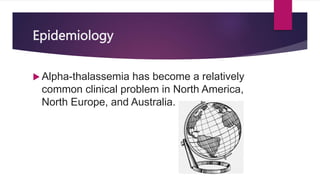
 Alpha-thalassemia has become a relatively
common clinical problem in North America,
North Europe, and Australia.
Etiology
 When there are not enough healthy red blood cells, there is also
not enough oxygen delivered to all the other cells of the body,
which may cause a person to feel tired, weak or short of breath.
This is a condition called anemia.
 People with thalassemia may have mild or severe anemia.
Severe anemia can damage organs and lead to death.
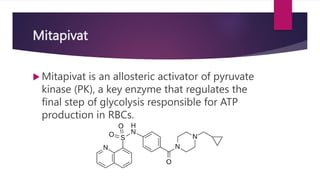
Mitapivat
 Mitapivat is an allosteric activator of pyruvate
kinase (PK), a key enzyme that regulates the
final step of glycolysis responsible for ATP
production in RBCs.
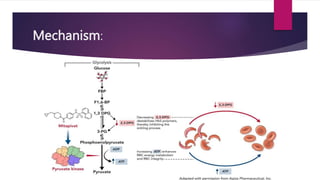
Mechanism:
Genetic Mutations
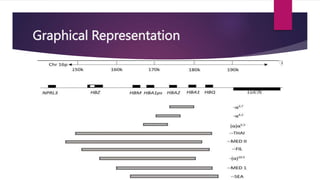
 The most common genetic defect in α-thalassemia is a
deletion in the α-globin gene involving one or both globin
genes such as -α3.7, -α4.2, --SEA, --THAI, -αCD59, -α20.5, -αIVS I-1
 A highly severe form of deletional α-thalassemia, known as
Haemoglobin (Hb) Bart’s hydrops fetalis, is a homozygous
α0-thalassemia deletion with a complete loss of functional
α-globin that leads to foetal death or death shortly after
birth
Graphical Representation
Any Question??????????????????
MIRZA NUMAN.pptx
MIRZA NUMAN.pptx

MIRZA NUMAN.pptx

  • 1.
    MIRZA NUMAN IMPACT OFMITAPIVAT FOR ALPHA THALASSEMIA AND ROLE OF PREVALENT GENETIC MUTATIONS
  • 2.
    Thalassemia  The thalassemiacomprise a group of hemoglobinopathies characterized by ineffective erythropoiesis and hemolysis, which lead to chronic anemia and associated complications.  Thalassemic red blood cells (RBCs) do not have sufficient levels of adenosine triphosphate (ATP) to meet their increased energy demands.  Alpha-Thalassemia  Beta- Thalassemia
  • 3.
    Epidemiology  Alpha-thalassemia hasbecome a relatively common clinical problem in North America, North Europe, and Australia.
  • 4.
    Etiology  When thereare not enough healthy red blood cells, there is also not enough oxygen delivered to all the other cells of the body, which may cause a person to feel tired, weak or short of breath. This is a condition called anemia.  People with thalassemia may have mild or severe anemia. Severe anemia can damage organs and lead to death.
  • 5.
    Mitapivat  Mitapivat isan allosteric activator of pyruvate kinase (PK), a key enzyme that regulates the final step of glycolysis responsible for ATP production in RBCs.
  • 6.
  • 8.
    Genetic Mutations  Themost common genetic defect in α-thalassemia is a deletion in the α-globin gene involving one or both globin genes such as -α3.7, -α4.2, --SEA, --THAI, -αCD59, -α20.5, -αIVS I-1  A highly severe form of deletional α-thalassemia, known as Haemoglobin (Hb) Bart’s hydrops fetalis, is a homozygous α0-thalassemia deletion with a complete loss of functional α-globin that leads to foetal death or death shortly after birth
  • 9.
  • 10.