Allen's Test
Check patency of ulnar artery prior to placing
radial artery line or ABG
ACUTE MESENTERIC ISCHEMIC [AMI
Abdominal Pain is DISPROPORTIONATE to
any physical exam findings]
Ballance's Sign
DuLLness to percussion in the Left
flank/LLQ and Resonance to percussion in
the Right flank [the sounds are "im-Balanced"]
Seen with splenic rupture/hematoma
Battles Sign
Bruising over the mastoid process-> Basilar skull Fx
Beck's Triad
Seen in pts w/ cardiacTAMPONADE:
1) JVD
2) Muffled heart sounds
3) Hypotension
Bergman's Triad
Seen w/ FAT EMBOLI syndrome:
1) mental status changes
2) petechiae
3) dyspnea
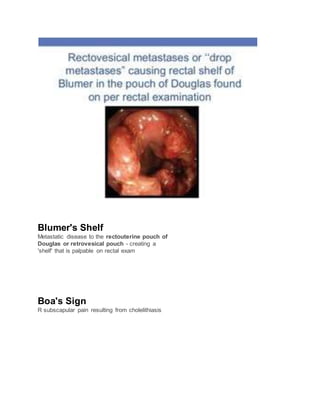
Blumer's Shelf
Metastatic disease to the rectouterine pouch of
Douglas or retrovesical pouch - creating a
'shelf' that is palpable on rectal exam
Boa's Sign
R subscapular pain resulting from cholelithiasis
Borchardt's Triad
Seen with GASTRIC VOLVULUS:
1) Retching followed by no emesis
2) epigastric distention
3) inability to pass NG tube
Carcinoid Triad
Seen with CARCINOID syndrome:
1) Flushing
2) Diarrhea
3) right-sided heart failure (Right HF) [dependent
edema, liver, etc]
Charcot's Triad
Seen with CHOLANGITIS
1) Fever and chills
2) Jaundice
3) RUQ pain
Chvostek's sign
Twitching of facial muscles upon tapping the
facial nerve in pts w/ hypOcalcemia
["Chew-twitch sign"]
Courvoisier's Law
An enlarged NONtender gallbladder seen
with obstruction of CBD (common bile duct),
most commonly w/ pancreatic cancer
Note: not seen w/ acute cholecystitis b/c
gallbladder is scarred secondary to chronic
cholelithiasis
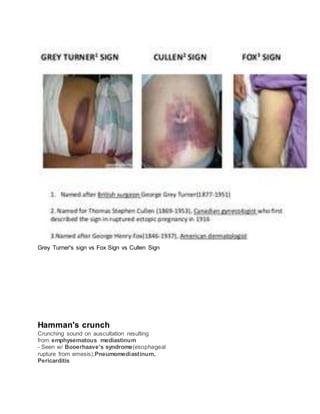
Cullen's Sign
Bluish discoloration of theperiumbilical area
secondary toretroperitoneal
hemorrhagetracking around the anterior abd
wall through fascial planes –
ie: acute hemorrhagic pancreatitis
Cullen's Sign Pic
Cushing's Triad
Signs of increased INTRACRANIAL
PRESSURE:
1) HTN
2) Bradycardia
3) Irregular respiration
Dance's Sign
Empty RLQ in children w/ ileocecal
intussusceptions
Fothergill's sign
Used to differentiate an intra-abdominal mass
from one in the abdominal wall -
If mass is felt while flexing abd musculature,
the mass is in the wall
Fox's Sign
Ecchymosis of inguinal ligament seen
with retroperitoneal bleeding[
"Foxy people wear their pants at inguinal level
(hip huggers)
Goodsall's Rule
Anal fistula course in a straight path anteriorly
and in a curved path posteriorly
Grey Turner's sign
Ecchymosis or discoloration of theflank in pts
w/ retroperitoneal hemorrhage
("sides are Turning grey")
Grey Turner's sign vs Fox Sign vs Cullen Sign
Hamman's crunch
Crunching sound on auscultation resulting
from emphysematous mediastinum
- Seen w/ Booerhaave's syndrome(esophageal
rupture from emesis),Pneumomediastinum,
Pericarditis
Homan's Sign
Calf pain on forced dorsiflexion of the foot in
patients w/ DVT
Howship-Romberg sign
Pain on the inner aspect of thigh; seen
w/ obturator hernia seconary to nerve
compression
Kehr's sign
Severe left shoulder pain in patients w/ splenic
rupture - secondary to referred pain
fromdiaphragmatic irritation
Krunkenbergtumor
Metastatic tumor to the ovary, classically from
gastric cance
Kelly's sign
Visible peristalsis of the ureter in response to
squeezing or retraction
- Used to identify ureters during surgery
Laplace's law
Wall tension = pressure x radius [T=Pr]
- Thus, the colon perforates preferentially at
the cecum b/c of↑ radius and thus, wall
tension
McBurney's point
1/3 the distance from the ASIS to the umbilicus
on a line connecting the two [Appendicitis pain]
McBurney's sign
Tenderness location in patients w/ apendicitis
Meckel's diverticulum Rule of 2s
2% of population
2% are symptomatic
occur w/in 2 ft of ileocecal valve
Mittelschmerz
Lower quadrant pain due to ovulation
Murphy's sign
Cessation of inspiration whilst palpating under
the right costal margin
- Pt cannot inspire deeply b/c it brings an
inflamed GB under pressure (acute cholecystitis)
Moodley's Sign
SIGN TO CHECK JVP waveforms-
Feel the radial pulse while simultaneously watching the JVP. The waveform that is seen
immediately after the arterial pulsation is felt is the 'v wave' of the JVP.
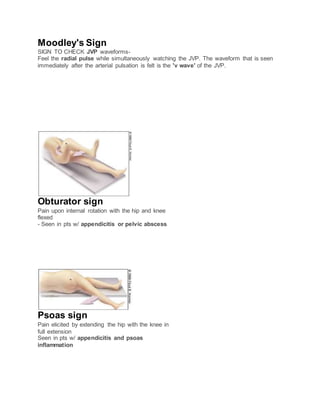
Obturator sign
Pain upon internal rotation with the hip and knee
flexed
- Seen in pts w/ appendicitis or pelvic abscess
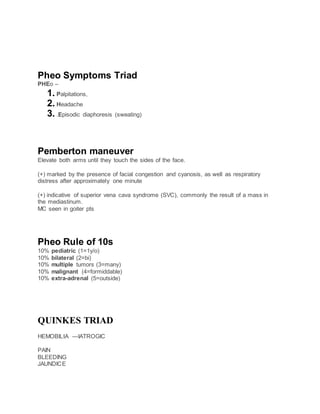
Psoas sign
Pain elicited by extending the hip with the knee in
full extension
Seen in pts w/ appendicitis and psoas
inflammation
Pheo Symptoms Triad
PHEo –
1. Palpitations,
2. Headache
3. .Episodic diaphoresis (sweating)
Pemberton maneuver
Elevate both arms until they touch the sides of the face.
(+) marked by the presence of facial congestion and cyanosis, as well as respiratory
distress after approximately one minute
(+) indicative of superior vena cava syndrome (SVC), commonly the result of a mass in
the mediastinum.
MC seen in goiter pts
Pheo Rule of 10s
10% pediatric (1=1y/o)
10% bilateral (2=bi)
10% multiple tumors (3=many)
10% malignant (4=formiddable)
10% extra-adrenal (5=outside)
QUINKES TRIAD
HEMOBILIA ---IATROGIC
PAIN
BLEEDING
JAUNDICE
Raccoon eyes
Bilateral black eyes due to basilar skull fracture
Reynold's Pentad
1) Fever and chills
2) jaundice
3) RUQ pain
[ 1-3 = Charcot'striad ] +
4) Mental status Δs, and
5) Shock or sepsis
Seen in patients w/ Supperative Cholangitis
Rovsing's sign
Palpation of LLQ resulting in pain in RLQ; seen
in appendicitis
["Rovsing = Right sings when left is pressed"]
Romana's Sign
unilateral painless periorbital swelling associated with the acute stage of CHAGAS
DISEASE.
Saint's triad
1) Cholelithiasis (Gallstones)
2) Hiatal hernia (GERD)
3) Diverticular disease (Gut & Butt)
Silk glove sign
Indirect hernia sac in the pediatric patient
Sister Mary Joseph's Node
Metastatic tumor to umbilical lymph nodes
Virchow's node
Metastatic tumor to the left supraclavicular
node, classically due to gastric cancer
Virchow's triad
Risk factors for thrombosis:
1) Stasis
2) Abdormal/injured endothelium
3) Hypercoagulability
Trousseau's sign
Carpal spasm after occlusion of blood to the
forearm (BP cuff) in pts with hypocalcemia
Valentino's sign
RLQ pain from a perforated peptic ulcer due to
succus/pus draining into the RLQ
Westermark's sign
Decreased pulmonary vasculature
markings on CXR in a pt w/ PE
[Wester-Mark = "Markings Wasting away"]
Whipple's Triad
Evidence for insulinoma:
1) Hypoglycemia < 50
2) CNS and vasomotor symptoms (syncope,
diaphoresis)
3) Relief of symptoms w/ administration of
glucose
Pj signs

Pj signs

  • 1.
    Allen's Test Check patencyof ulnar artery prior to placing radial artery line or ABG ACUTE MESENTERIC ISCHEMIC [AMI Abdominal Pain is DISPROPORTIONATE to any physical exam findings] Ballance's Sign DuLLness to percussion in the Left flank/LLQ and Resonance to percussion in the Right flank [the sounds are "im-Balanced"] Seen with splenic rupture/hematoma
  • 2.
    Battles Sign Bruising overthe mastoid process-> Basilar skull Fx Beck's Triad Seen in pts w/ cardiacTAMPONADE: 1) JVD 2) Muffled heart sounds 3) Hypotension Bergman's Triad Seen w/ FAT EMBOLI syndrome: 1) mental status changes 2) petechiae 3) dyspnea
  • 3.
    Blumer's Shelf Metastatic diseaseto the rectouterine pouch of Douglas or retrovesical pouch - creating a 'shelf' that is palpable on rectal exam Boa's Sign R subscapular pain resulting from cholelithiasis
  • 4.
    Borchardt's Triad Seen withGASTRIC VOLVULUS: 1) Retching followed by no emesis 2) epigastric distention 3) inability to pass NG tube Carcinoid Triad Seen with CARCINOID syndrome: 1) Flushing 2) Diarrhea 3) right-sided heart failure (Right HF) [dependent edema, liver, etc] Charcot's Triad Seen with CHOLANGITIS 1) Fever and chills 2) Jaundice 3) RUQ pain Chvostek's sign Twitching of facial muscles upon tapping the facial nerve in pts w/ hypOcalcemia ["Chew-twitch sign"] Courvoisier's Law
  • 5.
    An enlarged NONtendergallbladder seen with obstruction of CBD (common bile duct), most commonly w/ pancreatic cancer Note: not seen w/ acute cholecystitis b/c gallbladder is scarred secondary to chronic cholelithiasis Cullen's Sign Bluish discoloration of theperiumbilical area secondary toretroperitoneal hemorrhagetracking around the anterior abd wall through fascial planes – ie: acute hemorrhagic pancreatitis Cullen's Sign Pic Cushing's Triad Signs of increased INTRACRANIAL PRESSURE: 1) HTN 2) Bradycardia 3) Irregular respiration
  • 6.
    Dance's Sign Empty RLQin children w/ ileocecal intussusceptions Fothergill's sign Used to differentiate an intra-abdominal mass from one in the abdominal wall - If mass is felt while flexing abd musculature, the mass is in the wall Fox's Sign Ecchymosis of inguinal ligament seen with retroperitoneal bleeding[
  • 7.
    "Foxy people weartheir pants at inguinal level (hip huggers) Goodsall's Rule Anal fistula course in a straight path anteriorly and in a curved path posteriorly Grey Turner's sign Ecchymosis or discoloration of theflank in pts w/ retroperitoneal hemorrhage ("sides are Turning grey")
  • 8.
    Grey Turner's signvs Fox Sign vs Cullen Sign Hamman's crunch Crunching sound on auscultation resulting from emphysematous mediastinum - Seen w/ Booerhaave's syndrome(esophageal rupture from emesis),Pneumomediastinum, Pericarditis
  • 9.
    Homan's Sign Calf painon forced dorsiflexion of the foot in patients w/ DVT Howship-Romberg sign Pain on the inner aspect of thigh; seen w/ obturator hernia seconary to nerve compression Kehr's sign Severe left shoulder pain in patients w/ splenic rupture - secondary to referred pain fromdiaphragmatic irritation Krunkenbergtumor Metastatic tumor to the ovary, classically from gastric cance
  • 10.
    Kelly's sign Visible peristalsisof the ureter in response to squeezing or retraction - Used to identify ureters during surgery Laplace's law Wall tension = pressure x radius [T=Pr] - Thus, the colon perforates preferentially at the cecum b/c of↑ radius and thus, wall tension McBurney's point 1/3 the distance from the ASIS to the umbilicus on a line connecting the two [Appendicitis pain]
  • 11.
    McBurney's sign Tenderness locationin patients w/ apendicitis Meckel's diverticulum Rule of 2s 2% of population 2% are symptomatic occur w/in 2 ft of ileocecal valve Mittelschmerz Lower quadrant pain due to ovulation Murphy's sign Cessation of inspiration whilst palpating under the right costal margin - Pt cannot inspire deeply b/c it brings an inflamed GB under pressure (acute cholecystitis)
  • 12.
    Moodley's Sign SIGN TOCHECK JVP waveforms- Feel the radial pulse while simultaneously watching the JVP. The waveform that is seen immediately after the arterial pulsation is felt is the 'v wave' of the JVP. Obturator sign Pain upon internal rotation with the hip and knee flexed - Seen in pts w/ appendicitis or pelvic abscess Psoas sign Pain elicited by extending the hip with the knee in full extension Seen in pts w/ appendicitis and psoas inflammation
  • 13.
    Pheo Symptoms Triad PHEo– 1. Palpitations, 2. Headache 3. .Episodic diaphoresis (sweating) Pemberton maneuver Elevate both arms until they touch the sides of the face. (+) marked by the presence of facial congestion and cyanosis, as well as respiratory distress after approximately one minute (+) indicative of superior vena cava syndrome (SVC), commonly the result of a mass in the mediastinum. MC seen in goiter pts Pheo Rule of 10s 10% pediatric (1=1y/o) 10% bilateral (2=bi) 10% multiple tumors (3=many) 10% malignant (4=formiddable) 10% extra-adrenal (5=outside) QUINKES TRIAD HEMOBILIA ---IATROGIC PAIN BLEEDING JAUNDICE
  • 14.
    Raccoon eyes Bilateral blackeyes due to basilar skull fracture Reynold's Pentad 1) Fever and chills 2) jaundice 3) RUQ pain [ 1-3 = Charcot'striad ] + 4) Mental status Δs, and 5) Shock or sepsis Seen in patients w/ Supperative Cholangitis
  • 15.
    Rovsing's sign Palpation ofLLQ resulting in pain in RLQ; seen in appendicitis ["Rovsing = Right sings when left is pressed"] Romana's Sign unilateral painless periorbital swelling associated with the acute stage of CHAGAS DISEASE. Saint's triad 1) Cholelithiasis (Gallstones) 2) Hiatal hernia (GERD) 3) Diverticular disease (Gut & Butt) Silk glove sign Indirect hernia sac in the pediatric patient
  • 16.
    Sister Mary Joseph'sNode Metastatic tumor to umbilical lymph nodes Virchow's node Metastatic tumor to the left supraclavicular node, classically due to gastric cancer Virchow's triad Risk factors for thrombosis: 1) Stasis 2) Abdormal/injured endothelium 3) Hypercoagulability Trousseau's sign Carpal spasm after occlusion of blood to the forearm (BP cuff) in pts with hypocalcemia
  • 17.
    Valentino's sign RLQ painfrom a perforated peptic ulcer due to succus/pus draining into the RLQ Westermark's sign Decreased pulmonary vasculature markings on CXR in a pt w/ PE [Wester-Mark = "Markings Wasting away"] Whipple's Triad Evidence for insulinoma: 1) Hypoglycemia < 50 2) CNS and vasomotor symptoms (syncope, diaphoresis) 3) Relief of symptoms w/ administration of glucose