By,
ABIJITH ANTO
S7 MECHANICAL
ROLL NO:2
 What is an Air Powered Engine ?
 History of air engine.
 Classification of Air Engine.
 Various important parts of the engine.
(compressor, PLC circuit, Pulsed Pressure Control
Valves,Cam & Follower)
 Detail working of engine with compare to Two
stroke petrol engine.
 Advantages & Limitations.
 An engine powered by Compressed air is known as air
powered engine.
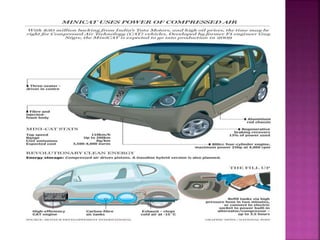
 Compressed air cars are powered by motors driven
by compressed air, which is stored in a tank at high
pressure such as 30 Mpa (4500 psi or 310 bar). Rather
than driving engine pistons with an ignited fuel-air
mixture, compressed air cars use the expansion of
compressed air, in a similar manner to the expansion of
steam in a steam engine.
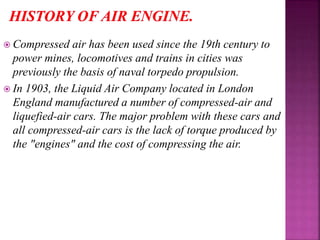
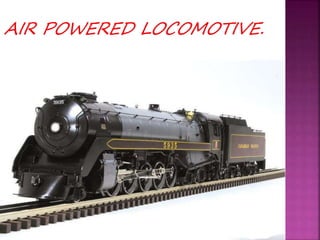
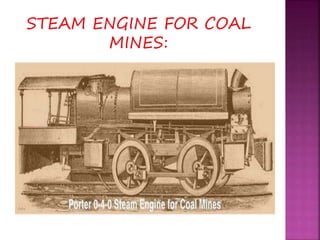
 Compressed air has been used since the 19th century to
power mines, locomotives and trains in cities was
previously the basis of naval torpedo propulsion.
 In 1903, the Liquid Air Company located in London
England manufactured a number of compressed-air and
liquefied-air cars. The major problem with these cars and
all compressed-air cars is the lack of torque produced by
the "engines" and the cost of compressing the air.
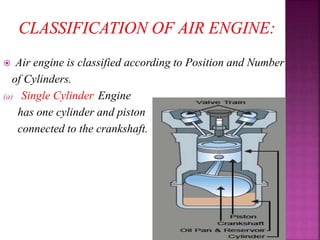
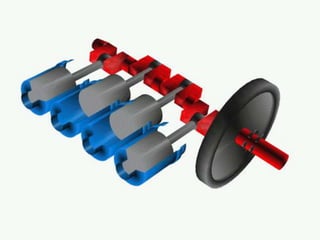
 Air engine is classified according to Position and Number
of Cylinders.
(a) Single Cylinder. Engine
has one cylinder and piston
connected to the crankshaft.
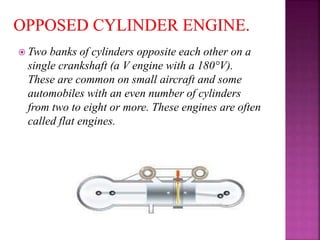
 Two banks of cylinders opposite each other on a
single crankshaft (a V engine with a 180°V).
These are common on small aircraft and some
automobiles with an even number of cylinders
from two to eight or more. These engines are often
called flat engines.
 To convert a conventional IC(four stroke petrol) engine
into an Air Powered one, few components are to be
replaced. First of all
1.Replace the spark plug with a pulsed pressure control
valve which can create required pressure.
2. Replace fuel tank with air vessel, as engine requires
pressurized air as input.
3. Replace cam with a modified cam. This is to be done, so
that both the inlet and outlet valves open and close at the
same time.
 The parts which are newly introduced to be used in air
engine are:
 PLC circuit.
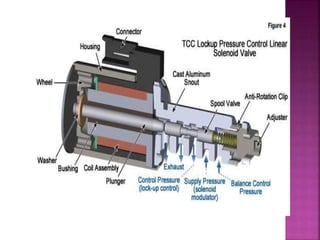
 pulsed pressure control valve.
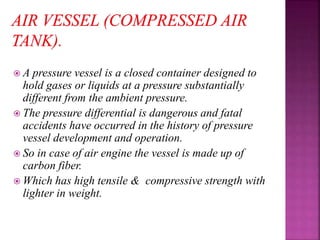
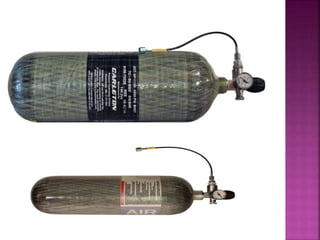
 air vessel(Compressed Air Tank made up of carbon fiber)
 modified cam.
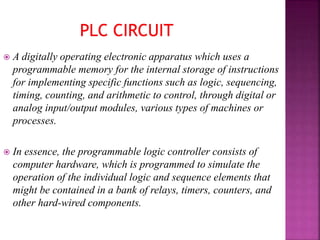
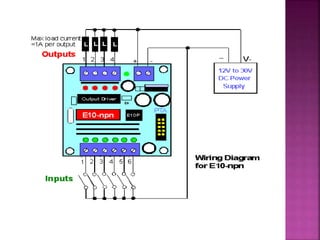
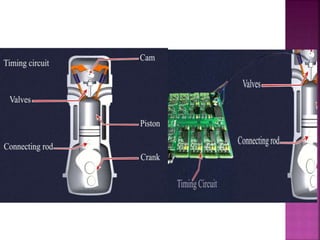
 A digitally operating electronic apparatus which uses a
programmable memory for the internal storage of instructions
for implementing specific functions such as logic, sequencing,
timing, counting, and arithmetic to control, through digital or
analog input/output modules, various types of machines or
processes.
 In essence, the programmable logic controller consists of
computer hardware, which is programmed to simulate the
operation of the individual logic and sequence elements that
might be contained in a bank of relays, timers, counters, and
other hard-wired components.
 The pulse sensing valve is a valve offered to provide
emergency closure based upon a decompression pulse in
the hydraulic medium used in large hydraulic piping
systems.
 A fluid decompression pulse is generally initiated during
a severe loss of compression on a fluid hydraulic system.
 This decompression pulse travels at the speed of sound in
the hydraulic fluid from the load interface point to the
supply source.
 A pressure vessel is a closed container designed to
hold gases or liquids at a pressure substantially
different from the ambient pressure.
 The pressure differential is dangerous and fatal
accidents have occurred in the history of pressure
vessel development and operation.
 So in case of air engine the vessel is made up of
carbon fiber.
 Which has high tensile & compressive strength with
lighter in weight.
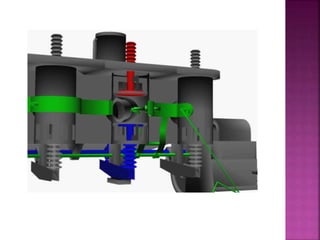
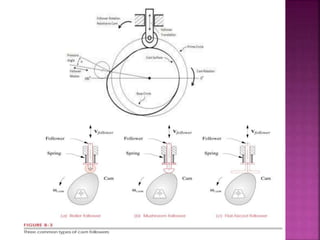
 Replacement cam with a modified cam. This is to be
done, so that both the inlet and outlet valves open and
close at the same time. Main advantage of doing this is to
achieve better scavenging system.
 Also this will result in conversion of 4 stroke engine into
2 stroke air engine, which in turn gives us the benefit of
low mean effective pressure requirement in addition to
other operational benefits.
 Carbonfiber,alternatively graphite fiber, carbon graphite or CF, is a
material consisting of fibers about 5–10 μm in diameter and composed
mostly of carbon atoms. The carbon atoms are bonded together in
crystals that are more or less aligned parallel to the long axis of the
fiber. The crystal alignment gives the fiber high strength-to-volume
ratio. Several thousand carbon fibers are bundled together to form
a tow, which may be used by itself or woven into a fabric.
 The properties of carbon fibers, such as high stiffness, high tensile
strength, low weight, high chemical resistance, high temperature
tolerance and low thermal expansion, make them very popular in
aerospace, civil engineering, military, and motorsports, along with
other competition sports. However, they are relatively expensive when
compared to similar fibers, such as glass fiber or plastic fibers.
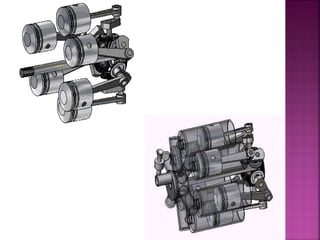
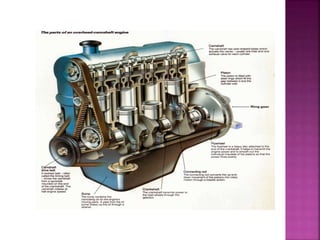
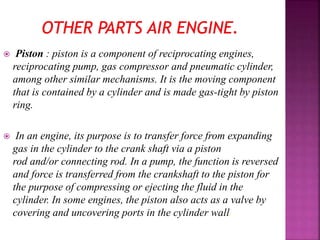
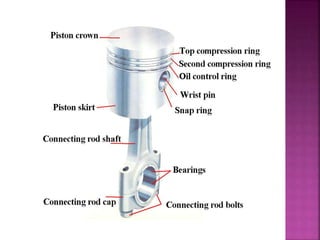
 Piston : piston is a component of reciprocating engines,
reciprocating pump, gas compressor and pneumatic cylinder,
among other similar mechanisms. It is the moving component
that is contained by a cylinder and is made gas-tight by piston
ring.
 In an engine, its purpose is to transfer force from expanding
gas in the cylinder to the crank shaft via a piston
rod and/or connecting rod. In a pump, the function is reversed
and force is transferred from the crankshaft to the piston for
the purpose of compressing or ejecting the fluid in the
cylinder. In some engines, the piston also acts as a valve by
covering and uncovering ports in the cylinder wall.
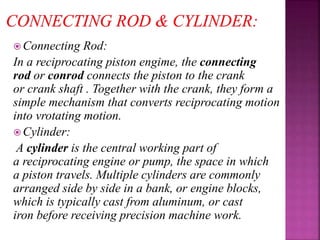
 Connecting Rod:
In a reciprocating piston engime, the connecting
rod or conrod connects the piston to the crank
or crank shaft . Together with the crank, they form a
simple mechanism that converts reciprocating motion
into vrotating motion.
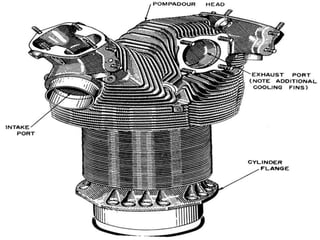
 Cylinder:
A cylinder is the central working part of
a reciprocating engine or pump, the space in which
a piston travels. Multiple cylinders are commonly
arranged side by side in a bank, or engine blocks,
which is typically cast from aluminum, or cast
iron before receiving precision machine work.
 Crank Shaft: The crankshaft, sometimes abbreviated
to crank, is the part of an engine that
translates reciprocating linear piston motion into rotation.
To convert the reciprocating motion into rotation, the
crankshaft has "crank throws" or “crank pins", additional
bearing surfaces whose axis is offset from that of the crank,
to which the "big ends" of the connecting rod from each
cylinder attach.
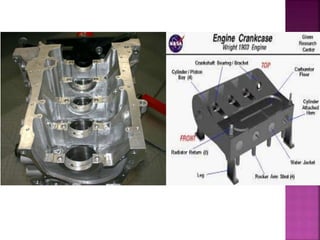
 Crank case: In an internal combustion engine of
the reciprocating type, the crankcase is the housing for
the crankshaft. The enclosure forms the largest cavity in the
engine and is located below the cylinders which in a
multicylinder engine are usually integrated into one or
several cylinder blocks.
 Operation:
Initial torque is supplied from the DC exciter motor, and then the
engine operation starts.
Stage 1: When the piston is in the TDC, compressed air is injected
through the pulsed air firing valve, which pushes the piston to BDC.
 On comparing it with the working of normal SI 4 stroke engine:
“Stage 1” of the air engine comprises of the combined operation of
“Suction stage” and “Power stage” of the normal 4 stroke SI engine.
“Stage 2” of the air engine comprises of the combined operation of
the “Compression stage” and “Exhaust stage” of the normal 4 stroke
SI engine.
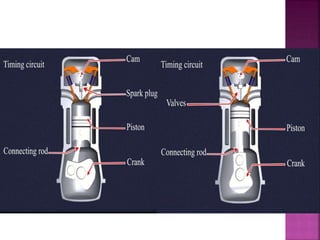
 Stage 2: Due to the motion of the engine and its inertia, the
piston moves back to TDC, pushing the air out of the valves.
 The plunger of the pulsed firing valve is controlled by a timing
circuit which is specifically a PLC programmed circuit. It
supplies the electronic signals by which the plunger moves so
that it opens and closes the pulsed firing valve.
 Technical benefits:
The temperature of the engine while working will be slightly less
than the ambient temperature. Smooth working of the engine due to
very less wear and tear of the components. There is no possibility
of knocking. No need of cooling systems and spark plugs or
complex fuel injection systems.
Economic benefits:
No use of expensive fossil fuels as the free air is
compressed and taken to use. For this reason
people can easily shift to the new technology.
Compressors use electricity for generating
compressed air which is relatively much cheaper
and widespread. Smooth working will lead to less
wear & tear, so lesser maintenance cost. cheaper
in cost and maintenance and it doesn’t cause any
kind of harm to the environment. Thus it is surely a
futuristic mode of transport.
 When air expands in the engine it cools dramatically and
must be heated to ambient temperature.
 This also leads to the necessity of completely dehydrating
the compressed air. pressure using a heat exchanger.
 Refueling the compressed air container using a home or
low-end conventional air compressor may take as long as
4 hours, though specialized equipment at service stations
may fill the tanks in only 3 minutes
 The overall efficiency of a vehicle using compressed air
energy storage, using the above refueling figures, is
around 5-7%.For comparison, well to wheel efficiency of
a conventional internal-combustion drivetrain is about
14%,
 Early tests have demonstrated the limited storage
capacity of the tanks; the only published test of a vehicle
running on compressed air alone was limited to a range
of 7.22 km.
Air powered vehicles

Air powered vehicles

  • 1.
  • 2.
     What isan Air Powered Engine ?  History of air engine.  Classification of Air Engine.  Various important parts of the engine. (compressor, PLC circuit, Pulsed Pressure Control Valves,Cam & Follower)  Detail working of engine with compare to Two stroke petrol engine.  Advantages & Limitations.
  • 4.
     An enginepowered by Compressed air is known as air powered engine.  Compressed air cars are powered by motors driven by compressed air, which is stored in a tank at high pressure such as 30 Mpa (4500 psi or 310 bar). Rather than driving engine pistons with an ignited fuel-air mixture, compressed air cars use the expansion of compressed air, in a similar manner to the expansion of steam in a steam engine.
  • 6.
     Compressed airhas been used since the 19th century to power mines, locomotives and trains in cities was previously the basis of naval torpedo propulsion.  In 1903, the Liquid Air Company located in London England manufactured a number of compressed-air and liquefied-air cars. The major problem with these cars and all compressed-air cars is the lack of torque produced by the "engines" and the cost of compressing the air.
  • 9.
     Air engineis classified according to Position and Number of Cylinders. (a) Single Cylinder. Engine has one cylinder and piston connected to the crankshaft.
  • 10.
     Two banksof cylinders opposite each other on a single crankshaft (a V engine with a 180°V). These are common on small aircraft and some automobiles with an even number of cylinders from two to eight or more. These engines are often called flat engines.
  • 11.
     To converta conventional IC(four stroke petrol) engine into an Air Powered one, few components are to be replaced. First of all 1.Replace the spark plug with a pulsed pressure control valve which can create required pressure. 2. Replace fuel tank with air vessel, as engine requires pressurized air as input. 3. Replace cam with a modified cam. This is to be done, so that both the inlet and outlet valves open and close at the same time.
  • 13.
     The partswhich are newly introduced to be used in air engine are:  PLC circuit.  pulsed pressure control valve.  air vessel(Compressed Air Tank made up of carbon fiber)  modified cam.
  • 15.
     A digitallyoperating electronic apparatus which uses a programmable memory for the internal storage of instructions for implementing specific functions such as logic, sequencing, timing, counting, and arithmetic to control, through digital or analog input/output modules, various types of machines or processes.  In essence, the programmable logic controller consists of computer hardware, which is programmed to simulate the operation of the individual logic and sequence elements that might be contained in a bank of relays, timers, counters, and other hard-wired components.
  • 17.
     The pulsesensing valve is a valve offered to provide emergency closure based upon a decompression pulse in the hydraulic medium used in large hydraulic piping systems.  A fluid decompression pulse is generally initiated during a severe loss of compression on a fluid hydraulic system.  This decompression pulse travels at the speed of sound in the hydraulic fluid from the load interface point to the supply source.
  • 20.
     A pressurevessel is a closed container designed to hold gases or liquids at a pressure substantially different from the ambient pressure.  The pressure differential is dangerous and fatal accidents have occurred in the history of pressure vessel development and operation.  So in case of air engine the vessel is made up of carbon fiber.  Which has high tensile & compressive strength with lighter in weight.
  • 22.
     Replacement camwith a modified cam. This is to be done, so that both the inlet and outlet valves open and close at the same time. Main advantage of doing this is to achieve better scavenging system.  Also this will result in conversion of 4 stroke engine into 2 stroke air engine, which in turn gives us the benefit of low mean effective pressure requirement in addition to other operational benefits.
  • 24.
     Carbonfiber,alternatively graphitefiber, carbon graphite or CF, is a material consisting of fibers about 5–10 μm in diameter and composed mostly of carbon atoms. The carbon atoms are bonded together in crystals that are more or less aligned parallel to the long axis of the fiber. The crystal alignment gives the fiber high strength-to-volume ratio. Several thousand carbon fibers are bundled together to form a tow, which may be used by itself or woven into a fabric.  The properties of carbon fibers, such as high stiffness, high tensile strength, low weight, high chemical resistance, high temperature tolerance and low thermal expansion, make them very popular in aerospace, civil engineering, military, and motorsports, along with other competition sports. However, they are relatively expensive when compared to similar fibers, such as glass fiber or plastic fibers.
  • 26.
     Piston :piston is a component of reciprocating engines, reciprocating pump, gas compressor and pneumatic cylinder, among other similar mechanisms. It is the moving component that is contained by a cylinder and is made gas-tight by piston ring.  In an engine, its purpose is to transfer force from expanding gas in the cylinder to the crank shaft via a piston rod and/or connecting rod. In a pump, the function is reversed and force is transferred from the crankshaft to the piston for the purpose of compressing or ejecting the fluid in the cylinder. In some engines, the piston also acts as a valve by covering and uncovering ports in the cylinder wall.
  • 28.
     Connecting Rod: Ina reciprocating piston engime, the connecting rod or conrod connects the piston to the crank or crank shaft . Together with the crank, they form a simple mechanism that converts reciprocating motion into vrotating motion.  Cylinder: A cylinder is the central working part of a reciprocating engine or pump, the space in which a piston travels. Multiple cylinders are commonly arranged side by side in a bank, or engine blocks, which is typically cast from aluminum, or cast iron before receiving precision machine work.
  • 30.
     Crank Shaft:The crankshaft, sometimes abbreviated to crank, is the part of an engine that translates reciprocating linear piston motion into rotation. To convert the reciprocating motion into rotation, the crankshaft has "crank throws" or “crank pins", additional bearing surfaces whose axis is offset from that of the crank, to which the "big ends" of the connecting rod from each cylinder attach.
  • 32.
     Crank case:In an internal combustion engine of the reciprocating type, the crankcase is the housing for the crankshaft. The enclosure forms the largest cavity in the engine and is located below the cylinders which in a multicylinder engine are usually integrated into one or several cylinder blocks.
  • 34.
     Operation: Initial torqueis supplied from the DC exciter motor, and then the engine operation starts. Stage 1: When the piston is in the TDC, compressed air is injected through the pulsed air firing valve, which pushes the piston to BDC.  On comparing it with the working of normal SI 4 stroke engine: “Stage 1” of the air engine comprises of the combined operation of “Suction stage” and “Power stage” of the normal 4 stroke SI engine. “Stage 2” of the air engine comprises of the combined operation of the “Compression stage” and “Exhaust stage” of the normal 4 stroke SI engine.
  • 36.
     Stage 2:Due to the motion of the engine and its inertia, the piston moves back to TDC, pushing the air out of the valves.  The plunger of the pulsed firing valve is controlled by a timing circuit which is specifically a PLC programmed circuit. It supplies the electronic signals by which the plunger moves so that it opens and closes the pulsed firing valve.
  • 38.
     Technical benefits: Thetemperature of the engine while working will be slightly less than the ambient temperature. Smooth working of the engine due to very less wear and tear of the components. There is no possibility of knocking. No need of cooling systems and spark plugs or complex fuel injection systems.
  • 39.
    Economic benefits: No useof expensive fossil fuels as the free air is compressed and taken to use. For this reason people can easily shift to the new technology. Compressors use electricity for generating compressed air which is relatively much cheaper and widespread. Smooth working will lead to less wear & tear, so lesser maintenance cost. cheaper in cost and maintenance and it doesn’t cause any kind of harm to the environment. Thus it is surely a futuristic mode of transport.
  • 40.
     When airexpands in the engine it cools dramatically and must be heated to ambient temperature.  This also leads to the necessity of completely dehydrating the compressed air. pressure using a heat exchanger.  Refueling the compressed air container using a home or low-end conventional air compressor may take as long as 4 hours, though specialized equipment at service stations may fill the tanks in only 3 minutes
  • 41.
     The overallefficiency of a vehicle using compressed air energy storage, using the above refueling figures, is around 5-7%.For comparison, well to wheel efficiency of a conventional internal-combustion drivetrain is about 14%,  Early tests have demonstrated the limited storage capacity of the tanks; the only published test of a vehicle running on compressed air alone was limited to a range of 7.22 km.