PISTON LESS PUMP
NAME: LINGARAJ R SATENAHALLI
USN: 4UB21ME408
BRANCH :MECHANICAL
UBDT COLLAGE OF ENGINEERING, DAVANAGERE
INTRODUCTION
> NASA have developed a Low cost rocket fuel pump which has Comparable performance to
turbo pump at 80-90% lower cost.. Perhaps the most difficult barrier to entry in the liquid
rocket business is the turbo pump.
> A turbo pump design requires a large engineering effort and is expensive to mfg. and test.
Starting a turbo pump fed rocket engine is a complex process, requiring a careful of many
valves and subsystems.
> Piston less pump for rocket has been proved to be the most economical than piston pump
or turbo pump. In piston less pumps, piston is absent. It has very much less rotating parts
than that of piston pumps or turbo pumps. So, it has less friction losses and there by it
helps to improve the efficiency of the engine considerably. They can be easily installed in
the rocket than turbo pumps. Also, it reduces the weight of rocket.
> This pump saves up to 90% of the mass of the tanks as compared to a pressure fed
system. This pump has really proved to be a boon for rockets. By this pump the rocket
does not have to carry heavy load and can travel with very high speed
LITERATURE REVIEW
> The Pulsometer steam pump is a pistonless pump which was patented in 1872 by
American Charles Henry Hall. In 1875 a British engineer bought the patent rights of the
Pulsometer, and it was introduced to the market soon thereafter.
> The invention was inspired by the Savery steam pump invented by Thomas Savery. Later
this design was modified by NASA scientists which is applicable to rocket, and successfully
tested with Liquid Nitrogen
> Atlas Vernier Engine in the early 80’s and 90’s.
> Liquid helium pressurization was used successfully in the apollo lander and is currently
used in LOX tank pressurization system for Ariane 5.
CONSTRUCTION
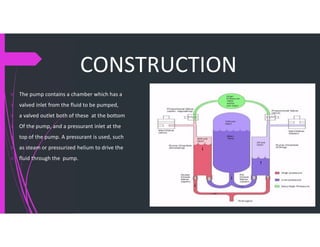
> The pump contains a chamber which has a
> valved inlet from the fluid to be pumped,
> a valved outlet both of these at the bottom
> Of the pump, and a pressurant inlet at the
> top of the pump. A pressurant is used, such
> as steam or pressurized helium to drive the
> fluid through the pump.
WORKING
* Outlet check valves, inlet check valves completely works on
pressure in the cylinder.
Fuel is supplied to the main tank to the 2 cylinders, these cylinders
are pressurized by the high pressure tank which is filled with pressurized
gas.
High pressure gas pressurizes one cylinder which is partially filed in the
first stage, because of partial fill there is negative pressure detected by
Vent valve allows the high pressure gas enter to the cylinder and it is vented
Vent valve get closed, the another cylinder is pressurized by same principle
To give the continues supply of fuel.
When cylinder is vented outlet checkvalve and vent valve get closed,
Inlet valve check valve open to refill the cylinder.
Each cylinder supply the fuel for each half cycle.As one cylinder supplies
the fuel other has enough time to refill.
COMPARISION
ADVANNTAGES
> The hardware in the pump consists of pressure vessel so the weight is low.
> The pump can be scaled up or down with similar performance andminimal
redesign issues.
> Low risk development; pump technology has been demonstrated and prototypes
have been built and tested.
> The manufacturing tolerancesneed not be tight.
> Less moving parts, hence lubrication required is quite low.
> Design issimple compared to turbo pumps.
DISADVANTAGES
> They cannot pump to higher pressure than drive gas (area ratio is 1:1).
> They cannot use either a staged combustion or expander cycle.
> A gas generator cycle is also difficult to integrate with the pistonless pump.
> The generated gas must be chemically compatible with both the propellants.
> This gas generator lowers the Ignition start period of the engine.
APPLICATION
> DEEP SPACE EXPLORATION –It has a need for high power propulsion to land
and spacecraft on the moons of Jupiter and beyond.
> This pump allows these missions to travel millions of light years ahead for
exploration.
conclusion
> The most significance of property of Piston less pump that makesthem different
from that of turbo pump, is the absence of piston. •
> This is the most unique technique. In this no. of rotating parts is very less as
compared to that of turbo pump. Also, it's installation is very easy, and moreover,
it is light weight than turbo pump. So, it has less losses and improves, rather
increases efficiency of engine. Also, it is much economical than turbo pump.
REFERENCES
> Harrington, S. Piston less Dual Chamber Rocket Fuel Pump: Testing and Performance"
AIAA 2003-4479., Joint Propulsion Conference, Huntsville, AL, 20-23 July 2003.
> Harrington, S. Launch Vehicle and Spacecraft System Design Using the Piston less Pump
Steve Harrington AIAA 2004-6130 AIAA Space 2004.
> Whitehead, J.C., Pittenger, LC.Colella, N.J. Design and Flight Testing of a Reciprocating
Pump Fed Rocket,
> 1994 Godwin, Felix Exploring the Solar System Plenum press 1960.
> http://www.rocketfuelpump.com
THANK YOU

The Piston Less Pump Working Explained in PPT

  • 1.
    PISTON LESS PUMP NAME:LINGARAJ R SATENAHALLI USN: 4UB21ME408 BRANCH :MECHANICAL UBDT COLLAGE OF ENGINEERING, DAVANAGERE
  • 2.
    INTRODUCTION > NASA havedeveloped a Low cost rocket fuel pump which has Comparable performance to turbo pump at 80-90% lower cost.. Perhaps the most difficult barrier to entry in the liquid rocket business is the turbo pump. > A turbo pump design requires a large engineering effort and is expensive to mfg. and test. Starting a turbo pump fed rocket engine is a complex process, requiring a careful of many valves and subsystems. > Piston less pump for rocket has been proved to be the most economical than piston pump or turbo pump. In piston less pumps, piston is absent. It has very much less rotating parts than that of piston pumps or turbo pumps. So, it has less friction losses and there by it helps to improve the efficiency of the engine considerably. They can be easily installed in the rocket than turbo pumps. Also, it reduces the weight of rocket. > This pump saves up to 90% of the mass of the tanks as compared to a pressure fed system. This pump has really proved to be a boon for rockets. By this pump the rocket does not have to carry heavy load and can travel with very high speed
  • 3.
    LITERATURE REVIEW > ThePulsometer steam pump is a pistonless pump which was patented in 1872 by American Charles Henry Hall. In 1875 a British engineer bought the patent rights of the Pulsometer, and it was introduced to the market soon thereafter. > The invention was inspired by the Savery steam pump invented by Thomas Savery. Later this design was modified by NASA scientists which is applicable to rocket, and successfully tested with Liquid Nitrogen > Atlas Vernier Engine in the early 80’s and 90’s. > Liquid helium pressurization was used successfully in the apollo lander and is currently used in LOX tank pressurization system for Ariane 5.
  • 4.
    CONSTRUCTION > The pumpcontains a chamber which has a > valved inlet from the fluid to be pumped, > a valved outlet both of these at the bottom > Of the pump, and a pressurant inlet at the > top of the pump. A pressurant is used, such > as steam or pressurized helium to drive the > fluid through the pump.
  • 5.
    WORKING * Outlet checkvalves, inlet check valves completely works on pressure in the cylinder. Fuel is supplied to the main tank to the 2 cylinders, these cylinders are pressurized by the high pressure tank which is filled with pressurized gas. High pressure gas pressurizes one cylinder which is partially filed in the first stage, because of partial fill there is negative pressure detected by Vent valve allows the high pressure gas enter to the cylinder and it is vented Vent valve get closed, the another cylinder is pressurized by same principle To give the continues supply of fuel. When cylinder is vented outlet checkvalve and vent valve get closed, Inlet valve check valve open to refill the cylinder. Each cylinder supply the fuel for each half cycle.As one cylinder supplies the fuel other has enough time to refill.
  • 6.
  • 7.
    ADVANNTAGES > The hardwarein the pump consists of pressure vessel so the weight is low. > The pump can be scaled up or down with similar performance andminimal redesign issues. > Low risk development; pump technology has been demonstrated and prototypes have been built and tested. > The manufacturing tolerancesneed not be tight. > Less moving parts, hence lubrication required is quite low. > Design issimple compared to turbo pumps.
  • 8.
    DISADVANTAGES > They cannotpump to higher pressure than drive gas (area ratio is 1:1). > They cannot use either a staged combustion or expander cycle. > A gas generator cycle is also difficult to integrate with the pistonless pump. > The generated gas must be chemically compatible with both the propellants. > This gas generator lowers the Ignition start period of the engine.
  • 9.
    APPLICATION > DEEP SPACEEXPLORATION –It has a need for high power propulsion to land and spacecraft on the moons of Jupiter and beyond. > This pump allows these missions to travel millions of light years ahead for exploration.
  • 10.
    conclusion > The mostsignificance of property of Piston less pump that makesthem different from that of turbo pump, is the absence of piston. • > This is the most unique technique. In this no. of rotating parts is very less as compared to that of turbo pump. Also, it's installation is very easy, and moreover, it is light weight than turbo pump. So, it has less losses and improves, rather increases efficiency of engine. Also, it is much economical than turbo pump.
  • 11.
    REFERENCES > Harrington, S.Piston less Dual Chamber Rocket Fuel Pump: Testing and Performance" AIAA 2003-4479., Joint Propulsion Conference, Huntsville, AL, 20-23 July 2003. > Harrington, S. Launch Vehicle and Spacecraft System Design Using the Piston less Pump Steve Harrington AIAA 2004-6130 AIAA Space 2004. > Whitehead, J.C., Pittenger, LC.Colella, N.J. Design and Flight Testing of a Reciprocating Pump Fed Rocket, > 1994 Godwin, Felix Exploring the Solar System Plenum press 1960. > http://www.rocketfuelpump.com
  • 12.