Trusted Advisory Services 
STRICTLY CONFIDENTIAL © Copyright 2014 Progressive Intelligence 
USA • UK • INDIA 
Progressive Intelligence 
Partners in Achievement 
9225 W. Jewell Place, 
#101, Lakewood 
Colorado 80227 
USA 
• 
1245 Wild Rose Lane 
Lake Forest 
Illinois 60045 
USA 
• 
333 Rector Pl, #908 
New York 
New York 10280 
USA 
• 
4921 Waterfowl Way, 
Rockville 
Maryland 20853 
USA 
• 
6143 Leesburg Pike, #607 
Falls Church 
Virginia 22041 
USA 
• 
1st Floor, 19 Bracknell 
Gardens, Hampstead, 
London NW3 7EE 
UK 
• 
B-18 Swasthya Vihar 
Vikas Marg 
Delhi 110092 
INDIA 
info@piplinc.com 
Knowledge Management 
Using “Business Intelligence” for Insights 
Tapping, Moulding and Utilizing Knowledge Assets 
Dr. Sanjeev B. Ahuja 
Managing Director 
sanjeev.ahuja@piplinc.com
Overview 
Background 
Knowledge and its management 
Practical challenges 
Scope and Strategy 
Compendium of KM technologies 
2 STRICTLY CONFIDENTIAL © Copyright 2014 Progressive Intelligence
Background 
Current state of play 
Years of incorrect and misleading claims that fed a desire to “dumb down” 
inherent complexities in representing and using knowledge have created a 
firestorm of expectations; suppliers are over-promising and under-delivering. 
Data and information sources abound in a market sans frontières 
• Businesses gain competitive edge with timely and informed decision-making 
− Heightened competition and market vulnerability has made intelligent assimilation 
and interpretation of strategic and tactical data a mission-critical requirement 
Knowledge workers in the labour force have taken on renewed import 
• There is growing recognition that know-how, experience, and practices are 
arguably the most significant corporate asset that must not be left tacit; it only 
becomes tangible once characterised, captured, and made operative 
− Differentiating low-value tasks of data capture and reporting, from high-value 
sophisticated processes that generate business intelligence, requires domain 
knowledge and creative data/information engineering 
3 STRICTLY CONFIDENTIAL © Copyright 2014 Progressive Intelligence
Background 
Businesses must clearly articulate their objectives from using data, analytics, and 
knowledge to make decisions, along with a strategic plan for realizing them 
After wading through ubiquitous hype about the “big data” tsunami and 
technology platforms for surfing it, one still cannot eke out a clear “so what” from it. 
The big deal around Big Data Analysis (BDA) 
• It is neither the ability to process large volumes nor the clever analytical 
techniques that is the raison d’être for BDA; both are but means to an end 
− Its purpose is “intelligent” or simply, informed decision making based on relevant 
data, its interpretation (at times with visualization aids) to draw useful inferences, 
and creation of other facts and valuable information that are otherwise “hidden”. 
− Once potentially useful data sources have been identified, the next challenge is to 
work one’s way through a forest of options for technology platforms, to select one 
that offers a range of appropriate tools and techniques. 
− It is only with aligning and integrating BDA within critical business decision 
making processes that its goals come to fruition. It delivers maximal value when it 
not only supports business as usual but rather, influences the way it is done. 
4 STRICTLY CONFIDENTIAL © Copyright 2014 Progressive Intelligence
Background 
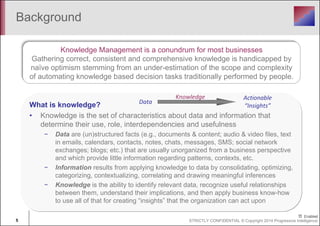
Knowledge Management is a conundrum for most businesses 
Gathering correct, consistent and comprehensive knowledge is handicapped by 
naïve optimism stemming from an under-estimation of the scope and complexity 
of automating knowledge based decision tasks traditionally performed by people. 
Knowledge 
Data 
Actionable 
“Insights” 
What is knowledge? 
• Knowledge is the set of characteristics about data and information that 
determine their use, role, interdependencies and usefulness 
− Data are (un)structured facts (e.g., documents & content; audio & video files, text 
in emails, calendars, contacts, notes, chats, messages, SMS; social network 
exchanges; blogs; etc.) that are usually unorganized from a business perspective 
and which provide little information regarding patterns, contexts, etc. 
− Information results from applying knowledge to data by consolidating, optimizing, 
categorizing, contextualizing, correlating and drawing meaningful inferences 
− Knowledge is the ability to identify relevant data, recognize useful relationships 
between them, understand their implications, and then apply business know-how 
to use all of that for creating “insights” that the organization can act upon 
5 STRICTLY CONFIDENTIAL © Copyright 2014 Progressive Intelligence
Knowledge and its management 
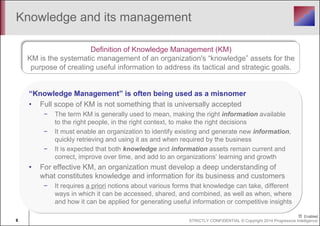
Definition of Knowledge Management (KM) 
KM is the systematic management of an organization's “knowledge” assets for the 
purpose of creating useful information to address its tactical and strategic goals. 
“Knowledge Management” is often being used as a misnomer 
• Full scope of KM is not something that is universally accepted 
− The term KM is generally used to mean, making the right information available 
to the right people, in the right context, to make the right decisions 
− It must enable an organization to identify existing and generate new information, 
quickly retrieving and using it as and when required by the business 
− It is expected that both knowledge and information assets remain current and 
correct, improve over time, and add to an organizations’ learning and growth 
• For effective KM, an organization must develop a deep understanding of 
what constitutes knowledge and information for its business and customers 
− It requires a priori notions about various forms that knowledge can take, different 
ways in which it can be accessed, shared, and combined, as well as when, where 
and how it can be applied for generating useful information or competitive insights 
6 STRICTLY CONFIDENTIAL © Copyright 2014 Progressive Intelligence
Practical challenges 
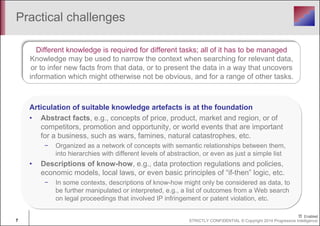
Different knowledge is required for different tasks; all of it has to be managed 
Knowledge may be used to narrow the context when searching for relevant data, 
or to infer new facts from that data, or to present the data in a way that uncovers 
information which might otherwise not be obvious, and for a range of other tasks. 
Articulation of suitable knowledge artefacts is at the foundation 
• Abstract facts, e.g., concepts of price, product, market and region, or of 
competitors, promotion and opportunity, or world events that are important 
for a business, such as wars, famines, natural catastrophes, etc. 
− Organized as a network of concepts with semantic relationships between them, 
into hierarchies with different levels of abstraction, or even as just a simple list 
• Descriptions of know-how, e.g., data protection regulations and policies, 
economic models, local laws, or even basic principles of “if-then” logic, etc. 
− In some contexts, descriptions of know-how might only be considered as data, to 
be further manipulated or interpreted, e.g., a list of outcomes from a Web search 
on legal proceedings that involved IP infringement or patent violation, etc. 
7 STRICTLY CONFIDENTIAL © Copyright 2014 Progressive Intelligence
Practical challenges 
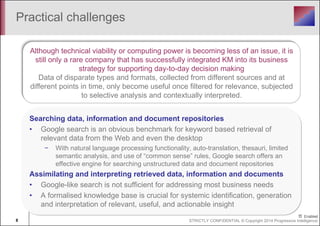
Although technical viability or computing power is becoming less of an issue, it is 
still only a rare company that has successfully integrated KM into its business 
strategy for supporting day-to-day decision making 
Data of disparate types and formats, collected from different sources and at 
different points in time, only become useful once filtered for relevance, subjected 
to selective analysis and contextually interpreted. 
Searching data, information and document repositories 
• Google search is an obvious benchmark for keyword based retrieval of 
relevant data from the Web and even the desktop 
− With natural language processing functionality, auto-translation, thesauri, limited 
semantic analysis, and use of “common sense” rules, Google search offers an 
effective engine for searching unstructured data and document repositories 
Assimilating and interpreting retrieved data, information and documents 
• Google-like search is not sufficient for addressing most business needs 
• A formalised knowledge base is crucial for systemic identification, generation 
and interpretation of relevant, useful, and actionable insight 
8 STRICTLY CONFIDENTIAL © Copyright 2014 Progressive Intelligence
Practical challenges 
Once categorized and integrated data can be searched, “mined”, interpreted and 
analysed, using effective presentation metaphors to communicate information 
Selecting meaningful dimensions for data modelling, recognizing relevant 
relationships, and knowing useful patterns on seeing them is knowledge; its 
application results in information, only a small portion of it is real insight. 
From data to business intelligence 
• Discovery of innate relationships between data through multi-dimensional 
visualization of interesting patterns is becoming increasingly critical 
− Handling the exponential increase in data entering an enterprise from mobile 
devices, social media, public internet, private repositories, etc., managing the 
range of data types, static/dynamic, structured/unstructured, multimedia, etc., 
knowing which (if any) of that data is relevant, sharing timely information derived 
from it with staff and most critically, its selective dissemination externally, enables 
a business to combat competitive forces and secure a leading market position 
9 STRICTLY CONFIDENTIAL © Copyright 2014 Progressive Intelligence
Practical challenges 
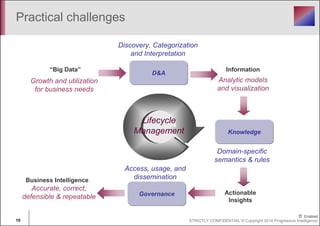
Discovery, Categorization 
and Interpretation 
“Big Data” D&A 
Growth and utilization 
for business needs 
Business Intelligence 
Accurate, correct, 
defensible & repeatable 
Lifecycle 
Management 
Access, usage, and 
dissemination 
Governance 
Information 
Analytic models 
and visualization 
Knowledge 
Domain-specific 
semantics & rules 
Actionable 
Insights 
10 STRICTLY CONFIDENTIAL © Copyright 2014 Progressive Intelligence
Practical challenges 
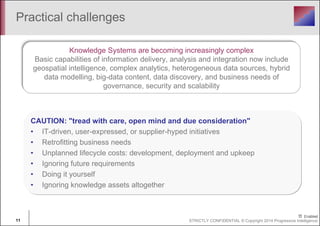
Knowledge Systems are becoming increasingly complex 
Basic capabilities of information delivery, analysis and integration now include 
geospatial intelligence, complex analytics, heterogeneous data sources, hybrid 
data modelling, big-data content, data discovery, and business needs of 
governance, security and scalability 
CAUTION: "tread with care, open mind and due consideration" 
• IT-driven, user-expressed, or supplier-hyped initiatives 
• Retrofitting business needs 
• Unplanned lifecycle costs: development, deployment and upkeep 
• Ignoring future requirements 
• Doing it yourself 
• Ignoring knowledge assets altogether 
11 STRICTLY CONFIDENTIAL © Copyright 2014 Progressive Intelligence
Scope and strategy 
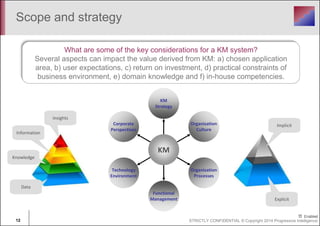
What are some of the key considerations for a KM system? 
Several aspects can impact the value derived from KM: a) chosen application 
area, b) user expectations, c) return on investment, d) practical constraints of 
business environment, e) domain knowledge and f) in-house competencies. 
Corporate 
Perspectives 
Technology 
Environment 
KM 
Strategy 
KM 
Functional 
Management 
Organization 
Culture 
Organization 
Processes 
Information 
Knowledge 
Data 
Insights 
Implicit 
Explicit 
12 STRICTLY CONFIDENTIAL © Copyright 2014 Progressive Intelligence
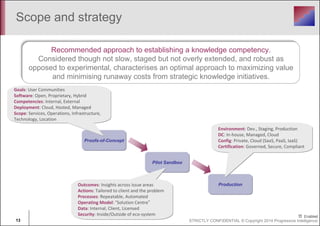
Scope and strategy 
Recommended approach to establishing a knowledge competency. 
Considered though not slow, staged but not overly extended, and robust as 
opposed to experimental, characterises an optimal approach to maximizing value 
and minimising runaway costs from strategic knowledge initiatives. 
Pilot Sandbox 
Goals: User Communities 
Software: Open, Proprietary, Hybrid 
Competencies: Internal, External 
Deployment: Cloud, Hosted, Managed 
Scope: Services, Operations, Infrastructure, 
Technology, Location 
Proofs-of-Concept 
Outcomes: Insights across issue areas 
Actions: Tailored to client and the problem 
Processes: Repeatable, Automated 
Operating Model: “Solution Centre” 
Data: Internal, Client, Licensed 
Security: Inside/Outside of eco-system 
Environment: Dev., Staging, Production 
DC: In-house, Managed, Cloud 
Config: Private, Cloud (SaaS, PaaS, IaaS) 
Certification: Governed, Secure, Compliant 
Production 
13 STRICTLY CONFIDENTIAL © Copyright 2014 Progressive Intelligence
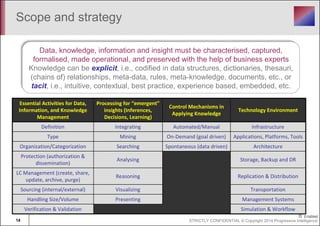
Scope and strategy 
Data, knowledge, information and insight must be characterised, captured, 
formalised, made operational, and preserved with the help of business experts 
Knowledge can be explicit, i.e., codified in data structures, dictionaries, thesauri, 
(chains of) relationships, meta-data, rules, meta-knowledge, documents, etc., or 
tacit, i.e., intuitive, contextual, best practice, experience based, embedded, etc. 
Technology Environment 
Control Mechanisms in 
Applying Knowledge 
Processing for “emergent” 
insights (Inferences, 
Decisions, Learning) 
Essential Activities for Data, 
Information, and Knowledge 
Management 
Definition Integrating Automated/Manual Infrastructure 
Type Mining On-Demand (goal driven) Applications, Platforms, Tools 
Organization/Categorization Searching Spontaneous (data driven) Architecture 
Analysing Storage, Backup and DR 
Protection (authorization & 
dissemination) 
Reasoning Replication & Distribution 
LC Management (create, share, 
update, archive, purge) 
Sourcing (internal/external) Visualizing Transportation 
Handling Size/Volume Presenting Management Systems 
Verification & Validation Simulation & Workflow 
14 STRICTLY CONFIDENTIAL © Copyright 2014 Progressive Intelligence
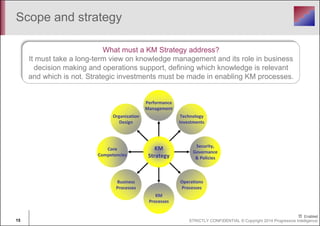
Scope and strategy 
What must a KM Strategy address? 
It must take a long-term view on knowledge management and its role in business 
decision making and operations support, defining which knowledge is relevant 
and which is not. Strategic investments must be made in enabling KM processes. 
Performance 
Management 
Technology 
Investments 
Security, 
Governance 
& Policies 
Operations 
Processes 
KM 
Strategy 
KM 
Processes 
Organization 
Core 
Design 
Competencies 
Business 
Processes 
15 STRICTLY CONFIDENTIAL © Copyright 2014 Progressive Intelligence
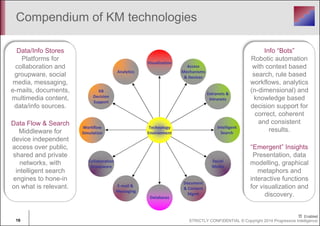
Compendium of KM technologies 
Analytics 
KB 
Decision 
Support 
Workflow 
Simulation 
Collaboration 
Groupware 
E-mail & 
Messaging 
Visualization 
Technology 
Environment 
Databases 
Access 
Mechanisms 
& Devices 
Document 
& Content 
Mgmt 
Extranets & 
Intranets 
Intelligent 
Search 
Social 
Media 
Info “Bots” 
Robotic automation 
with context based 
search, rule based 
workflows, analytics 
(n-dimensional) and 
knowledge based 
decision support for 
correct, coherent 
and consistent 
results. 
“Emergent” Insights 
Presentation, data 
modelling, graphical 
metaphors and 
interactive functions 
for visualization and 
discovery. 
Data/Info Stores 
Platforms for 
collaboration and 
groupware, social 
media, messaging, 
e-mails, documents, 
multimedia content, 
data/info sources. 
Data Flow & Search 
Middleware for 
device independent 
access over public, 
shared and private 
networks, with 
intelligent search 
engines to hone-in 
on what is relevant. 
16 STRICTLY CONFIDENTIAL © Copyright 2014 Progressive Intelligence
Progressive Intelligence, Ltd. 
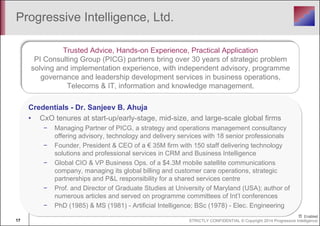
Trusted Advice, Hands-on Experience, Practical Application 
PI Consulting Group (PICG) partners bring over 30 years of strategic problem 
solving and implementation experience, with independent advisory, programme 
governance and leadership development services in business operations, 
Telecoms & IT, information and knowledge management. 
Credentials - Dr. Sanjeev B. Ahuja 
• CxO tenures at start-up/early-stage, mid-size, and large-scale global firms 
− Managing Partner of PICG, a strategy and operations management consultancy 
offering advisory, technology and delivery services with 18 senior professionals 
− Founder, President & CEO of a € 35M firm with 150 staff delivering technology 
solutions and professional services in CRM and Business Intelligence 
− Global CIO & VP Business Ops. of a $4.3M mobile satellite communications 
company, managing its global billing and customer care operations, strategic 
partnerships and P&L responsibility for a shared services centre 
− Prof. and Director of Graduate Studies at University of Maryland (USA); author of 
numerous articles and served on programme committees of Int’l conferences 
− PhD (1985) & MS (1981) - Artificial Intelligence; BSc (1978) - Elec. Engineering 
17 STRICTLY CONFIDENTIAL © Copyright 2014 Progressive Intelligence
Progressive Intelligence, Ltd. 
18 STRICTLY CONFIDENTIAL © Copyright 2014 Progressive Intelligence

PIPL - Practice Area Business Intelligence

  • 1.
    Trusted Advisory Services STRICTLY CONFIDENTIAL © Copyright 2014 Progressive Intelligence USA • UK • INDIA Progressive Intelligence Partners in Achievement 9225 W. Jewell Place, #101, Lakewood Colorado 80227 USA • 1245 Wild Rose Lane Lake Forest Illinois 60045 USA • 333 Rector Pl, #908 New York New York 10280 USA • 4921 Waterfowl Way, Rockville Maryland 20853 USA • 6143 Leesburg Pike, #607 Falls Church Virginia 22041 USA • 1st Floor, 19 Bracknell Gardens, Hampstead, London NW3 7EE UK • B-18 Swasthya Vihar Vikas Marg Delhi 110092 INDIA info@piplinc.com Knowledge Management Using “Business Intelligence” for Insights Tapping, Moulding and Utilizing Knowledge Assets Dr. Sanjeev B. Ahuja Managing Director sanjeev.ahuja@piplinc.com
  • 2.
    Overview Background Knowledgeand its management Practical challenges Scope and Strategy Compendium of KM technologies 2 STRICTLY CONFIDENTIAL © Copyright 2014 Progressive Intelligence
  • 3.
    Background Current stateof play Years of incorrect and misleading claims that fed a desire to “dumb down” inherent complexities in representing and using knowledge have created a firestorm of expectations; suppliers are over-promising and under-delivering. Data and information sources abound in a market sans frontières • Businesses gain competitive edge with timely and informed decision-making − Heightened competition and market vulnerability has made intelligent assimilation and interpretation of strategic and tactical data a mission-critical requirement Knowledge workers in the labour force have taken on renewed import • There is growing recognition that know-how, experience, and practices are arguably the most significant corporate asset that must not be left tacit; it only becomes tangible once characterised, captured, and made operative − Differentiating low-value tasks of data capture and reporting, from high-value sophisticated processes that generate business intelligence, requires domain knowledge and creative data/information engineering 3 STRICTLY CONFIDENTIAL © Copyright 2014 Progressive Intelligence
  • 4.
    Background Businesses mustclearly articulate their objectives from using data, analytics, and knowledge to make decisions, along with a strategic plan for realizing them After wading through ubiquitous hype about the “big data” tsunami and technology platforms for surfing it, one still cannot eke out a clear “so what” from it. The big deal around Big Data Analysis (BDA) • It is neither the ability to process large volumes nor the clever analytical techniques that is the raison d’être for BDA; both are but means to an end − Its purpose is “intelligent” or simply, informed decision making based on relevant data, its interpretation (at times with visualization aids) to draw useful inferences, and creation of other facts and valuable information that are otherwise “hidden”. − Once potentially useful data sources have been identified, the next challenge is to work one’s way through a forest of options for technology platforms, to select one that offers a range of appropriate tools and techniques. − It is only with aligning and integrating BDA within critical business decision making processes that its goals come to fruition. It delivers maximal value when it not only supports business as usual but rather, influences the way it is done. 4 STRICTLY CONFIDENTIAL © Copyright 2014 Progressive Intelligence
  • 5.
    Background Knowledge Managementis a conundrum for most businesses Gathering correct, consistent and comprehensive knowledge is handicapped by naïve optimism stemming from an under-estimation of the scope and complexity of automating knowledge based decision tasks traditionally performed by people. Knowledge Data Actionable “Insights” What is knowledge? • Knowledge is the set of characteristics about data and information that determine their use, role, interdependencies and usefulness − Data are (un)structured facts (e.g., documents & content; audio & video files, text in emails, calendars, contacts, notes, chats, messages, SMS; social network exchanges; blogs; etc.) that are usually unorganized from a business perspective and which provide little information regarding patterns, contexts, etc. − Information results from applying knowledge to data by consolidating, optimizing, categorizing, contextualizing, correlating and drawing meaningful inferences − Knowledge is the ability to identify relevant data, recognize useful relationships between them, understand their implications, and then apply business know-how to use all of that for creating “insights” that the organization can act upon 5 STRICTLY CONFIDENTIAL © Copyright 2014 Progressive Intelligence
  • 6.
    Knowledge and itsmanagement Definition of Knowledge Management (KM) KM is the systematic management of an organization's “knowledge” assets for the purpose of creating useful information to address its tactical and strategic goals. “Knowledge Management” is often being used as a misnomer • Full scope of KM is not something that is universally accepted − The term KM is generally used to mean, making the right information available to the right people, in the right context, to make the right decisions − It must enable an organization to identify existing and generate new information, quickly retrieving and using it as and when required by the business − It is expected that both knowledge and information assets remain current and correct, improve over time, and add to an organizations’ learning and growth • For effective KM, an organization must develop a deep understanding of what constitutes knowledge and information for its business and customers − It requires a priori notions about various forms that knowledge can take, different ways in which it can be accessed, shared, and combined, as well as when, where and how it can be applied for generating useful information or competitive insights 6 STRICTLY CONFIDENTIAL © Copyright 2014 Progressive Intelligence
  • 7.
    Practical challenges Differentknowledge is required for different tasks; all of it has to be managed Knowledge may be used to narrow the context when searching for relevant data, or to infer new facts from that data, or to present the data in a way that uncovers information which might otherwise not be obvious, and for a range of other tasks. Articulation of suitable knowledge artefacts is at the foundation • Abstract facts, e.g., concepts of price, product, market and region, or of competitors, promotion and opportunity, or world events that are important for a business, such as wars, famines, natural catastrophes, etc. − Organized as a network of concepts with semantic relationships between them, into hierarchies with different levels of abstraction, or even as just a simple list • Descriptions of know-how, e.g., data protection regulations and policies, economic models, local laws, or even basic principles of “if-then” logic, etc. − In some contexts, descriptions of know-how might only be considered as data, to be further manipulated or interpreted, e.g., a list of outcomes from a Web search on legal proceedings that involved IP infringement or patent violation, etc. 7 STRICTLY CONFIDENTIAL © Copyright 2014 Progressive Intelligence
  • 8.
    Practical challenges Althoughtechnical viability or computing power is becoming less of an issue, it is still only a rare company that has successfully integrated KM into its business strategy for supporting day-to-day decision making Data of disparate types and formats, collected from different sources and at different points in time, only become useful once filtered for relevance, subjected to selective analysis and contextually interpreted. Searching data, information and document repositories • Google search is an obvious benchmark for keyword based retrieval of relevant data from the Web and even the desktop − With natural language processing functionality, auto-translation, thesauri, limited semantic analysis, and use of “common sense” rules, Google search offers an effective engine for searching unstructured data and document repositories Assimilating and interpreting retrieved data, information and documents • Google-like search is not sufficient for addressing most business needs • A formalised knowledge base is crucial for systemic identification, generation and interpretation of relevant, useful, and actionable insight 8 STRICTLY CONFIDENTIAL © Copyright 2014 Progressive Intelligence
  • 9.
    Practical challenges Oncecategorized and integrated data can be searched, “mined”, interpreted and analysed, using effective presentation metaphors to communicate information Selecting meaningful dimensions for data modelling, recognizing relevant relationships, and knowing useful patterns on seeing them is knowledge; its application results in information, only a small portion of it is real insight. From data to business intelligence • Discovery of innate relationships between data through multi-dimensional visualization of interesting patterns is becoming increasingly critical − Handling the exponential increase in data entering an enterprise from mobile devices, social media, public internet, private repositories, etc., managing the range of data types, static/dynamic, structured/unstructured, multimedia, etc., knowing which (if any) of that data is relevant, sharing timely information derived from it with staff and most critically, its selective dissemination externally, enables a business to combat competitive forces and secure a leading market position 9 STRICTLY CONFIDENTIAL © Copyright 2014 Progressive Intelligence
  • 10.
    Practical challenges Discovery,Categorization and Interpretation “Big Data” D&A Growth and utilization for business needs Business Intelligence Accurate, correct, defensible & repeatable Lifecycle Management Access, usage, and dissemination Governance Information Analytic models and visualization Knowledge Domain-specific semantics & rules Actionable Insights 10 STRICTLY CONFIDENTIAL © Copyright 2014 Progressive Intelligence
  • 11.
    Practical challenges KnowledgeSystems are becoming increasingly complex Basic capabilities of information delivery, analysis and integration now include geospatial intelligence, complex analytics, heterogeneous data sources, hybrid data modelling, big-data content, data discovery, and business needs of governance, security and scalability CAUTION: "tread with care, open mind and due consideration" • IT-driven, user-expressed, or supplier-hyped initiatives • Retrofitting business needs • Unplanned lifecycle costs: development, deployment and upkeep • Ignoring future requirements • Doing it yourself • Ignoring knowledge assets altogether 11 STRICTLY CONFIDENTIAL © Copyright 2014 Progressive Intelligence
  • 12.
    Scope and strategy What are some of the key considerations for a KM system? Several aspects can impact the value derived from KM: a) chosen application area, b) user expectations, c) return on investment, d) practical constraints of business environment, e) domain knowledge and f) in-house competencies. Corporate Perspectives Technology Environment KM Strategy KM Functional Management Organization Culture Organization Processes Information Knowledge Data Insights Implicit Explicit 12 STRICTLY CONFIDENTIAL © Copyright 2014 Progressive Intelligence
  • 13.
    Scope and strategy Recommended approach to establishing a knowledge competency. Considered though not slow, staged but not overly extended, and robust as opposed to experimental, characterises an optimal approach to maximizing value and minimising runaway costs from strategic knowledge initiatives. Pilot Sandbox Goals: User Communities Software: Open, Proprietary, Hybrid Competencies: Internal, External Deployment: Cloud, Hosted, Managed Scope: Services, Operations, Infrastructure, Technology, Location Proofs-of-Concept Outcomes: Insights across issue areas Actions: Tailored to client and the problem Processes: Repeatable, Automated Operating Model: “Solution Centre” Data: Internal, Client, Licensed Security: Inside/Outside of eco-system Environment: Dev., Staging, Production DC: In-house, Managed, Cloud Config: Private, Cloud (SaaS, PaaS, IaaS) Certification: Governed, Secure, Compliant Production 13 STRICTLY CONFIDENTIAL © Copyright 2014 Progressive Intelligence
  • 14.
    Scope and strategy Data, knowledge, information and insight must be characterised, captured, formalised, made operational, and preserved with the help of business experts Knowledge can be explicit, i.e., codified in data structures, dictionaries, thesauri, (chains of) relationships, meta-data, rules, meta-knowledge, documents, etc., or tacit, i.e., intuitive, contextual, best practice, experience based, embedded, etc. Technology Environment Control Mechanisms in Applying Knowledge Processing for “emergent” insights (Inferences, Decisions, Learning) Essential Activities for Data, Information, and Knowledge Management Definition Integrating Automated/Manual Infrastructure Type Mining On-Demand (goal driven) Applications, Platforms, Tools Organization/Categorization Searching Spontaneous (data driven) Architecture Analysing Storage, Backup and DR Protection (authorization & dissemination) Reasoning Replication & Distribution LC Management (create, share, update, archive, purge) Sourcing (internal/external) Visualizing Transportation Handling Size/Volume Presenting Management Systems Verification & Validation Simulation & Workflow 14 STRICTLY CONFIDENTIAL © Copyright 2014 Progressive Intelligence
  • 15.
    Scope and strategy What must a KM Strategy address? It must take a long-term view on knowledge management and its role in business decision making and operations support, defining which knowledge is relevant and which is not. Strategic investments must be made in enabling KM processes. Performance Management Technology Investments Security, Governance & Policies Operations Processes KM Strategy KM Processes Organization Core Design Competencies Business Processes 15 STRICTLY CONFIDENTIAL © Copyright 2014 Progressive Intelligence
  • 16.
    Compendium of KMtechnologies Analytics KB Decision Support Workflow Simulation Collaboration Groupware E-mail & Messaging Visualization Technology Environment Databases Access Mechanisms & Devices Document & Content Mgmt Extranets & Intranets Intelligent Search Social Media Info “Bots” Robotic automation with context based search, rule based workflows, analytics (n-dimensional) and knowledge based decision support for correct, coherent and consistent results. “Emergent” Insights Presentation, data modelling, graphical metaphors and interactive functions for visualization and discovery. Data/Info Stores Platforms for collaboration and groupware, social media, messaging, e-mails, documents, multimedia content, data/info sources. Data Flow & Search Middleware for device independent access over public, shared and private networks, with intelligent search engines to hone-in on what is relevant. 16 STRICTLY CONFIDENTIAL © Copyright 2014 Progressive Intelligence
  • 17.
    Progressive Intelligence, Ltd. Trusted Advice, Hands-on Experience, Practical Application PI Consulting Group (PICG) partners bring over 30 years of strategic problem solving and implementation experience, with independent advisory, programme governance and leadership development services in business operations, Telecoms & IT, information and knowledge management. Credentials - Dr. Sanjeev B. Ahuja • CxO tenures at start-up/early-stage, mid-size, and large-scale global firms − Managing Partner of PICG, a strategy and operations management consultancy offering advisory, technology and delivery services with 18 senior professionals − Founder, President & CEO of a € 35M firm with 150 staff delivering technology solutions and professional services in CRM and Business Intelligence − Global CIO & VP Business Ops. of a $4.3M mobile satellite communications company, managing its global billing and customer care operations, strategic partnerships and P&L responsibility for a shared services centre − Prof. and Director of Graduate Studies at University of Maryland (USA); author of numerous articles and served on programme committees of Int’l conferences − PhD (1985) & MS (1981) - Artificial Intelligence; BSc (1978) - Elec. Engineering 17 STRICTLY CONFIDENTIAL © Copyright 2014 Progressive Intelligence
  • 18.
    Progressive Intelligence, Ltd. 18 STRICTLY CONFIDENTIAL © Copyright 2014 Progressive Intelligence