Pinyin Lesson 04
Spelling rules (2)
Spelling rules for compound vowels
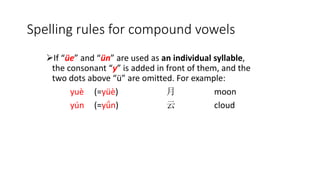
If “üe” and “ün” are used as an individual syllable,
the consonant “y” is added in front of them, and the
two dots above “ü” are omitted. For example:
yuè (=yüè) 月 moon
yún (=yǘn) 云 cloud
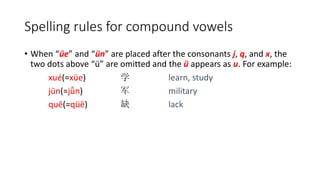
• When “üe” and “ün” are placed after the consonants j, q, and x, the
two dots above “ü” are omitted and the ü appears as u. For example:
xué(=xüe) 学 learn, study
jūn(=jǖn) 军 military
quē(=qüē) 缺 lack
Spelling rules for compound vowels
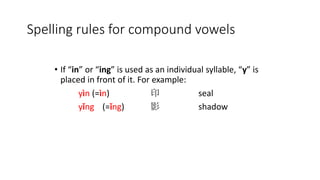
• If “in” or “ing” is used as an individual syllable, “y” is
placed in front of it. For example:
yìn (=ìn) 印 seal
yǐng (=ǐng) 影 shadow
Spelling rules for compound vowels
• There is only one retroflex final “er” in Pinyin. When
pronouncing “er”, first pronounce “e ” (like ‘ir’ in
‘dirty’), then raise and retract the tongue backwards.
èr 二 (two)
ěr 耳 (ear)
 Exercises
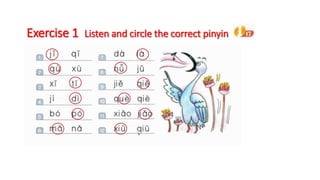
Exercise 1 Listen and circle the correct pinyin
á ì
è ǔ ù
ī ǐ uì
ǒu uō uò
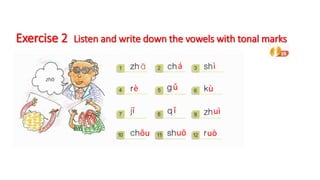
Exercise 2 Listen and write down the vowels with tonal marks
jǐ
qù
jī
kē
kǔ
jǔ
gù
xú
yuè
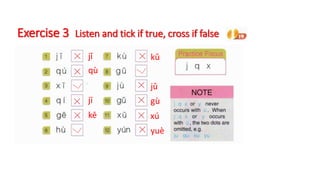
Exercise 3 Listen and tick if true, cross if false
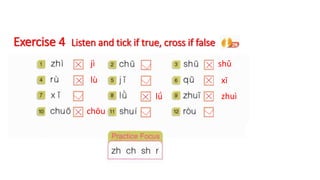
shǔjì
lù
chōu
lǘ
xī
zhuì
Exercise 4 Listen and tick if true, cross if false
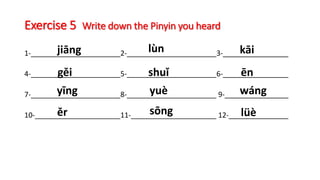
Exercise 5 Write down the Pinyin you heard
1- 2- 3-
4- 5- 6-
7- 8- 9-
10- 11- 12-
jiāng lùn kāi
gěi shuǐ ēn
yīng yuè wáng
ěr sōng lüè
Words for Kungfu-training
Extension
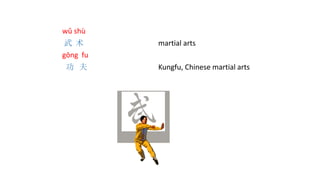
wǔ shù
武 术 martial arts
gōng fu
功 夫 Kungfu, Chinese martial arts
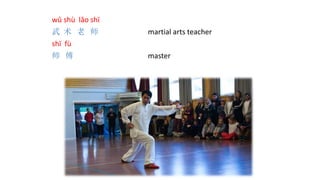
wǔ shù lǎo shī
武 术 老 师 martial arts teacher
shī fù
师 傅 master
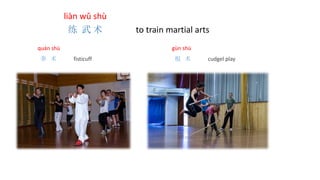
liàn wǔ shù
练 武 术 to train martial arts
quán shù
拳 术 fisticuff
gùn shù
棍 术 cudgel play
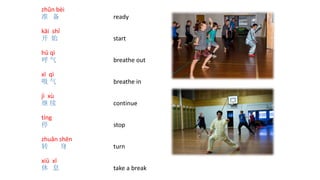
zhǔn bèi
准 备 ready
kāi shǐ
开 始 start
hū qì
呼 气 breathe out
xī qì
吸 气 breathe in
jì xù
继 续 continue
tíng
停 stop
zhuǎn shēn
转 身 turn
xiū xī
休 息 take a break
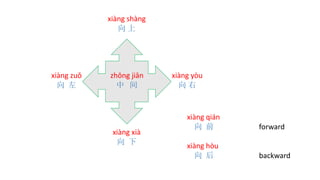
xiàng shàng
向 上
xiàng zuǒ
向 左
xiàng yòu
向 右
xiàng xià
向 下
zhōng jiān
中 间
xiàng qián
向 前 forward
xiàng hòu
向 后 backward
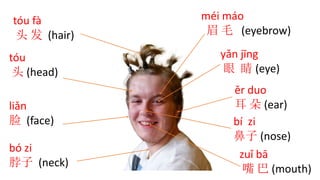
tóu
头 (head)
liǎn
脸 (face)
bó zi
脖子 (neck)
méi máo
眉 毛 (eyebrow)
tóu fà
头 发 (hair)
yǎn jīng
眼 睛 (eye)
bí zi
鼻子 (nose)
zuǐ bā
嘴 巴 (mouth)
ěr duo
耳 朵 (ear)
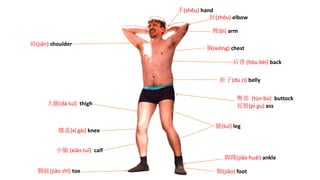
肩(jiān) shoulder
手(shǒu) hand
肘(zhǒu) elbow
臂(bì) arm
胸(xiōng) chest
肚子(dù zi) belly
膝盖(xī gài) knee
大腿(dà tuǐ) thigh
小腿 (xiǎo tuǐ) calf
腿(tuǐ) leg
脚踝(jiǎo huái) ankle
后背 (hòu bèi) back
臀部 (tún bù) buttock
屁股(pì gu) ass
脚(jiǎo) foot脚趾(jiǎo zhǐ) toe

Pinyin Lesson 4 Spelling rules 2

  • 1.
  • 2.
    Spelling rules forcompound vowels If “üe” and “ün” are used as an individual syllable, the consonant “y” is added in front of them, and the two dots above “ü” are omitted. For example: yuè (=yüè) 月 moon yún (=yǘn) 云 cloud
  • 3.
    • When “üe”and “ün” are placed after the consonants j, q, and x, the two dots above “ü” are omitted and the ü appears as u. For example: xué(=xüe) 学 learn, study jūn(=jǖn) 军 military quē(=qüē) 缺 lack Spelling rules for compound vowels
  • 4.
    • If “in”or “ing” is used as an individual syllable, “y” is placed in front of it. For example: yìn (=ìn) 印 seal yǐng (=ǐng) 影 shadow Spelling rules for compound vowels
  • 5.
    Spelling rules forcompound vowels • There is only one retroflex final “er” in Pinyin. When pronouncing “er”, first pronounce “e ” (like ‘ir’ in ‘dirty’), then raise and retract the tongue backwards. èr 二 (two) ěr 耳 (ear)
  • 6.
  • 7.
    Exercise 1 Listenand circle the correct pinyin
  • 8.
    á ì è ǔù ī ǐ uì ǒu uō uò Exercise 2 Listen and write down the vowels with tonal marks
  • 9.
  • 10.
    shǔjì lù chōu lǘ xī zhuì Exercise 4 Listenand tick if true, cross if false
  • 11.
    Exercise 5 Writedown the Pinyin you heard 1- 2- 3- 4- 5- 6- 7- 8- 9- 10- 11- 12- jiāng lùn kāi gěi shuǐ ēn yīng yuè wáng ěr sōng lüè
  • 12.
  • 13.
    wǔ shù 武 术martial arts gōng fu 功 夫 Kungfu, Chinese martial arts
  • 14.
    wǔ shù lǎoshī 武 术 老 师 martial arts teacher shī fù 师 傅 master
  • 15.
    liàn wǔ shù 练武 术 to train martial arts quán shù 拳 术 fisticuff gùn shù 棍 术 cudgel play
  • 16.
    zhǔn bèi 准 备ready kāi shǐ 开 始 start hū qì 呼 气 breathe out xī qì 吸 气 breathe in jì xù 继 续 continue tíng 停 stop zhuǎn shēn 转 身 turn xiū xī 休 息 take a break
  • 17.
    xiàng shàng 向 上 xiàngzuǒ 向 左 xiàng yòu 向 右 xiàng xià 向 下 zhōng jiān 中 间 xiàng qián 向 前 forward xiàng hòu 向 后 backward
  • 18.
    tóu 头 (head) liǎn 脸 (face) bózi 脖子 (neck) méi máo 眉 毛 (eyebrow) tóu fà 头 发 (hair) yǎn jīng 眼 睛 (eye) bí zi 鼻子 (nose) zuǐ bā 嘴 巴 (mouth) ěr duo 耳 朵 (ear)
  • 19.
    肩(jiān) shoulder 手(shǒu) hand 肘(zhǒu)elbow 臂(bì) arm 胸(xiōng) chest 肚子(dù zi) belly 膝盖(xī gài) knee 大腿(dà tuǐ) thigh 小腿 (xiǎo tuǐ) calf 腿(tuǐ) leg 脚踝(jiǎo huái) ankle 后背 (hòu bèi) back 臀部 (tún bù) buttock 屁股(pì gu) ass 脚(jiǎo) foot脚趾(jiǎo zhǐ) toe