
Pinyin Lesson 03
Spelling rules (1)
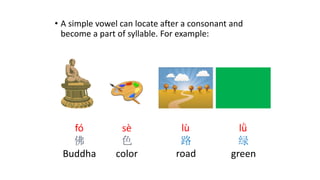
• A simple vowel can locate after a consonant and
become a part of syllable. For example:
fó
佛
Buddha
sè
色
color
lù
路
road
lǜ
绿
green
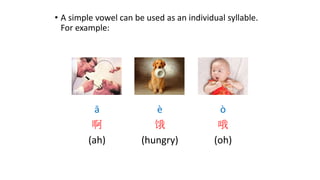
• A simple vowel can be used as an individual syllable.
For example:
ā
啊
(ah)
è
饿
(hungry)
ò
哦
(oh)
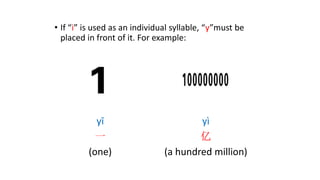
• If “i” is used as an individual syllable, “y”must be
placed in front of it. For example:
yī
一
(one)
yì
亿
(a hundred million)
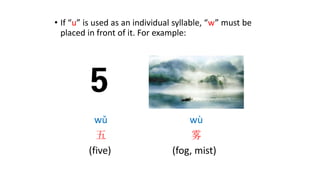
• If “u” is used as an individual syllable, “w” must be
placed in front of it. For example:
wǔ
五
(five)
wù
雾
(fog, mist)
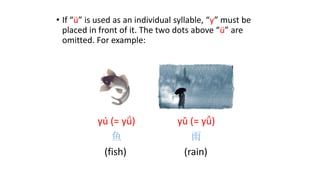
• If “ü” is used as an individual syllable, “y” must be
placed in front of it. The two dots above “ü” are
omitted. For example:
yú (= yǘ)
鱼
(fish)
yǔ (= yǚ)
雨
(rain)
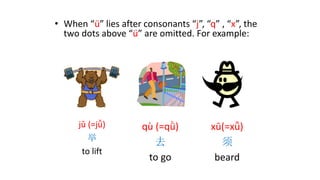
• When “ü” lies after consonants “j”, “q” , “x”, the
two dots above “ü” are omitted. For example:
jǔ (=jǚ)
举
to lift
qù (=qǜ)
去
to go
xū(=xǖ)
须
beard
 Exercises
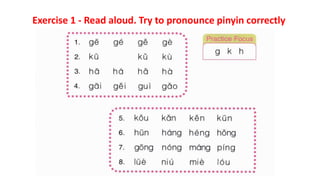
Exercise 1 - Read aloud. Try to pronounce pinyin correctly
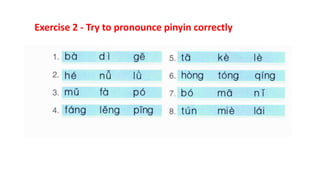
Exercise 2 - Try to pronounce pinyin correctly
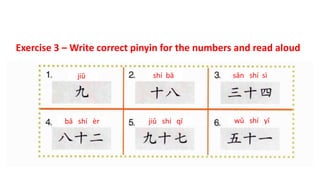
jiǔ shí bā sān shí sì
bā shí èr jiǔ shí qī wǔ shí yī
Exercise 3 – Write correct pinyin for the numbers and read aloud
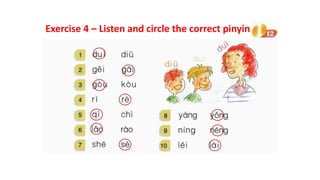
Exercise 4 – Listen and circle the correct pinyin
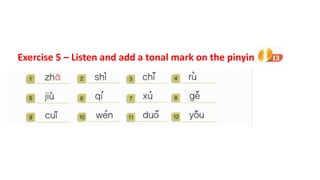
Exercise 5 – Listen and add a tonal mark on the pinyin
ā ū ì
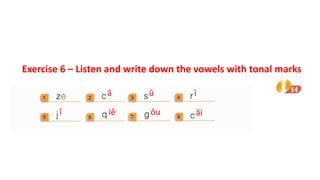
ǐ iě ǒu ǎi
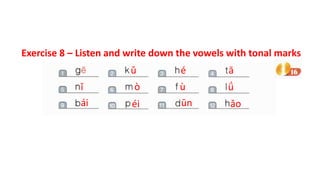
Exercise 6 – Listen and write down the vowels with tonal marks
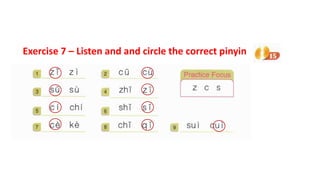
Exercise 7 – Listen and and circle the correct pinyin
ǔ é ā
ǐ ò ù ǘ
ái éi ūn ǎo
Exercise 8 – Listen and write down the vowels with tonal marks
Everyday conversations
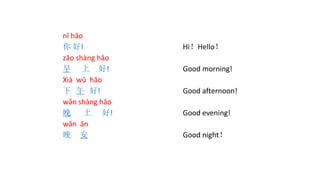
nǐ hǎo
你 好! Hi!Hello!
zǎo shàng hǎo
早 上 好! Good morning!
Xià wǔ hǎo
下 午 好! Good afternoon!
wǎn shàng hǎo
晚 上 好! Good evening!
wǎn ān
晚 安 Good night!
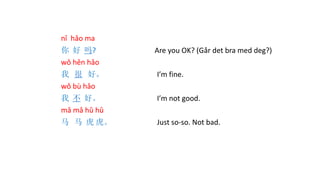
nǐ hǎo ma
你 好 吗? Are you OK? (Går det bra med deg?)
wǒ hěn hǎo
我 很 好。 I’m fine.
wǒ bù hǎo
我 不 好。 I’m not good.
mǎ mǎ hǔ hǔ
马 马 虎 虎。 Just so-so. Not bad.
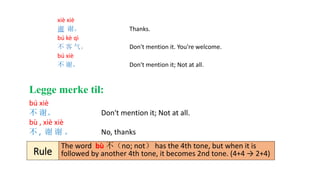
xiè xiè
谢 谢。 Thanks.
bú kè qì
不 客 气。 Don't mention it. You're welcome.
bú xiè
不 谢。 Don't mention it; Not at all.
bú xiè
不 谢。 Don't mention it; Not at all.
bù , xiè xiè
不 , 谢 谢 。 No, thanks
The word bù 不(no; not) has the 4th tone, but when it is
followed by another 4th tone, it becomes 2nd tone. (4+4 → 2+4)Rule
Legge merke til:
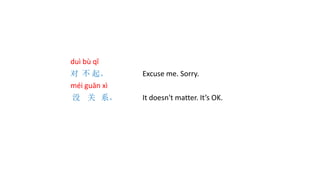
duì bù qǐ
对 不 起。 Excuse me. Sorry.
méi guān xì
没 关 系。 It doesn't matter. It’s OK.
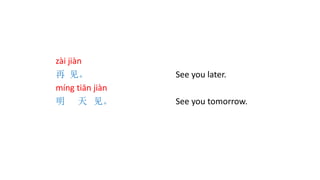
zài jiàn
再 见。 See you later.
míng tiān jiàn
明 天 见。 See you tomorrow.
Farvel
Sòng bié
送 别
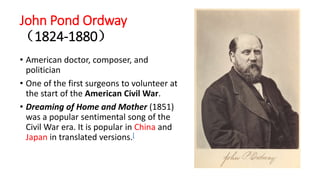
John Pond Ordway
(1824-1880)
• American doctor, composer, and
politician
• One of the first surgeons to volunteer at
the start of the American Civil War.
• Dreaming of Home and Mother (1851)
was a popular sentimental song of the
Civil War era. It is popular in China and
Japan in translated versions.[
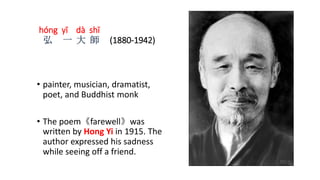
hóng yī dà shī
弘 一 大 師 (1880-1942)
• painter, musician, dramatist,
poet, and Buddhist monk
• The poem《farewell》was
written by Hong Yi in 1915. The
author expressed his sadness
while seeing off a friend.
cháng tíng wài
长 亭 外
Outside the resting arbor
gǔ dào biān
古 道 边
beside the ancient thoroughfare
fāng cǎo bì lián tiān
芳 草 碧 连 天
The fragrant grass so green, stretching to meet the sky afar
wǎn fēng fú liǔ dí shēng cán
晚 风 扶 柳 笛 声 残
The evening breeze brushing the willow,
the flute sound lingering.
xī yáng shān wài shān
夕 阳 山 外 山
The setting sun beyond the mountains.
tiān zhī yá
天 之 涯
At the verge of heaven,
dì zhī jiǎo
地 之 角
At the four corners of the earth
zhī jiāo bàn líng luò
知 交 半 零 落
My bosom friends are half gone and no longer seen
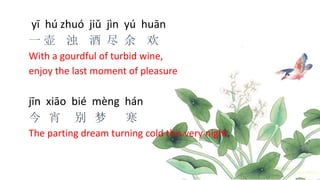
yī hú zhuó jiǔ jìn yú huān
一 壶 浊 酒 尽 余 欢
With a gourdful of turbid wine,
enjoy the last moment of pleasure
jīn xiāo bié mèng hán
今 宵 别 梦 寒
The parting dream turning cold this very night.
tiān zhī yá
天 之 涯
dì zhī jiǎo
地 之 角
zhī jiāo bàn líng luò
知 交 半 零 落
yī hú zhuó jiǔ jìn yú huān
一 壶 浊 酒 尽 余 欢
jīn xiāo bié mèng hán
今 宵 别 梦 寒
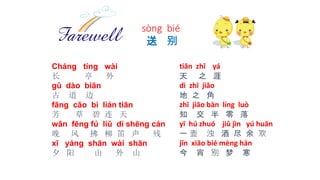
Cháng tíng wài
长 亭 外
gǔ dào biān
古 道 边
fāng cǎo bì lián tiān
芳 草 碧 连 天
wǎn fēng fú liǔ dí shēng cán
晚 风 拂 柳 笛 声 残
xī yáng shān wài shān
夕 阳 山 外 山
sòng bié
送 别

Pinyin 03 Spelling rules 1

  • 1.
  • 2.
    • A simplevowel can locate after a consonant and become a part of syllable. For example: fó 佛 Buddha sè 色 color lù 路 road lǜ 绿 green
  • 3.
    • A simplevowel can be used as an individual syllable. For example: ā 啊 (ah) è 饿 (hungry) ò 哦 (oh)
  • 4.
    • If “i”is used as an individual syllable, “y”must be placed in front of it. For example: yī 一 (one) yì 亿 (a hundred million)
  • 5.
    • If “u”is used as an individual syllable, “w” must be placed in front of it. For example: wǔ 五 (five) wù 雾 (fog, mist)
  • 6.
    • If “ü”is used as an individual syllable, “y” must be placed in front of it. The two dots above “ü” are omitted. For example: yú (= yǘ) 鱼 (fish) yǔ (= yǚ) 雨 (rain)
  • 7.
    • When “ü”lies after consonants “j”, “q” , “x”, the two dots above “ü” are omitted. For example: jǔ (=jǚ) 举 to lift qù (=qǜ) 去 to go xū(=xǖ) 须 beard
  • 8.
  • 9.
    Exercise 1 -Read aloud. Try to pronounce pinyin correctly
  • 10.
    Exercise 2 -Try to pronounce pinyin correctly
  • 11.
    jiǔ shí bāsān shí sì bā shí èr jiǔ shí qī wǔ shí yī Exercise 3 – Write correct pinyin for the numbers and read aloud
  • 12.
    Exercise 4 –Listen and circle the correct pinyin
  • 13.
    Exercise 5 –Listen and add a tonal mark on the pinyin
  • 14.
    ā ū ì ǐiě ǒu ǎi Exercise 6 – Listen and write down the vowels with tonal marks
  • 15.
    Exercise 7 –Listen and and circle the correct pinyin
  • 16.
    ǔ é ā ǐò ù ǘ ái éi ūn ǎo Exercise 8 – Listen and write down the vowels with tonal marks
  • 17.
  • 18.
    nǐ hǎo 你 好!Hi!Hello! zǎo shàng hǎo 早 上 好! Good morning! Xià wǔ hǎo 下 午 好! Good afternoon! wǎn shàng hǎo 晚 上 好! Good evening! wǎn ān 晚 安 Good night!
  • 19.
    nǐ hǎo ma 你好 吗? Are you OK? (Går det bra med deg?) wǒ hěn hǎo 我 很 好。 I’m fine. wǒ bù hǎo 我 不 好。 I’m not good. mǎ mǎ hǔ hǔ 马 马 虎 虎。 Just so-so. Not bad.
  • 20.
    xiè xiè 谢 谢。Thanks. bú kè qì 不 客 气。 Don't mention it. You're welcome. bú xiè 不 谢。 Don't mention it; Not at all. bú xiè 不 谢。 Don't mention it; Not at all. bù , xiè xiè 不 , 谢 谢 。 No, thanks The word bù 不(no; not) has the 4th tone, but when it is followed by another 4th tone, it becomes 2nd tone. (4+4 → 2+4)Rule Legge merke til:
  • 21.
    duì bù qǐ 对不 起。 Excuse me. Sorry. méi guān xì 没 关 系。 It doesn't matter. It’s OK.
  • 22.
    zài jiàn 再 见。See you later. míng tiān jiàn 明 天 见。 See you tomorrow.
  • 23.
  • 24.
    John Pond Ordway (1824-1880) •American doctor, composer, and politician • One of the first surgeons to volunteer at the start of the American Civil War. • Dreaming of Home and Mother (1851) was a popular sentimental song of the Civil War era. It is popular in China and Japan in translated versions.[
  • 25.
    hóng yī dàshī 弘 一 大 師 (1880-1942) • painter, musician, dramatist, poet, and Buddhist monk • The poem《farewell》was written by Hong Yi in 1915. The author expressed his sadness while seeing off a friend.
  • 26.
    cháng tíng wài 长亭 外 Outside the resting arbor gǔ dào biān 古 道 边 beside the ancient thoroughfare fāng cǎo bì lián tiān 芳 草 碧 连 天 The fragrant grass so green, stretching to meet the sky afar
  • 27.
    wǎn fēng fúliǔ dí shēng cán 晚 风 扶 柳 笛 声 残 The evening breeze brushing the willow, the flute sound lingering. xī yáng shān wài shān 夕 阳 山 外 山 The setting sun beyond the mountains.
  • 28.
    tiān zhī yá 天之 涯 At the verge of heaven, dì zhī jiǎo 地 之 角 At the four corners of the earth zhī jiāo bàn líng luò 知 交 半 零 落 My bosom friends are half gone and no longer seen
  • 29.
    yī hú zhuójiǔ jìn yú huān 一 壶 浊 酒 尽 余 欢 With a gourdful of turbid wine, enjoy the last moment of pleasure jīn xiāo bié mèng hán 今 宵 别 梦 寒 The parting dream turning cold this very night.
  • 30.
    tiān zhī yá 天之 涯 dì zhī jiǎo 地 之 角 zhī jiāo bàn líng luò 知 交 半 零 落 yī hú zhuó jiǔ jìn yú huān 一 壶 浊 酒 尽 余 欢 jīn xiāo bié mèng hán 今 宵 别 梦 寒 Cháng tíng wài 长 亭 外 gǔ dào biān 古 道 边 fāng cǎo bì lián tiān 芳 草 碧 连 天 wǎn fēng fú liǔ dí shēng cán 晚 风 拂 柳 笛 声 残 xī yáng shān wài shān 夕 阳 山 外 山 sòng bié 送 别