Determination of Refractive
Indicesof Water and Transparent
Oil
Using a Plane Mirror, Equiconvex
Lens, and Adjustable Object Needle
Presented by: [Your Name]
2.
Introduction
• This experimentinvolves determining the
refractive indices of water and transparent oil
using the apparent depth method. It helps in
understanding basic principles of optics and
refraction.
3.
Objective
• To findthe refractive indices of:
• (a) Water
• (b) Transparent oil
• using a plane mirror, equiconvex lens, and an
adjustable object needle.
4.
Importance of RefractiveIndex
• The refractive index determines how much
light bends when it enters a medium. It is
crucial in designing lenses, optical
instruments, and for material identification.
5.
Principle of ApparentDepth
• When an object is viewed through a
transparent medium, it appears closer due to
refraction. The apparent depth is less than the
real depth.
6.
Formula Used
• Refractiveindex (n) = Real Depth / Apparent
Depth
• This relationship forms the basis of the
experiment.
Description of EquiconvexLens
• An equiconvex lens has two outward-curving
surfaces. It is used here to hold the liquid and
allow focused observation of the image.
9.
Setting Up theApparatus
• Place the mirror flat on the table. The
equiconvex lens is positioned over it to form a
liquid container. The object needle is aligned
above.
10.
Procedure - Part1
• 1. Fill the lens with water.
• 2. Adjust the needle until its image aligns with
the actual tip (no parallax).
• 3. Measure the vertical distance from the
needle to the mirror.
11.
Procedure - Part2
• 4. Repeat the steps using transparent oil.
• 5. Record the apparent depth for both liquids.
• 6. Measure the real depth (thickness of the
liquid layer).
12.
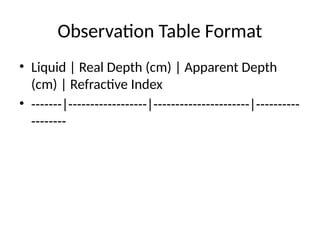
Observation Table Format
•Liquid | Real Depth (cm) | Apparent Depth
(cm) | Refractive Index
• -------|------------------|----------------------|----------
--------
13.
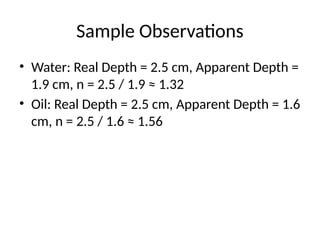
Sample Observations
• Water:Real Depth = 2.5 cm, Apparent Depth =
1.9 cm, n = 2.5 / 1.9 ≈ 1.32
• Oil: Real Depth = 2.5 cm, Apparent Depth = 1.6
cm, n = 2.5 / 1.6 ≈ 1.56
14.
Calculations
• Using theformula:
• n = Real Depth / Apparent Depth
• Compute n for each liquid using measured
values.
15.
Sources of Error
•- Parallax errors
• - Imprecise measurement
• - Uneven liquid surface
• - Misalignment of needle and mirror
16.
Precautions
• - Avoidshaking the table
• - Ensure needle is vertical
• - View needle from eye level to avoid parallax
• - Clean lens and mirror before use
17.
Applications of theExperiment
• - Used in optical material identification
• - Understanding light propagation in tissues
(biosciences)
• - Relevant in ophthalmology and microscopy
18.
Result
• Refractive Indices:
•- Water: Approximately 1.33
• - Transparent Oil: Approximately 1.56
• (Values vary slightly with temperature and
purity)
19.
Conclusion
• The refractiveindices of water and
transparent oil were determined using the
apparent depth method, confirming known
theoretical values.
20.
Viva Questions &Answers
• Q1: What is refractive index?
• A: Ratio of real depth to apparent depth.
• Q2: Why is oil's refractive index higher than
water?
• A: Due to greater optical density.
21.
Thank You
• Thankyou for your attention!
• Questions and discussions are welcome.
![Determination of Refractive
Indices of Water and Transparent
Oil
Using a Plane Mirror, Equiconvex
Lens, and Adjustable Object Needle
Presented by: [Your Name]](https://image.slidesharecdn.com/refractiveindexexperimentdetailed-250528162156-4516aa1c/85/Refractive_Index_Experiment_Detailed-pptx-1-320.jpg)
![Determination of Refractive
Indices of Water and Transparent
Oil
Using a Plane Mirror, Equiconvex
Lens, and Adjustable Object Needle
Presented by: [Your Name]](https://image.slidesharecdn.com/refractiveindexexperimentdetailed-250528162156-4516aa1c/75/Refractive_Index_Experiment_Detailed-pptx-1-2048.jpg)