PHYSICS – Work and Power
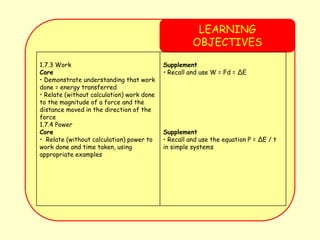
LEARNING
OBJECTIVES
1.7.3 Work
Core
• Demonstrate understanding that work
done = energy transferred
• Relate (without calculation) work done
to the magnitude of a force and the
distance moved in the direction of the
force
1.7.4 Power
Core
• Relate (without calculation) power to
work done and time taken, using
appropriate examples
Supplement
• Recall and use W = Fd = ∆E
Supplement
• Recall and use the equation P = ∆E / t
in simple systems
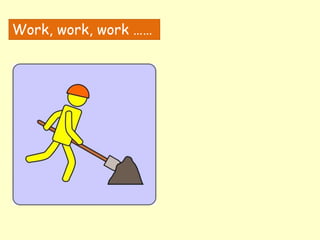
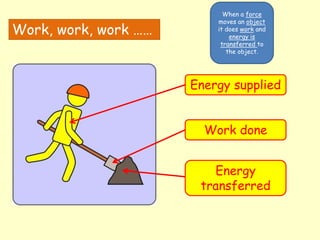
Work, work, work ……
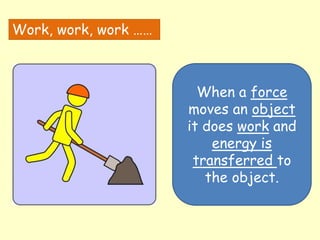
Work, work, work ……
When a force
moves an object
it does work and
energy is
transferred to
the object.
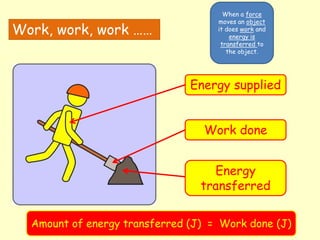
Work, work, work ……
When a force
moves an object
it does work and
energy is
transferred to
the object.
Energy supplied
Work done
Energy
transferred
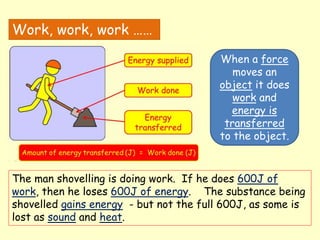
Work, work, work ……
When a force
moves an object
it does work and
energy is
transferred to
the object.
Energy supplied
Work done
Energy
transferred
Amount of energy transferred (J) = Work done (J)
Work, work, work ……
When a force
moves an
object it does
work and
energy is
transferred
to the object.
The man shovelling is doing work. If he does 600J of
work, then he loses 600J of energy. The substance being
shovelled gains energy - but not the full 600J, as some is
lost as sound and heat.
Work
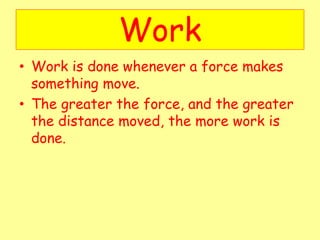
• Work is done whenever a force makes
something move.
Work
• Work is done whenever a force makes
something move.
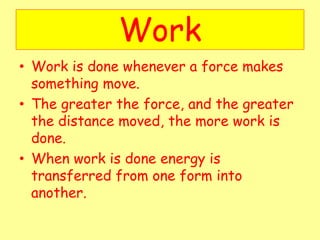
• The greater the force, and the greater
the distance moved, the more work is
done.
Work
• Work is done whenever a force makes
something move.
• The greater the force, and the greater
the distance moved, the more work is
done.
• When work is done energy is
transferred from one form into
another.
Work
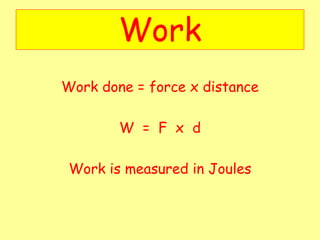
Work done = force x distance
W = F x d
Work is measured in Joules
Work
Work done = force x distance
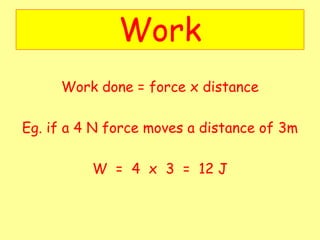
Eg. if a 4 N force moves a distance of 3m
W = 4 x 3 = 12 J
Work
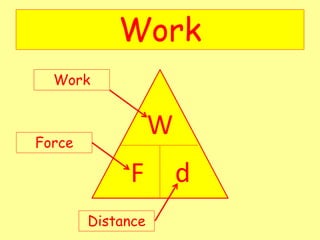
W
d
F
Work
Force
Distance
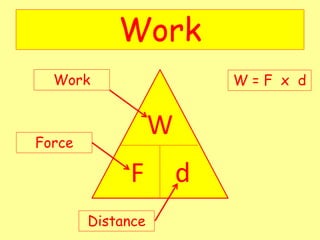
Work
W
d
F
Work
Force
Distance
W = F x d
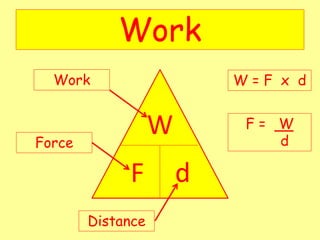
Work
W
d
F
Work
Force
Distance
W = F x d
F = W
d
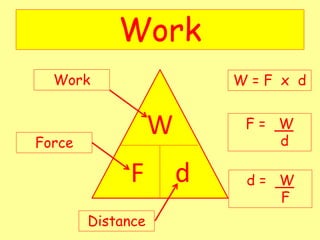
Work
W
d
F
Work
Force
Distance
W = F x d
F = W
d
d = W
F
Power and Efficiency
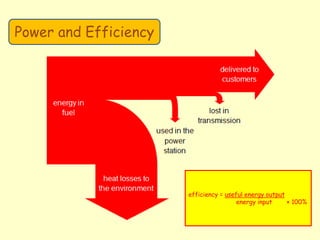
efficiency = useful energy output
energy input × 100%
Power and Efficiency
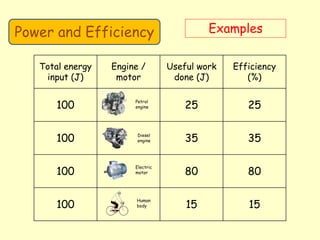
Power and Efficiency Examples
Total energy
input (J)
Engine /
motor
Useful work
done (J)
Efficiency
(%)
100 25 25
100 35 35
100 80 80
100 15 15
Petrol
engine
Diesel
engine
Electric
motor
Human
body
Power and Efficiency
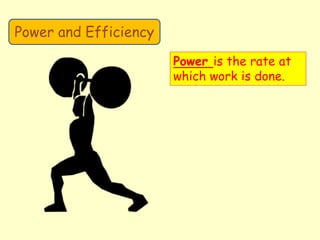
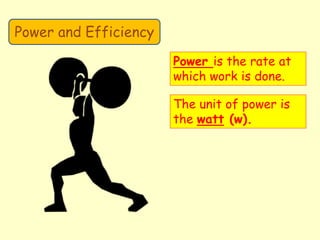
Power is the rate at
which work is done.
Power and Efficiency
Power is the rate at
which work is done.
The unit of power is
the watt (w).
Power and Efficiency
Power is the rate at
which work is done.
The unit of power is
the watt (w).
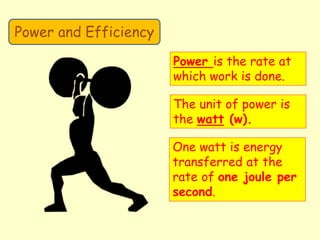
One watt is energy
transferred at the
rate of one joule per
second.
Power and Efficiency
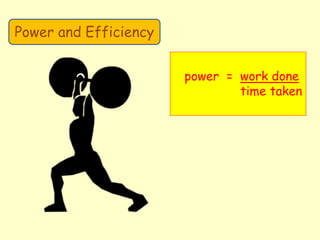
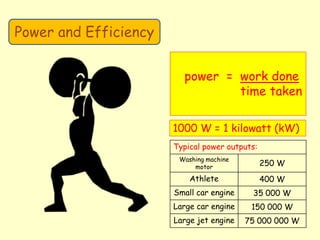
power = work done
time taken
Power and Efficiency
power = work done
time taken
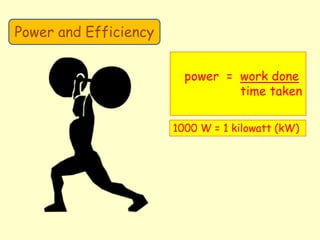
1000 W = 1 kilowatt (kW)
Power and Efficiency
power = work done
time taken
1000 W = 1 kilowatt (kW)
Typical power outputs:
Washing machine
motor
250 W
Athlete 400 W
Small car engine 35 000 W
Large car engine 150 000 W
Large jet engine 75 000 000 W
Power and Efficiency
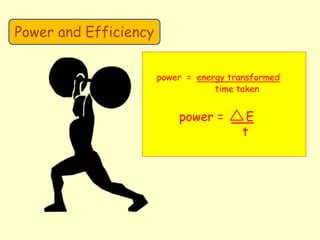
power = energy transformed
time taken
power = E
t
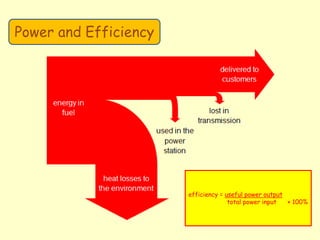
efficiency = useful power output
total power input × 100%
Power and Efficiency
Power and Efficiency Calculation examples
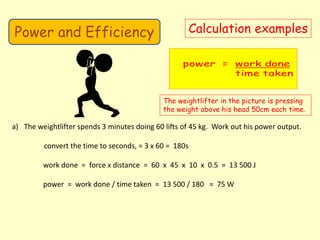
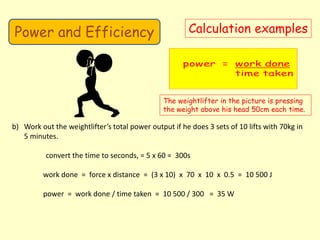
The weightlifter in the picture is pressing
the weight above his head 50cm each time.
a) The weightlifter spends 3 minutes doing 60 lifts of 45 kg. Work out his power output.
convert the time to seconds, = 3 x 60 = 180s
work done = force x distance = 60 x 45 x 10 x 0.5 = 13 500 J
power = work done / time taken = 13 500 / 180 = 75 W
Power and Efficiency Calculation examples
The weightlifter in the picture is pressing
the weight above his head 50cm each time.
b) Work out the weightlifter’s total power output if he does 3 sets of 10 lifts with 70kg in
5 minutes.
convert the time to seconds, = 5 x 60 = 300s
work done = force x distance = (3 x 10) x 70 x 10 x 0.5 = 10 500 J
power = work done / time taken = 10 500 / 300 = 35 W
Power and Efficiency Calculation examples
The weightlifter in the picture is pressing
the weight above his head 50cm each time.
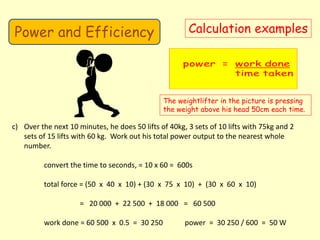
c) Over the next 10 minutes, he does 50 lifts of 40kg, 3 sets of 10 lifts with 75kg and 2
sets of 15 lifts with 60 kg. Work out his total power output to the nearest whole
number.
convert the time to seconds, = 10 x 60 = 600s
total force = (50 x 40 x 10) + (30 x 75 x 10) + (30 x 60 x 10)
= 20 000 + 22 500 + 18 000 = 60 500
work done = 60 500 x 0.5 = 30 250 power = 30 250 / 600 = 50 W
Power and Efficiency Calculation examples
The weightlifter in the picture is pressing
the weight above his head 50cm each time.
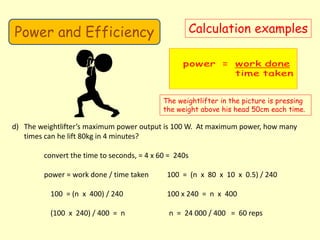
d) The weightlifter’s maximum power output is 100 W. At maximum power, how many
times can he lift 80kg in 4 minutes?
convert the time to seconds, = 4 x 60 = 240s
power = work done / time taken 100 = (n x 80 x 10 x 0.5) / 240
100 = (n x 400) / 240 100 x 240 = n x 400
(100 x 240) / 400 = n n = 24 000 / 400 = 60 reps
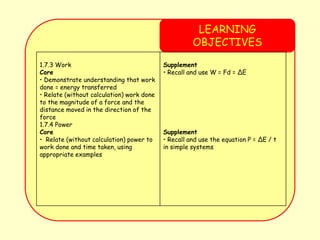
LEARNING
OBJECTIVES
1.7.3 Work
Core
• Demonstrate understanding that work
done = energy transferred
• Relate (without calculation) work done
to the magnitude of a force and the
distance moved in the direction of the
force
1.7.4 Power
Core
• Relate (without calculation) power to
work done and time taken, using
appropriate examples
Supplement
• Recall and use W = Fd = ∆E
Supplement
• Recall and use the equation P = ∆E / t
in simple systems
PHYSICS – Work and Power
Physics 10 - Work and Power.pptx

Physics 10 - Work and Power.pptx

  • 1.
  • 2.
    LEARNING OBJECTIVES 1.7.3 Work Core • Demonstrateunderstanding that work done = energy transferred • Relate (without calculation) work done to the magnitude of a force and the distance moved in the direction of the force 1.7.4 Power Core • Relate (without calculation) power to work done and time taken, using appropriate examples Supplement • Recall and use W = Fd = ∆E Supplement • Recall and use the equation P = ∆E / t in simple systems
  • 3.
  • 4.
    Work, work, work…… When a force moves an object it does work and energy is transferred to the object.
  • 5.
    Work, work, work…… When a force moves an object it does work and energy is transferred to the object. Energy supplied Work done Energy transferred
  • 6.
    Work, work, work…… When a force moves an object it does work and energy is transferred to the object. Energy supplied Work done Energy transferred Amount of energy transferred (J) = Work done (J)
  • 7.
    Work, work, work…… When a force moves an object it does work and energy is transferred to the object. The man shovelling is doing work. If he does 600J of work, then he loses 600J of energy. The substance being shovelled gains energy - but not the full 600J, as some is lost as sound and heat.
  • 8.
    Work • Work isdone whenever a force makes something move.
  • 9.
    Work • Work isdone whenever a force makes something move. • The greater the force, and the greater the distance moved, the more work is done.
  • 10.
    Work • Work isdone whenever a force makes something move. • The greater the force, and the greater the distance moved, the more work is done. • When work is done energy is transferred from one form into another.
  • 11.
    Work Work done =force x distance W = F x d Work is measured in Joules
  • 12.
    Work Work done =force x distance Eg. if a 4 N force moves a distance of 3m W = 4 x 3 = 12 J
  • 13.
  • 14.
  • 15.
  • 16.
  • 17.
  • 18.
    efficiency = usefulenergy output energy input × 100% Power and Efficiency
  • 19.
    Power and EfficiencyExamples Total energy input (J) Engine / motor Useful work done (J) Efficiency (%) 100 25 25 100 35 35 100 80 80 100 15 15 Petrol engine Diesel engine Electric motor Human body
  • 20.
    Power and Efficiency Poweris the rate at which work is done.
  • 21.
    Power and Efficiency Poweris the rate at which work is done. The unit of power is the watt (w).
  • 22.
    Power and Efficiency Poweris the rate at which work is done. The unit of power is the watt (w). One watt is energy transferred at the rate of one joule per second.
  • 23.
    Power and Efficiency power= work done time taken
  • 24.
    Power and Efficiency power= work done time taken 1000 W = 1 kilowatt (kW)
  • 25.
    Power and Efficiency power= work done time taken 1000 W = 1 kilowatt (kW) Typical power outputs: Washing machine motor 250 W Athlete 400 W Small car engine 35 000 W Large car engine 150 000 W Large jet engine 75 000 000 W
  • 26.
    Power and Efficiency power= energy transformed time taken power = E t
  • 27.
    efficiency = usefulpower output total power input × 100% Power and Efficiency
  • 28.
    Power and EfficiencyCalculation examples The weightlifter in the picture is pressing the weight above his head 50cm each time. a) The weightlifter spends 3 minutes doing 60 lifts of 45 kg. Work out his power output. convert the time to seconds, = 3 x 60 = 180s work done = force x distance = 60 x 45 x 10 x 0.5 = 13 500 J power = work done / time taken = 13 500 / 180 = 75 W
  • 29.
    Power and EfficiencyCalculation examples The weightlifter in the picture is pressing the weight above his head 50cm each time. b) Work out the weightlifter’s total power output if he does 3 sets of 10 lifts with 70kg in 5 minutes. convert the time to seconds, = 5 x 60 = 300s work done = force x distance = (3 x 10) x 70 x 10 x 0.5 = 10 500 J power = work done / time taken = 10 500 / 300 = 35 W
  • 30.
    Power and EfficiencyCalculation examples The weightlifter in the picture is pressing the weight above his head 50cm each time. c) Over the next 10 minutes, he does 50 lifts of 40kg, 3 sets of 10 lifts with 75kg and 2 sets of 15 lifts with 60 kg. Work out his total power output to the nearest whole number. convert the time to seconds, = 10 x 60 = 600s total force = (50 x 40 x 10) + (30 x 75 x 10) + (30 x 60 x 10) = 20 000 + 22 500 + 18 000 = 60 500 work done = 60 500 x 0.5 = 30 250 power = 30 250 / 600 = 50 W
  • 31.
    Power and EfficiencyCalculation examples The weightlifter in the picture is pressing the weight above his head 50cm each time. d) The weightlifter’s maximum power output is 100 W. At maximum power, how many times can he lift 80kg in 4 minutes? convert the time to seconds, = 4 x 60 = 240s power = work done / time taken 100 = (n x 80 x 10 x 0.5) / 240 100 = (n x 400) / 240 100 x 240 = n x 400 (100 x 240) / 400 = n n = 24 000 / 400 = 60 reps
  • 32.
    LEARNING OBJECTIVES 1.7.3 Work Core • Demonstrateunderstanding that work done = energy transferred • Relate (without calculation) work done to the magnitude of a force and the distance moved in the direction of the force 1.7.4 Power Core • Relate (without calculation) power to work done and time taken, using appropriate examples Supplement • Recall and use W = Fd = ∆E Supplement • Recall and use the equation P = ∆E / t in simple systems
  • 33.