Career Research
Katie Sutcliffe
Health 4190
Spring 2015
Clemson University
Introduction
The career I have chosen to do research on is
Occupational Therapy. Occupational Therapy is
involved in helping other people through the use of
therapeutic methods. It is a common goal to improve
a patient’s quality of life and to function at their best
within their everyday environment. Since this career
is growing, I have decided to research and present
the facts for this profession.
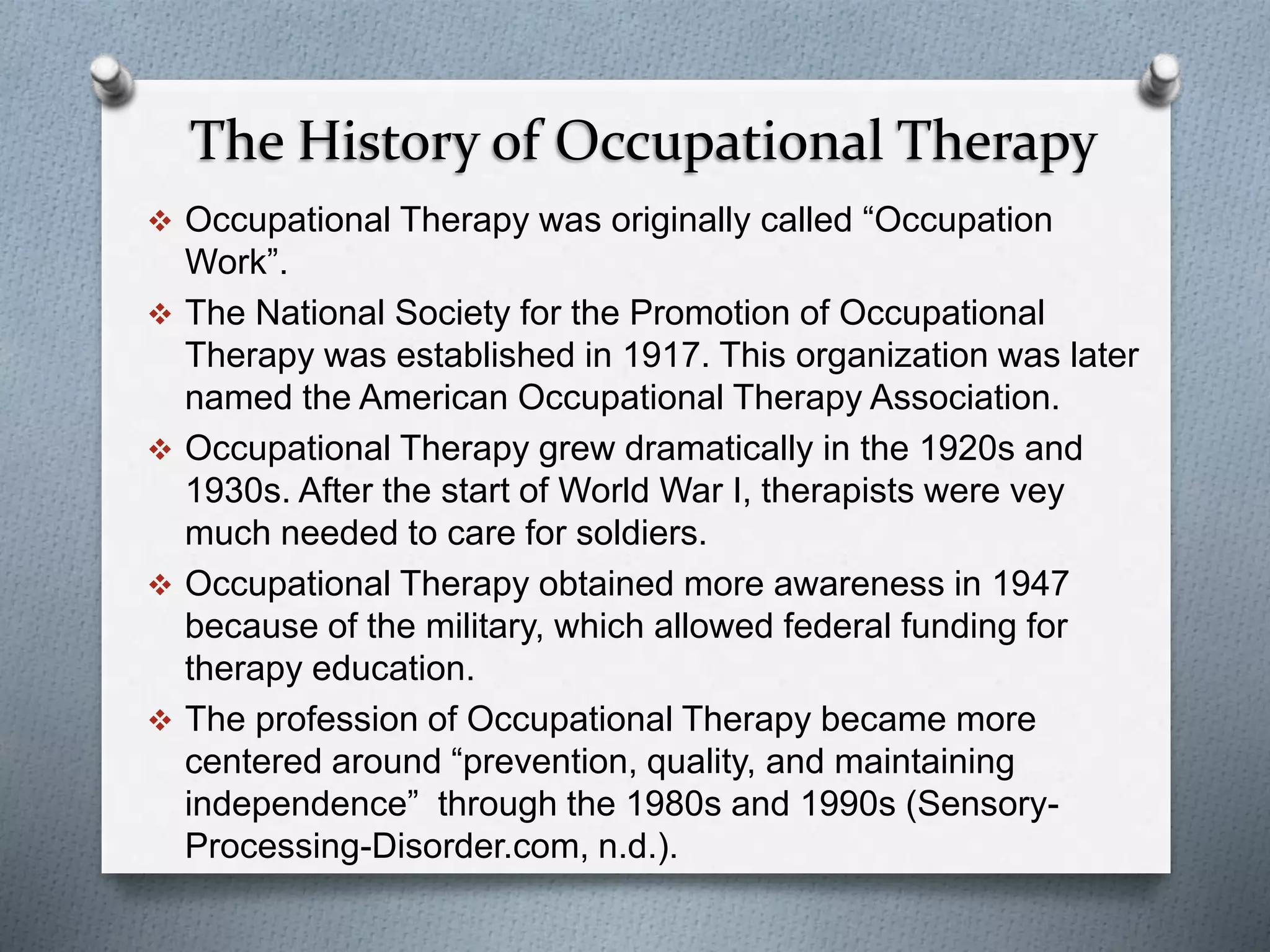
The History of Occupational Therapy
 Occupational Therapy was originally called “Occupation
Work”.
 The National Society for the Promotion of Occupational
Therapy was established in 1917. This organization was later
named the American Occupational Therapy Association.
 Occupational Therapy grew dramatically in the 1920s and
1930s. After the start of World War I, therapists were vey
much needed to care for soldiers.
 Occupational Therapy obtained more awareness in 1947
because of the military, which allowed federal funding for
therapy education.
 The profession of Occupational Therapy became more
centered around “prevention, quality, and maintaining
independence” through the 1980s and 1990s (Sensory-
Processing-Disorder.com, n.d.).
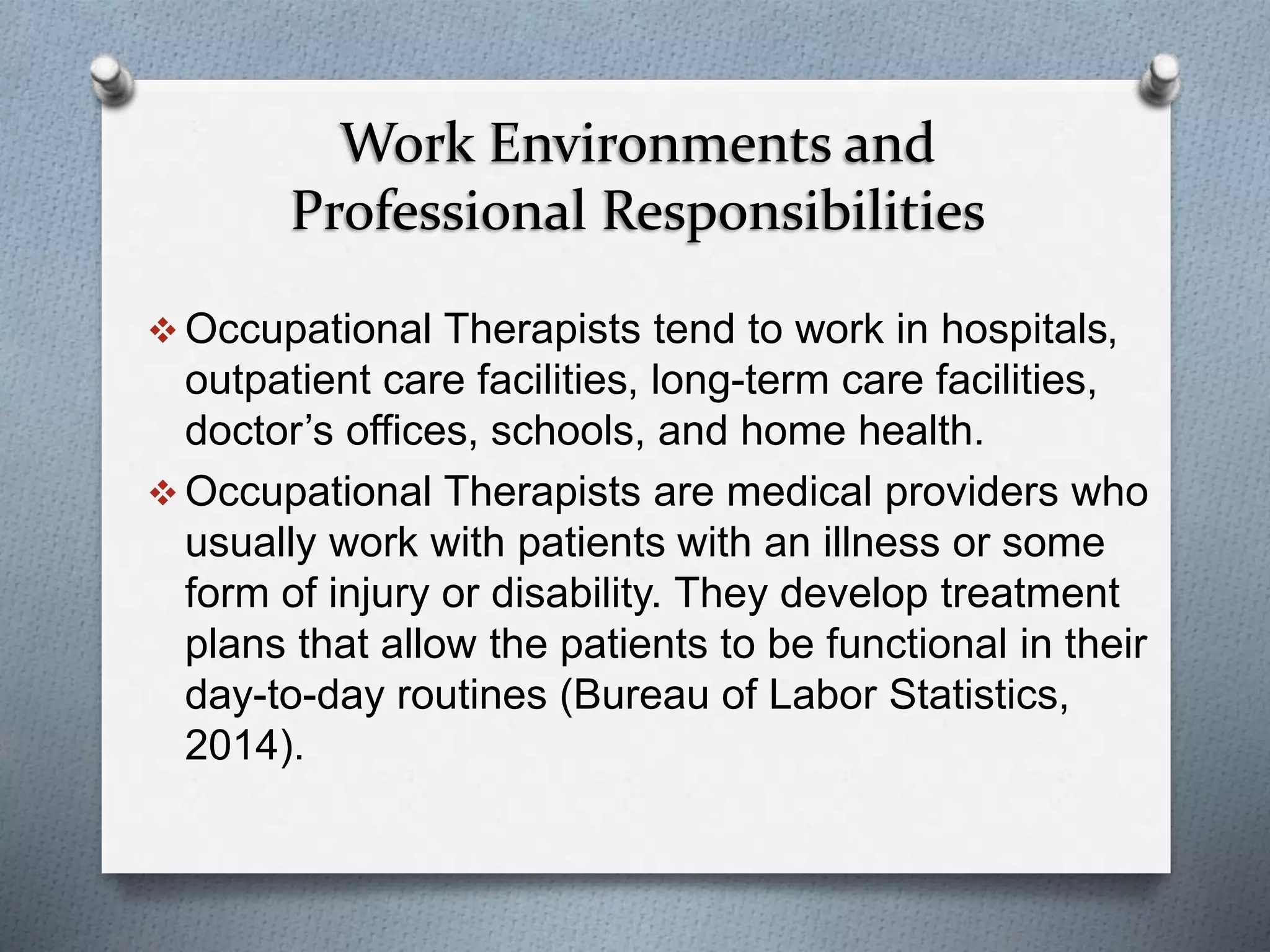
Work Environments and
Professional Responsibilities
 Occupational Therapists tend to work in hospitals,
outpatient care facilities, long-term care facilities,
doctor’s offices, schools, and home health.
 Occupational Therapists are medical providers who
usually work with patients with an illness or some
form of injury or disability. They develop treatment
plans that allow the patients to be functional in their
day-to-day routines (Bureau of Labor Statistics,
2014).
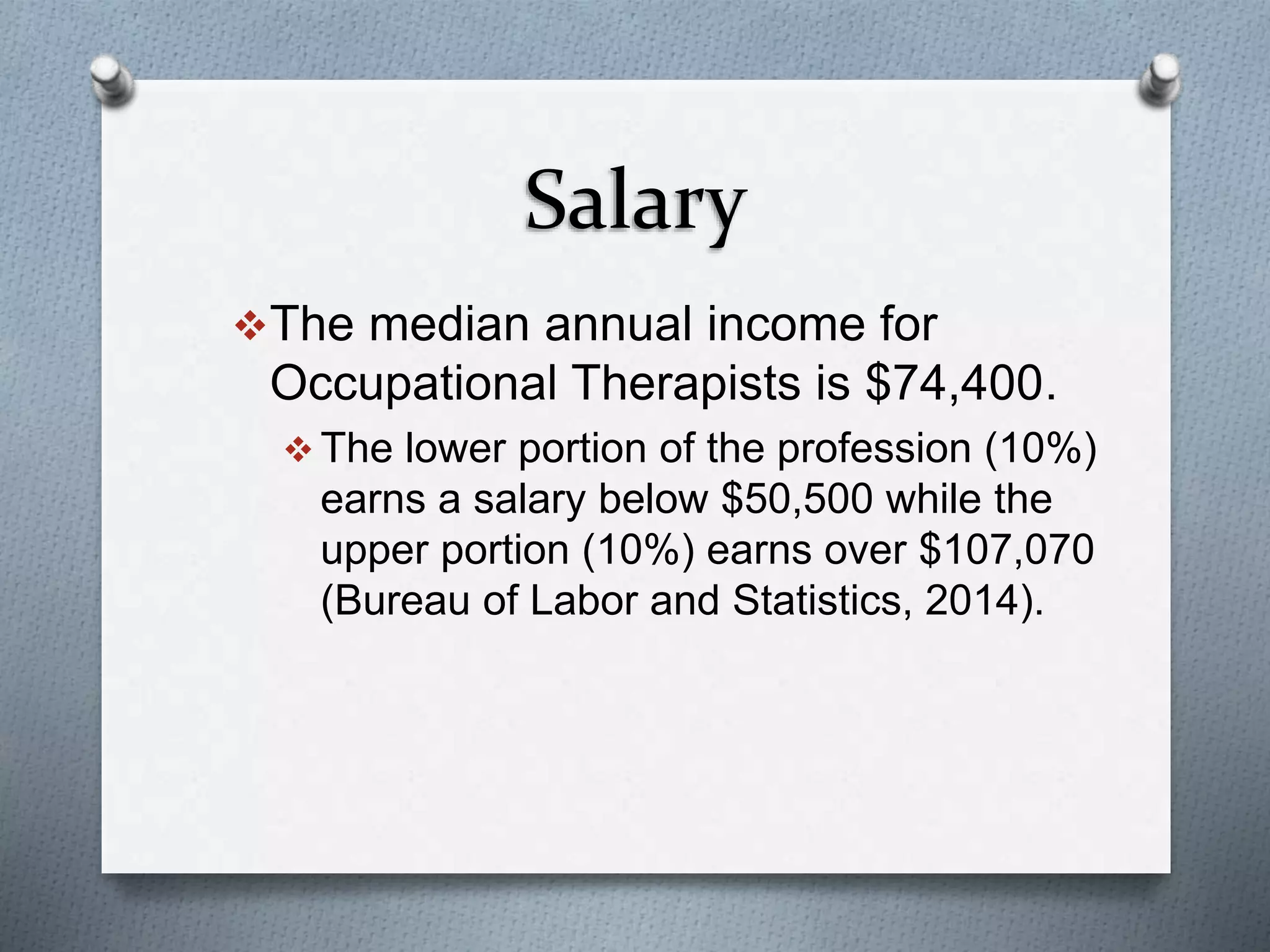
Salary
The median annual income for
Occupational Therapists is $74,400.
 The lower portion of the profession (10%)
earns a salary below $50,500 while the
upper portion (10%) earns over $107,070
(Bureau of Labor and Statistics, 2014).
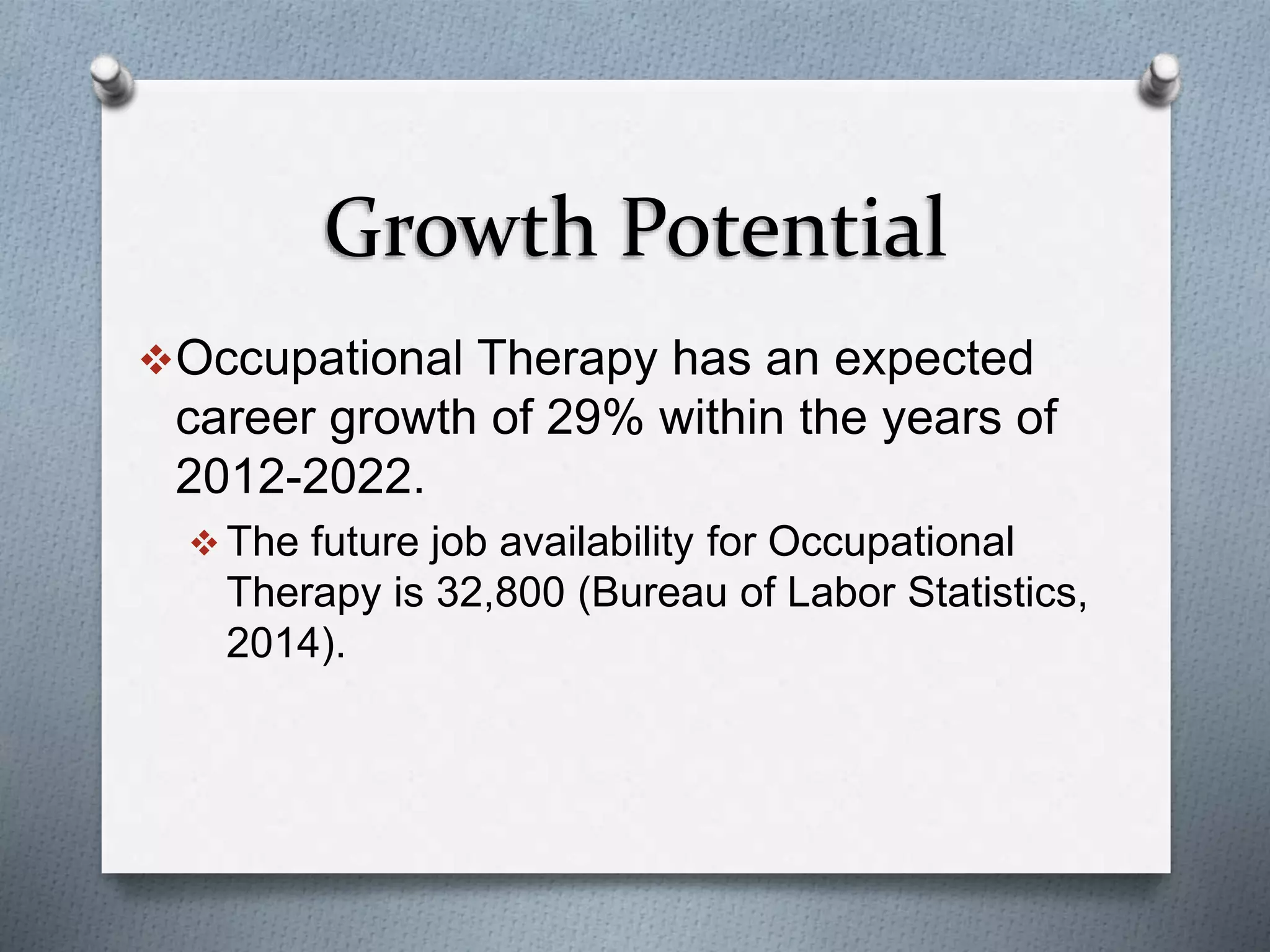
Growth Potential
Occupational Therapy has an expected
career growth of 29% within the years of
2012-2022.
 The future job availability for Occupational
Therapy is 32,800 (Bureau of Labor Statistics,
2014).
Education and Licensure
A Bachelor’s Degree
and prerequisite classes
are required before
entry into a Master’s
Degree in Occupational
Therapy.
Occupational Therapy
require students to take
and pass a State
Licensure Exam
(Bureau of Labor
Statistics, 2014).
Why I am Qualified
 I am a senior at Clemson University majoring in
Health Science with a concentration in
Preprofessional Health Studies.
 My cumulative GPA is a 3.65 out of a 4.00.
 My experience of learning and working with the
human body has been gained through the
following:
 I was an undergraduate lab assistant for Anatomy
and Physiology for the Fall of 2014.
 I have observed therapists at Oconee Memorial
Hospital for 67 hours (2014) and volunteered at
Sports Plus Physical Therapy for 78 hours (2013).
 I have also shadowed medical professionals for 120
hours at The Regional Medical Center (2012).
Why I am Qualified
(Continued)
 I have a hard work ethic and am very determined to learn as
much as I can. I believe that the following honors showcase
this:
 I have been an Enhanced LIFE Scholarship Recipient since
2012.
 In 2014, I became a member of Eta Sigma Gamma National
Health Education Honorary, Alpha Epsilon Delta Health
Preprofessional Honor Society, Sigma Alpha Lambda National
Leadership and Honors Organization.
 I also earned a spot on the President’s List (Fall 2013, Spring
2014) and the Dean’s List (Fall 2014).
 The love that I have for helping others can be seen through
the following:
 I have been involved in Gamma Sigma Sigma National Service
Sorority since 2013.
 I was also a Health Science Major Mentor in the Fall of 2014.
 Lastly, I am a member of the Student Health Advisory
Committee as of Spring 2015.
Relevant Coursework
(completed so far)
 Introduction to Public
Health
 Overview of Health
Care Systems
 Human Health and
Diseases
 Determinants of
Health Behavior
 Medical Terminology
and Communication
 Human Anatomy
and Physiology I
and II with labs
 Introduction to
General Psychology
 Introduction to
Sociology
 Statistical Methods I
*An A was earned in all courses listed above
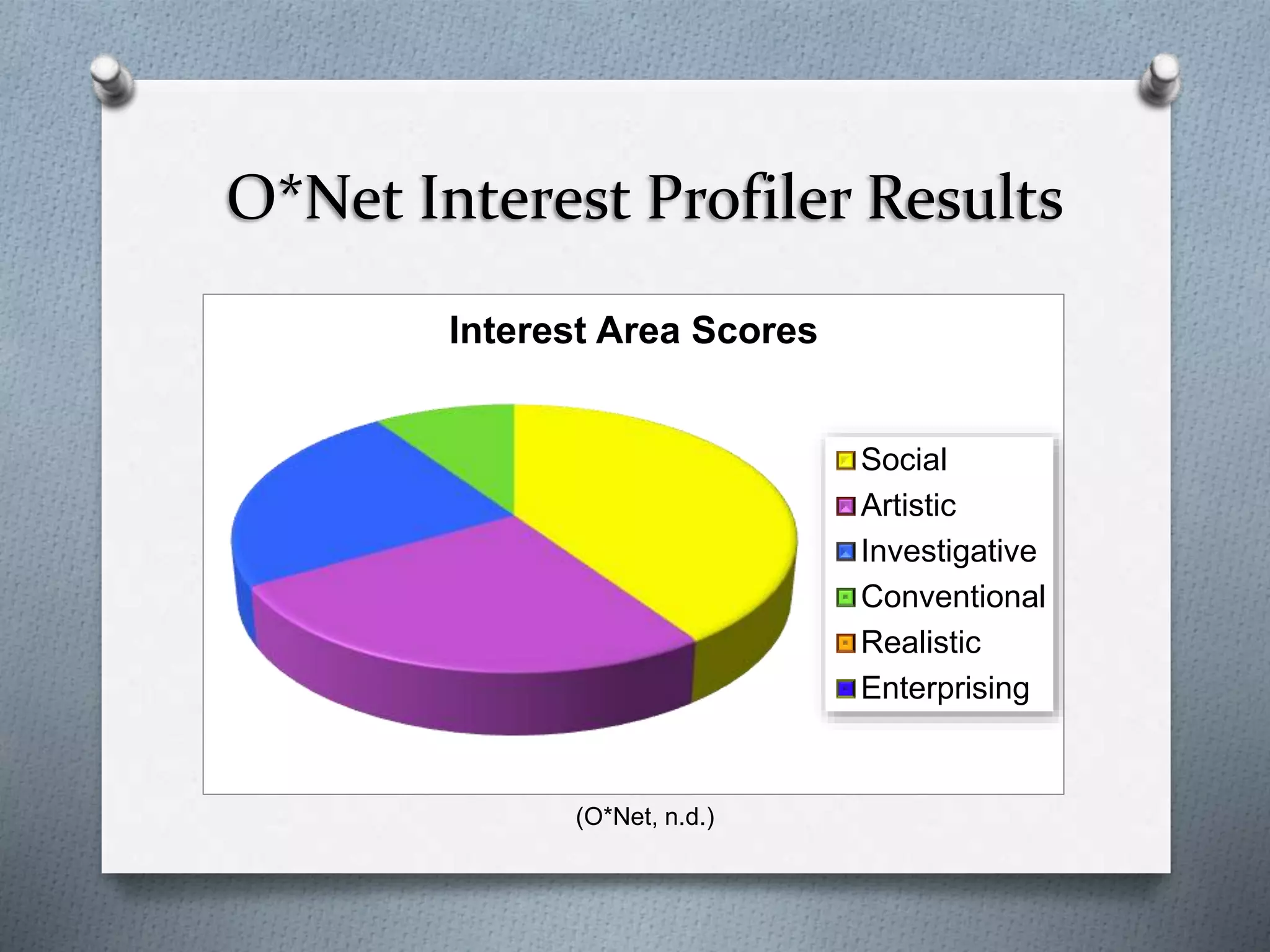
O*Net Interest Profiler Results
Interest Area Scores
Social
Artistic
Investigative
Conventional
Realistic
Enterprising
(O*Net, n.d.)
My Skills
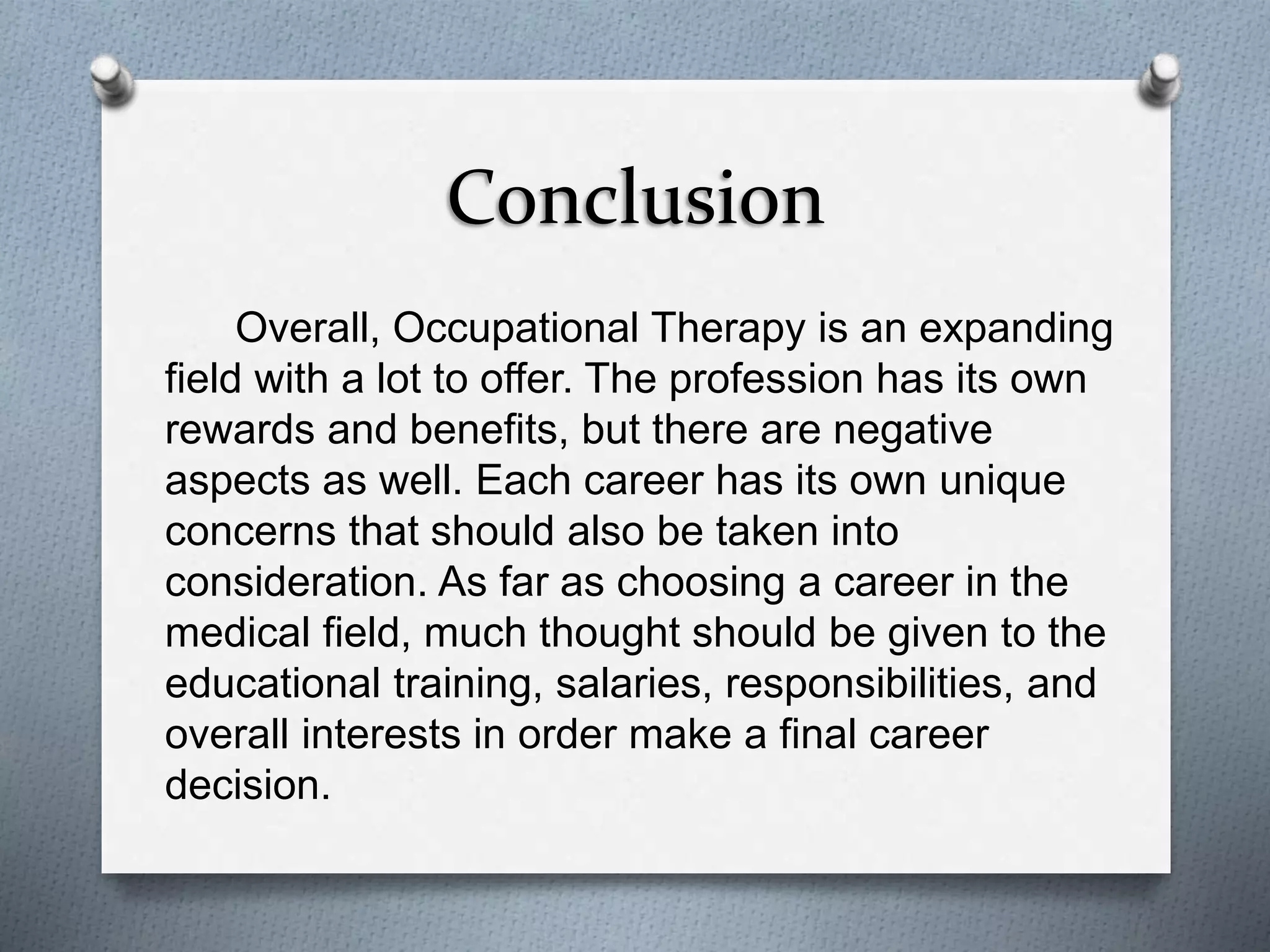
 The top score I obtained in my O*Net Interest Profiler Results was in
the Social area. I thought this was very appropriate as a top score for
myself because I am very personable and friendly. I have been
volunteering for Gamma Sigma Sigma National Service Sorority since I
was a freshman at Clemson. I believe this shows my love of service,
helping others, and meeting new people. I was also a Major Mentor for
Heath Science, which I shows how I am able to connect and relate to
others in order to be helpful to them.
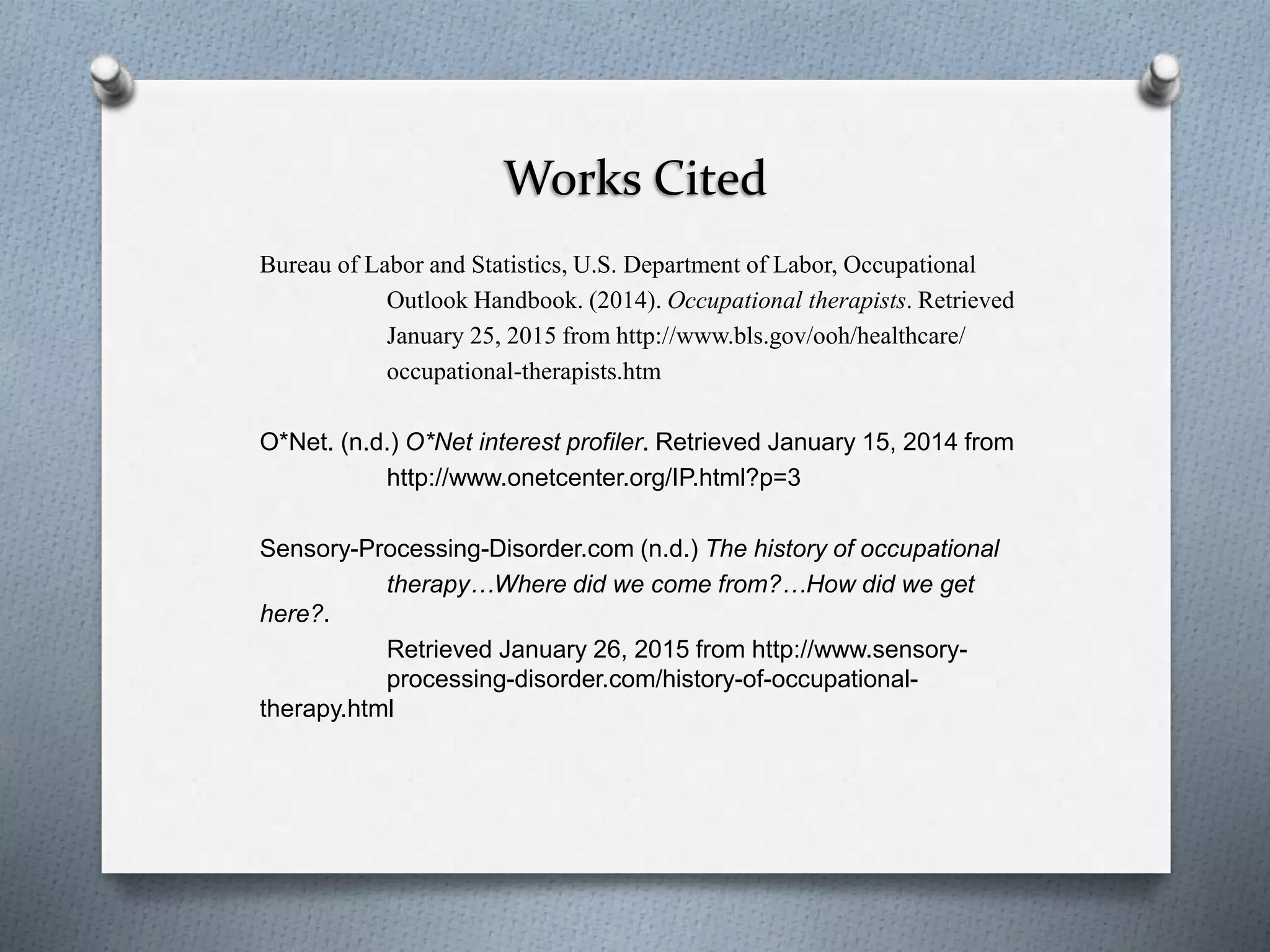
 My second highest score was in the Artistic area. I have always
enjoyed creating and designing things. I recently went to an art studio to
create coasters for my apartment. I was able to create something
beautiful as well as practical. This quality is especially important for
Occupational Therapists from what I have witnessed as a volunteer in
the past.
My Skills
(continued)
 The third highest score from my interest profiler was in the
Investigative area. This score was actually one point lower
than the Artistic score I received. I have always been a
curious person. I am a Health Science major, which includes
knowing “how?” and “why?” type questions relating to the
public’s health. I am also currently considering a minor in
Psychology because I love studying how the mind works. As a
medical provider you have to be able to know not only what a
patient's diagnosis is, but you have to be able to listen to the
patients and find out information that way. Being investigative
is definitely necessary in the medical field.
 I scored very low to none in the Realistic, Enterprising, and
Conventional interest areas. I realized what my interests are
as I have grown older and gained more experience, therefore
having a low score is appropriate for these areas.
Conclusion
Overall, Occupational Therapy is an expanding
field with a lot to offer. The profession has its own
rewards and benefits, but there are negative
aspects as well. Each career has its own unique
concerns that should also be taken into
consideration. As far as choosing a career in the
medical field, much thought should be given to the
educational training, salaries, responsibilities, and
overall interests in order make a final career
decision.
Works Cited
Bureau of Labor and Statistics, U.S. Department of Labor, Occupational
Outlook Handbook. (2014). Occupational therapists. Retrieved
January 25, 2015 from http://www.bls.gov/ooh/healthcare/
occupational-therapists.htm
O*Net. (n.d.) O*Net interest profiler. Retrieved January 15, 2014 from
http://www.onetcenter.org/IP.html?p=3
Sensory-Processing-Disorder.com (n.d.) The history of occupational
therapy…Where did we come from?…How did we get
here?.
Retrieved January 26, 2015 from http://www.sensory-
processing-disorder.com/history-of-occupational-
therapy.html

Career pwrpt ot for eportfolio-1-2

  • 1.
    Career Research Katie Sutcliffe Health4190 Spring 2015 Clemson University
  • 2.
    Introduction The career Ihave chosen to do research on is Occupational Therapy. Occupational Therapy is involved in helping other people through the use of therapeutic methods. It is a common goal to improve a patient’s quality of life and to function at their best within their everyday environment. Since this career is growing, I have decided to research and present the facts for this profession.
  • 3.
    The History ofOccupational Therapy  Occupational Therapy was originally called “Occupation Work”.  The National Society for the Promotion of Occupational Therapy was established in 1917. This organization was later named the American Occupational Therapy Association.  Occupational Therapy grew dramatically in the 1920s and 1930s. After the start of World War I, therapists were vey much needed to care for soldiers.  Occupational Therapy obtained more awareness in 1947 because of the military, which allowed federal funding for therapy education.  The profession of Occupational Therapy became more centered around “prevention, quality, and maintaining independence” through the 1980s and 1990s (Sensory- Processing-Disorder.com, n.d.).
  • 4.
    Work Environments and ProfessionalResponsibilities  Occupational Therapists tend to work in hospitals, outpatient care facilities, long-term care facilities, doctor’s offices, schools, and home health.  Occupational Therapists are medical providers who usually work with patients with an illness or some form of injury or disability. They develop treatment plans that allow the patients to be functional in their day-to-day routines (Bureau of Labor Statistics, 2014).
  • 5.
    Salary The median annualincome for Occupational Therapists is $74,400.  The lower portion of the profession (10%) earns a salary below $50,500 while the upper portion (10%) earns over $107,070 (Bureau of Labor and Statistics, 2014).
  • 6.
    Growth Potential Occupational Therapyhas an expected career growth of 29% within the years of 2012-2022.  The future job availability for Occupational Therapy is 32,800 (Bureau of Labor Statistics, 2014).
  • 7.
    Education and Licensure ABachelor’s Degree and prerequisite classes are required before entry into a Master’s Degree in Occupational Therapy. Occupational Therapy require students to take and pass a State Licensure Exam (Bureau of Labor Statistics, 2014).
  • 8.
    Why I amQualified  I am a senior at Clemson University majoring in Health Science with a concentration in Preprofessional Health Studies.  My cumulative GPA is a 3.65 out of a 4.00.  My experience of learning and working with the human body has been gained through the following:  I was an undergraduate lab assistant for Anatomy and Physiology for the Fall of 2014.  I have observed therapists at Oconee Memorial Hospital for 67 hours (2014) and volunteered at Sports Plus Physical Therapy for 78 hours (2013).  I have also shadowed medical professionals for 120 hours at The Regional Medical Center (2012).
  • 9.
    Why I amQualified (Continued)  I have a hard work ethic and am very determined to learn as much as I can. I believe that the following honors showcase this:  I have been an Enhanced LIFE Scholarship Recipient since 2012.  In 2014, I became a member of Eta Sigma Gamma National Health Education Honorary, Alpha Epsilon Delta Health Preprofessional Honor Society, Sigma Alpha Lambda National Leadership and Honors Organization.  I also earned a spot on the President’s List (Fall 2013, Spring 2014) and the Dean’s List (Fall 2014).  The love that I have for helping others can be seen through the following:  I have been involved in Gamma Sigma Sigma National Service Sorority since 2013.  I was also a Health Science Major Mentor in the Fall of 2014.  Lastly, I am a member of the Student Health Advisory Committee as of Spring 2015.
  • 10.
    Relevant Coursework (completed sofar)  Introduction to Public Health  Overview of Health Care Systems  Human Health and Diseases  Determinants of Health Behavior  Medical Terminology and Communication  Human Anatomy and Physiology I and II with labs  Introduction to General Psychology  Introduction to Sociology  Statistical Methods I *An A was earned in all courses listed above
  • 11.
    O*Net Interest ProfilerResults Interest Area Scores Social Artistic Investigative Conventional Realistic Enterprising (O*Net, n.d.)
  • 12.
    My Skills  Thetop score I obtained in my O*Net Interest Profiler Results was in the Social area. I thought this was very appropriate as a top score for myself because I am very personable and friendly. I have been volunteering for Gamma Sigma Sigma National Service Sorority since I was a freshman at Clemson. I believe this shows my love of service, helping others, and meeting new people. I was also a Major Mentor for Heath Science, which I shows how I am able to connect and relate to others in order to be helpful to them.  My second highest score was in the Artistic area. I have always enjoyed creating and designing things. I recently went to an art studio to create coasters for my apartment. I was able to create something beautiful as well as practical. This quality is especially important for Occupational Therapists from what I have witnessed as a volunteer in the past.
  • 13.
    My Skills (continued)  Thethird highest score from my interest profiler was in the Investigative area. This score was actually one point lower than the Artistic score I received. I have always been a curious person. I am a Health Science major, which includes knowing “how?” and “why?” type questions relating to the public’s health. I am also currently considering a minor in Psychology because I love studying how the mind works. As a medical provider you have to be able to know not only what a patient's diagnosis is, but you have to be able to listen to the patients and find out information that way. Being investigative is definitely necessary in the medical field.  I scored very low to none in the Realistic, Enterprising, and Conventional interest areas. I realized what my interests are as I have grown older and gained more experience, therefore having a low score is appropriate for these areas.
  • 14.
    Conclusion Overall, Occupational Therapyis an expanding field with a lot to offer. The profession has its own rewards and benefits, but there are negative aspects as well. Each career has its own unique concerns that should also be taken into consideration. As far as choosing a career in the medical field, much thought should be given to the educational training, salaries, responsibilities, and overall interests in order make a final career decision.
  • 15.
    Works Cited Bureau ofLabor and Statistics, U.S. Department of Labor, Occupational Outlook Handbook. (2014). Occupational therapists. Retrieved January 25, 2015 from http://www.bls.gov/ooh/healthcare/ occupational-therapists.htm O*Net. (n.d.) O*Net interest profiler. Retrieved January 15, 2014 from http://www.onetcenter.org/IP.html?p=3 Sensory-Processing-Disorder.com (n.d.) The history of occupational therapy…Where did we come from?…How did we get here?. Retrieved January 26, 2015 from http://www.sensory- processing-disorder.com/history-of-occupational- therapy.html

Editor's Notes