Department of Education
Region VII
SCHOOLS DIVISION OF BAYAWAN CITY
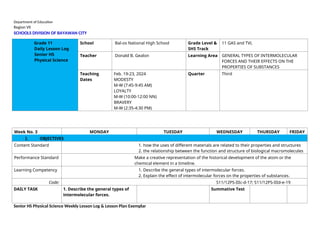
Week No. 3 MONDAY TUESDAY WEDNESDAY THURSDAY FRIDAY
I. OBJECTIVES
Content Standard 1. how the uses of different materials are related to their properties and structures
2. the relationship between the function and structure of biological macromolecules
Performance Standard Make a creative representation of the historical development of the atom or the
chemical element in a timeline.
Learning Competency 1. Describe the general types of intermolecular forces.
2. Explain the effect of intermolecular forces on the properties of substances.
Code: S11/12PS-IIIc-d-17; S11/12PS-IIId-e-19
DAILY TASK 1. Describe the general types of
intermolecular forces.
Summative Test
Senior HS Physical Science Weekly Lesson Log & Lesson Plan Exemplar
Grade 11
Daily Lesson Log
Senior HS
Physical Science
School Bal-os National High School Grade Level &
SHS Track
11 GAS and TVL
Teacher Donald B. Gealon Learning Area GENERAL TYPES OF INTERMOLECULAR
FORCES AND THEIR EFFECTS ON THE
PROPERTIES OF SUBSTANCES
Teaching
Dates
Feb. 19-23, 2024
MODESTY
M-W (7:45-9:45 AM)
LOYALTY
M-W (10:00-12:00 NN)
BRAVERY
M-W (2:35-4:30 PM)
Quarter Third
Department of Education
Region VII
SCHOOLS DIVISION OF BAYAWAN CITY
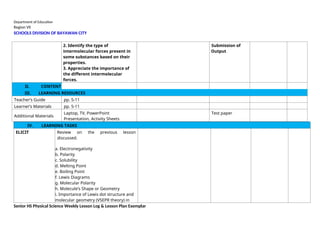
2. Identify the type of
intermolecular forces present in
some substances based on their
properties.
3. Appreciate the importance of
the different intermolecular
forces.
Submission of
Output
II. CONTENT
III. LEARNING RESOURCES
Teacher’s Guide pp. 5-11
Learner’s Materials pp. 5-11
Additional Materials
Laptop, TV, PowerPoint
Presentation, Activity Sheets
Test paper
IV. LEARNING TASKS
ELICIT Review on the previous lesson
discussed.
a. Electronegativity
b. Polarity
c. Solubility
d. Melting Point
e. Boiling Point
f. Lewis Diagrams
g. Molecular Polarity
h. Molecule’s Shape or Geometry
i. Importance of Lewis dot structure and
molecular geometry (VSEPR theory) in
Senior HS Physical Science Weekly Lesson Log & Lesson Plan Exemplar
Department of Education
Region VII
SCHOOLS DIVISION OF BAYAWAN CITY
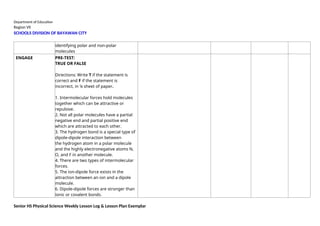
identifying polar and non-polar
molecules
ENGAGE PRE-TEST:
TRUE OR FALSE
Directions: Write T if the statement is
correct and F if the statement is
incorrect, in ¼ sheet of paper.
1. Intermolecular forces hold molecules
together which can be attractive or
repulsive.
2. Not all polar molecules have a partial
negative end and partial positive end
which are attracted to each other.
3. The hydrogen bond is a special type of
dipole-dipole interaction between
the hydrogen atom in a polar molecule
and the highly electronegative atoms N,
O, and F in another molecule.
4. There are two types of intermolecular
forces.
5. The ion-dipole force exists in the
attraction between an ion and a dipole
molecule.
6. Dipole-dipole forces are stronger than
ionic or covalent bonds.
Senior HS Physical Science Weekly Lesson Log & Lesson Plan Exemplar
Department of Education
Region VII
SCHOOLS DIVISION OF BAYAWAN CITY
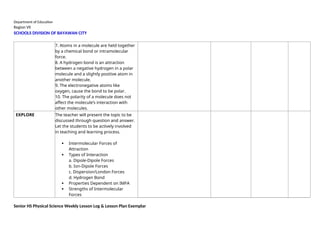
7. Atoms in a molecule are held together
by a chemical bond or intramolecular
force.
8. A hydrogen bond is an attraction
between a negative hydrogen in a polar
molecule and a slightly positive atom in
another molecule.
9. The electronegative atoms like
oxygen, cause the bond to be polar.
10. The polarity of a molecule does not
affect the molecule’s interaction with
other molecules.
EXPLORE The teacher will present the topic to be
discussed through question and answer.
Let the students to be actively involved
in teaching and learning process.
 Intermolecular Forces of
Attraction
 Types of Interaction
a. Dipole-Dipole Forces
b. Ion-Dipole Forces
c. Dispersion/London Forces
d. Hydrogen Bond
 Properties Dependent on IMFA
 Strengths of Intermolecular
Forces
Senior HS Physical Science Weekly Lesson Log & Lesson Plan Exemplar
Department of Education
Region VII
SCHOOLS DIVISION OF BAYAWAN CITY
 Importance of the Different
Intermolecular Forces
Senior HS Physical Science Weekly Lesson Log & Lesson Plan Exemplar
Department of Education
Region VII
SCHOOLS DIVISION OF BAYAWAN CITY
Senior HS Physical Science Weekly Lesson Log & Lesson Plan Exemplar
EXPLAIN
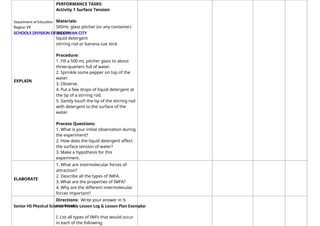
PERFORMANCE TASKS:
Activity 1 Surface Tension
Materials:
500mL glass pitcher (or any container)
pepper
liquid detergent
stirring rod or banana cue stick
Procedure:
1. Fill a 500 mL pitcher glass to about
three-quarters full of water.
2. Sprinkle some pepper on top of the
water.
3. Observe.
4. Put a few drops of liquid detergent at
the tip of a stirring rod.
5. Gently touch the tip of the stirring rod
with detergent to the surface of the
water.
Process Questions:
1. What is your initial observation during
the experiment?
2. How does the liquid detergent affect
the surface tension of water?
3. Make a hypothesis for this
experiment.
ELABORATE
1. What are intermolecular forces of
attraction?
2. Describe all the types of IMFA.
3. What are the properties of IMFA?
4. Why are the different intermolecular
forces important?
Directions: Write your answer in ½
crosswise.
I. List all types of IMFs that would occur
in each of the following:
Department of Education
Region VII
SCHOOLS DIVISION OF BAYAWAN CITY
Senior HS Physical Science Weekly Lesson Log & Lesson Plan Exemplar
EXTEND
Directions: Research on the
biological macromolecules. Do this
in short bond paper in either
handwritten or encoded.
V. REMARKS
VI. REFLECTION
From the evaluation,
No. of Learners who
earned:
• 80% and Above:
• Below 80%:
Did the remedial
lessons work? No. of
Learners who:
• have caught up
with the lesson
• continue to
require
remediation
Which of my teaching
strategies worked well?
Why did these work?
What difficulties did I
encounter which my
Principal/ Supervisor
can help me solve?
Department of Education
Region VII
SCHOOLS DIVISION OF BAYAWAN CITY
What innovation or
localized materials did
I use/ discover which I
wish to share with
other teachers?
Grade 11, Quarter 3
Daily Lesson Log
Week No. 3
Prepared by: Checked by:
Teacher: Donald B. Gealon School
Head:
Willa A. Onganon
Signature: Signature:
Date
Submitted:
Date:
Senior HS Physical Science Weekly Lesson Log & Lesson Plan Exemplar

physical science lesson plan quarter 3.docx

  • 1.
    Department of Education RegionVII SCHOOLS DIVISION OF BAYAWAN CITY Week No. 3 MONDAY TUESDAY WEDNESDAY THURSDAY FRIDAY I. OBJECTIVES Content Standard 1. how the uses of different materials are related to their properties and structures 2. the relationship between the function and structure of biological macromolecules Performance Standard Make a creative representation of the historical development of the atom or the chemical element in a timeline. Learning Competency 1. Describe the general types of intermolecular forces. 2. Explain the effect of intermolecular forces on the properties of substances. Code: S11/12PS-IIIc-d-17; S11/12PS-IIId-e-19 DAILY TASK 1. Describe the general types of intermolecular forces. Summative Test Senior HS Physical Science Weekly Lesson Log & Lesson Plan Exemplar Grade 11 Daily Lesson Log Senior HS Physical Science School Bal-os National High School Grade Level & SHS Track 11 GAS and TVL Teacher Donald B. Gealon Learning Area GENERAL TYPES OF INTERMOLECULAR FORCES AND THEIR EFFECTS ON THE PROPERTIES OF SUBSTANCES Teaching Dates Feb. 19-23, 2024 MODESTY M-W (7:45-9:45 AM) LOYALTY M-W (10:00-12:00 NN) BRAVERY M-W (2:35-4:30 PM) Quarter Third
  • 2.
    Department of Education RegionVII SCHOOLS DIVISION OF BAYAWAN CITY 2. Identify the type of intermolecular forces present in some substances based on their properties. 3. Appreciate the importance of the different intermolecular forces. Submission of Output II. CONTENT III. LEARNING RESOURCES Teacher’s Guide pp. 5-11 Learner’s Materials pp. 5-11 Additional Materials Laptop, TV, PowerPoint Presentation, Activity Sheets Test paper IV. LEARNING TASKS ELICIT Review on the previous lesson discussed. a. Electronegativity b. Polarity c. Solubility d. Melting Point e. Boiling Point f. Lewis Diagrams g. Molecular Polarity h. Molecule’s Shape or Geometry i. Importance of Lewis dot structure and molecular geometry (VSEPR theory) in Senior HS Physical Science Weekly Lesson Log & Lesson Plan Exemplar
  • 3.
    Department of Education RegionVII SCHOOLS DIVISION OF BAYAWAN CITY identifying polar and non-polar molecules ENGAGE PRE-TEST: TRUE OR FALSE Directions: Write T if the statement is correct and F if the statement is incorrect, in ¼ sheet of paper. 1. Intermolecular forces hold molecules together which can be attractive or repulsive. 2. Not all polar molecules have a partial negative end and partial positive end which are attracted to each other. 3. The hydrogen bond is a special type of dipole-dipole interaction between the hydrogen atom in a polar molecule and the highly electronegative atoms N, O, and F in another molecule. 4. There are two types of intermolecular forces. 5. The ion-dipole force exists in the attraction between an ion and a dipole molecule. 6. Dipole-dipole forces are stronger than ionic or covalent bonds. Senior HS Physical Science Weekly Lesson Log & Lesson Plan Exemplar
  • 4.
    Department of Education RegionVII SCHOOLS DIVISION OF BAYAWAN CITY 7. Atoms in a molecule are held together by a chemical bond or intramolecular force. 8. A hydrogen bond is an attraction between a negative hydrogen in a polar molecule and a slightly positive atom in another molecule. 9. The electronegative atoms like oxygen, cause the bond to be polar. 10. The polarity of a molecule does not affect the molecule’s interaction with other molecules. EXPLORE The teacher will present the topic to be discussed through question and answer. Let the students to be actively involved in teaching and learning process.  Intermolecular Forces of Attraction  Types of Interaction a. Dipole-Dipole Forces b. Ion-Dipole Forces c. Dispersion/London Forces d. Hydrogen Bond  Properties Dependent on IMFA  Strengths of Intermolecular Forces Senior HS Physical Science Weekly Lesson Log & Lesson Plan Exemplar
  • 5.
    Department of Education RegionVII SCHOOLS DIVISION OF BAYAWAN CITY  Importance of the Different Intermolecular Forces Senior HS Physical Science Weekly Lesson Log & Lesson Plan Exemplar
  • 6.
    Department of Education RegionVII SCHOOLS DIVISION OF BAYAWAN CITY Senior HS Physical Science Weekly Lesson Log & Lesson Plan Exemplar EXPLAIN PERFORMANCE TASKS: Activity 1 Surface Tension Materials: 500mL glass pitcher (or any container) pepper liquid detergent stirring rod or banana cue stick Procedure: 1. Fill a 500 mL pitcher glass to about three-quarters full of water. 2. Sprinkle some pepper on top of the water. 3. Observe. 4. Put a few drops of liquid detergent at the tip of a stirring rod. 5. Gently touch the tip of the stirring rod with detergent to the surface of the water. Process Questions: 1. What is your initial observation during the experiment? 2. How does the liquid detergent affect the surface tension of water? 3. Make a hypothesis for this experiment. ELABORATE 1. What are intermolecular forces of attraction? 2. Describe all the types of IMFA. 3. What are the properties of IMFA? 4. Why are the different intermolecular forces important? Directions: Write your answer in ½ crosswise. I. List all types of IMFs that would occur in each of the following:
  • 7.
    Department of Education RegionVII SCHOOLS DIVISION OF BAYAWAN CITY Senior HS Physical Science Weekly Lesson Log & Lesson Plan Exemplar EXTEND Directions: Research on the biological macromolecules. Do this in short bond paper in either handwritten or encoded. V. REMARKS VI. REFLECTION From the evaluation, No. of Learners who earned: • 80% and Above: • Below 80%: Did the remedial lessons work? No. of Learners who: • have caught up with the lesson • continue to require remediation Which of my teaching strategies worked well? Why did these work? What difficulties did I encounter which my Principal/ Supervisor can help me solve?
  • 8.
    Department of Education RegionVII SCHOOLS DIVISION OF BAYAWAN CITY What innovation or localized materials did I use/ discover which I wish to share with other teachers? Grade 11, Quarter 3 Daily Lesson Log Week No. 3 Prepared by: Checked by: Teacher: Donald B. Gealon School Head: Willa A. Onganon Signature: Signature: Date Submitted: Date: Senior HS Physical Science Weekly Lesson Log & Lesson Plan Exemplar