11
22
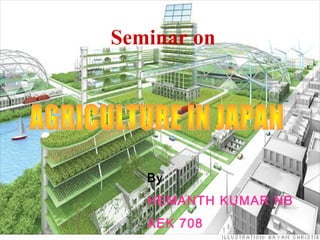
Seminar on
By
HEMANTH KUMAR NB
AEK 708
33
ContentsContents
 IntroductionIntroduction
 Agriculture economy of JapanAgriculture economy of Japan
 Agriculture in JapanAgriculture in Japan
 Crops in JapanCrops in Japan
 Rice farming in JapanRice farming in Japan
 Live stocks in JapanLive stocks in Japan
 ConclusionConclusion
44
IntroductionIntroduction
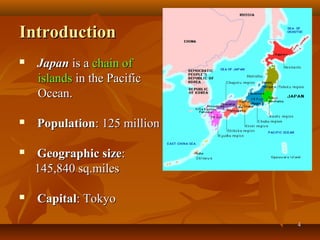
 JapanJapan is ais a chain ofchain of
islandsislands in the Pacificin the Pacific
Ocean.Ocean.
 PopulationPopulation: 125 million: 125 million
 Geographic sizeGeographic size::
145,840 sq.miles145,840 sq.miles
 CapitalCapital: Tokyo: Tokyo
55
Climate:Climate:
 Japanese summers are hot and humid.Japanese summers are hot and humid.
 Japanese winters are mild.Japanese winters are mild.
 The rainy season is June and July, and typhoonThe rainy season is June and July, and typhoon
season is in Septemberseason is in September
66
EconomyEconomy
Japan is a major economic power, it has theJapan is a major economic power, it has the
world’sworld’s
second-largest economysecond-largest economy
by nominal GDP,by nominal GDP,
third largest in purchasing power paritythird largest in purchasing power parity,,
fourth largest exporterfourth largest exporter
andand
fifth largest importerfifth largest importer
77
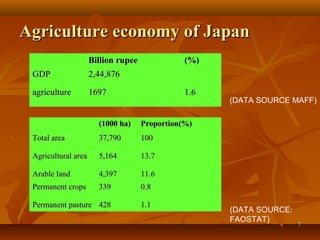
Agriculture economy of JapanAgriculture economy of Japan
(1000 ha)(1000 ha) Proportion(%)Proportion(%)
Total areaTotal area 37,79037,790 100100
Agricultural areaAgricultural area 5,1645,164 13.713.7
Arable landArable land 4,3974,397 11.611.6
Permanent cropsPermanent crops 339339 0.80.8
Permanent pasturePermanent pasture 428428 1.11.1
Billion rupeeBillion rupee (%)(%)
GDPGDP 2,44,8762,44,876
agricultureagriculture 16971697 1.61.6
(DATA SOURCE MAFF)
(DATA SOURCE:
FAOSTAT)
88
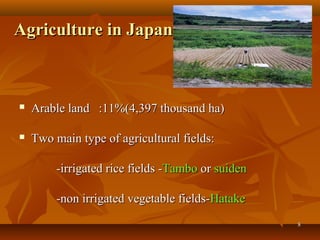
Agriculture in JapanAgriculture in Japan
 Arable land :11%(4,397 thousand ha)Arable land :11%(4,397 thousand ha)
 Two main type of agricultural fields:Two main type of agricultural fields:
-irrigated rice fields --irrigated rice fields -TamboTambo oror suidensuiden
-non irrigated vegetable fields--non irrigated vegetable fields-HatakeHatake
99
conti,,conti,,
 After world war ll -land took by powerfulAfter world war ll -land took by powerful
landownerslandowners and distribute it toand distribute it to ordinary farmersordinary farmers..
 Waste fishesWaste fishes traditionally used to fertilize ricetraditionally used to fertilize rice
fieldsfields
 Improved fertilizer and mechanizationImproved fertilizer and mechanization tripledtripled
Japan's rice productionJapan's rice production (1947 -1967)(1947 -1967)
1010
conti,,conti,,
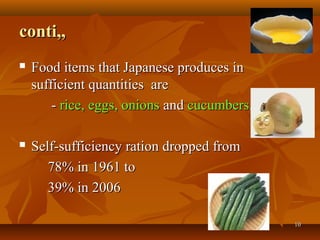
 Food items that Japanese produces inFood items that Japanese produces in
sufficient quantities aresufficient quantities are
-- rice, eggs, onionsrice, eggs, onions andand cucumberscucumbers..
 Self-sufficiency ration dropped fromSelf-sufficiency ration dropped from
78% in 1961 to78% in 1961 to
39% in 200639% in 2006
1111
Problems faced by farmers in JapanProblems faced by farmers in Japan
 A old farmer told to new York times IN 1990s,A old farmer told to new York times IN 1990s,
““Japanese agriculture has no money,Japanese agriculture has no money,
no youth, no futureno youth, no future.”.”
1212
conti,,conti,,
 Limits on productionLimits on production
 High cost of mechanized farmingHigh cost of mechanized farming
 Farmers faceFarmers face droughtdrought andand typhoonstyphoons in summerin summer
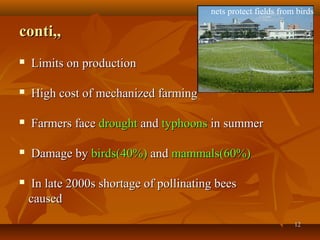
 Damage byDamage by birds(40%)birds(40%) andand mammals(60%)mammals(60%)
 In late 2000s shortage of pollinating beesIn late 2000s shortage of pollinating bees
causedcaused
nets protect fields from birds
1313
Small Farms in JapanSmall Farms in Japan
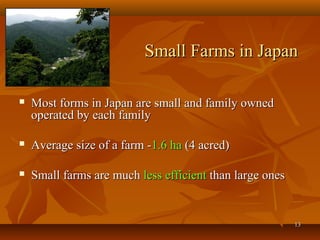
 Most forms in Japan are small and family ownedMost forms in Japan are small and family owned
operated by each familyoperated by each family
 Average size of a farm -Average size of a farm -1.6 ha1.6 ha (4 acred)(4 acred)
 Small farms are muchSmall farms are much less efficientless efficient than large onesthan large ones
1414
Conti,,Conti,,
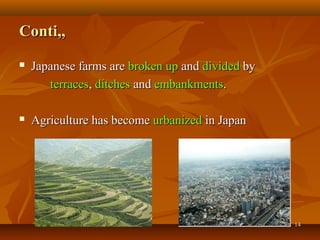
 Japanese farms areJapanese farms are broken upbroken up andand divideddivided byby
terracesterraces,, ditchesditches andand embankmentsembankments..
 Agriculture has becomeAgriculture has become urbanizedurbanized in Japanin Japan
1515
Eco-Farms in JapanEco-Farms in Japan
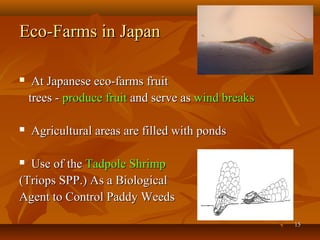
 At Japanese eco-farms fruitAt Japanese eco-farms fruit
trees -trees - produce fruitproduce fruit and serve asand serve as wind breakswind breaks
 Agricultural areas are filled with pondsAgricultural areas are filled with ponds
 Use of theUse of the Tadpole ShrimpTadpole Shrimp
(Triops SPP.) As a Biological(Triops SPP.) As a Biological
Agent to Control Paddy WeedsAgent to Control Paddy Weeds
1616
High-Tech Agriculture in JapanHigh-Tech Agriculture in Japan
 They are ahead inThey are ahead in biotechnologybiotechnology, they grow, they grow
their rice with amazing varietytheir rice with amazing variety
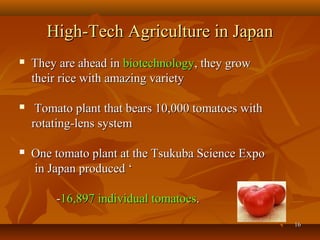
 Tomato plant that bears 10,000 tomatoes withTomato plant that bears 10,000 tomatoes with
rotating-lens systemrotating-lens system
 One tomato plant at the Tsukuba Science ExpoOne tomato plant at the Tsukuba Science Expo
in Japan produced ‘in Japan produced ‘
--16,897 individual tomatoes16,897 individual tomatoes..
1717
Conti,,Conti,,
 The modernization of rice paddy agricultureThe modernization of rice paddy agriculture
includesincludes
- consolidating small fields into large ones- consolidating small fields into large ones
- replacing open canals with underground- replacing open canals with underground
drainage pipesdrainage pipes
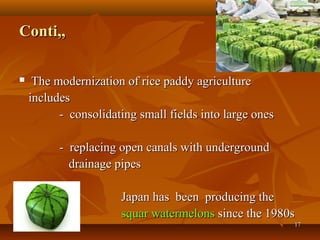
Japan has been producing theJapan has been producing the
squar watermelonssquar watermelons since the 1980ssince the 1980s
1818
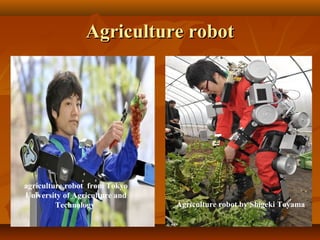
Agriculture robotAgriculture robot
Agriculture robot by Shigeki Toyama
agriculture robot from Tokyo
University of Agriculture and
Technology
1919
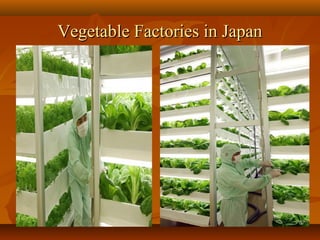
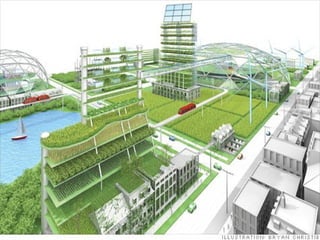
Vegetable Factories in JapanVegetable Factories in Japan
2020
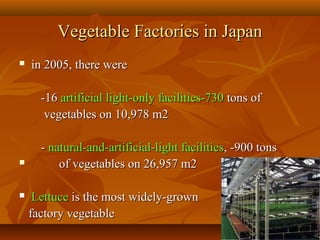
Vegetable Factories in JapanVegetable Factories in Japan
 in 2005, there werein 2005, there were
-16-16 artificial light-only facilities-730artificial light-only facilities-730 tons oftons of
vegetables on 10,978 m2vegetables on 10,978 m2
-- natural-and-artificial-light facilitiesnatural-and-artificial-light facilities, -900 tons, -900 tons
 of vegetables on 26,957 m2of vegetables on 26,957 m2
 LettuceLettuce is the most widely-grownis the most widely-grown
factory vegetablefactory vegetable
2121
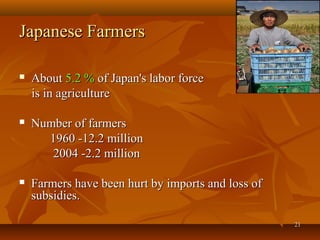
Japanese FarmersJapanese Farmers
 AboutAbout 5.2 %5.2 % of Japan's labor forceof Japan's labor force
is in agricultureis in agriculture
 Number of farmersNumber of farmers
1960 -12.2 million1960 -12.2 million
2004 -2.2 million2004 -2.2 million
 Farmers have been hurt by imports and loss ofFarmers have been hurt by imports and loss of
subsidies.subsidies.
2222
Conti,,Conti,,
 One farmer who manages one hectare of land (2.5One farmer who manages one hectare of land (2.5
acres) told National Geographicacres) told National Geographic
""I'd need 10 to 20 hectares nowadays toI'd need 10 to 20 hectares nowadays to
live welllive well.”.”
2323
Part Time Japanese FarmersPart Time Japanese Farmers
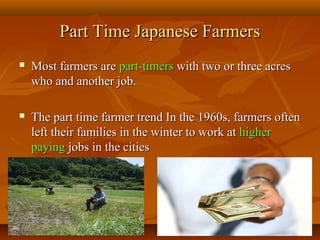
 Most farmers areMost farmers are part-timerspart-timers with two or three acreswith two or three acres
who and another job.who and another job.
 The part time farmer trend In the 1960s, farmers oftenThe part time farmer trend In the 1960s, farmers often
left their families in the winter to work atleft their families in the winter to work at higherhigher
payingpaying jobs in the citiesjobs in the cities
2424
Old Man Farmers inOld Man Farmers in
JapanJapan
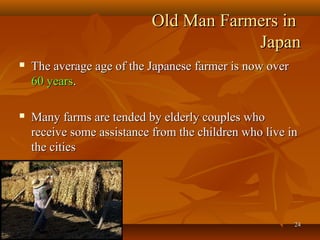
 The average age of the Japanese farmer is now overThe average age of the Japanese farmer is now over
60 years60 years..
 Many farms are tended by elderly couples whoMany farms are tended by elderly couples who
receive some assistance from the children who live inreceive some assistance from the children who live in
the citiesthe cities
2525
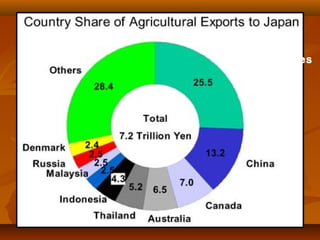
Exported and Imported Food in JapanExported and Imported Food in Japan

JapanJapan exportedexported 205 billion rupees205 billion rupees worth of agriculturalworth of agricultural
products in 2006products in 2006
-75% went to Asian countries-75% went to Asian countries
- 21% went to the United States.- 21% went to the United States.
 Japan is the world'sJapan is the world's largest net importerlargest net importer ofof
agricultural productsagricultural products andand foodfood
 Japan relies on imports for 60 percent of its food onJapan relies on imports for 60 percent of its food on
aa caloric basiscaloric basis
2626
United states
2727
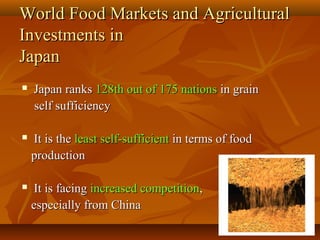
World Food Markets and AgriculturalWorld Food Markets and Agricultural
Investments inInvestments in
JapanJapan
 Japan ranksJapan ranks 128th out of 175 nations128th out of 175 nations in grainin grain
self sufficiencyself sufficiency
 It is theIt is the least self-sufficientleast self-sufficient in terms of foodin terms of food
productionproduction
 It is facingIt is facing increased competitionincreased competition,,
especially from Chinaespecially from China
2828
CROPS IN JAPANCROPS IN JAPAN
 Major cropsMajor crops::
rice, sugar beets, vegetables, fruitrice, sugar beets, vegetables, fruit..
 Much of Japan vegetables can be grown yearMuch of Japan vegetables can be grown year
round.round.
 Well grown vegetables in winterWell grown vegetables in winter ::
potatoes, sweet potatoes, cabbage, taro, carrots, and apotatoes, sweet potatoes, cabbage, taro, carrots, and a
variety of turnips and radishes.variety of turnips and radishes.
2929
Conti,,Conti,,
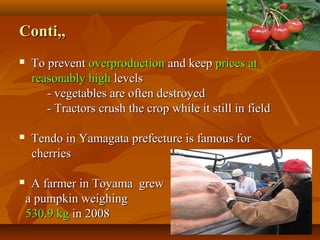
 To preventTo prevent overproductionoverproduction and keepand keep prices atprices at
reasonably highreasonably high levelslevels
- vegetables are often destroyed- vegetables are often destroyed
- Tractors crush the crop while it still in field- Tractors crush the crop while it still in field
 Tendo in Yamagata prefecture is famous forTendo in Yamagata prefecture is famous for
cherriescherries
 A farmer in Toyama grewA farmer in Toyama grew
a pumpkin weighinga pumpkin weighing
530.9 kg530.9 kg in 2008in 2008
3030
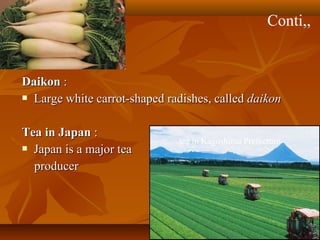
DaikonDaikon ::
 Large white carrot-shaped radishes, calledLarge white carrot-shaped radishes, called daikondaikon
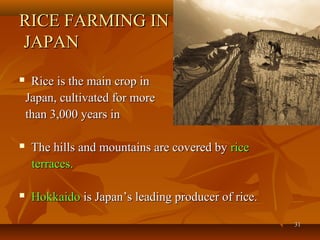
Tea in JapanTea in Japan ::
 Japan is a major teaJapan is a major tea
producerproducer
tea in Kagoshima Prefecture
Conti,,
3131
RICE FARMING INRICE FARMING IN
JAPANJAPAN
 Rice is the main crop inRice is the main crop in
Japan, cultivated for moreJapan, cultivated for more
than 3,000 years inthan 3,000 years in
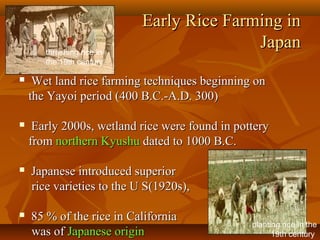
 The hills and mountains are covered byThe hills and mountains are covered by ricerice
terraces.terraces.
 HokkaidoHokkaido is Japan’s leading producer of rice.is Japan’s leading producer of rice.
3232
Early Rice Farming inEarly Rice Farming in
JapanJapan
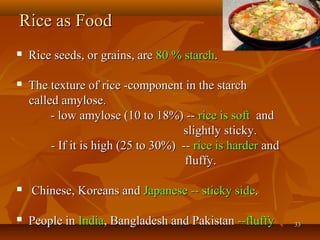
 Wet land rice farming techniques beginning onWet land rice farming techniques beginning on
the Yayoi period (400 B.C.-A.D. 300)the Yayoi period (400 B.C.-A.D. 300)
 Early 2000s, wetland rice were found in potteryEarly 2000s, wetland rice were found in pottery
fromfrom northern Kyushunorthern Kyushu dated to 1000 B.C.dated to 1000 B.C.
 Japanese introduced superiorJapanese introduced superior
rice varieties to the U S(1920s),rice varieties to the U S(1920s),
 85 % of the rice in California85 % of the rice in California
was ofwas of Japanese originJapanese origin
planting rice in the
19th century
threshing rice in
the 19th century
3333
Rice as FoodRice as Food
 Rice seeds, or grains, areRice seeds, or grains, are 80 % starch80 % starch..
 The texture of rice -component in the starchThe texture of rice -component in the starch
called amylose.called amylose.
- low amylose (10 to 18%) --- low amylose (10 to 18%) -- rice is softrice is soft andand
slightly sticky.slightly sticky.
- If it is high (25 to 30%) --- If it is high (25 to 30%) -- rice is harderrice is harder andand
fluffy.fluffy.
 Chinese, Koreans andChinese, Koreans and Japanese -- sticky sideJapanese -- sticky side..
 People inPeople in IndiaIndia, Bangladesh and Pakistan, Bangladesh and Pakistan --fluffy--fluffy
3434
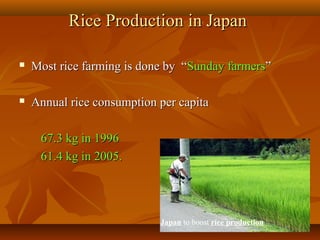
Rice Production in JapanRice Production in Japan
 Most rice farming is done by “Most rice farming is done by “Sunday farmersSunday farmers””
 Annual rice consumption per capitaAnnual rice consumption per capita
67.3 kg in 199667.3 kg in 1996
61.4 kg in 2005.61.4 kg in 2005.
Japan to boost rice production
3535
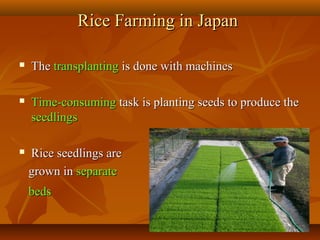
Rice Farming in JapanRice Farming in Japan
 TheThe transplantingtransplanting is done with machinesis done with machines
 Time-consumingTime-consuming task is planting seeds to produce thetask is planting seeds to produce the
seedlingsseedlings
 Rice seedlings areRice seedlings are
grown ingrown in separateseparate
bedsbeds
3636
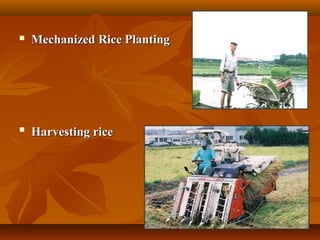
 Mechanized Rice PlantingMechanized Rice Planting

Harvesting riceHarvesting rice
3737
Modern Rice PaddiesModern Rice Paddies
in Japanin Japan
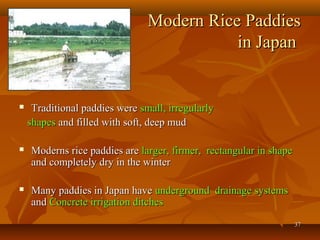
 Traditional paddies wereTraditional paddies were small, irregularlysmall, irregularly
shapesshapes and filled with soft, deep mudand filled with soft, deep mud
 Moderns rice paddies areModerns rice paddies are larger, firmer, rectangular in shapelarger, firmer, rectangular in shape
and completely dry in the winterand completely dry in the winter
 Many paddies in Japan haveMany paddies in Japan have underground drainage systemsunderground drainage systems
andand Concrete irrigation ditchesConcrete irrigation ditches
3838
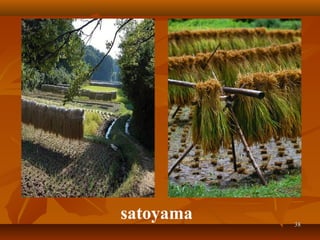
satoyama
3939
Import Restrictions and SubsidizedImport Restrictions and Subsidized
Rice in JapanRice in Japan
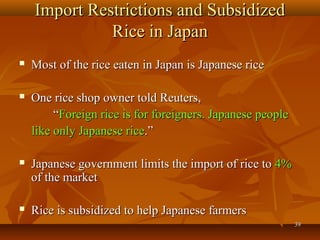
 Most of the rice eaten in Japan is Japanese riceMost of the rice eaten in Japan is Japanese rice
 One rice shop owner told Reuters,One rice shop owner told Reuters,
““Foreign rice is for foreigners. Japanese peopleForeign rice is for foreigners. Japanese people
like only Japanese ricelike only Japanese rice.”.”
 Japanese government limits the import of rice toJapanese government limits the import of rice to 4%4%
of the marketof the market
 Rice is subsidized to help Japanese farmersRice is subsidized to help Japanese farmers
4040
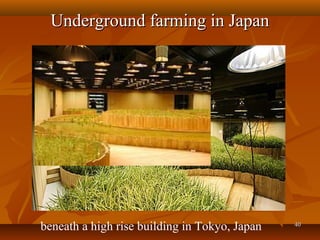
Underground farming in JapanUnderground farming in Japan
beneath a high rise building in Tokyo, Japan
4141
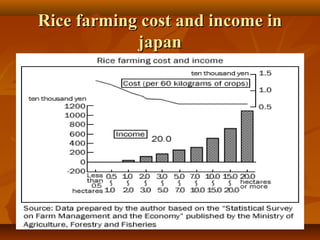
Rice farming cost and income inRice farming cost and income in
japanjapan
4242
LIVESTOCK INLIVESTOCK IN
JAPANJAPAN
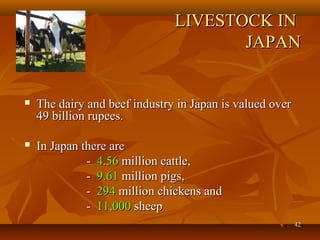
 The dairy and beef industry in Japan is valued overThe dairy and beef industry in Japan is valued over
49 billion rupees.49 billion rupees.
 In Japan there areIn Japan there are
-- 4.564.56 million cattle,million cattle,
-- 9.619.61 million pigs,million pigs,
-- 294294 million chickens andmillion chickens and
-- 11,00011,000 sheepsheep
4343
Conti,,Conti,,
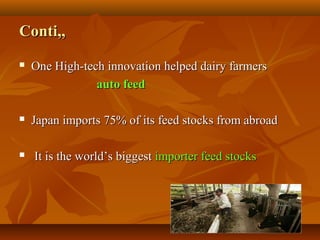
 One High-tech innovation helped dairy farmersOne High-tech innovation helped dairy farmers
auto feedauto feed
 Japan imports 75% of its feed stocks from abroadJapan imports 75% of its feed stocks from abroad
 It is the world’s biggestIt is the world’s biggest importer feed stocksimporter feed stocks
4444
COMMERCIAL FISHINGCOMMERCIAL FISHING
IN JAPANIN JAPAN
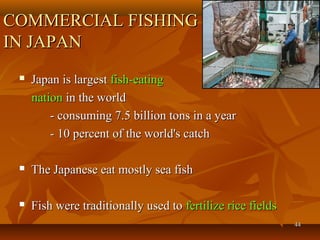
 Japan is largestJapan is largest fish-eatingfish-eating
nationnation in the worldin the world
- consuming 7.5 billion tons in a year- consuming 7.5 billion tons in a year
- 10 percent of the world's catch- 10 percent of the world's catch
 The Japanese eat mostly sea fishThe Japanese eat mostly sea fish
 Fish were traditionally used toFish were traditionally used to fertilize rice fieldsfertilize rice fields
4545
4646
conclusionconclusion
 Though the climatic conditions in our countryThough the climatic conditions in our country
are different from Japan but the agricultureare different from Japan but the agriculture
growth of Japan shows a clear path way to angrowth of Japan shows a clear path way to an
agriculture in India.agriculture in India.
 By adoption of innovative technology of JapanBy adoption of innovative technology of Japan
India also can accelerate its agricultureIndia also can accelerate its agriculture
growth.growth.
4747
ReferencesReferences
 www.maff.go.jp/hakusyo/kaigai/ehakusyo99.htmwww.maff.go.jp/hakusyo/kaigai/ehakusyo99.htm
 Factsanddetails.com/japanFactsanddetails.com/japan
 www.buddycom/japan/yasaikojo/index.htmlwww.buddycom/japan/yasaikojo/index.html
 Newshipper.sulekha.com/japanNewshipper.sulekha.com/japan
 www.impactlab.netwww.impactlab.net
 http://www.icscom.biz/nodai2010/index.htmlhttp://www.icscom.biz/nodai2010/index.html
 www.rieti.go.jp/.../yamashita/58.htmlwww.rieti.go.jp/.../yamashita/58.html
4848
4949
 THANK YOUTHANK YOU
 Punjab National Bank with 4497 offices and the largest nationalised bank is serving its 3.5 crore customers with the following wide variety of banking services:
 Corporate banking
 Personal banking
 Industrial finance
 Agricultural finance
 Financing of trade
 International banking
 Punjab National Bank has been ranked 38th amongst top 500 companies by The Economic Times. PNB has earned 9th position among top 50 trusted brands in India.
Punjab National Bank India maintains relationship with more than 200 leading international banks world wide. PNB India has Rupee Drawing Arrangements with 15 exchange companies
in UAE and 1 in Singapore.
PNB Online
Punjab National Bank of India is also a member of SWIFT and more than 150 PNB Branches are connected with terminals in Mumbai. It promotes "Any Time, Any Where Banking".
PNB offers Internet Banking services for both to the Corporates and Individuals. It provides 24 hours, 365 days banking from the PC of the user. A user can operate anytime and from
anywher its accounts. The following are some of the services available online:
 Access to account
 Complete details of transactions and statement of account
 Online information of deposits, loans overdraft account etc.
 Online Payment Facility for railway reservation through IRCTC Payment Gateway Project
 Online Utility Bill Payment Services which allows Internet Banking account holders to pay their telephone, mobile, electricity, insurance and other bills anytime from anywhere from their
desktop.
 Punjab National Bank Card user can buy goods and enable services from 45,000 merchant outlet in India and can withdraw cash from over 4500 ATMs with its own 450 ATMs.
Punjab National Bank Branches
Punjab National Bank has its Branches in all the 7 metropolitan and cosmopolitan cities in Inadi namely New Delhi, Mumbai, Calcutta, Chennai, Bangalore, Hyderabad and Ahmedabad. It
even has its branches in small town in both urban as well as rural areas.
PNB is always focussing on expanding abroad and till date has identified some emerging economies abroad. They are in few of these places.
 Almaty
 Kazakhktan
 Shanghai
 China
 London
 Kabul
 Afghanistan

Punjab National Bank Housing Loan
Any individual can avail Punjab National Bank Housing Loan for any of the following purpose:
 For construction of house.
 For purchase of house/ flat.
 For purchase of house/ flat from the original allottee, i.e. on First Power of Attorney basis.
 For carrying out repairs/ renovation/ additions/ alterations in the existing house.

Agriculture in japan

  • 1.
  • 2.
  • 3.
    33 ContentsContents  IntroductionIntroduction  Agricultureeconomy of JapanAgriculture economy of Japan  Agriculture in JapanAgriculture in Japan  Crops in JapanCrops in Japan  Rice farming in JapanRice farming in Japan  Live stocks in JapanLive stocks in Japan  ConclusionConclusion
  • 4.
    44 IntroductionIntroduction  JapanJapan isais a chain ofchain of islandsislands in the Pacificin the Pacific Ocean.Ocean.  PopulationPopulation: 125 million: 125 million  Geographic sizeGeographic size:: 145,840 sq.miles145,840 sq.miles  CapitalCapital: Tokyo: Tokyo
  • 5.
    55 Climate:Climate:  Japanese summersare hot and humid.Japanese summers are hot and humid.  Japanese winters are mild.Japanese winters are mild.  The rainy season is June and July, and typhoonThe rainy season is June and July, and typhoon season is in Septemberseason is in September
  • 6.
    66 EconomyEconomy Japan is amajor economic power, it has theJapan is a major economic power, it has the world’sworld’s second-largest economysecond-largest economy by nominal GDP,by nominal GDP, third largest in purchasing power paritythird largest in purchasing power parity,, fourth largest exporterfourth largest exporter andand fifth largest importerfifth largest importer
  • 7.
    77 Agriculture economy ofJapanAgriculture economy of Japan (1000 ha)(1000 ha) Proportion(%)Proportion(%) Total areaTotal area 37,79037,790 100100 Agricultural areaAgricultural area 5,1645,164 13.713.7 Arable landArable land 4,3974,397 11.611.6 Permanent cropsPermanent crops 339339 0.80.8 Permanent pasturePermanent pasture 428428 1.11.1 Billion rupeeBillion rupee (%)(%) GDPGDP 2,44,8762,44,876 agricultureagriculture 16971697 1.61.6 (DATA SOURCE MAFF) (DATA SOURCE: FAOSTAT)
  • 8.
    88 Agriculture in JapanAgriculturein Japan  Arable land :11%(4,397 thousand ha)Arable land :11%(4,397 thousand ha)  Two main type of agricultural fields:Two main type of agricultural fields: -irrigated rice fields --irrigated rice fields -TamboTambo oror suidensuiden -non irrigated vegetable fields--non irrigated vegetable fields-HatakeHatake
  • 9.
    99 conti,,conti,,  After worldwar ll -land took by powerfulAfter world war ll -land took by powerful landownerslandowners and distribute it toand distribute it to ordinary farmersordinary farmers..  Waste fishesWaste fishes traditionally used to fertilize ricetraditionally used to fertilize rice fieldsfields  Improved fertilizer and mechanizationImproved fertilizer and mechanization tripledtripled Japan's rice productionJapan's rice production (1947 -1967)(1947 -1967)
  • 10.
    1010 conti,,conti,,  Food itemsthat Japanese produces inFood items that Japanese produces in sufficient quantities aresufficient quantities are -- rice, eggs, onionsrice, eggs, onions andand cucumberscucumbers..  Self-sufficiency ration dropped fromSelf-sufficiency ration dropped from 78% in 1961 to78% in 1961 to 39% in 200639% in 2006
  • 11.
    1111 Problems faced byfarmers in JapanProblems faced by farmers in Japan  A old farmer told to new York times IN 1990s,A old farmer told to new York times IN 1990s, ““Japanese agriculture has no money,Japanese agriculture has no money, no youth, no futureno youth, no future.”.”
  • 12.
    1212 conti,,conti,,  Limits onproductionLimits on production  High cost of mechanized farmingHigh cost of mechanized farming  Farmers faceFarmers face droughtdrought andand typhoonstyphoons in summerin summer  Damage byDamage by birds(40%)birds(40%) andand mammals(60%)mammals(60%)  In late 2000s shortage of pollinating beesIn late 2000s shortage of pollinating bees causedcaused nets protect fields from birds
  • 13.
    1313 Small Farms inJapanSmall Farms in Japan  Most forms in Japan are small and family ownedMost forms in Japan are small and family owned operated by each familyoperated by each family  Average size of a farm -Average size of a farm -1.6 ha1.6 ha (4 acred)(4 acred)  Small farms are muchSmall farms are much less efficientless efficient than large onesthan large ones
  • 14.
    1414 Conti,,Conti,,  Japanese farmsareJapanese farms are broken upbroken up andand divideddivided byby terracesterraces,, ditchesditches andand embankmentsembankments..  Agriculture has becomeAgriculture has become urbanizedurbanized in Japanin Japan
  • 15.
    1515 Eco-Farms in JapanEco-Farmsin Japan  At Japanese eco-farms fruitAt Japanese eco-farms fruit trees -trees - produce fruitproduce fruit and serve asand serve as wind breakswind breaks  Agricultural areas are filled with pondsAgricultural areas are filled with ponds  Use of theUse of the Tadpole ShrimpTadpole Shrimp (Triops SPP.) As a Biological(Triops SPP.) As a Biological Agent to Control Paddy WeedsAgent to Control Paddy Weeds
  • 16.
    1616 High-Tech Agriculture inJapanHigh-Tech Agriculture in Japan  They are ahead inThey are ahead in biotechnologybiotechnology, they grow, they grow their rice with amazing varietytheir rice with amazing variety  Tomato plant that bears 10,000 tomatoes withTomato plant that bears 10,000 tomatoes with rotating-lens systemrotating-lens system  One tomato plant at the Tsukuba Science ExpoOne tomato plant at the Tsukuba Science Expo in Japan produced ‘in Japan produced ‘ --16,897 individual tomatoes16,897 individual tomatoes..
  • 17.
    1717 Conti,,Conti,,  The modernizationof rice paddy agricultureThe modernization of rice paddy agriculture includesincludes - consolidating small fields into large ones- consolidating small fields into large ones - replacing open canals with underground- replacing open canals with underground drainage pipesdrainage pipes Japan has been producing theJapan has been producing the squar watermelonssquar watermelons since the 1980ssince the 1980s
  • 18.
    1818 Agriculture robotAgriculture robot Agriculturerobot by Shigeki Toyama agriculture robot from Tokyo University of Agriculture and Technology
  • 19.
    1919 Vegetable Factories inJapanVegetable Factories in Japan
  • 20.
    2020 Vegetable Factories inJapanVegetable Factories in Japan  in 2005, there werein 2005, there were -16-16 artificial light-only facilities-730artificial light-only facilities-730 tons oftons of vegetables on 10,978 m2vegetables on 10,978 m2 -- natural-and-artificial-light facilitiesnatural-and-artificial-light facilities, -900 tons, -900 tons  of vegetables on 26,957 m2of vegetables on 26,957 m2  LettuceLettuce is the most widely-grownis the most widely-grown factory vegetablefactory vegetable
  • 21.
    2121 Japanese FarmersJapanese Farmers AboutAbout 5.2 %5.2 % of Japan's labor forceof Japan's labor force is in agricultureis in agriculture  Number of farmersNumber of farmers 1960 -12.2 million1960 -12.2 million 2004 -2.2 million2004 -2.2 million  Farmers have been hurt by imports and loss ofFarmers have been hurt by imports and loss of subsidies.subsidies.
  • 22.
    2222 Conti,,Conti,,  One farmerwho manages one hectare of land (2.5One farmer who manages one hectare of land (2.5 acres) told National Geographicacres) told National Geographic ""I'd need 10 to 20 hectares nowadays toI'd need 10 to 20 hectares nowadays to live welllive well.”.”
  • 23.
    2323 Part Time JapaneseFarmersPart Time Japanese Farmers  Most farmers areMost farmers are part-timerspart-timers with two or three acreswith two or three acres who and another job.who and another job.  The part time farmer trend In the 1960s, farmers oftenThe part time farmer trend In the 1960s, farmers often left their families in the winter to work atleft their families in the winter to work at higherhigher payingpaying jobs in the citiesjobs in the cities
  • 24.
    2424 Old Man FarmersinOld Man Farmers in JapanJapan  The average age of the Japanese farmer is now overThe average age of the Japanese farmer is now over 60 years60 years..  Many farms are tended by elderly couples whoMany farms are tended by elderly couples who receive some assistance from the children who live inreceive some assistance from the children who live in the citiesthe cities
  • 25.
    2525 Exported and ImportedFood in JapanExported and Imported Food in Japan  JapanJapan exportedexported 205 billion rupees205 billion rupees worth of agriculturalworth of agricultural products in 2006products in 2006 -75% went to Asian countries-75% went to Asian countries - 21% went to the United States.- 21% went to the United States.  Japan is the world'sJapan is the world's largest net importerlargest net importer ofof agricultural productsagricultural products andand foodfood  Japan relies on imports for 60 percent of its food onJapan relies on imports for 60 percent of its food on aa caloric basiscaloric basis
  • 26.
  • 27.
    2727 World Food Marketsand AgriculturalWorld Food Markets and Agricultural Investments inInvestments in JapanJapan  Japan ranksJapan ranks 128th out of 175 nations128th out of 175 nations in grainin grain self sufficiencyself sufficiency  It is theIt is the least self-sufficientleast self-sufficient in terms of foodin terms of food productionproduction  It is facingIt is facing increased competitionincreased competition,, especially from Chinaespecially from China
  • 28.
    2828 CROPS IN JAPANCROPSIN JAPAN  Major cropsMajor crops:: rice, sugar beets, vegetables, fruitrice, sugar beets, vegetables, fruit..  Much of Japan vegetables can be grown yearMuch of Japan vegetables can be grown year round.round.  Well grown vegetables in winterWell grown vegetables in winter :: potatoes, sweet potatoes, cabbage, taro, carrots, and apotatoes, sweet potatoes, cabbage, taro, carrots, and a variety of turnips and radishes.variety of turnips and radishes.
  • 29.
    2929 Conti,,Conti,,  To preventToprevent overproductionoverproduction and keepand keep prices atprices at reasonably highreasonably high levelslevels - vegetables are often destroyed- vegetables are often destroyed - Tractors crush the crop while it still in field- Tractors crush the crop while it still in field  Tendo in Yamagata prefecture is famous forTendo in Yamagata prefecture is famous for cherriescherries  A farmer in Toyama grewA farmer in Toyama grew a pumpkin weighinga pumpkin weighing 530.9 kg530.9 kg in 2008in 2008
  • 30.
    3030 DaikonDaikon ::  Largewhite carrot-shaped radishes, calledLarge white carrot-shaped radishes, called daikondaikon Tea in JapanTea in Japan ::  Japan is a major teaJapan is a major tea producerproducer tea in Kagoshima Prefecture Conti,,
  • 31.
    3131 RICE FARMING INRICEFARMING IN JAPANJAPAN  Rice is the main crop inRice is the main crop in Japan, cultivated for moreJapan, cultivated for more than 3,000 years inthan 3,000 years in  The hills and mountains are covered byThe hills and mountains are covered by ricerice terraces.terraces.  HokkaidoHokkaido is Japan’s leading producer of rice.is Japan’s leading producer of rice.
  • 32.
    3232 Early Rice FarminginEarly Rice Farming in JapanJapan  Wet land rice farming techniques beginning onWet land rice farming techniques beginning on the Yayoi period (400 B.C.-A.D. 300)the Yayoi period (400 B.C.-A.D. 300)  Early 2000s, wetland rice were found in potteryEarly 2000s, wetland rice were found in pottery fromfrom northern Kyushunorthern Kyushu dated to 1000 B.C.dated to 1000 B.C.  Japanese introduced superiorJapanese introduced superior rice varieties to the U S(1920s),rice varieties to the U S(1920s),  85 % of the rice in California85 % of the rice in California was ofwas of Japanese originJapanese origin planting rice in the 19th century threshing rice in the 19th century
  • 33.
    3333 Rice as FoodRiceas Food  Rice seeds, or grains, areRice seeds, or grains, are 80 % starch80 % starch..  The texture of rice -component in the starchThe texture of rice -component in the starch called amylose.called amylose. - low amylose (10 to 18%) --- low amylose (10 to 18%) -- rice is softrice is soft andand slightly sticky.slightly sticky. - If it is high (25 to 30%) --- If it is high (25 to 30%) -- rice is harderrice is harder andand fluffy.fluffy.  Chinese, Koreans andChinese, Koreans and Japanese -- sticky sideJapanese -- sticky side..  People inPeople in IndiaIndia, Bangladesh and Pakistan, Bangladesh and Pakistan --fluffy--fluffy
  • 34.
    3434 Rice Production inJapanRice Production in Japan  Most rice farming is done by “Most rice farming is done by “Sunday farmersSunday farmers””  Annual rice consumption per capitaAnnual rice consumption per capita 67.3 kg in 199667.3 kg in 1996 61.4 kg in 2005.61.4 kg in 2005. Japan to boost rice production
  • 35.
    3535 Rice Farming inJapanRice Farming in Japan  TheThe transplantingtransplanting is done with machinesis done with machines  Time-consumingTime-consuming task is planting seeds to produce thetask is planting seeds to produce the seedlingsseedlings  Rice seedlings areRice seedlings are grown ingrown in separateseparate bedsbeds
  • 36.
    3636  Mechanized RicePlantingMechanized Rice Planting  Harvesting riceHarvesting rice
  • 37.
    3737 Modern Rice PaddiesModernRice Paddies in Japanin Japan  Traditional paddies wereTraditional paddies were small, irregularlysmall, irregularly shapesshapes and filled with soft, deep mudand filled with soft, deep mud  Moderns rice paddies areModerns rice paddies are larger, firmer, rectangular in shapelarger, firmer, rectangular in shape and completely dry in the winterand completely dry in the winter  Many paddies in Japan haveMany paddies in Japan have underground drainage systemsunderground drainage systems andand Concrete irrigation ditchesConcrete irrigation ditches
  • 38.
  • 39.
    3939 Import Restrictions andSubsidizedImport Restrictions and Subsidized Rice in JapanRice in Japan  Most of the rice eaten in Japan is Japanese riceMost of the rice eaten in Japan is Japanese rice  One rice shop owner told Reuters,One rice shop owner told Reuters, ““Foreign rice is for foreigners. Japanese peopleForeign rice is for foreigners. Japanese people like only Japanese ricelike only Japanese rice.”.”  Japanese government limits the import of rice toJapanese government limits the import of rice to 4%4% of the marketof the market  Rice is subsidized to help Japanese farmersRice is subsidized to help Japanese farmers
  • 40.
    4040 Underground farming inJapanUnderground farming in Japan beneath a high rise building in Tokyo, Japan
  • 41.
    4141 Rice farming costand income inRice farming cost and income in japanjapan
  • 42.
    4242 LIVESTOCK INLIVESTOCK IN JAPANJAPAN The dairy and beef industry in Japan is valued overThe dairy and beef industry in Japan is valued over 49 billion rupees.49 billion rupees.  In Japan there areIn Japan there are -- 4.564.56 million cattle,million cattle, -- 9.619.61 million pigs,million pigs, -- 294294 million chickens andmillion chickens and -- 11,00011,000 sheepsheep
  • 43.
    4343 Conti,,Conti,,  One High-techinnovation helped dairy farmersOne High-tech innovation helped dairy farmers auto feedauto feed  Japan imports 75% of its feed stocks from abroadJapan imports 75% of its feed stocks from abroad  It is the world’s biggestIt is the world’s biggest importer feed stocksimporter feed stocks
  • 44.
    4444 COMMERCIAL FISHINGCOMMERCIAL FISHING INJAPANIN JAPAN  Japan is largestJapan is largest fish-eatingfish-eating nationnation in the worldin the world - consuming 7.5 billion tons in a year- consuming 7.5 billion tons in a year - 10 percent of the world's catch- 10 percent of the world's catch  The Japanese eat mostly sea fishThe Japanese eat mostly sea fish  Fish were traditionally used toFish were traditionally used to fertilize rice fieldsfertilize rice fields
  • 45.
  • 46.
    4646 conclusionconclusion  Though theclimatic conditions in our countryThough the climatic conditions in our country are different from Japan but the agricultureare different from Japan but the agriculture growth of Japan shows a clear path way to angrowth of Japan shows a clear path way to an agriculture in India.agriculture in India.  By adoption of innovative technology of JapanBy adoption of innovative technology of Japan India also can accelerate its agricultureIndia also can accelerate its agriculture growth.growth.
  • 47.
    4747 ReferencesReferences  www.maff.go.jp/hakusyo/kaigai/ehakusyo99.htmwww.maff.go.jp/hakusyo/kaigai/ehakusyo99.htm  Factsanddetails.com/japanFactsanddetails.com/japan www.buddycom/japan/yasaikojo/index.htmlwww.buddycom/japan/yasaikojo/index.html  Newshipper.sulekha.com/japanNewshipper.sulekha.com/japan  www.impactlab.netwww.impactlab.net  http://www.icscom.biz/nodai2010/index.htmlhttp://www.icscom.biz/nodai2010/index.html  www.rieti.go.jp/.../yamashita/58.htmlwww.rieti.go.jp/.../yamashita/58.html
  • 48.
  • 49.
  • 50.
     Punjab NationalBank with 4497 offices and the largest nationalised bank is serving its 3.5 crore customers with the following wide variety of banking services:  Corporate banking  Personal banking  Industrial finance  Agricultural finance  Financing of trade  International banking  Punjab National Bank has been ranked 38th amongst top 500 companies by The Economic Times. PNB has earned 9th position among top 50 trusted brands in India. Punjab National Bank India maintains relationship with more than 200 leading international banks world wide. PNB India has Rupee Drawing Arrangements with 15 exchange companies in UAE and 1 in Singapore. PNB Online Punjab National Bank of India is also a member of SWIFT and more than 150 PNB Branches are connected with terminals in Mumbai. It promotes "Any Time, Any Where Banking". PNB offers Internet Banking services for both to the Corporates and Individuals. It provides 24 hours, 365 days banking from the PC of the user. A user can operate anytime and from anywher its accounts. The following are some of the services available online:  Access to account  Complete details of transactions and statement of account  Online information of deposits, loans overdraft account etc.  Online Payment Facility for railway reservation through IRCTC Payment Gateway Project  Online Utility Bill Payment Services which allows Internet Banking account holders to pay their telephone, mobile, electricity, insurance and other bills anytime from anywhere from their desktop.  Punjab National Bank Card user can buy goods and enable services from 45,000 merchant outlet in India and can withdraw cash from over 4500 ATMs with its own 450 ATMs. Punjab National Bank Branches Punjab National Bank has its Branches in all the 7 metropolitan and cosmopolitan cities in Inadi namely New Delhi, Mumbai, Calcutta, Chennai, Bangalore, Hyderabad and Ahmedabad. It even has its branches in small town in both urban as well as rural areas. PNB is always focussing on expanding abroad and till date has identified some emerging economies abroad. They are in few of these places.  Almaty  Kazakhktan  Shanghai  China  London  Kabul  Afghanistan  Punjab National Bank Housing Loan Any individual can avail Punjab National Bank Housing Loan for any of the following purpose:  For construction of house.  For purchase of house/ flat.  For purchase of house/ flat from the original allottee, i.e. on First Power of Attorney basis.  For carrying out repairs/ renovation/ additions/ alterations in the existing house.