GENERAL SURVEY
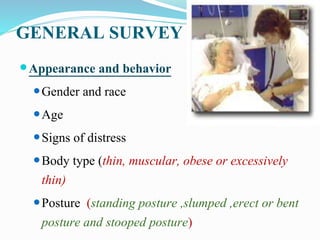
Appearance andbehavior
Gender and race
Age
Signs of distress
Body type (thin, muscular, obese or excessively
thin)
Posture (standing posture ,slumped ,erect or bent
posture and stooped posture)
4.
Gait
Bodymovements
Hygiene and grooming
Dress
Body odor
Affect and mood
Speech
Client abuse
Substance abuse
Guidelines
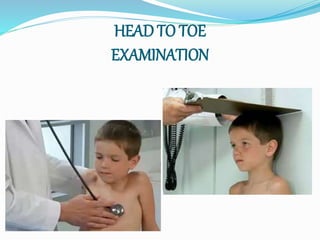
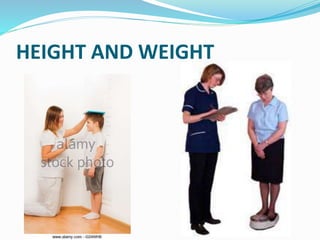
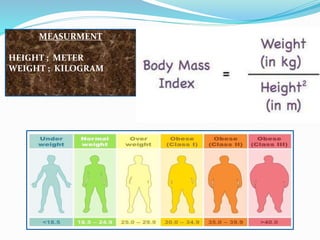
Height
Client should removethe shoe and stand erect with
heels together, and the heels ,buttocks and back of the
head against the measuring stick ; eye should be looking
straight ahead.
The nurse raises the L-shaped sliding arm on the weight
scale until it rests on top of the client’s head ,or places a
small flat object such as a ruler or book on the client’s
head . The edge of the flat object should about the
measuring guide.
15.
Weight ;
Weight usually measured when a client is admitted to
health agency and often regularly
Use the same scale each time and at same time each day
(accuracy)
Make sure the client has on a similar kind of clothing
and no footwear.
Procedure : the client stands on a platform ,and the
weight is read from a digital display panel or a balancing
arm.
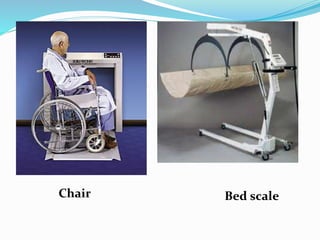
Client who cannot stand are weighted on chair or bed
scales .
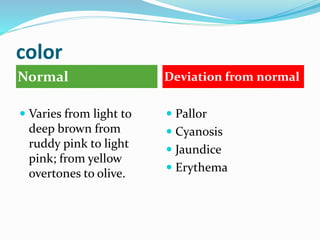
color
Normal Deviation fromnormal
Varies from light to
deep brown from
ruddy pink to light
pink; from yellow
overtones to olive.
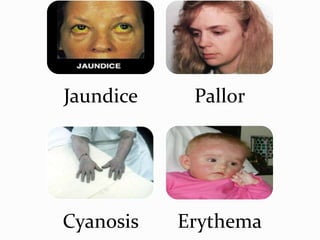
Pallor
Cyanosis
Jaundice
Erythema
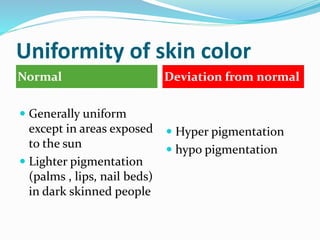
Uniformity of skincolor
Normal Deviation from normal
Generally uniform
except in areas exposed
to the sun
Lighter pigmentation
(palms , lips, nail beds)
in dark skinned people
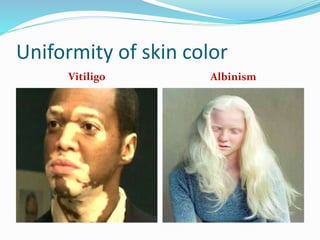
Hyper pigmentation
hypo pigmentation
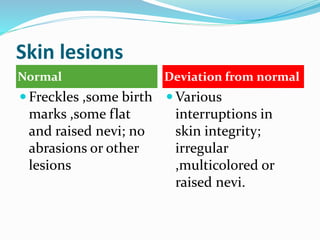
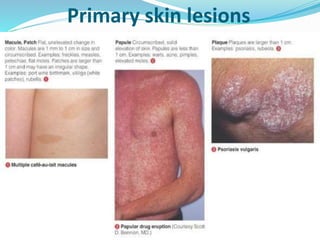
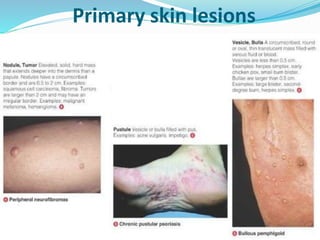
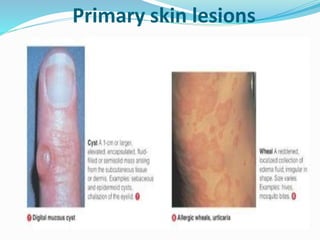
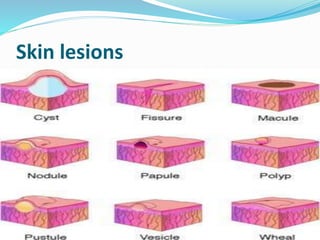
Skin lesions
Normal Deviationfrom normal
Freckles ,some birth
marks ,some flat
and raised nevi; no
abrasions or other
lesions
Various
interruptions in
skin integrity;
irregular
,multicolored or
raised nevi.
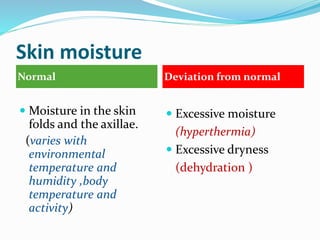
Skin moisture
Normal Deviationfrom normal
Moisture in the skin
folds and the axillae.
(varies with
environmental
temperature and
humidity ,body
temperature and
activity)
Excessive moisture
(hyperthermia)
Excessive dryness
(dehydration )
32.
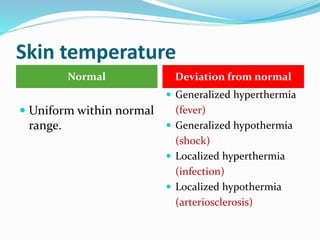
Skin temperature
Normal Deviationfrom normal
Uniform within normal
range.
Generalized hyperthermia
(fever)
Generalized hypothermia
(shock)
Localized hyperthermia
(infection)
Localized hypothermia
(arteriosclerosis)
33.
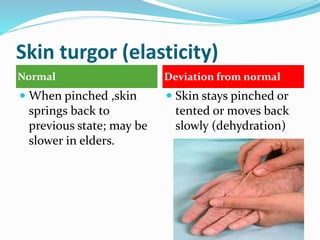
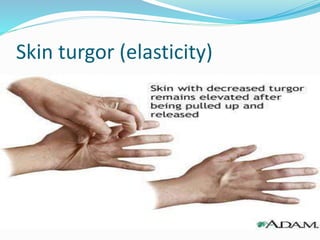
Skin turgor (elasticity)
NormalDeviation from normal
When pinched ,skin
springs back to
previous state; may be
slower in elders.
Skin stays pinched or
tented or moves back
slowly (dehydration)
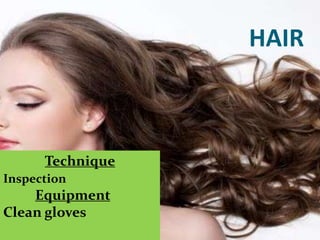
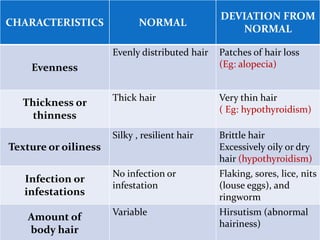
CHARACTERISTICS NORMAL
DEVIATION FROM
NORMAL
Evenness
Evenlydistributed hair Patches of hair loss
(Eg: alopecia)
Thickness or
thinness
Thick hair Very thin hair
( Eg: hypothyroidism)
Texture or oiliness
Silky , resilient hair Brittle hair
Excessively oily or dry
hair (hypothyroidism)
Infection or
infestations
No infection or
infestation
Flaking, sores, lice, nits
(louse eggs), and
ringworm
Amount of
body hair
Variable Hirsutism (abnormal
hairiness)
CHRACTERISTICS NORMAL
DEVIATION FROM
NORMAL
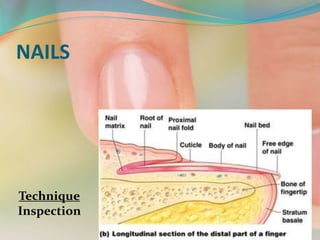
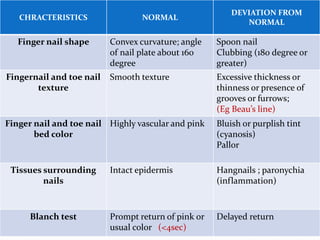
Fingernail shape Convex curvature; angle
of nail plate about 160
degree
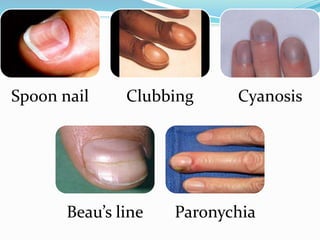
Spoon nail
Clubbing (180 degree or
greater)
Fingernail and toe nail
texture
Smooth texture Excessive thickness or
thinness or presence of
grooves or furrows;
(Eg Beau’s line)
Finger nail and toe nail
bed color
Highly vascular and pink Bluish or purplish tint
(cyanosis)
Pallor
Tissues surrounding
nails
Intact epidermis Hangnails ; paronychia
(inflammation)
Blanch test Prompt return of pink or
usual color (<4sec)
Delayed return
39.
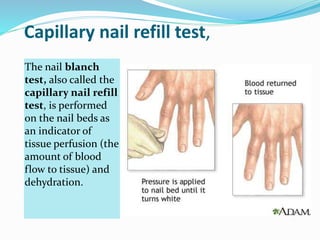
Capillary nail refilltest,
The nail blanch
test, also called the
capillary nail refill
test, is performed
on the nail beds as
an indicator of
tissue perfusion (the
amount of blood
flow to tissue) and
dehydration.



![CTEV [ clubfoot] DR ARUN LAL ,DR MOHAMED ASHRAF travancore medical college k...](https://cdn.slidesharecdn.com/ss_thumbnails/ctevclubfootdrarunlaldrmohamedashraftravancoremedicalcollegekollamkeralaindia-260208063247-18fc466c-thumbnail.jpg?width=640&height=640&fit=bounds)


