Amity School of Engineering & Technology
B.Tech CSE-603
Topic :
IoT-An Architectural
Overview (Arch & Design)
Amity School of Engineering & Technology
Contents
2
<SELO:
1,9>
<Reference No.: 1>
• Building An Architecture,
• Design Principles
• An Iot Architecture Outline,
Amity School of Engineering & Technology
BUILDING AN ARCHITECTURE
3
<SELO:
1,9>
<Reference No.: 1>
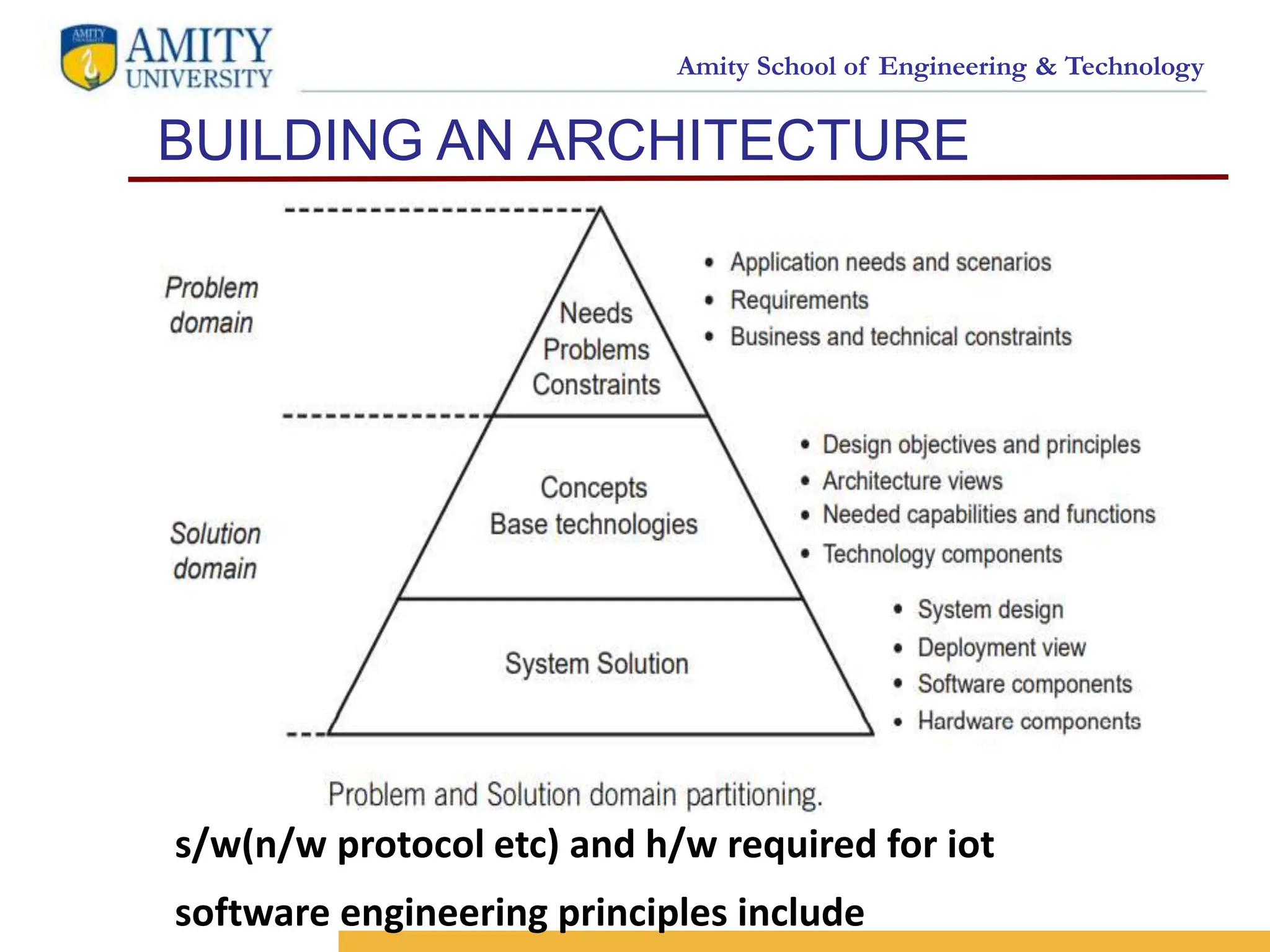
1. When creating a model for the reference architecture,
2. one needs to establish overall objectives for the
architecture as well as design principles that come
from understanding some of the desired major
features of the resulting system solution.
3. Problem to solution
4. The problem domain establishes the foundation for
the subsequent solutions.
Amity School of Engineering & Technology
BUILDING AN ARCHITECTURE
4
<SELO:
1,9>
<Reference No.: 1>
s/w(n/w protocol etc) and h/w required for iot
software engineering principles include
Amity School of Engineering & Technology
DESIGN PRINCIPLES
5
<SELO:
1,9>
<Reference No.: 1>
Main design principles and needed capabilities (design
objective and principles) main desired characteristics of an
M2M or IoT solution
The overall design objective of IoT architecture shall be to
target a horizontal system of real-world services that are
open, service-oriented, secure, and offer trust.
Amity School of Engineering & Technology
DESIGN PRINCIPLES
6
<SELO:
1,9>
<Reference No.: 1>
1. Design for reuse of deployed IoT resources across application
domains.
2. Design for a set of support services that provide open service-
oriented capabilities and can be used for application
development and execution.
• To access iot resources
• How to publish and discover resources,
• Tools for modeling contextual information
• Information related to the real world entities
• Capabilities that provide different levels of abstracted and
complex service
• Data filtering and analytics
• Apis & SDK
Amity School of Engineering & Technology
DESIGN PRINCIPLES
7
<SELO:
1,9>
<Reference No.: 1>
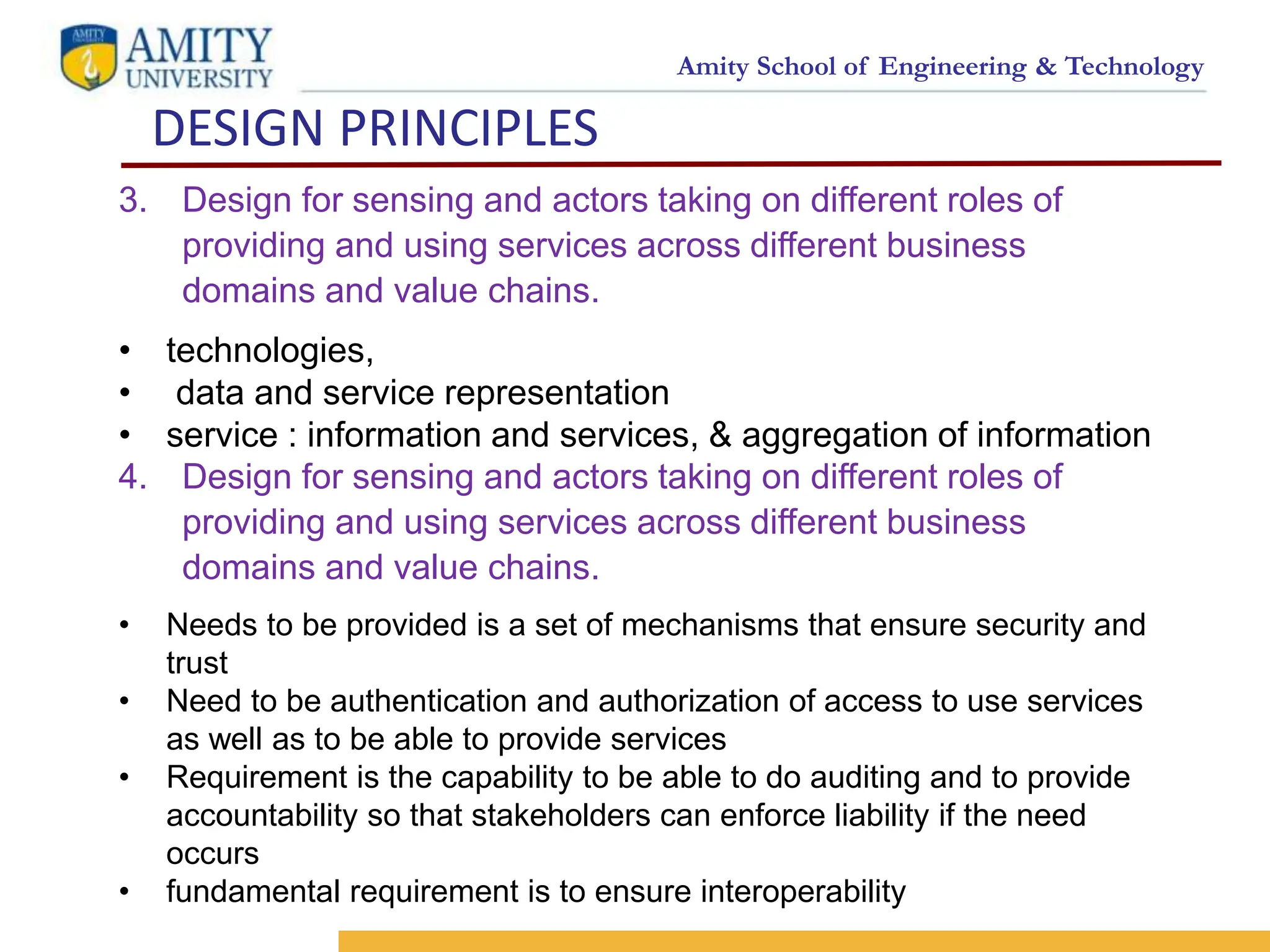
3. Design for sensing and actors taking on different roles of
providing and using services across different business
domains and value chains.
• technologies,
• data and service representation
• service : information and services, & aggregation of information
4. Design for sensing and actors taking on different roles of
providing and using services across different business
domains and value chains.
• Needs to be provided is a set of mechanisms that ensure security and
trust
• Need to be authentication and authorization of access to use services
as well as to be able to provide services
• Requirement is the capability to be able to do auditing and to provide
accountability so that stakeholders can enforce liability if the need
occurs
• fundamental requirement is to ensure interoperability
Amity School of Engineering & Technology
DESIGN PRINCIPLES
8
<SELO:
1,9>
<Reference No.: 1>
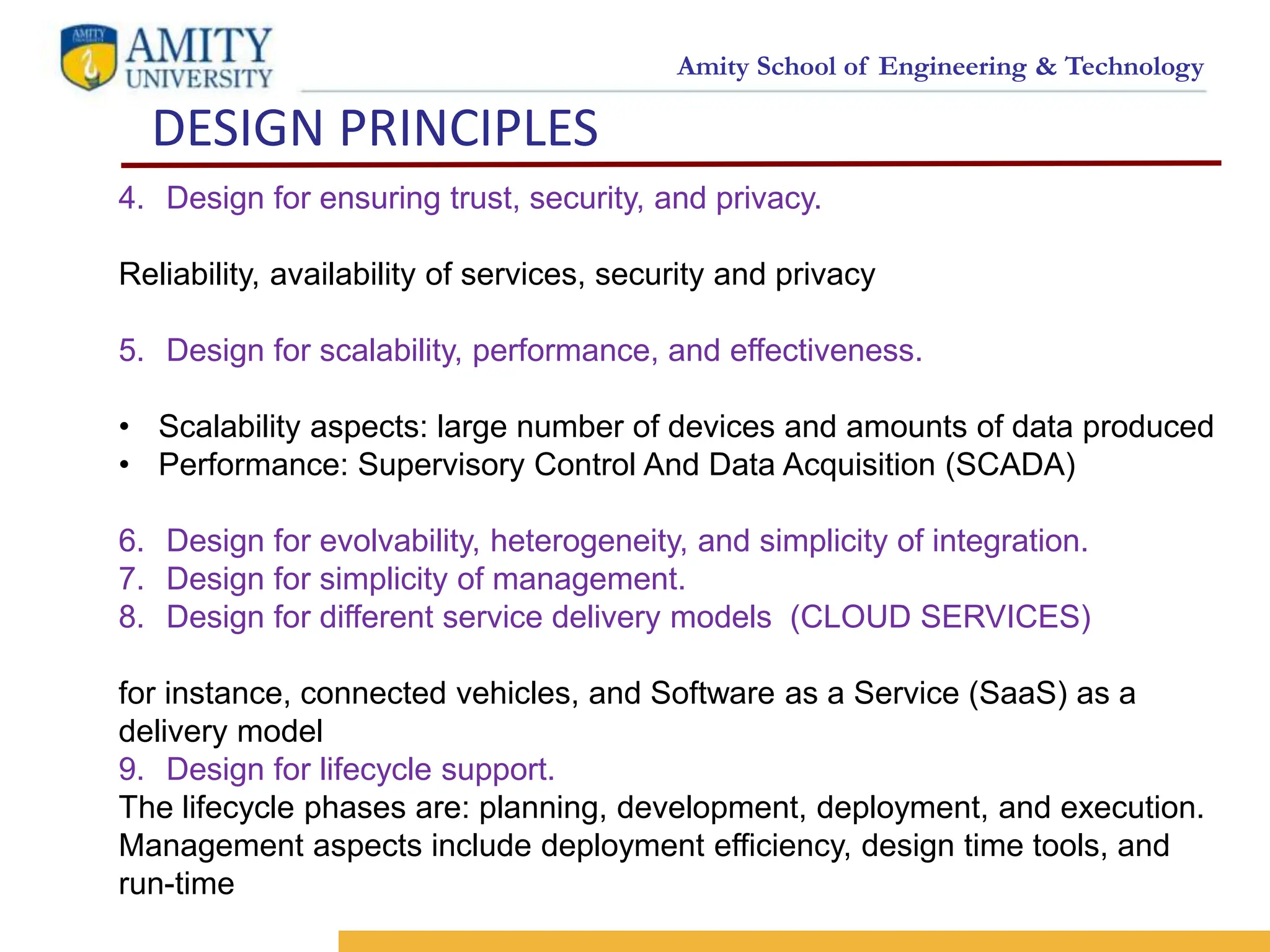
4. Design for ensuring trust, security, and privacy.
Reliability, availability of services, security and privacy
5. Design for scalability, performance, and effectiveness.
• Scalability aspects: large number of devices and amounts of data produced
• Performance: Supervisory Control And Data Acquisition (SCADA)
6. Design for evolvability, heterogeneity, and simplicity of integration.
7. Design for simplicity of management.
8. Design for different service delivery models (CLOUD SERVICES)
for instance, connected vehicles, and Software as a Service (SaaS) as a
delivery model
9. Design for lifecycle support.
The lifecycle phases are: planning, development, deployment, and execution.
Management aspects include deployment efficiency, design time tools, and
run-time
Amity School of Engineering & Technology
An IoT architecture outline
9
<SELO:
1,9>
<Reference No.: 1>
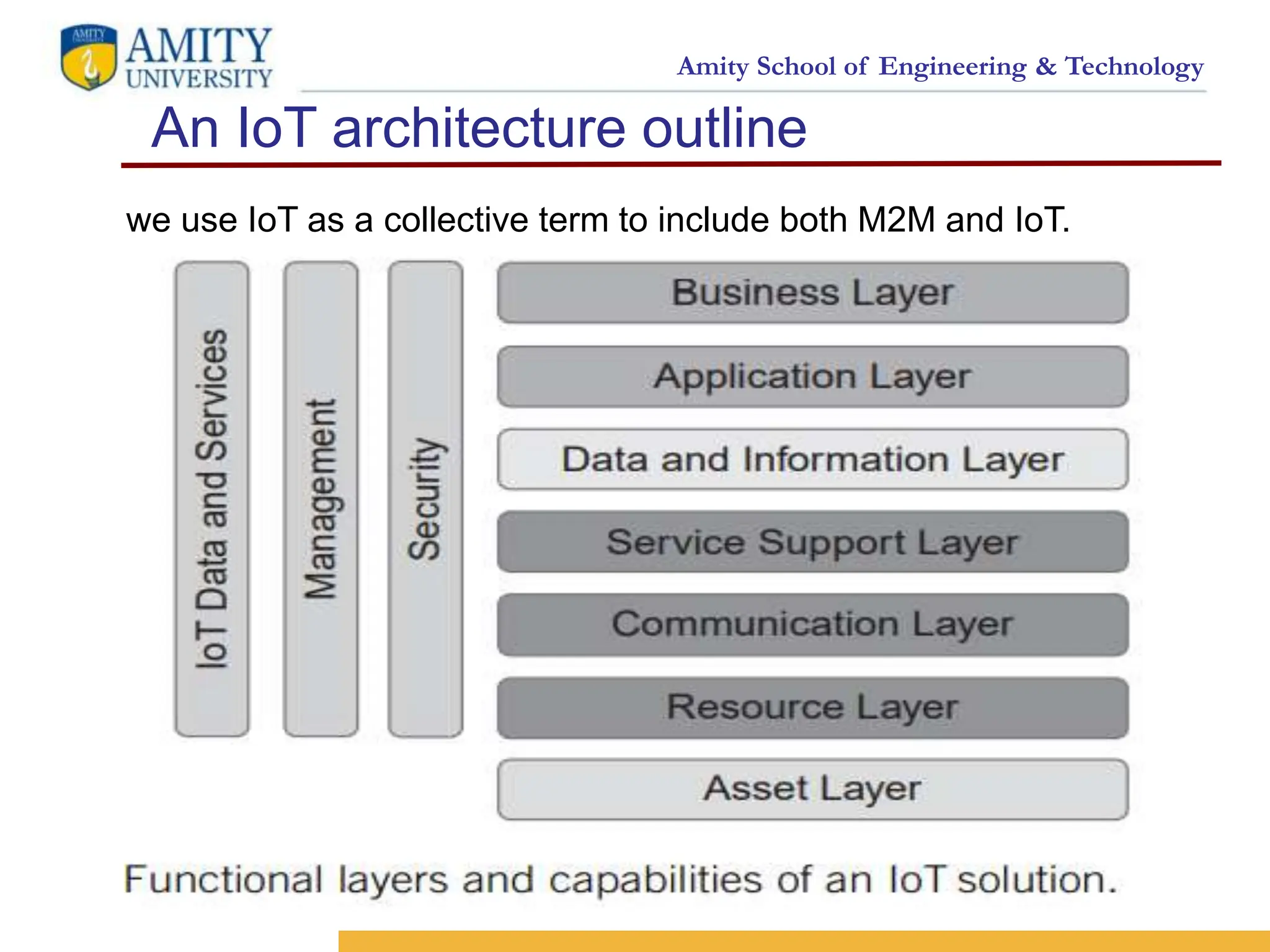
we use IoT as a collective term to include both M2M and IoT.
Amity School of Engineering & Technology
An IoT architecture outline
10
<SELO:
1,9>
<Reference No.: 1>
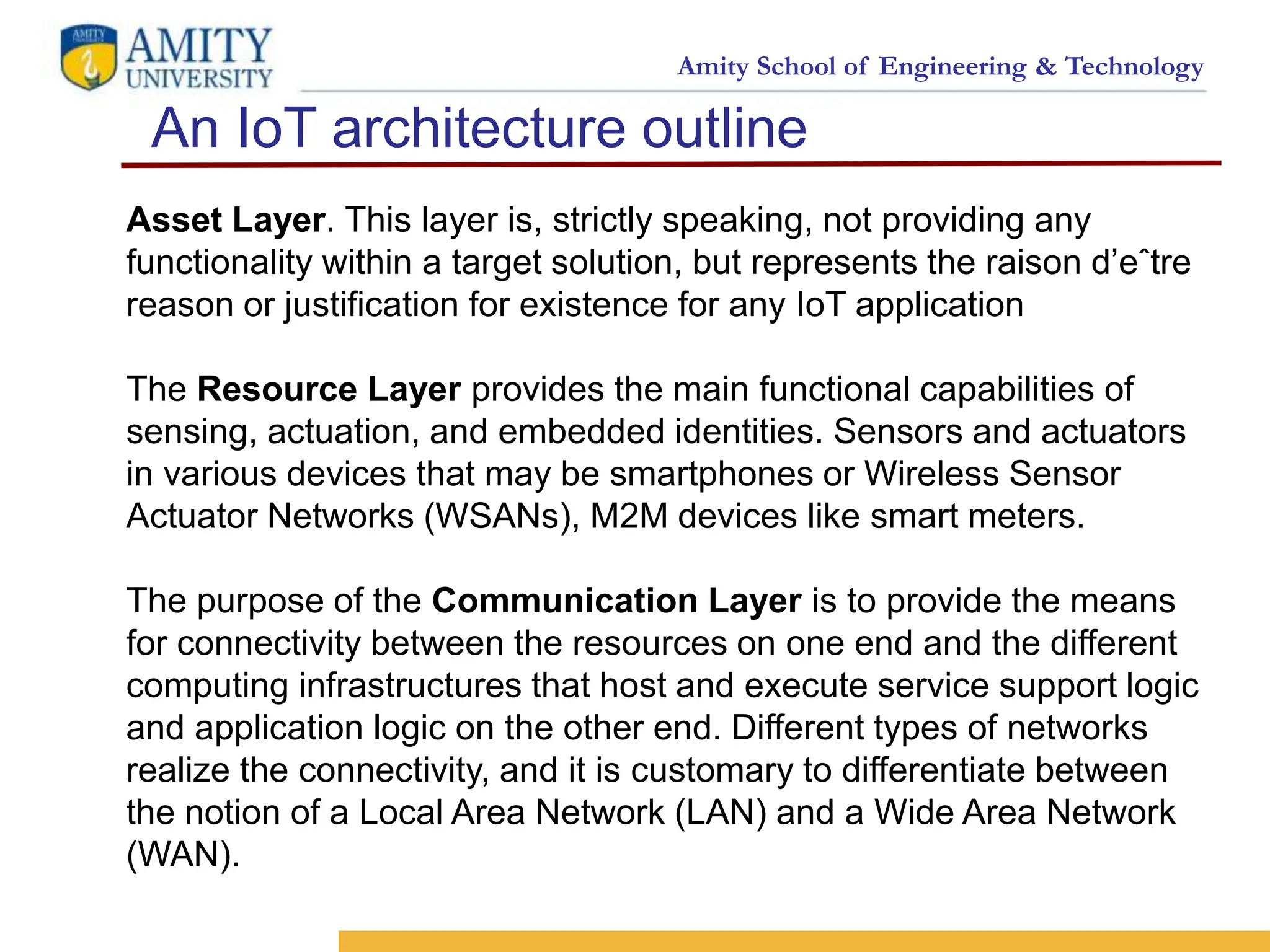
Asset Layer. This layer is, strictly speaking, not providing any
functionality within a target solution, but represents the raison d’eˆtre
reason or justification for existence for any IoT application
The Resource Layer provides the main functional capabilities of
sensing, actuation, and embedded identities. Sensors and actuators
in various devices that may be smartphones or Wireless Sensor
Actuator Networks (WSANs), M2M devices like smart meters.
The purpose of the Communication Layer is to provide the means
for connectivity between the resources on one end and the different
computing infrastructures that host and execute service support logic
and application logic on the other end. Different types of networks
realize the connectivity, and it is customary to differentiate between
the notion of a Local Area Network (LAN) and a Wide Area Network
(WAN).
Amity School of Engineering & Technology
An IoT architecture outline
11
<SELO:
1,9>
<Reference No.: 1>
IoT applications benefit from simplification by relying on support
services that perform common and routine tasks. These support
services are provided by the Service Support Layer and are typically
executing in data centers or server farms inside organizations or in a
cloud environment.
Where the Resource, Communication, and Service Support layers
have concrete realizations in terms of devices and tags, networks and
network nodes, and computer servers,
the Data and Information Layer provided set of functions that
capture knowledge and provide advanced control logic support.
Key concepts here include data and information models and
knowledge representation in general, and the focus is on the
organization of information.
Knowledge Management Framework (KMF) as a collective term to
include data, information, domain-specific knowledge, actionable
services descriptions
Amity School of Engineering & Technology
An IoT architecture outline
12
<SELO:
1,9>
<Reference No.: 1>
The Application Layer in turn provides the specific IoT applications:
Smart Grid, vehicle tracking, building automation, or participatory
sensing (PS)
The final layer in our architecture outline is the Business Layer,
which focuses on supporting the core business or operations of any
enterprise, organization, or individual that is interested in IoT
applications.
Customer Relationship Management (CRM), Enterprise Resource
Planning (ERP), or other Business Support Systems (BSS).
In addition to the functional layers, three functional groups cross the
different layers, namely Management, Security, and IoT Data and
Services.
Amity School of Engineering & Technology
An IoT architecture outline
13
<SELO:
1,9>
<Reference No.: 1>
Management, related to system solution related to its operation,
maintenance, administration, and provisioning.
This includes management of devices, communications networks, and
the general Information Technology (IT) infrastructure as well as
configuration and provisioning data, performance of services
delivered, etc.
Security is about protection of the system, its information and
services, from external threats or any other harm.
Security measures are usually required across all layers, for instance,
providing communication security and information security.
Amity School of Engineering & Technology
An IoT architecture outline
14
<SELO:
1,9>
<Reference No.: 1>
Data and Service processing can,
Basic event filtering and simpler aggregation,
such as data averaging, can take place in individual sensor nodes in
WSANs, contextual metadata such as location and temporal
information can be added to sensor readings, and further aggregation
can take place higher up in the network topology.
More advanced processing is, for instance, data mining and data
analytics that can be done in near real-time.
This functional group thus represents the vertical flow of data into
knowledge,
Amity School of Engineering & Technology
Connected World With IOT
15
<SELO:
1,9>
<Reference No.: 1>
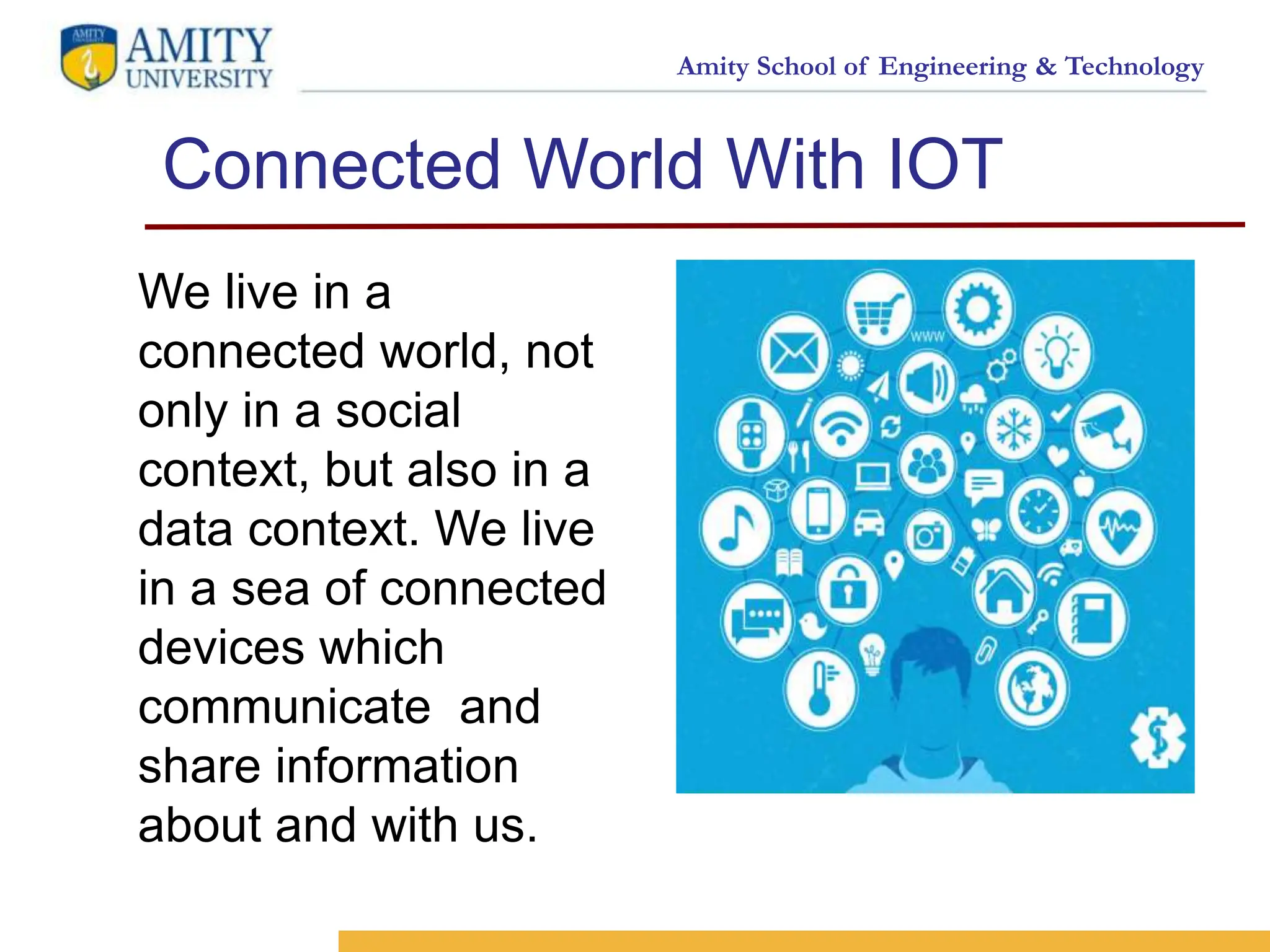
We live in a
connected world, not
only in a social
context, but also in a
data context. We live
in a sea of connected
devices which
communicate and
share information
about and with us.
Amity School of Engineering & Technology
Text and Reference Books
16
<SELO:
1,9>
<Reference No.: 1>
Text:
• Jan Holler, VlasiosTsiatsis, Catherine Mulligan, Stefan Avesand,
StamatisKarnouskos, David Boyle, “From Machine-to-Machine to the
Internet of Things: Introduction to a New Age of Intelligence”, 1 st
Edition, Academic Press, 2014.
Reference Books:
• Vijay Madisetti and ArshdeepBahga, “Internet of Things (A Hands-on-
Approach)”, 1 stEdition, VPT, 2014.
• Francis daCosta, “Rethinking the Internet of Things: A Scalable
Approach to Connecting Everything”, 1 st Edition, Apress Publications,
2013
Amity School of Engineering & Technology
Thank You

Physical Design, Logical Design – IoT Enabling Technologies

  • 1.
    Amity School ofEngineering & Technology B.Tech CSE-603 Topic : IoT-An Architectural Overview (Arch & Design)
  • 2.
    Amity School ofEngineering & Technology Contents 2 <SELO: 1,9> <Reference No.: 1> • Building An Architecture, • Design Principles • An Iot Architecture Outline,
  • 3.
    Amity School ofEngineering & Technology BUILDING AN ARCHITECTURE 3 <SELO: 1,9> <Reference No.: 1> 1. When creating a model for the reference architecture, 2. one needs to establish overall objectives for the architecture as well as design principles that come from understanding some of the desired major features of the resulting system solution. 3. Problem to solution 4. The problem domain establishes the foundation for the subsequent solutions.
  • 4.
    Amity School ofEngineering & Technology BUILDING AN ARCHITECTURE 4 <SELO: 1,9> <Reference No.: 1> s/w(n/w protocol etc) and h/w required for iot software engineering principles include
  • 5.
    Amity School ofEngineering & Technology DESIGN PRINCIPLES 5 <SELO: 1,9> <Reference No.: 1> Main design principles and needed capabilities (design objective and principles) main desired characteristics of an M2M or IoT solution The overall design objective of IoT architecture shall be to target a horizontal system of real-world services that are open, service-oriented, secure, and offer trust.
  • 6.
    Amity School ofEngineering & Technology DESIGN PRINCIPLES 6 <SELO: 1,9> <Reference No.: 1> 1. Design for reuse of deployed IoT resources across application domains. 2. Design for a set of support services that provide open service- oriented capabilities and can be used for application development and execution. • To access iot resources • How to publish and discover resources, • Tools for modeling contextual information • Information related to the real world entities • Capabilities that provide different levels of abstracted and complex service • Data filtering and analytics • Apis & SDK
  • 7.
    Amity School ofEngineering & Technology DESIGN PRINCIPLES 7 <SELO: 1,9> <Reference No.: 1> 3. Design for sensing and actors taking on different roles of providing and using services across different business domains and value chains. • technologies, • data and service representation • service : information and services, & aggregation of information 4. Design for sensing and actors taking on different roles of providing and using services across different business domains and value chains. • Needs to be provided is a set of mechanisms that ensure security and trust • Need to be authentication and authorization of access to use services as well as to be able to provide services • Requirement is the capability to be able to do auditing and to provide accountability so that stakeholders can enforce liability if the need occurs • fundamental requirement is to ensure interoperability
  • 8.
    Amity School ofEngineering & Technology DESIGN PRINCIPLES 8 <SELO: 1,9> <Reference No.: 1> 4. Design for ensuring trust, security, and privacy. Reliability, availability of services, security and privacy 5. Design for scalability, performance, and effectiveness. • Scalability aspects: large number of devices and amounts of data produced • Performance: Supervisory Control And Data Acquisition (SCADA) 6. Design for evolvability, heterogeneity, and simplicity of integration. 7. Design for simplicity of management. 8. Design for different service delivery models (CLOUD SERVICES) for instance, connected vehicles, and Software as a Service (SaaS) as a delivery model 9. Design for lifecycle support. The lifecycle phases are: planning, development, deployment, and execution. Management aspects include deployment efficiency, design time tools, and run-time
  • 9.
    Amity School ofEngineering & Technology An IoT architecture outline 9 <SELO: 1,9> <Reference No.: 1> we use IoT as a collective term to include both M2M and IoT.
  • 10.
    Amity School ofEngineering & Technology An IoT architecture outline 10 <SELO: 1,9> <Reference No.: 1> Asset Layer. This layer is, strictly speaking, not providing any functionality within a target solution, but represents the raison d’eˆtre reason or justification for existence for any IoT application The Resource Layer provides the main functional capabilities of sensing, actuation, and embedded identities. Sensors and actuators in various devices that may be smartphones or Wireless Sensor Actuator Networks (WSANs), M2M devices like smart meters. The purpose of the Communication Layer is to provide the means for connectivity between the resources on one end and the different computing infrastructures that host and execute service support logic and application logic on the other end. Different types of networks realize the connectivity, and it is customary to differentiate between the notion of a Local Area Network (LAN) and a Wide Area Network (WAN).
  • 11.
    Amity School ofEngineering & Technology An IoT architecture outline 11 <SELO: 1,9> <Reference No.: 1> IoT applications benefit from simplification by relying on support services that perform common and routine tasks. These support services are provided by the Service Support Layer and are typically executing in data centers or server farms inside organizations or in a cloud environment. Where the Resource, Communication, and Service Support layers have concrete realizations in terms of devices and tags, networks and network nodes, and computer servers, the Data and Information Layer provided set of functions that capture knowledge and provide advanced control logic support. Key concepts here include data and information models and knowledge representation in general, and the focus is on the organization of information. Knowledge Management Framework (KMF) as a collective term to include data, information, domain-specific knowledge, actionable services descriptions
  • 12.
    Amity School ofEngineering & Technology An IoT architecture outline 12 <SELO: 1,9> <Reference No.: 1> The Application Layer in turn provides the specific IoT applications: Smart Grid, vehicle tracking, building automation, or participatory sensing (PS) The final layer in our architecture outline is the Business Layer, which focuses on supporting the core business or operations of any enterprise, organization, or individual that is interested in IoT applications. Customer Relationship Management (CRM), Enterprise Resource Planning (ERP), or other Business Support Systems (BSS). In addition to the functional layers, three functional groups cross the different layers, namely Management, Security, and IoT Data and Services.
  • 13.
    Amity School ofEngineering & Technology An IoT architecture outline 13 <SELO: 1,9> <Reference No.: 1> Management, related to system solution related to its operation, maintenance, administration, and provisioning. This includes management of devices, communications networks, and the general Information Technology (IT) infrastructure as well as configuration and provisioning data, performance of services delivered, etc. Security is about protection of the system, its information and services, from external threats or any other harm. Security measures are usually required across all layers, for instance, providing communication security and information security.
  • 14.
    Amity School ofEngineering & Technology An IoT architecture outline 14 <SELO: 1,9> <Reference No.: 1> Data and Service processing can, Basic event filtering and simpler aggregation, such as data averaging, can take place in individual sensor nodes in WSANs, contextual metadata such as location and temporal information can be added to sensor readings, and further aggregation can take place higher up in the network topology. More advanced processing is, for instance, data mining and data analytics that can be done in near real-time. This functional group thus represents the vertical flow of data into knowledge,
  • 15.
    Amity School ofEngineering & Technology Connected World With IOT 15 <SELO: 1,9> <Reference No.: 1> We live in a connected world, not only in a social context, but also in a data context. We live in a sea of connected devices which communicate and share information about and with us.
  • 16.
    Amity School ofEngineering & Technology Text and Reference Books 16 <SELO: 1,9> <Reference No.: 1> Text: • Jan Holler, VlasiosTsiatsis, Catherine Mulligan, Stefan Avesand, StamatisKarnouskos, David Boyle, “From Machine-to-Machine to the Internet of Things: Introduction to a New Age of Intelligence”, 1 st Edition, Academic Press, 2014. Reference Books: • Vijay Madisetti and ArshdeepBahga, “Internet of Things (A Hands-on- Approach)”, 1 stEdition, VPT, 2014. • Francis daCosta, “Rethinking the Internet of Things: A Scalable Approach to Connecting Everything”, 1 st Edition, Apress Publications, 2013
  • 17.
    Amity School ofEngineering & Technology Thank You