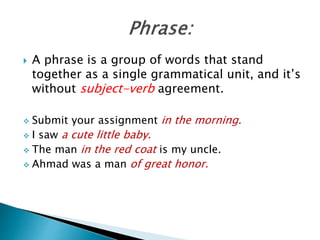
 A phrase is a group of words that stand
together as a single grammatical unit, and it’s
without subject-verb agreement.
 Submit your assignment in the morning.
 I saw a cute little baby.
 The man in the red coat is my uncle.
 Ahmad was a man of great honor.
 My friend from Turkey writes articles about politics.
(Noun Phrase) (verb) (Noun Phrase)
 My friend from Turkey writes articles about politics.
(NP) (adjective phrase) (V) (Noun) (adjective phrase)
 Please pass me the glass on the table.
(Noun Phrase)
 Please pass me the glass on the table.
(noun) (adjective phrase)
 A cheetah can run faster than an Olympic cyclist.
(NP) (VP) (adverb phrase)
 A cheetah can run faster than an Olympic cyclist.
(Noun Phrase)
 The sports car is moving fast.
 A teacher is looking for a fictional book.
 A little boy is studying an English grammar.
 He likes to write sad stories.
 He is searching for a video to make him
smile.
 The class is so calm and quiet.
 The Biryani of this restaurant is extremely
delicious.
 Aasif was a man with courage.
 Sarah is going to market to buy a necklace.
 Tahir ran as fast as possible.
 Players arrived just in time.
 Sarah completes her task with passion.
 Tahir is a teacher with passion.
 A student sat on his chair.
 Wolf jumps in a fast way. (adverb phrase)
 Akbar was a leader with a little patience.
(adjective phrase)
Participle Phrase:
 Arriving at the accident, James discovered
that it was too late.
 Painted a brilliant white, the small room
appeared bigger.
 There she saw her father jogging along the
path.
Gerund Phrase:
 He likes collecting old bottles.
 Running through the woods is a difficult
task.
 Going for an ice-cream is real treat.
Conjunctional Phrase:
 We have to work hard so that we can win the
next match.
Interjectional Phrase:
 What a pleasure! I got the prize.
Appositive Phrase:
 Tahir, an electrical engineer, didn’t agree.
 Her horse, an Arabian, was her pride and joy.
 Thomas Edison, the inventor of the light bulb,
is often called USA’s greatest inventor.
 To communicate a message now
complement modifier
(direct object) (adverb)
 To buy a book tomorrow
complement modifier
(direct object) (adverb)
 To understand the lesson completely
complement modifier
(direct object) (adverb)
(direct object)-
What?
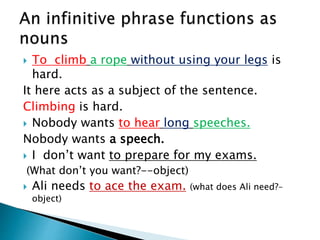
 To climb a rope without using your legs is
hard.
It here acts as a subject of the sentence.
Climbing is hard.
 Nobody wants to hear long speeches.
Nobody wants a speech.
 I don’t want to prepare for my exams.
(What don’t you want?--object)
 Ali needs to ace the exam. (what does Ali need?–
object)
 I want a book to read on philosophy.
I want a philosophy book.
 I wish I had a friend to study with me.
 Here is the marker to write on the board.
(it describes a noun or pronoun)
 I went to Germany to study the language
and culture. (why did you go to Germany?)
 He sat down to listen the speaker. (for what
reason/ purpose he sat down)
 I will return to complete the assignment.
(why will you return? – we get the reason for verb)
 I studied for hours to succeed in exams.
( for what purpose did you study?)

Phrase and its types.pptx

  • 1.
     A phraseis a group of words that stand together as a single grammatical unit, and it’s without subject-verb agreement.  Submit your assignment in the morning.  I saw a cute little baby.  The man in the red coat is my uncle.  Ahmad was a man of great honor.
  • 2.
     My friendfrom Turkey writes articles about politics. (Noun Phrase) (verb) (Noun Phrase)  My friend from Turkey writes articles about politics. (NP) (adjective phrase) (V) (Noun) (adjective phrase)  Please pass me the glass on the table. (Noun Phrase)  Please pass me the glass on the table. (noun) (adjective phrase)  A cheetah can run faster than an Olympic cyclist. (NP) (VP) (adverb phrase)  A cheetah can run faster than an Olympic cyclist. (Noun Phrase)
  • 3.
     The sportscar is moving fast.  A teacher is looking for a fictional book.  A little boy is studying an English grammar.  He likes to write sad stories.
  • 4.
     He issearching for a video to make him smile.  The class is so calm and quiet.  The Biryani of this restaurant is extremely delicious.  Aasif was a man with courage.
  • 5.
     Sarah isgoing to market to buy a necklace.  Tahir ran as fast as possible.  Players arrived just in time.  Sarah completes her task with passion.
  • 6.
     Tahir isa teacher with passion.  A student sat on his chair.  Wolf jumps in a fast way. (adverb phrase)  Akbar was a leader with a little patience. (adjective phrase)
  • 7.
    Participle Phrase:  Arrivingat the accident, James discovered that it was too late.  Painted a brilliant white, the small room appeared bigger.  There she saw her father jogging along the path. Gerund Phrase:  He likes collecting old bottles.  Running through the woods is a difficult task.  Going for an ice-cream is real treat.
  • 8.
    Conjunctional Phrase:  Wehave to work hard so that we can win the next match. Interjectional Phrase:  What a pleasure! I got the prize. Appositive Phrase:  Tahir, an electrical engineer, didn’t agree.  Her horse, an Arabian, was her pride and joy.  Thomas Edison, the inventor of the light bulb, is often called USA’s greatest inventor.
  • 9.
     To communicatea message now complement modifier (direct object) (adverb)  To buy a book tomorrow complement modifier (direct object) (adverb)  To understand the lesson completely complement modifier (direct object) (adverb) (direct object)- What?
  • 11.
     To climba rope without using your legs is hard. It here acts as a subject of the sentence. Climbing is hard.  Nobody wants to hear long speeches. Nobody wants a speech.  I don’t want to prepare for my exams. (What don’t you want?--object)  Ali needs to ace the exam. (what does Ali need?– object)
  • 12.
     I wanta book to read on philosophy. I want a philosophy book.  I wish I had a friend to study with me.  Here is the marker to write on the board. (it describes a noun or pronoun)
  • 13.
     I wentto Germany to study the language and culture. (why did you go to Germany?)  He sat down to listen the speaker. (for what reason/ purpose he sat down)  I will return to complete the assignment. (why will you return? – we get the reason for verb)  I studied for hours to succeed in exams. ( for what purpose did you study?)