Lambda Functions & Closures A Sydney PHP Group Presentation 2 nd  October 2008 By Timothy Chandler
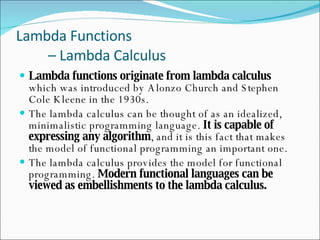
Lambda Functions – Lambda Calculus Lambda functions originate from lambda calculus  which was introduced by Alonzo Church and Stephen Cole Kleene in the 1930s. The lambda calculus can be thought of as an idealized, minimalistic programming language.  It is capable of expressing any algorithm , and it is this fact that makes the model of functional programming an important one. The lambda calculus provides the model for functional programming.  Modern functional languages can be viewed as embellishments to the lambda calculus.
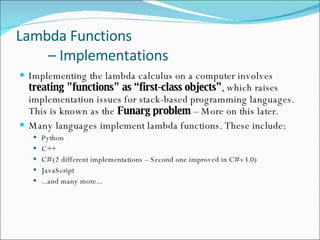
Lambda Functions – Implementations Implementing the lambda calculus on a computer involves  treating "functions" as “first-class objects” , which raises implementation issues for stack-based programming languages. This is known as the  Funarg problem  – More on this later. Many languages implement lambda functions. These include: Python C++ C# (2 different implementations – Second one improved in C# v3.0) JavaScript ...and many more...
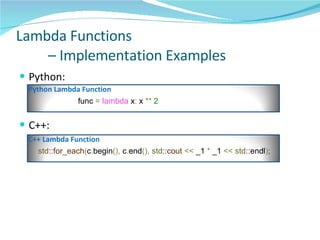
Lambda Functions – Implementation Examples Python: C++: s Python Lambda Function func  =   lambda  x :  x  **   2 s C++ Lambda Function std :: for_each ( c . begin (),  c . end (),   std :: cout   <<  _1  *  _1  <<   std :: endl ) ;
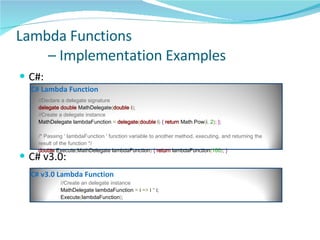
Lambda Functions – Implementation Examples C#: C# v3.0: s C# v3.0 Lambda Function //Create an delegate instance MathDelegate lambdaFunction  =  i  =>  i  *  i ; Execute ( lambdaFunction ) ; s C# Lambda Function //Declare a delegate signature delegate   double  MathDelegate ( double  i ) ; //Create a delegate instance MathDelegate lambdaFunction  =   delegate ( double  i )   {   return  Math . Pow ( i ,   2 ) ;   }; /* Passing ' lambdaFunction ' function variable to another method, executing,   and returning the result of the function   */ double  Execute ( MathDelegate lambdaFunction )   {   return  lambdaFunction ( 100 ) ;   }
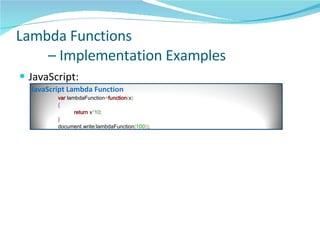
Lambda Functions – Implementation Examples JavaScript: s JavaScript Lambda Function var  lambdaFunction = function ( x )   {   return  x * 10 ; } document.write ( lambdaFunction ( 100 )) ;
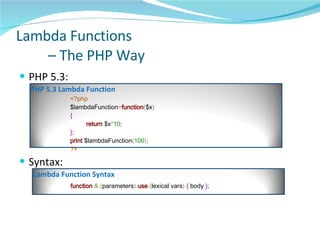
Lambda Functions – The PHP Way PHP 5.3: Syntax: s PHP 5.3 Lambda Function <?php $lambdaFunction = function ( $x )   { return  $x * 10 ; }; print  $lambdaFunction ( 100 ) ; ?>   s Lambda Function Syntax function   &   ( parameters )   use   ( lexical vars )   {  body  };
Lambda Functions – The PHP Way The goal of PHP’s Lambda function implementation is to allow for the creation of quick throw-away functions. Don’t confuse with “create_function()”. These functions compile at “run-time”. These functions  DO NOT  compile at “compile-time”. Optcode caches  CANNOT  cache them. Bad practice.
Closures
Closures – The Funarg Problem Lambda functions  MUST  be first-class objects. Funarg, meaning “functional argument”, is a problem in computer science where a “stack-based programming language” has difficulty implementing functions as “first-class objects”. The problem is when the body of a function refers to a variable from the environment that it was created but not the environment of the function call. Standard Solutions: Forbid such references. Create closures.
Closures – The PHP Funarg Problem Solution PHP  5.3  introduces a new keyword ‘use’. Use this new keyword when creating a lambda function to define what variables to import into the lambda functions scope –  This creates a Closure .
Closures – The “use” Keyword Example: Result: s Lambda Function Closure $config = array ( 'paths' => array ( 'examples' => 'c:/php/projects/examples/' )) ; $fileArray = array ( 'example1.php' , 'example2.php' , 'exampleImage.jpg' ) ; $setExamplesPath = function ( $file )   use ( $config )   { return  $config [ 'paths' ][ 'examples' ]. $file ; }; print_r ( array_map ( $setExamplesPath , $fileArray ) ) ; Array   (   [ 0 ]   =>  c : / php / projects / examples / example1 . php [ 1 ]   =>  c : / php / projects / examples / example2 . php [ 2 ]   =>  c : / php / projects / examples / exampleImage . jpg )
Closures – The “use” Keyword Example: Result: s Lambda Function Closure – As an Anonymous Function $config = array ( 'paths' => array ( 'examples' => 'c:/php/projects/examples/' )) ;   $fileArray = array ( 'example1.php' , 'example2.php' , 'exampleImage.jpg' ) ; print_r ( array_map ( function ( $file )   use ( $config ) { return  $config [ 'paths' ][ 'examples' ]. $file ; } , $fileArray )) ;   Array   (   [ 0 ]   =>  c : / php / projects / examples / example1 . php [ 1 ]   =>  c : / php / projects / examples / example2 . php [ 2 ]   =>  c : / php / projects / examples / exampleImage . jpg )
Closures – “use” as reference or copy Variables passed into the “use” block are copied in by default – This is the expected PHP behaviour. You can cause a variable to be imported by reference the same way you do when defining referenced parameters in function declarations. The PHP  5  pass by reference for objects rule still applies.
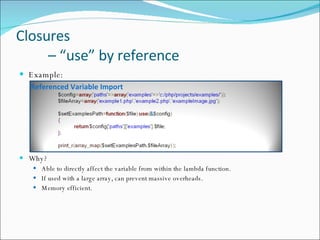
Closures – “use” by reference Example: Why? Able to directly affect the variable from within the lambda function. If used with a large array, can prevent massive overheads. Memory efficient. s Referenced Variable Import
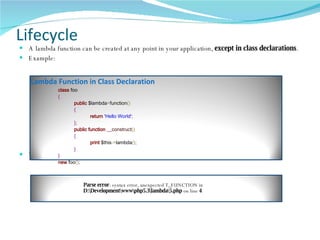
Lifecycle A lambda function can be created at any point in your application,  except in class declarations . Example: Throws Error: s Lambda Function in Class Declaration class  foo { public  $lambda = function () { return   'Hello World' ; }; public   function   __construct () { print  $this -> lambda () ; } } new  foo () ;   Parse error : syntax error, unexpected T_FUNCTION in  D:\Development\www\php5.3\lambda\5.php  on line  4
Lambda functions can live longer than whatever created them. Example: Result: Lifecycle s Lifecycle Example 1 class  foo { public  $lambda = null ; public   function   __construct () { $ this -> lambda = function ()  { return   'Hello World' ;}; } } $foo = new  foo () ; var_dump ( $foo ) ; $lambda = $foo -> lambda ; unset ( $foo ) ; var_dump ( $foo ) ; print  $lambda () ;   object(foo)#1 (1) { [&quot;lambda&quot;]=> object(Closure)#2 (0) { } } NULL Hello World
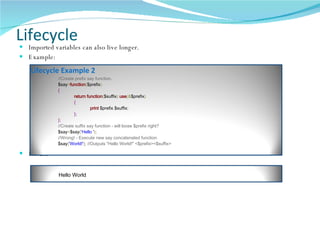
Imported variables can also live longer. Example: Result: Lifecycle s Lifecycle Example 2 //Create prefix say function. $say = function ( $prefix ) { return   function ( $suffix )   use (& $prefix ) { print  $prefix . $suffix ; }; }; //Create suffix say function - will loose $prefix right? $say = $say ( 'Hello ' ) ; //Wrong! - Execute new say concatenated function. $say ( 'World!' ) ;   //Outputs &quot;Hello World!&quot; <$prefix><$suffix>   Hello World
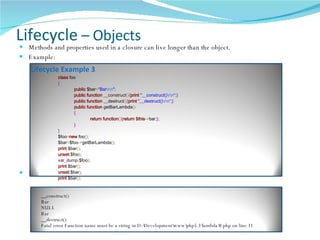
Methods and properties used in a closure can live longer than the object. Example: Result: Lifecycle  – Objects s Lifecycle Example 3 class  foo { public  $bar = &quot;Bar \r\n &quot; ; public   function   __construct () { print   &quot;__construct() \r\n “ ;} public   function  __destruct () { print   &quot;__destruct() \r\n “ ;} public   function  getBarLambda () { return   function () { return  $ this -> bar ;}; } } $foo = new  foo () ; $bar = $foo -> getBarLambda () ; print  $bar () ; unset ( $foo ) ; var_dump ( $foo ) ; print  $bar () ; unset ( $bar ) ; print  $bar () ;   __construct() Bar NULL Bar __destruct() Fatal error Function name must be a string in D:\Development\www\php5.3\lambda\8.php on line 31
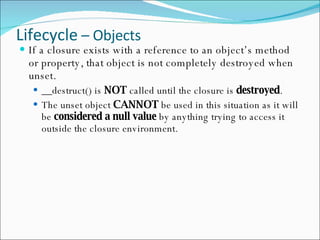
If a closure exists with a reference to an object’s method or property, that object is not completely destroyed when unset. __destruct() is  NOT  called until the closure is  destroyed . The unset object  CANNOT  be used in this situation as it will be  considered a null value  by anything trying to access it outside the closure environment. Lifecycle  – Objects
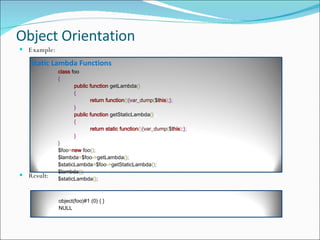
Lambda Functions are Closures because they automatically get bound to the scope of the class that they are created in. $this is not always needed in the scope. Removing $this can save on memory. You can block this behaviour by declaring the Lambda Function as static. Object Orientation
Object Orientation Example: Result: s Static Lambda Functions class  foo { public   function  getLambda () { return   function () { var_dump ( $ this ) ;}; } public   function  getStaticLambda () { return   static   function () { var_dump ( $ this ) ;}; } } $foo = new  foo () ; $lambda = $foo -> getLambda () ; $staticLambda = $foo -> getStaticLambda () ; $lambda () ; $staticLambda () ;   object(foo)#1 (0) { } NULL
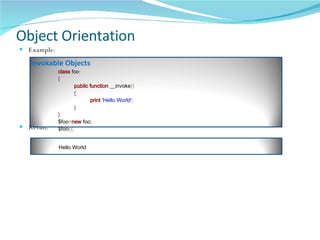
PHP  5.3  introduces a new magic method. Invokable objects are now possible through the use of the __invoke() magic method. Essentially makes the object a closure. Object Orientation
Object Orientation Example: Result: s Invokable Objects class  foo { public   function  __invoke () { print   'Hello World' ; } } $foo = new  foo ; $foo () ; Hello World
Questions?
Thank you. References http://en.wikipedia.org/wiki/Lambda_calculus http://en.wikipedia.org/wiki/Closure_(computer_science) http://en.wikipedia.org/wiki/Funarg_problem http://wiki.php.net/rfc/closures

PHP 5.3 Part 2 - Lambda Functions & Closures

  • 1.
    Lambda Functions &Closures A Sydney PHP Group Presentation 2 nd October 2008 By Timothy Chandler
  • 2.
    Lambda Functions –Lambda Calculus Lambda functions originate from lambda calculus which was introduced by Alonzo Church and Stephen Cole Kleene in the 1930s. The lambda calculus can be thought of as an idealized, minimalistic programming language. It is capable of expressing any algorithm , and it is this fact that makes the model of functional programming an important one. The lambda calculus provides the model for functional programming. Modern functional languages can be viewed as embellishments to the lambda calculus.
  • 3.
    Lambda Functions –Implementations Implementing the lambda calculus on a computer involves treating &quot;functions&quot; as “first-class objects” , which raises implementation issues for stack-based programming languages. This is known as the Funarg problem – More on this later. Many languages implement lambda functions. These include: Python C++ C# (2 different implementations – Second one improved in C# v3.0) JavaScript ...and many more...
  • 4.
    Lambda Functions –Implementation Examples Python: C++: s Python Lambda Function func = lambda x : x ** 2 s C++ Lambda Function std :: for_each ( c . begin (), c . end (), std :: cout << _1 * _1 << std :: endl ) ;
  • 5.
    Lambda Functions –Implementation Examples C#: C# v3.0: s C# v3.0 Lambda Function //Create an delegate instance MathDelegate lambdaFunction = i => i * i ; Execute ( lambdaFunction ) ; s C# Lambda Function //Declare a delegate signature delegate double MathDelegate ( double i ) ; //Create a delegate instance MathDelegate lambdaFunction = delegate ( double i ) { return Math . Pow ( i , 2 ) ; }; /* Passing ' lambdaFunction ' function variable to another method, executing, and returning the result of the function */ double Execute ( MathDelegate lambdaFunction ) { return lambdaFunction ( 100 ) ; }
  • 6.
    Lambda Functions –Implementation Examples JavaScript: s JavaScript Lambda Function var lambdaFunction = function ( x ) { return x * 10 ; } document.write ( lambdaFunction ( 100 )) ;
  • 7.
    Lambda Functions –The PHP Way PHP 5.3: Syntax: s PHP 5.3 Lambda Function <?php $lambdaFunction = function ( $x ) { return $x * 10 ; }; print $lambdaFunction ( 100 ) ; ?> s Lambda Function Syntax function & ( parameters ) use ( lexical vars ) { body };
  • 8.
    Lambda Functions –The PHP Way The goal of PHP’s Lambda function implementation is to allow for the creation of quick throw-away functions. Don’t confuse with “create_function()”. These functions compile at “run-time”. These functions DO NOT compile at “compile-time”. Optcode caches CANNOT cache them. Bad practice.
  • 9.
  • 10.
    Closures – TheFunarg Problem Lambda functions MUST be first-class objects. Funarg, meaning “functional argument”, is a problem in computer science where a “stack-based programming language” has difficulty implementing functions as “first-class objects”. The problem is when the body of a function refers to a variable from the environment that it was created but not the environment of the function call. Standard Solutions: Forbid such references. Create closures.
  • 11.
    Closures – ThePHP Funarg Problem Solution PHP 5.3 introduces a new keyword ‘use’. Use this new keyword when creating a lambda function to define what variables to import into the lambda functions scope – This creates a Closure .
  • 12.
    Closures – The“use” Keyword Example: Result: s Lambda Function Closure $config = array ( 'paths' => array ( 'examples' => 'c:/php/projects/examples/' )) ; $fileArray = array ( 'example1.php' , 'example2.php' , 'exampleImage.jpg' ) ; $setExamplesPath = function ( $file ) use ( $config ) { return $config [ 'paths' ][ 'examples' ]. $file ; }; print_r ( array_map ( $setExamplesPath , $fileArray ) ) ; Array ( [ 0 ] => c : / php / projects / examples / example1 . php [ 1 ] => c : / php / projects / examples / example2 . php [ 2 ] => c : / php / projects / examples / exampleImage . jpg )
  • 13.
    Closures – The“use” Keyword Example: Result: s Lambda Function Closure – As an Anonymous Function $config = array ( 'paths' => array ( 'examples' => 'c:/php/projects/examples/' )) ; $fileArray = array ( 'example1.php' , 'example2.php' , 'exampleImage.jpg' ) ; print_r ( array_map ( function ( $file ) use ( $config ) { return $config [ 'paths' ][ 'examples' ]. $file ; } , $fileArray )) ; Array ( [ 0 ] => c : / php / projects / examples / example1 . php [ 1 ] => c : / php / projects / examples / example2 . php [ 2 ] => c : / php / projects / examples / exampleImage . jpg )
  • 14.
    Closures – “use”as reference or copy Variables passed into the “use” block are copied in by default – This is the expected PHP behaviour. You can cause a variable to be imported by reference the same way you do when defining referenced parameters in function declarations. The PHP 5 pass by reference for objects rule still applies.
  • 15.
    Closures – “use”by reference Example: Why? Able to directly affect the variable from within the lambda function. If used with a large array, can prevent massive overheads. Memory efficient. s Referenced Variable Import
  • 16.
    Lifecycle A lambdafunction can be created at any point in your application, except in class declarations . Example: Throws Error: s Lambda Function in Class Declaration class foo { public $lambda = function () { return 'Hello World' ; }; public function __construct () { print $this -> lambda () ; } } new foo () ; Parse error : syntax error, unexpected T_FUNCTION in D:\Development\www\php5.3\lambda\5.php on line 4
  • 17.
    Lambda functions canlive longer than whatever created them. Example: Result: Lifecycle s Lifecycle Example 1 class foo { public $lambda = null ; public function __construct () { $ this -> lambda = function () { return 'Hello World' ;}; } } $foo = new foo () ; var_dump ( $foo ) ; $lambda = $foo -> lambda ; unset ( $foo ) ; var_dump ( $foo ) ; print $lambda () ; object(foo)#1 (1) { [&quot;lambda&quot;]=> object(Closure)#2 (0) { } } NULL Hello World
  • 18.
    Imported variables canalso live longer. Example: Result: Lifecycle s Lifecycle Example 2 //Create prefix say function. $say = function ( $prefix ) { return function ( $suffix ) use (& $prefix ) { print $prefix . $suffix ; }; }; //Create suffix say function - will loose $prefix right? $say = $say ( 'Hello ' ) ; //Wrong! - Execute new say concatenated function. $say ( 'World!' ) ; //Outputs &quot;Hello World!&quot; <$prefix><$suffix> Hello World
  • 19.
    Methods and propertiesused in a closure can live longer than the object. Example: Result: Lifecycle – Objects s Lifecycle Example 3 class foo { public $bar = &quot;Bar \r\n &quot; ; public function __construct () { print &quot;__construct() \r\n “ ;} public function __destruct () { print &quot;__destruct() \r\n “ ;} public function getBarLambda () { return function () { return $ this -> bar ;}; } } $foo = new foo () ; $bar = $foo -> getBarLambda () ; print $bar () ; unset ( $foo ) ; var_dump ( $foo ) ; print $bar () ; unset ( $bar ) ; print $bar () ; __construct() Bar NULL Bar __destruct() Fatal error Function name must be a string in D:\Development\www\php5.3\lambda\8.php on line 31
  • 20.
    If a closureexists with a reference to an object’s method or property, that object is not completely destroyed when unset. __destruct() is NOT called until the closure is destroyed . The unset object CANNOT be used in this situation as it will be considered a null value by anything trying to access it outside the closure environment. Lifecycle – Objects
  • 21.
    Lambda Functions areClosures because they automatically get bound to the scope of the class that they are created in. $this is not always needed in the scope. Removing $this can save on memory. You can block this behaviour by declaring the Lambda Function as static. Object Orientation
  • 22.
    Object Orientation Example:Result: s Static Lambda Functions class foo { public function getLambda () { return function () { var_dump ( $ this ) ;}; } public function getStaticLambda () { return static function () { var_dump ( $ this ) ;}; } } $foo = new foo () ; $lambda = $foo -> getLambda () ; $staticLambda = $foo -> getStaticLambda () ; $lambda () ; $staticLambda () ; object(foo)#1 (0) { } NULL
  • 23.
    PHP 5.3 introduces a new magic method. Invokable objects are now possible through the use of the __invoke() magic method. Essentially makes the object a closure. Object Orientation
  • 24.
    Object Orientation Example:Result: s Invokable Objects class foo { public function __invoke () { print 'Hello World' ; } } $foo = new foo ; $foo () ; Hello World
  • 25.
  • 26.
    Thank you. Referenceshttp://en.wikipedia.org/wiki/Lambda_calculus http://en.wikipedia.org/wiki/Closure_(computer_science) http://en.wikipedia.org/wiki/Funarg_problem http://wiki.php.net/rfc/closures

Editor's Notes