Introducing PHP Latest Updates
Presenter
Iftekhar Ahmed Eather
Software Engineer
Divine IT Limited
Source
php.net, slideshare.com, wiki, google, git document and others

1
Topics
• PHP 5.3
• PHP 5.4
• PHP 5.5
• PSR
• FlexiGrid

2
PHP 5.3
Released Date 30-Jun-2009

3
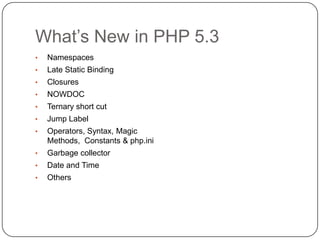
What‟s New in PHP 5.3
•
•

Late Static Binding

•

Closures

•

NOWDOC

•

Ternary short cut

•

Jump Label

•

Operators, Syntax, Magic
Methods, Constants & php.ini

•

Garbage collector

•

Date and Time

•

4

Namespaces

Others
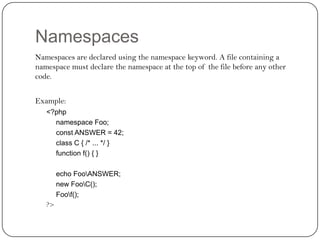
Namespaces
Namespaces are declared using the namespace keyword. A file containing a
namespace must declare the namespace at the top of the file before any other
code.
Example:
<?php
namespace Foo;
const ANSWER = 42;
class C { /* ... */ }
function f() { }
echo FooANSWER;
new FooC();
Foof();
?>
5
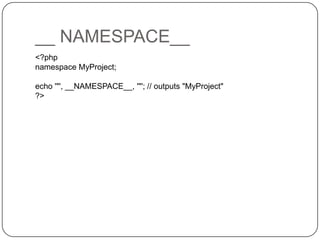
__ NAMESPACE__
<?php
namespace MyProject;
echo '"', __NAMESPACE__, '"'; // outputs "MyProject"
?>

6
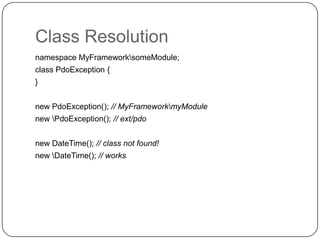
Class Resolution
namespace MyFrameworksomeModule;
class PdoException {

}
new PdoException(); // MyFrameworkmyModule
new PdoException(); // ext/pdo
new DateTime(); // class not found!
new DateTime(); // works

7
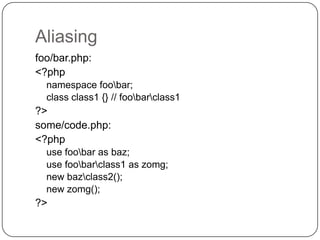
Aliasing
foo/bar.php:
<?php
namespace foobar;
class class1 {} // foobarclass1

?>
some/code.php:
<?php
use foobar as baz;
use foobarclass1 as zomg;
new bazclass2();
new zomg();

?>
8
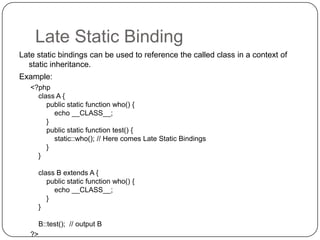
Late Static Binding
Late static bindings can be used to reference the called class in a context of
static inheritance.
Example:
<?php
class A {
public static function who() {
echo __CLASS__;
}
public static function test() {
static::who(); // Here comes Late Static Bindings
}
}
class B extends A {
public static function who() {
echo __CLASS__;
}
}
9

B::test(); // output B
?>
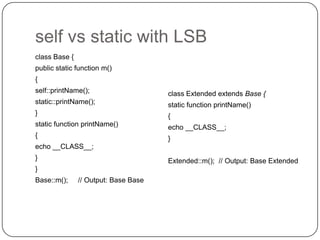
self vs static with LSB
class Base {
public static function m()
{
self::printName();

class Extended extends Base {

static::printName();

static function printName()

}

{

static function printName()

echo __CLASS__;

{

}

echo __CLASS__;
}

Extended::m(); // Output: Base Extended

}
Base::m();

10

// Output: Base Base
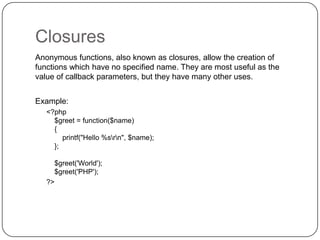
Closures
Anonymous functions, also known as closures, allow the creation of
functions which have no specified name. They are most useful as the
value of callback parameters, but they have many other uses.
Example:
<?php
$greet = function($name)
{
printf("Hello %srn", $name);
};
$greet('World');
$greet('PHP');
?>

11
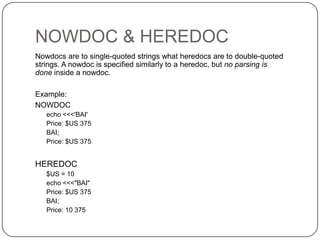
NOWDOC & HEREDOC
Nowdocs are to single-quoted strings what heredocs are to double-quoted
strings. A nowdoc is specified similarly to a heredoc, but no parsing is
done inside a nowdoc.
Example:
NOWDOC
echo <<<'BAI'
Price: $US 375
BAI;
Price: $US 375

HEREDOC
$US = 10
echo <<<"BAI"
Price: $US 375
BAI;
Price: 10 375
12
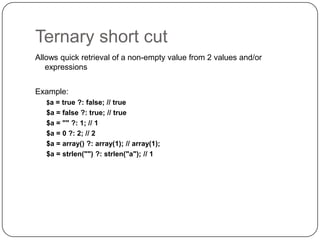
Ternary short cut
Allows quick retrieval of a non-empty value from 2 values and/or
expressions
Example:
$a = true ?: false; // true

$a = false ?: true; // true
$a = "" ?: 1; // 1
$a = 0 ?: 2; // 2
$a = array() ?: array(1); // array(1);
$a = strlen("") ?: strlen("a"); // 1

13
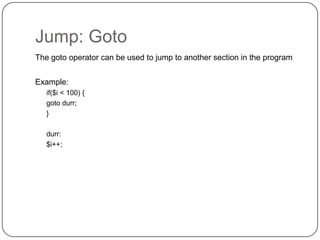
Jump: Goto
The goto operator can be used to jump to another section in the program

Example:
if($i < 100) {
goto durr;
}

durr:
$i++;

14
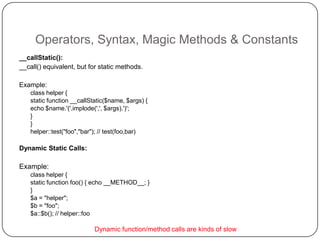
Operators, Syntax, Magic Methods & Constants
__callStatic():
__call() equivalent, but for static methods.

Example:
class helper {
static function __callStatic($name, $args) {
echo $name.'('.implode(',', $args).')';
}
}
helper::test("foo","bar"); // test(foo,bar)

Dynamic Static Calls:

Example:
class helper {
static function foo() { echo __METHOD__; }
}
$a = "helper";
$b = "foo";
$a::$b(); // helper::foo
15

Dynamic function/method calls are kinds of slow
Operators, Syntax, Magic Methods & Constants
__DIR__:
// old: function call, conditional include

include(dirname(__FILE__) . '/brother.php');
// new: magic constant, no conditional include
include(__DIR__ . '/brother.php');
Php_ini:
This list includes the php.ini sections you can set to configure your PHP setup
on a per Host or Path basis. These sections are optional.
These sections don't directly affect PHP. They are used to group
other php.ini directives together and to get them to act upon a particular host
or on a particular path
Example:
16

[HOST=dev.site.com] error_reporting = E_ALL display_errors = On
[PATH=/home/site/public/secure] auto_prepend_file=security.php
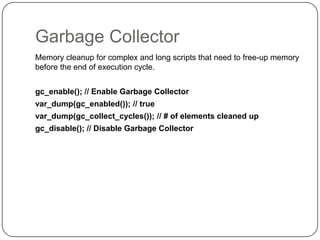
Garbage Collector
Memory cleanup for complex and long scripts that need to free-up memory
before the end of execution cycle.
gc_enable(); // Enable Garbage Collector
var_dump(gc_enabled()); // true
var_dump(gc_collect_cycles()); // # of elements cleaned up
gc_disable(); // Disable Garbage Collector

17
Date Extension Additions
Controllable strtotime() via date_create_from_format()
$date = strtotime("08-01-07 00:00:00");
var_dump(date("Y-m-d", $date)); // string(10) "2008-01-07"
$date = date_create_from_format("m-d-y", "08-01-07");
var_dump($date->format('Y-m-d')); // string(10) "2007-08-01“

Added date_get_last_errors() that returns errors and warnings in date
parsing.
array(4) {
["warning_count"] => int(0)
["warnings"] => array(0) { }
["error_count"] => int(2)
["errors"]=>
array(2) { [2]=> string(40) "The separation symbol could not be found"
[6]=> string(13) "Trailing data”
}

18

}
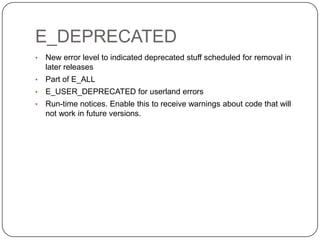
E_DEPRECATED
•
•

Part of E_ALL

•

E_USER_DEPRECATED for userland errors

•

19

New error level to indicated deprecated stuff scheduled for removal in
later releases

Run-time notices. Enable this to receive warnings about code that will
not work in future versions.
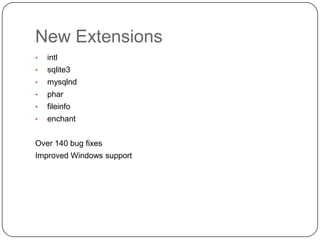
New Extensions
•

intl

•

sqlite3

•

mysqlnd

•

phar

•

fileinfo

•

enchant

Over 140 bug fixes
Improved Windows support

20
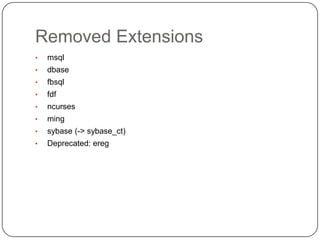
Removed Extensions
•
•

dbase

•

fbsql

•

fdf

•

ncurses

•

ming

•

sybase (-> sybase_ct)

•

21

msql

Deprecated: ereg
PHP 5.4
Released Date 1.Mar.2012

22
What‟s New in PHP 5.4
• Memory and Performance

Improvements

• JsonSerializable Interface
• Binary Notation

• Traits

• Improved Error Messages

• Short Array Syntax

• Array to String Conversion Notice

• Function Array De-referencing

• Short open tag

• Instance Method Call

• Upload progress

• Closure Binding

• Removed Features

• Objects as Functions

• Other Changes and Features

• Built-in Web Server (CLI)
23
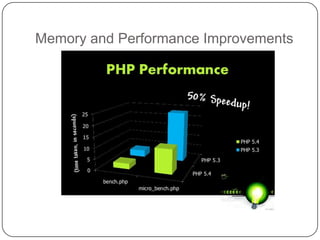
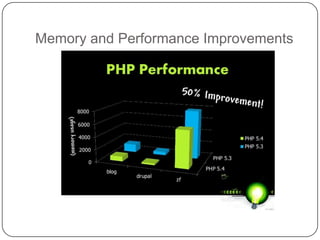
Memory and Performance Improvements

24
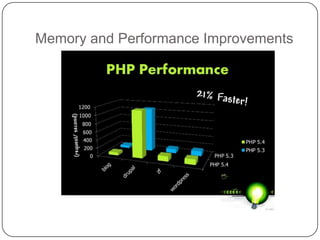
Memory and Performance Improvements

25
Memory and Performance Improvements

26
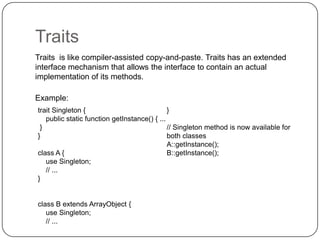
Traits
Traits is like compiler-assisted copy-and-paste. Traits has an extended
interface mechanism that allows the interface to contain an actual
implementation of its methods.
Example:
trait Singleton {
}
public static function getInstance() { ...
}
// Singleton method is now available for
}
both classes
A::getInstance();
class A {
B::getInstance();
use Singleton;
// ...
}

27

class B extends ArrayObject {
use Singleton;
// ...
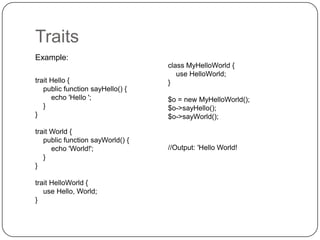
Traits
Example:
trait Hello {
public function sayHello() {
echo 'Hello ';
}
}
trait World {
public function sayWorld() {
echo 'World!';
}
}
trait HelloWorld {
use Hello, World;
}

28

class MyHelloWorld {
use HelloWorld;
}
$o = new MyHelloWorld();
$o->sayHello();
$o->sayWorld();

//Output: 'Hello World!
Short Array Syntax
A simple, but very popular syntax addition. That is, you now no longer
need to use the „array‟ keyword to define an array.
Example:
$a = [1, 2, 3];
$b = ['foo' => 'orange', 'bar' => 'apple'];

var_dump( array('foo', 'foo' => 'bar') == ['foo', 'foo' => 'bar'] ); //output: true

29
Function Array De-referencing
Another oft-requested syntax addition. Function calls that return an array
can now be de-referenced directly:
Example:
function fruits() {
return ['apple', 'banana', 'orange'];
}
echo fruits()[0]; // Outputs: apple

30
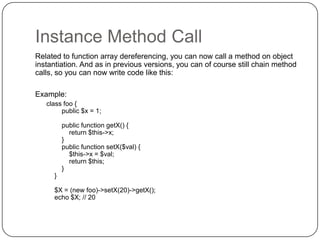
Instance Method Call
Related to function array dereferencing, you can now call a method on object
instantiation. And as in previous versions, you can of course still chain method
calls, so you can now write code like this:
Example:
class foo {
public $x = 1;
public function getX() {
return $this->x;
}
public function setX($val) {
$this->x = $val;
return $this;
}
}

$X = (new foo)->setX(20)->getX();
echo $X; // 20

31
Instance Method Call
Although, unless your constructor is doing something useful, since the
instantiated object is thrown away perhaps you should be using a static
method call here instead. If we combine it with the short array syntax and
function array de-referencing we can write some really convoluted code:
class foo extends ArrayObject {
public function __construct($arr) {
parent::__construct($arr);
}
}
echo (new foo( [1, [4, 5], 3] ))[1][0];

What is output?

32
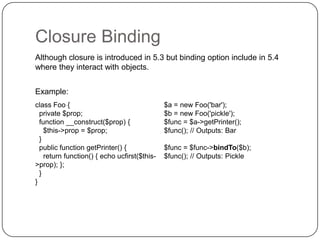
Closure Binding
Although closure is introduced in 5.3 but binding option include in 5.4
where they interact with objects.
Example:
class Foo {
private $prop;
function __construct($prop) {
$this->prop = $prop;
}
public function getPrinter() {
return function() { echo ucfirst($this>prop); };
}
}

33

$a = new Foo('bar');
$b = new Foo('pickle');
$func = $a->getPrinter();
$func(); // Outputs: Bar
$func = $func->bindTo($b);
$func(); // Outputs: Pickle
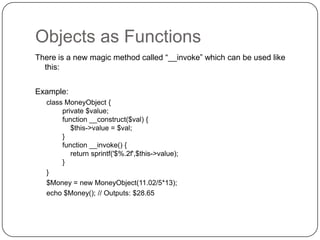
Objects as Functions
There is a new magic method called “__invoke” which can be used like
this:
Example:
class MoneyObject {
private $value;
function __construct($val) {
$this->value = $val;
}
function __invoke() {
return sprintf('$%.2f',$this->value);
}
}
$Money = new MoneyObject(11.02/5*13);
echo $Money(); // Outputs: $28.65

34
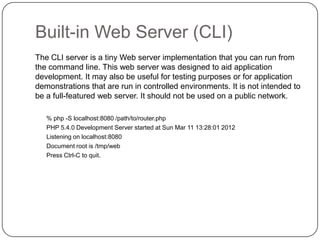
Built-in Web Server (CLI)
The CLI server is a tiny Web server implementation that you can run from
the command line. This web server was designed to aid application
development. It may also be useful for testing purposes or for application
demonstrations that are run in controlled environments. It is not intended to
be a full-featured web server. It should not be used on a public network.
% php -S localhost:8080 /path/to/router.php
PHP 5.4.0 Development Server started at Sun Mar 11 13:28:01 2012
Listening on localhost:8080
Document root is /tmp/web
Press Ctrl-C to quit.

35
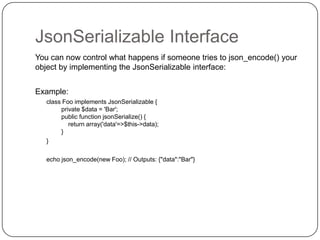
JsonSerializable Interface
You can now control what happens if someone tries to json_encode() your
object by implementing the JsonSerializable interface:
Example:
class Foo implements JsonSerializable {
private $data = 'Bar';
public function jsonSerialize() {
return array('data'=>$this->data);
}
}
echo json_encode(new Foo); // Outputs: {"data":"Bar"}

36
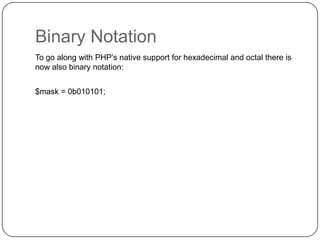
Binary Notation
To go along with PHP‟s native support for hexadecimal and octal there is
now also binary notation:
$mask = 0b010101;

37
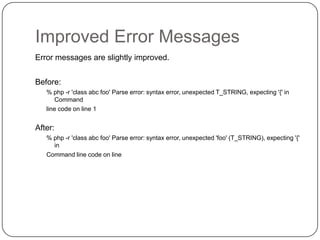
Improved Error Messages
Error messages are slightly improved.

Before:
% php -r 'class abc foo' Parse error: syntax error, unexpected T_STRING, expecting '{' in
Command
line code on line 1

After:
% php -r 'class abc foo' Parse error: syntax error, unexpected 'foo' (T_STRING), expecting '{'
in
Command line code on line

38
Array to String Conversion Notice
If you have ever used PHP you have probably ended up with the word
“Array” randomly appearing in your page because you tried to output an
array directly. Whenever an array is directly converted to a string, chances
are it is a bug and there is now a notice for that:
Example:
$a = [1,2,3];
echo $a;
//Output notice: Note: Array to string conversion in example.php onlLine 2

39
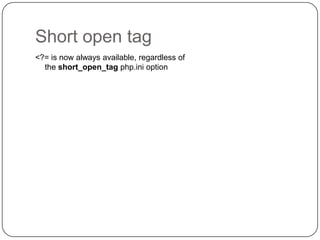
Short open tag
<?= is now always available, regardless of
the short_open_tag php.ini option

40
Upload progress
When the session.upload_progress.enabled INI option is enabled, PHP
will be able to track the upload progress of individual files being uploaded.
This information isn't particularly useful for the actual upload request
itself, but during the file upload an application can send a POST request to
a separate endpoint to check the status.
The upload progress will be available in the $_SESSION superglobal when
an upload is in progress, and when POSTing a variable of the same name
as the session.upload_progress.name INI setting is set to. When PHP
detects such POST requests, it will populate an array in the
$_SESSION, where the index is a concatenated value of the
session.upload_progress.prefix and session.upload_progress.name INI
options.
Example:

41

<?php
$key = ini_get("session.upload_progress.prefix") . $_POST[ini_get("session.upload_progr
ess.name")];
var_dump($_SESSION[$key]);
?>
Upload progress
<form action="upload.php" method="POST"
enctype="multipart/form-data">
<input type="hidden" name="<?php echo
ini_get("session.upload_progress.name"); ?>"
value="123" />
<input type="file" name="file1" />
<input type="file" name="file2" />
<input type="submit" />
</form>

t/>
field
// The following 3 elements equals those in $_FI
LES
"name" => "foo.avi",
"tmp_name" => "/tmp/phpxxxxxx",
"error" => 0,
"done" => true,
// True when the POST
handler has finished handling this file
"start_time" => 1234567890, // When this file
has started to be processed
"bytes_processed" => 57343250, // Number of b
ytes received and processed for this file
The data stored in the session will look like this:
),
// An other file, not finished uploading, in the sam
e request
<?php
1 => array(
$_SESSION["upload_progress_123"] = array(
"field_name" => "file2",
"start_time" => 1234567890, // The request time
"name" => "bar.avi",
"content_length" => 57343257, // POST content l
"tmp_name" => NULL,
ength
"error" => 0,
"bytes_processed" => 453489, // Amount of byte
"done" => false,
s received and processed
"start_time" => 1234567899,
"done" => false,
// true when the POST h
"bytes_processed" => 54554,
andler has finished, successfully or not
),
"files" => array(
)
0 => array(
);
"field_name" => "file1",
// Name of the <inpu

42
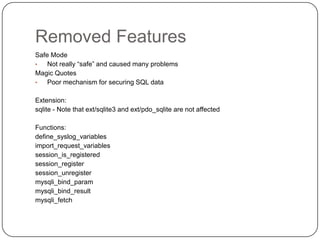
Removed Features
Safe Mode
•
Not really “safe” and caused many problems
Magic Quotes
•
Poor mechanism for securing SQL data
Extension:
sqlite - Note that ext/sqlite3 and ext/pdo_sqlite are not affected
Functions:
define_syslog_variables
import_request_variables
session_is_registered
session_register
session_unregister
mysqli_bind_param
mysqli_bind_result
mysqli_fetch

43
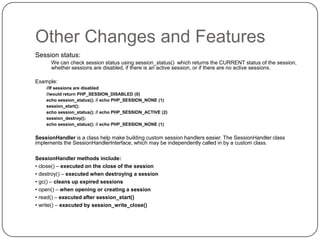
Other Changes and Features
Session status:
We can check session status using session_status() which returns the CURRENT status of the
session, whether sessions are disabled, if there is an active session, or if there are no active sessions.

Example:
//If sessions are disabled
//would return PHP_SESSION_DISABLED (0)
echo session_status(); // echo PHP_SESSION_NONE (1)
session_start();
echo session_status(); // echo PHP_SESSION_ACTIVE (2)
session_destroy();
echo session_status(); // echo PHP_SESSION_NONE (1)

SessionHandler is a class help make building custom session handlers easier. The SessionHandler class
implements the SessionHandlerInterface, which may be independently called in by a custom class.
SessionHandler methods include:
• close() – executed on the close of the session
• destroy() – executed when destroying a session
• gc() – cleans up expired sessions
• open() – when opening or creating a session
• read() – executed after session_start()
• write() – executed by session_write_close()

44
PHP 5.5
Release date 20-Jun-2013

45
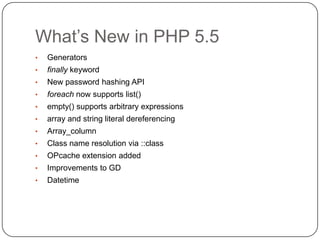
What‟s New in PHP 5.5
•
•

finally keyword

•

New password hashing API

•

foreach now supports list()

•

empty() supports arbitrary expressions

•

array and string literal dereferencing

•

Array_column

•

Class name resolution via ::class

•

OPcache extension added

•

Improvements to GD

•

46

Generators

Datetime
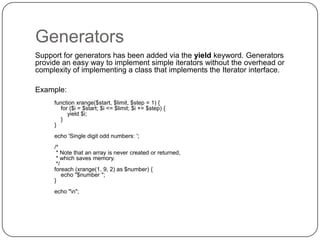
Generators
Support for generators has been added via the yield keyword. Generators
provide an easy way to implement simple iterators without the overhead or
complexity of implementing a class that implements the Iterator interface.
Example:
function xrange($start, $limit, $step = 1) {
for ($i = $start; $i <= $limit; $i += $step) {
yield $i;
}
}

echo 'Single digit odd numbers: ';
/*
* Note that an array is never created or returned,
* which saves memory.
*/
foreach (xrange(1, 9, 2) as $number) {
echo "$number ";
}
echo "n";

47
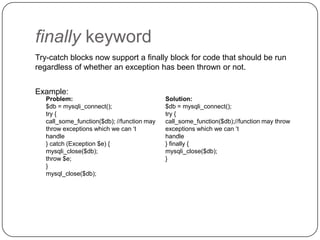
finally keyword
Try-catch blocks now support a finally block for code that should be run
regardless of whether an exception has been thrown or not.
Example:
Problem:
$db = mysqli_connect();
try {
call_some_function($db); //function may
throw exceptions which we can „t
handle
} catch (Exception $e) {
mysqli_close($db);
throw $e;
}
mysql_close($db);

48

Solution:
$db = mysqli_connect();
try {
call_some_function($db);//function may throw
exceptions which we can „t
handle
} finally {
mysqli_close($db);
}
New password hashing API
A new password hashing API that makes it easier to securely hash and manage
passwords using the same underlying library as crypt() in PHP has been added.
string password_hash ( string $password , integer $algo [, array $options ] )
Example:
echo password_hash("rasmuslerdorf", PASSWORD_DEFAULT)."n";
Output: $2y$10$.vGA1O9wmRjrwAVXD98HNOgsNpDczlqm3Jq7KnEd1rVAGv3Fykk1a
Using CRYPT_BLOWFISH algo and $2y$ identifier by default and default cost of 10
$options = [
'cost' => 12,
];
echo password_hash("rasmuslerdorf", PASSWORD_BCRYPT, $options)."n";

Output: $2y$12$QjSH496pcT5CEbzjD/vtVeH03tfHKFy36d4J0Ltp3lRtee9HDxY3K

49
foreach now supports list()
he foreach control structure now supports unpacking nested arrays into
separate variables via the list() construct.
Example:
<?php
$array = [
[1, 2],
[3, 4],
];

foreach ($array as list($a, $b)) {
echo "A: $a; B: $bn";
}
?>
Output:
A: 1; B: 2
A: 3; B: 4

50
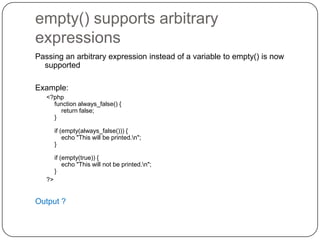
empty() supports arbitrary
expressions
Passing an arbitrary expression instead of a variable to empty() is now
supported
Example:
<?php
function always_false() {
return false;
}
if (empty(always_false())) {
echo "This will be printed.n";
}
if (empty(true)) {
echo "This will not be printed.n";
}
?>

Output ?
51
array and string literal dereferencing
Array and string literals can now be dereference directly to access
individual elements and characters:
Example:
<?php
echo 'Array dereferencing: ';
echo [1, 2, 3][0];
echo "n";
echo 'String dereferencing: ';
echo 'PHP'[0];
echo "n";
?>
Output:

Array dereferencing: 1
String dereferencing: P

52
Array_column
Array array_column ( array $array , mixed $column_key [, mixed $index_k
ey = null ] )
array_column() returns the values from a single column of
the array, identified by the column_key. Optionally, you may provide
an index_key to index the values in the returned array by the values from
the index_key column in the input array.

53

$records = array(
array(
Example:
'id' => 2135,
'first_name' => 'John',
'last_name' => 'Doe',
),
array(
'id' => 3245,
'first_name' => 'Sally',
'last_name' => 'Smith',
),
array(
'id' => 5342,
'first_name' => 'Jane',

)
);
$first_names = array_column($records, 'first_na
me');
print_r($first_names); //output Array ( [0] =>
John [1] => Sally [2] => Jane [3] => Peter )
$last_names = array_column($records, 'last_na
me', 'id');
print_r($last_names); //output Array ( [2135] =>
Doe [3245] => Smith [5342] => Jones [5623] =>
Doe )
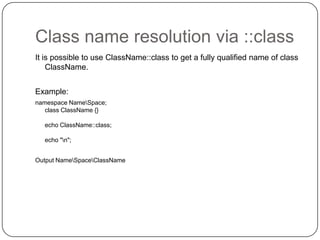
Class name resolution via ::class
It is possible to use ClassName::class to get a fully qualified name of class
ClassName.
Example:
namespace NameSpace;
class ClassName {}
echo ClassName::class;
echo "n";
Output NameSpaceClassName

54
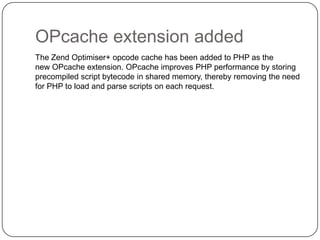
OPcache extension added
The Zend Optimiser+ opcode cache has been added to PHP as the
new OPcache extension. OPcache improves PHP performance by storing
precompiled script bytecode in shared memory, thereby removing the need
for PHP to load and parse scripts on each request.

55
Improvements to GD
Various improvements have been made to the GD extension, these
include:
 Flipping support using the new imageflip() function.
 Advanced cropping support using the imagecrop() & imagecropauto() functions.
 WebP read and write support using imagecreatefromwebp() & imagewebp() respectively.

56
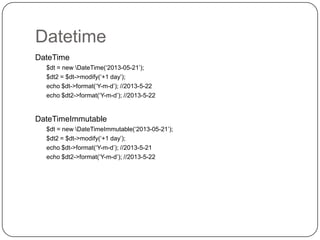
Datetime
DateTime
$dt = new DateTime(„2013-05-21‟);
$dt2 = $dt->modify(„+1 day‟);
echo $dt->format(„Y-m-d‟); //2013-5-22
echo $dt2->format(„Y-m-d‟); //2013-5-22

57
Removed/changed
•
•

Case insensitivity no longer locale specific

•

Logo functions removed: php_logo_guid(), php_egg_logo_guid() etc

•

58

No Windows XP or 2003 support

Changes to pack() and unpack()
Just a few things remaining
Tired?

59
PSR
PHP Standards Recommendation

60
PSR‟s
PSR-0: Autoloader Standard
PSR-1: Basic Coding Standard

PSR-2: Coding Style Guide
PSR-3: Logger Interface

61
Flexigrid
Why?

62
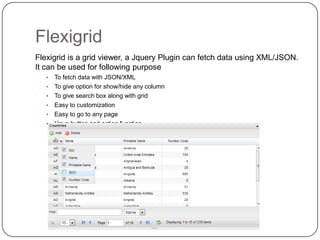
Flexigrid
Flexigrid is a grid viewer, a Jquery Plugin can fetch data using XML/JSON.
It can be used for following purpose
•
•
•
•
•
•

63

To fetch data with JSON/XML
To give option for show/hide any column
To give search box along with grid
Easy to customization
Easy to go to any page
Have button and action function
Thank you
Question?

64

Introducing PHP Latest Updates

  • 1.
    Introducing PHP LatestUpdates Presenter Iftekhar Ahmed Eather Software Engineer Divine IT Limited Source php.net, slideshare.com, wiki, google, git document and others 1
  • 2.
    Topics • PHP 5.3 •PHP 5.4 • PHP 5.5 • PSR • FlexiGrid 2
  • 3.
    PHP 5.3 Released Date30-Jun-2009 3
  • 4.
    What‟s New inPHP 5.3 • • Late Static Binding • Closures • NOWDOC • Ternary short cut • Jump Label • Operators, Syntax, Magic Methods, Constants & php.ini • Garbage collector • Date and Time • 4 Namespaces Others
  • 5.
    Namespaces Namespaces are declaredusing the namespace keyword. A file containing a namespace must declare the namespace at the top of the file before any other code. Example: <?php namespace Foo; const ANSWER = 42; class C { /* ... */ } function f() { } echo FooANSWER; new FooC(); Foof(); ?> 5
  • 6.
    __ NAMESPACE__ <?php namespace MyProject; echo'"', __NAMESPACE__, '"'; // outputs "MyProject" ?> 6
  • 7.
    Class Resolution namespace MyFrameworksomeModule; classPdoException { } new PdoException(); // MyFrameworkmyModule new PdoException(); // ext/pdo new DateTime(); // class not found! new DateTime(); // works 7
  • 8.
    Aliasing foo/bar.php: <?php namespace foobar; class class1{} // foobarclass1 ?> some/code.php: <?php use foobar as baz; use foobarclass1 as zomg; new bazclass2(); new zomg(); ?> 8
  • 9.
    Late Static Binding Latestatic bindings can be used to reference the called class in a context of static inheritance. Example: <?php class A { public static function who() { echo __CLASS__; } public static function test() { static::who(); // Here comes Late Static Bindings } } class B extends A { public static function who() { echo __CLASS__; } } 9 B::test(); // output B ?>
  • 10.
    self vs staticwith LSB class Base { public static function m() { self::printName(); class Extended extends Base { static::printName(); static function printName() } { static function printName() echo __CLASS__; { } echo __CLASS__; } Extended::m(); // Output: Base Extended } Base::m(); 10 // Output: Base Base
  • 11.
    Closures Anonymous functions, alsoknown as closures, allow the creation of functions which have no specified name. They are most useful as the value of callback parameters, but they have many other uses. Example: <?php $greet = function($name) { printf("Hello %srn", $name); }; $greet('World'); $greet('PHP'); ?> 11
  • 12.
    NOWDOC & HEREDOC Nowdocsare to single-quoted strings what heredocs are to double-quoted strings. A nowdoc is specified similarly to a heredoc, but no parsing is done inside a nowdoc. Example: NOWDOC echo <<<'BAI' Price: $US 375 BAI; Price: $US 375 HEREDOC $US = 10 echo <<<"BAI" Price: $US 375 BAI; Price: 10 375 12
  • 13.
    Ternary short cut Allowsquick retrieval of a non-empty value from 2 values and/or expressions Example: $a = true ?: false; // true $a = false ?: true; // true $a = "" ?: 1; // 1 $a = 0 ?: 2; // 2 $a = array() ?: array(1); // array(1); $a = strlen("") ?: strlen("a"); // 1 13
  • 14.
    Jump: Goto The gotooperator can be used to jump to another section in the program Example: if($i < 100) { goto durr; } durr: $i++; 14
  • 15.
    Operators, Syntax, MagicMethods & Constants __callStatic(): __call() equivalent, but for static methods. Example: class helper { static function __callStatic($name, $args) { echo $name.'('.implode(',', $args).')'; } } helper::test("foo","bar"); // test(foo,bar) Dynamic Static Calls: Example: class helper { static function foo() { echo __METHOD__; } } $a = "helper"; $b = "foo"; $a::$b(); // helper::foo 15 Dynamic function/method calls are kinds of slow
  • 16.
    Operators, Syntax, MagicMethods & Constants __DIR__: // old: function call, conditional include include(dirname(__FILE__) . '/brother.php'); // new: magic constant, no conditional include include(__DIR__ . '/brother.php'); Php_ini: This list includes the php.ini sections you can set to configure your PHP setup on a per Host or Path basis. These sections are optional. These sections don't directly affect PHP. They are used to group other php.ini directives together and to get them to act upon a particular host or on a particular path Example: 16 [HOST=dev.site.com] error_reporting = E_ALL display_errors = On [PATH=/home/site/public/secure] auto_prepend_file=security.php
  • 17.
    Garbage Collector Memory cleanupfor complex and long scripts that need to free-up memory before the end of execution cycle. gc_enable(); // Enable Garbage Collector var_dump(gc_enabled()); // true var_dump(gc_collect_cycles()); // # of elements cleaned up gc_disable(); // Disable Garbage Collector 17
  • 18.
    Date Extension Additions Controllablestrtotime() via date_create_from_format() $date = strtotime("08-01-07 00:00:00"); var_dump(date("Y-m-d", $date)); // string(10) "2008-01-07" $date = date_create_from_format("m-d-y", "08-01-07"); var_dump($date->format('Y-m-d')); // string(10) "2007-08-01“ Added date_get_last_errors() that returns errors and warnings in date parsing. array(4) { ["warning_count"] => int(0) ["warnings"] => array(0) { } ["error_count"] => int(2) ["errors"]=> array(2) { [2]=> string(40) "The separation symbol could not be found" [6]=> string(13) "Trailing data” } 18 }
  • 19.
    E_DEPRECATED • • Part of E_ALL • E_USER_DEPRECATEDfor userland errors • 19 New error level to indicated deprecated stuff scheduled for removal in later releases Run-time notices. Enable this to receive warnings about code that will not work in future versions.
  • 20.
  • 21.
  • 22.
    PHP 5.4 Released Date1.Mar.2012 22
  • 23.
    What‟s New inPHP 5.4 • Memory and Performance Improvements • JsonSerializable Interface • Binary Notation • Traits • Improved Error Messages • Short Array Syntax • Array to String Conversion Notice • Function Array De-referencing • Short open tag • Instance Method Call • Upload progress • Closure Binding • Removed Features • Objects as Functions • Other Changes and Features • Built-in Web Server (CLI) 23
  • 24.
    Memory and PerformanceImprovements 24
  • 25.
    Memory and PerformanceImprovements 25
  • 26.
    Memory and PerformanceImprovements 26
  • 27.
    Traits Traits is likecompiler-assisted copy-and-paste. Traits has an extended interface mechanism that allows the interface to contain an actual implementation of its methods. Example: trait Singleton { } public static function getInstance() { ... } // Singleton method is now available for } both classes A::getInstance(); class A { B::getInstance(); use Singleton; // ... } 27 class B extends ArrayObject { use Singleton; // ...
  • 28.
    Traits Example: trait Hello { publicfunction sayHello() { echo 'Hello '; } } trait World { public function sayWorld() { echo 'World!'; } } trait HelloWorld { use Hello, World; } 28 class MyHelloWorld { use HelloWorld; } $o = new MyHelloWorld(); $o->sayHello(); $o->sayWorld(); //Output: 'Hello World!
  • 29.
    Short Array Syntax Asimple, but very popular syntax addition. That is, you now no longer need to use the „array‟ keyword to define an array. Example: $a = [1, 2, 3]; $b = ['foo' => 'orange', 'bar' => 'apple']; var_dump( array('foo', 'foo' => 'bar') == ['foo', 'foo' => 'bar'] ); //output: true 29
  • 30.
    Function Array De-referencing Anotheroft-requested syntax addition. Function calls that return an array can now be de-referenced directly: Example: function fruits() { return ['apple', 'banana', 'orange']; } echo fruits()[0]; // Outputs: apple 30
  • 31.
    Instance Method Call Relatedto function array dereferencing, you can now call a method on object instantiation. And as in previous versions, you can of course still chain method calls, so you can now write code like this: Example: class foo { public $x = 1; public function getX() { return $this->x; } public function setX($val) { $this->x = $val; return $this; } } $X = (new foo)->setX(20)->getX(); echo $X; // 20 31
  • 32.
    Instance Method Call Although,unless your constructor is doing something useful, since the instantiated object is thrown away perhaps you should be using a static method call here instead. If we combine it with the short array syntax and function array de-referencing we can write some really convoluted code: class foo extends ArrayObject { public function __construct($arr) { parent::__construct($arr); } } echo (new foo( [1, [4, 5], 3] ))[1][0]; What is output? 32
  • 33.
    Closure Binding Although closureis introduced in 5.3 but binding option include in 5.4 where they interact with objects. Example: class Foo { private $prop; function __construct($prop) { $this->prop = $prop; } public function getPrinter() { return function() { echo ucfirst($this>prop); }; } } 33 $a = new Foo('bar'); $b = new Foo('pickle'); $func = $a->getPrinter(); $func(); // Outputs: Bar $func = $func->bindTo($b); $func(); // Outputs: Pickle
  • 34.
    Objects as Functions Thereis a new magic method called “__invoke” which can be used like this: Example: class MoneyObject { private $value; function __construct($val) { $this->value = $val; } function __invoke() { return sprintf('$%.2f',$this->value); } } $Money = new MoneyObject(11.02/5*13); echo $Money(); // Outputs: $28.65 34
  • 35.
    Built-in Web Server(CLI) The CLI server is a tiny Web server implementation that you can run from the command line. This web server was designed to aid application development. It may also be useful for testing purposes or for application demonstrations that are run in controlled environments. It is not intended to be a full-featured web server. It should not be used on a public network. % php -S localhost:8080 /path/to/router.php PHP 5.4.0 Development Server started at Sun Mar 11 13:28:01 2012 Listening on localhost:8080 Document root is /tmp/web Press Ctrl-C to quit. 35
  • 36.
    JsonSerializable Interface You cannow control what happens if someone tries to json_encode() your object by implementing the JsonSerializable interface: Example: class Foo implements JsonSerializable { private $data = 'Bar'; public function jsonSerialize() { return array('data'=>$this->data); } } echo json_encode(new Foo); // Outputs: {"data":"Bar"} 36
  • 37.
    Binary Notation To goalong with PHP‟s native support for hexadecimal and octal there is now also binary notation: $mask = 0b010101; 37
  • 38.
    Improved Error Messages Errormessages are slightly improved. Before: % php -r 'class abc foo' Parse error: syntax error, unexpected T_STRING, expecting '{' in Command line code on line 1 After: % php -r 'class abc foo' Parse error: syntax error, unexpected 'foo' (T_STRING), expecting '{' in Command line code on line 38
  • 39.
    Array to StringConversion Notice If you have ever used PHP you have probably ended up with the word “Array” randomly appearing in your page because you tried to output an array directly. Whenever an array is directly converted to a string, chances are it is a bug and there is now a notice for that: Example: $a = [1,2,3]; echo $a; //Output notice: Note: Array to string conversion in example.php onlLine 2 39
  • 40.
    Short open tag <?=is now always available, regardless of the short_open_tag php.ini option 40
  • 41.
    Upload progress When thesession.upload_progress.enabled INI option is enabled, PHP will be able to track the upload progress of individual files being uploaded. This information isn't particularly useful for the actual upload request itself, but during the file upload an application can send a POST request to a separate endpoint to check the status. The upload progress will be available in the $_SESSION superglobal when an upload is in progress, and when POSTing a variable of the same name as the session.upload_progress.name INI setting is set to. When PHP detects such POST requests, it will populate an array in the $_SESSION, where the index is a concatenated value of the session.upload_progress.prefix and session.upload_progress.name INI options. Example: 41 <?php $key = ini_get("session.upload_progress.prefix") . $_POST[ini_get("session.upload_progr ess.name")]; var_dump($_SESSION[$key]); ?>
  • 42.
    Upload progress <form action="upload.php"method="POST" enctype="multipart/form-data"> <input type="hidden" name="<?php echo ini_get("session.upload_progress.name"); ?>" value="123" /> <input type="file" name="file1" /> <input type="file" name="file2" /> <input type="submit" /> </form> t/> field // The following 3 elements equals those in $_FI LES "name" => "foo.avi", "tmp_name" => "/tmp/phpxxxxxx", "error" => 0, "done" => true, // True when the POST handler has finished handling this file "start_time" => 1234567890, // When this file has started to be processed "bytes_processed" => 57343250, // Number of b ytes received and processed for this file The data stored in the session will look like this: ), // An other file, not finished uploading, in the sam e request <?php 1 => array( $_SESSION["upload_progress_123"] = array( "field_name" => "file2", "start_time" => 1234567890, // The request time "name" => "bar.avi", "content_length" => 57343257, // POST content l "tmp_name" => NULL, ength "error" => 0, "bytes_processed" => 453489, // Amount of byte "done" => false, s received and processed "start_time" => 1234567899, "done" => false, // true when the POST h "bytes_processed" => 54554, andler has finished, successfully or not ), "files" => array( ) 0 => array( ); "field_name" => "file1", // Name of the <inpu 42
  • 43.
    Removed Features Safe Mode • Notreally “safe” and caused many problems Magic Quotes • Poor mechanism for securing SQL data Extension: sqlite - Note that ext/sqlite3 and ext/pdo_sqlite are not affected Functions: define_syslog_variables import_request_variables session_is_registered session_register session_unregister mysqli_bind_param mysqli_bind_result mysqli_fetch 43
  • 44.
    Other Changes andFeatures Session status: We can check session status using session_status() which returns the CURRENT status of the session, whether sessions are disabled, if there is an active session, or if there are no active sessions. Example: //If sessions are disabled //would return PHP_SESSION_DISABLED (0) echo session_status(); // echo PHP_SESSION_NONE (1) session_start(); echo session_status(); // echo PHP_SESSION_ACTIVE (2) session_destroy(); echo session_status(); // echo PHP_SESSION_NONE (1) SessionHandler is a class help make building custom session handlers easier. The SessionHandler class implements the SessionHandlerInterface, which may be independently called in by a custom class. SessionHandler methods include: • close() – executed on the close of the session • destroy() – executed when destroying a session • gc() – cleans up expired sessions • open() – when opening or creating a session • read() – executed after session_start() • write() – executed by session_write_close() 44
  • 45.
    PHP 5.5 Release date20-Jun-2013 45
  • 46.
    What‟s New inPHP 5.5 • • finally keyword • New password hashing API • foreach now supports list() • empty() supports arbitrary expressions • array and string literal dereferencing • Array_column • Class name resolution via ::class • OPcache extension added • Improvements to GD • 46 Generators Datetime
  • 47.
    Generators Support for generatorshas been added via the yield keyword. Generators provide an easy way to implement simple iterators without the overhead or complexity of implementing a class that implements the Iterator interface. Example: function xrange($start, $limit, $step = 1) { for ($i = $start; $i <= $limit; $i += $step) { yield $i; } } echo 'Single digit odd numbers: '; /* * Note that an array is never created or returned, * which saves memory. */ foreach (xrange(1, 9, 2) as $number) { echo "$number "; } echo "n"; 47
  • 48.
    finally keyword Try-catch blocksnow support a finally block for code that should be run regardless of whether an exception has been thrown or not. Example: Problem: $db = mysqli_connect(); try { call_some_function($db); //function may throw exceptions which we can „t handle } catch (Exception $e) { mysqli_close($db); throw $e; } mysql_close($db); 48 Solution: $db = mysqli_connect(); try { call_some_function($db);//function may throw exceptions which we can „t handle } finally { mysqli_close($db); }
  • 49.
    New password hashingAPI A new password hashing API that makes it easier to securely hash and manage passwords using the same underlying library as crypt() in PHP has been added. string password_hash ( string $password , integer $algo [, array $options ] ) Example: echo password_hash("rasmuslerdorf", PASSWORD_DEFAULT)."n"; Output: $2y$10$.vGA1O9wmRjrwAVXD98HNOgsNpDczlqm3Jq7KnEd1rVAGv3Fykk1a Using CRYPT_BLOWFISH algo and $2y$ identifier by default and default cost of 10 $options = [ 'cost' => 12, ]; echo password_hash("rasmuslerdorf", PASSWORD_BCRYPT, $options)."n"; Output: $2y$12$QjSH496pcT5CEbzjD/vtVeH03tfHKFy36d4J0Ltp3lRtee9HDxY3K 49
  • 50.
    foreach now supportslist() he foreach control structure now supports unpacking nested arrays into separate variables via the list() construct. Example: <?php $array = [ [1, 2], [3, 4], ]; foreach ($array as list($a, $b)) { echo "A: $a; B: $bn"; } ?> Output: A: 1; B: 2 A: 3; B: 4 50
  • 51.
    empty() supports arbitrary expressions Passingan arbitrary expression instead of a variable to empty() is now supported Example: <?php function always_false() { return false; } if (empty(always_false())) { echo "This will be printed.n"; } if (empty(true)) { echo "This will not be printed.n"; } ?> Output ? 51
  • 52.
    array and stringliteral dereferencing Array and string literals can now be dereference directly to access individual elements and characters: Example: <?php echo 'Array dereferencing: '; echo [1, 2, 3][0]; echo "n"; echo 'String dereferencing: '; echo 'PHP'[0]; echo "n"; ?> Output: Array dereferencing: 1 String dereferencing: P 52
  • 53.
    Array_column Array array_column (array $array , mixed $column_key [, mixed $index_k ey = null ] ) array_column() returns the values from a single column of the array, identified by the column_key. Optionally, you may provide an index_key to index the values in the returned array by the values from the index_key column in the input array. 53 $records = array( array( Example: 'id' => 2135, 'first_name' => 'John', 'last_name' => 'Doe', ), array( 'id' => 3245, 'first_name' => 'Sally', 'last_name' => 'Smith', ), array( 'id' => 5342, 'first_name' => 'Jane', ) ); $first_names = array_column($records, 'first_na me'); print_r($first_names); //output Array ( [0] => John [1] => Sally [2] => Jane [3] => Peter ) $last_names = array_column($records, 'last_na me', 'id'); print_r($last_names); //output Array ( [2135] => Doe [3245] => Smith [5342] => Jones [5623] => Doe )
  • 54.
    Class name resolutionvia ::class It is possible to use ClassName::class to get a fully qualified name of class ClassName. Example: namespace NameSpace; class ClassName {} echo ClassName::class; echo "n"; Output NameSpaceClassName 54
  • 55.
    OPcache extension added TheZend Optimiser+ opcode cache has been added to PHP as the new OPcache extension. OPcache improves PHP performance by storing precompiled script bytecode in shared memory, thereby removing the need for PHP to load and parse scripts on each request. 55
  • 56.
    Improvements to GD Variousimprovements have been made to the GD extension, these include:  Flipping support using the new imageflip() function.  Advanced cropping support using the imagecrop() & imagecropauto() functions.  WebP read and write support using imagecreatefromwebp() & imagewebp() respectively. 56
  • 57.
    Datetime DateTime $dt = newDateTime(„2013-05-21‟); $dt2 = $dt->modify(„+1 day‟); echo $dt->format(„Y-m-d‟); //2013-5-22 echo $dt2->format(„Y-m-d‟); //2013-5-22 57
  • 58.
    Removed/changed • • Case insensitivity nolonger locale specific • Logo functions removed: php_logo_guid(), php_egg_logo_guid() etc • 58 No Windows XP or 2003 support Changes to pack() and unpack()
  • 59.
    Just a fewthings remaining Tired? 59
  • 60.
  • 61.
    PSR‟s PSR-0: Autoloader Standard PSR-1:Basic Coding Standard PSR-2: Coding Style Guide PSR-3: Logger Interface 61
  • 62.
  • 63.
    Flexigrid Flexigrid is agrid viewer, a Jquery Plugin can fetch data using XML/JSON. It can be used for following purpose • • • • • • 63 To fetch data with JSON/XML To give option for show/hide any column To give search box along with grid Easy to customization Easy to go to any page Have button and action function
  • 64.