POP! GOES THE
WORLD
Professor Will Adams
POP ART
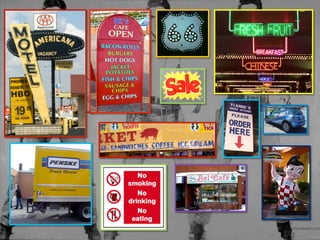
“Once you ‘got’ pop, you could never
see a sign the same way again.
And once you thought pop, you could
never see America the same way
again.”
- Andy Warhol
WHAT IS POP ART?
§  A major art movement from the mid 1950’s in
England and by the early 1960’s was at it’s fullest
potential in new York.
§  Themes and techniques were drawn from popular
culture (hence “pop” art):
§  Advertising & mass media
§  Comic strips
§  Celebrity photographs
§  Consumer product packaging
§  Everyday objects
WHAT IS POP ART?
§  Pop art aims to target a large
audience, but is often academic and
difficult for some people to understand.
§  The epic, or story, in art was replaced
with the everyday and the mass-
produced was awarded the same
significance as the unique. The division
between “high art” and “low art” was
decreasing.
WHAT IS POP ART?
§  “The term Pop Art was first used by
the English critic Lawrence Alloway in a
1958 issue of Architectural Digest to
describe those paintings that celebrate
post-war consumerism, defy the
psychology of Abstract Expressionism,
and worship the god of materialism.”
- Nicolas Pioch
THE NATURE OF POP
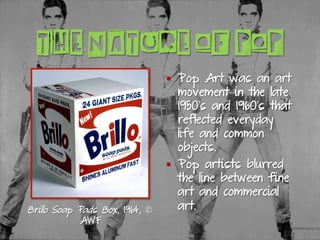
§  Pop Art was an art
movement in the late
1950’s and 1960’s that
reflected everyday
life and common
objects.
§  Pop artists blurred
the line between fine
art and commercial
art.Brillo Soap Pads Box, 1964, ©
AWF
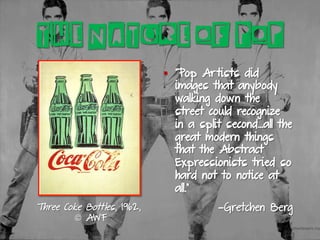
Three Coke Bottles, 1962,
© AWF
§  “Pop Artists did
images that anybody
walking down the
street could recognize
in a split second…all the
great modern things
that the Abstract
Expressionists tried so
hard not to notice at
all.”
—Gretchen Berg
THE NATURE OF POP
THE NATURE OF POP
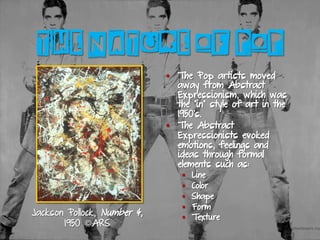
§  The Pop artists moved
away from Abstract
Expressionism, which was
the “in” style of art in the
1950’s.
§  The Abstract
Expressionists evoked
emotions, feelings and
ideas through formal
elements such as:
§  Line
§  Color
§  Shape
§  Form
§  Texture
Jackson Pollock, Number 4,
1950 ©ARS
THE NATURE OF POP
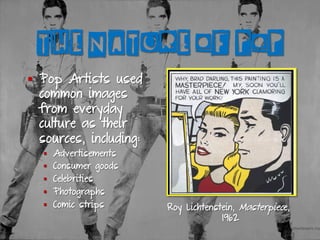
§  Pop Artists used
common images
from everyday
culture as their
sources, including:
§  Advertisements
§  Consumer goods
§  Celebrities
§  Photographs
§  Comic strips Roy Lichtenstein, Masterpiece,
1962
THE NATURE OF POP
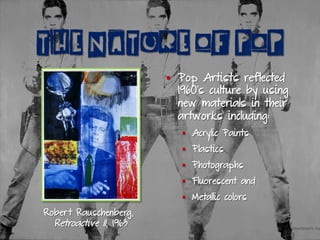
Robert Rauschenberg,
Retroactive II, 1963
§  Pop Artists reflected
1960’s culture by using
new materials in their
artworks including:
§  Acrylic Paints
§  Plastics
§  Photographs
§  Fluorescent and
§  Metallic colors
THE NATURE OF POP
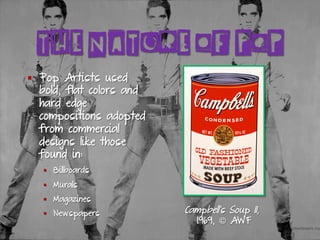
§  Pop Artists used
bold, flat colors and
hard edge
compositions adopted
from commercial
designs like those
found in:
§  Billboards
§  Murals
§  Magazines
§  Newspapers Campbell's Soup II,
1969, © AWF
THE NATURE OF POP
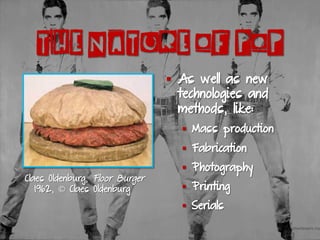
Claes Oldenburg, Floor Burger
1962, © Claes Oldenburg
§  As well as new
technologies and
methods, like:
§  Mass production
§  Fabrication
§  Photography
§  Printing
§  Serials
THE NATURE OF POP
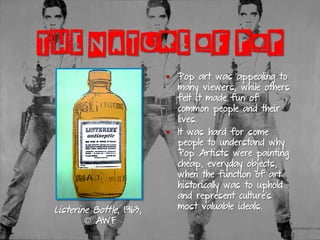
§  Pop art was appealing to
many viewers, while others
felt it made fun of
common people and their
lives.
§  It was hard for some
people to understand why
Pop Artists were painting
cheap, everyday objects,
when the function of art
historically was to uphold
and represent culture’s
most valuable ideals.Listerine Bottle, 1963,
© AWF
ANDY WARHOL
ANDY WARHOL
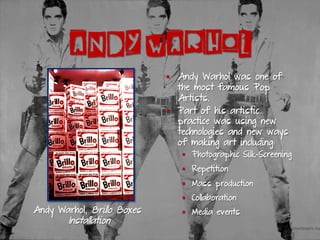
§  Andy Warhol was one of
the most famous Pop
Artists.
§  Part of his artistic
practice was using new
technologies and new ways
of making art including:
§  Photographic Silk-Screening
§  Repetition
§  Mass production
§  Collaboration
§  Media eventsAndy Warhol, Brillo Boxes
Installation
ANDY WARHOL
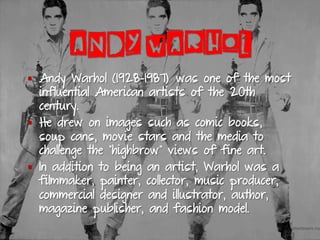
§  Andy Warhol (1928-1987) was one of the most
influential American artists of the 20th
century.
§  He drew on images such as comic books,
soup cans, movie stars and the media to
challenge the "highbrow" views of fine art.
§  In addition to being an artist, Warhol was a
filmmaker, painter, collector, music producer,
commercial designer and illustrator, author,
magazine publisher, and fashion model.
ANDY WARHOL
§  Andy Warhol often
appropriated (used
without permission)
images from
magazines,
newspapers, and
press photos of the
most popular people
of his time
Silver Liz [Ferus
Type], 1963, © AWF
ANDY WARHOL
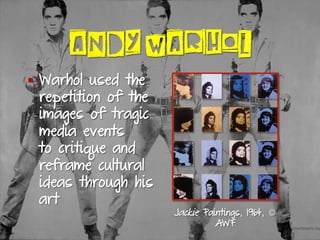
§  Warhol used the
repetition of the
images of tragic
media events
to critique and
reframe cultural
ideas through his
art
Jackie Paintings, 1964, ©
AWF
ANDY WARHOL
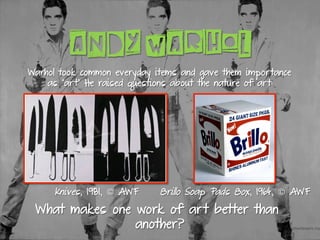
Knives, 1981, © AWF
What makes one work of art better than
another?
Brillo Soap Pads Box, 1964, © AWF
Warhol took common everyday items and gave them importance
as “art” He raised questions about the nature of art:
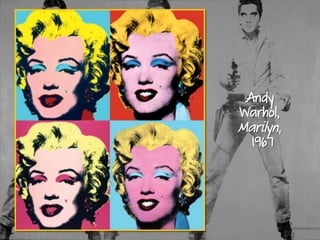
Andy
Warhol,
Marilyn,
1967
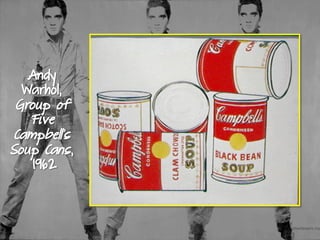
Andy
Warhol,
Group of
Five
Campbell's
Soup Cans,
1962
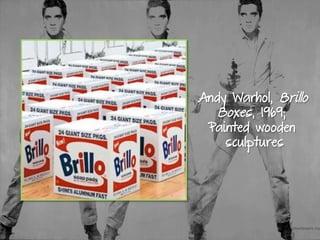
Andy Warhol, Brillo
Boxes, 1969;
Painted wooden
sculptures
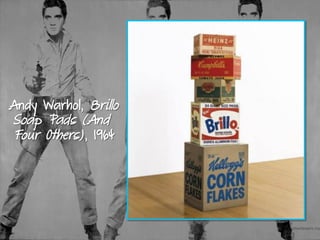
Andy Warhol, Brillo
Soap Pads (And
Four Others), 1964
QUOTABLE WARHOL
§  “Everybody will be famous for 15 minutes.”
§  “I’d asked around 10 or 15 people for suggestions.
Finally one lady friend asked the right question,
‘Well, what do you love most?’ That’s how I
started painting money.”
§  “I’ve decided something: Commercial things really do
stink. As soon as it becomes commercials for a
mass market it really stinks.”
§  “When I got my first television set, I stopped
caring so much about having close relationships.”
ROY
LICHTENSTEIN
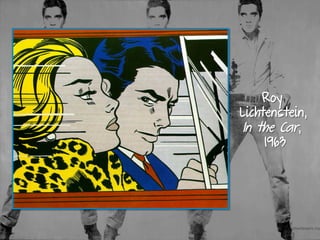
Roy
Lichtenstein,
In the Car,
1963
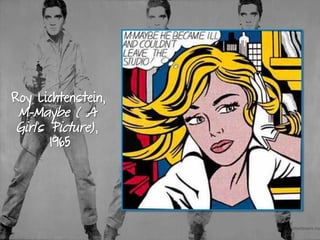
Roy Lichtenstein,
M-Maybe ( A
Girl’s Picture),
1965
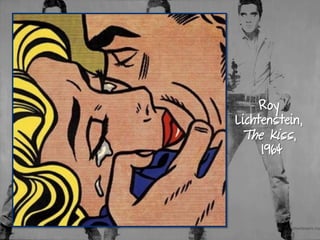
Roy
Lichtenstein,
The Kiss,
1964
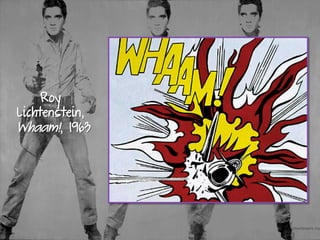
Roy
Lichtenstein,
Whaam!, 1963
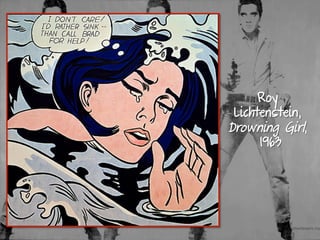
Roy
Lichtenstein,
Drowning Girl,
1963
DAVID HOCKNEY
DAVID HOCKNEY
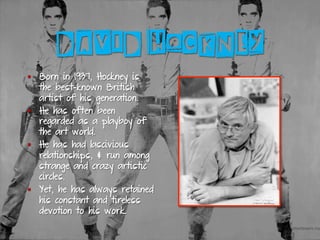
§  Born in 1937, Hockney is
the best-known British
artist of his generation.
§  He has often been
regarded as a playboy of
the art world.
§  He has had lascivious
relationships, & run among
strange and crazy artistic
circles.
§  Yet, he has always retained
his constant and tireless
devotion to his work.
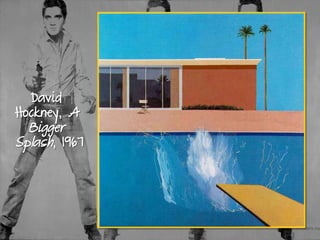
David
Hockney, A
Bigger
Splash, 1967
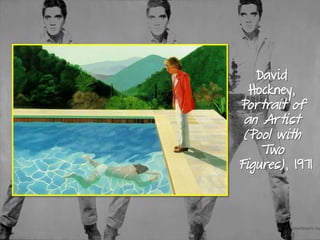
David
Hockney,
Portrait of
an Artist
(Pool with
Two
Figures), 1971
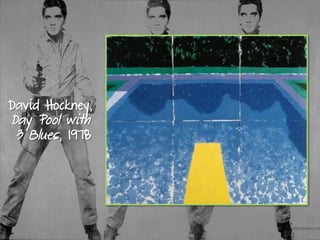
David Hockney,
Day Pool with
3 Blues, 1978
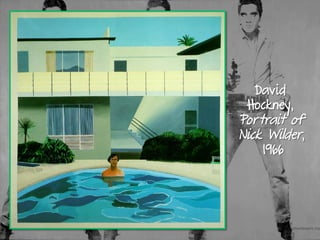
David
Hockney,
Portrait of
Nick Wilder,
1966
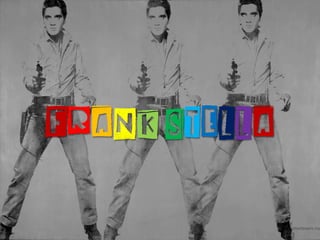
FRANK STELLA
FRANK STELLA
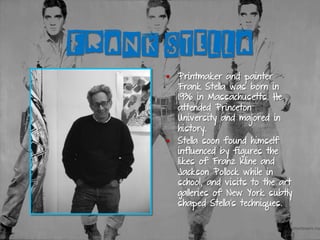
§  Printmaker and painter
Frank Stella was born in
1936 in Massachusetts. He
attended Princeton
University and majored in
history.
§  Stella soon found himself
influenced by figures the
likes of Franz Kline and
Jackson Pollock while in
school, and visits to the art
galleries of New York subtly
shaped Stella’s techniques.
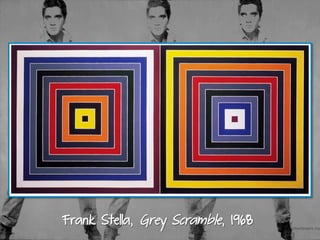
Frank Stella, Grey Scramble, 1968
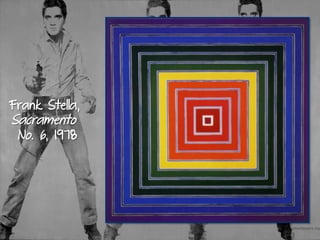
Frank Stella,
Sacramento
No. 6, 1978
JASPER JOHNS
JASPER JOHNS
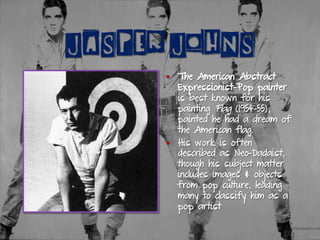
§  The American Abstract
Expressionist-Pop painter
is best known for his
painting Flag (1954-55),
painted he had a dream of
the American flag.
§  His work is often
described as Neo-Dadaist,
though his subject matter
includes images & objects
from pop culture, leading
many to classify him as a
pop artist
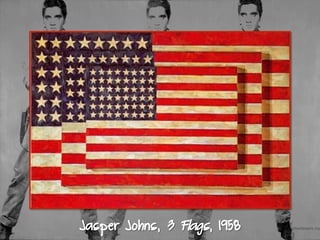
Jasper Johns, 3 Flags, 1958
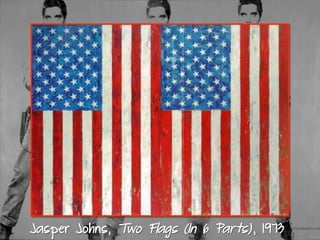
Jasper Johns, Two Flags (In 6 Parts), 1973
THE LEGACY OF POP
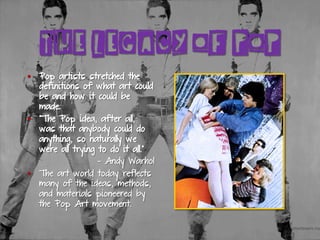
§  Pop artists stretched the
definitions of what art could
be and how it could be
made.
§  “The Pop idea, after all,
was that anybody could do
anything, so naturally we
were all trying to do it all.”
- Andy Warhol
§  The art world today reflects
many of the ideas, methods,
and materials pioneered by
the Pop Art movement.
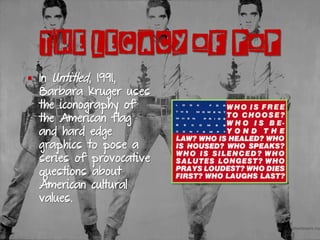
§  In Untitled, 1991,
Barbara Kruger uses
the iconography of
the American flag
and hard edge
graphics to pose a
series of provocative
questions about
American cultural
values.
THE LEGACY OF POP
THE LEGACY OF POP
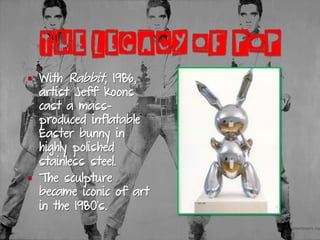
§  With Rabbit, 1986,
artist Jeff Koons
cast a mass-
produced inflatable
Easter bunny in
highly polished
stainless steel.
§  The sculpture
became iconic of art
in the 1980’s.
ENDANGERED
SPECIES SERIES
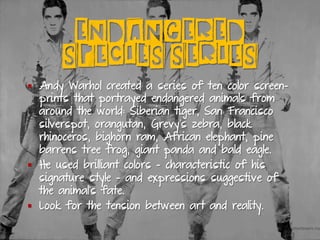
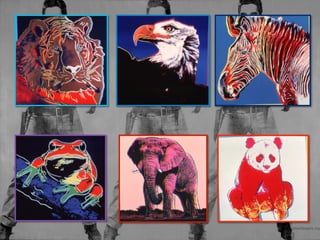
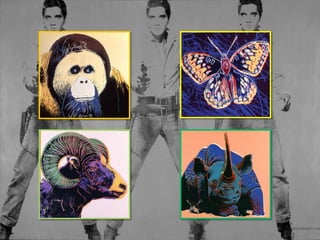
§  Andy Warhol created a series of ten color screen-
prints that portrayed endangered animals from
around the world: Siberian tiger, San Francisco
silverspot, orangutan, Grevy's zebra, black
rhinoceros, bighorn ram, African elephant, pine
barrens tree frog, giant panda and bald eagle.
§  He used brilliant colors - characteristic of his
signature style - and expressions suggestive of
the animal's fate.
§  Look for the tension between art and reality.
ENDANGERED
SPECIES SERIES
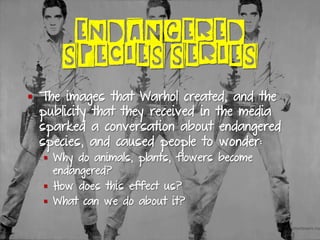
§  The images that Warhol created, and the
publicity that they received in the media
sparked a conversation about endangered
species, and caused people to wonder:
§  Why do animals, plants, flowers become
endangered?
§  How does this effect us?
§  What can we do about it?
THE END

Art1204 pop art

  • 1.
  • 2.
    POP ART “Once you‘got’ pop, you could never see a sign the same way again. And once you thought pop, you could never see America the same way again.” - Andy Warhol
  • 4.
    WHAT IS POPART? §  A major art movement from the mid 1950’s in England and by the early 1960’s was at it’s fullest potential in new York. §  Themes and techniques were drawn from popular culture (hence “pop” art): §  Advertising & mass media §  Comic strips §  Celebrity photographs §  Consumer product packaging §  Everyday objects
  • 5.
    WHAT IS POPART? §  Pop art aims to target a large audience, but is often academic and difficult for some people to understand. §  The epic, or story, in art was replaced with the everyday and the mass- produced was awarded the same significance as the unique. The division between “high art” and “low art” was decreasing.
  • 6.
    WHAT IS POPART? §  “The term Pop Art was first used by the English critic Lawrence Alloway in a 1958 issue of Architectural Digest to describe those paintings that celebrate post-war consumerism, defy the psychology of Abstract Expressionism, and worship the god of materialism.” - Nicolas Pioch
  • 7.
    THE NATURE OFPOP §  Pop Art was an art movement in the late 1950’s and 1960’s that reflected everyday life and common objects. §  Pop artists blurred the line between fine art and commercial art.Brillo Soap Pads Box, 1964, © AWF
  • 8.
    Three Coke Bottles,1962, © AWF §  “Pop Artists did images that anybody walking down the street could recognize in a split second…all the great modern things that the Abstract Expressionists tried so hard not to notice at all.” —Gretchen Berg THE NATURE OF POP
  • 9.
    THE NATURE OFPOP §  The Pop artists moved away from Abstract Expressionism, which was the “in” style of art in the 1950’s. §  The Abstract Expressionists evoked emotions, feelings and ideas through formal elements such as: §  Line §  Color §  Shape §  Form §  Texture Jackson Pollock, Number 4, 1950 ©ARS
  • 10.
    THE NATURE OFPOP §  Pop Artists used common images from everyday culture as their sources, including: §  Advertisements §  Consumer goods §  Celebrities §  Photographs §  Comic strips Roy Lichtenstein, Masterpiece, 1962
  • 11.
    THE NATURE OFPOP Robert Rauschenberg, Retroactive II, 1963 §  Pop Artists reflected 1960’s culture by using new materials in their artworks including: §  Acrylic Paints §  Plastics §  Photographs §  Fluorescent and §  Metallic colors
  • 12.
    THE NATURE OFPOP §  Pop Artists used bold, flat colors and hard edge compositions adopted from commercial designs like those found in: §  Billboards §  Murals §  Magazines §  Newspapers Campbell's Soup II, 1969, © AWF
  • 13.
    THE NATURE OFPOP Claes Oldenburg, Floor Burger 1962, © Claes Oldenburg §  As well as new technologies and methods, like: §  Mass production §  Fabrication §  Photography §  Printing §  Serials
  • 14.
    THE NATURE OFPOP §  Pop art was appealing to many viewers, while others felt it made fun of common people and their lives. §  It was hard for some people to understand why Pop Artists were painting cheap, everyday objects, when the function of art historically was to uphold and represent culture’s most valuable ideals.Listerine Bottle, 1963, © AWF
  • 15.
  • 16.
    ANDY WARHOL §  AndyWarhol was one of the most famous Pop Artists. §  Part of his artistic practice was using new technologies and new ways of making art including: §  Photographic Silk-Screening §  Repetition §  Mass production §  Collaboration §  Media eventsAndy Warhol, Brillo Boxes Installation
  • 17.
    ANDY WARHOL §  AndyWarhol (1928-1987) was one of the most influential American artists of the 20th century. §  He drew on images such as comic books, soup cans, movie stars and the media to challenge the "highbrow" views of fine art. §  In addition to being an artist, Warhol was a filmmaker, painter, collector, music producer, commercial designer and illustrator, author, magazine publisher, and fashion model.
  • 18.
    ANDY WARHOL §  AndyWarhol often appropriated (used without permission) images from magazines, newspapers, and press photos of the most popular people of his time Silver Liz [Ferus Type], 1963, © AWF
  • 19.
    ANDY WARHOL §  Warholused the repetition of the images of tragic media events to critique and reframe cultural ideas through his art Jackie Paintings, 1964, © AWF
  • 20.
    ANDY WARHOL Knives, 1981,© AWF What makes one work of art better than another? Brillo Soap Pads Box, 1964, © AWF Warhol took common everyday items and gave them importance as “art” He raised questions about the nature of art:
  • 21.
  • 22.
  • 23.
    Andy Warhol, Brillo Boxes,1969; Painted wooden sculptures
  • 24.
    Andy Warhol, Brillo SoapPads (And Four Others), 1964
  • 25.
    QUOTABLE WARHOL §  “Everybodywill be famous for 15 minutes.” §  “I’d asked around 10 or 15 people for suggestions. Finally one lady friend asked the right question, ‘Well, what do you love most?’ That’s how I started painting money.” §  “I’ve decided something: Commercial things really do stink. As soon as it becomes commercials for a mass market it really stinks.” §  “When I got my first television set, I stopped caring so much about having close relationships.”
  • 26.
  • 27.
  • 28.
    Roy Lichtenstein, M-Maybe (A Girl’s Picture), 1965
  • 29.
  • 30.
  • 31.
  • 32.
  • 33.
    DAVID HOCKNEY §  Bornin 1937, Hockney is the best-known British artist of his generation. §  He has often been regarded as a playboy of the art world. §  He has had lascivious relationships, & run among strange and crazy artistic circles. §  Yet, he has always retained his constant and tireless devotion to his work.
  • 34.
  • 35.
  • 36.
    David Hockney, Day Poolwith 3 Blues, 1978
  • 37.
  • 38.
  • 39.
    FRANK STELLA §  Printmakerand painter Frank Stella was born in 1936 in Massachusetts. He attended Princeton University and majored in history. §  Stella soon found himself influenced by figures the likes of Franz Kline and Jackson Pollock while in school, and visits to the art galleries of New York subtly shaped Stella’s techniques.
  • 40.
    Frank Stella, GreyScramble, 1968
  • 41.
  • 42.
  • 43.
    JASPER JOHNS §  TheAmerican Abstract Expressionist-Pop painter is best known for his painting Flag (1954-55), painted he had a dream of the American flag. §  His work is often described as Neo-Dadaist, though his subject matter includes images & objects from pop culture, leading many to classify him as a pop artist
  • 44.
    Jasper Johns, 3Flags, 1958
  • 45.
    Jasper Johns, TwoFlags (In 6 Parts), 1973
  • 46.
    THE LEGACY OFPOP §  Pop artists stretched the definitions of what art could be and how it could be made. §  “The Pop idea, after all, was that anybody could do anything, so naturally we were all trying to do it all.” - Andy Warhol §  The art world today reflects many of the ideas, methods, and materials pioneered by the Pop Art movement.
  • 47.
    §  In Untitled,1991, Barbara Kruger uses the iconography of the American flag and hard edge graphics to pose a series of provocative questions about American cultural values. THE LEGACY OF POP
  • 48.
    THE LEGACY OFPOP §  With Rabbit, 1986, artist Jeff Koons cast a mass- produced inflatable Easter bunny in highly polished stainless steel. §  The sculpture became iconic of art in the 1980’s.
  • 49.
    ENDANGERED SPECIES SERIES §  AndyWarhol created a series of ten color screen- prints that portrayed endangered animals from around the world: Siberian tiger, San Francisco silverspot, orangutan, Grevy's zebra, black rhinoceros, bighorn ram, African elephant, pine barrens tree frog, giant panda and bald eagle. §  He used brilliant colors - characteristic of his signature style - and expressions suggestive of the animal's fate. §  Look for the tension between art and reality.
  • 52.
    ENDANGERED SPECIES SERIES §  Theimages that Warhol created, and the publicity that they received in the media sparked a conversation about endangered species, and caused people to wonder: §  Why do animals, plants, flowers become endangered? §  How does this effect us? §  What can we do about it?
  • 53.